




Abstract
Environmental justice remains a critical issue in the United States, particularly in regions in the Southeast, where underserved and under-resourced communities continue to endure a disproportionate burden of environmental hazards due to systemic inequities. Addressing these disparities requires fostering community-driven partnerships that empower local stakeholders and catalyze meaningful change. This article presents a case study and takeaways of collaborative research efforts between academic institutions and community stakeholders in Georgia, specifically focusing on translating children’s environmental health (CEH) research through virtual environments. The Center for Children’s Health Assessment, Research Translation, and Combating Environmental Racism brings together Emory University, the University of Georgia, Spelman College, and the Center for Black Women’s Wellness to develop effective strategies to translate research findings on CEH to stakeholders in the community, academia, and healthcare. This case study draws upon our experience of leveraging cutting-edge digital technologies, including virtual reality and video games, to integrate experiential learning across all ages and enhance policymakers’ understanding of environmental justice impacts through translational strategies. This article examines the successes and challenges in bridging the gap between scientific knowledge and grassroots action. We offer insights into the broader implications of community-driven partnerships for promoting environmental sustainability and social justice.
INTRODUCTION
Children’s environmental health (CEH) research translation plays a pivotal role in safeguarding the well-being of future generations, addressing the complex interplay between environmental exposures and children’s health outcomes. 1 Given the multifaceted nature of environmental health challenges, it is imperative to adopt comprehensive approaches encompassing biomedical, behavioral, psychosocial, and environmental factors to inform evidence-based interventions and policies. 2 The Center for Children’s Health Assessment, Research Translation, and Combating Environmental Racism (CHARTER) is actively engaged in advancing these efforts, contributing to the innovation of and collaboration within the field of CEH research translation (CEHRT).
CHARTER is one of the six nationally based CEHRT centers led by the CEH Network (CEHN) and funded by the
Three main cores are unique to each CEHRT center that constitute the primary infrastructure: administrative, developmental, and translation. The administrative core provides managerial oversight, while the developmental core generates translational research projects addressing time-sensitive CEH issues. Central to all centers, the translation core leverages expertise from communication and education sciences to generate innovative and effective research translation strategies. 5
This article highlights the community-based participatory research approach between CHARTER and the Center for Black Women’s Wellness (CBWW), a community-based nonprofit organization in Atlanta, Georgia. We reflect on the progress made, lessons learned, and offer insights into innovative CEH research translation using virtual environments. By drawing upon the NIEHS translational research framework, 6 this collaborative research advances from identifying and observing CEH issues (i.e., fundamental questions) to testing virtual environments to translate CEH science into practical interventions (i.e., application and synthesis). The process focuses on refining virtual environments through iterative feedback with community partners (i.e., implementation and adjustment) to ensure effective, real-world applications (i.e., practice) and future policy change (i.e., impact). Embracing community-driven strategies, we highlight the transformative potential of interdisciplinary collaboration in advancing CEH and fostering environmental justice.
BUILDING A FOUNDATION FOR COMMUNITY-BASED PARTICIPATORY RESEARCH
Developing a deep level of engagement and connection with communities and organizational partners is critical to the success of collaborative projects with community organizations. Throughout the past three years, CHARTER and CBWW have worked together to understand the interests and concerns of community members through journey mapping exercises, surveys, and finding opportunities for bidirectional communication with community members. For example, in March of 2022, the U.S. Environmental Protection Agency (EPA) added Atlanta’s Westside Lead Site to their national priority list. 7 Of over 900 properties sampled, 377 were determined to have lead levels exceeding the 400 ppm cleanup threshold. Children in Atlanta’s Westside are disproportionately exposed to lead in the soil, posing serious health concerns in the community where they live and play. 8 Identifying these relevant health concerns provided a starting point for the collaborative translational process.
Based on these evidence-based foundations, CBWW aims to develop high-quality digital assets to (1) educate and engage community members; (2) increase potential audience and deployment options; and (3) share the created CEH messages with other networks for nationwide rollout. For example, in addition to printed flyers that describe the health risks related to lead and simple action plans to mitigate these risks, an augmented reality element can be embedded for community residents to scan using their phones, instantly creating an interactive dimension to the flyer. Earlier research has demonstrated that interactive material can help individuals better understand environmental health exposures and remember action plans compared with traditional and static resources. 9
Another venue for technological growth in communicating CEH and wellness is through virtual reality (VR). Growing literature demonstrates that VR experiences can be designed to provide high-efficacy messages for health behavior change, including vaccination, diet, and physical activity. 10 ,11 These earlier findings have demonstrated that the persuasive power of VR lies in its ability to render abstract events into concrete and tangible experiences. However, integrating complex, emerging technologies into an already complicated partnership between communities and researchers may seem daunting. To address the uncertainty and the potential questions that may arise in making this determination, we present a use case of VR to promote environmental justice and how other interactive media tools can support collaborative efforts to translate important CEH issues to community members.
USING VIRTUAL SPACES TO COMMUNICATE ENVIRONMENTAL HEALTH PROBLEMS OF PHYSICAL SPACES
Lived experiences of environmental injustice are difficult to communicate; issues are often at the structural level, harmful chemicals are usually invisible to the naked eye, and negative health impacts of environmental harm take a long time to manifest. VR allows users to experience events with rich layers of sensorimotor cues that closely mimic the physical world so that the virtual events feel as if they are happening at that moment. 12 Virtual time travel 13 also allows users to accelerate the passing of time to experience events that may have occurred over a long period. These novel features are useful as communication tools when translating abstract CEH findings and can vividly deliver the stories of community members about their own CEH experiences.
The critical difference between community-based participatory research and traditional research is the relationship between researchers and community members. 14 Rather than the typical top-down approach where a message is designed primarily by researchers and then evaluated by convenience samples determined by the researchers, community-based participatory research integrates community members much earlier in the research process, in this case, as the VR content is being conceptualized and created. The early integration of community feedback was possible due to the iterative process of prototyping during content creation to use as the experimental stimulus.
Prototyping is a concept often discussed in design 15 and engineering 16 but rarely in communication or translational sciences. Defined as an initial representation or a “proof of concept” of an idea, working with a prototype involves a process of trial and error through making iterative enhancements based on feedback. Earlier scholarship on prototyping notes several benefits of prototyping, including the externalization of one’s thoughts and providing a reference point for active collaboration. 17 Having an external reference point for discussions between the community partners and the research team is important because it allows (1) the research team to objectively confront and address their existing biases and (2) the community partners to provide feedback on a starting point that is more tangible than conceptual models and ideas.
Based on the large body of literature in communication science that points to the power of multi-channel approaches that can cast a wide net for reach and engagement, 18 ,19,20,21,22 it is important to consider many factors pertaining to message content, media channel, and intended audience. Incorporating a variety of communication channels, such as digital online platforms and virtual environments, and also tailoring the message to the target audience’s specific needs and preferences can enhance communication efforts’ effectiveness and maximize engagement. 23 ,24 For example, social media content allows for highly tailored asynchronous communication that can be delivered to specific audiences at specific times. 25 On the contrary, immersive VR experiences can place the audience within the message content, 26 providing feelings of presence, or the sense of “being there” in the virtual environment. 27
Public health professionals can leverage the affordances of VR, such as presence, to engage individuals in evidence-based simulations for effective health communication and engage broader audiences, increase health literacy, and promote self-efficacy. VR technology offers a unique immersive experience to allow users to feel immersed and create a deeper connection with the message content. Active listening to share others’ experiences and fostering understanding can be achieved through VR, as it enables users to experience situations firsthand. This approach addresses longstanding challenges in conveying environmental health practices to at-risk populations and effectively communicating the lived experiences of impacted communities to policymakers, highlighting the need for novel communication techniques and systematic evaluation of their efficacy in driving measurable outcomes. As the CEH field continues to evolve, it is crucial to re-evaluate traditional outreach and education methods to effectively address environmental injustices and promote health equity.
CO-CREATING AND SHARING VR EXPERIENCES WITH COMMUNITY PARTNERS
Given the highly disproportionate lead exposure found in Atlanta’s Westside community and the critical need to illuminate the historical ramifications of superfund sites, we developed an immersive VR narrative to shed light on the systemic and deeply ingrained impacts of environmental inequities. Following the iterative process of prototyping with community partners, we conceptualized, storyboarded, and constructed an interactive virtual experience using a 3D game engine platform (i.e., unity). The interactive storyline employs virtual time travel to enable users to witness how present-day health disparities are linked to past discriminatory housing policies, notably redlining. The VR experience centers on Linda, a 70-year-old Black legacy resident of a previously redlined neighborhood. Through an immersive, interactive dialogue with Linda, users are positioned as new neighbors to learn about six decades of environmental injustice that took place in the neighborhood.
The immersive narrative begins with Linda recounting her childhood experiences. As she reflects on her time as a young child, the world fades out to depict virtual time travel, taking participants back in time to 1965. When the scene fades back in, Linda is now a 10-year-old child and describes how her father told her about a discriminatory practice called redlining that confined families like hers to certain neighborhoods. As the narrative unfolds, young Linda leads the user to a window to show the factory that was built near her home and explains that the dirty air made it difficult to play outside. Time jumps forward to 1982, Linda, now about 30 years old, shows newspaper clippings of EPA discovering cancer-causing chemicals coming from the factory and plays news footage on TV about an environmental justice protest that took place that year. The story jumps to the early 2000s, and a now 50-year-old Linda shares how the local government finally cleaned the soil to safer levels. Back to the present-day, Linda returns to her 70-year-old appearance and informs the user of how gentrification is impacting the area in different ways, such as raising property taxes and pushing out long-term residents. The VR narrative ends with Linda sharing flowers she is now able to grow in her garden as she thanks the user for stopping by.
To enhance user engagement and immersion, interactive elements were strategically integrated throughout the narrative. For instance, the narrative takes place around a common mundane event: two neighbors communing over tea. While Linda shares her experiences, the user interacts with the virtual world in various ways using natural body movements, such as grabbing a teapot to fill with water at the sink, pulling a window curtain aside, picking up newspaper clippings, pouring tea, and taking a sip from a cup. Although verbal communication in this experience is unidirectional with users listening to Linda, by adding interactive moments for the user, they feel that they are actively engaging in conversation and that they are in the story with Linda (versus becoming Linda), sharing her reality.
To confront and address any biases the involved academic partners may have during this process, our academic-community partnership made multiple iterative enhancements of the VR prototype to ensure the accuracy and cultural authenticity of the narrative. Semi-structured interviews of content experts at CBWW provided valuable feedback, steering the narrative towards community-centric themes and perspectives. For example, after reviewing the initial prototype, those interviewed made suggestions to make the home feel less “sterile” like a laboratory setting. They emphasized the importance of an inviting home environment, recommending additions such as house plants, fruit baskets on the counter, and baked desserts on the table to accompany the tea. Linda’s script underwent revisions to amplify the portrayal of race as a direct and prevalent aspect of the storyline, aligning with community concerns about the authentic representation of lived experiences. Integration of actual journalistic sources (i.e., newspaper clippings, TV protest footage) stood out as tangible evidence underscoring decades-long environmental justice efforts within the virtual experience. These enhancements strengthened the narrative but also deepened the cultural resonance of the VR experience, aligning it more closely with the realities of the community. Insights gained from CBWW strengthened the VR narrative by establishing the story based on lived experiences and modeling Linda and her home after people she reminded them of in their own lives. The collaborative community-based participatory research process involved in the prototype enhancement allowed us to strengthen the trust between the researchers and community partnerships and resulted in a culturally acceptable VR experience that could then be taken out from the laboratory into the community. The equitable partnerships formed during the prototyping process build the capacity for community organizations to effectively leverage high-impact emerging technologies, such as VR, as an additional tool for communication and persuasion when discussing CEH and environmental justice issues with policymakers.
SUCCESS STORIES IN TRANSLATING CEH RESEARCH
Once created, VR experiences scale easily for widespread implementation in the community, such as, at community events, home visitation programs, and in local clinics.
For Earth Day 2023, as a part of their 3-year Black Women’s Environmental Wellness Project, CBWW’s community health fair served over 300 families, provided 130 environmental wellness kits, and provided resources and education to over 300 families. The attendees also had the chance to use CHARTER’s VR experience for environmental health education, which attracted a large crowd of children and adults (Fig. 1). Earlier studies have noted that cultural acceptance and positive attitudes toward novel technology are important predictors of impact and continued use of the technology. 28 The successful implementation of the VR experience at large-scale community events such as this one further emphasizes that establishing cultural acceptance of VR experiences through prototype development and iterative enhancement processes allow these emerging technologies to leave the laboratory and become integrated into the community.
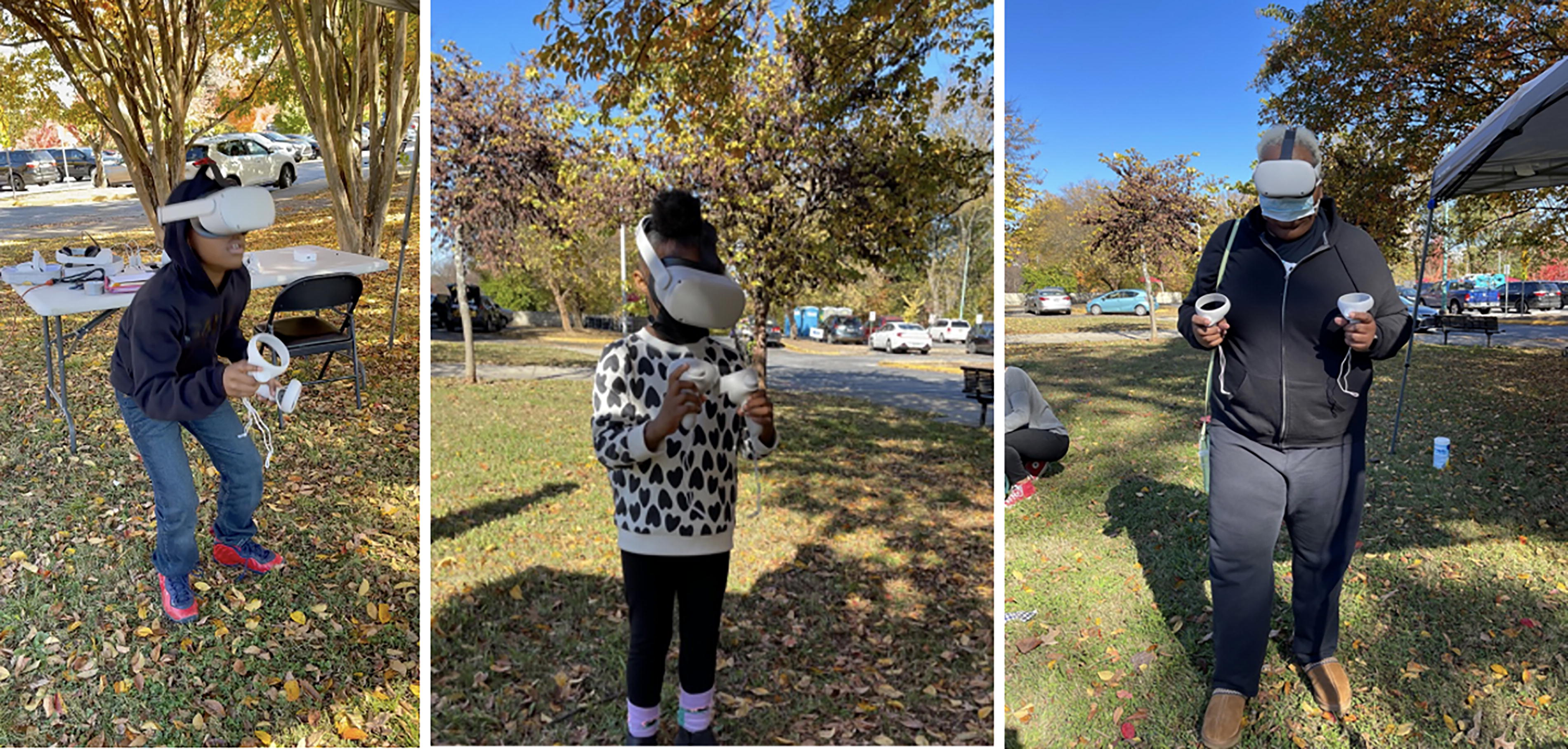
Sharing VR experiences with community members at Earth Day 2023. VR, virtual reality.
As another channel for translating CEH science, CHARTER, and CBWW partnered with other community organizations (Science for Georgia and Dogwood Alliance) to co-host the 2023 Environmental Justice Conference, engaging 185 public health workers online and in-person. The conference was attended by health professionals, researchers, students, public health practitioners, and federal agency employees. Following the conference, CBWW participated in a follow-up “Fireside Chat” with Science for Georgia, public health professionals, environmental science, medicine professionals, and federal agency employees from the EPA and Agency for Toxic Substances and Disease Registry (ATSDR) to review the environmental health impacts on local and regional communities through these strategic partnerships and collaborative work.
The feasibility of implementing VR experiences in rural communities for CEH education was also tested with some of the community health workers who attended this conference. CHARTER provided VR headsets preloaded with virtual worlds to community health workers, offering easy access to immersive educational content. The research team conducted comprehensive hands-on training to ensure the successful integration of VR experiences in rural communities. These training sessions equipped community health workers with the necessary skills to navigate VR technology effectively and facilitate meaningful educational experiences for community members. Since the training’s completion, the VR headsets have been integrated into various community events and outreach programs, where they have received positive feedback for their innovative approach to CEH education.
CHARTER and CBWW have actively engaged with and participated in numerous K-12 school visits to extend reach beyond community events. As part of Science Atlanta events, a local Atlanta science festival inaugurated in 2014, 29 elementary schools hosted an “Imagining the Future Day” for students. The event served as a platform to initiate discussions on the diverse career opportunities in science, the impact of the environment on health, and novel approaches to conveying scientific discoveries—such as using VR for educational purposes. For instance, CBWW demonstrated to students how to construct their own indoor air filters using box fans and other household materials. In addition, CHARTER presented the importance of science communication and emphasized the innovative potential of VR technology for enhancing understanding of health-related topics among students.
Translational and collaborative efforts within our academic-community partnership have also influenced policy-level changes. Specifically, CHARTER and CBWW participated at the annual 2023 collaborative centers CEHRT capitol hill briefing in Washington, D.C. representatives from the six CEH centers nationwide, alongside key stakeholders such as the director of NIEHS and executive director of the CEHN, met in the capitol building for a 3-day event. An associate of CBWW presented on behalf of our partnership to share the successful collaboration between research centers and community health organizations that can make lasting impacts on CEH. Moreover, the meeting facilitated networking opportunities with researchers and community partners to meet with policymakers and met with legislative correspondents from both Georgia Senators Rafael Warnock and Jon Ossoff, advocating for the inclusion of funds in the 2024 budgets to support initiatives targeting CEH in Georgia.
The success stories shared here are just a few examples of the extensive collaborative efforts between CHARTER and CBWW over the past 3 years, highlighting the impact of academic and community partnerships across various levels of the community. Through these endeavors, this collaboration has effectively engaged children from K-12 education, parents and caretakers, community organizations, public health experts, and policymakers, catalyzing meaningful advancements in CEH. Together, CHARTER and CBWW have fostered an environment to leverage each other’s strengths and continuously learn the intricacies of building community-centric translational science.
Furthermore, to ensure VR experiences effectively reach our education and translation goals, we have conducted thorough evaluations, including pilot tests and laboratory experiments. 30 For example, a pilot test involved first-year medical students during an environmental justice workshop and aimed to understand the effectiveness of the redlining VR experience in engaging users and conveying key messages about environmental racism. The laboratory experiment further explored how different aspects of the VR experience, such as virtual time travel, influenced participants’ perceptions and engagement. These evaluations provided valuable insights into how VR experiences could be used to better communicate complex scientific concepts linked to past discriminatory policies and foster a deeper understanding of environmental health issues.
CHALLENGES, LESSONS LEARNED, AND FUTURE DIRECTIONS
Despite the best intentions of everyone involved, community-based participatory research and collaborative relationships between researchers and community organizations are challenging. This is often related to the lack of reliable and validated assessments of success. 31 Measurable success needs to be recognized and rewarded, and both researchers and community organizations should benefit from the partnership. To effectively reward these collaborative relationships, administrators and leadership must understand that success can take place at multiple points along the entire pipeline of the partnership, from initial brainstorming to product development through iterative enhancements, implementation, and measurable outcomes. CHARTER and CBWW have presented together at several conferences in public health and environmental health sciences to advocate for the lasting impact our partnership has made in translating critical CEH information to relevant communities. Documenting measurable outcomes, such as the number of attendees, reach of the message, and the policy of the partnership impacted, would be helpful in such presentations.
Perhaps more importantly, research institutions must recognize that community-based participatory research involves building a long-term relationship with the community organization rather than treating it as a strategic partnership. One of the biggest challenges of forming an equitable, long-term partnership between research institutions and community organizations is that community organizations lack the capacity to gain the same level of resources (e.g., equipment, scientific expertise) as research institutions. At the same time, research institutions lack experience and trusted relationships with community members that civic organizations have. Therefore, capacity building must be mutual, and building trust in the relationship is important. For example, rather than meeting with the community organization only for data collection, researchers should remain involved and actively engaged in the organization’s events to demonstrate goodwill and solidarity for the organization’s mission and vision. Community organizations should also remain open to the idea of working with research institutions to expand their knowledge and expertise in areas they may be unfamiliar with. In addition to transparency during the research process, the results and findings of research activities that involved community members should be translated and shared widely within the community so that all stakeholders can benefit from the newfound knowledge.
CONCLUSION
The transformative potential of community-based participatory research in translating CEH science using virtual environments is well underway. The collaborative efforts between CHARTER and CBWW have demonstrated the efficacy of innovative approaches in engaging diverse stakeholders and fostering environmental justice. Through action research and community science, where both partners embrace co-learning and decision-making processes, shared information and knowledge can drive tangible changes within communities and among policy decision makers. Despite challenges, valuable lessons have been learned, emphasizing the need for transparent communication and long-term partnerships. Moving forward, a continued commitment to equity and collaboration is essential to address environmental injustices and promote health equity for future generations.
Footnotes
AUTHOR DISCLOSURE STATEMENT
We have no conflicts of interest to disclose.
AUTHORS’ CONTRIBUTIONS
H.R.H.: conceptualization, writing—original draft, writing—review and editing; A.M.: conceptualization and writing—original draft; M.B.: conceptualization, writing—original draft; G.S.: conceptualization, writing—original draft; S.J.A.: conceptualization, funding acquisition, writing—original draft, writing—review and editing.
FUNDING INFORMATION
The Black Women’s Environmental Wellness Project (BWEWP) at the Center for Black Women’s Wellness (CBWW) is supported by a multi-year grant from the Cedar Tree Foundation. Research reported in this publication was supported in part by the