




Abstract
This study develops a novel systems framework for advancing environmental justice in Alsen, Louisiana by addressing multiple environmental challenges with a specific focus on mitigation of pollution from stormwater runoff, air emissions, and floodwater. Employing smart technologies, earth science, and geospatial analytics, the framework aims to enhance public health by reducing exposure to environmental pollutants and facilitating improved emergency responsiveness. It integrates historical data, satellite imagery, and real-time sensor readings from floods and air quality monitors to support participatory risk management and decision making. The systems approach is expected to reduce health-related costs through better environmental health monitoring and proactive management of pollution. The framework promotes the use of accessible, cost-effective technologies that enable small, economically constrained communities to significantly mitigate pollution impacts. Anticipated outcomes from the application of this framework include improved health metrics and enhanced resilience to climate-related challenges, offering a scalable solution for similar communities globally facing environmental injustices.
INTRODUCTION
Alsen is a rural community located in East Baton Rouge, Louisiana. It has few municipal resources and has historically been underserved and underfunded. The community is within the 85-mile stretch of the Mississippi River known as “Cancer Alley” and has been heavily impacted by the historic mismanagement of industrial waste from companies such as ExxonMobil, Shell, Dow Chemical, and Georgia-Pacific. 1 The community has disproportionate levels of pollution exposure due to its close proximity to “Cancer Alley” which has been associated with negative health impacts.2,3 As a result, residents in Alsen are routinely exposed to contaminated air, land, and water that significantly threaten their health and food security due to climate change-driven extreme weather events and legacy industrial pollution in the community. 4
One important exposure pathway to toxic contaminants in Alsen, LA is through the mobilization of contaminants during heavy storm and flood events, and via proximity of people to hazardous waste discharge sites. The Alsen community has suffered from chronic flooding and heavy storm events throughout the community’s history. Globally, extreme weather events and increased rainfall intensity have dramatically shifted the volume of stormwater runoff to downstream water bodies in many regions of the United States 5 (especially in the southern coastal United States), as well as the amount of runoff pollutants conveyed to nearby outfalls from contact with engineered surfaces. 6 Increased frequency of heavy storm events causes flooding and mobilizes (deposited) contaminants from natural and engineered landscapes to downstream water bodies and residents’ homes. 7 Contaminants such as per- and polyfluoroalkyl substances (PFAS) “forever chemicals,” pesticides and other trace organics, microplastics, fecal coliform bacteria, heavy metals, and other pollutants can pose a severe risk to human and environmental health during flood events. For example, PFAS alone has been linked to low infant birth weight, 8 immunotoxicity, 9 and endocrine disruption. Alsen community members have been exposed to water contamination from Exxon Mobil and chemical manufacturing industrial activity which has released heavy metals, 1,4-dioxane, volatile organic compounds (e.g., benzene, xylene, toluene, and ethylbenzene), and PFAS into the nearby water supply, 10 in recent years. In fact, Alsen residents have submitted over 300 complaints to their local Department of Public Works regarding property flooding in 2016, 2017, and 2018 due to a lack of appropriate drainage, dredging, and clearing of ditches. 11 Alsen ranks in the riskiest 5% nationally for proximity to wastewater discharge and hazardous waste outfalls. 12
The combination of legacy waste dumping from nearby industrial activity, increased frequency of flooding and extreme weather events due to climate change, 13 and (re)mobilization of contaminants is posing a significant environmental justice (EJ) challenge for Alsen residents as many of the contaminants are difficult to remove and do not degrade naturally. 14 However, there are various cost-effective and easy-to-operate approaches that Alsen residents could deploy to reduce their exposure. The use of air, water, and flood sensors will not correct these decades of injustice, but they will equip residents with the tools necessary to be aware of real-time environmental conditions and make informed decisions. It’s important to note that while air quality sensors can measure fine particulate matter (PM2.5), standard water quality sensors can only monitor general parameters such as pH, temperature, turbidity, elevation, and dissolved oxygen rather than specific contaminants.
Air pollution is of particular concern in Alsen. 15 Community members commonly experience significant levels of both outdoor and indoor dust. 16 This reality coupled with the knowledge that the community contains several emission sources of particulate matter (including two nearby landfills), 17 suggests that residents are likely exposed to elevated levels of particulate matter. 18 Exposure to particulate matter is associated with many adverse health effects, such as respiratory and cardiovascular diseases, and lung cancer. 19 National-level racial and ethnic disparities in exposure to particulate matter are well documented. Recent studies have demonstrated a correlation between air pollution and increased cancer rates, particularly in impoverished and predominantly African American communities. 20 Research has also shown higher concentrations of PM2.5 in Black communities in the United States. 21 To reduce exposure to these particulates, Alsen residents must understand and effectively respond to air pollution sources and trends. They are currently hindered from doing so because of a lack of air quality data specific to their community. Deployment of a low-cost network of sensors dense enough to measure hyperlocal air pollution is a key objective of this work.
In this article, we offer a collective perspective for a community and multilevel stakeholder approach aimed at reducing and mitigating the effects of stormwater and air pollution in Alsen. Specifically, we propose a systems framework to holistically and collaboratively address the multifaceted environmental injustices within Alsen. This approach is scalable to other communities burdened by multiple pollution sources.
HISTORICAL CONTEXT
Port Hudson, LA, and Alsen both played significant roles in the post-Civil War Reconstruction era following the activities of the Freedmen’s Bureau. On May 22, 1863, Union forces initiated a siege on Port Hudson, a thriving outpost located north of Baton Rouge situated on high bluffs along the Mississippi River. 22 Control of Port Hudson was necessary for the strategic use of the river, and its capture was a crucial component of President Lincoln’s strategy to divide the southern states. 23 Confederate defenses were subjected to attacks, including the first major assault by African American soldiers during the Civil War. These soldiers, organized into regiments known as the Louisiana Native Guard, were among the first African American soldiers to volunteer for the Union cause, many of whom were formerly enslaved. 24 The siege of Port Hudson was one of the lengthiest conflicts of the Civil War, with the Confederates surrendering on July 9, 1863. Northern troops, including regiments of African American soldiers, held Port Hudson for the remainder of the war, securing access to the Mississippi River. 25
Following the war, the Freedmen’s Bureau—officially known as the Bureau of Refugees, Freedmen, and Abandoned Lands—was established by Congress in March 1865 to assist newly freed African Americans in the south with their transition to freedom and citizenship. 26 Both Port Hudson and Alsen were locations where the Freedmen’s Bureau operated field offices and provided various forms of assistance to formerly enslaved individuals. 27 These offices served as hubs for providing education, employment opportunities, medical care, and legal assistance to African Americans seeking to rebuild their lives after emancipation.
Prior to the Civil War, the Mount Pleasant Plantation was situated along the river, located just north of the present-day Alsen. 28 Exploring the history of Mount Pleasant Plantation allows us to gain a deeper understanding of the complexities of the antebellum south, the legacy of slavery, and the impact of the Civil War on the region. By preserving and interpreting sites such as Mount Pleasant, we can engage with this history and reflect on its significance in shaping the present-day landscape of Louisiana and the United States.
Established in 1872 as a farm community for freedmen, Alsen is an unincorporated community eight miles south of Port Hudson. The owners had a strong connection to cultivating the land, once referred to as a “sportsman’s paradise,” while also utilizing hunting and fishing areas now known as Devil’s Swamp. 29 In 1950, Alsen was zoned for industrial development without community input, as African Americans in Louisiana were systematically denied the right to vote. 30
During the 1960s, unoccupied areas along the Mississippi River attracted the development of numerous industries due to tax exemptions and policies that were favorable to businesses. 31 For example, the Dow Chemical Corporation, Ethyl Corporation, Co-Polymer, Uniroyal, Allied Chemical, American Hoechst, Exxon Chemical, Rubicon Chemical, Shell Chemical, and United States Steel (U.S.S.) Chemical established plants in or near Alsen during this period of industrial growth. As a result, Alsen is located at the entrance of the 85-mile stretch known as “Cancer Alley,” where a quarter of the nation’s petrochemicals are produced. 32 In 1964, Tim Alexander, an out of town businessman, created a large open pit for dumping toxic chemicals for these industry titans to manage the large quantities of toxic waste generated annually. 33 By the 1980s, the area became home to the nation’s fourth-largest hazardous waste dump, operated by Rollins Corporation. 34
This site would later become the Petro-Processors Superfund site: designated by the Environmental Protection Agency as the nation’s most contaminated land. 35 As a result, Alsen, LA is one of the most polluted communities in North America. 36
In response to the unprecedented destruction and toxication of their air, soil, and water and growing concern about declining quality of life and health, Alsen residents formed the Coalition for Community Action in (year) to challenge the Rollins hazardous waste incinerator operation. They received support from organizations such as the Louisiana Environmental Action Network and Gulf Coast Tenants Organization in their fight. 37 Due to community activism, between 1980 and 1985, the Rollins landfill received over 100 state and federal toxic emission violations but managed to avoid paying penalties. 38 In fact, in 1989, Rollins sought a permit to expand its operations. 39 Several national environmental groups, such as Greenpeace, Citizens’ Clearinghouse for hazardous waste, and the National Toxics Campaign, took notice of Rollins’ plan to incinerate polychlorinated biphenyls—toxic synthetic organohalogens that have been linked to cancer, skin conditions, and liver damage in humans. 40 Yet, despite protests and civil action against Rollins, the dumping of toxic waste and incineration of toxic chemicals persisted.
Thus, the predominately African American Alsen residents have endured generational turmoil and denial of human and civil rights dating back to the trans-Atlantic slave trade and emancipation following the Civil War. However, to this day, the transformation of racism, discrimination, and retaliation for their service in the Civil War has been met with decades of detrimentally harmful pollution of Alsen air, water, land, and bodies. Alsen is a community that has been silenced.
FRAMEWORK FOR MULTISTAKEHOLDER COLLABORATION
This study introduces a novel framework leveraging smart technology and participatory research to improve EJ and community resilience outcomes and empower historically marginalized communities. Specifically designed for Alsen, Louisiana—a community severely impacted by industrial pollution and systemic neglect—this framework employs low-cost sensors to monitor air and water quality in real time. The extent of environmental pollution in Alsen, LA meets all five types of disparities screened for in the Justice 40 Initiative, including environmental, economic, health, transportation, and housing inequities. 41 This data-driven approach enables residents to gather and analyze crucial information, providing them with the tools needed to mitigate environmental health risks. By applying Systems Theory, the framework not only explores the interconnectedness of socioenvironmental factors but also identifies key leverage points for interventions, such as addressing the compounded effects of poor housing, inadequate transportation, and pollution exposure.
The study expands on existing EJ frameworks, such as the EPA’s and Robert Bullard’s EJ frameworks, by incorporating Systems Theory and modern smart technologies that enhance community-driven data collection and advocacy. This integration allows for a holistic understanding of how socioenvironmental factors interconnect to influence community health, enabling the identification of key leverage points where interventions can have the most significant impact. Furthermore, the study aligns with the EJ Collaborative Problem-Solving model and supports the goals of the Justice40 Initiative, ensuring that disadvantaged communities such as Alsen receive equitable resources and support. By fostering participatory research and enabling real-time environmental monitoring, the study provides a scalable model adaptable to other communities facing similar environmental injustices. This systems-oriented approach moves beyond isolated efforts to address individual pollution sources, emphasizing the importance of engaging the community at every step of the research process. This engagement not only builds trust but also ensures that interventions are culturally relevant, tailored to the specific needs of Alsen residents, and empowers them to advocate for policy changes based on hyperlocal data.
Herein, we distill a cohesive systems framework (Fig. 1) that aims to provide a path in which communities impacted by historical and contemporary environmental injustice can gain traction in reducing exposure to pollution from multiple sources. This integrated framework ensures a holistic, systems-oriented approach to EJ, grounded in community engagement, reciprocal relationships, and a deep understanding of the interconnected nature of socioenvironmental factors, guided by Systems Theory.
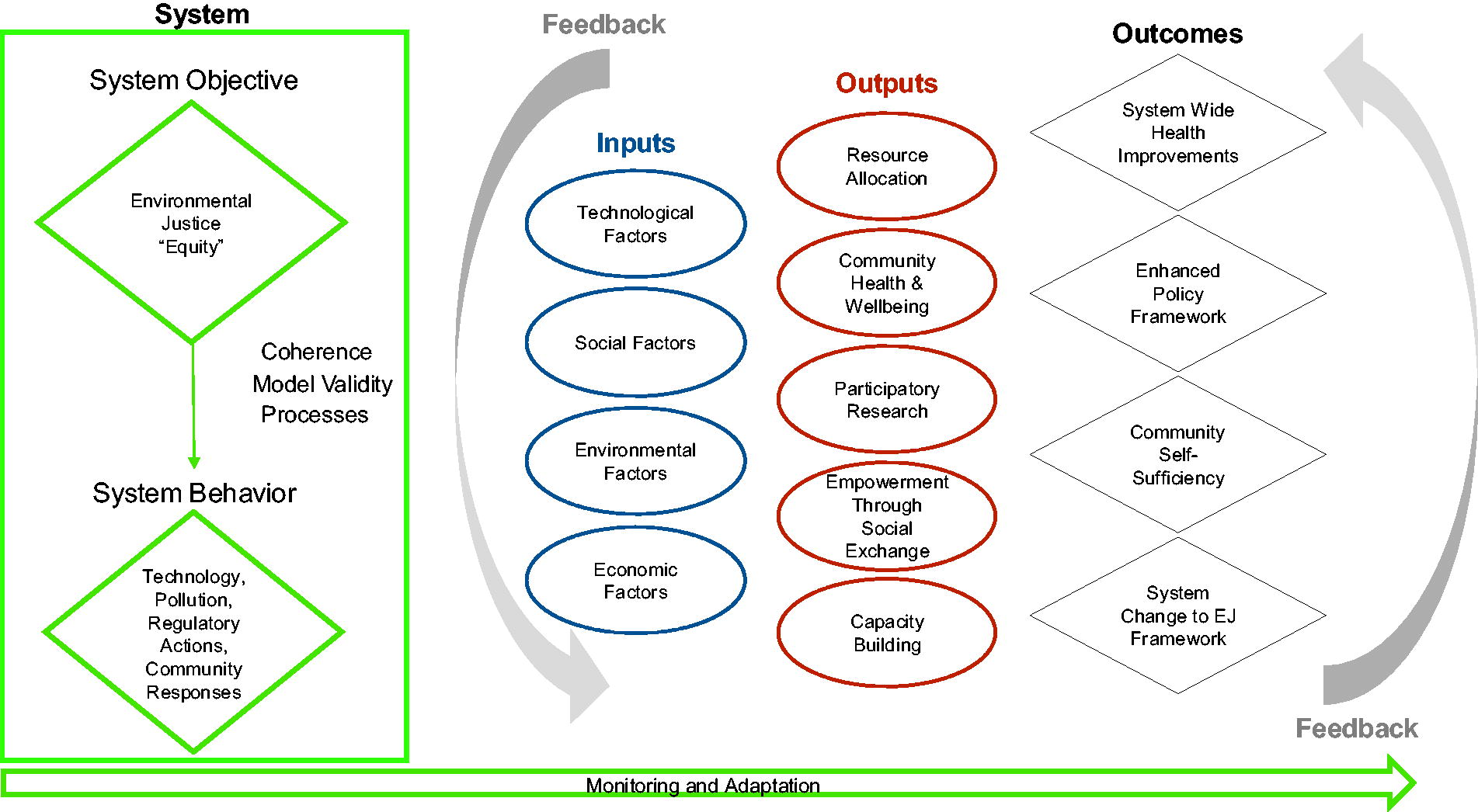
This diagram depicts a Systems Theory Framework for environmental justice, emphasizing the integration of inputs like technological, social, environmental, and economic factors, processed to inform system behaviors and generate targeted outputs such as resource allocation and community empowerment. Central to the framework is the objective of achieving equity, supported by coherence and model validity processes that ensure the system’s effectiveness and relevance. Outcomes such as enhanced policy frameworks and community self-sufficiency highlight the long-term impact of the system, while feedback loops and continuous monitoring and adaptation ensure responsiveness to evolving challenges within environmental justice contexts.
This framework utilizes Systems Theory to examine the interconnectedness of social, economic, and environmental factors that influence community health and well-being. It guides the research methodology, ensuring all relevant variables and their interdependencies are considered, leading to more effective interventions. By recognizing how elements such as housing, transportation, and economic stability interact with health outcomes, this approach identifies leverage points where interventions can have the most significant impact.
The core components of the framework are outlined below.
Community health and well-being
Holistic health focus: The framework prioritizes improving overall community health by addressing both physical and mental health outcomes. It acknowledges the influence of environmental exposures, access to healthcare, and community resilience on health. Social determinants of health: The focus areas include food accessibility, air and water quality, economic factors, and transportation networks, all analyzed through the lens of how they interact within a larger system to impact health outcomes. Participatory research and data collection
Community-centered approach: The research process engages community members, ensuring their voices and experiences are central to identifying and addressing environmental health concerns. This approach is crucial for building trust and ensuring that research outcomes are relevant and actionable. Feedback loops and system dynamics: Participatory research helps identify feedback loops within the community, allowing for dynamic adjustments to strategies as community conditions change. Social exchange theory in practice
Building reciprocal relationships: This component fosters strong, reciprocal relationships between community members, researchers, and policymakers, emphasizing trust, mutual benefit, and the exchange of resources and knowledge. Policy engagement and advocacy: Through these relationships, research findings are translated into actionable policy recommendations, advocating for systemic changes that address the root causes of environmental injustice. Sustainability and capacity building
Long-term capacity: The framework focuses on building long-term capacity within communities to sustain health improvements and continue advocating for EJ. This includes training community members, developing local leadership, and ensuring interventions are sustainable. Holistic interpretation of results: Systems Theory guides the interpretation of research findings, providing a nuanced understanding of EJ issues by considering how social determinants like income and education interact with environmental stressors. Culturally relevant methodologies
Tailoring interventions: Research and interventions are culturally sensitive and tailored to the specific needs and values of the community, respecting and incorporating local knowledge and traditions into the process. Equitable resource allocation
Ensuring fair distribution: The framework advocates for the equitable distribution of resources, ensuring that communities have the necessary funding, tools, and support to effectively address environmental health disparities. Informing policy and interventions
Comprehensive policy development: Policies and interventions are designed with an understanding of the broader system, balancing the needs and vulnerabilities of all stakeholders, and ensuring that they do not inadvertently create new problems.
CASE STUDY
For the Alsen case study, the framework particularly focuses on stormwater runoff and air pollution. The community began by identifying issues of concern, including impacts of stormwater runoff, air and water pollution, inadequate real-time environmental data, and the need for greater empowerment to advocate for effective policy changes. In October 2023, our team met Alsen residents at the HBCU Climate Change Conference. Three months later, in February 2024, our team visited Alsen, LA, to speak with the residents and learn more about their centuries-long fight for EJ. These meetings enabled our team to build strong ties with the Alsen community and develop a research plan reflective of their needs.
The community then assembled a multistakeholder team with united but broad interests, skills, and resources. This team, composed of African American engineers from UCLA, the University of Washington, and the RAND Corporation, worked in partnership with Alsen residents to develop tailored solutions to address their contamination issues. The team has since expanded to include a decorated 37-year Army veteran with expertise in emergency readiness and hazardous waste, a research assistant with experience in economic modeling and renewable energy, and a community impact director. Collaborators also include organizations such as the GreenARMY, JustAir, Tangipahoa African American Heritage Museum and Veteran’s Archive, Louisiana Native Guard Association, and The Water Institute.
In partnership with community organizations and members, Alsen residents cocreated a research plan with specific aims:
Characterizing flooding: Assess the extent and frequency of flooding and its impact on access to critical services. Community science program: Establish a program to collect and analyze contamination levels after rainfall and flooding events. Decision support tool: Develop a user-friendly tool to visualize the spatiotemporal distribution of flooding impacts and inform mitigation strategies.
These aims are achieved through four interconnected tasks:
EJ assessment: Conduct a cloud-computed, remotely sensed, GIS-based assessment utilizing community samples, and existing environmental, health, and socioeconomic data.
42
Community decision support tool: Develop a publicly available, web-based, tool to visualize environmental hazards and vulnerability based on contamination data collected by citizen scientists and recommended mitigation steps.
43
Community education and workshops: Conduct educational workshops to raise awareness and transparency about flooding and environmental hazards, the tool, and how residents can engage in ongoing community science.44,45 Policy briefs and capacity building: Translate research findings into actionable policy briefs, empowering residents to advocate for policy change,
46
to address flooding, environmental contamination, and transportation needs.
Finally, ongoing conversations with key stakeholders ensure that this study achieves demonstrable change through a multilayered and multisystem transformation addressing air, soil, and water quality issues. Collaboration with government, academic institutions, and nonprofits has already led to tangible improvements, including the replacement of Alsen’s water pipes and the acquisition of grants for microcontrollers, PM sensors, ozone sensors, and water quality (pH, temperature, dissolved oxygen, turbidity, elevation, etc.) sensors.
In February 2024, the Alsen community initiated several significant collaborations, beginning with a meeting between local stakeholders, including representatives from the EPA and the Louisiana Department of Environmental Quality, facilitated by engineers from the research team. This period also saw the community partnering with the Southern University Agriculture Department to introduce healthy nutritional classes to residents. By March 2024, a multitiered team had been established to address community needs and concerns, collaborating on multiple federal grants with the community serving as a colead or lead. During this time, an organization donated air monitors to the community, enabling real-time data collection.
In April 2024, stakeholder meetings were held to further address community concerns and conditions. The community also formed a partnership with the East Baton Rouge Parish Library, which began providing internet hot spots and monthly visits from the East Baton Rouge (EBR) bookmobile. June 2024 marked a milestone as the community partnered with Open Health to bring the first-ever mobile clinic to the Alsen community. By August 2024, a Community Advisory Board had been created in collaboration with the Environmental Protection Agency (EPA) to address ongoing community concerns.
In addition, the community partnered with the American Heart Association to establish the first community health hub in East Baton Rouge Parish.
These changes highlight the study’s immediate impact on the community and its potential for long-term improvements. The study will culminate in a robust 3-year roadmap designed to substantially improve the quality of life in Alsen while empowering the community to advocate for and sustain these improvements.
RECOMMENDATIONS
To ensure sustained commitment to the adoption of our systems framework for EJ, we recommend the following three actions: (1) implement community-driven monitoring systems; (2) develop educational programs; and (3) advocate for policy change.
Implementing community-driven monitoring systems builds the technical capacity of residents to collect and assess data. We recommend the installation of a network of low-cost sensors to continuously monitor environmental issues of concern. In the case of Alsen, residents are leading data collection and analysis efforts on water contamination and air quality, with support from research scientists and government agencies. Such community-driven monitoring enhances risk dissemination. 47
Educational programs increase awareness of environmental hazards and empower residents to engage in community science. In Alsen, educational programs are being developed to encourage long-term, participatory research. For example, its Scientists in the Schools (SIS) and summer science camp curricula are being modified to include study-relevant topics, such as machine learning and remote sensing. SIS brings science practitioners into a multigenerational community science learning environment to reach all learner levels, including scaffolded instruction to accommodate the high population of individuals with learning and intellectual disabilities in Alsen.
Our framework results in actionable data that should be used to advocate for policy change that reduces the environmental burden. Community-driven monitoring systems provide hyperlocal data, which can improve policy making, 48 in highly uncertain environments. 49 The data generated are also easily accessible to residents, which can support experiential data in pushing for policies to reduce pollution. In addition, the data provide a baseline against which to assess the impacts of future legislative changes. Ultimately, policy change is critical for improving health outcomes and community resilience to climate change.
CONCLUSION
This study presents a transformative approach to EJ, empowering the Alsen community with the tools, data, and strategies necessary to address and mitigate the long-standing environmental inequities by leveraging low-cost smart technologies, our systems framework ensures Alsen residents are equipped to monitor and respond to air and water quality issues in real-time and advocate for systemic change grounded in data-driven insights. The success of this initiative hinges on three critical strategies: interdisciplinary collaboration, community-driven research, and the integration of all study components into a cohesive action plan tailored to the unique needs of Alsen. Our iterative and participatory approach ensures that the community benefits from the study’s findings throughout its implementation, rather than waiting for its conclusion. As new data are gathered, they are immediately incorporated into the decision support tools, enabling residents to take proactive measures to safeguard their health and environment.
The framework and methodologies developed in this study hold promise not only for Alsen but also for other historically marginalized and underserved communities across the United States. By addressing the root causes of environmental injustice and fostering long-term community resilience, this study sets a precedent for how localized, data-driven, and community-centered approaches can create lasting, equitable change. Through sustained engagement, capacity building, and policy advocacy, Alsen’s journey from environmental vulnerability to resilience can serve as a model for other communities facing similar challenges.
Ultimately, this work is a testament to the power of collaboration, innovation, and community empowerment in the fight for EJ. The Alsen community, once burdened by decades of pollution and neglect, is now on a path toward a healthier, more sustainable future—one that they are actively shaping with the knowledge, tools, and support gained through this study.
Footnotes
ACKNOWLEDGMENTS
The authors extend their deepest gratitude to the community organizers, policymakers, and policy advisors whose insights and dedication greatly enriched this study. They are especially grateful to the residents of Alsen, Louisiana, for their unwavering commitment, resilience, and active participation throughout this research. Their lived experiences and invaluable contributions shaped the direction and outcomes of this work. The authors also thank their collaborators from academic institutions, government agencies, and nonprofit organizations who provided expertise and resources to support the study. This project would not have been possible without the collective effort and shared vision for advancing environmental justice.
AUTHORS’ CONTRIBUTIONS
M.L.M.: Conceptualization (equal), methodology (equal), project administration (lead), writing—original draft (lead), and writing—review and editing (lead). R.F.P.: Conceptualization (equal), methodology (equal), writing—original draft (supporting), and writing—review and editing (supporting). J.R.R.: Methodology (equal), writing—original draft (supporting), and writing—review and editing (supporting). Q.R.J.: Conceptualization (equal), writing—original draft (supporting), and writing—review and editing (equal). A.K.: Writing—review and editing (supporting). M.M.L.M.: Writing—review and editing (supporting). M.C.: Writing methodology and illustration (supporting).
DISCLAIMER
M.L.M. is currently serving as an Associate Engineer at the RAND Corporation. A.K. is currently serving as an Assistant Policy Researcher at the RAND Corporation. M.C. is currently serving as a Senior Technical Analyst at the RAND Corporation. The views, opinions, findings, conclusions, and recommendations contained herein are the authors' alone and not those of RAND or its research sponsors, clients, or grantors.
AUTHOR DISCLOSURE STATEMENT
No competing financial interests exist.
FUNDING INFORMATION
Funding for this research was provided in part by gifts from RAND supporters and income from operations.