




Abstract
The scoping literature review examines nearly four decades of scholarly contributions, navigating the evolution of the environmental justice framework from its nascent roots to its contemporary dimensions. It aims to provide a comprehensive overview of its conceptual trajectory, identifying key themes, pillars, and current directions. Spanning 7001 publications, the review employs lexical-metric content analyses to synthesize the corpus and reveal semantic clusters and temporal trends. The data underscore the increasing scholarly interest in environmental justice, manifested in a well-established field of study and multidisciplinary approaches. The analyses identify four pillars underpinning the framework: assessing built environment quality, mitigating climate change effects, promoting responsible research and innovation (RRI), and emphasizing human dimensions. The pillars reflect the classical justice dimensions (i.e., distributive, procedural—also in its participatory sense—and recognition justice, respectively), while restorative justice is a cross-cutting dimension. They undergo significant transformations over time, defining some directions toward which the current scientific debate seems to orient: ensuring everyone’s well-being, realizing just transition, reducing global inequalities, and facing societal challenges together. Overall, the review delineates two complementary and interconnected frameworks: environmental justice as a theoretical framework for global issues and environmental justice as a concrete framework for situated issues. The conceptual frameworks have implications for environmental governance and activism, advocating for democratic, participatory, and cooperative approaches. Furthermore, they suggest avenues for future research, particularly in understanding social dynamics that bridge global and local concerns, aligning research agendas with the interests and needs of affected communities.
INTRODUCTION AND OBJECTIVES
In an era marked by amplified awareness of environmental degradation and social inequalities, understanding and addressing the equitable distribution of environmental burdens and benefits have become paramount.1,2 As contemporary societies struggle with unprecedented environmental challenges, ranging from climate change and pollution to resource depletion and biodiversity loss, examining environmental justice is an essential effort with concrete implications.3,4
Environmental justice has not only emerged but also evolved as a critical framework for investigating the intricate relationships between society and the environment.5,6 Its scope has broadened beyond its initial focus on ethnic background to encompass various dimensions of inequality, including socioeconomic status, geographic location, and power dynamics.7,8 Over time, environmental justice has evolved into a multifaceted and pivotal domain within the broader field of environmental studies, aiming to empirically assess environmental inequities and their interconnected socioeconomic and ethical ramifications through theoretical developments, policy analyses, and normative discussions.9,10 This evolution provides insights into the holistic understanding of the intersecting factors that influence inequalities and the growing recognition of the mutual link between environmental sustainability and social justice.11,12,13
This scoping literature review crosses nearly four decades of the academic landscape to trace the conceptual trajectory of the environmental justice framework from its nascent roots to its contemporary dimensions, delineating its nuanced contours.
Over the years, numerous literature reviews have been published to map the environmental justice framework.14,15,16 These works have adopted various approaches, contributing to a rich scientific debate on the concept. Some have used environmental justice to reflect on relevant issues17,18,19, while others have focused on specific applications through which to discuss environmental justice.20,21,22 However, no study has yet provided a comprehensive and historical analysis of the evolution of themes and their nuances over time. This gap is addressed by the methodological approach adopted in the present work, which utilizes lexical-metric techniques, thus enabling the investigation of large amounts of data. This represents a novelty since previous reviews have not employed automatic content analyses and modern text-mining procedures. This approach allows for a historical perspective on the conceptual framework of environmental justice and “has constructive and heuristic functions for developing critical views of the past as well as the future” 23 (p. 671). Viewing environmental justice as a historical product facilitates tracing the theoretical evolution of the concept and situating it within various institutions, communities, and practices that organize it with different degrees of visibility and meaning.
The scientific literature is thus used here as a proxy to understand how the academic world has positioned itself regarding historical events, political decisions, economic measures, and legislative regulations concerning environmental justice. While recognizing that scientific literature often articulates as a response to “actual” changes, with a delay effect due to the time required for elaborating and publishing a contribution, it often critically engages with them, proposing alternative views.
The primary objective of this review is to unravel complexity, offering a panoramic view of the scholarly contributions that have shaped and defined the environmental justice framework and its various dimensions. By synthesizing a diverse body of literature spanning the last 40 years, the review aims to identify key themes, pillars, and current directions, map the conceptual terrain, navigate the evolution of thought in the field, and elucidate its implications for contemporary environmental governance and activism. This comprehensive approach ensures that no aspect of the environmental justice framework is overlooked.
In the subsequent sections, the review delves into the nuances of the environmental justice framework, categorizing literature based on thematic clusters and identifying gaps and trends across the decades. The goal is to navigate the past and present and pave the way for future research avenues. This review aspires to offer a more comprehensive understanding of the environmental justice framework, serving as a valuable resource for scholars, policymakers, and advocates interested in unraveling the complex interplay between environmental concerns and social justice and committed to advancing the principles of justice in the face of environmental challenges.
DATA SOURCES AND METHODS
This scoping review was inspired by the Preferred Reporting Items for Systematic Reviews and Meta-Analyses 2020 statement. 24 The Scopus database was employed to identify the records25,26,27, which were retrieved by searching “environmental justice” in titles, abstracts, and keywords of journal articles, editorials, and reviews published in English from the first appearance to the end of 2023.
The search retrieved 7395 documents, comprising 89.9% journal articles (n = 6650), 8.7% reviews (n = 640), and 1.4% editorials (n = 105). The temporal distribution of documents, as illustrated in Figure 1, reveals that the term “environmental justice” first appeared in 1986 in two publications, with a consistent upward trend in scientific interest, especially in recent years (e.g., n = 1034 publications in 2023, n = 899 in 2022, and n = 732 in 2021).

Documents by year.
The documents are indexed within various subject areas, especially social sciences (35.1%) and environmental sciences (30.9%). In addition, journals such as Environmental Justice (n = 390 publications), followed distantly by Local Environment (n = 197), International Journal of Environmental Research and Public Health (n = 192), and Sustainability (n = 152), frequently host publications on environmental justice. Among authors, S.E. Grineski, University of Utah (n = 54 publications), T.W. Collins, University of Utah (n = 50), and J. Chakraborty, University of California, Santa Barbara (n = 47) are the most active contributors, followed by I. Anguelovski, Universitat Autònoma de Barcelona (n = 35) and R. Morello-Frosch, University of California, Berkeley (n = 34).
The documents were screened to eliminate duplicates and items without available abstracts (n = 394). Thus, the review covered 7001 publications. Their abstracts were subjected to lexical-metric content analyses using the IRaMuTeQ software. 28 The analyses focused on abstracts for two reasons: first, abstracts immediately and effectively convey the core content of a publication (i.e., its objectives, methods, and key findings), thus serving as a valid proxy for accessing the general content of the entire contribution; second, abstracts exhibit stable linguistic characteristics (e.g., standardization and conciseness), making them suitable for lexicon-based statistical examinations. 29
The textual corpus underwent initial preprocessing, including normalization (elimination of replicas of graphic forms), lemmatization (transformation of graphic forms into lemma), and segment extraction (identification of repeated sequences of adjacent words). Then, descriptive statistics were computed to assess the corpus’s suitability for subsequent analyses (see Table 1).
Lexical-Metric Measures
A descendant hierarchical classification was run following the Reinert method. 30 This analysis synthesizes textual corpora (in this case, the 7001 abstracts) by detecting semantic classes of words through associative measures based on the Chi-square test and visualizing them with a dendrogram. 31 Each class represents a key theme in the academic landscape of environmental justice, providing valuable insights into its nuances and mapping its multifaceted conceptual terrain.
Subsequently, a temporal analysis was performed using a customized R software package. 32 The yearly classes’ presence was displayed, and their statistical over-representations (based on the Chi-square test) were marked according to the association’s intensity.33,34 The results endeavor to navigate the evolution of thought in the field, identifying gaps and trends and delving into current directions.
RESULTS
Mapping key themes, pillars, and dimensions of environmental justice: a panoramic view
The descendant hierarchical classification identified 14 classes, covering 95.89% of the text segments (n = 32,840).
Upon observing the dendrogram in Figure 2, the classes can be interpreted as distinct key themes or broader overarching pillars defined by varying degrees of interconnectedness. Four pillars have been identified. Tracing the dendrogram’s branches from top to bottom, a primary division emerges, separating four classes (7, 6, 11, and 10) and forming the first pillar. The remaining 10 classes are further distributed into 3 main clusters, delineating the second pillar (classes 5, 4, 13, and 12), the third pillar (classes 1, 14, 3, and 2), and the fourth pillar (classes 9 and 8).

Dendrogram summarizing key themes (i.e., classes) and pillars. Note: For each class, some words are listed; they are the most characteristic according to the Chi-square test. All listed words have a p value of <0.0001.
Each pillar and key theme are described below and summarized in Table 2, which lists the first three most statistically representative publications and journals based on their Chi-square values.
Recap of Pillars and Key Themes, with the Most Representative Publications and Journals
Dinkelacker T. Brian. Garcia P. Rivera, Kioutsioukis, Ioannis, Adams, J. Peter, and Pandis N. Spyros. “Evaluation of high-resolution predictions of fine particulate matter and its composition in an urban area using PMCAMx-v2. 0.” Geoscientific Model Development 15(2022): 8899–8912.
Morelli Xavier, Gabet Stephan, Rieux Camille, Bouscasse Hélène, Mathy Sandrine and Slama Rémy. “Which decreases in air pollution should be targeted to bring health and economic benefits and improve environmental justice?.” Environment International 129 (2019): 538–550.
Vodonos, Alina, and Joel Schwartz. “Estimation of excess mortality due to long-term exposure to PM2. 5 in continental United States using a high-spatiotemporal resolution model.” Environmental Research 196 (2021): 110904.
Rothenberg E. Sarah, Furrer M. Jessica, Ingram A. Lucy, Ashford-Carroll S. Tami, Foster A. Stephany, Hystad Perry, Hynes M. Denise, Navab-Daneshmand Tala, Branscum J. Adam and Kruearat Pemika. “Sanitary sewage overflows, boil water advisories, and emergency room and urgent care visits for gastrointestinal illness: a case-crossover study in South Carolina, USA, 2013–2017.” Journal of exposure science & environmental epidemiology 33.1 (2023): 102–110.
Padula M. Amy, Ma Chen, Huang Hongtai, Morello-Frosch Rachel, Woodruff j. Tracey, and Carmichael L. Suzan. “Drinking water contaminants in California and hypertensive disorders in pregnancy.” Environmental Epidemiology 5.2 (2021): e149.
Van Horne, Yoshira Ornelas, Shohreh F. Farzan, and Jill E. Johnston. “Metal-mixtures in toenails of children living near an active industrial facility in Los Angeles County, California.” Journal of exposure science & environmental epidemiology 31.3 (2021): 427–441.
Wang, Wei-Ching, and Chung-Hsien Lin. “Understanding spatial inequities in urban neighborhood park services: A mixed method study in Taiwan.” Journal of Outdoor Recreation and Tourism 40 (2022): 100589.
Xu, Shuna, and Yinzhen Wang. “Influence of spatial scale on the study of access fairness of urban park green space.” Frontiers in Environmental Science 10 (2023): 1030796.
Geoffrey H. Donovan, Jeffrey P. Prestemon, David T. Butry, Abigail R. Kaminski, Vicente J. Monleon. “The politics of urban trees: Tree planting is associated with gentrification in Portland, Oregon. Forest Policy and Economics 124 (2021): 102387.
Perlin, Susan A., David Wong, and Ken Sexton. “Residential Proximity to Industrial Sources of Air Pollution: Interrelationships among Race, Poverty, and Age.” Journal of the Air & Waste Management Association 51, no. 3 (2001): 406–421.
Grineski E. Sara, Collins W. Timothy, and Morales X. Danielle. “Asian Americans and disproportionate exposure to carcinogenic hazardous air pollutants: A national study.” Social Science & Medicine 185 (2017): 71–80.
Woodruff J. Tracey, Parker D. Jennifer, Kyle D. Amy, and Schoendorf C. Kenneth. “Disparities in exposure to air pollution during pregnancy.” Environmental health perspectives 111 no. 7 (2003): 942–946.
Bass, Ronald. “Evaluating environmental justice under the national environmental policy act.” Environmental Impact Assessment Review 18 no. 1 (1998): 83–92.
Phelan R. Scott, and Marilyn E. Phelan E. Marilyn. “Environmental considerations for a proposed tolled highway project.” Journal of Professional Issues in Engineering Education and Practice 134 no. 1 (2008): 116–118.
Burger, Joanna, Harris Stuart, and Gochfeld Micheal. “Ecological information needs for environmental justice.” Risk Analysis: An International Journal 30 no. 6 (2010): 893–905.
Marsden, Terry. “Mobilities, vulnerabilities and sustainabilities: exploring pathways from denial to sustainable rural development.” Sociologia ruralis 49 no. 2 (2009): 113–131.
Samvel, Gor. “Non-judicial, advisory, yet impactful? The Aarhus convention compliance committee as a gateway to environmental justice.” Transnational Environmental Law 9 no. 2 (2020): 211–238.
Yerezhepkyzy Roza, Egorov, Andrey, Sadvokassov, Asset and Shestak, Viktor. “Implementing the aarhus convention.” European Energy and Environmental Law Review, 30 no. 4 120–127.
Puaschunder M. Julia M. “Intergenerational climate change burden sharing: An economics of climate stability research agenda proposal.” Global Journal of Management and Business Research: Economics and Commerce 16 no. 3 (2016): 31–38.
Mathur, Vivek N., Stavros Afionis, Jouni Paavola, Andrew J. Dougill, and Lindsay C. Stringer. “Experiences of Host Communities with Carbon Market Projects: Towards Multi-Level Climate Justice.” Climate Policy 14, no. 1 (2014): 42–62.
Muttitt, Greg, and Sivan Kartha. “Equity, climate justice and fossil fuel extraction: principles for a managed phase out.” Climate Policy 20 no. 8 (2020): 1024–1042.
Greenberg, Pierce. “Sites of Ambivalence? Conflicting Attitudes Toward Coal in Southern West Virginia.” Environmental justice 16 no. 1 (2023): 19–28.
Malin Stephanie A., and DeMaster T. Kathryn. “A devil's bargain: Rural environmental injustices and hydraulic fracturing on Pennsylvania's farms.” Journal of Rural Studies 47 (2016): 278–290
Granovsky-Larsen Simon, and Benavides Larreátegui Paulina. “Environmental Conflict and the Expansion of Renewable Energy in Central America: Exploring Canadian Participation.” Canadian Journal of Latin American and Caribbean Studies/Revue Canadienne Des Études Latino-Américaines et Caraïbes 48, no. 2 (2023): 192–214.
Sebastien, Lea, Jerome Pelenc, and Julien Milanesi. “Resistance as an Enlightening Process: A New Framework for Analysis of the Socio-Political Impacts of Place-Based Environmental Struggles.” Local Environment 24, no. 5 (2019): 487–504.
Cadieux, Kirsten Valentine. “Possible moral ecologies, the function of everyday curation, and the experience of regions.” Journal of Political Ecology 23, no. 1 (2016): 134–146.
Leonard, Llewellyn. “Another political ecology of civil society reflexiveness against urban industrial risks for environmental justice: The case of the Bisasar landfill, Durban, South Africa.” Singapore Journal of Tropical Geography 33, no. 1 (2012): 77–92.
Wood, Nathan, and Katy Roelich. “Substantiating Energy Justice: Creating a Space to Understand Energy Dilemmas” Sustainability 12, no. 5 (2020): 1917.
Moernaut Renée, Jelle Mast, Martina Temmerman. “All climate stories worth telling. Salience and positionality at the intersection of news values and frames.” Discourse, Context & Media 28 (2019): 93–111.
Kenter O. Jasper, and Seb O’Connor. “The Life Framework of Values and living as nature; towards a full recognition of holistic and relational ontologies.” Sustainability Science 17 no. 6 (2022): 2529–2542.
Gandy, Matthew. “Between borinquen and the barrio: Environmental justice and new york city's puerto rican community, 1969–1972.” Antipode 34 no. 4 (2002): 730–761.
Guasco, Anna. “‘As dead as a dodo’: Extinction narratives and multispecies justice in the museum.” Environment and Planning E: Nature and Space 4 no. 3 (2021): 1055–1076.
Marland, Pippa. “Ecocriticism.” Literature Compass 10 no. 11 (2013): 846–868.
Graddy-Lovelace, Garrett. “Towards abolitionist agrarian geographies of Kentucky.” Environment and Planning E: Nature and Space 6 no. 3 (2023): 1561–1589
Gay-Antaki, Miriam. “Embodied geographies of environmental justice: Toward the sovereign right to wholly inhabit oneself.” Environment and Planning E: Nature and Space 6 no. 4 (2023): 2379–2399.
Dowler, Lorraine, and A. Marie Ranjbar. “Praxis in the City: Care and (Re)Injury in Belfast and Orumiyeh.” Annals of the American Association of Geographers 108, no. 2 (2018): 434–444.
Stieb M. Sara, de Busserolles Fanny, Carleton L. Karen, Cortesi Fabio, Chung Wen-Sung, Dalton E. Brian, Hammond A. Luke, and Marshall N. Justin. “A detailed investigation of the visual system and visual ecology of the Barrier Reef anemonefish, Amphiprion akindynos.” Scientific reports 9 no. 1 (2019): 16459.
Dick Jan, Carruthers-Jones Jonathan, Carver Steve, Dobel J. Anne, and Miller D. James. “How are nature-based solutions contributing to priority societal challenges surrounding human well-being in the United Kingdom: a systematic map.” Environmental Evidence 9 (2020): 1–21.
Kabisch, Nadja, Niki Frantzeskaki, Stephan Pauleit, Sandra Naumann, McKenna Davis, Martina Artmann, Dagmar Haase, et al. “Nature-Based Solutions to Climate Change Mitigation and Adaptation in Urban Areas: Perspectives on Indicators, Knowledge Gaps, Barriers, and Opportunities for Action.” Ecology and Society 21, no. 2 (2016).
Shallcross, Tony, and John Robinson. “Is a Decade of Teacher Education for Sustainable Development Essential for Survival?” Journal of Education for Teaching 33, no. 2 (2007): 137–147.
Adams E. Paula, Driessen P. Emily, Granados E. Enya, Ragland Penny, Henning A. Jeremiah, Beatty E. Abby, and Ballen J. Cissy.“Embracing the inclusion of societal concepts in biology improves student understanding.” Frontiers in Education 8. (2023).
De Marco, Molly, William Kearney, Tosha Smith, Carson Jones, Arconstar Kearney-Powell, and Alice Ammerman. “Growing Partners: Building a Community–Academic Partnership to Address Health Disparities in Rural North Carolina.” Progress in Community Health Partnerships: Research, Education, and Action 8, no. 2 (2014): 181–186.
Pillar 1: Quality assessments of built environments
This pillar (accounting for 29.1% of the text segments) frames environmental justice using objective indicators to assess the quality of built environments. It encompasses the causes, consequences, and monitoring strategies related to pollution in urban areas (Urban pollution, 13.3%, classes 7 and 6), as well as the morphology and demography of human settlements (Urban geography, 15.8%, classes 11 and 10). Specifically, the semantic classes composing this pillar are
Air quality and monitoring indexes (class 7). It focuses on air pollution (e.g., smog and polluting emissions), along with indicators for monitoring it and developing prediction models, such as concentrations of specific pollutants and their effects due to long-term exposures. Environmental contamination and public health (class 6). It addresses the impact of hazardous pollutants on human health. Pollution spans from air to water or soil, focusing on highly industrialized contexts and analyzing potential correlations with the incidence of severe diseases. City planning and green indicators (class 11). It discusses cities’ morphology, urban fabric, and related indicators, with particular attention paid to green spaces in land-use planning and their fair allocation and accessibility. Demographic data and ethnic inequalities (class 10). It delves into the distribution of urban population based on ethnic background and socioeconomic status, shedding light on potential housing inequalities or situations of residential segregation.
Pillar 2: Mitigation efforts for climate change
This pillar (27.8%) provides a view of environmental justice related to limiting the effects of climate change. It consists of reflections on legislative and institutional agendas to reduce greenhouse gas emissions (Normative framework, 11.8%, classes 5 and 4) and the energy issue and its associated challenges (Energy management, 16.0%, classes 13 and 12). The semantic classes constituting this pillar are
Policies and regulations (class 5). It addresses the decision-making processes, governance structures, administrative requirements, and assessment tools underlying proenvironmental actions at the national level. Conventions and treaties (class 4). Unlike the previous one, this class refers to a supranational level, encompassing the legal and juridical dimensions of agreements between nations concerning climate change mitigation, their implementations, and related potential compliances or disputes. Carbon neutrality and economic growth (class 13). It tackles the energy issue, focusing on the current phasing-out of fossil fuels facilitated by renewable and sustainable sources. Energy is conceptualized as an economic commodity subject to market laws; thus, this process is considered a viable investment opportunity, supported institutionally, to foster national development. Energy transition and local exploitation (class 12). It provides a view of energy based on the often irreconcilable gap between transition processes and exploited rural communities.
Pillar 3: Human dimensions of justice perspectives
This pillar (27.6%) frames environmental justice through a definitional and historical lens. It emphasizes the social dynamics involved in the mechanisms of justice, or perceived injustice, by individuals or communities. Attention ranges from sociopolitical and philosophical analyses of justice constructs (Cultural reflection, 16.3%, classes 1 and 14) to historical interpretations of grassroots activism and social movements (Social action, 11.3%, classes 3 and 2). The semantic classes composing this pillar are
Justice and its multilevel conceptualizations (class 1). It focuses on environmental and ecological justice, inviting scholars to delve into its multidimensional nature and formulate new epistemological frameworks and precise conceptualizations. Ethics in human–nature relationships (class 14). Similarly, this class reflects on justice within the broader context of human–nature relationships. The discussion also adopts philosophical positions, exploring the construct’s value-related, moral, and ethical dimensions. History of social movements (class 3). From a historical perspective, it addresses the emergence and evolution of social movements and grassroots activism as sources of influence and drivers of change. Tracing this centuries-long trajectory to the present day, it also utilizes cultural products, such as literary texts or films, to narrate a story of struggle and solidarity. Power dynamics and social conflicts (class 2). It complements the previous class by revisiting the traditional conception of environmental justice. It examines the complex relationships between dominant and marginalized social groups, studying oppression and violence. It views resistance as a form of struggle against injustice and environmental racism.
Pillar 4: Responsible research and innovation frameworks
This last pillar (15.5%) is closely interconnected with the third, as shown by the dendrogram’s branches. It embeds the view of environmental justice within the responsible research and innovation (RRI) framework, which advocates for public engagement in research processes to align scholarly goals and outcomes with social needs and challenges. The two classes composing this pillar are
Participatory research for nature-based solutions (class 9). It shares similarities with class 1 regarding scientific and academic interest in environmental issues. However, while class 1 primarily referred to theoretical reflections and basic research, this class emphasizes applied research, including action or intervention research. The goal is not to develop comprehensive conceptual frameworks but to provide practical solutions in concrete cases. The aim is, therefore, to transfer knowledge to practitioners so that they can plan strategies tailored to specific communities through their direct involvement. Educational responsibility of academia (class 8). It builds upon the other two missions of academia beyond the “research” mission discussed in the previous class: teaching and public engagement. It highlights the importance of transferring knowledge to new generations of students (and, thus, potential future scholars) and nonacademic audiences. This class also includes studies that engage in cocreating knowledge with communities involved in projects.
In the domain of environmental justice, each of the identified pillars can be understood through the lens of classical dimensions recognized in the literature. Specifically, Pillar 1 relates to distributive justice, which concerns the equitable distribution of burdens and benefits; Pillar 2 pertains to procedural justice, which ensures fairness in decision-making processes; Pillar 3 invokes principles of recognition justice, which involves respecting human dignity and cultural status; and lastly, Pillar 4 stresses the participatory meaning of procedural justice, which entails the right to contribute to community development meaningfully. In addition, the dimension of restorative justice, providing opportunities to correct harmful practices or damages, intersects with the first three pillars, albeit in varying ways.
Navigating gaps, trends, and current directions of environmental justice: a temporal perspective
The temporal analysis shows that key themes and pillars of environmental justice experience peaks and dips in attention over the years. However, it is noteworthy that each theme remains present over time and is never irrelevant. Therefore, the trends and the corresponding current directions described below and summarized in Table 3 should be understood as part of a complex, articulated, and layered debate. Specifically, the four pillars identified earlier will now be described in their historical evolution, highlighting the main changes in framing environmental justice and the current directions of the debate.
Recap of Gaps, Trends, and Directions
Neumann, A. U., Lam, N. P., Dahari, H., Gretch, D. R., Wiley, T. E., Layden, T. J., & Perelson, A. S. (1998). “Hepatitis C viral dynamics in vivo and the antiviral efficacy of interferon-α therapy.” Science 282.5386 (1998): 103–107.
Moos, Nicolai, Carsten Juergens, and Andreas P. Redecker. “Combined Small- and Large-Scale Geo-Spatial Analysis of the Ruhr Area for an Environmental Justice Assessment” Sustainability 14, no. 6 (2022): 3447.
Bass, Ronald. “Evaluating environmental justice under the national environmental policy act.” Environmental Impact Assessment Review 18 no. 1 (1998): 83–92
Satyal Poshendra, Corbera Esteve, Dawson Neil, Dhungana Hari, and Maskey Gyanu. “Justice-related impacts and social differentiation dynamics in Nepal's REDD+ projects.” Forest Policy and Economics 117 (2020): 102203
Alier, Joan Martínez. “Retrospective environmentalism and environmental justice movements today.” (2000): 45–50
Jacob, Michelle M., Kelly L. Gonzales, Deanna Chappell Belcher, Jennifer L. Ruef, and Stephany RunningHawk Johnson. “Indigenous Cultural Values Counter the Damages of White Settler Colonialism.” Environmental Sociology 7, no. 2 (2021): 134–46.
Washington R. O., and Strong Denise. “A Model for Teaching Environmental Justice in a Planning Curriculum.” Journal of Planning Education and Research 16 no. 4 (1997): 280–290.
Casey A. Joan, Daouda Misbath, Babadi S. Ryan, Do Vivian, Flores M. Nina, Berzansky Isa, González J.X. David, Van Horne O. Yoshira, and James-Todd Tamarra. “Methods in public health environmental justice research: a scoping review from 2018 to 2021.” Current environmental health reports 10.3 (2023): 312–336.
Figure 3 graphically illustrates the overrepresentations of classes in specific years, with varying shades indicating their intensity proportional to the strength of the association between class and year. The uncolored years should not be understood as periods characterized by the absence or underrepresentation of classes but rather as periods in which classes are present according to their expected values.
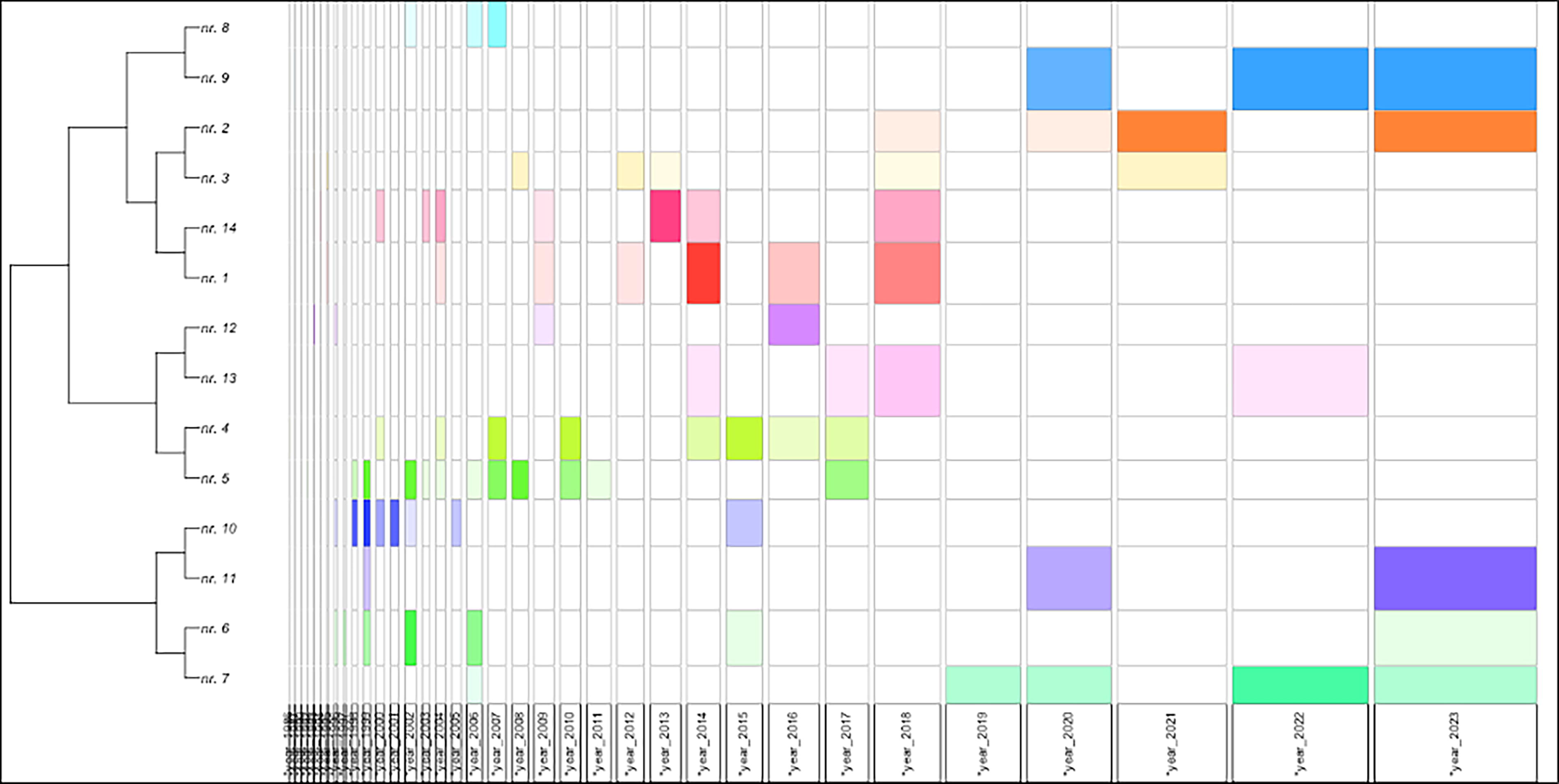
Classes’ overrepresentations during the years. Note: The height of the bars for each class is proportional to the size of the class in terms of the number of texts it contains. The width of the cells is proportional to the frequency of texts in a given year. The color tone is proportional to the strength of the association between class and year.
Direction 1: Environmental justice as ensuring everyone’s well-being
Pillar 1 on quality assessment of built environments has consistently drawn attention in scientific literature across the last four decades regarding urban pollution and geography. However, significant differences in its connotations have emerged over time. Issues related to environmental contamination and public health (class 6) or demographic data and ethnic inequalities (class 10) were particularly prominent in the early 2000s and even until 2015, albeit with some gaps. Conversely, in the last 5 years (from 2018 to 2019), the reflection on the quality assessment of built environments seems to have mainly focused on air quality and monitoring indexes (class 7), notably in 2022, and city planning and green indicators (class 11), prevalent in 2023.
Interest is shifting toward an inclusive view of environmental justice, less centered on specific indicators targeting vulnerable groups (such as the sick, children, ethnic minorities, or the less affluent). Instead, the focus has broadened beyond ensuring access to health and services; the quality of the built environment also involves urban planning and monitoring to preserve all residents’ well-being. This trend suggests a shift from a narrower, more restorative-focused environmental justice framework to a broader interpretation rooted in distributive justice principles.
Direction 2: Environmental justice as realizing just transition
Pillar 2 on mitigation efforts for climate change receives comparatively less attention in recent scientific literature regarding energy management and, especially, normative framework. Substantial differences in contents also emerge in this case. Issues related to policies and regulations (class 5) or conventions and treaties (class 4) were particularly prominent until 2017 but lost appeal recently. On the energy side, the study of transition and local exploitation (class 12) was mainly relevant in 2009 and, after a brief gap, notably in 2016, before regressing to baseline levels of consideration. The issue of carbon neutrality and economic growth (class 13) is relatively recent and has remained attractive since 2014.
While the normative framework remains pivotal, it is increasingly regarded as an unquestionable premise for environmental justice rather than a topic to be debated. The trajectory shifts toward the energy issue, particularly toward carbon neutrality. Similar to the previous direction, the normative framework takes on broader and more generalized tones in addressing a global issue such as energy. Environmental justice thus moves from being more focused on restoring damage to specific communities to embodying the principles of procedural justice, ensuring an institutional and juridical agenda of development and growth for all.
Direction 3: Environmental justice as reducing global inequalities
Pillar 3 on human dimensions in justice perspectives follows a similar temporal trend to the previous one. The following differences emerge in cultural reflection and social action over the four decades. Issues related to justice and its multilevel conceptualizations (class 1) or ethics in human–nature relationships (class 14) were particularly relevant until 2018, diminishing in prominence after that. Conversely, concerning social action, the exploration of the history of social movements (class 3) has been mainly significant, albeit with some gaps, until 2021, while that of power dynamics and social conflicts (class 2) is more recent and highly represented since 2018, especially in the last 3 years.
Like the previous scenario about the normative framework, the cultural reflection on environmental justice emerges over time as a solid foundation upon which (and through which) to build subsequent considerations, even about social action. In this regard, the conceptual trajectory shifts toward a broader view of the issue, moving from the actions of specific social movements to those of macro-actors on a global scale. Reflecting the previous trends, environmental justice thus evolves from the traditional approaches of top-down and bottom-up influences in understanding inequalities; it progresses toward a comprehensive understanding of recognition justice.
Direction 4: Environmental justice as facing societal challenges together
Pillar 4 of the RRI framework has evolved significantly. While, until the early 2000s, the reflection was mainly centered on the educational responsibility of academia (class 8), after a gap of over a decade, it increasingly focused on participatory research for nature-based solutions (class 9), centralizing the debate in the last 4 years.
This trend differs the most from the previous ones. The direction concerns the broader conception of public engagement, which has undergone significant redefinition over the past few decades. Initially, the debate focused on literacy, with experts responsible for transmitting knowledge to the general public. More recently, positions advocating for a close relationship of cocreation of knowledge between experts and laypeople are increasingly recognized (e.g., the citizen science approach). This shift can be interpreted in this sense: environmental justice increasingly acquires its dimension of participatory justice, intending participation as an egalitarian and non-top-down process.
DISCUSSION AND CONCLUSIONS
This scoping review examined nearly 40 years of scientific literature to navigate the origins, evolution, and current state of the art of the environmental justice framework, thus highlighting its implications for future research.
A preliminary consideration concerns the recognized awareness of the issue’s relevance, complexity, and multifaceted nature within the academic landscape. This awareness is evident from the steadily increasing interest in environmental justice, almost exponential interest in recent years, giving rise to a well-established field of study (as proved, for example, by the fact that the journal Environmental Justice is entirely dedicated to it). 35 Moreover, this awareness is also reflected in the willingness to approach the issue in a broad and multidisciplinary manner, proposing theoretical reflections, empirical studies, and practical applications with a critical and holistic view of the close relationship between environmental challenges and social justice.
The results of this scoping review provide an overview of the environmental justice framework based on some macro-themes, which we have called pillars. The first two pillars concern efforts to assess the quality of built environments and mitigate the effects of climate change. 36 Alongside them, another equally relevant pillar in scientific literature regards the human dimensions underlying the definition of environmental justice. 37 Lastly, in connection with the previous pillar, the issue is addressed in the fourth pillar, highlighting the opportunities and responsibilities for those involved, drawing on the principles of the RRI framework and, more broadly, public engagement. 38
This synthetic framing of environmental justice evokes the classical dimensions of justice in the literature: distributive, procedural, especially participatory, and recognition justice. Notably, restorative justice is a cross-cutting dimension whose contribution becomes more evident in the temporal analysis of the texts under examination. From the results, the emphasis on repairing damage caused is a legacy of the past, and this dimension has received less prominence in recent scientific literature.
The pillars on which the environmental justice framework is based undergo significant transformations over time, defining some directions toward which the current scientific debate seems to orient. The first direction, particularly relevant in the present literature, is attributable to the dimension of distributive justice and the pillar focused on assessing built environment quality. It suggests an inclusive conception of environmental justice that must ensure well-being for all. 39 The procedural justice dimension, evident in the pillar on efforts to mitigate climate change, is more apparent in the second direction identified, the least salient, namely that which sees environmental justice as a fundamental prerequisite for achieving a just transition. 40 The third direction, attributable to the dimension of recognition justice and the pillar on the human dimensions of justice, proposes a broad vision of the construct based on reducing inequalities on a global scale. 41 Finally, the dimension of participatory justice characteristic of the RRI pillar emerges in the last direction identified, namely that which conceives environmental justice as the premise for jointly addressing societal challenges in an egalitarian manner. 42
The adopted lexical-metric methodological approach has proven particularly valid for addressing the questions guiding this review. However, it requires rigorous decisions by the researcher to ensure the results can be interpreted effectively and that the overall research process maintains satisfactory levels of validity and reliability. Some of these decisions, particularly those related to the construction of the corpus, such as the criteria for inclusion and exclusion of texts, deserve critical discussion here as they constitute potential limitations of this work.
The first decision concerned the selection of the data source. In this review, the analyzed data were abstracts. This led to the exclusion of books and essays from the analysis despite their foundational role in scientific knowledge on a topic. Book abstracts (or essay abstracts) are not always present, available, or easily accessible. Moreover, the complexity of a book compared with a journal contribution means that a book abstract cannot be directly compared with that of a journal contribution. Therefore, in order to maintain the integrity and consistency of the data corpus, the review focused exclusively on articles, reviews, and editorials, excluding other sources such as books or essays. However, this may have introduced a bias toward disciplines that primarily disseminate scientific knowledge through journals. In addition, the choice to use Scopus as a database, for reasons outlined in the methodological section, further suggested favoring journal contributions over books or essays, as the latter are often not indexed in this database. The same applies to other forms of publication, such as white papers, which are still crucial in the debate on environmental justice.
Another decision concerned the selection of keywords for text search. In this review, texts were selected based on the presence of a single keyword (i.e., environmental justice). This led to the exclusion of publications focusing on related terms, such as environmental equity, environmental inequality, and environmental racism. In the introduction, we acknowledged the complexity and multidisciplinarity of the topic and clarified our interest in tracing the conceptual trajectory of the construct. Moreover, it would have been very challenging to account for the plethora of terms related to environmental justice, ensuring none were omitted. Such terms are sometimes derivatives of the umbrella construct of environmental justice, but, in other cases, they refer to different theoretical traditions. Therefore, for methodological rigor, we focused exclusively on the construct of environmental justice. However, this may have introduced a bias toward a segment, albeit broad, of the literature at the expense of other perspectives that could have enriched the understanding of the phenomenon by defining alternative and complementary pillars and directions.
Despite these limitations, the reading of the results into pillars and directions proposed by this review allows for some conclusive considerations to be drawn.
Overall, the results can be interpreted using two complementary and interconnected frameworks: environmental justice as a theoretical framework for global issues and environmental justice as a concrete framework for situated issues.
Conceptualizing environmental justice as a theoretical framework for global issues means shifting the focus from specific vulnerable groups (in a “horizontal” perspective based on sociodemographic characteristics) to broader vulnerable communities (in a “vertical” perspective based on regional factors). Today’s environmental challenges are global and affect vast geographical areas; hence, without forgetting that different groups are impacted unequally, environmental justice must address entire populations and be inclusive. This requires wide frameworks and comprehensive conceptualizations. The distributive justice dimension, together with the procedural one, assumes a fuller meaning here, less intertwined with that of restorative justice, and more focused on preventing rather than just managing problems.
However, this framework does not call for shifting attention away from local problems. In this sense, conceptualizing environmental justice as a concrete framework for situated issues means having the ability to apply complexity to concrete cases. This requires the involvement of affected communities, which should not be seen as victims to be compensated but as actors and proper agents of change. The dimensions of recognition and participatory justice assume a more egalitarian meaning here, less associated with top-down visions that, once again, see affected communities as passive entities to be taken care of.
It allows reflections on potential forthcoming research avenues. Soon, one of the most pressing challenges of the scientific debate on environmental justice may be to develop knowledge and empirical assessments on the social levers that allow for the effective convergence of global and situated issues closer to the interests and needs of affected communities. 43
Finally, the interpretations in terms of conceptual frameworks for environmental justice have implications for both contemporary environmental governance and activism. From a governance perspective, it means understanding and fostering forms of governance not as top-down, hierarchical, and linear processes where decisions are taken and communicated but as bottom-up, democratic, and circular processes where solutions are cocreated and negotiated. From an activism perspective, it means conceiving and promoting forms of activism not as moments of protest aimed at conflict, dispute, and resistance but as moments of participation oriented toward cooperation, dialogue, and change promotion. As this review’s primary focus was on scientific literature, a historical comparison between academic reflections and the institutional level (political, economic, legislative, etc.) would be beyond its scope. However, it would be interesting to closely examine the correspondence or divergence of themes, pillars, and directions with the events or processes in which a certain scientific debate has arisen, developed, or changed.
Footnotes
ACKNOWLEDGMENTS
The authors thank Valentina Rizzoli for her support during the analysis process. They also thank Pierluigi Cervelli, Mirella De Falco, and Mauro Sarrica for their comments on the first draft of the article.
AUTHORS’ CONTRIBUTIONS
S.B.: Conceptualization, methodology, resources, supervision, validation, writing—original draft preparation, writing—review and editing, funding acquisition, and project administration; G.C.: Data curation, formal analysis, investigation, methodology, software, visualization, writing—original draft preparation, and writing—review and editing; E.M.: Conceptualization, supervision, validation, writing—original draft preparation, and writing—review and editing.
AUTHOR DISCLOSURE STATEMENT
The authors have no conflict of interest to declare.
FUNDING INFORMATION
This study was carried out within the JUST4WHOM project—Boosting “full” environmental justice and resilience in communities facing transitions and received funding from the European Union Next-GenerationEU—National Recovery and Resilience Plan (NRRP)—Mission 4, Component 2, Investiment 1.1 Fondo per il Programma Nazionale di Ricerca e Progetti di Rilevante Interesse Nazionale (PRIN)—CUP N. H53D23009850001. This article reflects only the authors’ views and opinions; neither the European Union nor the European Commission can be considered responsible for them.