




Abstract
The sidewalks were lined with images of women of color who came before us—many still at work today. We met on July 8, 2023, at the Kemeny Recreation Center in Southwest Detroit, the heart of a community affected by environmental (in)justices for decades. Greeted by youth and elder community leaders, we were welcomed with grace and a buzz of optimism and brilliance. When everyone was glad the person next to them came, we knew we were in the right place. When every chair was full and the walls were lined with leaning bodies, of all shapes, colors, and ages, we knew we were in the right place. Together we engaged in the selfie station, art through a therapeutic lens, healthy cooking sessions, and an obstacle course. During a panel discussion, moderated by Laprisha Berry Daniels, six panelists, Rhonda Anderson, Theresa Landrum, Sylvia Orduno, Faizah Nasser, Maria Salinas, and Maureen Taylor, shared their experiences, and we left knowing that pollution has no boundaries. We were reminded that organizing is not only about dreaming; it is about mobilizing. We were given clear instructions to mobilize across generations and to rest, as the struggle is long. This day devoted to environmental justice work should not soon be forgotten.
ENVIRONMENTAL JUSTICE ROOTS IN METRO DETROIT
Emerging from the environmental and civil rights movements, several key events galvanized the environmental justice movement in the late 20th century.1,2 In the 1970s and 1980s, communities across the United States were mobilizing to address the disproportionate burden of pollution, environmental hazards, and disinvestment fueled by racist policies and planning. 3
Advocates and scholars in Michigan played a significant role in this mobilization.4,5 This is in part because Michigan has experienced a list of devastating environmental disasters, largely fueled by environmental racism. This includes both sudden and slow-moving disasters that have harmed communities of color and low-wealth communities more than their wealthier, White counterparts. Scholar-activists at University of Michigan were also leaders in this work, including Bunyan Bryant and Paul Mohai and, more recently, Kyle Whyte, Michelle Martinez, and others.
Many events galvanized the environmental justice movement in the 1970s and 1980s. In Michigan in 1978, the Michigan Department of Natural Resources approved a permit for Warren Industries to operate a hazardous waste treatment facility in Warren, a suburb of Detroit. Warren Industries accepted toxic waste from nearby industries, which they mishandled. This caused high levels of air, water, and soil pollution, which led to increased rates of cancer, respiratory illnesses, and other health problems for the nearby, mostly Black residents. 6
For decades, in Metro Detroit, environmental justice advocates have built coalitions, attended meetings, written public comments, educated decision-makers, strategized through media, and fought against the harmful placement and expansion of hazardous waste facilities, an incinerator, transportation infrastructure, and an oil refinery in historically marginalized neighborhoods. 7 These industries have impacted many residents in Detroit, Dearborn, River Rouge, Ecorse, and Melvindale where many of these faculties are co-located, as shown in Figure 1.
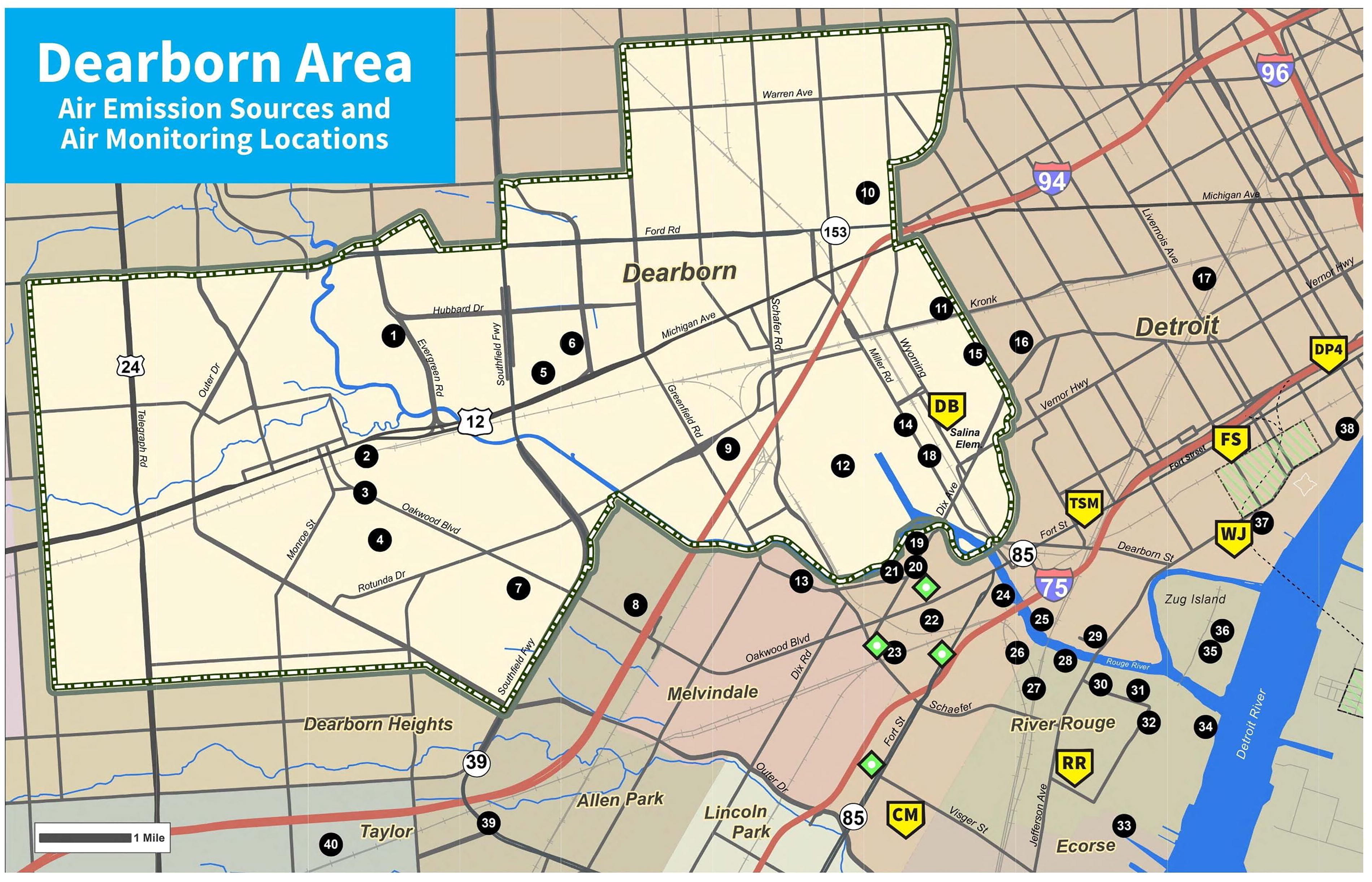
Map of air emission sources and monitoring locations, showing cumulative exposures affecting health in Southwest Detroit and nearby, Michigan Department of Environment, Great Lakes, and Energy.
The purpose of this article is to describe an event designed to honor Metro Detroit’s leaders in the environmental justice movement, as well as to share some perspectives and lessons from legendary panelists at the event. The majority of these leaders are women of color. For readers, these proceedings may provide inspiration for how or why such events may help to document and sustain the environmental justice movement today.
AN EVENT TO HONOR LEGENDS OF ENVIRONMENTAL JUSTICE
Given a $15,000 budget from a University of Michigan “Engage Detroit” grant, an intergenerational planning team (authors of this article) convened regularly for 6 months to intentionally determine the goals and activities of the event. This was to ensure that the event would be reflective of longtime environmental justice leaders’ priorities and vision.
After several discussions, the planning team determined the event should have four main goals: (1) to celebrate and honor women of color leading environmental justice efforts in Metro Detroit for decades; (2) to discuss the realities of this work, including experiences of implicit bias and overt intersecting racism and sexism; (3) to connect across generations—as well as cultural, religious, geographic, racial, and ethnic identities—to confront these realities together, heal, and re-energize; and (4) to find joy and moments of self-care.
Several decisions about the event helped to meet these goals. We identified local food vendors who were women of color-owned businesses. At registration, we generated a playlist by asking registrants to name the song that energizes them, fires them up, or brings them joy. We identified trusted organizations and individuals to facilitate activities, including staff from the Kemeny Community Center and Leaders Advancing and Helping Communities. They provided restorative activities including an art therapy session, a healthy cooking session, and hula hooping. When participants walked in, they were greeted by a series of portraits of several legendary women we wanted to honor (Fig. 2), and a Legends of Environmental Justice slideshow, which included pictures and inspirational quotes from environmental justice leaders, played throughout the event. Detroiters Working for Environmental Justice also set up a selfie booth, which led to many laughs and outtakes. Participants were all invited to take a gift, as well, which was either a succulent plant or a copy of the book All We Can Save: Truth, Courage, and Solutions for the Climate Crisis.

Portraits lining the sidewalk of the Kemeny Center in Southwest Detroit as participants entered the event.
Advertised with the flyer (Fig. 3), about 100 people attended the event on July 8, 2023, from 10:00 am to 3:00 pm, including community leaders, residents, and several high school students who were participating in the Environmental Health Research-to-Action Academy. 8
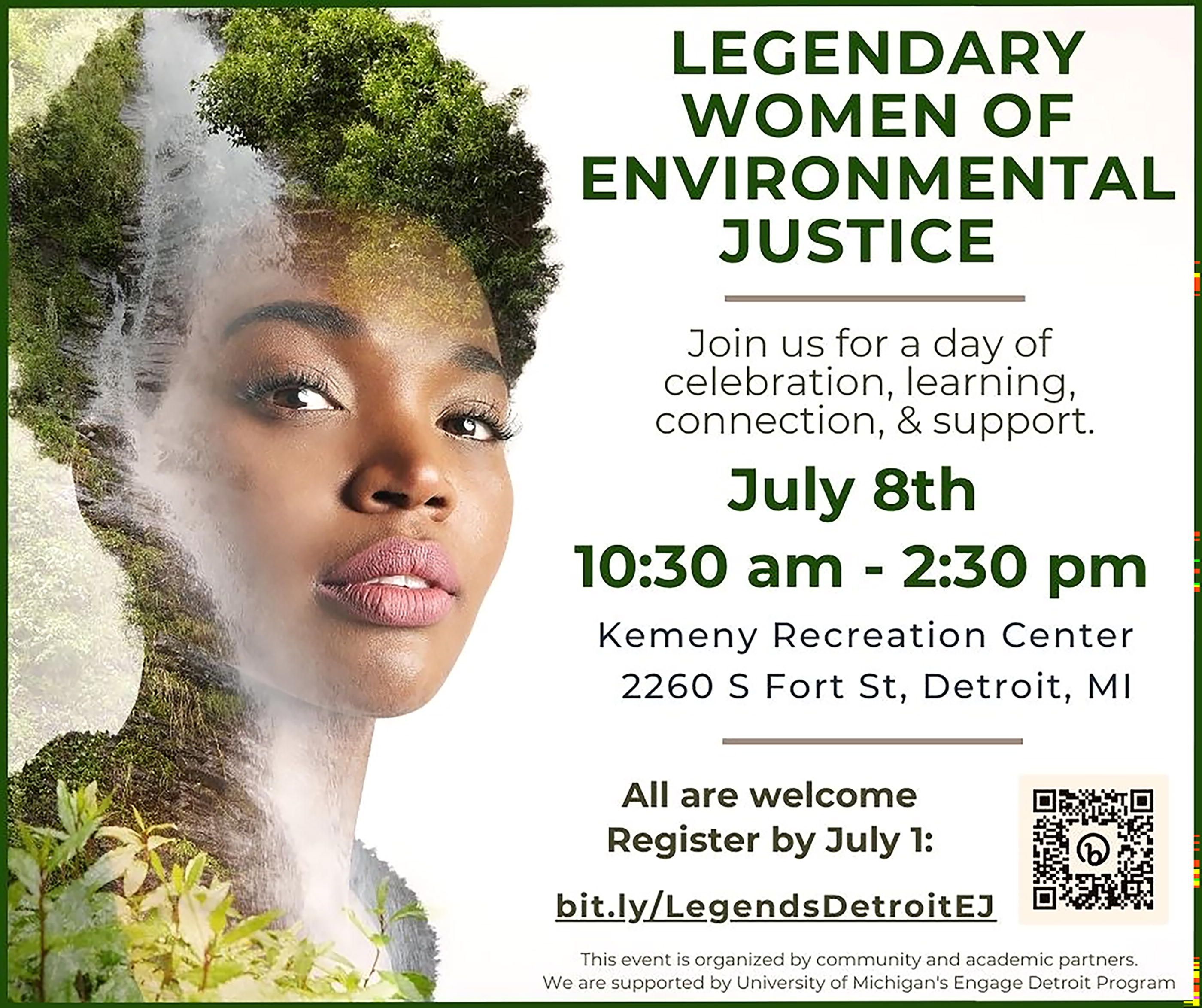
Event flyer designed by Bunmi Kumasi.
As a follow-up, participants received an e-mail with:
links to (1) the Legends of Environmental Justice slideshow, (2) the crowdsourced playlist, and (3) Pollution Has No Boundaries; opportunities to engage more deeply in environmental justice work, including a list of local environmental and social justice organizations; and a list of mental health and wellness resources, including trusted providers serving people of color and activists.
LEARNING FROM LEGENDS
Here we share major themes and powerful messages that emerged during the morning panel with the legendary women of environmental justice (Fig. 4). We note that this section cannot possibly cover all of the panel’s topics or the lessons that came from the countless discussions among attendees.
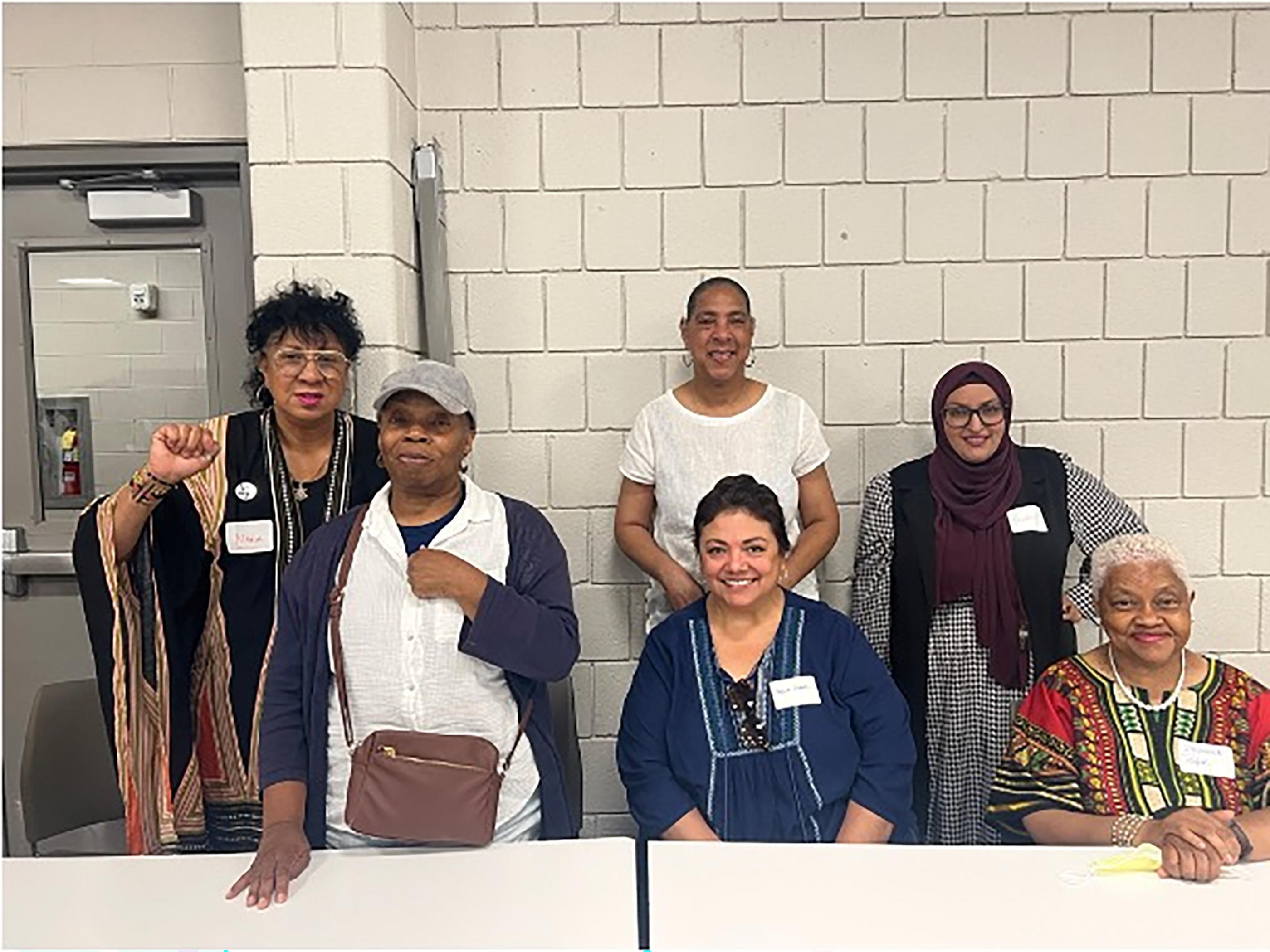
Image of panelists (from left to right) Maria Salinas, Rhonda Anderson, Theresa Landrum, Sylvia Orduno, Faizah Nasser, and Maureen Taylor.
The panelists: Legendary women
Rhonda Anderson—Recently retired environmental justice organizer for the Sierra Club Michigan Chapter, Rhonda has been a champion for raising awareness of Southeast Michigan’s environmental pollution for nearly two decades. Rhonda has utilized her strong expertise in union organizing, and her own experiences growing up in Detroit, to represent the voices of those disproportionately impacted by surrounding environmental pollution.
Theresa Landrum—For more than 20 years, Theresa has been an outspoken advocate for environmental justice in Southwest Detroit. A lifelong resident of Southwest Detroit 48217, Theresa grew up learning about how she and her community were discriminately impacted by pollution from surrounding factories. Theresa’s activism is ever-evolving as she continues to work with her community in their ongoing efforts to fight against environmental racism and protect the health of their community members.
Sylvia Orduno—Sylvia has been a community organizer for Detroit for over 20 years, serving for frontline community organizations such as the Michigan Welfare Rights Organization, and is currently a region 5 member for the EPA’s Environmental Justice Advisory Council. In her fight for welfare rights, Sylvia has also worked with communities in Detroit to address water insecurity.
Faizah Nassar—Faizah has been working in mental health services for a decade, currently working with the Crestwood School District and previously with Dearborn Public Schools, as a social worker. In her environmental activism, Faizah aims to bring awareness of mental well-being and remove stigmas of mental health in Dearborn and its Southend.
Maria Salinas—Born and raised in Southwest Detroit, Maria has been a lifelong activist and community organizer, founding the nonprofit Congress of Communities in 2006. Maria encourages leadership development and emphasizes youth engagement on issues such as environmental justice.
Maureen Taylor—Lifelong activist for welfare rights, currently serving as state chair for the Michigan Welfare Rights Organization, Maureen has become a voice for the underrepresented in Detroit, determined to address issues of social justice and find solutions for residents and families living in poverty.
The panelists described themselves as “OGs” or “Old Girls,” “boots on the ground,” and “wonderful warriors,” telling stories of how they came to this work mostly by necessity. As Anderson explained:
“I worked in 48217 with Theresa, with Dr. Leonard, for all these years primarily because I had the opportunity to do it. I was born and raised out here. I was born in River Rouge. I graduated from Ecorse High. This is my home. So when I learned that I could bring resources out here and help this community, I felt like Santa Claus.”
Others explained that “this is my home,” and ways they wanted to address their community’s priorities.
They also discussed how they each came to this role as a caregiver, or mother, with a sense of collective care for each other and their community. For instance, they discussed how, as many families were struggling to afford their bills or were at risk of evictions, older generations of women, like Taylor, have long provided resources and information to support them, as well as to address related social, economic, and environmental barriers that were shaped by disinvestment in their community.
Intersecting issues: “When your neighbor’s house is on fire”
As panelists shared their stories, they mentioned various campaigns or issues they worked on to support their community. Over the years, there have been many fires to put out that relate to their community’s overall well-being, particularly environmental exposures and emergencies, and Landrum extended this metaphor:
“If your neighbor’s house is on fire, right, and you see it, what are you going to do? You’re gonna run. You’re gonna knock on that door and say your house is on fire, right? And then, guess what? That neighbor’s house next to him catches on fire. So what you’re gonna do? You’re gonna run and say, ‘Your house is on fire’. All around each house is catching on fire. You’re going door-to-door-to-door pulling people out for a common cause, to save lives, right?”
The many topics that emerged illustrated the ways environmental justice connects to so many other issues, as indicated in Table 1 and reflected in the current larger environmental justice movement and scholarship. 9
Intersecting Issues Discussed by Environmental Justice Leaders
Realities of this work: “It was hard”
The panelists spelled out the realities of this work, particularly the experiences of racism, sexism, xenophobia, and other forms of marginalization, as well as the experience of activist burnout that has been documented by many. 10 Anderson shared that she was a single parent who had to take on the environmental issues impacting the health of her children. She also spoke about the challenges associated with being a woman of color in the environmental movement:
“I just retired from this work. 23 years. And, it was 23 years of exhausting work being a Black woman in this mostly white organization, probably one of the largest environmental organizations in this country…in the background fighting for representation—for us, for Latinas, Asian Americans. It was hard.”
Nasser discussed how her community in Dearborn’s Southend “is predominantly first and second generation [from Arab nations]…you barely find third generation.” She explained that “advocacy and activism were new for many,” and additionally challenging due to limited representation and access to decision-making. Yet, it is necessary, as their neighborhood is fenceline to many industrial facilities and harmful pollution sources.
Panelists’ expertise spanned academia, community organizing, and navigating state, federal, and local municipalities. Despite their deep expertise, all had stories of mistreatment, dismissal, and harmful ways they had been treated by decision-makers, scientists, and others who upheld intersecting systems of discrimination. 11
Lessons for organizers and advocates: “One of the most critical things you can do in the world”
Panelists shared lessons for organizers and advocates from their organizing and campaign experience. As Orduno explained:
“And, I’ve been extremely proud to be a community organizer. I feel like it’s one of the most critical things you can do in the world. But it’s often underappreciated, and people don’t understand what it means. But it means trying to build the power of our communities.”
Panelists impressed many lessons, including that as advocates, you must:
understand your rights, when they are being violated, and who or what entity is responsible for addressing violations and harm; fight for representation in decision-making; connect across race, gender, and class, even when it is hard; recognize that, most of the time, a community knows what solutions are needed; understand the advocacy needed at local, state, and federal levels without losing focus on your own local community; learn from other generations and your community, as everyone has some expertise; and work with decision-makers, but trust yourself and “watch out” and proceed with a healthy dose of skepticism.
A call to action: “Should of brought a notebook and a pencil”
The panelists began and ended with a call to action for all in the room. They recognized that through their years of organizing and advocacy they had gained knowledge and skills from the communities they have served and those that came before them in this work. With this recognition, they reminded younger attendees that they must do the same. As Taylor explained, “I want to be able to share with you that over the years, I’ve made so many mistakes. I know what works.” Also, Landrum explained, “I had to become a researcher…you can learn anything you want to learn, whether advocacy skills, research skills, or other skills to advance environmental justice.” Throughout their dialogue, they spoke directly to the audience, saying things including “Speak up,” and “Stand up.” Anderson stated, “You are so young. You are yesterday, the movement needs you so bad….” Finally, Landrum emphasized the urgency of the moment and reminded everyone that the climate crisis is already underway.
CONCLUSION
Some of the environmental justice movements’ deepest roots emerged within Detroit, Michigan, and nearby communities. More often than not, for decades, this work has been led by women, particularly women of color. These proceedings document an event that occurred in the summer of 2023 to recognize these women. Participants heard perspectives from panelists who have been advocating for environmental justice for decades related to a range of intersecting issues—from water to air, from land use to infrastructure, and from workers’ health to housing and education. The panelists openly discussed the realities of doing this work within intersecting systems of racism and patriarchy. The event also provided an opportunity to connect and find joy across generational, gender, racial, and cultural boundaries. Today, despite many policy and funding advances, environmental racism persists in Detroit, Dearborn, and beyond. Such intergenerational dialogues may help to ensure important history is not lost and to grow capacity, power, knowledge, and skills needed for achieving environmental justice. Finally, this event provides a reminder and example of how we must pause to honor the legends who make countless sacrifices and dedicate their lives to fight for the right to clean, safe, and healthy environments for all.
Footnotes
ACKNOWLEDGMENT
The authors are particularly grateful for the many people dedicated to addressing injustice in Metro Detroit, working day in and day out, many of whom took the time to engage and connect with the authors for this event.
AUTHORS’ CONTRIBUTIONS
C.E.P.: Conceptualization, formal analysis, funding acquisition, project administration, resources, supervision, visualization, writing—original draft, and writing—review and editing. T.L.: Conceptualization, funding acquisition, resources, visualization, and writing—review and editing. N.S.: Conceptualization, formal analysis, funding acquisition, supervision, visualization, and writing—original draft. J.J.: Data curation, formal analysis, and writing—original draft. L.D.: Conceptualization, resources, supervision, visualization, and writing—review and editing. Y.E.: Conceptualization, formal analysis, visualization, and writing—original draft. R.G.: Conceptualization, resources, visualization, and writing—review and editing. S.L.: Conceptualization, visualization, and writing—review and editing. J.G.: Conceptualization, visualization, and writing—review and editing. M.G.: Conceptualization, visualization, and writing—review and editing.
AUTHOR DISCLOSURE STATEMENT
No competing financial interests exist.
FUNDING INFORMATION
This event was made possible with a grant from the University of Michigan’s Engaged Detroit program, as well as in-kind contributions from the Original United Citizens of Southwest Detroit, Detroiters Working for Environmental Justice, and Southwest Detroit Environmental Vision.
ADDITIONAL RESOURCES

1
Charles Lee. “A Game Changer in the Making? Lessons From States Advancing Environmental Justice Through Mapping and Cumulative Impact Strategies.” Environmental Law Reporter 50 (2020): 10203.
2
Rebecca C. Rehr, Nancy Simcox, Na’Taki Osborne Jelks, Michele Okoh, Brandon Hunter, Candis M. Hunter, Omega Wilson, Brenda Wilson, Natalie Sampson and Garry Harris. “Environmental Justice: From the Grassroots to the White House.”(report from a Virtual Event Hosted by the American Public Health Association and United Church of Christ October 28, 2021, to Celebrate the 30th Anniversary of the First National People of Color Environmental Leadership Summit, Washington, DC. Environmental Justice 2023).
3
Sacoby M. Wilson. “Environmental Justice Movement: A Review of History, Research, and Public Health Issues.” Journal of Public Management & Social Policy 16 (2010).
4
Paul C. Rosier. Environmental Justice in North America. (Routledge, 2024).
5
Bunyan Bryant and Paul Mohai. “The Michigan Conference: A Turning Point.” EPA Journal 18 (1992): 9–10.
6
Robin Saha and Paul Mohai. “Historical Context and Hazardous Waste Facility Siting: Understanding Temporal Patterns in Michigan.” Social Problems 52 (2005): 618–648.
7
Amy J. Schulz, Graciela B. Mentz, Natalie Sampson, Melanie Ward, Rhonda Anderson, Ricardo de Majo, Barbara A. Israel, Toby C. Lewis and Donele Wilkins. “Race and the Distribution of Social and Physical Environmental Risk: A Case Example from the Detroit Metropolitan Area.” Du Bois Review: Social Science Research on Race 13 (2016): 285–304.
8
Natalie R. Sampson, Carmel E. Price, Adam Almaleky, Zeina Reda, and Yara Reda. 2024. “Lessons from the Environmental Health Research-to-Action Youth Academy.” Environmental Justice, published online September 30.
9
Erik Kojola and David N. Pellow. “New Directions in Environmental Justice Studies: Examining the State and Violence.” Environmental Politics 30 (2020): 100–118.
10
Andrew Schneller, Saima Hannan, Haja Isatu Bah, Sophia Livecchi and Stacy Pettigrew. “Environmental Justice Is Exhausting: Five Decades of Air Pollution and Community Advocacy at Ezra Prentice Homes in Albany, New York.” Local Environment: the International Journal of Justice and Sustainability 27 (2022): 1514–1535.
11
Kimberle Crenshaw. “Mapping the Margins: Intersectionality, Identity Politics, and Violence Against Women of Color.” Stanford Law Review 43 (1991): 1241–1299.