




Abstract
In the present study, 31 coliform strains were isolated from salad, cheese, and meat products sold in commercial establishments in Rio de Janeiro city, and were tested for antibiotic resistance and antimicrobial substance production. Thirteen strains (41.9%) were resistant to at least one antibiotic tested, among which one presented resistance to nine different antibiotics. Two strains (6.4%) exhibited inhibitory activity against the indicator strains, Escherichia coli LMIFRJ and Salmonella enterica I. The antimicrobial substances that they produced were sensitive to proteolytic enzymes, suggesting that they might be bacteriocins. The producer strains were identified as Klebsiella ozaenae and Raoultella terrigena. Although they had similar spectrums of action, the bacteriocins were shown to be different. Both of them were able to inhibit E. coli, Klebsiella, Enterobacter, and Salmonella strains, including antibiotic-resistant ones. Our results suggest that these bacteriocins, named klebicin K and raoultellin L, could have potential use against some foodborne pathogens.
Introduction
The presence of antibiotic-resistant bacteria in food can be an important threat to public health, since antibiotic resistance determinants may be transferred to other bacteria of clinical significance by genetic transference mechanisms like conjugation and transformation (Sunde and Nordstrom, 2006; Van et al., 2007; Walsh et al., 2007).
Over recent decades, antibiotics have been used as therapy for bacterial infections in humans and animals. However, many studies have demonstrated occurrences of antibiotic-resistant bacteria, especially from the coliform group, in various environments as a consequence of uncontrolled discharges of urban and animal wastewater, which may contaminate food of animal or vegetable origin (Kumar et al., 2005; Silva et al., 2006; Watkinson et al., 2007). A new class of antimicrobial substances, termed “natural antibiotics,” may be an alternative for combating antibiotic resistance. Bacteriocins are included in this group (Hancock, 2001; Papagianni, 2003).
Bacteriocins are peptides with antimicrobial activity produced by bacteria. These compounds possess potential use either as food preservatives or for the treatment and prevention of bacterial infections (Jack et al., 1995; Nascimento et al., 2004, 2006; Gálvez et al., 2007).
In this study, the production of antimicrobial substances by coliform strains isolated from food was investigated, with the aim of finding substances of bacteriocin type with potential use against foodborne pathogens, especially antibiotic-resistant strains.
Materials and Methods
Sample collection and bacterium identification
In this study, 8 samples of raw and cooked salads, 5 samples of meat products, and 10 samples of different kind of cheese were analyzed between December 2007 and March 2008. All these foodstuffs were available for sale in arbitrarily chosen commercial establishments in the city of Rio de Janeiro. Samples were collected in the packing supplied by the commercial establishments and were immediately taken for analysis.
Isolation of total and thermotolerant coliforms was performed in accordance with APHA (1992). Aliquots from culture tubes of positive brilliant green lactose bile broth (Himedia, São Paulo, Brazil) and E. coli broth (Himedia) were inoculated into eosin methylene blue agar medium plates (Himedia) and were incubated at 37°C for 18–24 h. Approximately 1 in every 50 colonies was selected and subjected to identification procedures.
Strains were identified and/or differentiated using conventional biochemical tests (Farmer et al., 1985) or using a commercial kit for Enterobacteriaceae identification (Laborclin, São Paulo, Brazil) when the conventional tests were inconclusive. The biochemical tests included motility and indole production in sulfide indole motility medium (Himedia); glucose and lactose or sucrose fermentation; gas and H2S production in triple sugar iron agar (Himedia); oxidase test; methyl red and Voges–Proskauer tests; citrate and malonate utilization; arginine, lysine, and ornithine decarboxylation; phenylalanine deamination; growth at 10°C; D-melezitose assimilation; and urease production. Carbohydrates, amino acids, and other reagents were obtained from Vetec Química (Rio de Janeiro, Brazil).
The bacterial strains used as indicators in bacteriocin testing were grown in brain heart infusion broth (BHI; Himedia) at 37°C for 18 h. When necessary, the medium was supplemented with agar at 1.5% (w/v) or 0.6% (w/v). The bacteria were stored in BHI with 40% glycerol (w/v) at −20°C until needed.
Antibiotic resistance
Resistance patterns were determined by disc diffusion, in accordance with the procedures of the CLSI (2006). The following antibiotics were used (Sensifar, São Paulo, Brazil): amikacin (30 μg), ampicillin (10 μg), cephalothin (30 μg), cefotaxime (30 μg), chloramphenicol (30 μg), ciprofloxacin (5 μg), gentamicin (10 μg), imipenem (10 μg), kanamycin (30 μg), nalidixic acid (30 μg), norfloxacin (10 μg), streptomycin (10 μg), and tetracycline (30 μg).
Bacteriocin testing
The agar-spot assay was performed as described by Giambiagi-deMarval et al. (1990). The producer cells were grown in 5 mL of BHI (Himedia) for 24 h. Five microliters of culture was spotted onto BHI plates. After 24 h at 37°C, the bacteria were killed by exposure to chloroform vapor and the plates were sprayed with the indicator strain culture (0.3 mL of a previously grown culture in 3 mL of BHI soft agar). The plates were further incubated for 24 h at 37°C and the inhibition zones (clear zones around producer strain growth) were measured. E. coli LMIFRJ and Salmonella enterica I were used as the indicator strains for production of antimicrobial substances.
To determine the spectrum of action of the antimicrobial substances detected in this study, several strains from different species of Gram-negative and some Gram-positive bacteria were tested as indicators.
The effects of the proteolytic enzymes trypsin (Sigma-Aldrich, São Paulo, Brazil), pronase (Sigma-Aldrich), and proteinase K (Sigma-Aldrich) on antimicrobial substance activity were determined in accordance with Giambiagi-deMarval et al. (1990). The enzymes (1 mg/mL) were prepared in 0.05 M Tris (pH 8.0) with 0.01 M CaCI2, and 40 μL was applied around the producer colonies after chloroform treatment. The plates were incubated at 37°C for a further 4 h and were sprayed with the indicator strain. After the treatment with the enzymes, absence of inhibition zones when the indicator strains were used indicated that the antimicrobial substance was of proteinaceous nature. The antimicrobial substances were also treated with 0.2 N NaOH to rule out the possibility that the inhibition exhibited might have been due to organic acids produced by the producer strain during its metabolism.
Results and Discussion
Out of the 31 strains isolated from the samples analyzed (Table 1), 17 (54.8%) were identified as E. coli, which constituted the species most frequently isolated. Strains belonging to the genera Enterobacter, Klebsiella, and Raoultella were also found.
Samples originated from salads (S), meat products (M), and cheese (C). Both intermediate and resistant categories were considered resistant.
AMI, amikacin; AMP, ampicillin; CTX, cefotaxime; CLO, chloramphenicol; CIP, ciprofloxacin; GEN, gentamicin; KAN, kanamycin; NAL, nalidixic acid; NOR, norfloxacin; STR, streptomycin; TET, tetracycline; —, sensitive to all the antibiotics tested.
The strains were subjected to the antibiogram test (Table 1), in which 13 (41.9%) were resistant to at least one antibiotic. Seven (63.6%) out of the 11 strains isolated from salad presented antibiotic resistance. Among these, strain 04 (E. coli) was resistant to nine different antibiotics, thus showing a typical multiresistance profile.
Several studies have been performed with the aim of investigating the potential role that natural antimicrobial substances might have either as food preservatives or for treating clinical and veterinary diseases, as replacements for traditional antibiotics because of increasing antibiotic resistance (Threlfall et al., 2000; Gillor et al., 2004; Gordon et al., 2006).
All the 31 strains isolated in this study were tested to evaluate their ability to produce antimicrobial substances. Two of them (6.4%), that is, strains K and L (Klebsiella ozaenae and Raoultella terrigena, respectively) isolated from the same sample of salad, exhibited antimicrobial activity against the indicator strains E. coli LMIFRJ and S. enterica I (Fig. 1). The spectrum of action of these strains was evaluated, and the results are presented in Table 2. Both strains were able to inhibit several Gram-negative strains and two Gram-positive strains (Bacillus subtilis and Staphylococcus xylosus). Among the Gram-negative strains that were inhibited, the E. coli and Salmonella multiresistant strains can be highlighted.
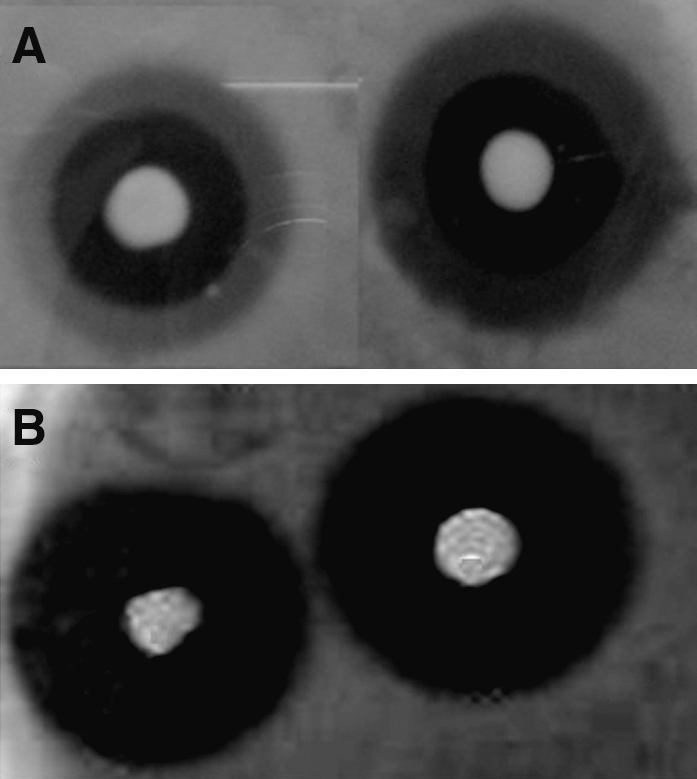
Agar-spot assay demonstrating the antimicrobial activity exhibited by Klebsiella ozaenae K and Raoultella terrigena L against the indicator strains Salmonella enterica I (
Diameter of the producer strain spots ranged from 4 to 5 mm. Values represent the mean from three independent experiments.
Antibiotic-resistant strains.
—, no inhibition; ATCC, American Type Culture Collection; NCTC, National Collection of Type Cultures; LMIFRJ, Laboratory of Microbiology of Instituto Federal do Rio de Janeiro.
The main criterion that has been established to characterize antimicrobial substances as bacteriocins is the presence of a biologically active proteinaceous compound (Tagg et al., 1976; Luria and Suit, 1987; Cascales et al., 2007).
Both antimicrobial substances in the present study were resistant to 0.2 N NaOH, thus ruling out the possibility that the inhibition zones exhibited were due to the acids produced by the producer strain during its metabolism. The antimicrobial substance produced by K. ozaenae K was sensitive to the three proteolytic enzymes tested, whereas the one produced by R. terrigena L was sensitive to pronase and proteinase K, thereby indicating the difference between the two substances. They both presented a biologically active proteinaceous compound in their structures, and therefore they fulfill the main criterion for defining them as typical bacteriocins.
Since Gram-negative bacteria produce a variety of bacteriocins, which are named after the genus (e.g., klebicins from Klebsiella pneumoniae) or species (e.g., colicins from E. coli, marcescins from Serratia marcescens, alveicins from Hafnia alvei, and cloacins from Enterobacter cloacae) of the producing bacteria (Chavan and Rilley, 2006), the antimicrobial substances produced by the strains K. ozaenae K and R. terrigena L will be called klebicin K and raoultellin L, respectively.
These bacteriocins seem to belong to the microcin group, since they are not lethal to the producer cell (data not shown). The spectrum of action of most microcins is directed against bacteria of the Enterobacteriaceae family, including the genera Escherichia, Salmonella, Shigella, Citrobacter, Klebsiella, and Enterobacter (Jack and Jung, 2000; Pons et al., 2002; Papagianni, 2003), both klebicin K and rauoltellin L were able to inhibit Gram-positive strains.
Since klebicin K and raoultellin L could have potential application against foodborne pathogen strains, further studies will be developed on these bacteriocins with this aim.
Footnotes
Acknowledgments
This work was supported by a research grant from Fundação de Amparo à Pesquisa do Estado do Rio de Janeiro to J.S. Nascimento.
Disclosure Statement
No competing financial interests exist.