




Abstract
Chicken meat is considered an important vehicle of foodborne pathogens such as Salmonella spp., demanding an effective control of its contamination during industrial processing. This study aimed to investigate the presence of Salmonella spp. and microbiological indicators at different stages of processing in two slaughterhouses (Sh1, high-capacity; Sh2, low-capacity). Surface samples of chicken carcasses were collected in the following sequential stages: (A) immediately before evisceration, (B) after evisceration, (C) after showering, and (D) after chiller. All samples were submitted for detection of Salmonella spp. and enumeration of mesophilic aerobes, total coliforms, thermotolerant coliforms, and Escherichia coli. The obtained means and frequencies were compared by analysis of variance and chi-square tests (p < 0.05), considering different slaughterhouses and stages of processing. No significant differences were observed between the frequencies of Salmonella spp. obtained at different steps in Sh1 and Sh2 (p > 0.05). Sh2 showed higher levels of microbiological contamination when compared with Sh1 for mesophilic aerobes (in stages B and D), total coliforms and thermotolerant coliforms (stage D), and E. coli (all stages) (p < 0.05). The variation in the levels of contamination by microbiological indicators over the processing indicated the significance of different control procedures adopted by slaughterhouses for the microbiological quality of chicken carcasses.
Introduction
Because of the great demands from importing countries for products with better quality, including hygienic concerns as to the achievement of poultry carcasses, new methodologies for systematic control have been increasingly used by slaughtering houses. An effective way to perform such control is hygiene indicator monitoring, as proposed by the Hazard Analysis and Critical Control Point (HACCP) (ICMSF, 1988). Although they do not pose any harm to consumers, hygiene indicator microorganisms are frequently used as indicators of pathogens, such as Salmonella spp. and Campylobacter spp. (Scott et al., 2001). Mesophilic aerobes (MA) are frequently used as hygiene indicators in the meat production process, the same way that the presence of Escherichia coli (EC) is considered an indication of fecal contamination (Ghafir et al., 2008). Other indicators, such as enterobacteria, may suggest the presence of specific pathogens in the production environment or in the final product (Martins and Germano, 2007).
The control of pathogen contamination is the main strategy to prevent foodborne diseases. Salmonella spp. is considered a major cause of these diseases and is responsible for 10–15% of the cases of acute gastroenteritis in humans, frequently associated with poultry meat and eggs (Jay et al., 2005). The presence of Salmonella spp. in carcasses depends on the conditions to which poultry were exposed during production until the end of the slaughtering process, including the sanitary conditions in rural properties, transport, and processing in slaughterhouses (Fluckey et al., 2003). In Brazil, there are a great variety of poultry slaughterhouses with different capacities, volumes, procedures, equipment, and tools. These variables can directly affect the contamination by Salmonella spp. and hygiene microbiological indicators (Dickel et al., 2005b).
The objective of the present work was to compare two slaughterhouses with different capacities and processing characteristics as to the presence of Salmonella spp. and hygiene microbiological indicators in important slaughter line stages.
Materials and Methods
Sampling and dilutions
Two slaughterhouses with distinct slaughter capacities were selected in the region of Viçosa, Minas Gerais state, Brazil, being identified as Sh1 (high-capacity of slaughtering) and Sh2 (low-capacity). The main characteristics of each slaughterhouse are described on Table 1. In both slaughterhouses, four sequential stages were defined according Rodrigues et al. (2008), considering relevant sources of microbial contamination: (A) immediately before evisceration, (B) after evisceration, (C) after shower, and (D) after cooling tank (chiller). In each stage, superficial samples were collected from chicken carcasses (Sh1: 27 samples per point, and Sh2: 30). Each sample unit was achieved by swabbing a surface area of 50 cm2 with sterile polyurethane sponges in two different locations on the carcass: the chest, near the neck, and the dorsal region, adjacent to the cloacae. The sponges were previously soaked in 10 mL of 0.1% peptone water (H2Op) (ICMSF, 1986).
After swabbing, the sponges were placed in sterile bags and homogenized in a “Stomacher” (400 Seward circulator, West Sussex, United Kingdom) for 1 min with 40 mL of 0.1% H2Op, to achieve a homogenate with a volumetric equivalent of the sampled area (1 mL = 1 cm2). The obtained homogenates were then submitted to 10-fold dilution using 0.1% H2Op (ICMSF, 1986).
Salmonella spp.
The methodology described by MAPA (2003a) was followed. An aliquot of 25 mL of the homogenate was added to 225 mL of buffered H2Op 1%, followed by incubation at 37°C for 20 h (preenrichment). Then, 1 mL was inoculated into selenite cystine broth (incubation at 37°C for 24 h) and 0.1 mL in Rappaport Vassiliadis broth (42.5°C for 24 h in water bath) (selective enrichment). The cultures achieved were streaked onto brilliant green phenol red lactose sucrose agar and xylose lysine deoxycholate agar and incubated at 37°C for 24 h. Once the typical colonies were identified (brilliant green phenol red lactose sucrose agar: colorless or pinkish colonies, and xylose lysine deoxycholate agar: opaque colonies, with or without H2S production), they were submitted to preliminary biochemical identification in triple sugar iron agar and lysine iron agar and incubated at 37°C for 24 h. The final verification was carried out by serologic agglutination tests with somatic (O) and flagellar (H) polyvalent antisera (Probac do Brazil, São Paulo, SP, Brazil). The samples with characteristic biochemical reactions were considered positive, as well as those with positive reactions in both serological studies.
All the cultures that presented positive results in the serological tests with polyvalent antigens were also submitted to confirmation of belonging to the genus Salmonella by polymerase chain reaction (Oliveira et al., 2002) and serotyping at Fundação Oswaldo Cruz (Rio de Janeiro, Brazil). All the analyses were carried out simultaneously with Salmonella Enteritidis ATCC 13076 as positive control, and all the culture media used were from Oxoid (Basingstoke, United Kingdom).
Microbiological hygiene indicators
The collected samples were also submitted for the enumeration of hygiene indicator microorganisms (MAPA, 2003a). MA were enumerated by direct plating in standard count agar (pour plate) and incubation at 35°C for 48 h. The colonies formed were counted and the results were expressed as colony-forming units/cm2.
Total coliforms (TC) were quantified by the multiple tube technique, using the presumptive test in lauryl sulfate tryptose broth (35°C for 24–48 h) and confirmed in 2% brilliant green bile broth (35°C for 24–48 h). The obtained results were expressed as most probable number (MPN)/cm2. Based on the TC-positive results, the thermotolerant coliforms (TTC) were detected using EC broth (44.5°C for 24 h in water bath), with final results expressed as MPN/cm2.
Based on the positive results for TTC, EC was detected according Kornacki and Johnson (2001). Aliquots of the EC tubes with positive results were streaked on plates of eosin methylene blue agar and incubated at 35°C for 24 h. When typical colonies of EC were present, with a metallic aspect, they were streaked in plate count agar with incubation at 35°C for 24 h. Next, they were streaked on prehydrated Petrifilm™ EC plates (3M Microbiology, St. Paul, MN) and incubated at 35°C for 24 h, for the evaluation of the glucuronidase activity (blue colonies) and EC confirmation. Cultures still suspected were biochemically identified using Bactray 1 and 2 (Laborclin Produtos para Laboratório, Pinhais, PR, Brazil). All the analyses were carried out simultaneously with the positive control, which consisted of a culture of EC isolated from mastitic milk. The final results were expressed as MPN/cm2.
Temperature and residual chlorine monitoring
During nine sample collections in Sh2, the temperatures of scalding, prechiller, chiller, and the swabbed carcasses were measured using a digital thermometer. The amount of free residual chloride in the prechiller and chiller was also checked with the use of a digital electronic equipment (LaMotte 1200 Colorimeter; LaMotte, Chertertown, MD), with reading magnification from 0.00 to 5.00 mg/L. In Sh1, the temperatures from distinct stages and residual chlorine from chiller tanks were measured by inspectors from the Ministry of Agriculture (Ministério da Agricultura, Pecuária e Abastecimento, Brazil), as routine control.
Analysis of the results
The frequencies of positive samples for Salmonella spp. at each step and at each slaughterhouse were compared by the chi-square test (p < 0.05). The mean counts of MA, TC, TTC, and EC were compared by analysis of variance in each stage of the processing and in each slaughterhouse (p < 0.05). All the analyses were carried out using the Statistica 7.0 (StatSoft, Tulsa, OK) and XLStat 2009.1.02 (Addinsoft, New York, NY). The temperatures at different stages and of carcasses and the concentrations of chlorine were compared with the values established by the MAPA (1998).
Results and Discussion
A total of 9 samples out of the 108 analyzed from Sh1 were contaminated with Salmonella spp. (8.3%), whereas 6 out of the 119 samples from Sh2 were contaminated by this pathogen (5.0%) (Table 2). Although the slaughterhouses presented different frequencies of Salmonella spp. in the studied stages, no significant differences were found between these frequencies, considering both the stages of processing and the slaughterhouses (Table 2). All Salmonella spp. isolates obtained from Sh2 were confirmed by polymerase chain reaction (Fig. 1) and serotyped as Salmonella Enteritidis.
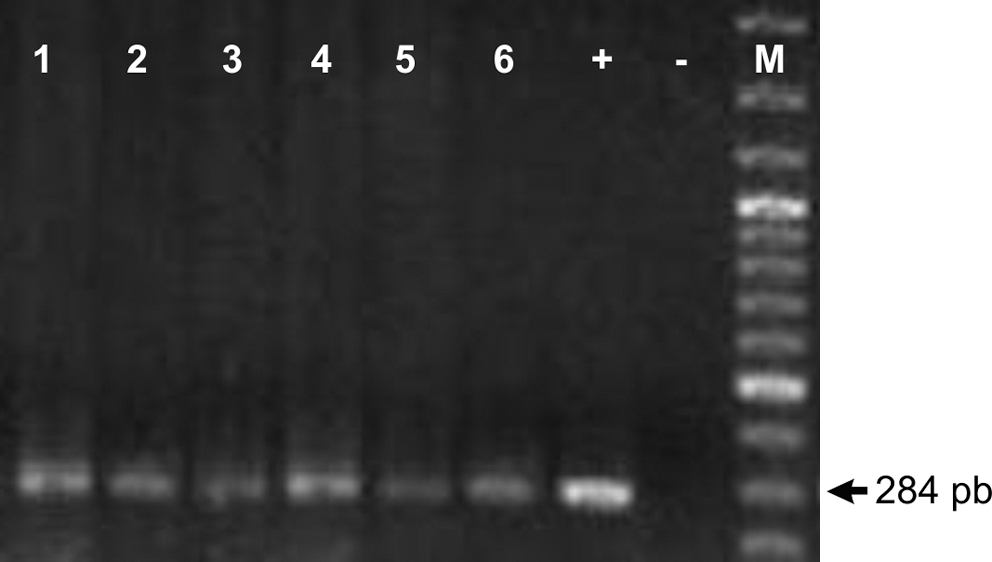
Gel electrophoresis with the products of amplification obtained by the polymerase chain reaction from six cultures of Salmonella spp. (1–6) isolated from superficial samples of chicken carcasses obtained from different processing steps in a small-sized slaughterhouse. M, molecular marker of 100 bp (Promega, Madison, WI); Salmonella Enteritidis ATCC 13076 was used as positive control (+) with a segment of 284 pb; Milli-Q water was used as negative control (−).
A, immediately before evisceration; B, after evisceration; C, after shower; D, after cooling tank.
χ 2, chi-square; df, degree of freedom; p, level of significance.
Lopes et al. (2007) found a low frequency of Salmonella spp. in a poultry slaughterhouse, as the pathogen was detected in only 1.6% of the analyzed chicken carcasses (i.e., one positive sample before entrance into the chiller tank and another after the chiller tank exit). Different results were found by Dickel et al. (2005a), who compared the presence of Salmonella spp. in slaughterhouses with different slaughtering capacities: there was no isolation of Salmonella spp. in the small-sized slaughterhouse, whereas in the larger slaughterhouse, 50% of the samples were positive, with oscillation during the processing and a predominance of contamination after evisceration. Evisceration is a significant factor in contamination by Salmonella spp. because it was carried out in a mechanized way, favoring the rupture of viscera of animals with nonstandardized sizes (Dickel et al., 2005b). Despite the identification of main steps for Salmonella spp. contamination (Table 1), the obtained results in both slaughterhouses met the demands of the Program for the Reduction of Pathogens, with values below 23.5% (MAPA, 2003b).
The mean values and the analysis of the results of the microbial contamination in each stage of the processing and each slaughterhouse are presented in Table 3. A significant reduction was observed for MA, TC, and TTC in Sh1 only between C and D stages (p < 0.05), whereas the mean counts of EC did not present significant differences in the processing stages (p > 0.05). In Sh2, MA presented a significant reduction between B and C stages, whereas TC, TTC, and EC were reduced between C and D stages (p < 0.05). These results indicate the importance of the shower (C) in Sh2 and the chilling tank (D) in both slaughterhouses to promote the reduction of contamination by hygiene indicator microorganisms. Such results are similar to those observed by Gill et al. (2006), who suggested that MA are associated not only with the skin of the poultry carcass, but also with superficial and adhered organic matter, which is easily eliminated by showers, as observed in Sh2 (Table 3). Defects in the adjustment of the water pressure of these showers may affect their efficiency in the reduction of the superficial microbial contamination (Bolder, 1997), as observed in MA in Sh1 (Table 3). Further, a significant reduction in the contamination by coliforms between these stages (TC, TTC, and EC) in both slaughterhouses was not observed, possibly because of the higher adhesion capacity of these microorganisms (Gill et al., 2006). Cason et al. (2004) affirmed that several microorganisms strongly adhere to the carcasses because they are sheltered in the skin folds and are thus resistant to removal during processing.
In the column Stage, A indicates immediately before evisceration; B, after evisceration; C, after shower; D, after cooling tank. In the column Slaughterhouse, distinct superscript capital letters indicate significant differences between the mean values presented in the same column, for each microbiological group and each slaughterhouse. Distinct superscript lowercase letters indicate significant differences between the mean values in the same line, in both slaughterhouses. Analysis of variance, p < 0.05.
The passage through the chiller was important to promote a significant reduction in TC and TTC in carcasses processed in both slaughterhouses, besides MA in Sh1 and EC in Sh2. This reducing effect promoted by this stage was described by Allen et al. (2000), who performed a study on the efficiency of immersion cooling tanks and observed a significant reduction in the contamination by coliforms in chicken carcasses. In a similar study, Huezo et al. (2007) observed that after passing through the chiller, chicken carcasses had a 90% reduction of coliform populations, especially EC.
By comparing the results achieved in both slaughterhouses in the different processing stages, higher counts were found in the samples collected in Sh2, for all the indicator microorganisms studied in stage D, after passing through the chiller (p < 0.05) (Table 3). Comparing the results obtained from temperature measurement (Fig. 2), it can be observed that Sh2 presented high variation, all of them out of the limits established by MAPA (1998), whereas Sh1 presented these values in conformity with MAPA parameters (data not shown). Considering the residual chlorine (Fig. 3), despite the high variation in both chiller tanks, all measurements were between 1 and 5 mg/L, as established by MAPA (1998) and observed in Sh1 (data not shown). Variations in Sh2 may explain the lower reduction of the indicator microorganisms in the last stage of processing, because the water from the cooling tanks may contribute to the microbial contamination to chicken carcasses (Gill et al., 2006).
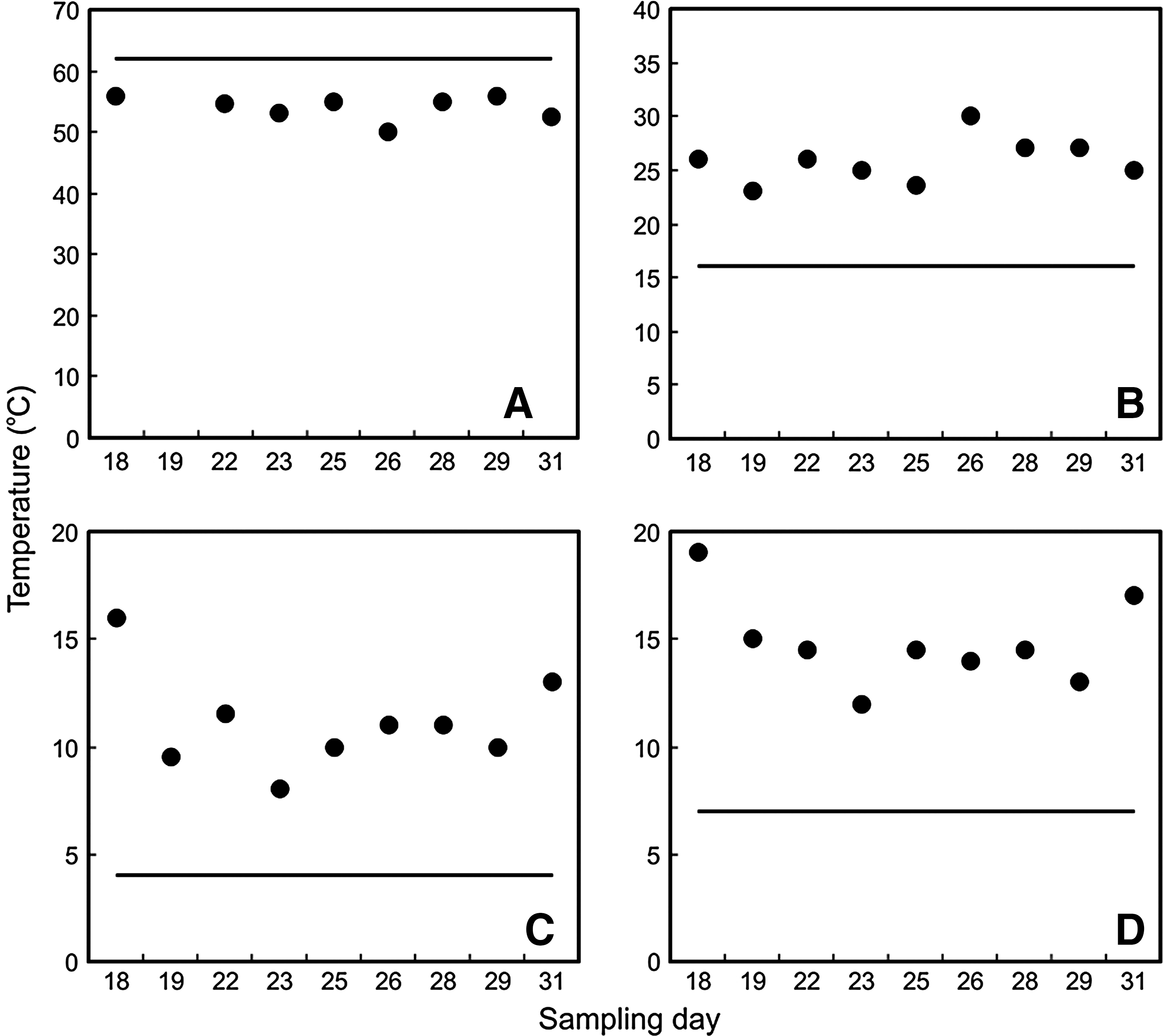
Variation of the measured temperatures from different processing steps (
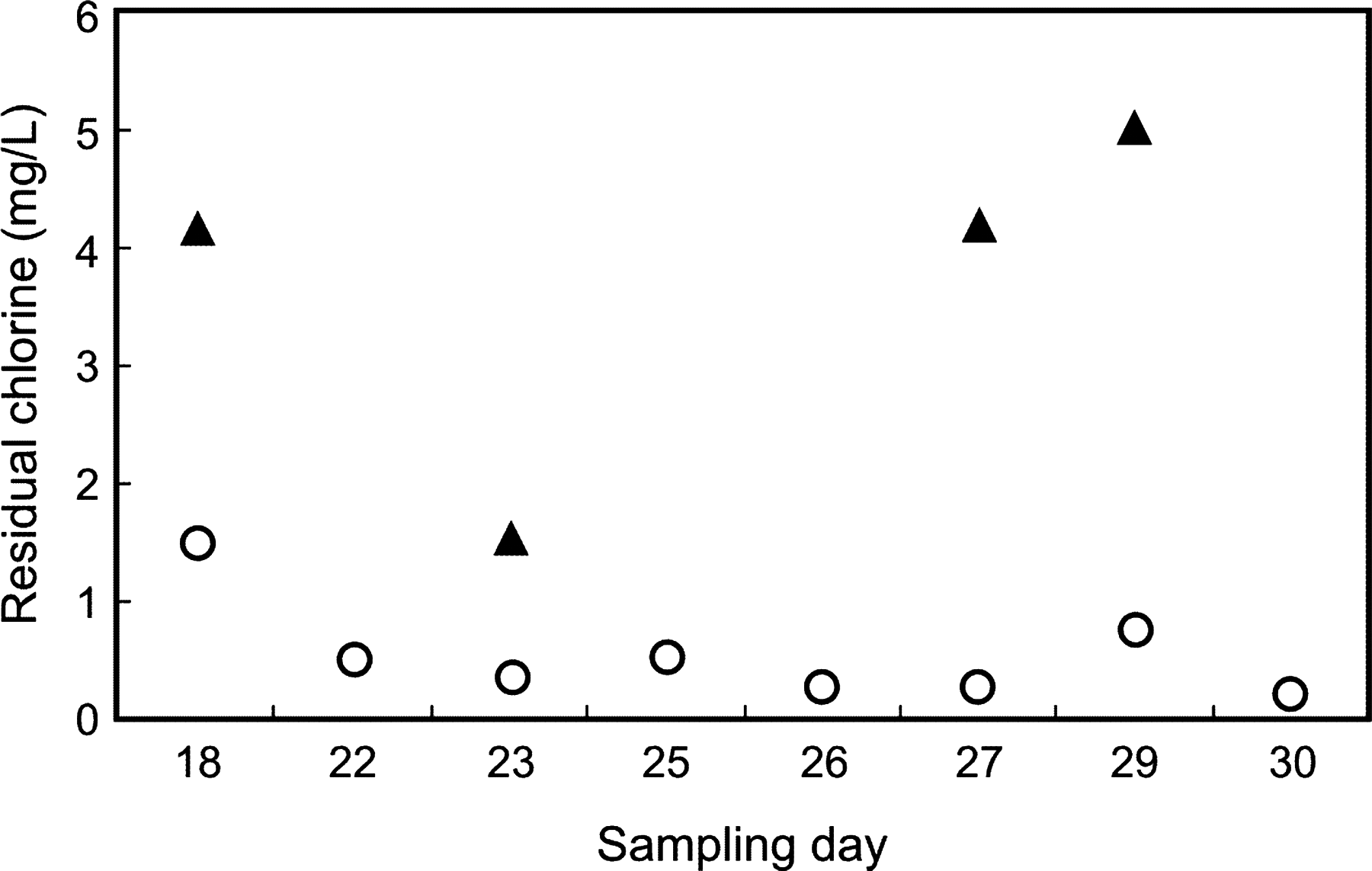
Variation of the free residual chloride concentration in precooling (▴) and cooling (▲) tanks, obtained from a small-sized slaughterhouse.
It was observed that MA means were significantly higher in the B stage (evisceration) and EC in all the stages (p < 0.05) (Table 3). A plausible reason for the higher microbial contamination in Sh2 after evisceration is the slaughtering structure in that facility. At this stage, the operation is carried out manually in Sh2, which may lead to a higher risk of contamination by operator handling or from improperly cleaned tools. Russell and Walker (1997) stated that the increase in the contamination by MA after the evisceration of the chicken carcasses is inevitable. Göksoy et al. (2004), however, did not find any effect of evisceration on the contamination by MA in the same product.
The relevance of the research on EC was different for each slaughterhouse. In Sh1, EC was characterized in only 61% of the TTC (Table 3). According to Voidarou et al. (2007), EC cannot be used as a classic indicator in chiller tanks, because EC was found in only 30% of the TTC. However, EC was present in 99.5% of the TTC in Sh2, demonstrating that, in this case, this group can be considered as a good hygiene indicator. These results suggest that even when the original microbiota is the same, there are, over the slaughter process, changes in its behavior because of the different technologies employed by each slaughterhouse.
There are few studies on the differences of contamination between large- and small-sized slaughterhouses. Although Sh2 is a small-sized facility, where a validated control system does not yet exist, in general, comparing both facilities, contamination over the slaughter stages presented punctual differences. Sh2 is a new facility, with low slaughter speed, which may contribute to the control of the contamination in the process. Sh1, on the other hand, has a consolidated HACCP program, but the great volume of slaughter may affect the adequate performance of the quality control procedures. Similar results were found by Tsola et al. (2008), who investigated the impact of the modernization of the main critical control points on an automated slaughterhouse, using microbiological indicators. It was observed that, after modernization, there was a significant reduction in the microbial contamination over the slaughter line, although there were no changes in the main critical control point stressed by the HACCP.
Conclusions
The results of this study showed that the use of indicators in the identification and monitoring of the main stages of microbial contamination in poultry may be valuable, also allowing an evaluation of the efficiency of the quality control established in each slaughterhouse. As to the pathogen studied, it was concluded that the hygiene management in the sampled slaughterhouses did not affect the frequencies of Salmonella spp. Variations in the levels of contamination in different slaughter systems strengthen the HACCP concepts as specific plans of implantation of the system for products and different processes, including poultry slaughters.
Footnotes
Acknowledgments
The authors thank Dr. Ernesto Hofer and Elaine Moura Falavina dos Reis from the Laboratory of Enterobacteria of the Fundação Oswaldo Cruz, for performing the serotyping of the isolated cultures of Salmonella spp. Luís Augusto Nero received financial support from FAPEMIG (Fundação de Amparo a Pesquisa do Estado de Minas Gerais—Programa Pesquisador Mineiro; PPM-00093-09).
Disclosure Statement
No competing financial interests exist.