




Abstract
We conducted stabilization studies to determine the ability of Clostridium perfringens spores to germinate and grow during exponential cooling of a commercial formulation of pork scrapple. Scrapple was inoculated with a mixture of three strains of C. perfringens spores (NTCC 8238, NCTC 8239, and ATCC 10288), vacuum packaged, and reheated (20 min/93.3°C) in a circulating water bath. The cooked samples were cooled (30 s) in an ice bath before being transferred to a programmable water bath to cool through the temperature range of 54.4°C to 7.2°C in 12, 14, or 21 h to simulate deviations from the required cooling time of 6.5 h. After cooling, the samples, in duplicate, were analyzed to determine if growth from spores had occurred. The samples were plated onto tryptose–sulfite–cycloserine agar and incubated anaerobically at 37°C for 48 h before counting the colonies. Minimal growth (less than 1.0 log) was observed during a 12- or 14 h cooling period. However, when the time to achieve 7.2°C was extended to 21 h, C. perfringens spores germinated and grew from an inoculum of ∼3.0 log10 to ∼7.8 log10 CFU/g. Thus, scrapple must be cooled after cooking to 7.2°C within 6.5 h, but for no more than 14 h, to prevent a food safety hazard from outgrowth of C. perfringens spores during cooling.
Introduction
C. perfringens is one of the most commonly reported bacterial agents of foodborne illness in the United States. The organism causes an estimated 250,000 cases of food poisoning annually, leading to about 41 hospitalizations and 7 deaths per year in the United States (Mead et al., 1999). The vehicles of transmission are often cooked meat and poultry products in which spores of C. perfringens have survived the cooking process. The time and temperature employed for cooking may cause spore germination, and a subsequent inadequate rate and extent of cooling may then foster germination, outgrowth, and multiplication of the vegetative cells. As a result of rapid growth, more than a 5-log10 increase in vegetative cells could occur within 2 h under optimal conditions. Subsequent refrigeration will not significantly reduce population densities (Taormina et al., 2003), and inadequate heating would render the product high risk and unsafe for human consumption. If food containing large numbers of vegetative cells is ingested, some cells may survive the acidic environment during passage through the stomach and sporulate in the intestine, elaborating an enterotoxin that is responsible for typical symptoms of food poisoning, namely diarrhea and abdominal pain.
Since inadequate cooling of foods in retail operations is a major safety problem, safe time/temperature for cooling of cooked foods is a critical control point and one of the most common means of assuring the microbiological safety of ready-to-eat (RTE) foods. The U.S. Department of Agriculture/Food Safety Inspection Service (USDA/FSIS, 2001) draft compliance guidelines for RTE meat and poultry products state that cooling of uncured products from 54.4°C to 26.7°C should take no longer than 1.5 h, and cooling from 26.6°C to 4.4°C should take no longer than an additional 5 h. These federal guidelines also state that if meat processors are unable to follow the prescribed time–temperature cooling schedule, they must be able to prove or document that the customized or alternative cooling regimen used will result in less than a 1.0-log (10-fold) increase in C. perfringens in the finished product. These guidelines do not take into account the efficacies of food additives/antimicrobials, including phosphates, nitrites, and organic salts that are widely used in processed foods as bacteriostatic/bacteriocidal and flavoring agents.
Scrapple is an ethnic food produced/consumed almost exclusively in the Middle Atlantic states of the United States. It is typically made from ground pork trimmings, organ meat, seasonings, cornmeal, and flour. This mixture is cooked and then shaped into loaves that are cooled and subsequently stored refrigerated until sliced for cooking by consumers or restaurants. Due to the process by which scrapple is manufactured, and due to the absence of any published process validation data, the objective of this study was to explore the potential of C. perfringens to germinate and multiply during the cooling of cooked scrapple.
Materials and Methods
Test organisms and spore production
Three strains of C. perfringens, NCTC 8238 (Hobbs serotype 2), NCTC 8239 (Hobbs serotype 3), and ATCC 10288 (Hobbs serotype 13), were obtained from the Microbial Food Safety Research Unit culture collection (Wyndmoor, PA). C. perfringens spores were produced in a modified formulation of the Duncan and Strong sporulation medium as described previously (Juneja et al., 1993). After the spore crop of each strain was washed twice and resuspended in sterile distilled water, the spore suspensions were stored at 4°C. A spore cocktail was prepared immediately before experimentation by mixing equal numbers of spores of C. perfringens from each of the three suspensions. This composite of spore strains was not heat shocked at 75°C for 20 min before use.
Product and proximate composition analyses
Semisolid pork scrapple was obtained from a cooperate producer just after the final cook at 93.3°C for 20 min, but before retail packaging. Pork scrapple was portioned into 200 g samples, placed into sterile nylon polyethylene bags, and then stored at −20°C for up to 14 days. The physical–chemical analysis of the pork scrapple tested herein was performed on a representative sample (∼150 g total) in each of the two trials. The analyses were determined using methods approved and described by the Association of Official Analytical Chemists (McNeal, 1990) as conducted by a commercial testing laboratory.
Inoculation of scrapple
Duplicate scrapple (5 g) samples were aseptically weighed into low-oxygen transmission Whirl Pak bags (4-oz/120-mL capacity; 3″ wide by 7¼″ long; 7.5 × 18.5 cm; barrier film 0.125 mL of oxygen transmission per 100-inch square in 24 h; Part #B01298WA; Nasco, Modesto, CA) and inoculated with 0.1 mL of the nonheat-shocked C. perfringens spore cocktail to a target level of ∼3.0 log10 spores/g. The contents of the bags were thoroughly mixed manually for ∼2 min to ensure even distribution of the spores in the meat sample. Negative controls consisted of bags containing noninoculated pork scrapple. The bags were then evacuated to a negative pressure of 1000 millibars and heat sealed using a Multivac gas-packaging machine (model A300/16; Multivac, Kansas City, MO).
Cooking and cooling procedures
The bags containing inoculated pork scrapple samples were sandwiched between stainless steel wire racks as described previously (Thippareddi et al., 2003), submerged completely in a circulating water bath (Exacal, Model RTE-221; Neslab Instruments, Newington, NH), and heated at 93.3°C for 20 min. The bags were then removed and chilled immediately in an ice water bath for ∼30 s. Thereafter, the bags were transferred to another water bath (Model RTE-221; Neslab Instruments Inc.) set at 54.4°C. The bath was allowed to equilibrate at this temperature for 10 min and then three time–temperature cooling regimes, simulating typical retail food operations and simulating abuse of the USDA/FSIS stabilization requirements for processed meat and poultry products, were studied. Samples were chilled at an exponential rate from 54.4°C to 7.2°C in target chilling times of 12, 14, or 21 h (Table 1). The times and temperatures computed for 12, 14, and 21 h cooling periods were obtained using the following equation:
where T is the desired temperature (°C), T initial the temperature at the beginning of the cooling procedure (54.4°C), k cool the cooling rate, and t the time (h). This formula was based on the work of Dickerson and Read (1973) and Pflug and Blaisdell (1963) in which Fourier's law of heat conduction and Newton's law of cooling to food systems were applied. In this study, for each cooling procedure, k cool was obtained by using 54.4°C as T initial, 7.2°C as T, and 12, 14, or 21 h as t. Two independent trials, each performed in duplicate, as defined by a new batch of meat, were performed for each of the exponential chilling rates (12, 14, and 21 h).
FSIS, Food Safety Inspection Service.
Enumeration of bacteria
Immediately after cooking and/or chilling, samples were removed and enumerated for the total germinated C. perfringens population by spiral plating (Spiral Systems Model D Plating Instruments; Spiral Systems, Cincinnati, OH) on tryptose–sulfite–cycloserine agar (Difco–Becton Dickinson, Sparks, MD) as described previously (Juneja and Marmer, 1998). The total C. perfringens population was determined after 48 h incubation at 37°C in a Bactron anaerobic chamber (Bactron IV; Sheldon Laboratories, Cornelius, OR). The lower limit of detection by this procedure is 21 CFU/g. Both uninoculated and cooked scrapple were used to verify the absence of naturally occurring C. perfringens. This verification involved use of lactose–gelatin and nitrate-motility medium (Schwab et al., 1984).
Results and Discussion
The physical–chemical analyses of the pork scrapple tested herein are given in Table 2. Water activity (a w), sodium chloride level, and pH of pork scrapple were 0.97%, 1.11%, and 6.4%, respectively. According to the published literature (Labbe and Juneja, 2006a, 2006b), an a w ranging from 0.93 to 0.97 is inhibitory to growth of C. perfringens. The a w of scrapple was at the high end of this a w range. Growth of C. perfringens is not inhibited by 4% (wt/vol) NaCl, and the optimum pH for growth is between 6.0 and 7.0 (Labbe and Juneja, 2006a, 2006b). Thus, the salt percentage in the pork scrapple formulation and the pH of the scrapple also provided a favorable environment for the growth of C. perfringens. Spores of C. perfringens are likely to germinate and multiply in cooked scrapple if the rate and extent of cooling is not sufficient.
Mean of two trials ± standard deviation (n = 2 trials, n = 2 samples per trial; Adekunle et al., 2009).
In the present study, we determined if the cooling period could be extended beyond 6.5 h, specified in the regulatory stabilization guidelines, without posing a safety hazard from outgrowth of C. perfringens spores. Our intent was to simulate the cooking environment and exponential cooling of foods that exist in commercial food operations and to determine if C. perfringens spores will germinate and outgrow during abusive chilling of cooked scrapple. The final temperature in our experiments was 7.2°C versus 4.4°C in USDA/FSIS stabilization guidelines (Table 1). This is because the critical cooling period, based on the optimum growth temperature range, is approximately between 54.4°C and 26.6°C. C. perfringens growth at temperatures <15°C is very slow and no growth occurs at temperatures <10–11°C (Labbe and Juneja, 2006a).
Figure 1 shows the programmed and observed temperature profiles of the water bath for the 12-, 14-, and 21-h exponential chill rates. The three temperature profiles represent extended chilling rates relative to the USDA/FSIS (2001) stabilization guidelines for cooling of cooked, uncured meat, and poultry products. The use of a programmable water bath to generate the desired product temperature profiles is highly reproducible and should be used in validation studies or for the evaluation of microbiological safety of much larger quantities of meat products in meat processing operations. In the present study, we demonstrated that small (5 g) portions of meat inoculated with spores of C. perfringens can be used in challenge/validation studies. This simple and easy to perform method addressed the small amount of product at the center of a large pork roast, considered to be the cold spot (worst-case scenario).
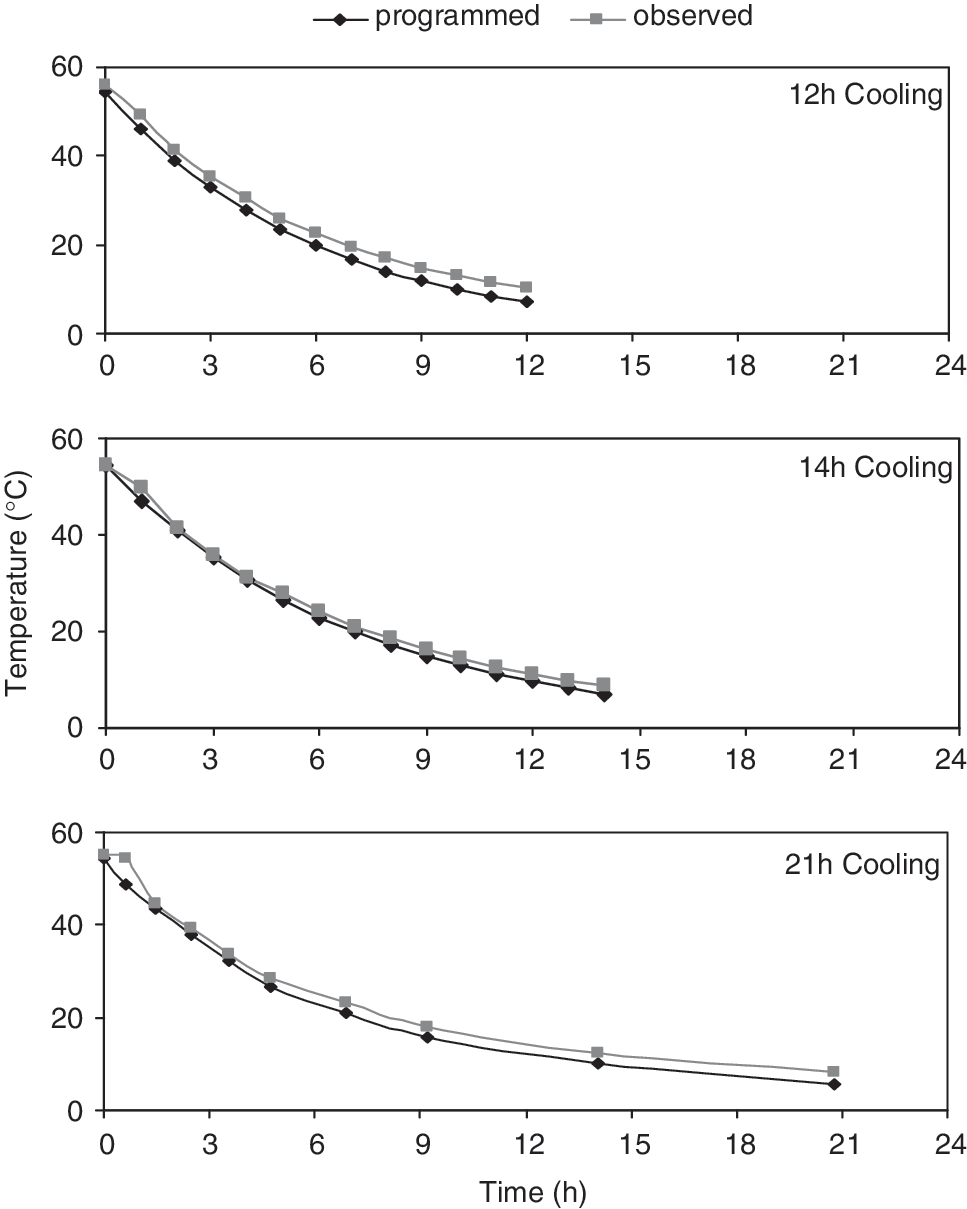
Time–temperature profiles of the water in the water bath chilled from 54.4°C to 7.2°C in 12, 14, and 21 h.
Depending on the rate and extent of cooling, Table 3 shows that germination and outgrowth of C. perfringens spores can occur in scrapple. Specifically, cooling from 54.4°C to 7.2°C in 12 or 14 h resulted in minimal (<1.0 log) increases in C. perfringens populations in the scrapple. Although a 12- or 14-h exponential cooling rate in this study is longer than the USDA/FSIS-recommended cooling regime (6.5 h) for uncured, cooked RTE meat, and poultry products, the C. perfringens germination and outgrowth observed was in compliance with the USDA/FSIS stabilization guidelines (<1.0 log CFU). Based on these results, it is logical to conclude that the USDA/FSIS cooling regime (6.5 h) is conservative and provides a considerable margin of safety in limiting C. perfringens spore germination and outgrowth in cooling of pork scrapple.
Values are averages from two separate experiments each in duplicate ± standard deviations shown in parenthesis.
The presence of C. perfringens spores in foods is a potential health hazard (Novak et al., 2005). C. perfringens is frequently found in raw meats, generally through fecal contamination of carcasses, contamination from other ingredients, and/or from postprocessing contamination. Cooking contaminated meat usually increases the anaerobic environment in food and reduces the numbers of competing spoilage organisms, which are ecologically important, because C. perfringens competes poorly with the spoilage flora of many foods. Cooking food can also heat shock C. perfringens spores, since germination activation of C. perfringens spores can occur at temperatures between 60°C and 80°C (Walker, 1975). It is worth mentioning that not all spores germinate at the same time because spore populations are heterogeneous with regard to germination. In a study by Billon et al. (1997), time to germination was skewed (with a tail) and the shape of the distribution depended on the germination temperature. According to Billon et al. (1997), this variation was because of a variability in the permeability of the spores or molecules, such as lytic enzymes in the spore population. Concepts pertaining to the trigger mechanism of spore germination suggest that heat activates a germinant receptor, which then binds to the germinant to become an active enzyme that can hydrolyze the precursor of a germination-specific lytic enzyme and that eventually hydrolyzes the cortex, leading to spore germination (Johnstone, 1994). Nevertheless, spores of C. perfringens germinate at a higher rate after heat shock. For instance, while only 3% of the inoculated C. perfringens spores germinated in raw beef without prior heat shock, almost all spores germinated after the beef received a heat treatment (Barnes et al., 1963). After heat shock, germination and outgrowth of spores, and C. perfringens vegetative growth is likely to occur in cooked foods if the rate and extent of cooling is not sufficient. Also, abusive conditions in the food chain could favor germination and outgrowth of the spores. Temperature abuse of the processed foods may occur during transportation, distribution, storage, or handling in supermarkets or preparation of foods by consumers, which includes low-temperature long-time cooking of foods, as well as the scenarios when the foods are kept on warming trays before final heating or reheating.
In the present study, when the time to achieve 7.2°C was extended to 21 h, C. perfringens spores germinated and grew from an inoculum of ∼3.0 log10 to ∼7.8 log10 CFU/g (Table 3). This implies that C. perfringens is capable of rapid growth in pork scrapple, making this organism a particular concern to meat processors, as well as to the food service industry.
In a study by Juneja et al. (2007), chilling of ground-cooked pork from 54.4°C to 7.2°C resulted in germination and outgrowth of C. perfringens spores from initial populations of about 3.2 log CFU/g to 7.26, 7.45, 6.17, and 7.30 log CFU/g following 12, 15, 18, and 21 h of exponential chilling, respectively. In another study (Thippareddi et al., 2003), chilling of injected pork samples from 54.4°C to 7.2°C resulted in C. perfringens population increases of 3.70 and 4.41 log CFU/g for the 18 and 21 h exponential chill rates, respectively. In these previous studies, we assessed the fate of C. perfringens in ground pork that was obtained by grinding boneless pork loins injected with minimal levels of salt (NaCl, 0.85%), potato starch (0.25%), and potassium tetra pyrophosphate (0.2%) at a 12% pump rate. While NaCl and phosphate are the common ingredients in injected pork and other processed meat formulations used in the industry, pork scrapple used in the present study was formulated to include 1.11% NaCl and no potassium tetra pyrophosphate. These differences in the product formulations and the meat product characteristics, such as pH and water activity, may have accounted for the differences in the germination and outgrowth of C. perfringens spores.
The results of the present study demonstrate for the first time that the regionally consumed ethnic food, pork scrapple, can be a public health hazard if the rate and extent of cooling of the cooked product is not adequate. Thus, scrapple must be cooled after cooking to 7.2°C in 6.5 h, but for no more than 14 h, to prevent a food safety hazard from germination and outgrowth of C. perfringens spores during cooling of cooked scrapple. Further studies are warranted to assess the effects and interactions of various levels of ground pork trimmings, seasonings, cornmeal, and flour, used in the formulation of scrapple, on the fate of C. perfringens during cooling of cooked product. Additionally, it would be of interest to determine if low levels of organic acids and salts, which are reported to protect meat against C. perfringens (Juneja and Marmer, 1998; Thippareddi et al., 2003; Juneja and Thippareddi, 2004; Sabah et al., 2004), will exhibit additive or synergistic antimicrobial effects in scrapple matrices.
Disclaimer
Mention of trade names or commercial products in this publication is solely for the purpose of providing specific information and does not imply recommendation or endorsement by the U.S. Department of Agriculture.
Footnotes
Disclosure Statement
No competing financial interests exist.