




Abstract
Shiga toxin-producing Escherichia coli (STEC) is an important foodborne pathogen, and ruminants are recognized as the main natural reservoir. The purposes of this study were to detect E. coli O157 in bovine feces and surface water in a beef cattle farm of Gualeguaychú, Argentina; to characterize the isolates; and to establish the clonal relatedness by pulsed-field gel electrophoresis. Between September 2005 and November 2006, 288 samples of bovine feces and 79 samples of water troughs were studied. E. coli O157 was detected by immunomagnetic separation and polymerase chain reaction as screening techniques. The rfb O157 gene was detected in 3.8% of the 288 fecal samples and in 17.7% of the 79 water samples. The stx gene was detected in all rfb O157-positive fecal samples and in 5.1% of water samples. Eleven E. coli O157 strains isolated from bovine fecal samples and eight from water samples were characterized. The most frequent stx genotype identified was stx 1 and stx 2c(vh-a). Twelve (63.2%) strains harbored fliCH7, eae, and ehxA genes. Using pulsed-field gel electrophoresis with the enzyme XbaI, a total of eight patterns with at least 72.1% similarity were identified among the 19 strains. The patterns of 15 strains were grouped into four clusters: two of them included only bovine strains and the other two only aquatic strains. No genetic correlation was established between the bovine and water STEC strains detected. The prevalence of STEC O157:H7 established in the herd studied was higher than that previously reported for Argentine grazed cattle.
Introduction
S
Materials and Methods
Between September 2005 and November 2006, 288 swabs of rectal feces from healthy animals (Rice et al., 2003) and 79 water samples (Spira and Ahmed, 1981) were collected. Sample size was calculated using the Epi Info software (version 6.0), taking into account an estimated frequency of 10% and a precision of 1.5% at 95% confidence level. The estimated prevalence was based on a 0.5% prevalence previously reported (Meichtri et al., 2004), which was multiplied by a factor of 20 because of an increase in sensitivity resulting from the use of the immunocapture system. Rectal swabs were placed in 100 mL of modified EC broth (Biokar Diagnostics, Beauvois, France) with 20 mg/L of sodium novobiocin (mEC + N; Sigma Chemical, St. Louis, MO). The water samples were taken with modified Moore swabs from two streams, one inside the study area (200 acres), accessible for the animals, and the other downhill out of the field. The swabs were placed in flasks with 100 mL of mEC + N. Enrichment broths were incubated for 24 h at 42°C and processed by immunomagnetic separation (Dynal, Compiàgne, France); the immunoconcentrates were streaked on two media: O157:H7 ID™ (bioMérieux, Marcy l'Etoile, France), and MacConkey sorbitol agar (Biokar) supplemented with 2.5 mg/L of potassium tellurite and 0.05 mg/L of cefixime (bioMérieux). After incubation, confluent growth zone and individual colonies were screened for stx 1, stx 2, and rfb O157 genes by multiplex polymerase chain reaction (PCR) (Leotta et al., 2005).
The isolates were characterized by standard biochemical tests (Ewing, 1986) and genotypic techniques (Leotta et al., 2008). The antimicrobial susceptibility was carried out by the Kirby–Bauer method following the recommendations of the Clinical and Laboratory Standards Institute. XbaI-PFGE was performed according to the Centers for Disease Control and Prevention protocol (CDC, 2007). BlnI (Promega, Madison, WI) was used as second enzyme.
Results and Discussion
Eleven (3.8%) out of the 288 fecal samples were rfb
O157 positive. Two samples were detected in autumn and nine in winter. STEC strains were isolated from all rfb
O157-positive samples. Four (36%) of them harbored stx
2 genes, and seven (64%) carried stx
1 and stx
2 sequences, simultaneously (Fig. 1). All strains were β-
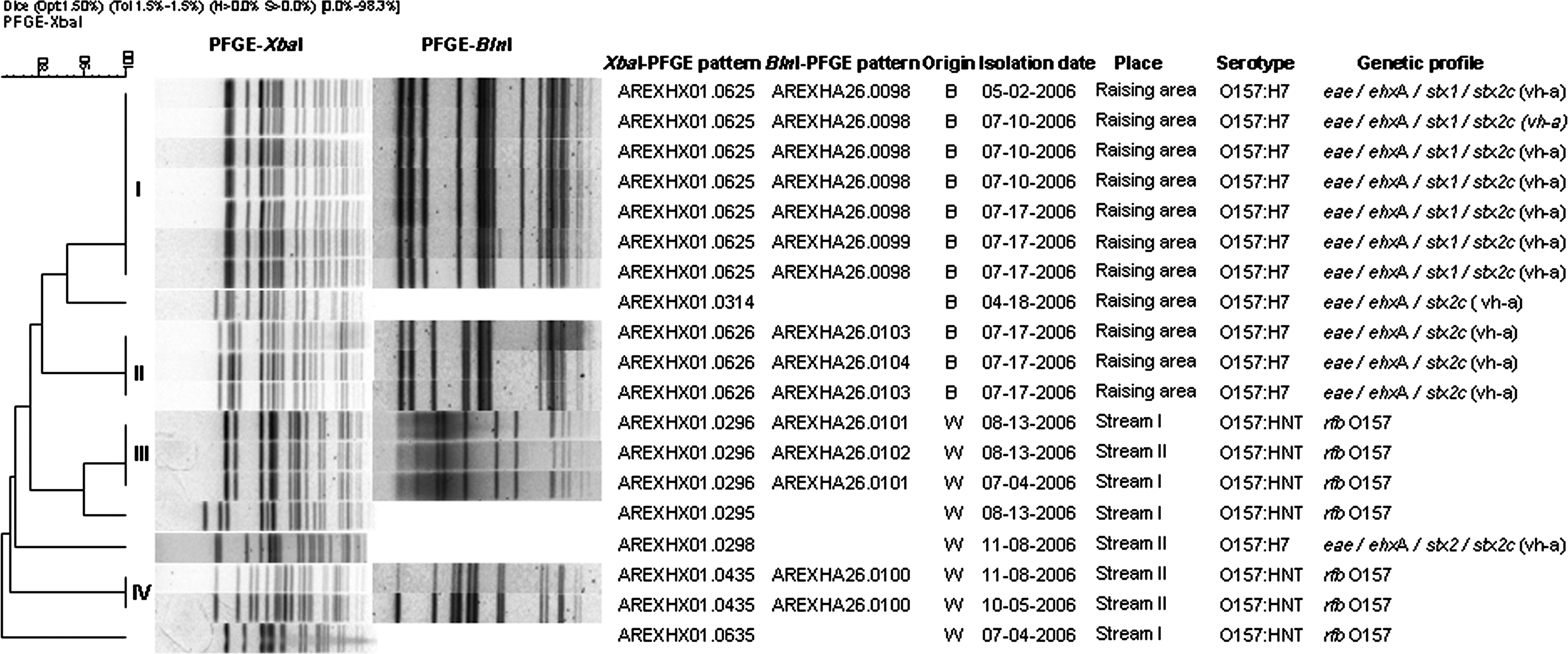
Phenotypic and genotypic characterization and clonal relatedness, into 4 clusters, of 19 Escherichia coli O157 strains isolated from cattle and water in a beef cattle farm, Gualeguaychú, Argentina, 2005–2006.
A previous report from Argentina confirmed that calves harbored STEC O157:H7, with a prevalence of 0.5% (Meichtri et al., 2004). In this study, the prevalence of E. coli O157:H7 in fecal samples of grazed cattle was 3.8%. These isolates were recovered during autumn and winter in 2006. Both precipitation (240.5 mm) and temperature (10.6–19.8°C) in May, June, and July 2006 were higher than normal (Argentine National Weather Service). In water samples, E. coli O157 could only be isolated from 57% of PCR-positive samples but only one isolate was toxigenic. This strain harbored stx 2 and stx 2c(vh-a) genes, which is the prevalent genotype in bloody diarrhea and HUS cases (Rivas et al., 2006). It presented the AREXHX01.0298 profile not previously included in the E. coli O157 Argentine Database. However, Shiga toxin-negative E. coli O157 strains detected in water could be able to acquire stx genes as described by Wetzel and LeJeune (2007). The eight strains recovered from water showed five different XbaI profiles, whereas the 11 bovine strains showed only three XbaI profiles. This would indicate that there is more diversity in the aquatic environment.
In conclusion, in the herd studied we found (a) a higher prevalence of STEC O157:H7 than that previously reported for Argentine grazed cattle, (b) the toxigenic strain recovered from water was genetically different from the toxigenic animal strains, and (c) during the study period, strains from both sources, animal and environment, showed different virulence profiles. However, other studies should be conducted to better understand the risk of STEC transmission in Argentina, considering bovine and environmental reservoirs or both.
Footnotes
Acknowledgments
The authors thank Sergio Sosa-Estani for his helpful suggestions, and Lucía Isturiz for critical reading of the manuscript.
Disclosure Statement
No competing financial interests exist.