




Abstract
This study used integrated surveillance data to assess the seasonality in retail chicken contamination and of human activities and their role on the seasonality of human endemic salmonellosis. From June 2005 to May 2008, reported cases of salmonellosis were followed-up comprehensively using a standardized questionnaire, and 616 retail chicken breasts were systematically tested for Salmonella, in one Canadian community. Poisson regression was used to model seasonality of human cases, Salmonella in retail chicken, and to assess the relationship between these and selected meteorological variables. The case–case approach was used to compare the activities of salmonellosis cases that occurred during the summer peak to the other cases. There were 216 human endemic salmonellosis cases (incidence rate: 14.7 cases/100,000 person-years), predominantly of Typhimurium and Enteritidis serotypes (28.4% and 20.8%, respectively). The monthly distribution of cases was associated with ambient temperature (p < 0.001) with a significant seasonal peak in June (p = 0.03) and July (p = 0.0005), but it was not associated with precipitation (p = 0.38). Several activities reported by cases tended to be more frequent during summer. Particularly, attending a barbeque and gardening within the 3 days before the disease onset were two significant risk factors for salmonellosis in June or July compared with the salmonellosis cases that occurred in the other months. Out of all chicken samples, 185 (30%) tested positive for Salmonella spp., Kentucky being the dominant serotype (44.3% of positive samples). The monthly proportion of positive chicken samples showed no seasonal variations (p = 0.30) and was not associated with the monthly count of human cases (p = 0.99). In conclusion, even though evidence generally supports chicken as a primary vehicle of Salmonella to humans, the contamination of retail chicken was not driving the seasonality in human salmonellosis. Attending a barbeque or gardening during the hotter months of the year should be further assessed for their risk.
Introduction
The epidemiology of human salmonellosis is complex due to numerous Salmonella serotypes pathogenic to humans, a wide range of reservoirs, including domestic animals, companion animals, and wildlife, and the various possible pathways for the fecal–oral transmission of Salmonella: foodborne, waterborne, animal-to-person, or person-to-person (Anonymous, 2007). Source attribution data show that, in developed countries, the foodborne route is by far the predominant route (Mead et al., 1999; Adak et al., 2002; Lee and Middleton, 2003; Hall et al., 2005; Vaillant et al., 2005) and poultry meat and eggs are the most frequent food vehicles, the latter being specific to the Enteritidis serotype (Molbak and Neimann, 2002; Gillepsie et al., 2005; Parry et al., 2005; Doorduyn et al., 2006; Anonymous, 2007; Khaitsa et al., 2007; Marcus et al., 2007; Poirier et al., 2008; Greig and Ravel, 2009).
Salmonellosis exhibits seasonal variation, with higher rates in warmer months in temperate countries (Anonymous, 2003; D'Souza et al., 2004; Kovats et al., 2004; Fleury et al., 2006; Gradel et al., 2007; Naumova et al., 2007; Oloya et al., 2007; Collard et al., 2008; Zhang et al., 2008). In Australia, it was estimated that a 1°C rise in ambient temperatures is associated with a 4%–10% increase in human salmonellosis cases (D'Souza et al., 2004). In Canada, a 1°C rise in weekly ambient temperatures in the province of Alberta was associated with a 1.2% increase in weekly human cases (Fleury et al., 2006). Reasons for seasonality in infectious diseases have been more hypothesized than proven (Grassly and Fraser, 2006; Fisman, 2007). The main driving factors of seasonality are potentially related to particular or specific seasonal human behaviors; to seasonal environmental changes influencing the pathogen survival, amount, or virulence; to variation in the host susceptibility; and to some interactions between pathogens that spread synergistically.
This study aimed to simultaneously examine the seasonal variation of human salmonellosis, human behavioral risk factors for salmonellosis, and retail chicken meat contamination by Salmonella (as a primary vehicle source for salmonellosis). It also assessed the associations between all these factors and between them and meteorological factors.
Materials and Methods
Data mainly came from the National Integrated Enteric Pathogen Surveillance program (C-EnterNet) facilitated by the Public Health Agency of Canada. Its objective to detect changes in trends in human enteric disease and in levels of pathogen exposure from food, animal, and water sources is achieved by using a sentinel site surveillance approach. It encompasses enhanced laboratory and epidemiological surveillance of gastrointestinal diseases in the community, and active surveillance of the corresponding enteric pathogens in exposure sources within the same community.
Population under study and time frame
The study area was C-EnterNet's first sentinel site: the Region of Waterloo (ROW), Ontario. It includes three cities (Cambridge, Kitchener, and Waterloo) and four rural townships (North Dumfries, Wellesley, Wilmot, and Woolwich) with various agricultural activities located within the Grand River watershed (
Human surveillance data
Within C-EnterNet's first sentinel site, human enteric disease surveillance is an enhancement of the existing passive surveillance in place in the province of Ontario. Basically, a physician requests a stool specimen, which is submitted to a medical laboratory and tested for enteric pathogens (bacteria, parasites, and viruses). If a Salmonella spp. is detected, the medical laboratory reports this to the local public health authority, as required in provincial and Canadian legislation. In addition to this standard notification, the ROW Public Health authorities followed all salmonellosis cases reported using a standard follow-up form (Supplemental Fig. S1, available online at
Since the study focused on endemic salmonellosis, outbreak-related cases and travel-related cases (i.e., those who had traveled outside of Canada within 3 days before disease onset) were removed before analysis. The onset dates reported by the patients were used to assign cases to a specific month. When date of onset was missing, it was calculated as the date the case was reported minus 9 days, as this was the median time found between actual onset date and reported date for all cases that had both dates.
C-EnterNet also collects information in a similar way for other gastrointestinal diseases. Endemic cases of campylobacteriosis, verotoxigenic Escherichia coli infections, and yersiniosis that occurred during the same time period were used as controls in the case–case analysis.
Retail chicken contamination monitoring
The sampling scheme for the chicken breasts was based on a weekly random selection of retail stores located within the sentinel site and the purchase of a chicken breast package in each store. Stores were selected based on a census of the retail grocery store outlets operating within the sentinel site (∼120). This included large and medium-sized chain stores as well as independently owned butcher and market shops. A computerized random number generator was used each week to select the stores. All stores were eligible to each selection; hence, some stores were selected more than once (repetition).
The number of stores selected weekly and the kind of chicken pieces purchased changed over time for reasons unrelated to this study objective. In August 2005, when the study began, three stores were randomly selected and visited each week (two chain stores and one independent). At each store visitation one skin-on chicken breast package was purchased for testing. Beginning in March 2006 a fourth store (chain store) was randomly selected every week, resulting in the purchase of an additional skin-on chicken breast package each week. In January 2007 an additional skin-off chicken breast was purchased at each store visitation so that skin-on and skin-off chicken breast were being sampled in parallel. In January 2008, the sampling of skin-on chicken breasts was discontinued, whereas skin-off sampling continued. After purchase, samples were shipped at temperatures of 4°C–6°C to a laboratory for Salmonella spp. detection by culture using an excision method. The Salmonella isolates were serotyped at the Laboratory for Foodborne Zoonoses in Guelph, Ontario, an Office International des Epizooties reference laboratory for Salmonella spp. Details of the sampling scheme and the laboratory methods used can be found at
Meteorological monitoring data
Maximum, minimum, and mean daily temperatures and total daily precipitation at the Waterloo airport weather station over the study period were downloaded from Environment Canada National Climate Data and Information Archive through its website application (
Statistical methods
The human cases' data were statistically described for serotype, sex, age, and risk factor distribution, and crude mean annual incidence rate was computed. To demonstrate seasonal variation, a Poisson regression analysis was used with the monthly number of cases as dependent variable and year and month as independent variables. Because of the required assumption of equidispersion (i.e., mean equals standard deviation) in Poisson regression, over- or underdispersion was tested using the Pearson chi-squared statistics (Cameron and Trivedi, 1998). The year was defined as a successive 12-month period: year 1 included June 2005 to May 2006; year 2, June 2006 to May 2007; year 3, June 2007 to May 2008. Since two successive months (June and July) were significantly associated with more cases, the salmonellosis cases that occurred during these months were grouped (hereafter named summer salmonellosis cases). Following the case–case approach (McCarthy and Giesecke, 1999), the summer salmonellosis cases were compared first with the remaining salmonellosis cases and second with the combined cases of campylobacteriosis, verotoxigenic E. coli infections, and yersiniosis that occurred in June or July (hereafter named the summer campylobacteriosis, verotoxigenic E. coli infections, and yersiniosis cases). Comparisons were evaluated for age, sex, and 14 risk factors using univariate logistic regression.
The potential temporal relationship between human salmonellosis and Salmonella contamination in retail chicken and meteorological variables were investigated at the monthly level using a Poisson regression model that included either the proportion of Salmonella-positive chicken, the mean temperature, or the total precipitation as an independent variable with year (1, 2, or 3) as a covariate, with month as a repetition with a first-order autocorrelation between months.
The proportion of positive retail chicken samples was analyzed by month and year with an exact 95% confidence interval (CI). The Wilcoxon rank-sum test was used to compare the serotype distribution in chicken to the one in humans. To test for monthly variations, the probability of being a positive sample was modeled with a logistic regression that included the independent variables: month, year (1, 2, and 3), and type of store (chain vs. independent outlet) without interaction terms. In addition, the fact that some stores were visited more than once because of the random selection was considered a repetition of the store in the model.
All analyses were carried out with SAS 9.1 (Cary, NC) statistical software.
Results
From June 2005 to May 2008, 216 endemic cases of human salmonellosis were reported in the study area, yielding an annual incidence rate of 14.7 cases/100,000 person-years. The 197 (91.2% of the 216 cases) isolates with known serotypes were distributed among 42 different serotypes (Table 1). Typhimurium and Enteritidis were the most frequent serotypes (28.4% and 20.8%, respectively). Exactly half of the cases were women and 17.1% were less than 5 years old (Table 2). Approximately half of the cases reported contact with household pets (54.7%) or eating food prepared outside the home (47.5%). The other risk factors were reported by 2% to 19% of the cases followed-up (Table 2).
Newport (6), Agona (5), Group B (5), Muenchen (4), Oranienburg (4), Adelaide (2), Berta (2), Branderup (2), Derby (2), Hartford (2), Java (2), Javiana (2), Saintpaul (2), Senftenberg (2), Agoueve (1), Anatum (1), Bovismorbificans (1), Chester (1), Choleraesuis (1), Diarizonae (1), Flutern (1), Litchfield (1), London (1), Ohio (1), Oslo (1), Panama (1), Sandiego (1), Tennessee (1), Uganda (1), and Virchow (1).
Kiambu (5), serotype I:4,5,12:i:- (3), Tumodi (1), and serotype I:8,20:i:- (1).
Numbers in bold highlight monthly numbers that encompass 25% or more of the annual total within the respective row.
The monthly counts of human cases ranged from 1 to 18 (mean = 6.0; variance = 13.5) and showed a seasonal pattern with one peak during the summer (Fig. 1). Significantly more cases were reported in June and July compared with December (p = 0.03 and 0.0005), and significantly less cases were reported for year 1 (2005–2006) and 2 (2006–2007) as compared with year 3 (2007–2008) (p = 0.0005 and 0.04, respectively). Overall, the monthly counts of cases according to their sex, age group, and potential risk factors did not seem uniformly distributed across the months, with higher counts tending to appear during the hotter months, that is, June to August (Table 2). More precisely, high monthly counts (defined as 25% or more of the total count over the 12 months for a given variable) were observed in July for the following factors: 5- to 15-year-old age group, swimming, having or attending a barbeque, and knowing anyone else with concurrent diarrheal illness. Other high counts were outdoor activities in July and August; eating meat from any other place than the grocery store in April and June; visiting a farm, petting zoo, or fair in August and September; gardening in June and July; and traveling inside Canada in July and August.
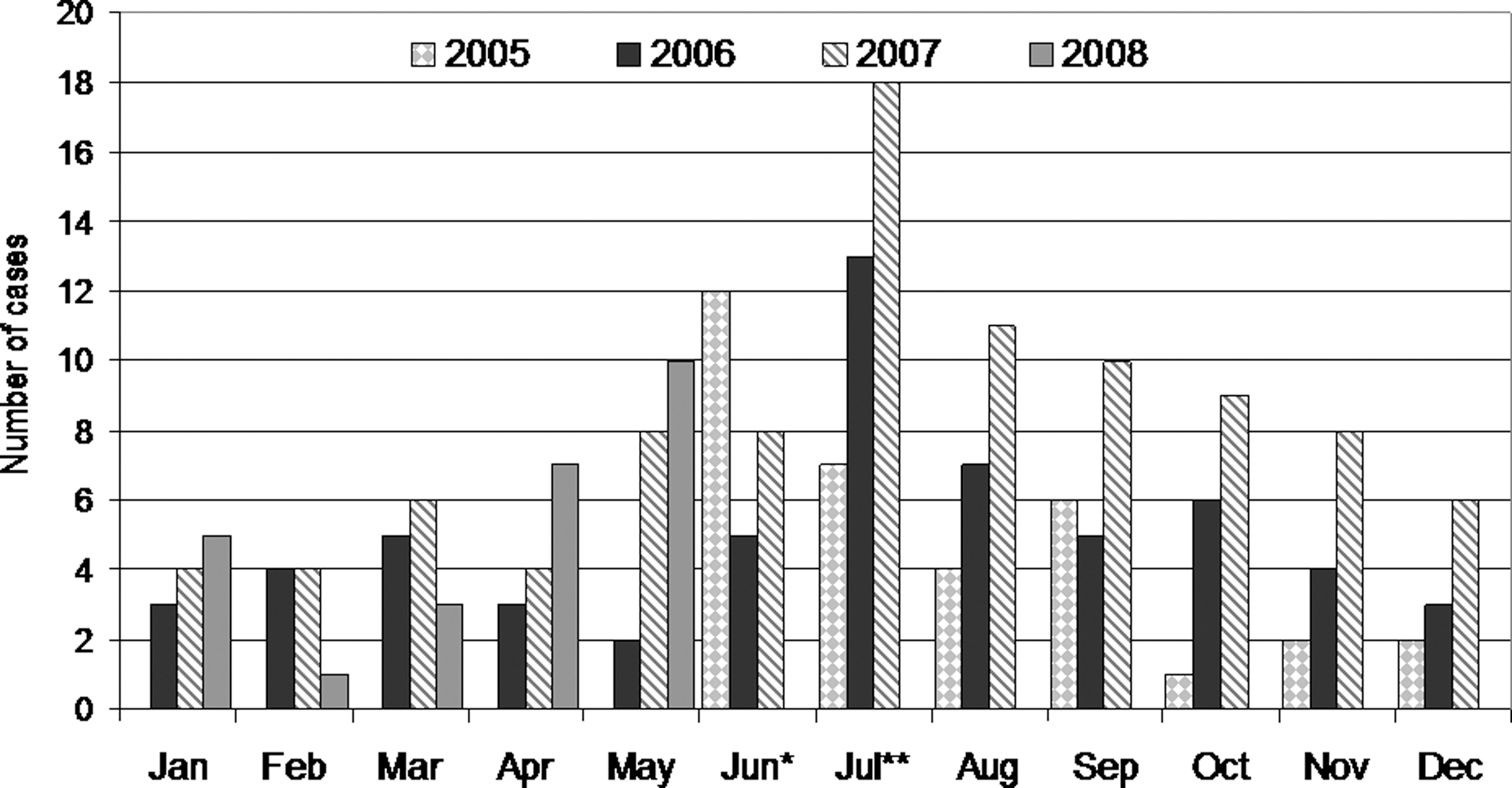
Monthly counts of human endemic salmonellosis cases reported in the Region of Waterloo, Ontario, from June 2005 to May 2008 (statistically significant difference between months (reference December) based on a Poisson regression model including month and year: *p < 0.05; **p < 0.01).
Two risk factors were statistically significant when the summer salmonellosis cases were compared with the nonsummer ones: having or attending a barbeque (odds ratio [OR] 95% CI = 1.6–8.2) and gardening (OR 95% CI = 1.4–9.9) (Table 3). The serotypes of those having a barbeque in June or July were Typhimuirum (6 cases), Oranienburg (2), Heidelberg (1), Infantis (1), Montevideo (1), Muenchen (1), Newport (1), Schwartzengrund (1), Thompson (1), and unknown (2). The serotypes of those having gardening in June or July were Typhimuirum (3 cases), Berta (1), Kentucky (1), Heidelberg (1), Oranienburg (1), Schwartzengrund (1), Thompson (1), and unknown (2). When the same summer salmonellosis cases were compared with the summer cases of campylobacteriosis, verotoxigenic E. coli infections, and yersiniosis, the ORs were generally below 1 and only statistically significant for having or attending a barbeque (OR 95% CI = 0.25–0.96) and visiting a farm, petting zoo, or fair (OR 95% CI = 0.015–0.89) (Table 3).
The risk factor questions were asked for the 3 days before the disease onset for salmonellosis, 10 days for campylobacteriosis and E. coli infection, and 7 days for yersiniosis.
Positive answers over the number of answers given (unknown answers and blank were not considered).
OR, odds ratio; CI, confidence interval.
The monthly number of salmonellosis cases was significantly associated with year and mean temperature of the current month (coefficient = 0.0403; p < 0.0001), and with year and mean temperature of the previous month (coefficient = 0.0298; p = 0.0003), but not with total monthly precipitation (p = 0.38) (Fig. 2). The monthly number of cases also was not statistically associated with the monthly proportion of Salmonella-positive chicken breast of the current month (p = 0.99) or of the previous month (p = 0.48).
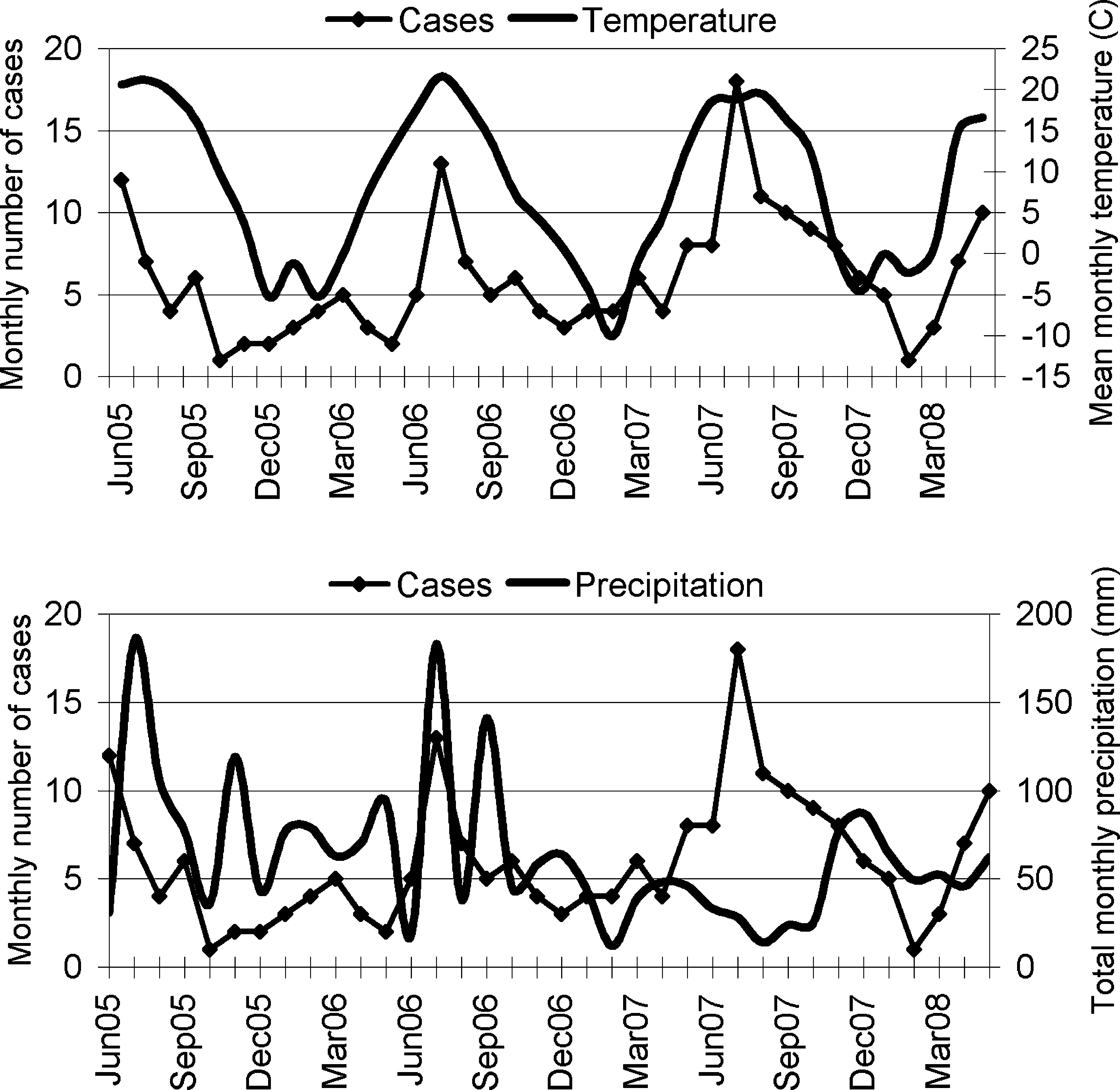
Mean monthly temperature, total monthly precipitation, and counts of human endemic salmonellosis cases reported in the Region of Waterloo, Ontario, from June 2005 to May 2008.
During the study period, 616 retail chicken samples were tested for the presence of Salmonella spp., and 185 (30.0%) were positive (exact 95% CI: 26.4–33.8%). Fifteen serotypes were found among the chicken breast Salmonella isolates, of which 11 were also detected in humans (Table 1). There was a significant difference between the distribution of serotypes in human cases and in retail chicken samples (Wilcoxon rank-sum test; p < 0.0001).
There was no seasonal pattern in the proportion of Salmonella-positive chicken (Fig. 3); the detection of Salmonella was not associated with month (p = 0.30) nor year (p = 0.05). Visually, the distribution of the serotypes grouped according to their occurrence, and their commonality with serotypes found in salmonellosis cases did not show any seasonal pattern (Fig. 4).
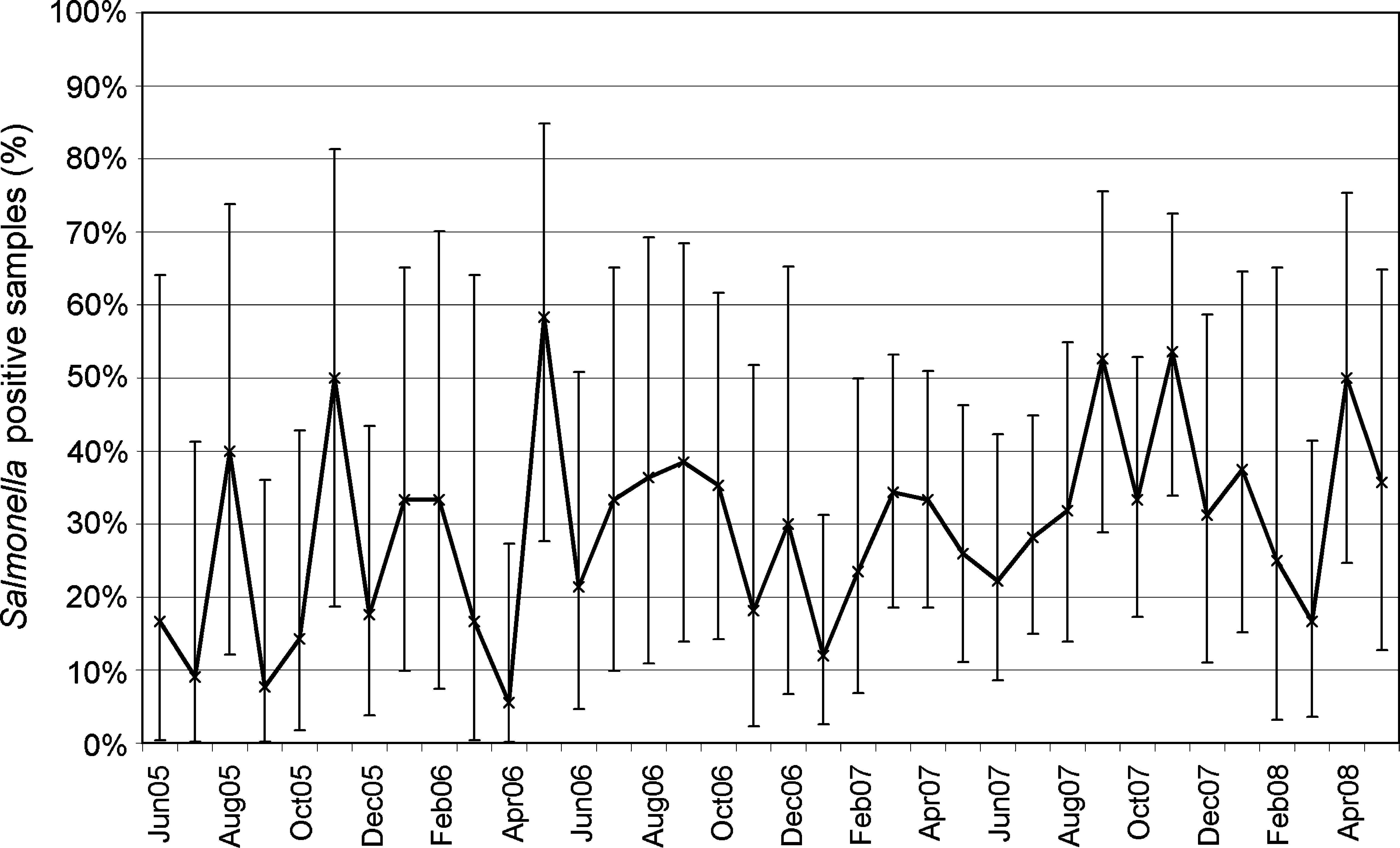
Monthly proportion (with exact 95% confidence interval) of Salmonella-positive retail chicken pieces systematically sampled every week in the Region of Waterloo, Ontario, from June 2005 to May 2008.
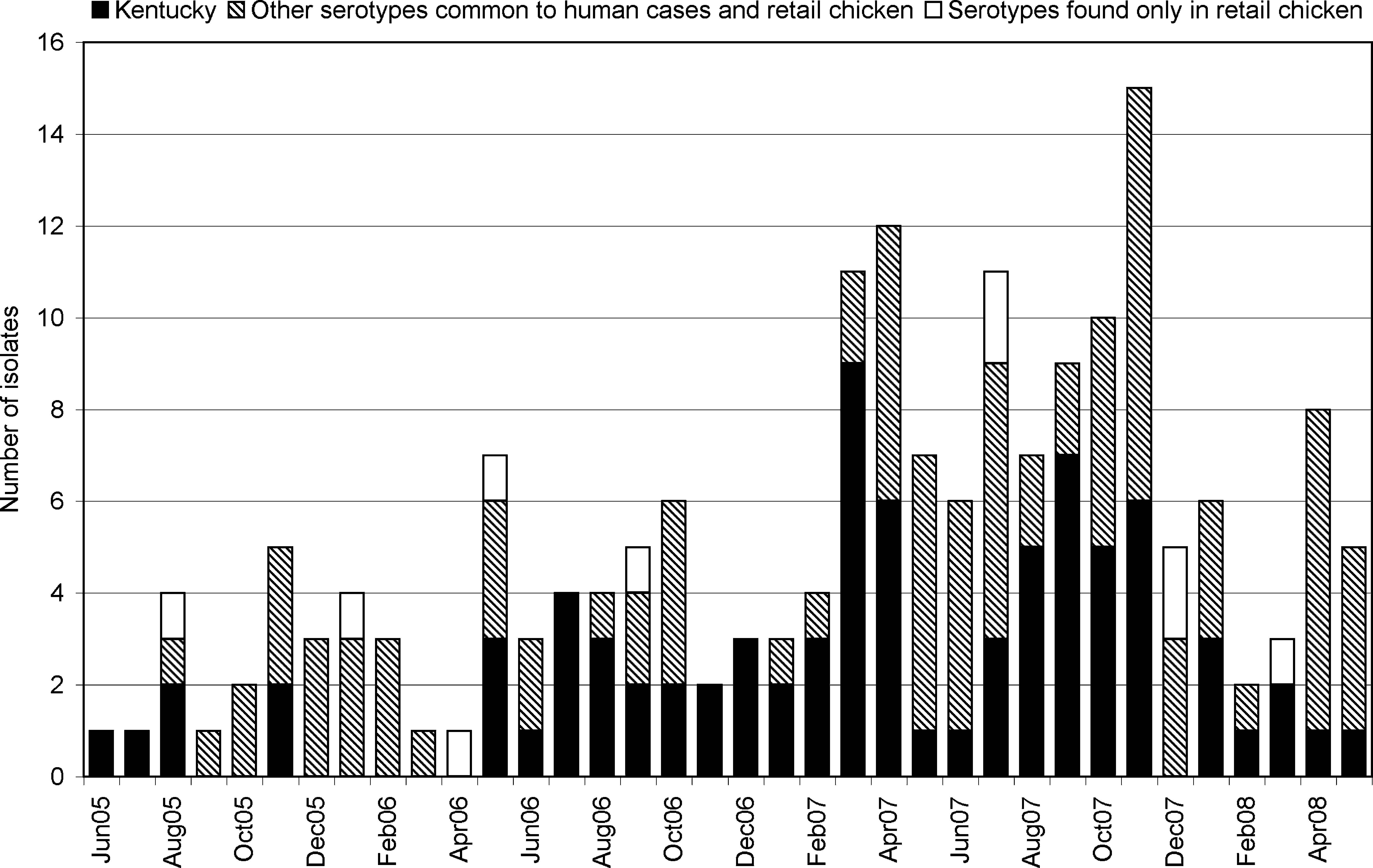
Monthly distribution of serotypes of Salmonella isolates found in retail chicken pieces systematically sampled every week in the Region of Waterloo, Ontario, from June 2005 to May 2008 (the other [than Kentucky] serotypes common to human cases and retail chicken in that area were Enteritidis, Hadar, Heidelberg, Indiana, Infantis, Mbandaka, Montevideo, Schwarzengrund, Thompson, and Typhimurium; the serotypes found only in retail chicken were Kiambu, Tumodi, serotype I:4,5,12:i:-, and serotype I:8,20:i:-).
Discussion
The results confirm a seasonal variation in endemic, domestic human salmonellosis in association with ambient temperature as previously described in temperate countries (Anonymous, 2003; D'Souza et al., 2004; Kovats et al., 2004; Fleury et al., 2006; Gradel et al., 2007; Naumova et al., 2007; Oloya et al., 2007; Collard et al., 2008; Zhang et al., 2008). Original to this study is the use of integrated surveillance data to explore the seasonality in both retail chicken contamination and human activities in the same geographic location, which may explain this seasonal variation.
Given that retail chicken has been considered as one of the main Salmonella vehicles to humans (Lee and Middleton, 2003; Parry et al., 2005; Anonymous, 2007; Hoffmann et al., 2007; Karns et al., 2007; Greig and Ravel, 2009; Ravel et al., 2009), any seasonality in chicken contamination at the retail level might drive the seasonality in humans. Our results showed that although 30% of retail chicken pieces were contaminated with Salmonella spp., there was no seasonal pattern in this contamination and there was an imperfect match between serotypes found in human salmonellosis cases and the ones detected in chicken meat. The scheduled number of chicken breasts to be sampled per week changed three times over the course of the study, resulting in some variations in the 95% CIs around the proportion of positive samples per month (Fig. 3). Since the CIs still were large, the influence of those three changes on the results if present is minimal. During the course of the study, the type of chicken breast selected changed from skin-on to skin-off breasts to reflect what people in the study area purchased most frequently (Nesbitt, 2006). This change is most likely not important since a direct comparison of Salmonella isolated from the skin-on to skin-off chicken breasts found similar recovery proportion: 33% versus 31%, respectively (Cook, personal communication, 2009). In addition, the change in chicken pieces was gradual over time (i.e., skin-on only from August 2005 to December 2006, both skin-on and skin-off through out 2007, and skin-off only from January 2008 to May 2008) and was not accompanied by significant differences between years according to the Poisson regression. The 30% contamination observed in this study was high compared to observations by another Canadian surveillance system: 12% of retail positive chicken in Ontario and in Quebec; 16% in Saskatchewan (Anonymous, 2009); and a range between 3% and 36% reported in the literature (Zhao et al., 2001; Jordan et al., 2006; Straver et al., 2007; Wong et al., 2007). Various factors influence the Salmonella recovery rate in poultry, thus impeding direct comparison between these results. Such factors include, among other things, sample type (e.g., whole carcass vs. piece), type of material tested (e.g., rinse fluid vs. meat), the laboratory test (i.e., culture based vs. molecular based), and sample preparation (e.g., preenrichement broth, homogenization, and incubation time) (Mahon et al., 1994; Jorgensen et al., 2002; Fratamico, 2003; Simmons et al., 2003; Myint et al., 2006; Schonenbrucher et al., 2008; Kanki et al., 2009). The imperfect match between human serotypes and the ones detected in chicken meat is consistent with other results (Sarwari et al., 2001; Zhao et al., 2001; Wilson, 2002; Wong et al., 2007) as is the lack of seasonal variation in chicken contamination in developed countries (Zhao et al., 2001; Jordan et al., 2006; Meldrum et al., 2006; Wong et al., 2007). One study reported a statistically significant seasonal peak in the first quarter of the year (Wilson, 2002). When looking at the full chicken production chain, the results are inconsistent as well. In the Netherlands, seasonal changes in broiler contamination were detected at the farm and slaughter but not at the processing stage (van der Fels-Klerx et al., 2008). Monthly variations in the contamination of broiler flocks by Salmonella were also detected in only one out of the four Irish companies studied (Gutierrez et al., 2009). No seasonal patterns were detected in the cecal contamination of broilers at slaughter in a single abattoir in Japan over a 6-year study period (Shahada et al., 2008). Given this information it can be concluded that even though the contamination of retail chicken meat by nontyphoidal Salmonella may be responsible for a certain proportion of human endemic cases of salmonellosis, this chicken contamination is not per se the driving factor of seasonality in human salmonellosis.
With regard to the seasonality of human activities, the use of data from an integrated surveillance system of enteropathogens allowed us to apply the case–case approach to highlight the risk factors specific to salmonellosis during the time it peaks. The case–case modification of the case–control design has been advocated because of standardization of recall bias between cases and controls, which is a drawback in case–control studies, and for the pragmatic reason of easy recruitment of diseased controls compared with healthy controls (McCarthy and Giesecke, 1999; Wilson et al., 2008). There is empirical evidence that a case–case study using other salmonellosis cases as controls provides similar results as a case–control study using healthy people as controls (Krumpkamp et al., 2008). This case–case approach has been successfully used for Salmonella (Glynn et al., 1998; Van Beneden et al., 1999; Kist and Freitag, 2000; Gillepsie et al., 2005; Voetsch et al., 2009) and other pathogens (Smith et al., 1999; Gillepsie et al., 2002; Morgan et al., 2008). Our results highlighted having or attending a barbeque and gardening as risk factors specific for salmonellosis in June or July compared with occurrence of human salmonellosis during the other months, implying that the risk of salmonellosis in relation to having a barbeque is not independent of the time of the year. Many outbreaks were linked to food consumed at a barbeque. Food safety remains a challenge when barbequing for several reasons: inadequate cooking, cross contamination between raw and prepared food, and errors in basic safe food-handling practices may occur more frequently in outdoor settings (e.g., reduced or absence of hand washing in the absence of a facility near the barbeque location). Canadians more likely host or attend a barbeque during the summer than the winter because of the climate. Actually, the present study observed attendance at barbeque from May to December with a peak in July. The reasons mentioned above for the risk associated with attending a barbeque hold at any time of the year and therefore cannot explain the higher risk in June and July. The higher risk needs a more solid explanation linked to other factors that would uniquely exist in June and July. Obviously, the higher ambient temperature in June and July can itself be one factor, since temperature drives bacterial survival and growth. By analogy with Campylobacter transmitted by flies (Nichols, 2005), higher ambient temperature also increases the abundance and activity of insects that may act as mechanical vectors of Salmonella when meals are prepared or eaten outside. With regard to gardening, our results tend to indicate that the risk of salmonellosis in relation to gardening is not independent of the time of the year, that is, with higher risk in June and July. Gardening is a less documented risk factor for gastrointestinal disease. General reviews concluded that risks for gastrointestinal illness potentially exist, but more research is required to better assess them (McLaughlin, 2002; Santamaria and Toranzos, 2003). The soil can be contaminated by a range of human pathogens. Such contamination arises as a balance between the fate of the pathogens in the soil and the soil's continuous contamination by stools and urine of domestic (e.g., dogs and cats) and wild animals (e.g., birds and rodents). In addition, organic fertilizers used by gardeners may be contaminated because they generally are made of untreated soil or animal waste. Similarly to barbequing, gardening is a seasonal activity in Canada as illustrated by our data (Table 2). Here again, the risk factors previously summarized holding at any time cannot explain the higher risk of salmonellosis associated with gardening in June or July. The higher temperature in June and July may favor, first, Salmonella growth and survival in soil and in animal waste and, second, animal activities, hence increasing the contamination of the garden and chance of getting contaminated.
Because the potential risk factors included in this study are general and apply to any gastrointestinal illness, differences between the summer salmonellosis cases and the summer cases of the other bacterial enteric diseases were unexpected. One of the two significant differences, namely, having or attending a barbeque, was already shown as a risk factor for salmonellosis in June and July compared with salmonellosis the other months of the year, but appeared to be a protective factor compared to the other summer gastrointestinal diseases. If this activity is confirmed as a risk factor of summer cases of campylobaceriosis, yersiniosis, and verotoxigenic E. coli infection, and of salmonellosis as well (with a weaker association though), these findings might suggest some specificities of the diseases resulting from different biological pathogen transmission mechanisms associated with having or attending a barbeque. On the other hand, the nonsalmonellosis cases had more chances to answer positively to any of the potential risk factors because their recall windows were longer (7 to 10 days compared with 3 days before onset for salmonellosis). This might have biased the observed OR estimates toward a protective effect.
This study was conducted within one limited geographical community, which provides some strength for the associations looked at, but presents some limitations as well. First, the results may not be generalized to all of Canada. Second, the number of cases of salmonellosis and of the other diseases was limited, thus constraining our ability to highlight risk factors in the case–case comparisons. Third, analysis was done at the month level, whereas temporal relationships may be better examined using a smaller scale since the best lag time to assess the relationship between salmonellosis onset and ambient temperature has been reported to be 1 to 2 weeks (Kovats et al., 2004; Zhang et al., 2008). The results should be seen as indicative, and future research over wider geographic areas is required to obtain further insight into the factors associated with seasonality in salmonellosis.
Overall, the study confirms the summer increase in human salmonellosis in association with higher ambient temperature. It does not support the hypothesis that contamination of retail chicken by Salmonella as an important driving factor of this seasonality. It points out two human activities, that is, gardening and having or attending a barbeque in June or July, as potential risk factors for salmonellosis in June or July. Further studies are required to verify these findings and to explore the underlying reasons.
Footnotes
Acknowledgments
The Laboratory Services Division, University of Guelph, for primary isolation on the retail samples. Laboratory for Foodborne Zoonoses for serotyping and phagetyping on the retail Salmonella isolates. The Ontario Ministry of Health and Long Term Care's Toronto Public Health Laboratory (now the Ontario Agency for Health Protection and Promotion's Toronto Public Health Laboratory), Grand River Hospital Regional Microbiology Laboratory, Canadian Medical Laboratories, Gamma-Dynacare Laboratories, Lifelabs, and the Region of Waterloo Public Health for their work with and reporting of cases of human Salmonella. The field workers who obtained the chicken samples.
Disclosure Statement
No competing financial interests exist.
References
Supplementary Material
Please find the following supplemental material available below.
For Open Access articles published under a Creative Commons License, all supplemental material carries the same license as the article it is associated with.
For non-Open Access articles published, all supplemental material carries a non-exclusive license, and permission requests for re-use of supplemental material or any part of supplemental material shall be sent directly to the copyright owner as specified in the copyright notice associated with the article.
