




Abstract
In this study, an outbreak of Campylobacter jejuni gastroenteritis occurring at a boarding school was investigated using a retrospective cohort study and environmental health investigation. Thirty-five cases of gastroenteritis were recorded among 58 questionnaire respondents, with 14 of 18 persons submitting fecal samples having confirmed C. jejuni infections. Attendance at one evening meal was statistically associated with illness (ratio of proportions of 3.09; 95% confidence intervals: 1.21, 14.09; p = 0.02). There was no statistically significant association between any single food provided at the implicated evening meal and illness, suggesting that the potential cause of the outbreak was a cross-contamination event. Among the human isolates, two distinct restriction fragment length polymorphism-flaA subtypes were found. Results from subsequent multilocus sequence typing data were consistent with the flaA typing results. The study highlights the potential of cross-contamination as a cause of epidemic campylobacteriosis. The application of molecular techniques to aid epidemiological investigation of recognized C. jejuni outbreaks is illustrated.
Introduction
C
Despite the frequency and potential severity of Campylobacter infections, point-source outbreaks are rarely reported. This may be due to different modes of transmission for outbreak-related and sporadic cases of infection. The investigation of outbreaks such as this offers unique opportunities for improving the understanding of how this very common infection is acquired.
In November 2005, a hospital physician notified C. jejuni infection in a girl who attended a boarding school in Adelaide, South Australia. She reported that a number of other boarding students were also unwell. Initial enquiries revealed that at least 8 others among the 43 boarding students at the school were suffering gastrointestinal symptoms. An epidemiological, environmental, and microbiological investigation was commenced to determine if there was an outbreak, to identify any potential point-source food and to inform public health measures to prevent further cases.
Materials and Methods
Epidemiological investigation
On November 17, initial face-to-face interviews were conducted with eight students reporting recent history of gastrointestinal illness. Details of their illness, recent travel, and foods consumed in the 7 days before the onset of symptoms were collected. Using menu listings provided by kitchen staff and a food frequency table, a structured food history questionnaire was developed and retrospective cohort study was then initiated. A subsequent questionnaire was developed to examine associations with other foods (including cream) that had been served to students but not identified on the menu lists provided. The cohort consisted of 58 students, staff, and guests identified as having eaten at the boarding school dining room in the second week of November 2005. Another student, present during this period and subsequently hospitalized with C. jejuni gastroenteritis, was unavailable to participate in the analytical study. Ethics approval was not sought as the investigation was conducted under the auspices of public health legislation.
The questionnaire responses were analyzed using Epi-Info 6, with univariate analysis involving the calculation of relative risk (RR), in conjunction with a two-tailed Fischer's exact test and 95% confidence limits. To manage data sparseness, reanalysis of data was performed using an exact program, StatXact® Version 7. Ratios of proportions, in conjunction with a two-tailed Fischer's exact test and 95% confidence limits, were generated. A case was defined as any person residing at the boarding school who ate a meal at the boarding school in the second week of November and who developed abdominal pain or diarrhea within 10 days.
Environmental health investigation
On November 17, Environmental Health Officers from the local council and the Department of Health conducted a site visit to the boarding school kitchen. The investigation focused on food preparation and handling, water sources, and foods supplied to the kitchen. A number of food samples were collected, including chicken, raw shell eggs, raw salad vegetables, manufactured meats, and prepared soups. With the exception of chicken sausage, no raw chicken was found on the premises. The supplier of poultry products to the boarding school kitchen was inspected by Environmental Health Officers from the Department of Health on November 21. Raw whole chickens, skin from thigh fillets, and value-added products including kebab meat, schnitzels, and drumsticks were sampled from the poultry supplier. Swabs were also taken from slicers, workbenches, and other equipment at the poultry supplier's processing room.
Laboratory investigations
At the request of investigators, a total of 18 symptomatic persons (not including the hospitalized case) voluntarily submitted fecal specimens in “clean-room” standard screw-topped containers to the Institute of Medical and Veterinary Science (IMVS), Adelaide, the same working day they were produced. The isolate from the hospitalized case was discarded before investigators could arrange for it to be sent to the IMVS. Culture for Campylobacter, Salmonella, Shigella, Yersinia, Aeromonas, and Plesiomonas species was initiated within 24 hours of specimen collection using routine diagnostic media. An ∼10% suspension of feces was prepared in 0.85% saline and 50 μL aliquots were inoculated onto the appropriate media including Campylobacter selective agar (Oxoid). Campylobacter cultures were incubated at 37°C for 48 hours in a microaerophilic atmosphere using Campygen gas packs (Oxoid). Fecal samples were also examined for ova, cysts, and parasites with microscopy using an iron–hematoxylin-stained smear and iodine-stained ether concentration. A range of food and environmental samples were also collected from the boarding school kitchen and an Adelaide-based commercial poultry supplier. These samples were processed by the Food and Environmental Laboratory at the IMVS as per standard AS 5013.6-2004 (Anonymous, 2004). Environmental swabs were directly inoculated onto Campylobacter selective media (Oxoid). Isolates were identified and speciated using conventional biochemistry tests and hippurate hydrolysis. Isolates of Campylobacter were stored frozen at −80°C and emulsified in 2 mL of 10% glycerol/nutrient broth at a density of 3–4 MacFarland.
Molecular typing of human and environmental C. jejuni isolates was undertaken using restriction fragment length polymorphism (RFLP) DdeI digestion targeting a region of the flagellin A gene (RFLP-flaA), based on methods previously described (Nachamkin et al., 1993). Essentially, the flaA gene was amplified from 5 μL of boiled, centrifuged extract of overnight culture of bacteria using a forward primer consisting of nucleotides 1 to 26 of the flaA gene and a reverse primer corresponding to nucleotides 1705–1728. The amplified DNA was digested overnight with DdeI and observed after electrophoresis for 2 hours at 100 V on a 2% agarose gel by a UV transilluminator. Analysis of the RFLP patterns was performed by unweighted paired group mean analysis by using the BioNumerics software (Applied Maths). Isolates were assigned fla types as described previously for Australian isolates (O'Reilly et al., 2006).
For multilocus sequence typing (MLST), the seven loci were amplified using primer sets described by Dingle et al. (2001) with modified amplification conditions (denaturation at 94°C for 1 minute, annealing at 50°C for 1 minute, and extension at 72°C for 1 minute, 40 cycles only) (Mickan et al., 2007). The amplification products were purified using the QIAquick PCR Purification Kit (Qiagen GmbH). The nucleotide sequences were determined using the BigDye Terminator v2 Ready Reaction Cycle Sequencing Kit (Applied Biosystems). The reaction products were detected with the ABI Prism 3700 Capillary Sequencer (Applied Biosystems). The sequences were aligned and assembled using the GeneBase computer program (Applied Maths). Sequences were assigned allele numbers and isolates their sequence types (ST) consistent with the Campylobacter MLST database. Novel alleles were submitted for allocation to new STs (
The results of RFLP-flaA were then compared with the MLST types (ST) to gauge the reliability of RFLP-flaA typing in the setting of a point-source outbreak.
Results
Epidemiological investigation—cohort study
Fifty-eight questionnaires were returned, providing a 92% response rate. Respondents included 50 boarding school staff and students and 8 dinner guests. All staff and students were female, while five dinner guests were male. The median age of student respondents was 16 years (range, 11–19 years). For staff and guests it was 43 years (range, 6–44 years). Among respondents to the food history questionnaire were 35 cases of gastroenteritis. Eleven students and three guests tested positive for C. jejuni, including one student who did not answer the questionnaire. Six guests, including these three culture-positive cases, shared no common exposure with staff or students other than the November 8 meal. Dates of onset ranged from November 9 to 18 (Fig. 1). The attack rate for the meal was 69% (33 of the 48 present). The response rate to a second questionnaire on cream consumption was considerably lower (60%) because of departure of senior students at the end of the school semester.
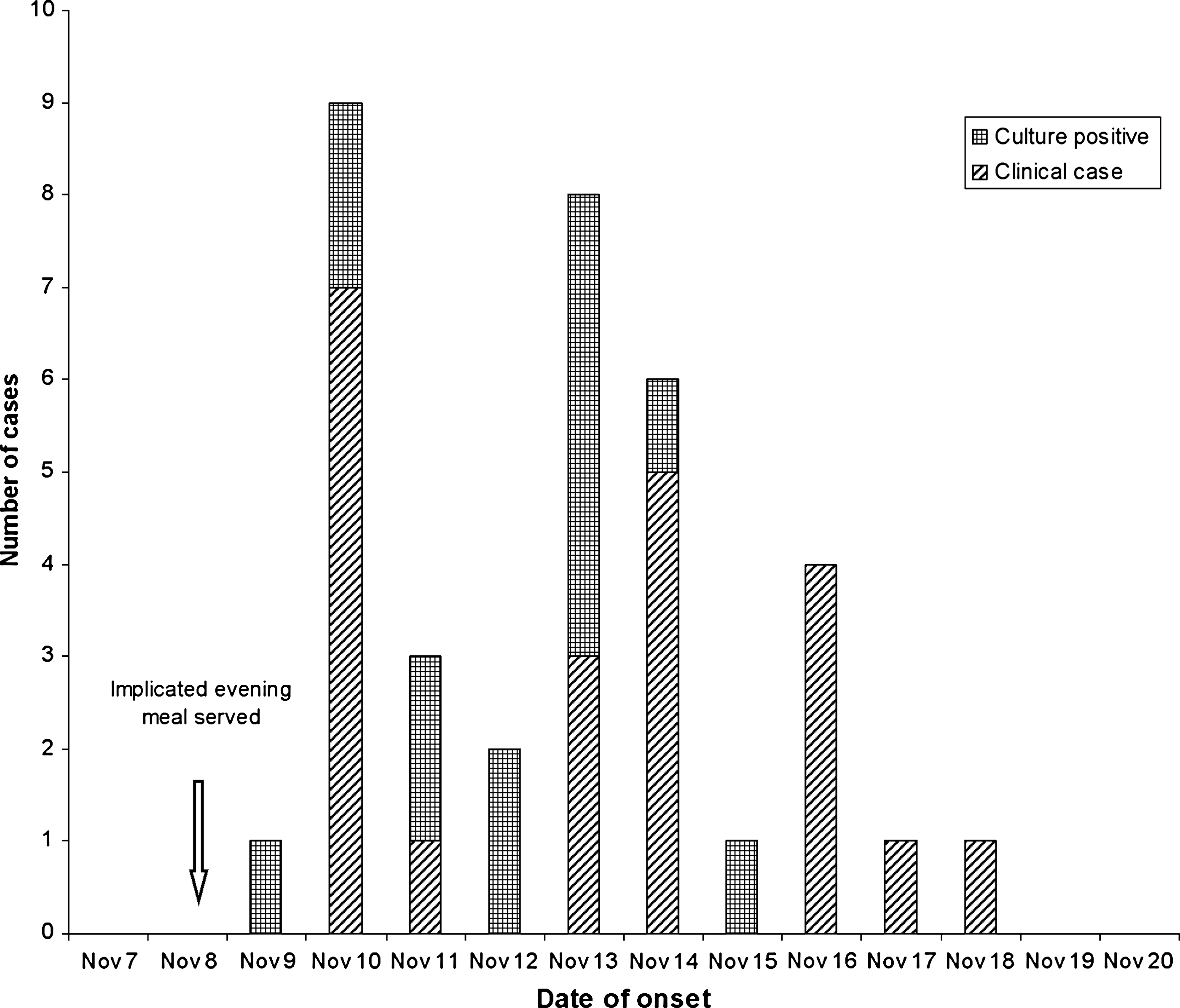
Epidemic curve showing cases by date of onset.
The prevalence of symptoms for cases completing a food history questionnaire was abdominal pain 91%, diarrhea 71%, nausea 54%, chills 49%, fever 46%, headache 34%, vomiting 23%, and bloody diarrhea 6%. Incubation periods from the time of the November 8 dinner ranged from 20 hours to over 9 days, with the median incubation period of 2.3 days (mean, 3.9 days). At the time of questionnaire completion, 10 cases remained unwell. For the 13 Campylobacter-positive cases included in the cohort analysis, incubation periods ranged from 20 hours to 7.1 days, with a median of 2.7 days (mean, 3.3 days). Median illness duration among those who were C. jejuni positive was 4 days (range, 1–9 days).
Using Epi-Info, the meal served on the evening of Tuesday November 8 had a close to significant association with illness at the conventional statistical level (RR: 3.09; 95% confidence interval (CI): 0.90, 10.66; p ≤ 0.05; Table 1). Recalculation of this result using an exact program, StatXact, showed a ratio of proportions of 3.094 (95% CI: 1.21, 14.09; p = 0.02; Table 1). Among individual foods, roast beef had the highest food-specific attack rate (75%), with a rate difference of 35%, but this was not significant (ratio of proportions of 1.88; 95% CI: 0.93, 8.30). No association between having eaten any cream on November 8 and illness was demonstrated.
Calculated using StatXact®.
CI, confidence interval.
Environmental health findings
At the inspection at 8 days after the onset of symptoms in the first case, general hygiene and food handling practices were considered adequate. All potentially hazardous food items were shown to be under temperature control. The handling of raw food was closely examined, particularly the separation of chicken from other raw or ready-to-eat foods contained within the cold room. All foods were adequately covered and protected from contamination in the cold room, freezers, and dry storage. Cleaning and sanitizing of utensils, equipment, and work surfaces was very good. The kitchen used color-coded cutting boards with staff displaying a good understanding of washing and sanitizing practices.
Investigation of cream served at the evening meal on November 8 showed it was a commercially available pasteurized product delivered to the school on November 2 and first served with a dessert that evening. The kitchen manager reported that the cream was not used again until served with pancakes for a brunch meal on November 5 (although the weekend cook denied this). At the time the pancakes were being prepared, 10 raw chickens were taken from the cool room to be roasted. It is possible that the cream container was cross-contaminated with Campylobacter from the raw chicken. The cream container was next reported as being used with the evening meal on November 8.
The site visit to the poultry processor supplying chicken to the school enabled raw chicken samples to be collected as well as swabs from equipment and fittings in the poultry processing room to be taken.
Laboratory findings
Bacterial isolation
C. jejuni was isolated from 14 of the 18 cases for whom fecal specimens had been submitted for investigation. No other bacterial species or parasites were isolated from the cases. C. jejuni was cultured from a 25-g sample of raw chicken sausage obtained from the boarding school kitchen at a site visit on November 18. A 25-g sample of chicken kebab meat obtained from the school poultry supplier on the November 21 was also positive for C. jejuni. Swabs from a raw chicken mincer and from stainless-steel slicing blades in the supplier's poultry processing room were also positive for C. jejuni. All other food and environmental samples were negative for pathogens. Unfortunately, none of these tested food items were remnant products from the time of the implicated meal.
Molecular typing
Human, chicken meat, and environmental samples yielded five C. jejuni subtypes (Fig. 2). Among human cases were two distinct flaA subtypes: Fla type 128 and Fla type 14b. The majority of these were Fla type 128. Nine of these came from students and one from a guest. Of the three Fla type 14b isolates, two were from guests, with the remaining isolate from a student. Chicken sausage recovered from the school kitchen was identified as being Fla type 19, whereas chicken kebab meat sampled from the poultry processor was identified as being Fla type 6b. The remaining environmental isolates from swabs of blades and a mincer at the poultry processor yielded Fla type 122. The MLST data were consistent with the flaA typing (Table 2). Among the human isolates, those of Fla type 128 were all found to be ST-49, whereas those of type Fla 14b were all ST-52. Isolates from different guests who only ate at the implicated dinner were the same two Campylobacter STs as the student isolates. The isolates from the blades and mincer were ST-45, whereas that from the chicken sausage was ST-137. Interestingly, the kebab meat (FlaA Type 6b) was found to be ST-2529, which was a new ST.

Unweighted paired group mean analysis dendrogram of the restriction fragment length polymorphism-flaA patterns of Campylobacter jejuni isolates from human and environment.
RFLP, restriction fragment length polymorphism; MLST, multilocus sequence typing.
Discussion
Despite the frequent incidence of Campylobacter infections, outbreaks are often under detected. Reported sources have included water contamination (Clark et al., 2003), unpasteurized milk (Birkhead et al., 1988), and cross-contamination from raw to ready-to-eat foods in preparation areas (Graves et al., 1998). Reasons contributing to the infrequency of outbreak reporting may be biological, including the fastidious growth requirements of the organism and the self-limiting nature of the infection in humans. In addition, the lack of convenient, standardized subtyping methods makes it impossible to distinguish clusters of related cases from the background of sporadic cases (Frost, 2001; Hall and Kirk, 2005).
The results of the cohort study suggested an association between attending the November 8 meal at the boarding school and the subsequent development of gastroenteritis. This was supported by a temporal association: the dates of onset for all cases occurred after the implicated meal. Further, among the cases were dinner guests, who reported no other shared exposure with the staff and students. Isolates from different guests who ate at the boarding school only at the November 8 dinner had the same two Campylobacter STs that the student isolates had.
Epidemiologically, although use of a retrospective cohort study was an appropriate analytical method, there exists potential for recall bias and nondifferential misclassification of exposures. Students and guests who experienced gastrointestinal symptoms may have given greater consideration to the foods they consumed before becoming unwell than those who were not affected, hence reporting exposure with a greater degree of completeness. There were also some student reports of attendance at the implicated meal that conflicted with the school's own attendance records. Because of the school's duty of care to students, the investigators felt confident in having identified those who were present but there is likely less certainty surrounding recollection by individuals of the foods they consumed.
Cross-contamination is frequently cited as an important contributing factor in Campylobacter spp. outbreaks (Brown et al., 1988; Graves et al., 1998; Roels et al., 1998). Environmental health investigators did identify a potential for Campylobacter on raw chickens to have cross-contaminated cream served at the implicated meal. Given the high levels of surface contamination on raw Australian poultry products (Anonymous, 2005) and evidence suggesting that meals prepared from raw chicken result in widespread dissemination of C. jejuni to multiple hand and chicken contact sites (Humphrey et al., 2001), it is not unreasonable to suggest a cross-contamination event has occurred. However, such risks are not easily quantifiable and microbiological evidence of cross-contamination is needed for a conclusive demonstration of risk. Although no foods prepared or used at the time of the implicated meal were recovered, the epidemiological analysis did reveal low relative risks across a range of foods. This provided circumstantial support to the investigators' opinion that cross-contamination of one or more foods may have been responsible for this outbreak, although the possibility of some other unrecognized factor as the cause remains.
The results of typing used to aid this investigation showed two apparently distinct MLST types (ST-49 ST-52) occurring in epidemiologically linked cases. Interrogation of the Campylobacter MLST database (
As well, culture methodologies possess an inherent bias in that only a finite number of colonies can be picked from culture plates and typed (Hiett et al., 2002). This may result in only the most dominant subtype being detected. The finding that the majority of human isolates were Fla type 128/ST-49 may be a reflection of the prevalence of this subtype over Fla type 14b/ST-52 at the original source of contamination.
Despite concerns of the genomic instability of C. jejuni (Harrington et al., 1997), the findings of this work support RFLP analysis of the flaA gene as a useful method for epidemiological linkage (Fitzgerald et al., 2001a, 2001b) and for detection of clonal complexes in the species C. jejuni, which may contain more than one ST (Djordjevic et al., 2007). This study's use of a sequencing method for direct comparison showed flaA genotypes to closely predict MLST, a finding supported by other recent works (Djordjevic et al., 2007; Levesque et al., 2008).
Conclusions
Although only small numbers of isolates were examined, this study provides insight into how RFLP-flaA typing might be applied in an outbreak setting involving Campylobacter spp. The investigation also illustrates the role cross-contamination plays in outbreaks of campylobacteriosis, especially those linked to commercial catering and kitchen premises.
Footnotes
Acknowledgments
The authors acknowledge the following people for their assistance with the investigation: staff from the Disease Surveillance and Investigation Unit at the Communicable Disease Control Branch; staff from the Food Section, Environmental Health Branch; staff at the IMVS enteric and food and environment laboratories; and environmental health staff from the Unley City Council. The authors also thank Graeme Tucker, Health Statistics Unit, Department of Health, South Australia, for providing assistance with the StatXact program. This publication made use of the C. jejuni MLST website ( ). The development of this site has been funded by the Wellcome Trust. The Master of Applied Epidemiology program is funded by the Australian Government Department of Health and Ageing.
Disclosure Statement
No competing financial interests exist.