




Abstract
In this study, we evaluated the Salmonella detection capability and compatibility of a LightCycler polymerase chain reaction (LC PCR) system with two bacteriological methods, United States Food and Drug Administration's Bacteriological Analytical Manual Chapter 5: Salmonella (FDA) and International Organization for Standardization Method 6579 (ISO). The aim was to determine which bacteriological method would support LC PCR for testing naturally contaminated poultry and red meat samples with Salmonella. Twenty three (50.0%) and 24 (52.2%) out of 46 chicken meat samples were positive for Salmonella by the FDA and ISO methods, respectively. Five of the 15 (33.3%) turkey meat samples were found to harbor Salmonella by both bacteriological methods. None of the red meat samples were positive for Salmonella using the FDA method. There was one red meat sample (3.3%) positive for Salmonella using ISO method. LC PCR results indicated that 23 (50.0%) and 31 (67.4%) of the DNA templates obtained from the 46 preenriched chicken meat FDA and ISO samples were positive for Salmonella. Salmonella detection rate from turkey meat samples by ISO LC PCR was 6.7%, whereas no detection was observed by FDA LC PCR. FDA LC PCR detection rate in red meat samples was 23.3%, whereas the ISO LC PCR was 43.3%. Relative accuracy rates of ISO LC PCR and FDA LC PCR were 67.4%, 60.0%, 53.3% and 56.5%, 66.7%, 76.7% for chicken, turkey, and red meats, respectively. We presume that the low relative accuracy problem, which can be related to the use of FDA and ISO preenrichments for template preparations in the PCRs, can be overcome by the use of primary enrichments of both FDA and ISO bacteriologies.
Introduction
Today, the primary goal of red and poultry meat producers is to provide consumers with safe and wholesome products. In this context, rapid, reliable, and economical detection of Salmonella contamination in these types of foods is crucial. For example, in Turkey, the determination of Salmonella contamination in any step of the food chain, particularly in the final product, by “internationally recognized methods” has also become a legal requirement (TFC, 2009). According to the Directive on Microbiological Criteria of Turkish Food Codex (2009), none of the five 25 g randomly selected poultry meat and red meat samples should harbor Salmonella. Also, regulation (EC) 2160/2003 of the European Parliament and of the Council of 17 November 2003 on the control of Salmonella and other food-borne zoonotic agents (Anonymous, 2003b) specifies that the “Salmonella: absence in 25 g” rule will be in effect beginning in December 2010 for fresh poultry meat from broilers, laying hens, and turkeys to be placed on the market for human consumption.
Currently, the most commonly applied standard guidelines for the detection of Salmonella in foods are (1) the detection method indicated in the United States Food and Drug Administration's Bacteriological Analytical Manual Chapter 5: Salmonella (FDA-BAM, 2007-FDA) and (2) International Organization for Standardization Method 6579 (ISO 6579:2002-ISO) in the countries of the European Union. Both methods are based on traditional culture techniques, which require specific modifications in isolation and identification steps depending upon the food type. In addition, these tests require 5–11 days for confirmation of the results (ISO, 2002; FDA, 2007). Real-time polymerase chain reaction (PCR), on the other hand, is one alternative method for a rapid, reliable, feasible, highly specific, and sensitive detection of Salmonella from foods (Anonymous, 2003a; Croci et al., 2004; Ellingson et al., 2004; Leon-Velarde et al., 2004; Perelle et al., 2004; Hein et al., 2006; Malorny et al., 2007; Badosa et al., 2009). Among specific real-time PCR systems, the LightCycler PCR (LC PCR), a capillary air-thermal cycler, has a short detection time of Salmonella DNA from various foods over other real-time PCR systems (Eyigor et al., 2002; Eyigor and Carli, 2003; Jothikumar et al., 2003; Cheung et al., 2004; Wang et al., 2004; Mercanoglu and Griffiths, 2005; Catarame, 2006).
In this study, the LC PCR system, with its commercially available kits (Highpure Foodproof I Kit [Roche, Mannheim, Germany] for DNA isolation, LightCycler Foodproof Salmonella Detection Kit [Roche] for Salmonella detection), was evaluated with FDA and ISO bacteriological methods for the detection of Salmonella contamination in potentially naturally contaminated poultry and red meat samples.
Materials and Methods
Salmonella strains
Salmonella enterica subsp. enterica serovar Enteritidis 64K (M.Y. Popoff, Institut Pasteur, 28 rue du Dr Roux, 75015 Paris Cedex 15, France), S. enterica subsp. enterica serovar Typhimurium LT2-CIP60–62 and S. enterica subsp. enterica serovar Typhimurium NCTC 12416 (Refik Saydam National Public Health Agency, Ankara, Turkey), and S. enterica subsp. enterica serovar Typhimurium ATCC 14028 and S. enterica subsp. enterica serovar Enteritidis ATCC 13076 (Department of Microbiology, Uludag University Medical School, Bursa, Turkey) were used as positive controls in real-time PCR and in bacteriological detection methods.
Samples
Forty-six chicken meat, 15 turkey meat, and 30 red meat retail samples (Table 1) were randomly collected and transferred to the laboratory on ice. Samples in their original packages were individually repacked in polyethylene bags to prevent cross contamination during purchase and transfer. The analysis of all samples was initiated immediately after transfer to the laboratory.
LC PCR: LightCycler polymerase chain reaction; FDA: Food And Drug Administration Bacteriological and Analytical Manual Salmonella Isolation and Identification Method; ISO: International Organization for Standardization Method 6579: Microbiology of Food and Animal Feeding Stuffs-Horizontal Method for the Detection of Salmonella spp.; FDA LC PCR: PCR result of sample template DNA obtained from lactose preenrichment of FDA-BAM bacteriological method; ISO LC PCR: PCR result of sample template DNA obtained from buffered peptone water preenrichment of ISO 6579 bacteriological method; +: positive; −: negative.
Bacteriology
Samples were analyzed by both FDA and ISO (Fig. 1) methods. Using the FDA method, briefly, 25 g of the meat sample was aseptically transferred into 225 mL lactose broth (LB; Oxoid, Hampshire, England; CM0137) in a stomacher bag. Each sample was hand massaged from the outside of the bag for 3 min, incubated at room temperature for 1 h, and then incubated at 35°C for 24 h. After this preenrichment incubation, 1 mL of sample was taken for PCR template preparation, 1 mL of sample was transferred to tetrathionate broth (Oxoid; CM029), and 0.1 mL of sample was transferred to Rappaport Vassiliadis R10 broth (RV R10B; Beckton Dickinson, Sparks, MD; 218581); the broth samples were incubated for 24 h at 43°C and 42°C, respectively, for primary enrichment. Selective plating was performed from each of the primary enrichment broths on xylose lysine deoxycholate agar (Beckton Dickinson, 278850) and xylose lysine tergitol-4 agar (Beckton Dickinson, 223420), and the plates were incubated at 35°C for 24 h. Suspected Salmonella colonies were subjected to biochemical identification by API 20E (Biomerieux, Marcy-l'Etoile, France; 20100) and serological identification using Salmonella group-specific antisera (Beckton Dickinson). Using the ISO method, a similar approach was applied for sample preparation as indicated in FDA-BAM, although the sample preenrichment was performed in 225 mL buffered peptone water (BPW; Oxoid; CM1049) at 37°C for 18 h. After this incubation, 1 mL of the sample was taken for PCR template preparation, 1 mL of the sample was transferred to Muller–Kauffmann tetrathionate–novobiocin broth (MKTTnB; Oxoid; CM1048), and 0.1 mL of the sample was transferred to Rappaport Vassiliadis soya peptone broth (Oxoid; CM0866); the inoculated broths were incubated for primary enrichment for 24 h at 37°C and 41.5°C, respectively. Selective plating, biochemical identification, and serological identification were performed as indicated in the FDA.
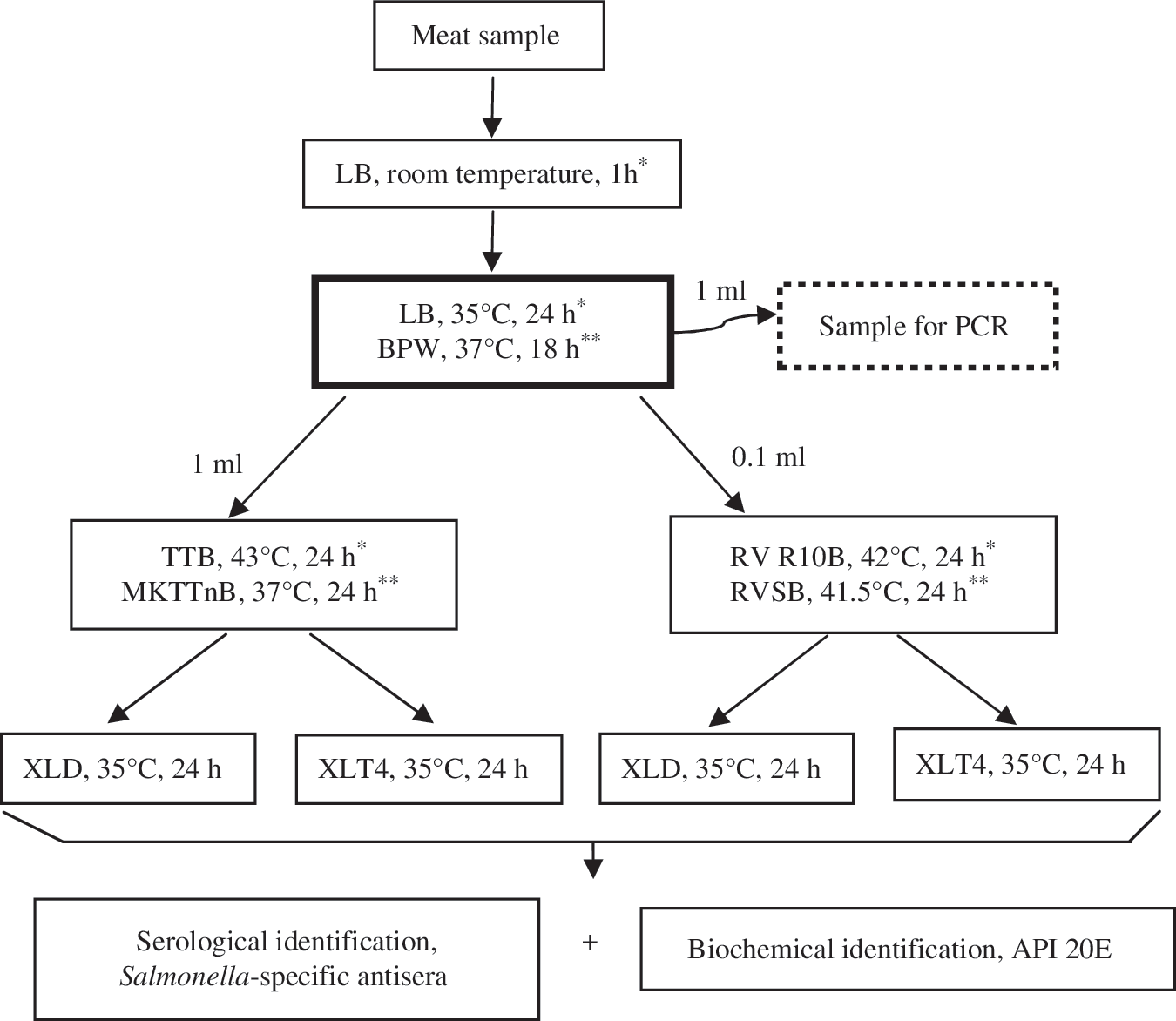
Schematic outline of the FDA and ISO methods used for bacteriological analysis of the meat samples. *Only for FDA method; **only for ISO method. FDA, Food and Drug Administration; ISO, International Organization for Standardization; LB, lactose broth; BPW, buffered peptone water; PCR, polymerase chain reaction; TTB, tetrathionate broth; MKTTnB, Muller–Kauffmann tetrathionate–novobiocin broth; RV R10B, Rappaport Vassiliadis R10 broth; RVSB, Rappaport Vassiliadis soya peptone broth; XLD, xylose lysine deoxycholate agar; XLT4, xylose lysine tergitol-4 agar.
DNA isolation and real-time PCR
DNA was isolated from 1 mL aliquots of the preenrichment broths indicated in the FDA and ISO 6579 (Fig. 1) methods by using a Highpure Foodproof I Kit (Roche; 03 358 089 001); isolated DNA was used as template in real-time PCR, which was performed using a LightCycler Foodproof Salmonella Detection Kit (Roche; 03 357 449 001) after concentration and purity determination using NanoDrop spectrophotometer (Thermo, Wilmington, DE; ND1000). The total PCR reaction volume was 20 μL comprised of 5 μL of template DNA added into 15 μL PCR mix (13 μL of LightCycler Foodproof Salmonella Master Mix primers, standard Salmonella control DNA and Hybprobe mix for internal control, 1 μL of LightCycler Foodproof Salmonella Enzyme Solution, and 1 μL of LightCycler Foodproof Salmonella Internal Control). The LightCycler Foodproof Salmonella Control template DNA from one of the selected Salmonella strains indicated above was used as a positive control for PCR; ultrapure water was used as a negative control for PCR. The amplification protocol included an initial denaturation step at 95°C for 10 min, 55 cycles of denaturation at 95°C for 0 s, annealing at 59°C for 30 s, and 5 s of primer extension at 72°C. Fluorescence values of the internal control and of each sample were automatically measured at 705/Back 530 nm (Channel F3/Back-F1) and at 640/Back 530 (Channel F2/Back-F1) at the end of each annealing step. Data analysis was automatically performed by the LightCycler software version 4.05 (Roche).
Statistical analysis
Relative accuracy, sensitivity, and specificity were calculated according to the protocol described in ISO 16140 (ISO, 2003). Relative accuracy, sensitivity, and specificity calculations were complemented with Cohen's kappa test to evaluate the correspondence between results obtained by methods.
Results
In this study, 23 (50.0%) and 24 (52.2%) out of 46 chicken meat samples were determined to be positive for Salmonella by the FDA and ISO methods, respectively (Table 1). Five of the 15 (33.3%) same turkey meat samples were found to harbor Salmonella by both bacteriological methods (Table 1). None of the red meat samples were found to be positive for Salmonella using the FDA method. There was one red meat sample (3.3%) (R29) found positive for Salmonella using ISO method (Table 1).
LC PCR results indicated that 23 (50.0%) and 31 (67.4%) of the DNA templates obtained from the 46 preenriched chicken meat LB (FDA) and BPW (ISO) samples were positive for Salmonella. All LB positive samples were also positive by BPW. Additionally, eight samples (C1, C2, C4, C6, C7, C8, C10, C27) were positive only in the BPW preenrichments, bringing the ISO LC PCR detection rate to 67.4% (31 positive samples) (Table 1).
For the turkey meat samples, none of the LB preenriched DNA templates was positive with FDA LC PCR analysis. However, one of the BPW preenrichments of the same samples (T1) was found positive with ISO LC PCR; therefore, the Salmonella detection rate from turkey meat samples by ISO LC PCR was 6.7% (Table 1).
In 30 red meat samples, FDA LC PCR detection rate with LB preenriched DNA templates was 23.3%, whereas the PCR with BPW preenrichments of the same samples detected 43.3% positive samples (Table 1).
Following the ISO 16140 statistical protocol (ISO, 2003), when two bacteriological methods were compared using the ISO bacteriology as the reference method, one false-negative sample was detected in chicken meat and red meat samples. The relative accuracy rates were 97.8%, 100%, and 96.7% for chicken, turkey, and red meat samples, respectively (Table 2).
Kappa index values: 0.96, 1.00, 0.34, and 0.13, respectively.
NC: could not be calculated.
There were several disagreements between ISO and ISO LC PCR related to false-negative and -positive results in ISO LC PCR, when ISO bacteriology was used as the reference method. Therefore, relative accuracy, sensitivity, and specificity rates of ISO LC PCR were considerably low for all meat types (Table 2). Similarly, when FDA bacteriology was used as the reference method, all three statistical parameters of FDA LC PCR were also considerably low for all sample types (Table 2).
Discussion
In this study, we evaluated the Salmonella detection capability and compatibility of a LC PCR system with two bacteriological methods, FDA and ISO. By testing these methods on poultry and red meat samples, we have defined a supporting bacteriological method to complement LC PCR.
The detection rates from both bacteriological methods used were similar regardless of the meat type (Table 1). Only in the FDA bacteriology, there was one chicken and one red meat sample determined as negative, whereas both of these samples were positive in ISO (Table 2). This shows that, although rarely, FDA bacteriology could account for these types of false negativities compared with ISO bacteriology (Table 2).
LC PCR Salmonella detection rates from chicken meat and red meat samples in contrast to turkey meat samples were higher than bacteriology detection rates (Table 1). As seen in Table 2, the positivities and false negativities observed in the ISO and FDA LC PCRs could have led to relatively low accuracy, sensitivity, and specificity for these tests (Table 2). Similar findings have been reported previously by Bohaychuk et al. (2007) and O'Regan et al. (2008). Circumstances for this type of “bacteriology negative, PCR positive” (FDA LC PCR and ISO LC PCR) results can be related to high numbers of nonculturable/dead Salmonella cells in chicken and red meat samples or to overgrowth of lactose-positive bacteria masking the typical Salmonella colonies on selective agar plates. Another reason for this type of positivity in these PCRs can be insufficient recovery of injured cells, despite enrichment in bacteriology, causing “false negativity” in bacteriology (Schrank et al., 2001; Eyigor et al., 2002; Lofstrom et al., 2004).
False negativities in PCRs used in this study cannot be related to inhibitory substances, which had been previously reported (Hoorfar et al., 2003), because the LC PCR system we used in this study already included an internal control. Other possible reasons for these false-negative results might be due to very low or no initial Salmonella-specific template DNA in preenrichment cultures (Bohaychuk et al., 2007). In our study, we obtained PCR template DNA from LB and BPW preenrichment cultures using FDA and ISO bacteriological methods (Fig. 1), respectively. This preenrichment culturing was based on instructions from the LightCycler Foodproof Salmonella Detection Kit, although the kit did not specify whether samples taken from enrichment cultures were from preenrichments or primary enrichments (Anonymous, 2006). After being informed that we would sample from the “preenrichment step” by personal communication with the company, we applied the tests accordingly, despite the previous contrary findings of our laboratory and others (Eyigor et al., 2002; Uyttendaele et al., 2003; Fakhr et al., 2006). Results from this study indicate that sampling from preenrichment cultures of FDA and ISO bacteriological methods is not appropriate for template DNA isolation for Salmonella detection in poultry and red meat samples by LC PCR. Primary enrichment of these bacteriological methods could be more reliable as indicated previously (Bohaychuk et al. 2007; Malorny et al. 2007; Krascsenicsova et al. 2008; O'Regan et al. 2008).
Conclusion
In conclusion, low relative accuracy in FDA and ISO LC PCR was observed for the detection of Salmonella from chicken, turkey, and red meat samples. In our opinion, the low accuracy in Salmonella detection of LC PCRs can be increased by the use of primary enrichments of both FDA and ISO bacteriologies. In addition, bacteriology should be continued for confirmation of PCR results.
Footnotes
Acknowledgments
This work was funded by the Scientific and Technical Research Council of Turkey (TUBİTAK, Project TOVAG-106O666). The authors thank Özlem Zengin for technical assistance. This article was edited and revised for English by American Journal Experts.
Disclosure Statement
No competing financial interests exist.