




Abstract
In this study, the antimicrobial effects of hypochlorite (HOCl) on Escherichia coli in tap water were investigated. The effects of 0.1% thyme oil and 100 mg/L HOCl on E. coli on vegetables (lettuce, parsley leafs, and red pepper) were also studied. E. coli was reduced by 2.54, 3.33, 3.93, 4.87, and 5.57 log colony forming units (cfu)/mL with 0.25, 0.5, 1.0, 10, and 50 mg/mL HOCl, respectively. There was an increase of more than 30% in the inactivation of E. coli with 10°C rise in temperature, a remarkable increase in antimicrobial activity at pH 5.0 was also observed with 5.62 log cfu/mL reductions in 30 sec, as well as marked neutralization of the effect in the presence of 0.1% peptone in water was noted. Biphasic kinetics in the inactivation curves of E. coli was observed. HOCl, thyme oil, and their mixture reduced the number of E. coli between 1.23 and 3.75 log cfu/mL after 5-min exposure on vegetables. The degree of E. coli inactivation depends on concentration of residual chlorine, suspending medium, type of vegetables, and the use of thyme essential oil.
Introduction
T
Most pathogenic microorganisms of interest in minimally processed fresh foods are Escherichia coli, Listeria monocytogenes, Shigella, Salmonella, and hepatitis A virus. These organisms have been implicated in outbreaks of foodborne illness linked to the consumption of contaminated fresh vegetables (Schuenzel and Harrison, 2002; Flint et al., 2005; Nguz et al., 2006). One outbreak has been linked to lettuce (Ackers et al., 1998) and radish sprouts (Gutierrez, 1997; Nathan, 1997). The public health hazard of fresh vegetables contaminated with feces used as fertilizer is a longstanding concern because cattle is a main reservoir of E. coli in manure (Machado et al., 2006). Traditional washing technologies utilize washing fresh fruits and vegetables with chlorinated water (50–200 ppm active chlorine) to reduce microorganisms. Essential oils from some spices have antimicrobial properties (Ozcan and Erkmen, 2001; Ceylan and Fung, 2004). The main constituents responsible for antimicrobial properties in thyme oil are thymol, p-cymene, and carvacrol (Oussalah et al., 2007). Wan et al. (1998) reported that washing lettuce with 0.1% (v/v) and 1.0% (v/v) suspensions of basal oil resulted in 2.0 and 2.3 log reduction of viable bacteria, respectively, on fresh cut lettuce.
Presence of E. coli in foods such as meat, fish, milk, and raw dairy products is an indicator of fecal contamination (Erkmen and Bozoglu, 2008a). Outbreaks of E. coli have been associated with various foods such as vegetables, raw milk, undercooked beef patties, drinking water, and swimming water (Zhao et al., 2001). Pathogenic E. coli can cause diarrhea, gastroenteritis, hemolytic uremic syndrome, and hemorrhagic colitis following the consumption of contaminated foods (Ricourt et al., 2003; Erkmen and Bozoglu, 2008a).
The objective of this study was to determine the antimicrobial efficacy of hypochlorite (HOCl) against E. coli in water as affected by HOCl concentration, temperature, pH, and the presence of peptone. In addition, the antimicrobial effects of HOCl and thyme essential oil against E. coli on lettuce, parsley leaves, and red pepper were also determined.
Materials and Methods
Bacterial culture preparation
E. coli KUEN 1504 culture was obtained from Microorganisms Culture Collection Research and Applied Center, Faculty of Medicine, University of Istanbul, Istanbul, Turkey. The stock culture was maintained on brain heart infusion agar (Difco, Detroit, MI) slants at 4°C. The cultures for experiments were repeated twice from stock culture by inoculating in 10 mL of tryptone soy broth (Difco) and incubating at 35°C for 18 h.
Activated culture was inoculated again into tryptone soy broth and incubated at 37°C for 24 h. About 500 mL of E. coli culture was centrifuged at 4000 g for 30 min under aseptic conditions. After centrifugation, supernatant fluids were discarded, cell pellets were washed twice with phosphate buffer solution (pH 7.0) and then suspended in phosphate buffer (about 100 mL), and this suspension was used as stock culture of E. coli. The final number of E. coli in phosphate-buffered solution was about 4.86 × 10⁹ colony forming units (cfu)/mL. Cell suspensions were prepared immediately before treatment.
Preparation of test solutions
All glassware was thoroughly cleaned and then rinsed with deionized water before use. Phosphate-buffered solutions (pH 8.0, 7.0, 6.0) were prepared using depotassium hydrogen phosphate and potassium dehydrogen phosphate with deionized water. Citrate buffer solution (pH 5.0) was prepared using sodium citrate and citric acid with deionized water. HOCl stock solution (100 mg/L) was prepared from household bleach (sodium hypochlorite, NaHOCl, with 92.66 g/L of available chlorine) using deionized water. A 0.1 M sodium thiosulfate solution (STS) was prepared to neutralize chlorine after treatment. All solutions were freshly prepared.
Chlorine determination
Available chlorine concentrations in solutions were determined by the standard iodometric titration method (Anonymous, 1985). In this method, potassium iodide solution (10%) was added into a sample of chlorine solution, acidified by 1 N hydrochloric acid, and then titrated using sodium thiosulfate.
Antimicrobial effect of HOCl
The following HOCl solutions were prepared and used in treatments of E. coli: (i) 0.25, 0.5, 1.0, 10, and 50 mg/L HOCl solutions (pH 7.0) were prepared by completing 0.25, 0.5, 1.0, 10, and 50 mL of HOCl stock solution, respectively, to 98.5 mL using deionized water; (ii) 1.0, 10, and 50 mg/L HOCl solutions (pH 7.0) were prepared by completing 1.0, 10, and 50 mL of HOCl stock solution, respectively, to 98.5 mL using 0.1% peptone water; and (iii) 10 mg/L HOCl solutions with pH 8.0, 7.0, 6.0, and 5.0 were prepared by completing 10 mL of HOCl stock solution to 98.5 mL using deionized water. pH of the solutions was adjusted using phosphate and citrate buffers before completing to 98.5 mL.
The following experiments were performed by addition of 1.5 mL of E. coli stock culture into HOCl solutions (98.5 mL) to determine (i) the effect of different HOCl concentrations (0.25, 0.5, 1.0, 10, and 50 mg/L) at 30°C and pH 7.0 with exposure from 30 to 270 sec; (ii) the effect of 0.1% peptone on neutralization of HOCl (1, 10, and 50 mg/L) at 30°C and pH 7.0 with exposure from 30 to 450 sec; (iii) the effect of temperatures (20°C, 30°C, and 40°C) with 10 mg/L HOCl at pH 7.0; (iv) the effect of pH (8.0, 7.0, 6.0, and 5.0) with 10 mg/L HOCl at 30°C with exposure from 30 to 270 sec; and (v) the level of free HOCl (10 mg/L) at 35°C and pH 7.0 from 30 to 270 sec.
After treatment time, 5 mL of 0.1 M STS was added to neutralize disinfectants in solution.
E. coli contamination and treatment of vegetables
Surface-uninjured lettuce, parsley, and Turkish red pepper were purchased from a local supermarket. The outer three or four leaves of lettuce were removed and discarded. The red pepper and the left leaves of lettuce and parsley were then washed with cold tap water at 25°C for 1 min before inoculation with E. coli. The leaves of lettuce were cut into pieces (3 × 3 cm).
Ten milliliters of the E. coli stock culture was completed to 500 mL (treating solution) using sterile deionized water. The final number of E. coli in this solution was about 7.74 × 10⁷ cfu/mL. For surface inoculation, red pepper (100 g) and the cut pieces of lettuce (12 g) and parsley leaves (12 g) were evenly contaminated with E. coli by immersing into treating solution and then shaken using waterbath shaker (ST-402; Nüve, Sanayii ve Malzemeleri İmalat ve Ticaret A.Ş., Istanbul, Turkey). During shaking, vegetables were completely submerged in the inoculum, and after 5 min incubation, vegetables were thoroughly drained. To allow the attachment of E. coli, inoculated vegetables were air-dried under a dust-free area for 2 h before treatment with HOCl.
E. coli-inoculated lettuce (10 g), parsley leaves (10 g), and red pepper (50 g) were exposed into 500 mL of HOCl solution (pH 7.0) for 5 min in a sterile bag with continuous agitation using a shaker at 120 rpm at 30°C and to treatments with (i) solution containing 100 mg/L HOCl, (ii) 0.1% (v/v) thyme oil, (iii) 100 mg/L HOCl + 0.1% thyme oil mixture, and (iii) sterile deionized water as control. At the end of each treatment, lettuce, parsley leaves, and red pepper were drained and immersed immediately into sterile blenders that contain 88 mL of sterile deionized water and 2 mL of sterile STS (for lettuce and parsley), or 440 mL of sterile deionized water and 10 sterile STS (for red pepper). They were shaken for 1 min to neutralize residual HOCl and thyme oil, and then the vegetables were blended. The blended vegetable slurries were allowed for 5 min to settle the particles.
Enumeration of E. coli
Each sample (water and vegetable slurries) from initial inoculum and after treatment with disinfectant was serially diluted with sterile 0.1% peptone (Difco) water solution. Initial counts and the surviving E. coli were determined by spread plating 1 mL of diluted (or homogenized) samples on duplicate plates of violet red bile agar (Difco). The plates were incubated at 35°C for 24 h, after which all the characteristic visible colonies on violet red bile agar were counted (Erkmen, 2007).
Statistical analysis
Three replicate trials were performed for each experiment. Analysis of variance was performed on data obtained at different stages of processing by means of a computer program, Statgraphics 2.0 (Stsc., Inc., Rockville, MD). Significant differences between means in populations of E. coli were determined and a p-value of <0.05 significance level was used in all analysis.
Results and Discussion
Effect of HOCl on E. coli
The effects of different HOCl concentrations in deionized water on E. coli at 30°C (pH 7.0) are shown in Figure 1. The 10 mg/L HOCl significantly (p < 0.05) decreased viable E. coli after very brief exposure (30 sec), whereas prolonged exposure (over 1 min) was required for 0.25 and 1.0 mg/L HOCl. After 30-sec exposure, initial E. coli number was reduced by 2.54, 3.33, 3.92, and 5.57 logs/mL with 0.25, 0.5, 1.0, 10, and 50 mg/L HOCl, respectively, whereas over 6 log reduction was achieved in 120 sec with 10 and 50 mg/L HOCl. A chlorine concentration of 10 mg/L killed more than 5.66 log cfu/mL of E. coli in 60 sec. Significant (p < 0.05) differences between HOCl concentrations (0.25, 0.5, 1.0, 10, and 50 mg/L) were observed in the inactivation of E. coli.
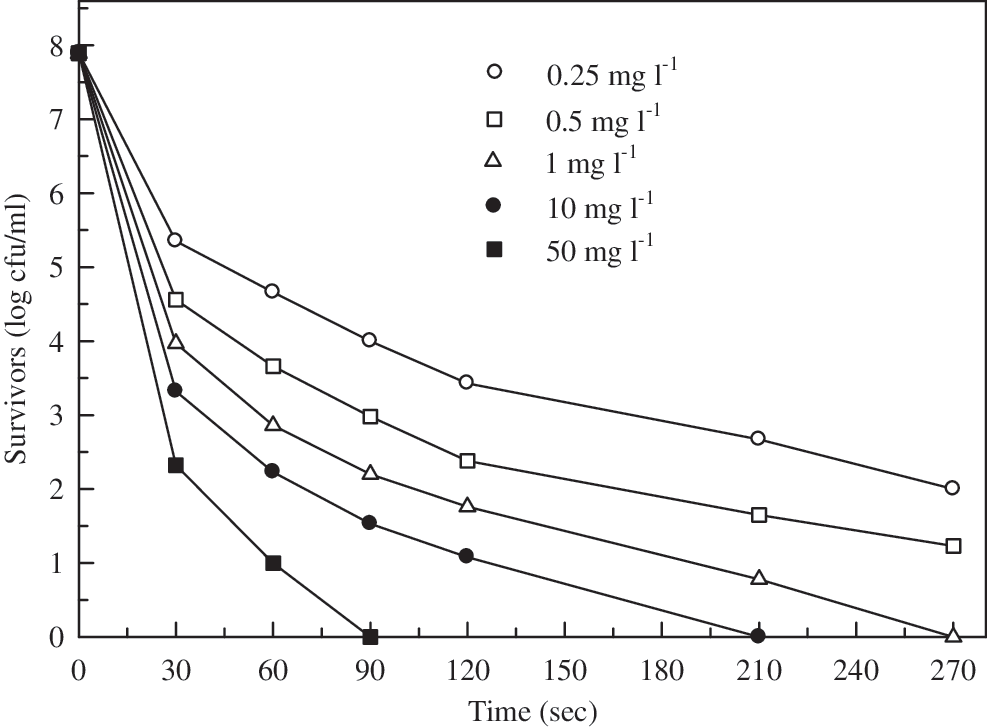
Effects of different hypochlorite (HOCl) concentrations in deionized water on Escherichia coli at 30°C (pH 7.0).
Previous studies have revealed that HOCl kills E. coli by damaging the respiratory and transport processes of the cell membrane (Barrette et al., 1987). Lisle et al. (1999) inactivated E. coli O157:H7 using chlorine in water. Zhao et al. (2001) reported that a chlorine concentration of 0.25 mg/L killed more than 7.0 log cfu/mL of E. coli O157:H7 in 30 sec and E. coli ATCC 11229 in 60 sec. Similar results were also reported by Rice et al. (1999) on E. coli O157:H7. E. coli used in this study was more resistant to chlorination than the ones used by Rice et al. (1999) and Zhao et al. (2001). The concentration of chlorine showing the antimicrobial effect on E. coli can vary according to disinfecting method, type and source of microbial strain, and concentration of residual chlorine (Rice et al., 1999; Zhao et al., 2001; Singh et al., 2002). Biphasic inactivation curve has been observed in the inactivation of E. coli with HOCl in deionized water. The observation of two phases in the inactivation of E. coli agreed with the results of Paz et al. (1993). The earlier stage was characterized by a higher rate of inactivation, which decreased afterward, suggesting greater sensitivity of most cells to HOCl at the beginning of exposure, followed by resistance of some cells depending on time and reduction of the level of residual chlorine.
Temperature effects
The effects of 10 mg/L HOCl (pH 7.0) in deionized water at different temperatures (20°C, 30°C, and 40°C) on E. coli are shown in Figure 2. Destruction effects of HOCl on E. coli at two temperatures differing by 10°C proved more than 30% reduction. Similar result was also reported for Yersinia enterocolitica by Paz et al. (1993). The biocidal activity of chlorine decreases with decreasing temperature. E. coli was reduced by 3.57, 4.87, and 6.33 log cfu/mL after 30 sec at 20°C, 30°C, and 40°C, respectively.

Effects of 10 mg/L HOCl in deionized water at different temperatures on E. coli (pH 7.0).
pH effect
The effects of 10 mg/L HOCl (pH 7.0) in deionized water at different pHs (8.0, 7.0, 6.0, and 5.0) and at 30°C on E. coli are shown in Figure 3. Results showed that maximum activity of HOCl on E. coli was observed in acid solution. HOCl activity correlates with the concentration of undissociated HOCl molecules (Fukuyama et al., 2009). Increased microbicidal effect of HOCl may thus be due to its diffusion through microbial walls (Paz et al., 1993). The activity of any given HOCl system is not determined by the concentration of HOCl molecules actually present, but rather by the combined concentration of H+ ions (pH) and total available chlorine, which produce HOCl molecules as fast as they are depleted by the disinfection process (Pazi et al., 2008; Fukuyama et al., 2009).

Effects of 10 mg/L HOCl in deionized water at different pH on E. coli at 30°C (pH 7.0).
Neutralization by peptone
Figure 4 shows that a relative low peptone concentration (0.1%) caused a large decrease in HOCl efficiency against E. coli. Chlorination and oxidation reactions between the amino groups and chlorine are most likely responsible for this effect. As peptone is nitrogenous, compounds such as proteins should be thoroughly removed before using chlorine as a disinfectant (Paz et al., 1993; Norwood and Gilmour, 2000; Byun et al., 2007). The efficiency of HOCl is reduced in the presence of nitrogenous compounds such as proteins (Bessems, 1998; Lambert and Johnston, 2001).

Interference of 0.1% peptone on effects of 1, 10, and 50 mg/L HOCl in deionized water on E. coli at 30°C (pH 7.0).
Chlorine uptake during E. coli treatment
Free chlorine concentration decreased rapidly at first during cell treatment and later slowly (Fig. 5), showing a pattern of chlorine uptake resembling that of E. coli death on exposure to HOCl. It is likely that during treatment, E. coli gains resistance to chlorine, in agreement with biphasic survival kinetics, indicating a noteworthy demand for free chlorine by bacterial biomass.
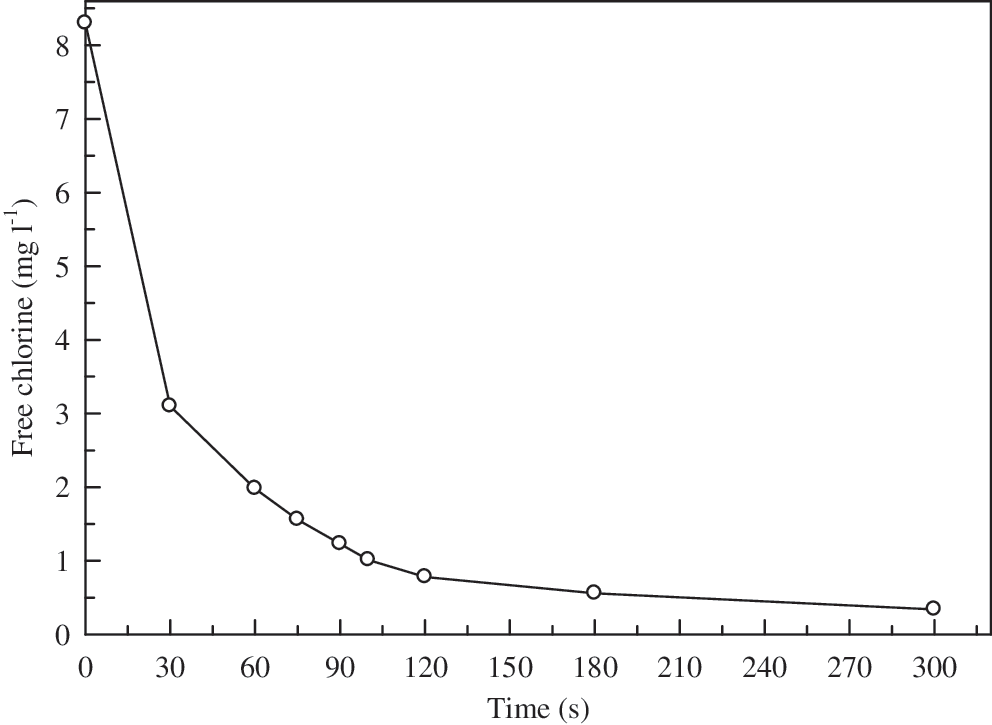
Free chlorine uptake of E. coli during 10 mg/L of HOCl treatment in deionized water at 30°C (pH 7.0).
Effects of HOCl on E. coli on vegetables
Survival of E. coli on lettuce, parsley leaves, and red pepper after treatments are given in Table 1. No detectable E. coli was found on uninoculated vegetables. Exposures of E. coli to 100 mg/L HOCl on vegetables for 5 min at 30°C (pH 7) have significant antimicrobial effect. Exposures of E. coli to 100 mg/L HOCl, 0.1% thyme oil, and their mixture on vegetables for 5 min reduced cells from 1.23 to 3.75 log cfu/g.
Washing of fresh fruits and vegetables with chlorinated water (50–200 ppm chlorine) on a commercial scale reduced not more than 3 logs of bacteria after 20-sec treatments (Taormina and Beuchat, 1999). It is common sense that HOCl is more effective against E. coli if used in water than on vegetables. This may be due to attachment of bacteria to the surface and/or protection by some special sites of attachment (Seo and Frank, 1999; Han et al., 2000). Seo and Frank (1999) found many live E. coli O157:H7 cells in the stomata and on cut edges of lettuce after treatment with 20 mg/L chlorine solution. Itoh et al. (1998) also found that viable E. coli O157:H7 in the radish sprouts was reduced by HgCl2. Fruits and vegetables not only can have complex surface properties for bacterial attachment, but also may provide nutrients for bacterial growth. Therefore, it is very important that a good sanitation technology should be used for sufficient reduction of E. coli in vegetables. Chlorine is an oxidizing agent to an extent and highly reactive with organic compounds (Han et al., 2000). Zhang and Farber (1996) reported that the maximum reduction of L. monocytogenes on fresh lettuce and cabbage treated with 200 ppm of chlorine was 1.7 and 1.2 log cfu/g, respectively, after 10-min exposure at 22°C.
The reduction of E. coli ranged between 3.23 and 6.89 log cfu/mL after exposure to HOCl concentrations ranging from 0.25 to 50 mg/L in water. The reduction of E. coli ranged between 1.23 and 2.27 log cfu/g after exposure of contaminated vegetables to 100 mg/L HOCl. Izumi (1999) reported that dipping of fresh-cut carrots, bell peppers, spinach, and potatoes for 4 min in 20 mg/L chlorine (at 23°C) reduced microorganisms between 0.6 and 2.6 log cfu/g. In the HOCl concentration treatments from 0.25 to 50 mg/L, the chlorinated water containing 50 mg/L HOCl had the strongest microbicidal affect. Increasing the chlorine concentration in HOCl water resulted in a decreasing number of microorganisms (Izumi, 1999; Pazi et al., 2008; Fukuyama et al., 2009) on salad vegetables (Izumi, 1999). Adams et al. (1989) recommended that 100 mg/L available chlorine should be adopted as the working concentration because higher levels could cause product tainting and equipment corrosion. The degree of reduction of bacterium was dependent on concentration of residual chlorine, suspending medium, and type of fresh vegetables as indicated in this research. This also depends on test method and type and source of microbial strain as reported by Izumi (1999), Zhang and Farber (1996), and Youm et al. (2004).
This pathogen can be effectively controlled by chlorination of water, but residual chlorine can dissipate under adverse conditions, and exposure to sunlight or organic substances can greatly diminish chlorine levels. Protection of organisms associated with particulate matter, such as fecal material, can also readily decrease the biocidal activity of chlorine. These considerations are particularly important in determining the efficacy of chlorination in a recreational water setting.
Footnotes
Acknowledgment
This work was supported by the Gaziantep University Research fund.
Disclosure Statement
No competing financial interests exist.