




Abstract
This article reports on the antimicrobial efficiency of a new active packaging concept based on the use of two essential oils (cinnamon and oregano) and their chemical descriptors (cinnamaldehyde, thymol, and carvacrol) against the Gram-positive bacterium Listeria monocytogenes, the Gram-negative bacterium Salmonella choleraesuis, the yeast Candida albicans, and the mold Aspergillus flavus. Complete inhibition of these microorganisms with either bactericidal or bacteriostatic effect has been demonstrated. It has been proven that the inhibition provided by these solutions is related not to the total amount of the active chemical released but to the amount of active compounds that reach the agar surface at a critical time. This critical time is notably related with the duration of the lag phase, as demonstrated for the bacteria, and shows that kinetic behavior has a critical role in the antimicrobial properties of the active packaging. Two different active films, polypropylene and the complex polyethylene-ethylenvynil alcohol, have been studied and a higher efficiency was found for polypropylene, mainly because of the mentioned kinetic reasons. These results can be used to understand the mechanism of action of the chemicals and provide valuable data for the development of the active packaging concept.
Introduction
T
Natural antimicrobials of microbial, animal, or plant origin are increasingly used to extend the shelf-life of foods and avoid health-related problems as well as other deleterious effects such as off-odors, unpleasant tastes, textural problems, or changes in color, basically caused by enzymatic or metabolic systems of the microorganisms that lead to the alteration of foods (López-Malo et al., 2000; Nielsen and Ríos, 2000; Feng and Zheng, 2007). Among natural antimicrobials, the essential oils (EOs) extracted from many spices, plants, and fruits have been recognized as potent antioxidants and several studies have also described their antimicrobial effects (Cowan, 1999; Burt, 2004; Draughon, 2004; López et al., 2005, 2007a, 2007b; Rodriguez et al., 2007; Viuda et al., 2007; Rodriguez et al., 2009), although different results were found depending on the test conditions, microorganisms, or source of the antimicrobial compound. Among the EOs, cinnamon and oregano EOs are pointed out as the most efficient ones.
Cinnamon EO primarily contains the major compound cinnamaldehyde (Helander et al., 1998; Kwon et al., 2003; Ceylan and Fung, 2004; Kim et al., 2004; Goñi et al., 2009), which has been reported to have the highest antifungal activity among aliphatic aldehydes (Smid et al., 1996). It has been hypothesized that cinnamaldehyde causes a partial collapse of the integrity of the cytoplasmic membrane, leading to massive leakage of metabolites and enzymes from the cell and finally producing loss of cell viability (Gill and Holley, 2004; Becerril et al., 2007; Di Pasqua et al., 2007; Rodriguez et al., 2008). The major components of oregano EO are carvacrol and thymol, whose antimicrobial properties have been reported (Lambert et al., 2001; Valero and Francés, 2006; Goñi et al., 2009). Their antibacterial effects have been attributed to their ability to permeabilize and depolarize the cytoplasmic membrane (Cristani et al., 2007; Xu et al., 2007). However, although there are many studies dealing with the antimicrobial activity of these compounds, either as pure compounds or in the corresponding EOs, none of them explained the mechanism of action, the way through which these compounds affect the growth of microorganisms. This article tries to elucidate the critical steps involved in the antimicrobial activity of several active films containing cinnamaldehyde, carvacrol, thymol, or their corresponding EOs in which they are the major components. For this purpose two different active films have been studied versus several microorganisms, and the antimicrobial properties, the concentration of active compounds released by the films, as well as the kinetic study have been carried out. The results obtained and the relationship between all the data are shown and discussed.
Materials and Methods
Active films
The antimicrobial films were produced by the company Artibal by incorporating a known concentration (w/w) of EOs in films of either polypropylene (PP) or polyethylene-ethylenvynil alcohol (PE/EVOH), suitable for being used as food-packaging materials. A coating technology was used to produce the active materials, via an innovative process protected by the European Patent EP1657181 held by the company ARTIBAL S.A. (Sabiñánigo, Spain). The actual concentration of the active compound incorporated to the coating is expressed as percentage of active compound in the coating matrix (w/w), and concentrations used in the first screening are shown in Table 1. Final concentration in each case will be obtained by multiplying each of the values by a factor of 0.088. The EOs contained in the active films were supplied by Argolide Química S.L. (Barcelona, Spain). EOs from Cinnamonum zeylanicum (cinnamon, Chemical Abstract Service, CAS number 8015-91-6) and Origanum vulgaris (oregano, CAS 8007-11-2) were tested in this work. Pure cinnamaldehyde, carvacrol, and thymol were supplied by Sigma (Barcelona, Spain).
EO, essential oils; PE-EVOH, polyethylene-ethylenvynil alcohol; PP, polypropylene.
Microbial cultures
The following foodborne microbial strains were selected for the study: the Gram-positive bacterium Listeria monocytogenes (Colección Española de Cultivos Tipo, CECT 7644), the Gram-negative bacterium Salmonella choleraesuis (CECT 4000), the yeast Candida albicans (American Culture Collection 64550), and the mold Aspergillus flavus (CECT 2687). The strains were stored at −18°C in sterilized skimmed milk and subcultured as follows. Bacteria were subcultured on Mueller–Hinton agar, at 30°C for 48 hours (L. monocytogenes) or 24 hours (S. choleraesuis). Fungi were subcultured on Sabouraud cloramphenicol agar at either 30°C for 48 hours (C. albicans) or at 36.5°C for 7 days (A. flavus). Both media Mueller–Hinton and Sabouraud were supplied by Scharlab (Barcelona, Spain).
Antimicrobial tests
Inhibition tests were carried out in triplicate by inoculating plates of the appropriate solidified agar media (see above) in Petri dishes with 100 μL of a physiological saline solution containing 108 colony-forming units per milliliter of each organism. Then, the cover of the Petri dish was replace by the active films. Each antimicrobial film was placed over the top of a Petri dish, without being in direct contact with the microorganism. Each Petri dish and film assembly were then sealed with a nylon cable tie (Coferdroza, Zaragoza, Spain) and incubated under the conditions previously described. After the incubation period, the number of colonies that had formed on each plate was counted. Controls without plastic films and blanks with nonactive PP or PE/EVOH films (without active compounds) were also tested.
Agar extraction
Three aliquots of 1 g each of the agar sample to be analyzed for active compounds were collected by using a stainless steel cylindrical tool. Samples were independently analyzed by mixing them with 2 mL of a p-xylene solution containing 5 μg/mL of verbenone, which was used as internal standard. The mixture was centrifuged at 6000 rpm for 10 minutes and filtered; 1 μL was directly injected into the gas chromatography/mass spectrometric (GC/MS) system.
GC-MS analysis
GC-MS analyses were performed using a Hewlett-Packard 6890 gas chromatograph (Wilmington, DE) equipped with a 5973 mass selective detector and a HP-5 MS (60 m × 0.25 mm, 0.25 μm film thickness) capillary column.
The temperature program for the GC was as follows: initial temperature 75°C, and linear ramp at 10°C/minutes to 190°C, then 20°C/minutes to 280°C, which was held for 5 minutes. A solvent delay of 7.3 minutes was selected to prevent detector damage from the organic solvent peak. The injector temperature was 270°C, injection was in splitless mode (splitless time 18 s), and the run was conducted in constant pressure mode (18.9 psi). The carrier gas was helium (99.999% purity) supplied by Carburos Metálicos (Barcelona, Spain). Samples were first screened in scan mode (from 45 to 250 m/z at a rate of 6.6 amu/s) and quantified by selected ion monitoring analysis once their characteristic masses had been selected from their full spectra.
Statistical analysis
Statistical analyses were performed using SPSS software package version 13.0 (SPSS Inc., Chicago, IL). Data were compared using the Tukey's Honestly Significant Differences (HSD) test. The test, based on the Student's range distribution, ensures that the chance of finding a significant difference in any comparison (unplanned) is maintained at a α-significance level. In all cases, comparisons were performed at the 95% (α = 0.05) significance.
Results and Discussion
In a first step, the minimum concentration of the EO incorporated into the film that provides consistent inhibition of the target microorganisms, usually named as minimum inhibitory concentration (MIC) in the packaging, was determined using the antimicrobial testing procedure described in the previous epigraph. Increasing concentrations of EOs were tested, and two concentration values were selected: the minimum concentration that inhibited microorganisms growth, and the maximum concentration that allowed microorganism growth. As could be expected, molds and some of the yeasts such as C. albicans were proven to be more sensitive to the natural preservatives than bacteria. To determine if the achieved effect was bactericidal or only bacteriostatic, a new set of experiments was conducted. In these tests, after the lag phase of the different microorganisms had ended (determined by comparison with fully developed blank cultures developed without active agents), the active material was replaced by an inert cover and incubated under the optimum conditions. Table 2 presents both series of results.
Results expressed as % of active compounds in the coating matrix.
MIC, minimum inhibitory concentrations.
As can be seen, cinnamon EO presents stronger activity against the target microorganisms, especially against the molds, than the oregano EO. Accordingly, their effect was proven to be bactericidal against most of the microorganisms. Concerning the different plastic materials, stronger effect was detected for PP than for PE/EVOH. However, no conclusive explanation could be provided at this time, but it was hypothesized that the different structure of the polymeric matrix affected the release of the active component and therefore its kinetic and its activity. This point will be further discussed.
To investigate in depth these results, the next step was to determine the amount of chemicals with known antimicrobial activity that were really transferred to the agar medium or to the packaged food in an actual application, as a function of both the nominal concentration of the EO (tested 1, 2, 4, 6, 8, and 10) and that in the plastic material. Among the major components responsible for the antimicrobial activity, taking into account the scientific literature as well as our previous work (López et al., 2006), cinnamaldehyde was selected as the active ingredient in the case of cinnamon EO, whereas thymol and carvacrol were chosen as the active chemicals in the case of oregano EO.
Agar was extracted 1, 3, 6, and 8 hours after the microorganisms were inoculated on it and the Petri dish covered by the active film containing either the Oregano or the Cinnamon as active agents. Data analysis by Tukey's HSD, for the average value, revealed four different groups as a function of the amount of active compounds detected in the agar. From 1% to 4% there are no significant differences; however, for 6%, 8%, and 10% of cinnamon in the plastic samples, the differences found in the concentration of cinnamaldehyde in the agar were significant within group and also different from the other group. In the case of oregano EO, three groups were found as a function of the amount of active compounds present in the agar, when the nominal concentrations were 2 and 4; 4 and 8; and 8, 10, and 14. The results obtained are consistent with those displayed in Table 3 and depict that there is a relationship between the EO incorporated in the film and the amount of their components detected in the agar. When the active plastic material was analyzed, a higher concentration should be obtained for PP than for PE/EVOH if the selection of descriptors is correct and taking into account the results shown in Table 2, where the MIC (AU) is the concentration in the plastic film. Nevertheless, the results demonstrated just the opposite: a higher active concentration was consistently obtained at the end of the test inside the Petri dish when using PE/EVOH and this difference became significant at higher concentration levels (8 and up). Thus, it is clear that the absolute concentration of the active compounds released, considered as the concentration of the major compounds at the end of the test, is not the key factor for this active package to be successful. Therefore, the differences should be related with the kinetic of release of the chemicals from the packaging material together with the evolution of their concentration with time into either the agar or the food where they actually exert their activity.
Descriptors used: cinnamaldehyde for cinnamon EO; sum of thymol and carvacrol for oregano EO (results expressed as μg of the descriptor per gram of agar).
G, noninhibitory effect; NG, inhibitory effect.
Thus, a new analysis of the results was conducted and the concentration of the descriptors was analyzed in the agar as a function of the exposure time. To do so, data were evaluated using the HSD test. The only significant differences were found between the first hour and the upper times, demonstrating an increase of concentration during the first period of 3 hours for all concentrations under study. Also, no degradation processes were observed for the active chemicals once they reached the agar medium. Figure 1 shows the release profile built as well as the concentration detected in the agar medium for cinnamon EO, and Figure 2 shows the results obtained for oregano EO. The solid line represents the concentration of active compound in the agar in the different hour, and the dashed line represents speed of release of the active compound expressed as the difference of concentration in the agar between the concentration of one point and the previous one. This behavior means that the different speed of releasing from the active plastic could explain the differences in the antimicrobial properties versus both bacteria and molds. The next logical step for the development is to correlate the amounts released from the different concentrations in the active plastic as a function of time. No differences were found between the different concentrations after the first hour (first day for A. flavus), but the differences increased and become significant after the third hour (day) and up, giving the distribution previously described. Therefore, it seems clear that it is the concentration that actually has reached the agar after the third hour (day) at the incubation temperature that defines the antimicrobial efficiency. These results can be correlated with the duration of the lag phase for the target microorganisms. It is estimated that the duration of the lag phase is about 3.2 hours for L. monocytogenes and 3.8 hours for Salmonella spp., according to the data estimated by using the Pathogen Modelling Program, version 6.1.

Active chemical release profile (solid line) and concentration detected in the agar (dashed line) as a function of time. PP active packaging based on cinnamon essential oil (as cinnamaldehyde). PP, polypropylene.
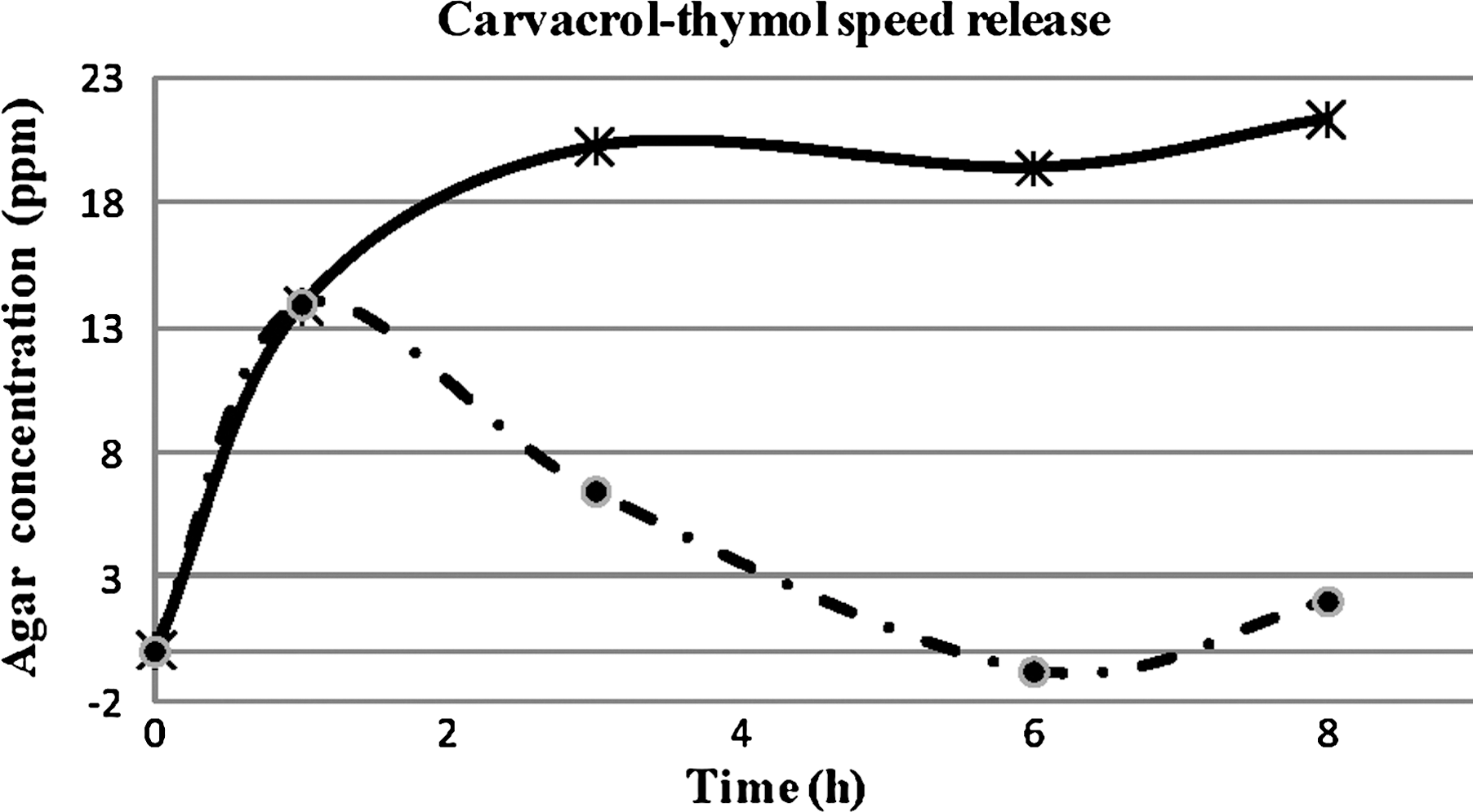
Active chemical release profile (solid line) and concentration detected in the agar (dashed line) as a function of time. PP active packaging based on oregano essential oil (as carvacrol-thymol).
To understand the different efficiency for different films, the concentration of active agents in the agar at different times (1, 3, and 12), coming from the different films (PP and PE/EVOH), was analyzed from the values obtained. It was concluded that in the interval from 1 to 3 hours the concentration is higher for PP, but after 12 hours the concentration of active compounds coming from PP is lower than that released by PE/EVOH, as can be seen in Figures 3 and 4, for cinnamaldehyde and thymol-carvacrol. This means that the release from PP is faster than from PE/EVOH, and explain why is necessary to increase the concentration of active compounds in the latter material. This behavior could be attributed to the presence of EVOH in the laminate, which strongly links the polar compounds and exerts an important role of fixing them in the plastic material.
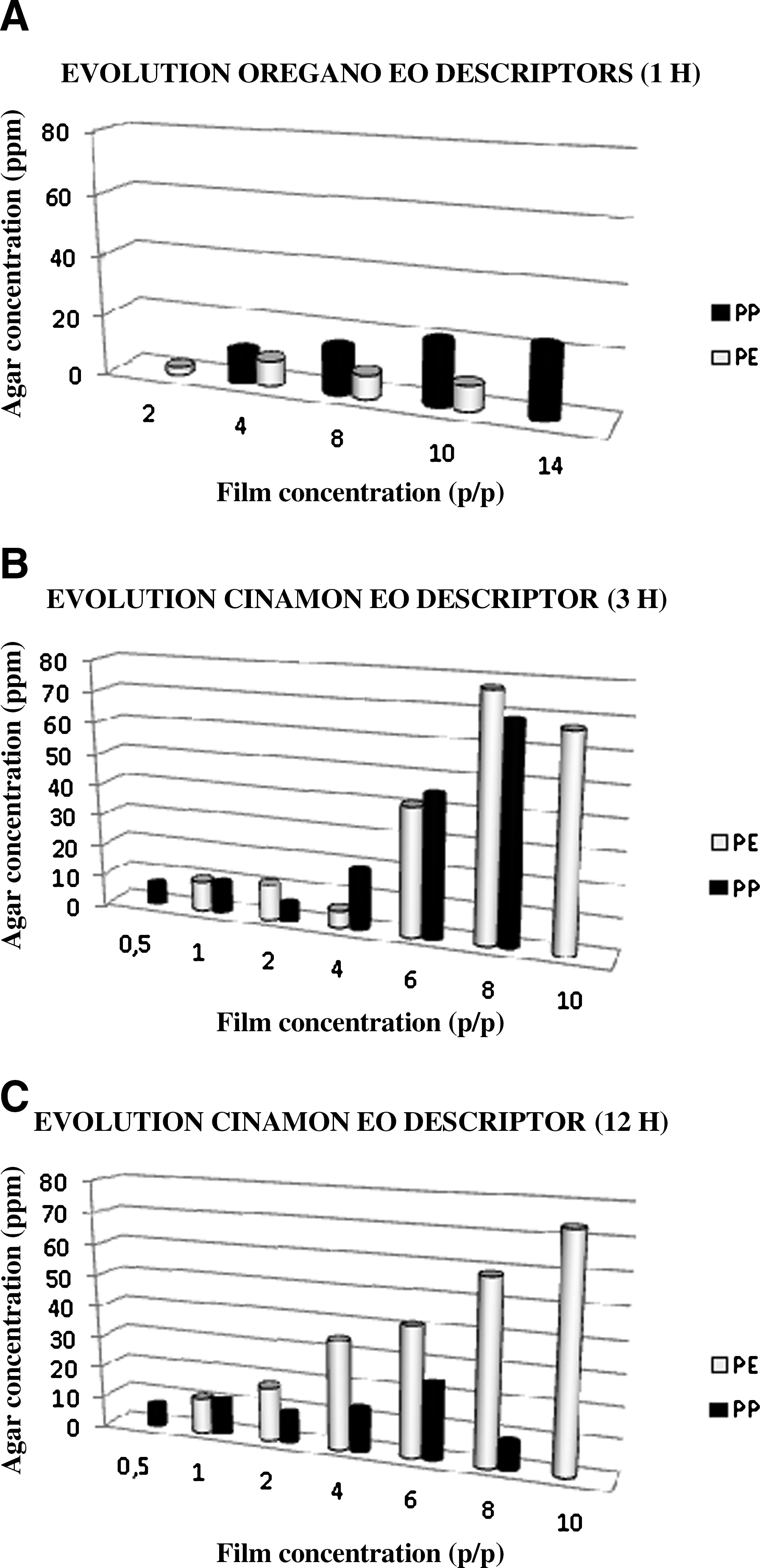
Evolution of cinnamon descriptor with time for different films (
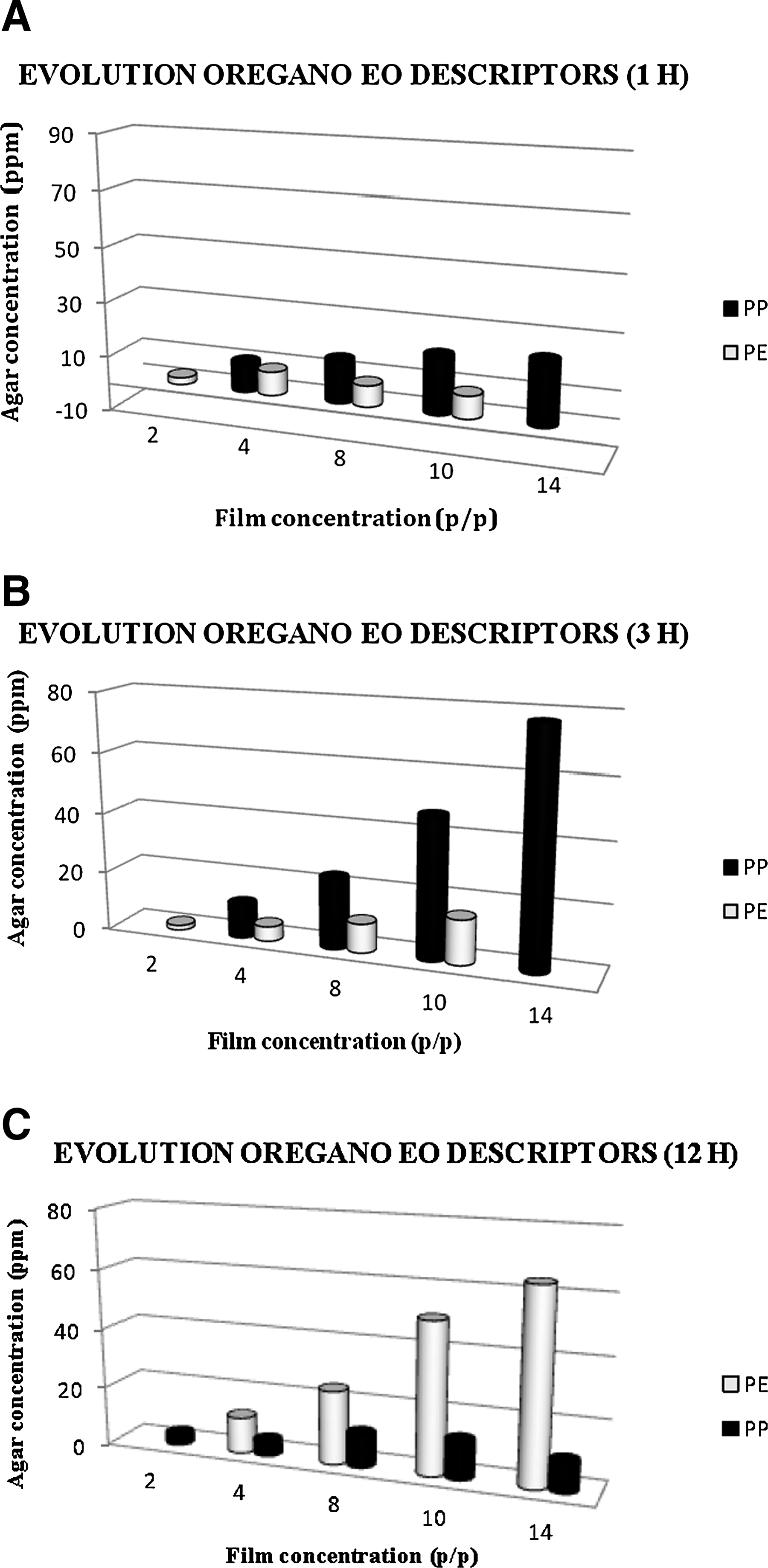
Evolution of oregano descriptors with time for different films (
Finally, it is very interesting to compare the concentrations of the descriptors in the agar as a function of time and the successful and unsuccessful active solutions. The data shown in Table 3 demonstrate a clear relationship between the concentration of the active chemicals in the agar and the inhibitory effect. It is hypothesized that there could be additional chemicals responsible for the inhibition. In fact, more terpene-like chemicals were detected in the agar, such as linalool, camphor, and borneol, than in the atmosphere. The time when the concentration is achieved is critical, as demonstrated by the results obtained for A. flavus displayed in the Table 3.
This phenomenon is the key to understanding the different behavior of different films, as it is necessary to reach a minimum concentration of active compounds in the agar during the lag phase of the microorganism. Such a release is quicker from PP than from PE-EVOH, so the initial concentration in the plastic could be lower in PP than in PE/EVOH, to get the same results. Thus, a critical point in the design of a new active packaging is the material used, and not only the active compound selected. This statement is now supported by the values, and not only implied by the global results of antimicrobial properties.
Also, in the case of oregano, the highest speed of release from PP is reached at a time of 1.5 hours, as shown in Figure 4, so maybe the critical concentrations are reached before 3 hours, but there are no results for that time.
The reported results displayed in Tables 2 and 3 also provide additional confirmation for both the MIC and the explanation introduced by Juve et al. (1994) about the effect of these chemicals on microorganisms. In other words, an increase in the amount of preservative included in the material is not directly related with an increase in the antimicrobial effect. It is concluded that since the effect of these chemicals take place by binding them to specific sites of the cytoplasmic membrane, the effect will be evident only when these sites are occupied to a certain extension.
Concerning the sensory perception of the food packaged with this new active packaging, a sensory study was carried out (Gutiérrez et al., 2009a) using the same active packaging here studied and different combinations of the active agents and several food aromas. The results confirmed that the active packaging is compatible with most of the food aromas.
Conclusions
The study carried out demonstrated that cinnamon and oregano EOs incorporated in the packaging material such as PP or PE-EVOH provide them with antimicrobial properties, being cinnamaldehyde, thymol, and carvacrol, their major components, the main chemical descriptors of such antimicrobial properties. However, this study showed that not only the concentration of these chemical descriptors, but also the kinetic of release and the polymer play an important role. It is necessary to reach a minimum concentration of active compounds in the agar during the lag phase of the microorganism to inhibit their growth, and this occurs faster with active PP than with active PE-EVOH. An increase in the concentration of the active compounds in the polymer does not correspond to an increase in its antimicrobial properties, as they depend on the number of occupied binding sites in the cytoplasmic membrane. Sensory analysis carried out in a previous article confirmed that this active packaging could be safely used without modifying the sensorial profile of the packaged food.
Footnotes
Acknowledgments
This work has been funded by the Research Projects Cal03-080 from INIA and FEDER; AGL2004-07545 from the Spanish Ministry of Education and University and FEDER and INTERREG IIIA-5-326 C. L.G. acknowledges the Spanish Ministry of Education and University for a grant (BES-2005-10186). R.B. expresses his gratitude to the former Spanish Ministry of Science and Technology for personal funding through the Ramón y Cajal program.
Disclosure Statement
No competing financial interests exist.