




Abstract
This study investigated the efficacy of plant-derived antimicrobials, namely, trans-cinnamaldehyde, β-resorcylic acid, carvacrol, thymol, and eugenol or their combination, in increasing the sensitivity of Salmonella Typhimurium DT104 to five antibiotics. The subinhibitory concentrations of each antimicrobial or their combination containing concentrations lower than the individual subinhibitory concentrations were added to tryptic soy broth supplemented with antibiotics at their respective break points for resistance. Salmonella Typhimurium DT104 was inoculated into tryptic soy broth at ∼6 log CFU/mL, and growth (optical density at 600 nm) was determined before and after incubation at 37°C for 24 hours. Appropriate controls were included. Duplicate samples were assayed and the experiment was replicated three times. Trans-cinnamaldehyde increased the sensitivity of Salmonella Typhimurium DT104 (p < 0.05) toward all five antibiotics, namely, ampicillin, chloramphenicol, streptomycin, sulfamethoxazole, and tetracycline, thereby making the pathogen susceptible to drugs. Thymol made the pathogen susceptible to all four antibiotics except ampicillin, whereas carvacrol increased the sensitivity to two antibiotics (chloramphenicol and sulfamethoxazole for strain H3380, and streptomycin and sulfamethoxazole for strain 43). The combination of five molecules was more effective than individual ones (p < 0.05) in rendering the pathogen susceptible to the antibiotics. Results indicate that these natural molecules individually and synergistically increased the sensitivity of Salmonella Typhimurium DT104 to all the five antibiotics, and justify future studies to control antibiotic resistance of the pathogen in food animals using these plant molecules.
Introduction
An estimated range of 59,200–296,000 cases of DT104 infections occur in the United States accounting for a loss of ∼$360–$900 million annually (Hogue et al., 1997). The prevalence of Salmonella Typhimurium DT104 infection has increased from a scanty 0.6% of human isolates in 1979 to 23% in 2004 (CDC, 2007). A wide range of animals and birds, including cattle, calves, goats, sheep, pigs, chickens, turkeys, ducks, geese, and game birds, can act as reservoirs of Salmonella Typhimurium DT104, with significant incidence rates noticed in cattle and pigs (Perron et al., 2007). It is widely accepted that Salmonella Typhimurium DT104 strains are spread from cattle to pigs and humans, underscoring its zoonotic transmission and existence in natural environment. Moreover, several common food products such as roast beef, pork sausage, cooked meats, chicken legs, unpasteurized milk, and cheese serve as potential vehicles. Recently, it has been reported that ampicillin resistance could be transferred from Salmonella Typhimurium DT104 strains to other bacteria such as Escherichia coli K12 in model food systems like milk and meat in vitro at temperatures as low as 15°C (Walsh et al., 2008), and during sausage and cheese fermentation (Cocconcelli et al., 2003).
The use of natural antimicrobial molecules for inactivating pathogenic microorganisms has received renewed attention due to concerns for toxicity of synthetic chemicals (Cleveland et al., 2001; Salamci et al., 2007). Plants have served as a source for development of novel drugs, thereby contributing to human health and well-being. A variety of plant-derived polyphenols serve as dietary constituents as well as active components in a number of herbal and traditional medicines. The antimicrobial properties of several plant-derived essential oils have been demonstrated (Burt, 2004; Holley and Patel, 2005) and a variety of active components of these oils have been identified. Trans-cinnamaldehyde (TC) is an aromatic aldehyde present as a major component of bark extract of cinnamon (Cinnamomum zeylandicum). Carvacrol (CAR) and thymol (THY) are antimicrobial ingredients in oregano oil obtained from Origanum glandulosum. Similarly, eugenol (EUG) is an active ingredient in the oil from cloves (Eugenia caryophillis). β-Resorcylic acid (BR; 2, 4 dihydroxy benzoic acid) is a phytophenolic compound widely distributed among the angiosperms, and is a secondary metabolite that plays a key role in the biochemistry and physiology of plants (Friedman et al., 2003). All the aforementioned molecules are classified as generally regarded as safe by the U.S. Food and Drug Administration.
Previous research conducted in our laboratory revealed that TC, EUG, CAR, and THY were effective in inactivating major mastitis pathogens in milk (Ananda Baskaran et al., 2009), and TC inactivated Salmonella Enteritidis and Campylobacter jejuni in chicken drinking water (Kollanoor Johny et al., 2008). These compounds have also been reported to exhibit antimicrobial activity against Salmonella Typhimurium and Salmonella Typhimurium DT104 (Friedman et al., 2002; Si et al., 2006; Feng et al., 2007).
The objective of our study was to determine the efficacy of subinhibitory concentrations (SICs) of TC, EUG, THY, CAR, and BR independently or in combination in increasing the sensitivity of Salmonella Typhimurium DT104 to ampicillin, chloramphenicol, streptomycin, sulfonamide (sulfamethoxazole), and tetracycline.
Materials and Methods
Bacterial cultures and growth conditions
Two strains of Salmonella Typhimurium DT104, namely, H3380 (CDC, human strain) and 43 (pork strain), were used in the study. Each strain was cultured separately in 10 mL of tryptic soy broth (TSB; Difco, Sparks, MD) at 37°C for 24 hours with agitation (100 rpm) to reach an optical density at 600 nm (OD600) of ≥0.7 yielding ∼9 log10 CFU/mL. The cultures were sedimented by centrifugation (3600 g, 15 minutes, 4°C), and the pellet was washed twice, resuspended in sterile phosphate-buffered saline (pH 7.3), and used as the inoculum. The bacterial population of the cultures was determined by plating 0.1 mL portions of appropriate dilutions on xylose lysine desoxycholate (XLD) agar (Difco) and tryptic soy agar (TSA) plates (Difco), with incubation at 37°C for 24 hours.
Antibiotics and antibiotic resistance testing
Both strains of Salmonella Typhimurium DT104 were confirmed for multiple antibiotic resistance by broth dilution assay in 24-well tissue culture plates (CLSi, 2006). Briefly, duplicate wells containing 2 mL of TSB were inoculated with ∼6.0 log CFU of bacteria in the presence of antibiotics at their respective breakpoints for resistance, as described by CLSI (Rajić et al., 2004; CLSi, 2006; Farzan et al., 2008). Resistance breakpoint of an antibiotic is defined as the concentration at or above which the strain is resistant (Turnidge and Bell, 2005; Van Eldere, 2005). The antibiotics screened were ampicillin (Fisher Scientific, Fairlawn, NJ) at 32 μg/mL, chloramphenicol (Sigma Aldrich, St. Louis, MO) at 32 μg/mL, streptomycin (Fisher Scientific) at 32 μg/mL, sulfamethoxazole (Research Products International Corp., Mt. Prospect, IL) at 512 μg/mL, and tetracycline (MP Biomedical Inc., Aurora, OH) at 16 μg/mL. The cultures were incubated at 37°C for 24 hours in a reciprocal shaker incubator (New Brunswick Scientific Co. Inc., Edison, NJ), followed by determination of OD600 in a microplate reader (Model 550; Bio-Rad, Hercules, CA) (Nazer et al., 2005). The culture was also streaked on TSA and XLD agar plates supplemented with respective concentrations of antibiotics, and incubated at 37°C for 24 hours.
Plant molecules and determination of SICs
TC, CAR, THY, EUG, and BR were purchased from Sigma Aldrich. Stock solutions of these molecules were prepared in absolute ethanol (Nazer et al., 2005). To duplicate tissue culture plate wells containing 2 mL of TSB inoculated with ∼6.0 log CFU Salmonella Typhimurium DT104, 1–10 μL of stock solutions of each molecule with an increment of 0.5 μL was added. The plates were then incubated in a shaker incubator at 37°C for 24 hours, and bacterial growth was monitored by determining OD600, and plating on TSA and XLD plates. The highest concentration of each plant molecule that did not inhibit bacterial growth after 24 hours of incubation was selected as the SIC of the molecule. Duplicate samples were included and the experiment was replicated three times.
Effect of plant molecules on antibiotic resistance
To determine if the plant molecules increased the sensitivity of Salmonella Typhimurium DT104 to antibiotics, the SIC of each molecule was added to duplicate wells of 24-well polystyrene tissue culture plates containing 2 mL TSB inoculated with 0.1 mL (∼6 log10 CFU) of the bacterial culture and supplemented with each antibiotic at the respective breakpoint for resistance. Additionally, to study the synergistic effect of the five molecules in combination (COMB) to increase the sensitivity of Salmonella Typhimurium DT104 to ACSSuT, a cocktail containing each of the five compounds at less than the respective SIC was added to the wells. COMB contained TC, EUG, CAR, TH, and BR at final concentrations of 85 μg/mL EUG, 84 μg/mL TC, 78 μg/mL CAR, 14 μg/mL BR, and 12 μg/mL THY in each treatment well. These concentrations were selected from a series of preliminary experiments, where several 10-fold diluted combinations of the five plant molecules were tested for increasing the sensitivity of Salmonella Typhimurium DT104 to all the five antibiotics. Final concentration of alcohol in the treatment wells was 0.35%v/v. Suitable controls, including positive control (TSB+DT104), negative control (TSB−DT104), positive antibiotic control (TSB+DT104, +antibiotic), negative antibiotic control (TSB−DT104, +antibiotic), positive molecule control (TSB+DT104, +molecule), negative molecule control (TSB−DT104, +molecule), and alcohol control (TSB+DT104, +0.35% alcohol), were included.
The tissue culture plates were incubated at 37°C for 24 hours in a reciprocal shaker incubator. Each well was mixed with a 1 mL pipette, and 0.2 mL portions were transferred to a 96-well polystyrene cell culture plate for OD600 determination in a microplate reader (Nazer et al., 2005). Appropriate blanks were included. Duplicate samples were included for each treatment and the experiment was replicated three times.
Statistical analysis
For the absorbance data, each well was considered as an experimental unit and a completely randomized 5 × 6 (five antibiotics and six treatments) factorial design was used. The data from three trials were averaged and analyzed with the Proc-mixed version of Statistical Analysis Software (version 9.2; SAS Institute Inc., Cary, NC). Differences among the means were considered significant at p ≤ 0.05 and were detected using Fisher's least significant difference test, with appropriate corrections for multiple comparisons.
Results
The SICs of various plant molecules that allowed the growth of Salmonella Typhimurium DT104 isolates as in positive control (TSB+DT104) are provided in Table 1. The analysis of the absorbance data revealed a significant interaction effect (p < 0.0001) between the plant molecules and antibiotics in reducing the growth of the bacterium. Although Salmonella Typhimurium DT104 grew in the presence of all the antibiotics, bacterial growth was significantly (p < 0.05) lesser in the presence of tetracycline and chloramphenicol in comparison to that with other antibiotics. However, in the presence of ampicillin, streptomycin, or sulfamethoxazole, Salmonella Typhimurium DT104 grew to the maximum density as in the positive controls. The mean absorbance in the negative control (TSB alone) was zero at 0 and 24 hours of incubation, and that in alcohol control (1.1 ± 0.02) was similar to the mean absorbance in positive control (1.1 ± 0.02).
SIC, subinhibitory concentration; XLD, xylose lysine desoxycholate; TSA, tryptic soy agar.
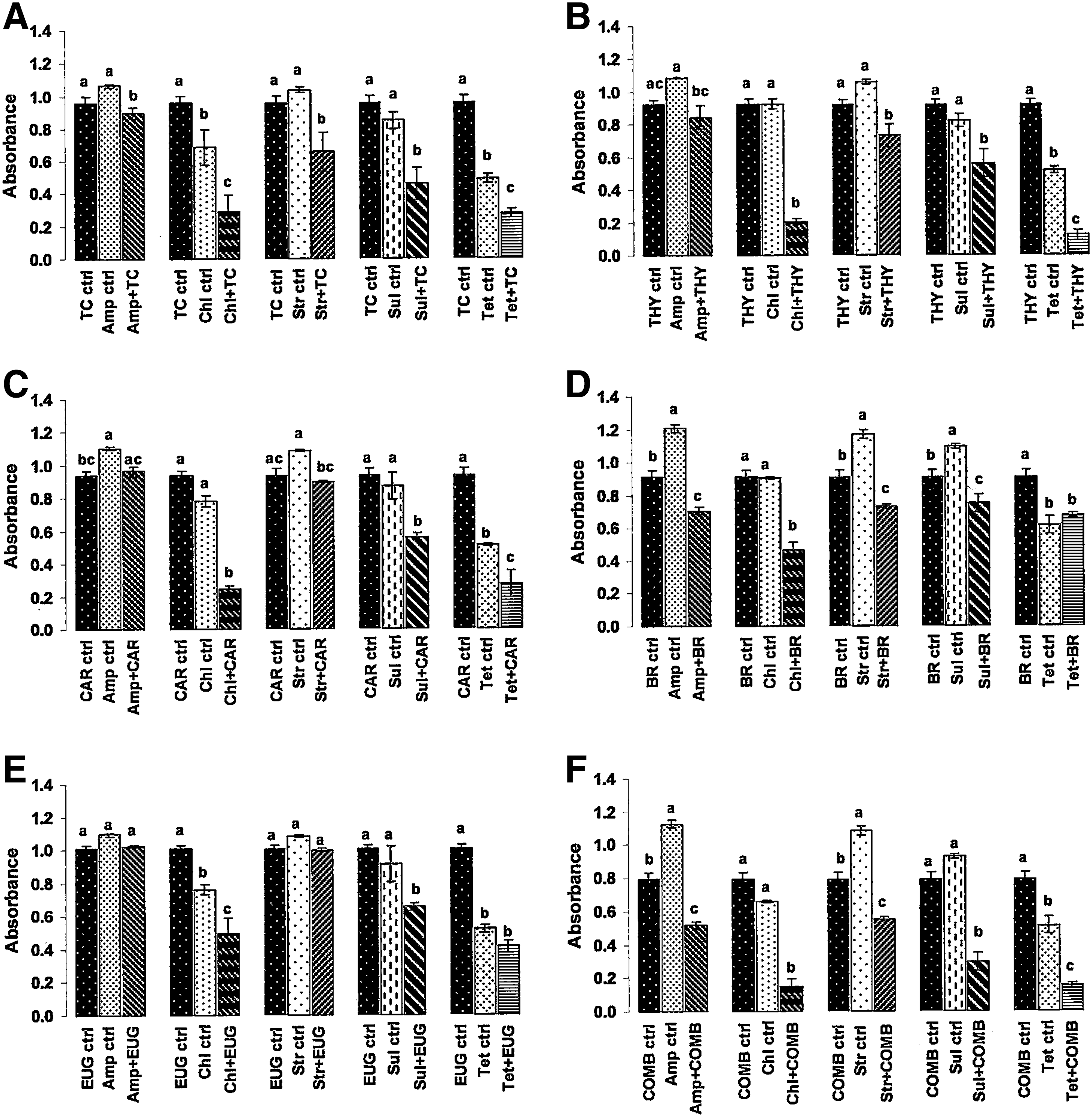
The effect of various plant molecules and their combination on the sensitivity of Salmonella Typhimurium DT104 strain H3380 to the five antibiotics is depicted in Figure 1A–F. Compared to the respective controls, TC increased the sensitivity of the pathogen to all the five antibiotics (p < 0.05), as evidenced by the decreased absorbance values for samples containing the plant molecule and antibiotic (Fig. 1A). THY was found to increase the sensitivity of the bacterium to all the antibiotics (p < 0.05) except ampicillin (Fig. 1B), whereas CAR made the pathogen sensitive to chloramphenicol, sulfamethoxazole, and tetracycline (p < 0.05) (Fig. 1C). BR was also effective in increasing the sensitivity of the strain H3380 to all the antibiotics (p < 0.05), excluding tetracycline (Fig. 1D). However, EUG was least effective among the five plant molecules, making the bacterium sensitive to only two antibiotics (p < 0.05), namely, chloramphenicol and sulfamethoxazole (Fig. 1E). On the contrary, the COMB was very effective in modulating the antibiotic resistance of Salmonella Typhimurium DT104 strain H3380; the pathogen growth was significantly suppressed (p < 0.05) compared to the controls (Fig. 1F).
Effect of (
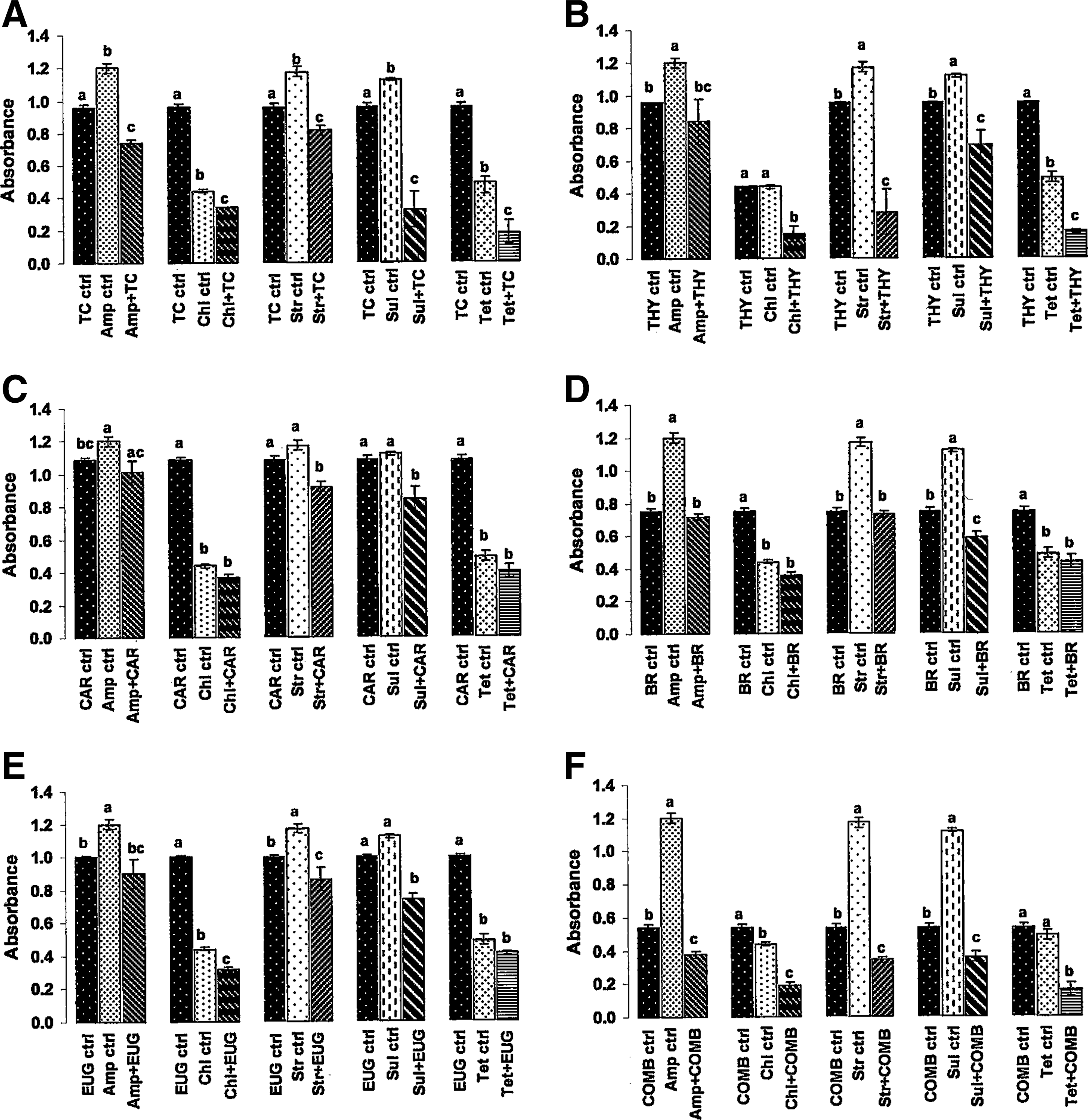
The effect of various plant molecules and their combination on the sensitivity of Salmonella Typhimurium DT104 strain 43 to the five antibiotics is depicted in Figure 2A–F. The effect of TC and THY on increasing the sensitivity of strain 43 to antibiotics was similar to that observed with H3380. TC was effective in increasing the sensitivity to all five antibiotics (p < 0.05) (Fig. 2A), whereas THY increased sensitivity to four antibiotics (p < 0.05) except ampicillin (Fig. 2B). EUG made the strain more sensitive to chloramphenicol, streptomycin, and sulfamethoxazole (p < 0.05) (Fig. 2E). Additionally, CAR was significantly effective (p < 0.05) in sensitizing the pork strain to streptomycin and sulfamethoxazole (Fig. 2C) instead of three antibiotics in H3380 (Fig. 1C). It was observed that BR could increase the sensitivity of strain 43 to only sulfamethoxazole (p < 0.05) as against four antibiotics in strain H3380 (Fig. 2D). The COMB group significantly increased the sensitivity of the strain 43 to all antibiotics (p < 0.05) compared to individual treatments.
Effect of (
Among the five antibiotics tested, ampicillin resistance was found to be the most difficult to modulate by the plant molecules in both the strains of Salmonella Typhimurium DT104. However, TC and the combination of all the five plant molecules were able to reduce the ampicillin resistance of both strains significantly (p < 0.05).
Discussion
A wide variety of antibiotics are used at subtherapeutic levels in animal production worldwide (Sarmah et al., 2006; Silbergeld et al., 2008), favoring the selection of resistant bacteria, including Salmonella Typhimurium DT104 in food animals (Van Duijkeren et al., 2003; Varga et al., 2008). Since Salmonella Typhimurium DT104's resistance to multiple antibiotics is chromosomally mediated, the removal of selective pressure from these antibiotics would not possibly reverse the resistance (Humprey, 2001). Therefore, we investigated the efficacy of SICs of plant-derived antimicrobial molecules for increasing the pathogen sensitivity to the five antibiotics, including ampicillin, chloramphenicol, streptomycin, sulfamethoxazole, and tetracycline. Although numerous studies have investigated the antimicrobial effect of a variety of plant molecules on various pathogenic bacteria (Friedman et al., 2002, 2003; Si et al., 2006; Feng et al., 2007; Kollanoor Johny et al., 2008; Ananda Baskaran et al., 2009), only limited information is available on their effect on bacterial antibiotic resistance. A recent study reported that TC decreased clindamycin resistance in Clostridium difficile, a Gram-positive bacterium (Shahverdi et al., 2007).
Since the antibiotics and plant molecules were used at their breakpoints and SICs, respectively, the reduced growth of Salmonella Typhimurium DT104 observed in the presence of antibiotics and phytophenolics, in comparison to that in samples containing antibiotic or plant molecule alone, indicates increased pathogen sensitivity to the antibiotics mediated by the natural molecules. All the five tested phytophenolics were effective in making Salmonella Typhimurium DT104 susceptible to one or more antibiotics. Among the various molecules, TC and THY were significantly (p < 0.05) more effective than the other phytophenolics in increasing bacterial sensitivity to antibiotics. Moreover, the combination of all the plant molecules at less than their respective SICs was highly effective (p < 0.05) in reducing antibiotic resistance in the pathogen, thereby suggesting a synergistic effect among the phytophenolics.
Salmonella Typhimurium DT104 has been reported to possess multiple genes encoding antibiotic resistance. These include bla PSE-1 that encodes class A β-lactamase PSE-1, and ant (3′′)-Ia (aadA), encoding ANT (3′′)-I responsible for resistance to streptomycin and spectinomycin by modifying different residues on the active sites of these antibiotics (Ridley and Threlfall, 1998; Briggs and Fratamico, 1999). In addition, DT104 expresses a cmlA homolog that mediates chloramphenicol resistance, sul1 that code for a dihydropteroate synthase giving resistance to sulfonamides, and tetA that encodes an efflux pump that mediates resistance to tetracycline (Briggs and Fratamico, 1999). Additional mechanisms that confer antibiotic resistance in bacteria include antibiotic-impermeable cell membrane or lack of transport systems necessary for antibiotic uptake. Moreover, bacteria could synthesize inactivators/enzymes such as trans-peptidase (for ampicillin resistance), trans-acetylase (for chloramphenicol resistance), and a membrane-bound protein (for streptomycin resistance), capable of deactivating antibiotics (Brooks et al., 1998).
Although it is not clear how the plant molecules decreased the antibiotic resistance of Salmonella Typhimurium DT104, the following potential mechanisms are suggested. Since plant essential oils and their components are hydrophobic in nature, they primarily target the lipid-containing bacterial plasma membrane, making the membrane more permeable (Carson et al., 2002; Ultee et al., 2002). This change in permeability of bacterial plasma membrane brought about by the plant molecules could have permitted an increased uptake of antibiotics by the bacterial cell. It is also possible that the phytophenolics at their SICs could have sublethally injured Salmonella Typhimurium DT104, thereby increasing bacterial sensitivity to the antibiotics. Another plausible explanation is that after entering the bacterial cell, the plant molecules inhibited the efflux pumps responsible for reduced antibiotic concentration within the cell. Currently, further studies exploring the mechanism(s) behind the phytophenolic-mediated antibiotic sensitivity in Salmonella Typhimurium DT104 are underway in our laboratory.
Conclusions
Results of this study indicate that TC, THY, CAR, EUG, and BR were effective in enhancing Salmonella Typhimurium DT104's sensitivity to one or more antibiotics. These molecules could potentially be used as feed supplements to reduce the antibiotic resistance in Salmonella Typhimurium DT104 in food animals.
Footnotes
Disclosure Statement
No competing financial interests exist.