




Abstract
Grass-fed and organic beef products make up a growing share of the beef market in the United States. While processing, animal handling, and farm management play large roles in determining the safety of final beef products, grass-fed beef products are often marketed as safer alternatives to grain-finished beef products based on the potential effects of all-forage diets on host microbiota. We conducted a series of experiments examining bacterial contamination rates in 50 beef products labeled as “grass-fed” versus 50 conventionally raised retail beef products. Coliform concentrations did not differ between conventional and grass-fed beef (conventional: 2.6 log10 CFU/mL rinsate; grass-fed: 2.7 log10 CFU/mL rinsate). The percentages of Escherichia coli positive samples did not differ between the two groups (44% vs. 44%). Enterococcus spp. were frequently isolated from both grass-fed beef products (44%) and conventional beef products (62%; p = 0.07). No Salmonella or E. coli O157:H7 isolates were recovered from any of the meat samples. Enterococcus spp. isolates from conventional beef were more frequently resistant to daptomycin and linezolid (p < 0.05). Resistance to some antimicrobials (e.g., chloramphenicol, erythromycin, flavomycin, penicillin, and tetracyline) was high in Enterococcus spp. isolated from both conventional and grass-fed beef. There were no differences in the percentages of antimicrobial resistant E. coli isolates between the two groups. Taken together, these data indicate that there are no clear food safety advantages to grass-fed beef products over conventional beef products.
Introduction
C
Grass-fed beef products are often marketed as safer alternatives to conventional beef products based on the potential impact of the all-forage diet on gut microbiota (McCluskey et al., 2005). There are other aspects of beef production that perhaps play larger roles than diet in the contamination rates of finished products. Foremost is how and where the products are processed. Most grass-fed cattle are processed by small and very small processors—a U.S. Department of Agriculture (USDA) classification of meat processors based upon their size and annual revenues (USDA, 2001). USDA Food Safety Inspection Service data indicate that meat produced in small and very small processors can have different contamination rates and characteristics compared with meat processed by large processors (USDA, 2008). Other management practices could also play large roles. Grass-fed cattle are most often on pasture, whereas conventional cattle are often finished in lots, which could affect transmission of microorganisms. Additionally, preventative antimicrobial use (direct-fed), which can significantly alter gut microbiology (Harmoinen et al., 2004), is usually lower with cattle on pasture.
We conducted a preliminary study to compare the rates and types of bacterial contamination in conventionally raised beef with beef labeled “grass-fed.” We measured several fecal contamination indicators as well as antimicrobial resistance profiles in Enterococcus spp. and E. coli isolates. We hypothesized that (1) grass-fed beef products would have higher overall contamination rates, resulting in higher pathogen contamination rates based on where and how the cattle were processed; and (2) more frequent use of antimicrobials in conventional beef production would result in greater antimicrobial resistance in bacteria isolated from conventional beef products.
Materials and Methods
Sample collection
Conventionally raised and “grass-fed” labeled beef retail samples were collected from retail outlets in Illinois and Indiana between July 2008 and March 2009. A total of 50 conventional beef retail samples were collected from four retail outlets. The 50 retail beef samples labeled as “grass-fed” were collected from 10 sources representing both retail outlets as well as more direct markets (farm stores or farmers' markets). All products were processed in USDA or state-inspected facilities. The conventional beef sample set included 34 solid cuts (e.g., steaks, stew meat, ribs, soup bones, etc.) and 16 ground beef samples. The grass-fed beef sample set included 33 solid cuts and 17 ground beef samples. On collection, all samples were immediately placed on ice for transport to the laboratory. Samples were then frozen at −20°C until processed.
Bacterial isolation
Each sample was screened for the presence of Enterococcus spp., total coliforms, generic E. coli, and E. coli O157:H7 using previously published protocols with some modifications (USFDA, 2006). Meat samples (25 g) were placed in sterile plastic bags containing 100 mL buffered peptone water (Becton Dickinson and Company) and washed at 22°C for 3 min to produce a rinsate. To isolate Enterococcus, rinsate samples (50 mL) were added to 50 mL of double-strength enterococcosel broth (Becton Dickinson and Company) and incubated at 45°C for 24 h. Enriched samples were then plated on enterococcosel agar plates (Becton Dickinson and Company) and incubated at 37°C for 24 h. Presumptive Enterococcus spp. colonies were confirmed by API (API Strep System; bioMérieux).
To isolate coliforms, rinsate samples were serially diluted (10-fold), plated on MacConkey agar (Becton Dickinson and Company), and incubated at 37°C for 24 h for enumeration (Finney et al., 2003; Feng et al., 1998). Colonies formed on MacConkey plates were identified as generic coliforms.
Pink-colored colonies formed on MacConkey medium were presumptively identified as E. coli. Such isolates were transferred to eosin-methylene blue medium (Becton Dickinson and Company) and violet red bile agar (Becton Dickinson and Company) before biochemical confirmation (API 20E; bioMérieux).
Salmonella was isolated using previously published protocols (Ebner and Mathew, 2000; USFDA, 2006). Rinsate samples were transferred to tetrathionate broth (Becton Dickinson and Company) or Rappaport-Vassiliadis R10 (Becton Dickinson and Company) broth and incubated at 37°C and 42°C, respectively, for 24 h. Overnight cultures were then plated on xylose lysine Tergitol 4 (XLT4) medium and incubated at 37°C overnight. Presumptive Salmonella colonies were transferred to triple sugar iron and lysine iron agar (LSA) slants before further biochemical confirmation (API 20E; bioMérieux).
To isolate E. coli O157:H7, rinsate samples (1 mL) were combined with 9 mL GN broth (Becton Dickinson and Company) supplemented with 50 μg/L cefixime and 10 mg/L cefsulodin and incubated at 37°C for 12 h. E. coli O157:H7 was immunoprecipitated from overnight cultures using Dynabeads (Invitrogen Dynal AS) and transferred to sorbitol MacConkey agar plates supplemented with cefixime (25 μg/L) and tellurite (1.25 mg/L). Presumptive E. coli O157:H7 isolates were tested for the presence of stx1 (primers: 5′-TAG TGG AAC CTC ACT GAC GC-3′ and 5′-TAG TGT GCG TAA TCC CAC GG-3′), stx2 (primers: 5′-GAC TAT CTT CAT TCA CGG CGC-3′ and 5′-GCC GGG TTG GTT AAT ACG GC-3′), and eae (primers: 5′-GCA TTT GGT CAG GTC GGA GC-3′ and 5′-ATC GAA GCC ATT TGC TGG GC-3′) by multiplex polymerase chain reaction.
Antimicrobial resistance testing
Antimicrobial resistance in Enterococcus spp. and E. coli isolates was tested by microbroth dilution according to protocols of the National Antimicrobial Resistance Monitoring System and the National Committee on Clinical Laboratory Standards (NCCLS, 2000; USFDA, 2006). E. coli isolates were tested using the CMV1AGNF panel (Trek Diagnostics). Enterococcus spp. isolates were examined using the CMV2AGPF panel (Trek Diagnostics).
For both E. coli and Enterococcus spp., individual isolates were chosen at random from positive meat samples. On average, two isolates per positive meat sample were tested. Isolates were inoculated into 3 mL Mueller-Hinton media (Becton Dickinson and Company) and grown to reach a 0.5 McFarland standard. Cultures were then combined (1:100 dilution) with diluted Mueller-Hinton (1:10 diluted by distilled water) and transferred (50 μL/well) to the 96-well plate. Minimum inhibitory concentrations (MICs) were recorded as the minimum concentration of each antimicrobial that completely inhibited bacterial growth. Breakpoint levels (i.e., resistant vs. susceptible) were based on those used by the National Committee on Clinical Laboratory Standards (NCCLS, 2000). In addition, MIC50 (antimicrobial concentration that inhibited 50% of tested isolates) and MIC90 (antimicrobial concentration that inhibited 90% of tested isolates) concentrations were calculated and compared for each tested isolate as previously described (Sapkota et al., 2007).
Statistical analysis
A two-sample Wilcoxon rank-sum test was used to compare the concentrations of coliforms between the two types of beef. Percentages of antimicrobial resistant Enterococcus spp. and E. coli between the two groups were compared using a chi-square and Fisher's exact test, respectively. Data were analyzed using the mixed procedure of SAS (version 9.01). Two-sample Wilcoxon rank-sum test and Fisher's exact test were performed using the FREQ procedure and NPAR1WAY procedure, respectively. Individual meat samples served as the experimental unit.
Results
Coliforms
Overall coliform contamination rates did not significantly differ (conventional beef: 2.6 log10 CFU/mL rinsate; grass-fed beef: 2.7 log10 CFU/mL rinsate; Fig. 1). Whole cuts were also analyzed separately from ground samples, and coliform contamination rates did not differ between the two types of beef (conventional beef cuts: 2.7 log10 CFU/mL rinsate; grass-fed beef cuts: 2.8 log10 CFU/mL rinsate; data not shown). The average concentration of coliforms isolated from ground beef samples also did not statistically differ (conventional ground beef: 2.1 log10 CFU/mL rinsate; grass-fed ground beef: 2.6 log10 CFU/mL rinsate; data not shown).
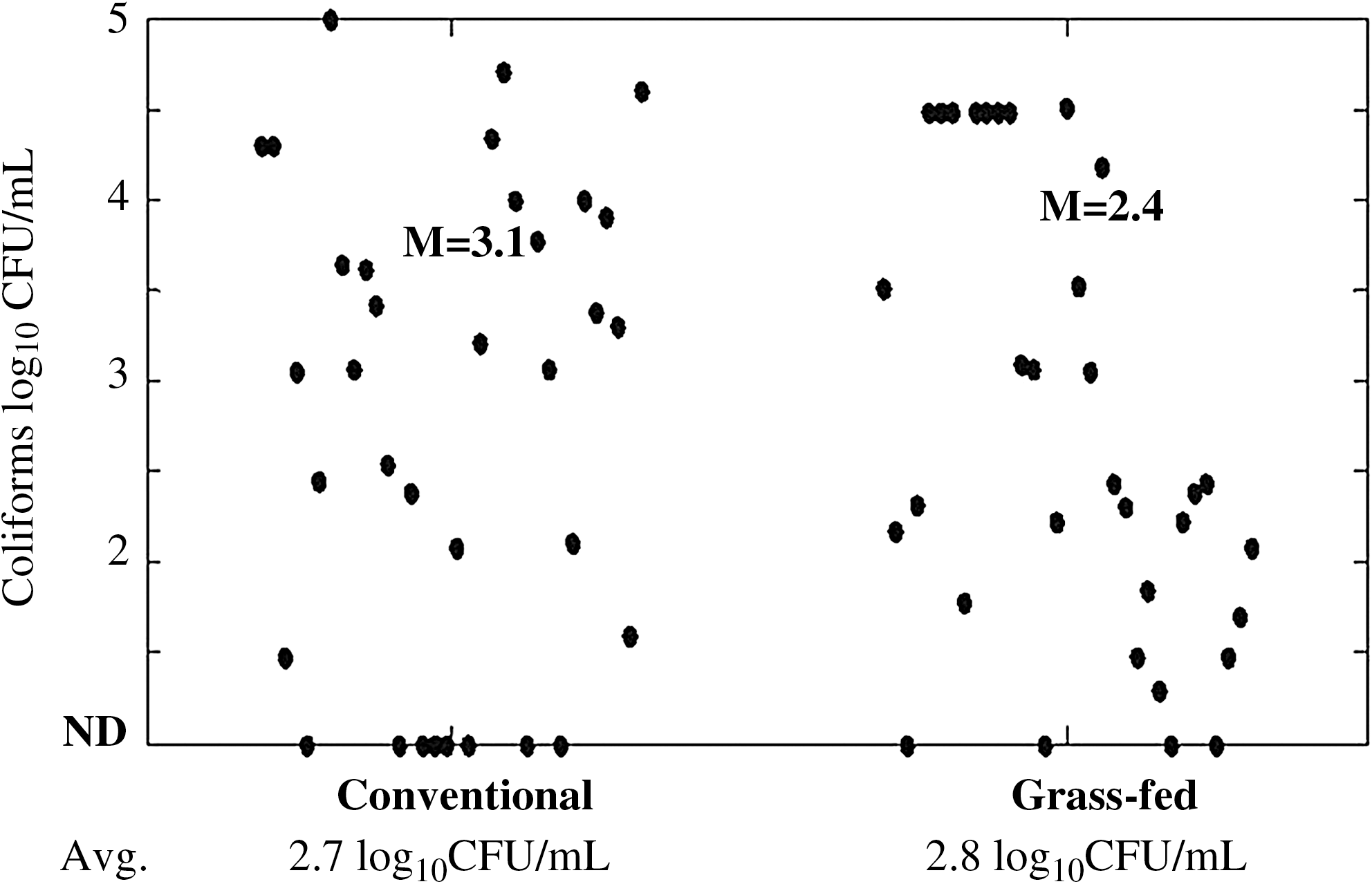
Coliform contamination rates (log10 CFU/mL) in conventionally raised beef versus grass-fed beef. Black dots represent individual samples. ND, not detectable (<10 CFU/mL rinsate); M, median; Avg., average.
Enterococcus spp.
Enterococcus spp. were isolated from 62% and 44% of the conventional and grass-fed beef samples, respectively (p = 0.07). The percentages of Enterococcus spp. positive samples from conventionally raised beef cuts and grass-fed beef cuts were 58.8% and 45.5%, respectively. These differences were not statistically significant (p = 0.27). The percentages of Enterococcus spp. positive samples in conventionally raised ground beef and grass-fed ground beef were 75.0% and 41.2%, respectively (p < 0.05; Table 1).
Figures with different superscripts are statistically different (p < 0.05). Comparisons are within columns and bacterial species.
Beef cuts and ground beef counts together.
E. coli
In each sample set, 44% of samples tested positive for E. coli contamination. The percentages of E. coli positive samples from conventionally raised beef cuts and grass-fed beef cuts were 41.2% and 27.3%, respectively. These differences were not statistically significant (p = 0.3). The percentages of E. coli positive samples in conventionally raised ground beef and grass-fed ground beef were 50% and 76.5%, respectively (p = 0.16; Table 1). When conventional and grass-fed samples were analyzed together, ground beef samples were more frequently E. coli positive compared with beef cuts (ground: 63.6%; cuts: 34.3%; data not shown).
Salmonella or E. coli O157:H7
There were no Salmonella or E. coli O157:H7 recovered from any beef samples using selective enrichment and culture procedures.
Antimicrobial resistance
There were no differences in the percentages of antimicrobial resistant E. coli isolated from conventional versus grass-fed beef. E. coli isolates from both groups were most frequently resistant to sulfisoxazole (grass-fed: 90%; conventional: 78.57%) followed by tetracycline (grass-fed: 17.50%; conventional: 14.29%; data not shown). Enterococcus spp. isolates obtained from conventional beef were more frequently resistant to daptomycin and linezolid (p < 0.05; Fig. 2) compared with isolates obtained from grass-fed beef samples.
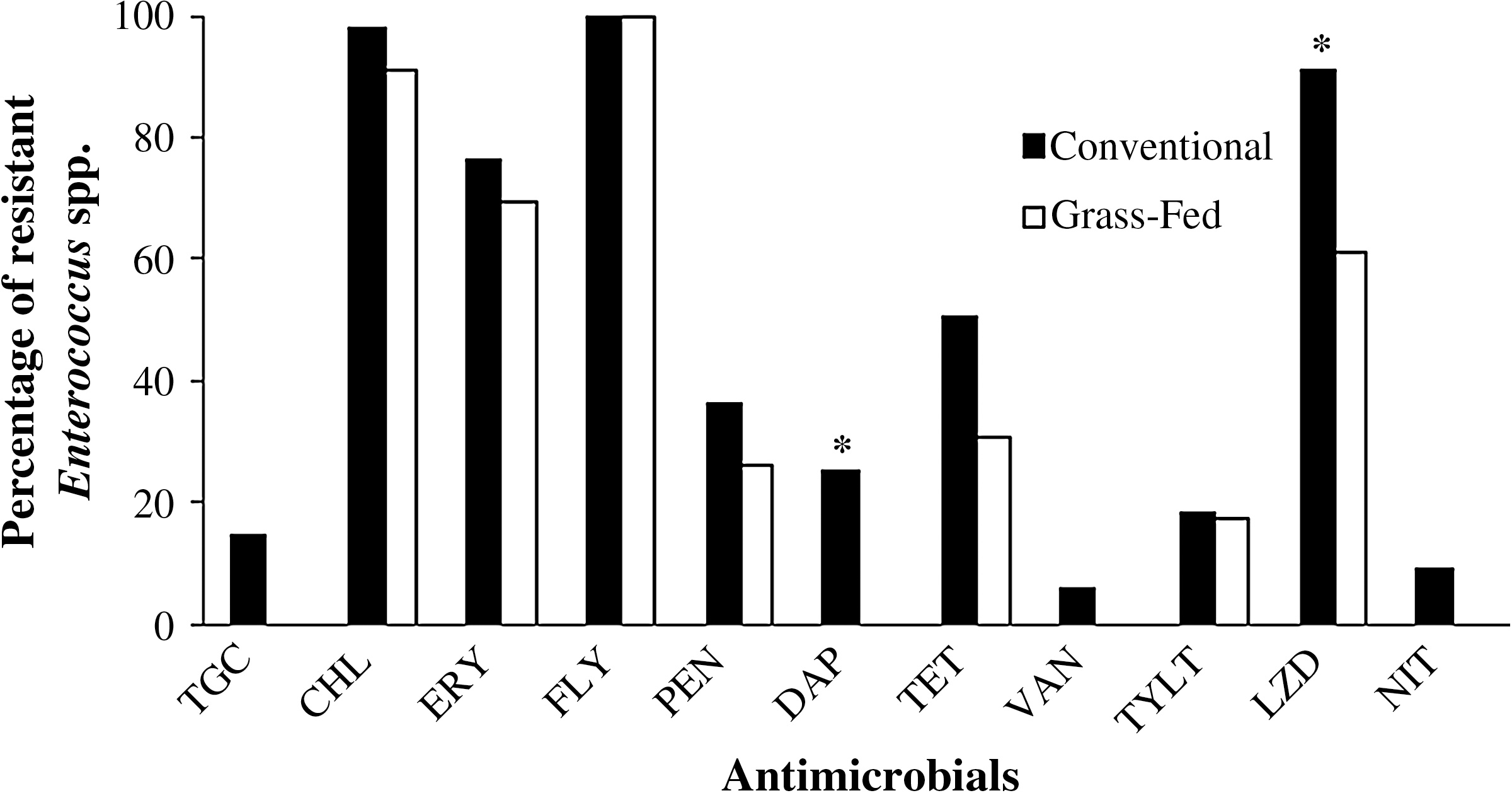
Percentages of antimicrobial resistant Enterococcus spp. isolated from conventional and grass-fed beef products. *Statistically significant differences (p < 0.05). Comparisons are within antimicrobial. TGC, tigecycline; CHL, chloramphenicol; ERY, erythromycin; FLV, flavomycin; PEN, penicillin; DAP, daptomycin; TET, tetracycline; VAN, vancomycin; TYLT, tylosin tartrate; LZD, linezolid; NIT, nitrofurantoin.
MIC of E. coli and Enterococcus spp. were also compared between the two groups. E. coli isolated from conventional beef samples had numerically higher MICs (MIC50 or MIC90) for cefoxitin, chloramphenicol, ceftriaxone, and ampicillin compared with isolates obtained from grass-fed beef samples (Table 2). Enterococcus spp. isolated from conventional beef samples had numerically higher MICs (MIC50 or MIC90) for tigecycline, chloramphenicol, erythromycin, and vancomycin (Table 3).
Differences were not observed in antibiotics not listed in the table. MIC, minimum inhibitory concentration.
Differences were not observed in antimicrobials not listed in the table.
Discussion
In the United States, grass-fed beef products are often marketed as safer than conventional beef products based on the all-forage or high fiber diet and its potential to limit the growth of pathogenic E. coli. Studies examining E. coli O157:H7 carriage rates in grass-fed versus conventionally raised (i.e., grain finished) cattle before harvest, however, have produced mixed results (Hovde et al., 1999; Callaway et al., 2003; Depenbusch et al., 2008; Jacob et al., 2009). Moreover, diet is only one factor that could affect contamination rates and characteristics. The grass-fed and conventional beef products in our sample set also differed considerably in how they were processed. The USDA classifies meat processors in the United States based on size and revenue (“very small,” “small,” and “large”). The grass-fed samples in our study were processed in small and very small processors, whereas the conventional samples were processed in large processors. Smaller processors share other characteristics and practices, apart from size, that differ from large processors and contamination type and rates are consistently different in finished products coming from smaller versus larger processors (Keener, 2007; USDA, 2008; Bosilevac et al., 2009). Therefore, it is likely that processing would play as great a role as diet in the overall safety of the final products. Thus, we undertook this preliminary study to examine the microbiological profiles of beef products labeled as “grass-fed” versus conventional beef products, taking into account all factors that influence contamination rates and types.
In our study, grass-fed beef and conventional beef products had similar contamination profiles with a few exceptions. There was an overall trend for conventional beef products to be more frequently contaminated with Enterococcus spp., with ground beef being more frequently positive. Similarly, there was a trend for ground grass-fed beef to be more frequently contaminated with E. coli compared with conventional ground beef. Similar to other studies, both grass-fed and conventional ground beef samples had higher contamination rates in comparison with their respective solid cuts (USDA, 2002; CDC, 2005). This is most likely due to trim, a main component of ground beef, having a greater likelihood of coming in contact with feces during processing.
Salmonella and E. coli O157:H7 were chosen as sentinel pathogens, as they are often associated with beef products (Fedorka-Cray et al., 1998; CDC, 2006; USFDA, 2006). Neither organism, however, was detected in any of our samples. The prevalence of pathogens in retail beef can be low, with some surveys reporting less than 2% and 1% Salmonella and E. coli O157:H7 contamination rates, respectively (Zhao et al., 2001; USFDA, 2006; Kennedy et al., 2006; USDA, 2009). Therefore, sample size was probably the largest factor in not recovering these pathogens from our samples.
In the United States, antimicrobials are used in livestock production in two basic manners: high doses for short periods to treat specific diseases; and low doses for sometimes longer periods, often direct fed, to prevent disease in general and/or promote growth (McEwen and Fedorka-Cray, 2002; Mathew et al., 2007). Although antimicrobial use histories were not collected from the farms, it is widely accepted that antimicrobial use is much lower in grass-fed beef production, as the nature of grazing makes consistent direct-fed administration of antimicrobials impractical.
In comparing breakpoints, the Enterococcus spp. isolated from conventional beef were more frequently resistant to daptomycin and linezolid. In E. coli, high rates of tetracycline and sulfisoxazole resistance were observed for both sample sets. Tetracycline resistance rates in our study were similar to those reported in the latest FDA National Antimicrobial Resistance Monitoring System report as well as other similar studies (USFDA, 2006; Fluckey et al., 2007). Levels of sulfisoxazole resistance, however, were higher in our study. This is most likely due to subjectivity in gauging resistance to sulfa-based drugs (Woods et al., 1999). Both E. coli and Enterococcus spp. isolated from conventionally raised beef, however, frequently had higher MIC50 and MIC90 values, respectively, demonstrating a possible trend for bacteria isolated from conventional beef products to be more antimicrobial resistant.
In some cases (e.g., chloramphenicol, erythromycin, flavomycin, penicillin, and tetracyline), resistance was still relatively high in Enterococcus spp. isolated from grass-fed beef products. Unlike organic beef production, no regulations exist that prohibit antimicrobial use in grass-fed beef production; and the use of antimicrobials to treat specific diseases increases the prevalence of resistance in the same manner that preventative use does. Erythromycin (New Animal Drug Application [NADA] 012-123), penicillin (NADA 065-110), and oxytetracycline (NADA 008-769) are each approved as injectables for cattle in the United States. While chloramphenicol is not used in food animal production in the United States, florfenicol is approved as an injectable in beef cattle production (NADA 141-265); and cross-resistance between these two drugs is common (Singer et al., 2004).
Alternatively, high levels of antimicrobial resistance are not necessarily directly associated with the use of the antimicrobial. Antimicrobial resistance genes are often linked to unrelated genes on mobile elements. This is especially true in the case of chloramphenicol, where resistance levels can remain high, and even increase, in the absence of the drug due to coselection of neighboring genes (Schwarz et al., 2006).
It should be noted that the Enterococcus spp. isolates in our sample set were analyzed as a genus. Some Enterococcus species have higher levels of intrinsic resistance to different antimicrobials. As an example, Enterococcus gallinarum and other VanC carrying species display intermediate resistance to vancomycin; and Enterococcus facium are more often resistant to penicillins and quinolones than Enterococcus faecalis (Leclercq et al., 1992; USFDA, 2006). In the case of daptomycin and linezolid resistance, it is entirely possible that our sample set contained enterococci with some amount of intrinsic resistance, as resistance to these antimicrobials in most Enterococcus spp. is still quite low. Therefore, a more comprehensive and molecular characterization of the Enterococcus spp. isolates is needed to better determine the true implications of these differences.
The grass-fed beef samples were not labeled as organic. In the United States, meat products labeled as organic must be processed in a certified organic processor. Single facilities can process both organic and nonorganic meat but not at the same time, and lines must be cleaned between the two groups (USDA, 2010). No such standards exist for grass-fed beef processing, and cattle can be held together in lairage and processed simultaneously. Therefore, cross-contamination between grass-fed and conventional beef during processing could also account for antibiotic resistant Enterococcus spp. found on grass-fed products.
Taken together, these preliminary experiments indicate that grass-fed beef products do not have clear advantages over conventionally raised beef products in terms of food safety. E. coli and Enterococcus spp. were frequently isolated from both types of beef. The high level of resistance to some antimicrobials seen in Enterococcus spp. isolated from both types of beef deserves further examination. Future studies should more comprehensively examine the transmission of both these organisms on the farm but, perhaps more importantly, throughout the postfarm environment. It will be necessary to collect and compare pretransport fecal samples from cattle under different management systems with samples from transport trailers, holding pens and processors to determine the likely sources of the contaminants found on final products. As previously mentioned, these sources may differ based on the type and size of the processor. Nevertheless, the results could be used to develop intervention strategies that could eliminate or limit contamination at these critical control points.
Footnotes
Disclosure Statement
No competing financial interests exist.