




Abstract
In this study, the effects of the incorporation of some herbal teas at different concentrations into the ice cream mix on the population of Listeria monocytogenes were studied using Taguchi method. The ice cream mix samples flavored with herbal teas were prepared using green tea and sage at different concentrations. Afterward, fresh culture of L. monocytogenes was inoculated into the samples and the L. monocytogenes was counted at different storage periods. Taguchi method was used for experimental design and analysis. In addition, some physicochemical properties of samples were examined. Results suggested that there was some effect, although little, on the population of L. monocytogenes when herbal tea was incorporated into the ice cream mix. Additionally, the use of herbal tea caused a decrease in the pH values of the samples and significant changes in the color values.
Introduction
There have been various studies in the literature about the antioxidative and antimicrobial properties of certain plants, vegetables, and fruit extracts (Kahkonen et al., 1999; Sagdic et al., 2002, 2003). Green tea (Camellia sinensis L.) is commonly consumed as a hot beverage in the Far East countries such as China (Hamilton-Miller, 1995). Green tea contains a high amount of natural polyphenols, of which catechins are the major components (Leung et al., 2001). Green tea was incorporated into ice cream to flavor the product (Kubo et al., 1992). It has been shown that green tea extracts or polyphenols had antimicrobial activity against some bacteria, protozoa, and viruses (Hamilton-Miller, 1995; Sakanaka et al., 2000). Sage (Salvia officinalis) is a popular herb commonly consumed as hot beverage. Sage is a wild shrub that usually grows in the Mediterranean region. There are ∼500 Salvia species in the nature (Gali-Muhtasib, 2006). Salvia species contain essential oils and phenolic compounds with antioxidative, anti-inflammatory, anticancer, and antimicrobial activities (Sagdic et al., 2002, 2003; Gali-Muhtasib, 2006; Ozkan et al., 2010).
Taguchi method, developed by Genichi Taguchi, is a highly effective statistical method specifically devised for the improvement of industrial products in Japan (Taguchi, 1986). Although initially implemented in various fields of engineering, it could be utilized for the optimization of any complex process (Dawson and Barnes, 1992). The effect of factors on characteristic properties and the optimum conditions of factors can be determined using Taguchi design. Taguchi design has certain advantages over the conventional statistical experimental designs in terms of determination of the optimum experimental conditions. The experimental condition with the least variability can be determined as the optimum condition. The signal-to-noise (S/N) ratio is used for the expression of variability in Taguchi method. Variability characteristics are inversely proportional to the S/N ratio and the optimum condition is the experimental condition with the maximum S/N ratio (Oztop et al., 2007). The higher the S/N, the better will be the quality of product. Also, the S/N ratio characteristic is commonly divided into three categories: smaller-the-better; larger-the-better; and nominal-the-best. In this study, the larger-the-better approach with the following equation was utilized:
where n ≥ 2 is the number of observations in a sample size n and y is the observed data. Orthogonal arrays are often employed for determination of effect of many different parameters on the quality performance characteristics in a designed product set of experiments. Once the parameters affecting a product that can be controlled have been determined, the levels at which these parameters should be varied must be determined. The proper orthogonal array can be selected after determining the number of parameters and the number of levels.
The aim of the present study was to eliminate or reduce the potential risk of L. monocytogenes by incorporation of green tea and Salvia fructicosa extracts into the ice cream mix. Additionally, the experimental results of the study were evaluated using Taguchi method for decision of optimum values.
Materials and Methods
Preparation of the ice cream mix
Ingredients including UHT milk, nonfat milk powder, sugar, salep, emulsifier, and gelatine were purchased from a local market. Cream (70% fat) and herbal teas (sage: S. fructicosa Mill., and green tea: Camellia sinensis L.) were obtained from Unal Dairy and Ozselamoglu Food Ind., respectively. The ice cream mixes were prepared according to the method described by Karaman (2009). Teas at different concentration (2%, 5%, and 10%) were incorporated into the milk at 80°C and brewed for 15 minutes. Afterward, milk flavored with tea was used for the preparation of ice cream mix. Also, a control sample containing only L. monocytogenes with no herbal tea extract was prepared in the experimental design. Having been inoculated with 1010 cfu/mL L. monocytogenes 1/2b bacterial fresh culture at 0.5% concentration, the prepared ice cream mixes were aged at 4°C for different ageing times, namely 0, 5, 10, and 20 hours.
Enumeration of Listeria monocytogenes
Ten mL of ice cream mix samples was homogenized using a magnetic stirrer (Yellowline) after addition of 90 mL sterile solution of 0.85% (w/v) sodium chloride (Merck). Decimal dilutions were prepared in 9 mL sterile NaCl (0.85%).
At 0, 5, 10, and 20 hours of ageing of the ice cream mix, L. monocytogenes was enumerated on Oxford Listeria Selective Agar (Merck) using the pour-plate method, after incubation at 37°C for 24 hours (Akkaya et al., 2009). Bacterial counts were expressed as log10 cfu/mL.
Physicochemical analysis
The color values of the samples were determined using an automatic colorimeter (Lovibond RT Series Reflactance Tintometer). A benchtop pH meter (WTW Inolab, Terminal Level 3, Weilheim) was utilized for determination of pH values. Titratable acidity was calculated according to the method described by Karaman (2009). Each analysis was repeated three times with two replications.
Taguchi method, design of experiment, and analysis
In the present study, for design of experiment, there were three factors and a mixed level design with two, four, and four levels, respectively. All experiments were carried out using Minitab 14 statistical software. The mixed level design used was L 32 (21 × 42) orthogonal array. The levels of each factor were represented by “1,” “2,” “3,” or “4” in the matrix. The factors and levels are presented in Table 1 and the L 32 (21 × 42) orthogonal array is shown in Table 2.
L
32 (21 × 42)
S/N, signal-to-noise ratio.
Results and Discussion
Experimental results and data analysis
The objective of this experiment was to minimize the microbial load of ice cream mix with incorporation of herbal teas, and the “larger-the-better” approach was used to evaluate the microbial load of samples. Table 2 shows the actual data for the microbial population along with its computed S/N ratio. Table 3 shows the mean S/N ratio for each levels of the microbial population. These data were then plotted as shown in Figure 1 and also the interaction S/N ratios were plotted as shown in Figure 2.
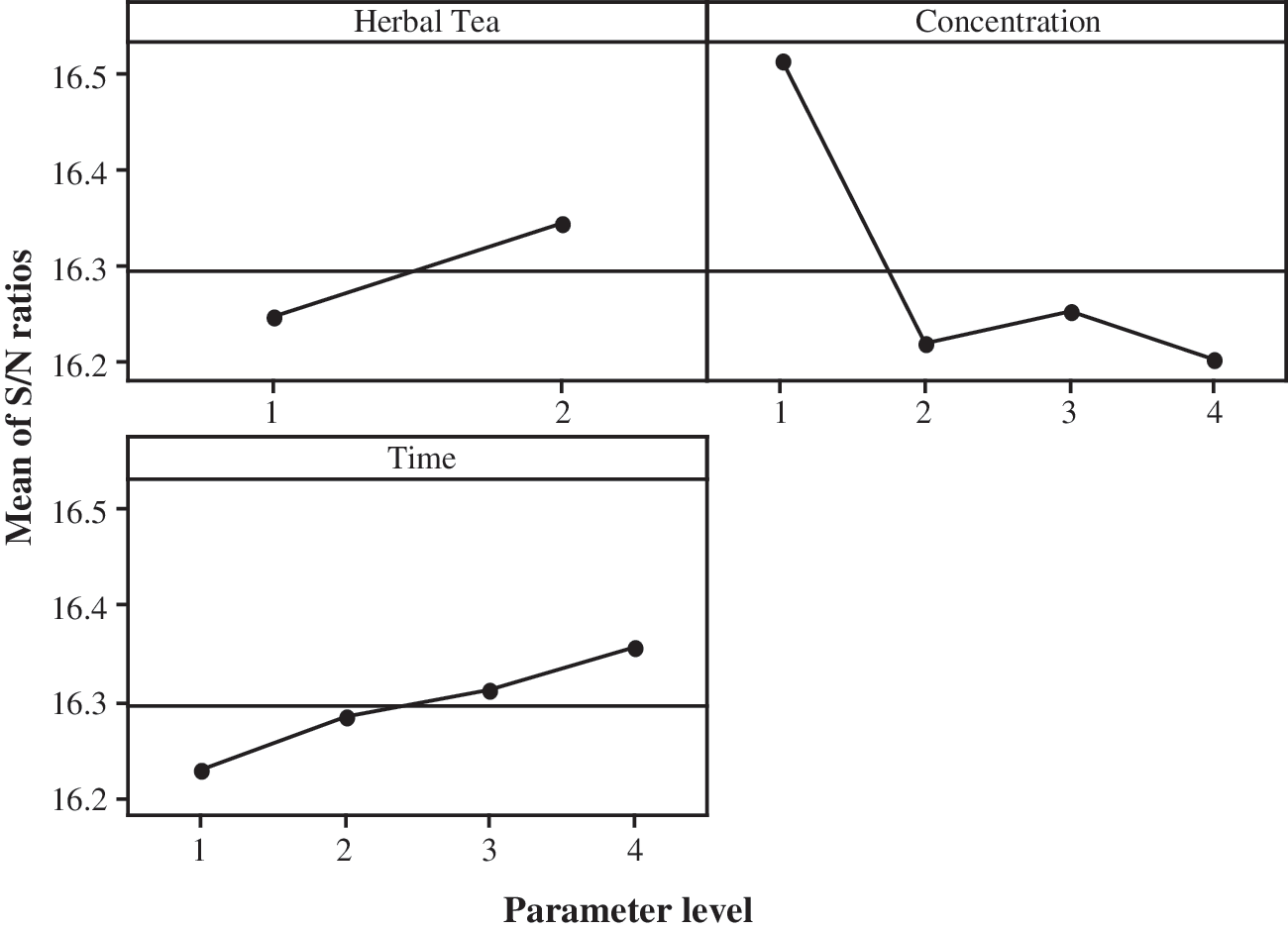
The larger-the-better signal-to-noise ratio (S/N) graphs for the microbial population factors.
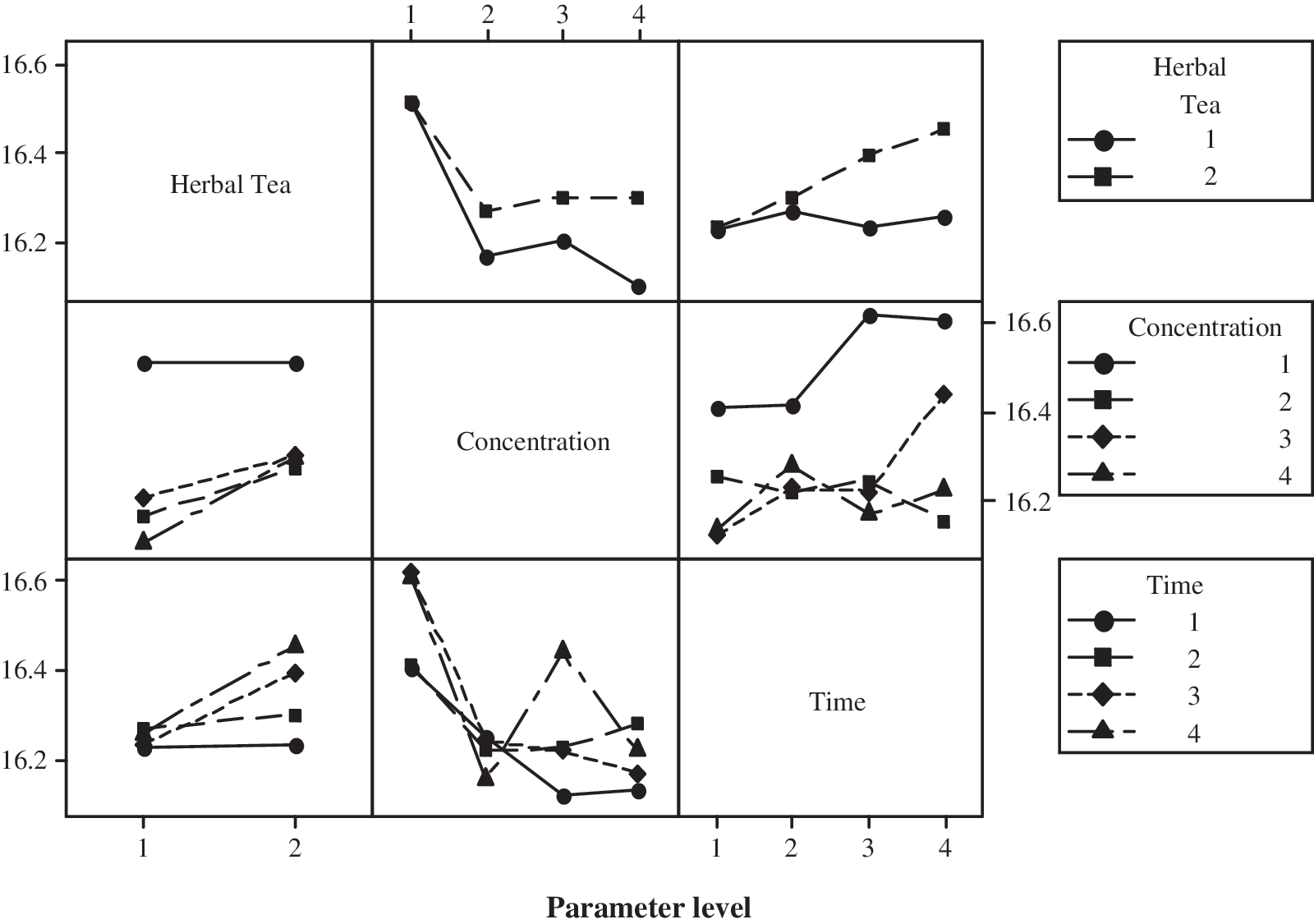
Interaction S/N ratio graphs for microbial population factors. Herbal tea 1: sage; herbal tea 2: green tea; concentration 1: control; concentration 2: 2% of the herbal tea; concentration 3: 5% of the herbal tea; concentration 4: 10% of the herbal tea; time 1: 1st hour; time 2: 5th hour; time 3: 10th hour; time 4: 20th hour.
Conceptual S/N ratio approach
Taguchi suggests evaluating the means and S/N ratio using conceptual approach that involves plotting the effects and visually identifying the factors that are significant (Phadke, 1989).
The average S/N ratios for the larger-the-better approach for the microbial population and significant interactions are shown in Figures 1 and 2, respectively. Figure 1 suggests that the type of herbal tea, concentration, and time factors were significant. The sample containing green tea at the concentration of 2% and aged for 5 hours appears to be the best choice to get low value of the microbial load. Therefore, the optimum combination to get low value of the microbial population was F 11 F 22 F 34 within the tested range. Further, as shown in the interaction graphs of S/N ratios in Figure 2, it could be claimed that the addition of green tea was more effective than sage in the reduction of L. monocytogenes.
In the present study, two different techniques have been used for the analysis of data. Both techniques gave similar conclusions. The use of S/N ratio indicated that the middle concentration of herbal tea was the level to obtain a microbiologically safe ice cream mix. The results also revealed that there was no effect of aging time on microbial count of ice cream mix. For example, the sample containing 2% sage had an initial microbial load of 6.47 log cfu/mL, and then the microbial load became 6.40, 6.57, and 6.58 log cfu/mL at the time of 5, 10, and 20 hours, respectively.
Physicochemical properties
The color, pH, and acidity values of ice cream mix samples are given in Table 4. The use of herbal tea affected the color of ice cream mix. The L* values decreased while a* and b* values increased for all samples as expected. It was observed that L* value of control sample was 63.36, but when the mix was incorporated with sage at 10%, L* value became 55.71. Similar trend was also observed for samples containing green tea, in which the L* value decreased with increasing concentration of herbal tea. Incorporation of herbal tea decreased the pH value of the ice cream mixes. The decrease in the pH value increased with increasing the amount of herbal tea incorporated into the mix. The pH value was measured as 6.43 for control sample, whereas it was 6.22 and 6.18 for samples 4 and 7, respectively. It could be stated that a decrease in pH value could be related to the reduction of L. monocytogenes in the samples. Titratable acidity of the samples increased with increasing herbal tea amount in the ice cream mix. The highest acidity value was determined in the samples flavored with incorporation of green tea at high concentration.
Conclusion
The results obtained from conceptual S/N ratio approach for aged ice cream mixes flavored with herbal tea and the physicochemical properties of products indicated that Taguchi's robust design method could be suitable to analyze the microbial load of the ice cream samples in this study. Both conceptual S/N ratio and physicochemical properties of products for data analysis draw similar conclusions.
The microbial load of ice cream is very important for consumer health. Some psychrotrophic bacteria such as L. monocytogenes can grow in ice cream mix during ageing. It could be concluded that incorporation of herbal tea into the ice cream mix decreased the count of L. monocytogenes. The ice cream mix flavored with herbal tea may be acceptable for consumers. Further studies could be recommended to determine the acceptability of ice cream flavored with herbal tea extracts for consumers.
Footnotes
Disclosure Statement
No competing financial interests exist.