




Abstract
In this study, 154 Staphylococcus aureus isolates were detected from 1070 food samples (14.4%) collected from seven cities in Turkey. Antimicrobial susceptibility testing against 21 antibiotics was performed by agar disk diffusion method, and those isolates resistant to any antibiotic were further analyzed to determine minimum inhibitory concentration by E-test and polymerase chain reaction analysis of vanA and mecA genes. According to disk diffusion test results, a total of 139 strains were resistant to at least one tested antibiotic, with 39 (25.3%) strains being multidrug resistant (MDR) and the other 15 strains being susceptible to all antibiotics. Penicillin G, linezolid, erythromycin, and tetracycline took up 71.4%, 23.4%, 18.2%, and 15.6% of the tested strains, respectively. In addition, all of the strains were susceptible to vancomycin, oxacillin, cefoxitin, and imipenem. Only one strain (S158B) was resistant to both teicoplanin and cefazolin. On the other hand, the presence of vanA and mecA genes was not detected in the strains. Pulsed-field gel electrophoresis analysis was used to identify genetic-relatedness of the MDR strains. It is noteworthy that some strains from different sources showed 100% homology; however, some of MDR strains were found unrelated with 60% or less homology. The high diversity observed in pulsed-field gel electrophoresis results indicated the possible contamination of S. aureus from different sources and routes.
Introduction
The use of antimicrobials in food animals creates an important source of resistant bacteria that can spread to humans through the food supply. Improved management of the use of antimicrobials in food animals, particularly reducing the usage of those defined as “critically important” for human medicine, is an important step toward preserving the benefits of antimicrobials for people (Collignon et al., 2009). Moreover, food can be considered an excellent mechanism for introducing pathogenic bacteria into the general population and immune-compromised patients, and it serves as a vehicle for transfer of antibiotic-resistant bacteria to the intestinal tract, causing exchanging resistance genes between nonpathogenic bacteria and pathogenic bacteria in the intestine (Sørum and L'Abée-Lund, 2002).
The World Health Organization (WHO) classification, a core list of the most critical antimicrobial agents globally (WHO, 2007), was generated in an effort to provide a tool for developing risk management strategies and focusing resources to address antimicrobial use in agriculture and veterinary medicine (JETACAR, 1999; WHO, 2003). To categorize the relative importance of these drugs in human and veterinary medicine, three categories of antimicrobials were defined: critically important, highly important, and important (Collignon et al., 2009). In the last decade, S. aureus strains from food have shown a considerable increase in resistance against most antibiotics in Turkey (Gundogan et al., 2005; Sudagidan and Aydin, 2009) as well as in other countries (Chao et al., 2007; Normanno et al., 2007; Peles et al., 2007; Pesavento et al., 2007; Lin et al., 2009), with some other reports concerning methicillin (Kitai et al., 2005) and vancomycin (Manie et al., 1998).
The objectives of this study includes determination of the prevalence of S. aureus in Turkish food products, investigation of the antibiotic resistance patterns of S. aureus strains, and analysis of the genetic-relatedness of multidrug resistant (MDR) S. aureus strains by pulsed-field gel electrophoresis (PFGE).
Materials and Methods
Sample collection and processing
Between July 2007 and December 2008, a total of 1070 food samples were collected from supermarkets, conventional markets, or bazaars in large cities in the Marmara Region of Turkey including Balikesir, Bursa, Canakkale, Edirne, Istanbul, Kirklareli, and Tekirdag. These samples included 115 meat (beef, mutton, chicken, and turkey meat), 15 meat products (Turkish type fermented sausage-sucuk, salami, and sausage), 303 raw milk, 452 dairy products (cheese, butter, yoghurt, and cream), 141 bakery products (pasta, thin sheet of dough, and cake), and 44 ready-to-eat foods.
Bacterial isolation and identification
The isolation of S. aureus strains from food samples was performed according to EN ISO 6881-1 standard procedure of the International Organization for Standardization (ISO, 1999). Typical colonies on Baird Parker Agar (Oxoid) were subcultured and identified by Gram staining, catalase test, coagulase test (Oxoid Dryspot Staphytect Plus), DNase activity (DNase agar; Oxoid), and mannitol fermentation (Mannitol Salt Agar; Oxoid). DNA isolation procedure was carried out accordingly (Sudagidan et al., 2008). Presence of S. aureus specific genes (thermonuclease [nuc], coagulase [coa], and S. aureus protein A [spa]) was determined by polymerase chain reaction (PCR) analysis as previously described (Hookey et al., 1999; Aires-De-Sousa et al., 2006; Sudagidan and Aydin, 2009).
Antibiotic susceptibility
Antibiotic susceptibility testing was performed by agar disk diffusion method according to the Clinical and Laboratory Standards Institute (CLSI, 2006); and antibiotics included gentamicin, kanamycin, tobramycin, rifampicin, imipenem, teicoplanin, vancomycin, erythromycin, linezolid, amoxicillin/clavulanic acid, penicillin G, levofloxacin, ofloxacin, cefazolin, cefoxitin, sulfamethoxazole/trimethoprim, tetracycline, chloramphenicol, fusidic acid, clindamycin, and oxacillin (Oxoid). The tested antibiotics represented the three main categories of antibiotic classification (Collignon et al., 2009), with nine subcategories of the critically important category, four subcategories from the highly important category, and four subcategories from the important category being tested. The inhibition zone diameters were evaluated according to CLSI (2006) and Comité de L'antibiogramme de la Société Française de Microbiologie Communiqué (for fusidic acid) (1998). S. aureus ATCC 25293 was used as a quality control standard (Microbiologics). Further, those S. aureus strains found resistant to any tested antibiotics were then investigated and evaluated by E-test (AB Biodisk) or MICE test (Oxoid) according to CLSI (2006). Multidrug resistance was defined as showing resistance to at least three of the antimicrobials used.
Detection of vanA and mecA genes
The presence of vancomycin-resistance gene (vanA) (Clark et al., 1993) and methicillin-resistance gene (mecA) (Lem et al., 2001) was determined for all S. aureus strains by PCR analysis.
PFGE analysis
Genetic-relatedness of MDR S. aureus strains was determined by PFGE analysis. Agarose plugs were prepared as previously described (Sudagidan and Aydin, 2010). Bacterial DNA in plugs were digested with 30 U SmaI (Fermentas) overnight and were run in 1% (w/v) pulsed-field certified agarose (Bio-Rad) with 5–40 sec pulse time, 6 V/cm, 120° angle, at 14°C for 22 h using CHEF-Mapper PFGE system (Bio-Rad). After electrophoresis, the gel was stained with 20 μg/mL ethidium bromide and visualized with VersaDoc 4000MP image analyzer system (Bio-Rad). The band patterns were analyzed and compared with BIO-PROFIL Bio-1D++ software (Vilber Lourmat).
Results
Prevalence and antibiotic susceptibility of S. aureus in food samples
Out of 1070 food samples, 154 (14.4%) S. aureus strains were identified and characterized by biochemical and molecular tests. The prevalence of the strains on the basis of food samples and sampling cities were shown in Table 1. Most the strains were isolated from raw milk (41.6%) and dairy products (35.1%). In addition, Istanbul showed high prevalence (53.3%) in contaminated food and food products by S. aureus. In the critically important category, most of the strains (71.4%) were found to be resistant to penicillin G. In the highly important category and important category, 15.6% and 8.4% of S. aureus strains were resistant to tetracycline and clindamycin, respectively (Table 2). None of the strains were resistant to vancomycin, oxacillin, cefoxitin, and imipenem, with 15 strains (9.7%) being susceptible to all tested antibiotics. A total of 36 S. aureus strains (23.4%) were found resistant to only one antibiotic (penicillin G [21.5%] or teicoplanin [1.9%]), with 39 MDR strains, most of which were isolated from raw milk samples in Istanbul and from dairy products in Istanbul, Balikesir and Kirklareli. The highest multidrug resistance was detected in 2 S. aureus strains (S174A and S175A, against 11 antibiotics) from raw milk samples in Istanbul (Fig. 1).
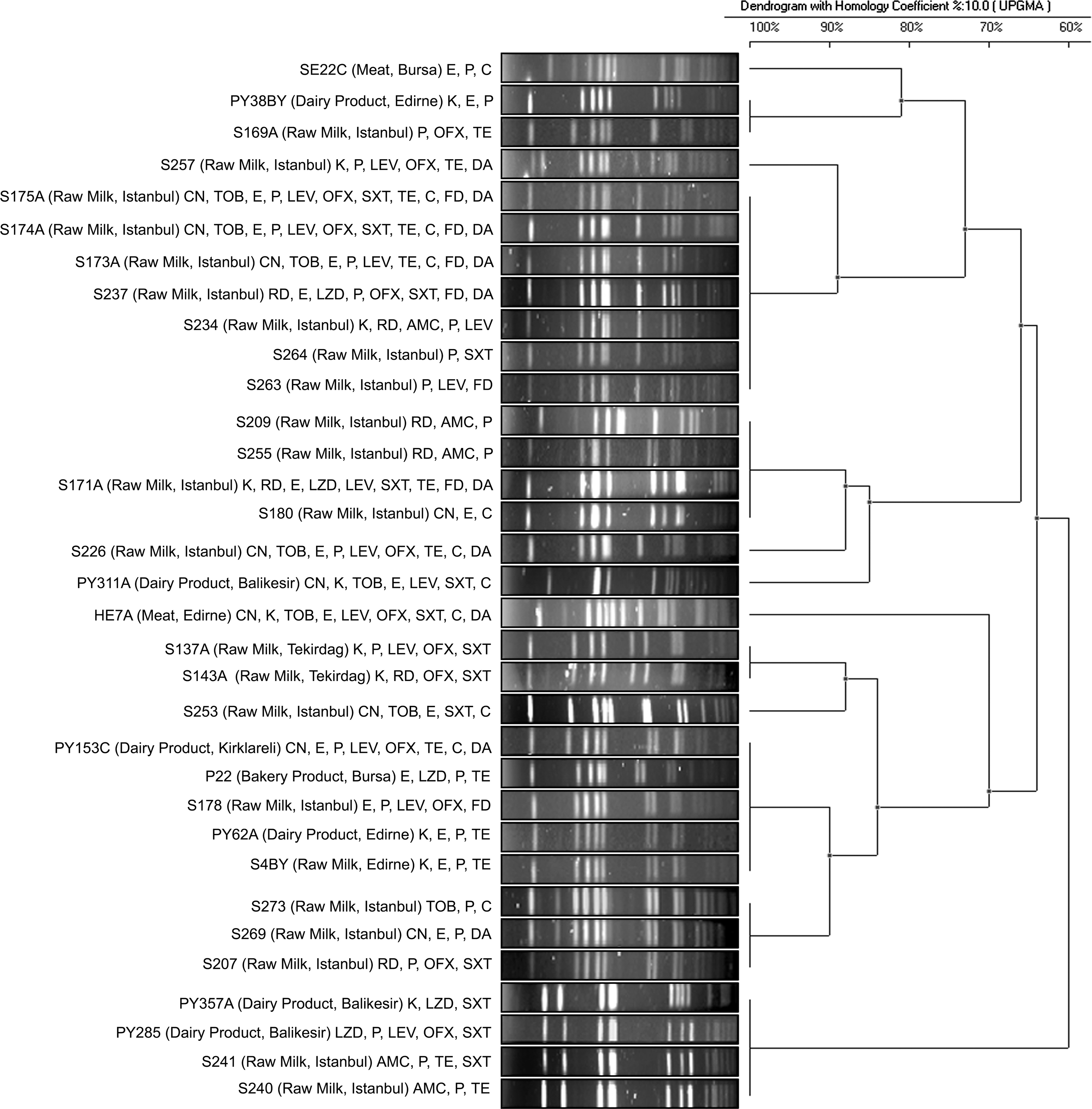
Dendrogram of pulsed-field gel electrophoresis patterns showing the genetic-relatedness of 33 multidrug-resistant Staphylococcus aureus strains. The name of strains, the source of samples, the isolated area of S. aureus, and the code of resistant antibiotics were shown in left side. AMC, amoxicillin/clavulanic acid; C, chloramphenicol; CN, gentamicin; DA, clindamycin; E, erythromycin; FD, fusidic acid; K, kanamycin; LEV, levofloxacin; LZD, linezolid; OFX, ofloxacin; P, penicillin G; RD, rifampicin; SXT, sulfamethoxazole/trimethoprim; TE, tetracycline; TOB, tobramycin.
Resistant (R) or intermediate (I) against antibiotics (R, I; in mm): gentamicin <12,13–14; kanamycin <13,14–17; tobramycin <12,13–14; rifampicin <12,13–14; imipenem <13,14–15; teicoplanin <10,11–13; vancomycin <15; erythromycin <13,14–22; linezolid <21; amoxicillin/clavulanic acid <19; penicillin G <28; levofloxacin <15,16–18 ofloxacin <14,15–17; cefazolin <14,15–17; cefoxitin <19; sulfamethoxazole/trimethoprim <10,11–15; tetracycline <14,15–18; chloramphenicol <12,13–17; fusidic acid <15,16–21; clindamycin <14,15–20; oxacillin <10,11–12 (Comité de L'antibiogramme de la Société Française de Microbiologie Communiqué, 1998) [levels for fusidic acid]; CLSI, 2006).
Determination of minimum inhibitory concentration of antibiotic-resistant S. aureus strains
Minimum inhibitory concentration (MIC) values of eight antibiotics were further determined for resistant S. aureus strains (Table 3). For penicillin G, tetracycline, linezolid, erythromycin, and sulfamethoxazole/trimethoprim, 99.1% (109/110), 58.3% (14/24), 33% (12/36), 21.4% (6/28), and 5% (1/20) of the tested strains were found in higher resistance than maximum detection limits. Three S. aureus strains from raw milk (S15D, S158B, and S264) were resistant to oxacillin by disk diffusion test. However, these strains were determined as susceptible with MIC values 1 μg/mL or lower.
Levels of MIC values against tested antibiotics (CLSI, 2006).
MIC, minimum inhibitory concentration.
PCR and PFGE analysis
None of the strains was positive for vanA or mecA genes in PCR analysis. The genetic-relatedness of 39 MDR S. aureus strains was investigated by PFGE, and the results exhibited wide variation in banding patterns (Fig. 1). Two major clusters with 60% homology were obtained, with six MDR S. aureus strains determined as distinct for showing less than 60% homology. It is noteworthy that strains with different isolation resources or resistance patterns reveal 100% homology, such as strains sampled from raw milk in Istanbul, five MDR strains (two from raw milk, two from dairy products, and one from a bakery product), the most resistant strains (S174A and S175A), and two other MDR strains (S137A and S143A).
Discussion
Investigation and determination of S. aureus contamination in food samples is significant with regard to food safety. Isolation rate of the current study (14.4%) (154/1070) (Table 1) was similar to a previous study, in which 209 (12.8%) S. aureus strains were identified from 1634 food samples (Normanno et al., 2007). However, it was lower than that from another study in Turkey, in which 138 out of 413 (33.4%) food samples (48.7% [80/164] for meat products and 23.2% [58/249] for dairy products] were found contaminated with S. aureus (Guven et al., 2010). Further, Andre et al. (2008) found that raw milk appears to be the most probable source of S. aureus contamination in cheese.
Foodstuffs were studied on the basis of specific food groups with regard to antibiotic susceptibility of S. aureus strains shown in Table 4. Similarly, in most previous studies, penicillin, tetracycline, and erythromycin resistance had been mainly reported in S. aureus strains from meat, meat products, raw milk, and dairy products (Gundogan et al., 2005; Andre et al., 2008; Guven et al., 2010). The reason of this high resistance to penicillins (e.g., amoxicillin/clavulanic acid or bacitracin/tetracycline combinations) could be explained as to the extensive use of these drugs for treatment and prophylaxis in farm animals in Turkey (Budak, 2008). In addition, it is important to point out that S. aureus strains from ready-to-eat foods and bakery products showed high level of resistance to penicillin G (Table 4), most probably due to ineffective heat treatment of these foods.
S. aureus has developed multidrug resistance worldwide, with wide diversity in prevalence rate in different regions (Gundogan et al., 2005; Chao et al., 2007; Normanno et al., 2007; Andre et al., 2008). Normanno et al. (2007) reported that 9.6% (12/125) and 4% (5/125) of the S. aureus strains had resistance to three and four of the tested antibiotics, respectively. In addition, Chao et al. (2007) found a high level (79%) (69/87) of multidrug resistance amongst isolates. In this study, 25.3% (39/154) of S. aureus strains showed multidrug resistance (Fig. 1) primarily to penicillin G (28/39), erythromycin (19/39), and sulfamethoxazole/trimethoprim (14/39). The results demonstrated that a large proportion of resistant strains were isolated from raw milk and dairy products, indicating a higher incidence of MDR S. aureus in dairy farms.
The use of antimicrobials as feed additives has been one of the major concerns in antibiotic-resistant food-related bacteria (Sørum and L'Abée-Lund, 2002). In a recent study, Pereira et al. (2009) isolated 148 foodborne S. aureus strains and found that 73%, 70%, 38%, 5%, 3%, and 1% of S. aureus strains were resistant to penicillin G, ampicillin, oxacillin, erythromycin, gentamicin, and tetracycline, respectively. Plasmidic penicillin resistance spreads rapidly among strains and remains the most frequently detected in foodborne S. aureus. In previous studies concerning penicillin resistance, Peles et al. (2007) found the penicillin resistance to be 88.9% with 20% of the strains recovered from mastitic milk and bulk tank milk; and Moon et al. (2007) determined that 90.2% and 89% of S. aureus strains were resistant to penicillin G and ampicillin, respectively; Guven et al. (2010) showed that penicillin resistance was the highest (92.7%) among S. aureus food isolates. It was found to be 71.4% in this study, taking up most of the tested strains.
Broad-spectrum tetracyclines are widely used as growth factors in veterinary medicine for livestock rearing as well as in the treatment of bacterial infections occurring in plants, agriculture, and human medicine (Ardic et al., 2005). Tetracycline resistance rate in foodborne S. aureus was previously reported to be 19.1%, 24.7%, and 50% (Chao et al., 2007; Pesavento et al., 2007; Andre et al., 2008); and in the current study, it was found to be 15.6%, which was lower comparing to preliminary studies from Turkey (55.3% and 39.6%) (Bayhun, 2008; Unal and Istanbulluoglu, 2009).
In the current study, two S. aureus strains showed 14 mm zone diameter against vancomycin, but they were determined as susceptible by E-test and negative for vanA-PCR. Vancomycin has been commonly used in methicillin-resistant S. aureus infection cases. Since the first discovery of clinical vancomycin intermediate S. aureus in 1997 (Hiramatsu et al., 1997), S. aureus with reduced sensitivity to vancomycin had been reported worldwide (CDCP, 2002). Up to date, few studies concern vancomycin-resistant S. aureus strains in food; and as an exception, Manie et al. (1998) reported that 7% Staphylococcus isolates (n = 190) from chickens were resistant to vancomycin in South Africa.
Prevalence of methicillin-resistant S. aureus strains in food samples is low; and in the current study, MICs of oxacillin-resistant strains were low and the presence of 2 out of 714 S. aureus isolates from retail raw chicken meat in Japan was found to be mecA positive (Kitai et al., 2005). In another study from Turkey, Unal and Istanbulluoglu (2009) reported 3.1% resistance to oxacillin. Although Pereira et al. (2009) found that 38% of the S. aureus strains were resistant to oxacillin (≥6 μg/mL), only 0.68% (1/148) of the strains contained mecA. In our study, MIC levels of oxacillin-resistant strains were very low (1 μg/mL or lower), and the presence of mecA was not detected in these strains.
PFGE is “gold standard” technique in determination of genetic-relatedness of the bacteria, especially in outbreaks due to its high discriminatory power. According to the PFGE patterns (Fig. 1), some strains (PY38BY and S169A; PY153C, P22, S178, PY62A and S4BY; PY357A, PY285, S241 and S240) from different sources were found highly homologous, and no endemic clone was detected among MDR strains. The existence of a variety of genetically diverse S. aureus strains and lack of predominance of an endemic clone observed in this study, which had been previously observed (Andre et al., 2008), indicated the possible contamination by S. aureus from different sources and routes (Peles et al., 2007).
Conclusions
The present study demonstrated that the most S. aureus food isolates were found to be resistant to tested antibiotics, especially in the critically important category, with a large percentage of MDR isolates, which raised a great concern for the risk of consuming foods contaminated by resistant bacteria. Further, PFGE analysis indicated a high genetic diversity showing that bacterial contaminations of food products could come from numerous sources such as processing environments, personnel, and farms.
Footnotes
Acknowledgments
The authors thank Biotechnology and Bioengineering Central Research Laboratory (Izmir Institute of Technology) and Res. Assist. Funda YILMAZ (Istanbul University) for their invaluable assistance. Further, Assist. Prof. Dr. Faith Critzer (Univeristy of Georgia, Center for Food Safety) is acknowledged for critical reading of the manuscript. This work was supported by The Scientific and Technological Research Council of Turkey (TUBITAK) (Project number: 107T266). A part of this study was presented in 3rd National Veterinary Food Hygiene Congress (May 14–16, 2009) in Bursa–Turkey.
Disclosure Statement
No competing financial interests exist.