




Abstract
The pathogenicity of Yersinia pestis depends on the presence of a virulence plasmid (pYV). The unstable nature of pYV in Y. pestis leads to the eventual outgrowth of pYV-less cells due to its higher growth rate. Thus, it was necessary to develop procedures to monitor the presence of the plasmid during cultivation, storage, and laboratory manipulations. A procedure was developed to monitor the presence of pYV in Y. pestis by using low calcium response and Congo red binding techniques. The selection of pYV in the isolated clones was confirmed by polymerase chain reaction and by expression of pYV-associated phenotypes. Thus, using this procedure, low calcium response-Congo red-positive clones can be isolated for use in the development of growth models of virulent Y. pestis in food.
Introduction
Materials and Methods
Bacteria
Y. pestis KIM5, a derivative of strain KIM (Kurdistan Iran man), which lacks the chromosomally encoded pigmentation (Pgm−) locus but harbors pYV (Bearden and Perry, 2008), was used in this study. This strain is conditionally virulent (a conditional mutant is infectious if inoculated intravenously) and it is the only strain available that can be used in a BL2 laboratory facility (Bearden and Perry, 2008). This strain is well characterized, and has been extensively used to study the microbiology and molecular pathogenesis of Y. pestis (Brubaker, 2006; Bearden and Perry, 2008; Bhaduri and Sommers, 2008).
Preparation of media
BHI broth was prepared as recommended by the supplier (Becton-Dickinson, Sparks, MD). Calcium-deficient CR magnesium oxalate agar (CR-MOX) was prepared by adding 20% D-galactose (Sigma Chemical Co., St. Louis MO), 0.25 M sodium oxalate (Sigma Chemical Co.), 0.25 M magnesium chloride (Sigma Chemical Co.), and 1% CR (Sigma Chemical Co.) to tryptic soy agar (Becton-Dickinson), as described previously (Bhaduri et al., 1991). Low-calcium (238 μM Ca2+) CR BHI agarose (CR-BHO) was prepared by adding agarose (GibcoBRL, Grand Island, NY) to a final concentration of 1.2% to BHI broth supplemented with 0.1% magnesium chloride (Sigma Chemical Co.), and CR (Sigma Chemical Co.) was added at a concentration of 75 μg/mL as described previously (Bhaduri et al., 1991).
Presence of pYV and virulence characteristics in Lcr and CR uptake positive clones
The phenotypic virulence characteristics of pYV, including Lcr, CR uptake, and CV binding, were determined as described previously (Bhaduri et al., 1991; Bhaduri and Sommers, 2008). In both CR-MOX and CR-BHO, pYV expressed Lcr and CR uptake facilitated differentiation of pYV-bearing cells from pYV-less cells for subsequent isolation of pYV-bearing cells (Bhaduri et al., 1991; Bhaduri and Sommers, 2008). These two media were compared to determine which medium is more suitable for monitoring the presence of pYV under culture conditions. The presence of pYV was also confirmed by a PCR assay targeting a key regulatory gene virF, from pYV, which encodes a transcriptional activator for expression of pYV-encoded outer membrane proteinYop51 (Nakajima et al., 1992; Bhaduri, 2003; Thoerner et al., 2003).
Results and Discussion
Since pYV of Y. pestis is easily lost during laboratory manipulations such as subculturing, the procedures outlined in Flow Chart 1 were developed to monitor the presence of pYV and differentiate pYV-positives clone from pYV-less colonies during laboratory investigations. After receiving the pYV-bearing strain of Y. pestis KIM5 from Dr. Susan Straley (Department of Microbiology and Immunology, University of Kentucky, Lexington, KY), the presence of pYV was immediately confirmed by demonstrating that virulence-associated phenotypes were present and by a PCR assay targeting the pYV-encoded virF (Fig. 1, lane 3) (Bhaduri, 2003; Bhaduri and Sommers, 2008). The strain was then stored at −80°C. Since pYV is readily lost during the first passage of subculturing and laboratory manipulation (Bhaduri and Sommers, 2008; Bhaduri, 2009; Tamplin and Bhaduri, unpublished data), a procedure was developed to ensure that the working culture retained pYV in the cells. At the initial stage, it is essential to culture first on CR-MOX and CR-BHO to isolate pYV-bearing clones from the frozen stock culture. The pYV-positive colonies appeared as red pinpoint colonies (0.36 mm in diameter) showing both Lcr and CR uptake, whereas pYV-less colonies appeared as much larger white or orange colonies (1.37 mm in diameter) (Bhaduri et al., 1991; Bhaduri and Sommers, 2008). The colony morphology and CR uptake can be used to differentiate between pYV-positive clones and pYV-less colonies. The Lcr- and CR-positive clones were further confirmed as pYV positive by the PCR assay (Fig. 1, lane 4 [CR-MOX] and lane 5 [CR-BHO]) and by pYV-associated Lcr, CR uptake, and CV binding phenotypes (see Flow Chart 1). These pYV-bearing clones were inoculated into BHI broth for the preparation of frozen and working stock cultures as described in Flow Chart 1. Before frozen storage and preparation of working stock cultures, the culture prepared in BHI broth at 28°C was tested for the presence of pYV and its virulence-associated phenotypes (Fig. 1, lane 6). The Lcr-CR positive clones on CR-MOX were used as working stock cultures and could be used for 15 days for laboratory studies by storage at −80°C. After that period of storage the red pin point colonies lost pYV (Fig. 1, lane 11). The CR-BHO was also successfully used to ensure the selection of pYV in Y. pestis although CR uptake was not as intense as on CR-MOX. The Lcr-CR positive clones were used as working stock cultures from CR-BHO and could be stored for 30 days at 2°C. The reason for the shorter storage stability of pYV in Y. pestis on CR-MOX may be the use of oxalate, which chelates calcium. The use of oxalate in this medium raises the possibility that other essential ions may be sequestered by oxalate, thereby affecting bacterial behavior (Bhaduri et al., 1991).
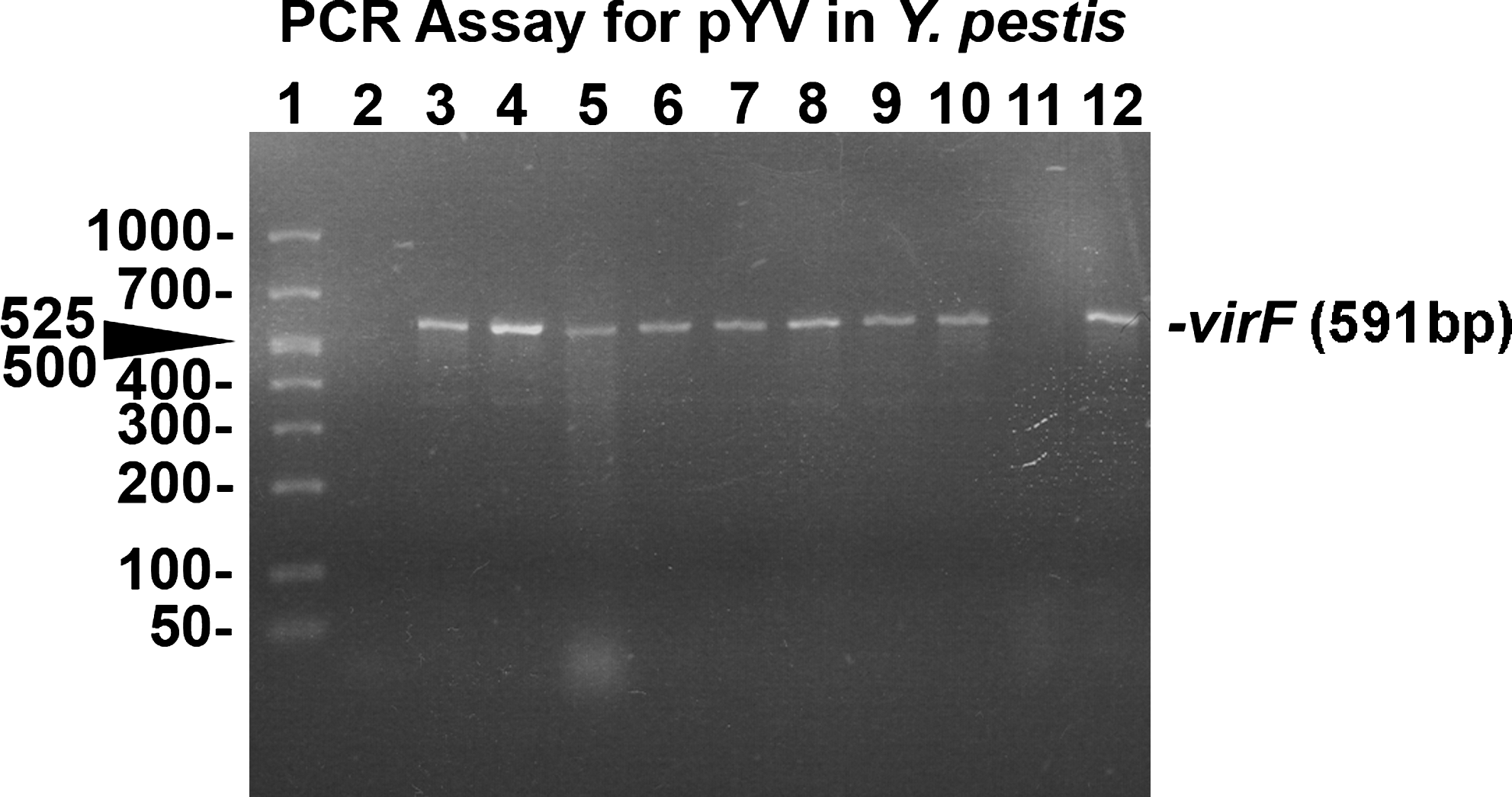
Confirmation of presence of pYV in the original strain, and CR-positive clones from CR-MOX, CR-BHO, and BHI broth using polymerase chain reaction assay targeting a key regulatory gene virF from pYV. The primer pairs (5'-TCATGGCAGAACAGCAGTCAG-3' and 5'-ACTCATCTTACCATTAAGAAG-3') for detection of the virF gene (430- to 1020-nucleotide region) amplified a 591-bp product from the pYV. The low calcium response-CR+ clones showed the presence of 591-bp products from pYV (lanes 2–10 and 12). Lane 1, 50–1000 bp ladder marker; lane 2, negative control with no template, lane 3, original KIM5 strain as positive control; lanes 4 and 5, low calcium response-CR+ colonies from the CR-MOX and CR-BHO, respectively (Flow Chart 2; #1); lane 6, BHI broth (Flow Chart 2; 1st passage; #2); lane 7, stock culture on CR-MOX (#3; 1st passage); lane 8, stock culture on CR-BHO (#3; 1st passage); lane 9, BHI broth (#4, 2nd passage from CR-MOX); lane 10, BHI broth (#4, 2nd passage from CR-BHO); lane 11 (#5, 2nd passage on CR-MOX) showing the absence of 591-bp product, and lane 12 (#5, 2nd passage on CR-BHO). pYV, virulence plasmid; CR, Congo red; BHI, brain heart infusion; BHO, BHI agarose; MOX, magnesium oxalate agar.
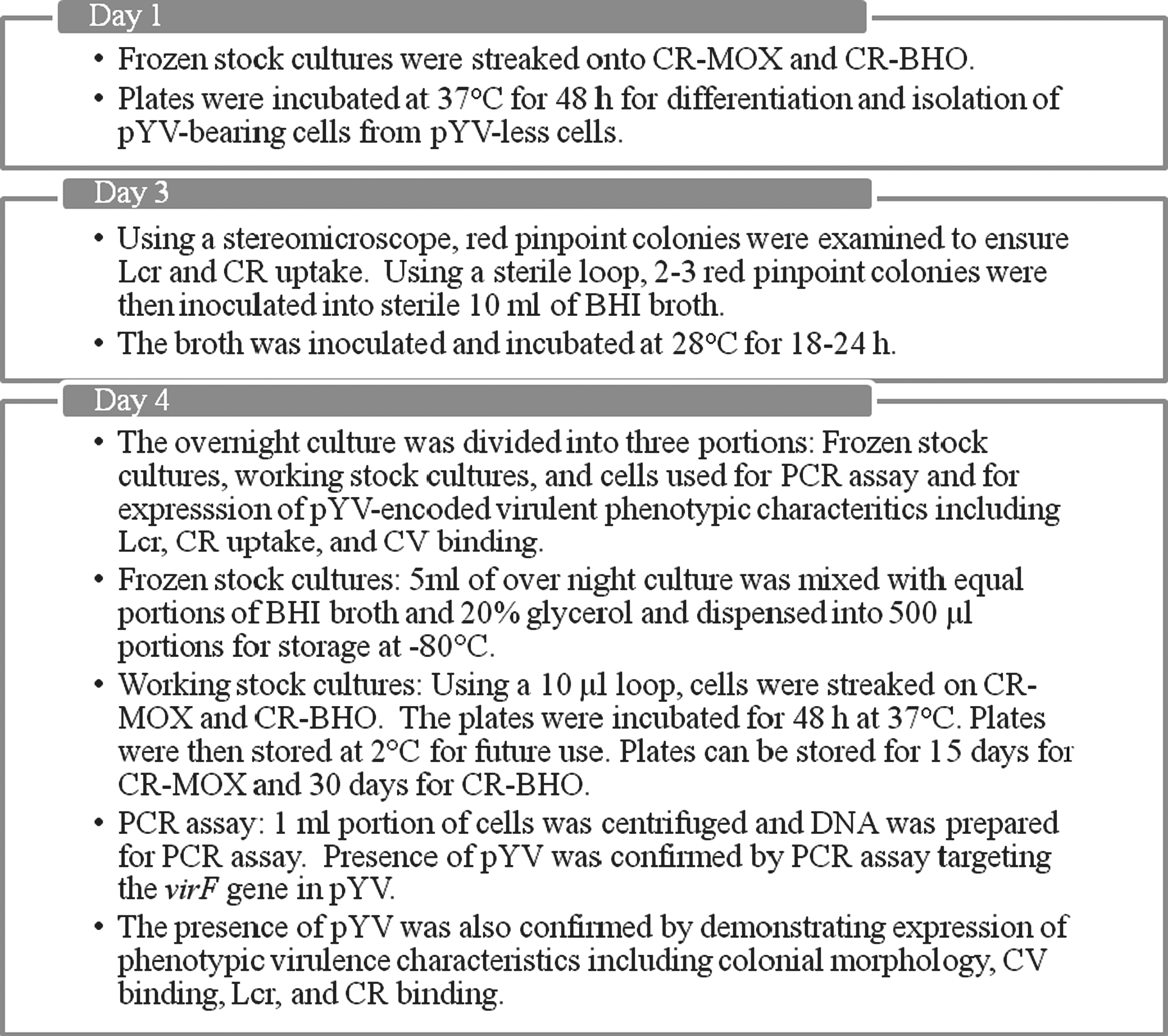
Isolation and maintenance of virulence plasmid in Yersinia pestis.
To ensure the validity of this procedure for selecting pYV in Y. pestis cells, we also examined and monitored pYV stability during the subculturing of pYV-bearing cells in BHI broth, CR-MOX, and CR-BHO. Y. pestis from stock cultures stored at 2°C on CR-MOX and CR-BHO and were subcultured as explained in Flow Chart 2. The presence of pYV in Y. pestis cells in each medium and after each passage was monitored and confirmed at every step of culture transfer (#2–5) by the PCR assay for pYV and by expression of pYV-associated phenotypic virulence characteristics, including Lcr, CR uptake, and CV binding. The PCR data for the presence of pYV are shown in Fig. 1. PCR results confirm that primers amplified a 591-bp product from the pYV (virF gene) from each phase of the culture as described above and all PCR-positive clones on CR-MOX and CR-BHO showed their virulent phenotypic characteristics, including Lcr, CR uptake, and CV binding. The presence of virF gene demonstrates the presence of pYV, which confers pYV-associated phenotypes.
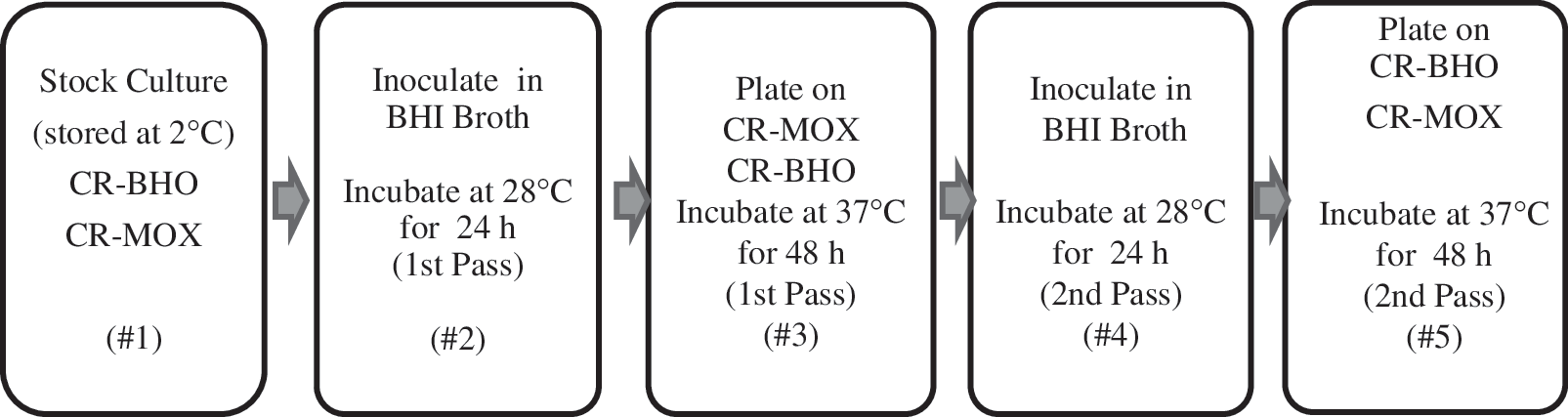
Confirmation of virulence plasmid in Yersinia pestis.
Conclusions
The procedure developed here provides a method to ensure the selection of pYV in Y. pestis and for studying pYV-bearing Y. pestis without losing pYV during experimental procedures by storing at −80°C for 30 days. Although CR-BHO is a better medium for subculturing of pYV-bearing Y. pestis, the pYV-bearing red pin point colonies are more easily detectable on CR-MOX due to more intense absorption of CR in the cells (Bhaduri and Sommers, 2008). Hence, the use CR-MOX for the preparation of stock cultures and to monitor the selection of pYV is recommended for investigations on the growth of pYV-bearing Y. pestis in food. At present, the development of a growth model for pYV-bearing Y. pestis in ground beef and pork is in progress using the pYV-bearing clones isolated by this procedure.
Disclaimer
Mention of trade names or commercial products in this publication is solely for the purpose of providing specific information and does not imply recommendation or endorsement by the U.S. Department of Agriculture.
Footnotes
Disclosure Statement
No competing financial interests exist.