




Abstract
We conducted a study to compare the prevalence and antimicrobial resistance profile of Campylobacter isolated from 34 farm-slaughter pair cohorts of pigs raised in conventional and antimicrobial-free (ABF) production systems. Isolates originated from four different states of two geographic regions (region 1—Ohio and Michigan; region 2—Wisconsin and Iowa). A total of 838 fecal and 1173 carcass samples were examined. Campylobacter isolates were speciated using multiplex polymerase chain reaction targeting ceuE and hipO genes. The minimum inhibitory concentration was determined using agar dilution to a panel of six antimicrobials: chloramphenicol, erythromycin, gentamicin, ciprofloxacin, nalidixic acid, and tetracycline. Campylobacter spp. was isolated from 472 of 838 pigs (56.3%). Campylobacter prevalence did not vary significantly based on production system (conventional [58.9%] and ABF [53.7%], odds ratio [OR] 1.4, 95% confidence interval [CI] 0.8–2.6, p = 0.24) or geographic region (region 1 [54.1%] and region 2 [58.2%], OR 1.02, 95% CI 0.6–1.9, p = 0.92). At slaughter plant, Campylobacter prevalence varied based on processing stages (19.4% at pre-evisceration, 25.3% at postevisceration, and 3.2% at postchill). Resistance was common to tetracycline (64.5%), erythromycin (47.9%), and nalidixic acid (23.5%). Campylobacter isolates from conventional production systems were more likely to be erythromycin resistant than from ABF (OR 3.2, 95% CI 1.4–7.2, p = 0.01). The proportion of ciprofloxacin-resistant Campylobacter coli isolates were 3.7% and 1.2% from ABF and conventional production systems, respectively. Thirty-seven out of 1257 C. coli (2.9%) were resistant to both erythromycin and ciprofloxacin, drugs of choice for treatment of invasive human campylobacteriosis. The finding of ciprofloxacin resistance, particularly from ABF herds, has significant implications on the potential role of risk factors other than mere antimicrobial use for production purposes.
Introduction
Different reports have showed C. coli prevalence in pig ranges between 50% and 100% (Manser and Dalziel, 1985; Alter et al., 2005; Boes et al., 2005; Leblanc Maridor et al., 2008). Piglets become infected with Campylobacter by their mothers as early as 4 weeks of life (Weijtens et al., 1997). A study by Weijtens et al. (1993) showed >85% intestinal carriers of Campylobacter at different stages of fattening pigs with subsequent decrease in fecal shedding as the pigs got older. Pig carcasses commonly become contaminated with feces in the slaughter plant during the evisceration process, and as a result there is potential for pathogens present in feces to be transported on the contaminated carcass from the slaughtering operation to final product and consumers (Pearce et al., 2003). In addition, previous reports showed pig carcass contamination with Campylobacter ranges from 2.9% to 10.3% (Oosterom et al., 1985; Pezzotti et al., 2003).
Most Campylobacter infections in human are self-limiting and do not require antimicrobial therapy unless they develop severe systemic cases involving other infections or occur in immunocompromised individuals. In such conditions, the drugs of choice are erythromycin and fluoroquinolones. Antimicrobials are used in food animals for treatment, prophylaxis, and growth promotion. The most commonly used antimicrobials in the pig industry are tetracyclines, tylosin, and sulfamethazine or other sulfas (McEwen and Fedorka-Cray, 2002). C. coli is commonly recovered from pig sources and displays multiple antimicrobial resistance, including resistance against fluoroquinolones and macrolides (Prats et al., 2000; Engberg et al., 2001; Gupta et al., 2004; Thakur and Gebreyes, 2005). There are concerns that the use of antimicrobials in food animals contributes to the spread and persistence of antimicrobial-resistant foodborne pathogens (Aarestrup and Wegener, 1999). The concern on antimicrobial resistance resulted in increased consumer demands toward antimicrobial-free (ABF) production systems, and the U.S. pig industry has attempted to create additional pork products with a voluntary limited antimicrobial usage (Baker, 2006). One such intervention is growing pigs in ABF production settings.
There are limited studies that compare the prevalence and antimicrobial resistance of Campylobacter between different pig production systems and regions (Gebreyes et al., 2005; Rollo et al., 2010). The present study was carried out to investigate the prevalence and antimicrobial resistance of Campylobacter recovered, from pigs reared under conventional and ABF conditions, at the farm and different stages of processing (pre-evisceration, postevisceration, and postchill) from two different geographical regions.
Materials and Methods
Sample collection
This study focused on the prevalence and antimicrobial resistance of Campylobacter recovered from market age pigs and carcasses. Fecal and carcass swab samples were collected from a total of 34 farm-slaughter pairs: 16 from region 1 (Ohio and Michigan) and 18 from region 2 (Wisconsin and Iowa). Ten of the farms from region 1 were from conventional production system and the remaining 6 were from ABF pig production system. Of the 18 farms included from region 2, 6 were from conventional and 12 from ABF. The number of pigs sampled per farm ranged between 10 and 34 for region 1, and 19 and 32 for region 2. The farms were selected based on convenience. The sample size was calculated to be 30 per farm. However, as many of the ABF farms were of niche market small farm types, we were not able to achieve that. We, therefore, added secondary criteria with a minimum requirement of 10 pigs per farm.
The criterion for selection of farms was primarily based on their antimicrobial use status as growth promoter and therapeutic purposes. ABF was defined as farms that do not use any antimicrobials postweaning and ABF farms that have to use antimicrobials therapeutically were required to remove the pig(s) to a separate barn. Conventional farms were those that use antimicrobials routinely for prophylactic and therapeutic purposes. The pigs in the conventional system were reared in multisite all in all out (by barn) condition, and there was no movement of pigs from conventional to ABF. In addition, pigs were kept in confinement in conventional production farms, whereas they were kept outdoors in ABF. Sampling was conducted within a 3-year period between 2002 and 2005.
Four slaughter plants that process pigs from those selected farms were used to collect carcass swab samples. There was no commingling of pigs from different production system during transportation and slaughtering operation. When ABF pigs slaughtered in plant that process conventional pigs, ABF pigs were slaughtered early in the morning before conventional pigs processed.
Ten grams of fecal sample was collected with a gloved hand directly from the rectum of market age pigs within 48 hours before slaughter. The same groups of pigs were followed to the slaughter plant and carcass swabs were collected from slaughter plants where the pigs were processed. One swab sample was collected from each carcass, and a total of 10 carcasses per group were swabbed at pre- and postevisceration stages. Sterile swabs soaked in 10 mL of buffered peptone water (Becton Dickinson, Sparks, MD) were swiped along the midline of the carcass extending from the jowl to the ham. At the postchill stage, carcass swab samples were taken by swabbing a 100-cm2 area at each of the three sample sites (ham, jowl, and belly) from 20 carcasses per group following the method recommended by U.S. Department of Agriculture (Palumbo et al., 1999). This design resulted in a total of 40 carcass swab samples from each group of pigs at the slaughter plants: 10 carcass swab samples each at pre-evisceration and postevisceration, and 20 carcass swab samples at postchill stages. Samples were transported immediately to the laboratory on ice and processed on the same day upon arrival.
Isolation and identification
A total of 838 fecal and 1173 carcass samples were examined for the presence of Campylobacter from two geographic regions: region 1 (379 fecal and 493 carcass swabs) and region 2 (459 fecal and 680 carcass swabs). Fecal samples collected directly from the rectum were stored in sterile cups and transported to the laboratory on ice and processed for Campylobacter on the same day upon arrival at the laboratory. Briefly, fecal samples were directly plated on campy-cefex selective plates and incubated at 42°C for 48 hours under microaerobic conditions (10% CO2, 5% O2, and 85% N2) using GasPak™ EZ Campy sachets (Becton Dickinson, Franklin Lakes, NJ). Carcass swab samples were enriched in 30 mL Bolton broth (Oxoid, Hampshire, United Kingdom) and incubated at 42°C for 48 hours in microaerobic conditions. A loopful of the enriched sample was streaked onto campy-cefex and incubated under similar condition to fecal samples. Putative isolated colonies were transferred to Mueller Hinton (MH) agar (Remel, Lenexa, KS). Presumptive Campylobacter colonies were biochemically tested using catalase (Becton Dickinson, Sparks, MD) and oxidase (Becton Dickinson) and those that were positive for catalase and oxidase stored at −80°C using Brucella broth (Becton Dickinson, Sparks, MD) containing 10% glycerol until further characterization.
Antimicrobial susceptibility testing
Isolates were tested for antimicrobial susceptibility using agar dilution method against six antimicrobials following the recommendation of the Clinical Laboratory Standard Institute (CLSI) (NCCLS, 2002a, 2002b). Briefly, the isolates from −80°C were re-streaked onto MH agar supplemented with 5% defibrinated sheep blood and incubated at 42°C for 48 hours under microaerophilic conditions. Growth from the plates was suspended in MH broth to adjust the density of inocula to 0.5 McFarland standard using Vitek colorimeter (BioMerieux, Durham, NC). Liquid suspensions (400 μL from each) were transferred into the wells of a 37-well Cathra replicator plate. MH agar plates containing 5% defibrinated sheep blood and dilutions of the antimicrobial agents were inoculated using the Cathra replicator (Oxoid Inc., Nepean, Ontario, Canada) and incubated at 42°C for 24 hours under microaerobic conditions. Growth on agar plates containing a series of dilutions of the antimicrobial agents was checked visually. The lowest concentration of an antimicrobial agent that inhibited visible growth of Campylobacter isolates was reported as the minimum inhibitory concentration. The antimicrobials (abbreviations, dilution ranges, and break points used) were chloramphenicol (Ch: 0.25–128, 32 mg/L), erythromycin (Ery: 0.06–32, 8 mg/L), gentamicin (Gen: 0.06–32, 16 mg/L), ciprofloxacin (Cip: 0.008–4, 4 mg/L), nalidixic acid (Nal: 0.25–128, 32 mg/L), and tetracycline (Tet: 0.06–32, 16 mg/L). The CLSI breakpoint interpretive criteria were used for all the antimicrobials except erythromycin. For erythromycin, the National Antimicrobials Resistance Monitoring System breakpoint was used (CDC, 2003). C. jejuni ATCC 33560 reference strain was tested on every plate as recommended.
Multiplex polymerase chain reaction speciation
Speciation of Campylobacter isolates was done using multiplex polymerase chain reaction (PCR) targeting the hipO (forward primer, GTGCGATGATGGCTTCTTC; reverse primer, GCTCCTATGCTTACAACTGC) specific for C. jejuni (designed in this study) and CeuE (forward primer, CC2 5′-GATTTTATTATTTGTAGCAGCG-3′; reverse primer, CC3 5′-TCCATGCCCTAAGACTTAACG-3′) specific for C. coli (Gonzalez et al., 1997). The expected amplicon fragment size for hipO and ceuE gene fragments was 181 and 647 bp, respectively. The PCR amplification conditions used was an initial denaturation at 95°C for 15 minutes followed by 30 cycles of denaturing for 30 seconds at 94°C, annealing at 55°C for 60 seconds, and extension at 72°C for 60 seconds. A final extension of 7 minutes at 72°C was used after the final cycle.
Statistical analysis
Logistic regression using proc genmod procedure (SAS version 9.1; SAS Institute Inc., Cary, NC) was used to compare Campylobacter prevalence and antimicrobial resistance profile between regions, production systems, and stages of processing. Outcomes of interest were Campylobacter prevalence and resistance to each antimicrobial. A generalized estimating equations method with an exchangeable correlation structure was used to model within farm dependence (Hosmer and Lemeshow, 2000). A separate model was used at the farm and slaughter plant. At the farm level, a logistic regression model was used to compare Campylobacter prevalence and proportion of antimicrobial resistance for each of the six antimicrobial agents between production systems and regions. Geographic regions (region 1 and 2) and production systems (ABF and conventional) were included in the model as fixed effect categorical variables. The model included farm as a random effect variable.
At slaughter plant for each stage of processing, separate logistic regression models were used to compare Campylobacter prevalence and antimicrobial resistance between production systems and regions. In addition, within region comparison between production systems was conducted. Further, a separate comparison between pre- and postevisceration, and between postevisceration and postchill stages were conducted. In all instances the model included farm as a random effect variable. p-Values <0.05 were considered significant.
Results
Prevalence of Campylobacter
The overall prevalence of Campylobacter among the pigs tested was 56.3% (472 of 838). The observed prevalence of Campylobacter for conventional farms ranged from 2.9% to 100% and for ABF farms from 0% to 71.9%. Two hundred fifty-two of 428 (58.9%) conventionally reared pigs and 220 of 411 (53.8%) pigs from ABF farms were found to carry Campylobacter. Although a higher frequency of Campylobacter was detected in conventional than in ABF farms, the difference was not statistically significant (odds ratio [OR] 1.4, 95% confidence interval [CI] 0.8–2.6, p = 0.24). Campylobacter prevalence in region 1 and region 2 was 54.1% and 58.2%, respectively. In region 2 pigs raised in conventional production system were more likely to have Campylobacter than those from ABF (OR 2.5, 95% CI 1.4–4.4, p = 0.02) (Fig. 1).
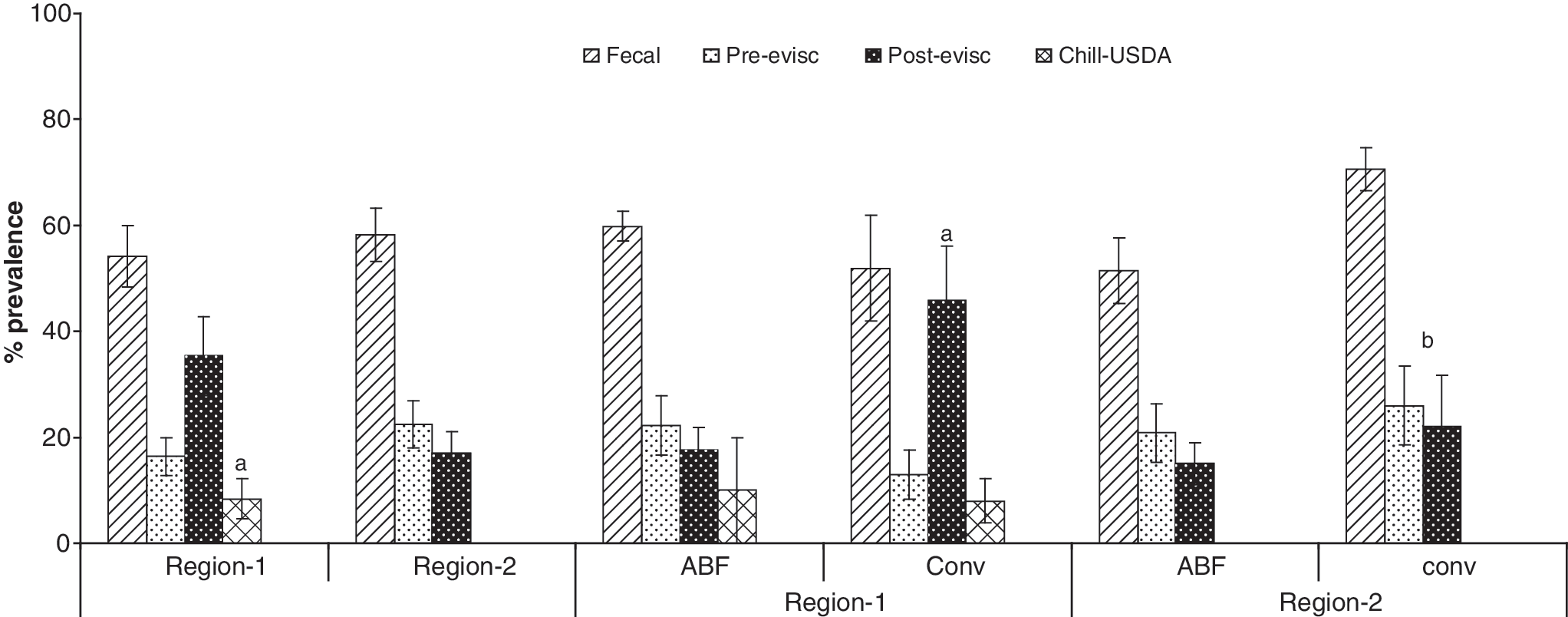
Campylobacter prevalence in different geographic regions, production systems, and stage of processing. The first two graphs show Campylobacter prevalence at different stages in region 1 and 2 (irrespective of production system). The remaining graphs show Campylobacter prevalence in antimicrobial free (ABF) and conventional production systems within region 1 and 2. aSignificantly higher at postevisceration than pre-evisceration; bsignificantly higher at conventional farms than ABF.
At slaughter, Campylobacter was recovered from carcass swab samples collected at different stages of processing (pre-evisceration, postevisceration, and postchill). A total of 315 pre-evisceration and 304 postevisceration carcass swabs were examined for the presence of Campylobacter. Of these, 61 (19.4%) pre-evisceration and 77 (25.3%) postevisceration carcass swabs were positive for Campylobacter. In region 1, carcass Campylobacter contamination was significantly higher at post- (35.8%) than pre-evisceration stages (15.9%) in conventional production system (p = 0.03) (Fig. 1). At postchill stage, 18 of 554 (3.2%) carcass swab samples were positive for Campylobacter.
Antimicrobial resistance of Campylobacter isolates
A total of 1257 Campylobacter isolates (936 from farm and 321 from slaughter) were tested for antimicrobial susceptibility. Overall, resistance was common to tetracycline (64.5%) and erythromycin (47.9%) (Table 1). None of the isolates showed resistance to all the tested antimicrobials. A total of 602 (47.9%) and 61 (4.9%) Campylobacter isolates were found to be resistant to erythromycin and ciprofloxacin, respectively. From 602 erythromycin-resistant Campylobacter isolates, 346 (57.5%) were from conventional and 256 (42.5%) were from ABF production systems. Forty-six of 61 (75.4%) ciprofloxacin-resistant Campylobacter were recovered from ABF and the remaining 15 (24.6%) from conventional production systems.
Region 1 represents farms from Ohio and Michigan; region 2 represents farms from Wisconsin and Iowa.
Significantly higher in conventional than in ABF (p < 0.05).
With in region 1 significantly higher in conventional than in ABF (p < 0.05).
Significantly higher in ABF than in conventional (p < 0.05).
With in region 2 significantly higher in ABF than in conventional (p < 0.05).
ABF, antimicrobial free farms; Chl, chloramphenicol; Cip, ciprofloxacin; Conv., conventional; Ery, erythromycin; Gen, gentamicin; Nal, nalidixic acid; Tet, tetracycline.
At farm level, Campylobacter isolates from conventional production systems were more likely to be erythromycin resistant than those from ABF (OR 3.2, 95% CI 1.4–7.2, p = 0.01). Although the proportions of Campylobacter resistant to nalidixic acid and ciprofloxacin varied between ABF (33.3% for nalidixic acid and 8.2% for ciprofloxacin) and conventional (19.7% for nalidixic acid and 3.1% for ciprofloxacin) farms, no significant association was found between production system and resistance to fluoroquinolones (ciprofloxacin, OR 1.9, 95% CI 0.6–5.5, p = 0.26, and nalidixic acid, OR 1.4, 95% CI 0.6–3.0, p = 0.42) following adjustment for the confounding effect of farm in a logistic regression model. We found no significant difference in antimicrobial resistance between the two geographic regions (p > 0.05). In region 1, Campylobacter isolates from conventional production system had significantly higher odds of being erythromycin resistant than ABF (OR 5.2, 95% CI 1.4–18.9, p = 0.03). Conversely, in region 2 no significant associations were found between production systems and prevalence of antimicrobial resistance to any of the drugs (p > 0.05) (Table 1).
At slaughter, a total of 321 Campylobacter isolates recovered at different stages of processing (pre-evisceration, postevisceration, and postchill) were tested for their antimicrobial susceptibility. Of these, 149 (46.4%) were from conventional and 172 (53.6%) were from ABF. Eighty-eight of the 321 (27.4%) Campylobacter isolates recovered from the slaughter plant were susceptible to all tested antimicrobials as compared to 20.6% from on-farm. Resistance was most common to tetracycline (59.8%) followed by erythromycin (43.6%), nalidixic acid (13.7%), chloramphenicol (11.5%), ciprofloxacin (2.2%), and gentamicin (0.6%). Campylobacter isolates recovered from ABF pig carcasses were more likely to be resistant to nalidixic acid or chloramphenicol than their conventional counter parts (nalidixic acid OR 5.7, 95% CI 2.0–15.9, p = 0.001 and chloramphenicol OR 6.7, 95% CI 1.3–34.2, p = 0.02).
One isolate recovered at the postevisceration stage from conventional production system was found to be ciprofloxacin resistant. On the contrary, six isolates of ABF origin (four from pre-evisceration and two from postevisceration stages) were resistant to ciprofloxacin, corroborating the findings at the farm stage. Campylobacter isolates from pre- and postevisceration stages of ABF production systems demonstrated varying frequency of resistance to chloramphenicol, erythromycin, nalidixic acid, ciprofloxacin, and tetracycline (Table 1). Generally, the prevalence of Campylobacter and proportion of resistance were lower at the postchill stages. None of the isolates from either production systems or geographic regions showed resistance to ciprofloxacin or nalidixic acid at postchill. Only one isolate recovered at postchill stage of conventional production system showed resistance to gentamicin.
Overall, 458 of 936 (48.9%) Campylobacter isolates recovered at the farm level showed multidrug-resistance (resistant to two or more classes of antimicrobials). One hundred eight out of 321 (33.6%) Campylobacter isolates from slaughter plant were also multidrug resistant. Thirty-seven (2.9%) of the total (farm and slaughter) 1257 Campylobacter isolates were resistant to both erythromycin and ciprofloxacin. Among Campylobacter isolates from ABF production system, the predominant resistance pattern was resistance to tetracycline only (R-type Tet, 25.2%), followed by erythromycin–tetracycline (R-type EryTet, 10.3%) and erythromycin–nalidixic acid–tetracycline (R-type EryNalTet, 10.3%). The predominant resistance pattern among Campylobacter isolates recovered from conventional production system was EryTet (33.4%) followed by Tet (16%) and Ery (12.6%) (Table 2).
Campylobacter speciation
Out of 1257 Campylobacter isolates recovered, 1087 were speciated using multiplex PCR targeting hipO and ceuE gene for C. jejuni and C. coli, respectively. The remaining 170 Campylobacter isolates could not be re-grown, despite multiple attempts using different enrichment media, including blood agar and Brucella broth. One thousand thirty-four (95%) Campylobacter isolates were found to be C. coli and the remaining 53 Campylobacter isolates were neither C. coli nor C. jejuni.
Discussion
The present study demonstrated that Campylobacter is prevalent in pig farms in both production systems and geographic locations. More than half of the pigs (56.3%) were found to be positive for Campylobacter. Previous reports have shown that C. coli prevalence in pigs ranges between 50% and 100% (Manser and Dalziel, 1985; Harvey et al., 1999; Alter et al., 2005; Boes et al., 2005; Jensen et al., 2006; Varela et al., 2007; Leblanc Maridor et al., 2008; Wright et al., 2008). In the current study, there was no statistically significant difference in Campylobacter prevalence between the two production systems. Our finding is in agreement with a previous study that compared Campylobacter prevalence between conventional and ABF pig farms from North Carolina (Thakur and Gebreyes, 2005). In addition, a similar study that compared prevalence in ABF and conventional pig production systems in eight states in the Midwestern United States did not identify a significant difference in prevalence between the two production systems (Rollo et al., 2010). Jensen et al. (2006) showed the presence of Campylobacter in more than a third of the samples from organic pigs and their outdoor environment. The findings from this study indicate that pigs reared in either production system could serve as important reservoirs of Campylobacter.
The overall recovery rate of Campylobacter was not significantly different before and after evisceration implying that evisceration process did not result in further carcass contamination. In region 1, Campylobacter carcass contamination was significantly higher at postevisceration stages than pre-evisceration for conventional production system. This may indicate differences in the evisceration process between the slaughter plants. A study conducted in North Carolina showed that Campylobacter carcass contamination was significantly higher at postevisceration than pre-evisceration (Thakur and Gebreyes, 2005). A possible explanation is that removal of the intestinal tract during the evisceration process may facilitate the spread of pathogens through fecal contamination. It is also possible that cross contamination of carcasses may occur through the use of common utensils. Oosterom et al. (1985) indicated that most contamination originated from surfaces, equipment, and utensils in the slaughter hall. In previous report, pulsed-field gel electrophoresis analysis of Campylobacter isolates recovered from rectal swab samples, carcass surfaces, and the slaughter line showed genetic similarity, indicating cross contamination during the slaughter process (Malakauskas et al., 2006). However, in the present study pulsed-field gel electrophoresis or other molecular typing methods were not used to determine the genetic similarity of the isolates and was difficult to ascertain whether the same clone present at different stages of processing.
At postchill stages, the recovery of Campylobacter was significantly reduced. This is in agreement with previous studies that showed a significant reduction in Campylobacter recovery at postchill stages (Oosterom et al., 1985; Pearce et al., 2003; Alter et al., 2005; Thakur and Gebreyes, 2005). This significant reduction in Campylobacter recovery might be due to the sensitive nature of the pathogen to environmental stress (Park, 2002). In addition, Chang et al. (2003) demonstrated that C. coli isolates were reduced to undetectable levels after chill treatment of carcasses.
Several studies have shown the occurrence of antimicrobial resistance among Campylobacter isolates (Bywater et al., 2004; Gupta et al., 2004; Gebreyes et al., 2005; Schuppers et al., 2005; Thakur and Gebreyes, 2005; Larkin et al., 2006; Gallay et al., 2007; Van Hees et al., 2007; Varela et al., 2007). In the current study, we found resistance to all six antimicrobials tested with different frequencies in both production systems and geographic locations. However, resistance was common to erythromycin and tetracycline. Erythromycin is one of the drugs of choice for the treatment of campylobacteriosis in humans. In the present study, 47.9% of C. coli isolates were resistant to erythromycin. Guevremont et al. (2006) found that 61% of C. coli isolates from pigs in Quebec were resistant to erythromycin. Our findings are also in agreement with a previous study conducted in North Carolina that reported C. coli resistance to erythromycin, regardless of production system and stage (Thakur and Gebreyes, 2005). Several studies have also demonstrated a tendency for C. coli to acquire erythromycin resistance in pigs (Harada et al., 2006; Larkin et al., 2006; Gallay et al., 2007; Varela et al., 2007).
In the current study, Campylobacter isolates recovered from conventional farms were more likely to be erythromycin resistant than those recovered from ABF farms. Our data agree with a previous report that showed the presence of higher proportion of erythromycin-resistant Campylobacter isolates among conventional than ABF farms (Thakur and Gebreyes, 2005). A large proportion of conventional pig population receives antimicrobials, particularly tylosin (macrolides), tetracyclines, and sulfa in their feed (Cromwell, 2002; McEwen and Fedorka-Cray, 2002). Conversely, ABF farms included in the current study did not use antimicrobials as growth promoters and if used for therapeutic purposes, treated pigs are separated from the rest of the herd. This variation in the consumption of antimicrobials between conventional and ABF farms may partly explain the significant variation in erythromycin resistance. The presence of high levels of erythromycin resistance, regardless of the production system, is of great concern, as erythromycin is one of the drugs of choice for the treatment of human campylobacteriosis.
Interestingly, close to 5% of the C. coli isolates showed resistance to ciprofloxacin. This finding is similar to previous reports in Europe and Canada (Bywater et al., 2004; Varela et al., 2007). A study in Quebec, Canada reported ciprofloxacin resistance as high as 11% among C. coli isolates of pig origin (Guevremont et al., 2006). On the other hand, in a study conducted in North Carolina, <2% of C. coli isolates were ciprofloxacin resistant (Thakur and Gebreyes, 2005). Although the rate of ciprofloxacin resistance varied between conventional and ABF production systems, there was no association between ciprofloxacin resistance and production system (p = 0.18). The relatively higher number of ciprofloxacin resistance among ABF isolates might be explained by the differences in the management of the production systems. Pigs were kept in confinement in conventional production systems, whereas in ABF, they were kept out-doors, and as a result they may have had more contact with humans (animal handlers), companion animals, birds, and rodents. It is worth noting that no fluoroquinolone antimicrobials are used in pig industry in United States for any purpose. Bywater et al. (2004) reported a relatively high incidence of ciprofloxacin resistance among Campylobacter isolates from pigs in Sweden, even though no fluoroquinolones use are authorized. In our study, 37 (2.9%) Campylobacter isolates were resistant to both erythromycin and ciprofloxacin. This may be of particular public health concern as these are the two drugs of choice for human campylobacteriosis, if treatment is needed for invasive cases.
The highest frequency of resistance was found against tetracycline in both production systems and geographic locations. Our finding is in agreement with a study that compared conventional and ABF pig farms in North Carolina (Thakur and Gebreyes, 2005). Additionally, Guevremont et al. (2006) reported that the highest proportion of resistance found was against tetracycline, where 68% of C. coli of pig origin showed resistance. Tetracycline has been widely used in therapy and as a growth promoter in pig production systems for a long time, and this continuous exposure may serve as selective pressure, resulting in the maintenance of resistance genes from generation to generation. Langlois et al. (1983) showed persistence of tetracycline-resistant coliforms in pigs, even after the removal of antibiotics from feed or treatment for more than a decade. In addition, Funk et al. (2006) found strong association of tetracycline resistance, in aerobic Gram-negative isolates that originated from pigs fed subtherapeutic chlortetracycline, than those not receiving the drugs. Several studies have also indicated that some of the resistance genes to tetracycline are carried on a plasmid that may facilitate the transfer (Ansary and Radu, 1992; Velazquez et al., 1995; Chopra and Roberts, 2001).
In the current study, close to half of Campylobacter isolates recovered at the farm level showed resistance to two or more classes of antimicrobials. In addition, multidrug-resistant Campylobacter strains were detected both at the farm and slaughter stages of conventional and ABF herds. This may indicate the need to study other possible factors that facilitates coselection for different antimicrobials and contribution of MDR efflux pumps in multidrug resistance expression. The common finding of coresistance between tetracycline and erythromycin in our study isolates warrants further investigation. Several studies indicated the presence of MDR efflux pumps in Campylobacter spp. (Pumbwe and Piddock, 2002; Piddock, 2006; Hannula and Hanninen, 2008).
In a nutshell, the current study showed high prevalence of Campylobacter in both conventional and antibiotic free pig production systems and the presence of antimicrobial resistance regardless of the antimicrobial use status of the farms. The finding of antimicrobial resistance to the available drugs of choice for the treatment of human campylobacteriosis warrants further investigation as to what other variables play a role in resistance development for these drugs.
Footnotes
Acknowledgments
This study was funded by National Integrated Food Safety Initiative (2002-51110-5118), U.S. Department of Agriculture. We sincerely thank the pig producers and abattoir personnel who participated in this project. We gratefully acknowledge the technical support of Heather Lowman, Pamela Fry, and Narry Tiao.
Disclosure Statement
No competing financial interests exist.