




Abstract
In the face of emerging new pathogens and ever-growing health-conscious customers, food preservation technology remains on the top agenda of food industry. This study was aimed at determining the effects of the essential oil of Mentha longifolia L., alone and in combination with nisin, on Bacillus cereus and Bacillus subtilis at 8°C and 25°C in a food model (commercial barley soup) during 15 days. The essential oil alone at 8°C inhibited bacterial growth significantly compared with the control (p < 0.05). However, at 25°C, none of the concentrations of the essential oil alone showed inhibitory effect on bacterial growth. At 8°C, the combination effect of the essential oil and nisin on bacteria was noted at 0.25 μg mL−1 for nisin and 0.05 μL mL−1 for the essential oil (p < 0.05). The combination of nisin and the essential oil demonstrated significant inhibitory effects on the vegetative forms of bacteria at 25°C, although it was comparable to that of nisin alone at the same concentrations. Electron microscopy studies revealed a great deal of damage to B. cereus treated with a combination of nisin and the essential oil. However, the combination of nisin with the essential oil led to a complete destruction of cell wall and cytoplasm of vegetative cells of B. subtilis.
Introduction
Materials and Methods
Plant material
Plant of M. longifolia L. was collected from the northern area of Kordestan Province (Iran). Identification and confirmation were performed in the Institute of Medicinal Plants and Natural Products Research, Karaj, Iran.
Extraction of essential oils
The essential oil of dried aerial parts of M. longifolia L. was extracted by hydro-distillation method using Clevenger-type apparatus (Moosavy et al., 2008). The extracted oil was dehydrated using sodium sulfate, sterilized using 0.45-μm filters, and stored at 4°C until further use.
Gas chromatography–mass spectrometry
Gas chromatography–mass spectrometry (GC/MS) analysis was performed using an Agilent 6890 (Agilent Technologies) gas chromatograph equipped with a flame ionization detector and an HP-5 capillary column (30 m × 0.25 mm; 0.25 μm film thickness) coupled with an Agilent 5973 Mass system. GC analysis was carried out in the oven and temperature was held at 50°C for 5 min, then programmed at 3°C min−1 to 240°C, and after that programmed at 15°C min−1 to 300°C (held for 3 min) and finally reached 340°C (at 3°C min−1). Other operating conditions were carrier gas He with a flow rate of 0.8 mL min−1. Injector and detector temperatures were 290°C and 209°C, respectively. Mass spectra were taken at 70 eV. The components of the essential oil were identified by comparison of their mass spectra with those published in the literature and the MS computer library (Wiley 275 library). Further confirmation was done by referring to Kovats index data generated from a series of alkanes (C9–C28) (Adams, 1995).
Nisin
The nisin used in this study contained 2.5% active nisin (Sigma-Aldrich; EC 215-807-5). HCl (0.02 M, pH = 1.6) was used as a solvent. After vortexing the solution, it was sterilized by filtration. In the present study, concentrations of nisin are expressed as active nisin.
Antibacterial activity
Test organisms. B. cereus
ATCC 11778 and B. subtilis ATCC 6633 were used as test organisms. Suspension of the vegetative form was prepared by culturing bacteria twice consequently in brain heart infusion (BHI) broth (Merck, KGaA) and incubating at 30°C for 18 h. Then bacteria were cultured in slant BHI agar (Merck, KGaA) medium and kept at 4°C.
Preparation of bacterial suspensions
Spectrophotometery was used to measure the exact amount of inoculated bacteria. A suspension of the vegetative form of bacteria was prepared through culturing in BHI broth and incubating at 30°C for two consecutive times for 18 h. Serial dilutions were prepared. The optical density of bacterial broth cultures were adjusted at 600 nm using a spectrophotometer (Pharmacia LKB-Nova Spacell England) to give a cell concentration of 1 × 10⁷ cfu mL−1 for B. cereus and B. subtilis.
Preparation and inoculation of barley soup
In this study, commercial barley soup was used as a food model. The barley soup was prepared based on the producer manual. The samples were sterilized in autoclave. The essential oil was added in concentrations of 0, 0.05, 0.15, 0.30, and 0.45 μL mL−1 and nisin was added at 0, 0.125, 0.25, and 0.5 μg mL−1. Bacteria were added into sterilized flasks at 103 cfu mL−1. Each control for bacterial growth was kept at 8°C and 25°C for 15 days. The pH of control and treatment samples was measured and no obvious difference was observed. Bacterial growth in barley samples was evaluated at time intervals 0, 1, 2, 3, 4, 5, 6, 9, 12, and 15 days through serially diluting and spread plating on BHI agar medium. Each test was undertaken in triplicate.
Sensory analysis
A sensory acceptance test was conducted to evaluate the sensory characteristics after addition of the essential oil of M. longifolia L. to barley soup. The prepared soup was divided into seven equal parts and the essential oils were added at 0, 0.05, 0.15, 0.30, 0.45, 0.60, and 0.75 μL mL−1. The sensory acceptance test was carried out by a board of seven people mainly from the Department of Food Hygiene of the Faculty of Veterinary Medicine (Urmia University). The member of the board rated their evaluation based on a nine-point hedonic scale, where 9 = like extremely, 8 = like very much, 7 = like moderately, 6 = like slightly, 5 = neither like nor dislike, 4 = dislike slightly, 3 = dislike moderately, 2 = dislike very much, and 1 = dislike extremely. All data were analyzed using one-way analysis of variance and Fisher's least significant difference to ascertain any statistical significance between experimental groups (SPSS 17.0 for Windows). The differences were considered significant when p < 0.05.
Transmission electron microscopy
The vegetative cells of bacteria grown in BHI culture medium were exposed to the highest concentration of the essential oil (0.45 μL mL−1) and nisin (0.5 μg mL−1) for 1 h at 25°C. Then bacteria were fixed in 2.5% glutaraldehyde for 2 h at 4°C, washed with 0.1 M phosphate-buffered solution three times, and centrifuged at 3000 rpm for 10 min to harvest the bacterial pellet. The pellet was postfixed with 1% osmium tetroxide for 1 h, washed again three times with phosphate-buffered solution, and dehydrated with ascending grades of ethanol and acetone. Then the samples were embedded in resin (TAAB). The samples were polymerized for at least 48 h at 70°C. Ultrathin sections of 50 nm thickness were cut using an ultra-microtome (LKB 4801A), stained with uranyl acetate and lead citrate, and examined under transmission electron microscopy (TEM) (Philips BIOTWIN100) at 75 kV, and the electron micrographs were taken.
Statistical analysis
The effects of the essential oil of M. longifolia L. alone and in combination with nisin on logarithm of bacterial numbers were analyzed by one-way analysis of variance followed by Tukey's test using SPSS 17.0 statistical software (SPSS 17.0 for Windows; SPSS, Inc.). The differences were considered significant when p < 0.05.
Results
Chemical composition of the essential oil
Table 1 shows the results of chemical analysis of M. longifolia L. by GC/MS. Pulegone (31.54%) is a major component of M. longifolia L. The yield of essential oil was about 2.7% of plant dry matter.
Kovats index on HP-5 capillary column in reference to C4-C28 n-alkanes.
Sensory effects of M. longifolia L. essential oil
The mean value for barley soup sensory acceptance test with various concentrations of the essential oil has been shown in Table 2. Concentrations of 0, 0.05, and 0.15 μL mL−1 did not show significant differences. Nevertheless, concentrations of 0.30 and 0.45 μL mL−1 were also acceptable.
Values with different superscript alphabets are significantly different (p < 0.05).
EO, essential oil; SD, standard deviation.
Factor effects
Tables 3 –6 show the survival of vegetative cells of B. cereus and B. subtilis under the influence of various concentrations of M. longifolia L. alone and in combination with nisin in barley soup at 8°C and 25°C. Results showed that different concentrations of M. longifolia L. affected the number of both types of bacteria at 8°C, significantly compared with those of the control group. Although the higher concentrations had more antimicrobial activity, there was no significant difference between concentrations of 0.30 and 0.45 μL mL−1 in terms of bacterial population. The least concentration of the essential oil that prevented bacterial growth at 8°C when significantly compared with the control group was 0.05 μL mL−1. The least concentration of nisin that prevented bacterial growth was 0.125 μg mL−1 and the same value for a combination of nisin with M. longifolia L. The combination effect of the essential oil and nisin on bacteria was noted in 0.25 μg mL−1 for nisin and 0.05 μL mL−1 for the essential oil (p < 0.05). In treatment group combination of 0.5 μg mL−1 nisin and 0.45 μL mL−1 of the essential oil demonstrated the highest inhibitory effect on bacterial growth. However, regarding sensory effects of the essential oil in the mentioned concentration, the most appropriate combination with the highest effect on bacteria at 8°C was 0.25 μg mL−1 for nisin and 0.15 μL mL−1 for the essential oil. Although a combination of nisin and the essential oil demonstrated significant inhibitory effects on the vegetative forms of bacteria at 25°C, none of the concentrations of the essential oil alone showed an inhibitory effect on bacterial growth at the same temperature. In the present study, nisin at the least concentration could completely inhibit the growth of B. subtilis at 25°C. The combination of nisin and the essential oil did not show significant difference in comparison with nisin alone at the same concentrations. Nisin alone and in combination with essential oil showed an inhibitory effect at 25°C when compared with the control group.
In case the number of bacteria (log) was <1, MPN was used to calculate their population.
MPN, most probable number; N, nisin.
In case the number of bacteria (log) was > 7, the counting was not carried out in the later days.
In case the number of bacteria (log) was < 1, MPN was used to calculate their population.
In case the number of bacteria (log) was > 7, the counting was not carried out in the later days.
In case the number of bacteria (log) was < 1, MPN was used to calculate their population.
Electron microscopy
TEM analyses of B. cereus (Fig. 1) and B. subtilis (Fig. 2) in the control and treatment groups incubated at 25°C were conducted. The normal structure of the bacterial cells in the control group has been typified by a distinct cell wall and opaque cytoplasm. Bacteria in the group treated only with the essential oil did not show any remarkable change in comparison with the control groups. The highest concentration of nisin in this study completely destroyed the cellular structure of B. subtilis. However, cellular structure of B. cereus was destroyed partially. The vegetative cells of B. cereus treated with a combination of nisin and the essential oil showed a great deal of destruction and disintegration, and extrusion of cellular contents was also evident. However, the combination of nisin and the essential oil led to a complete loss of the integrity of cell wall and destruction of the cells of B. subtilis.
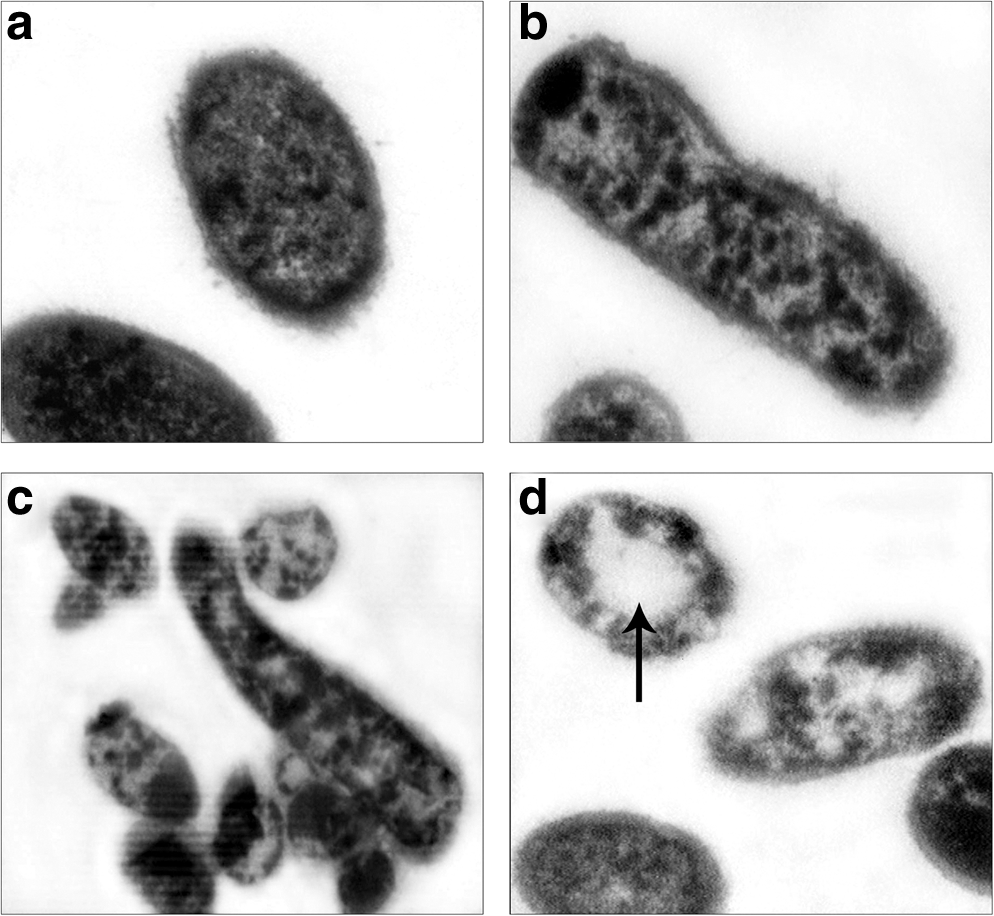
Electron micrographs of Bacillus cereus.
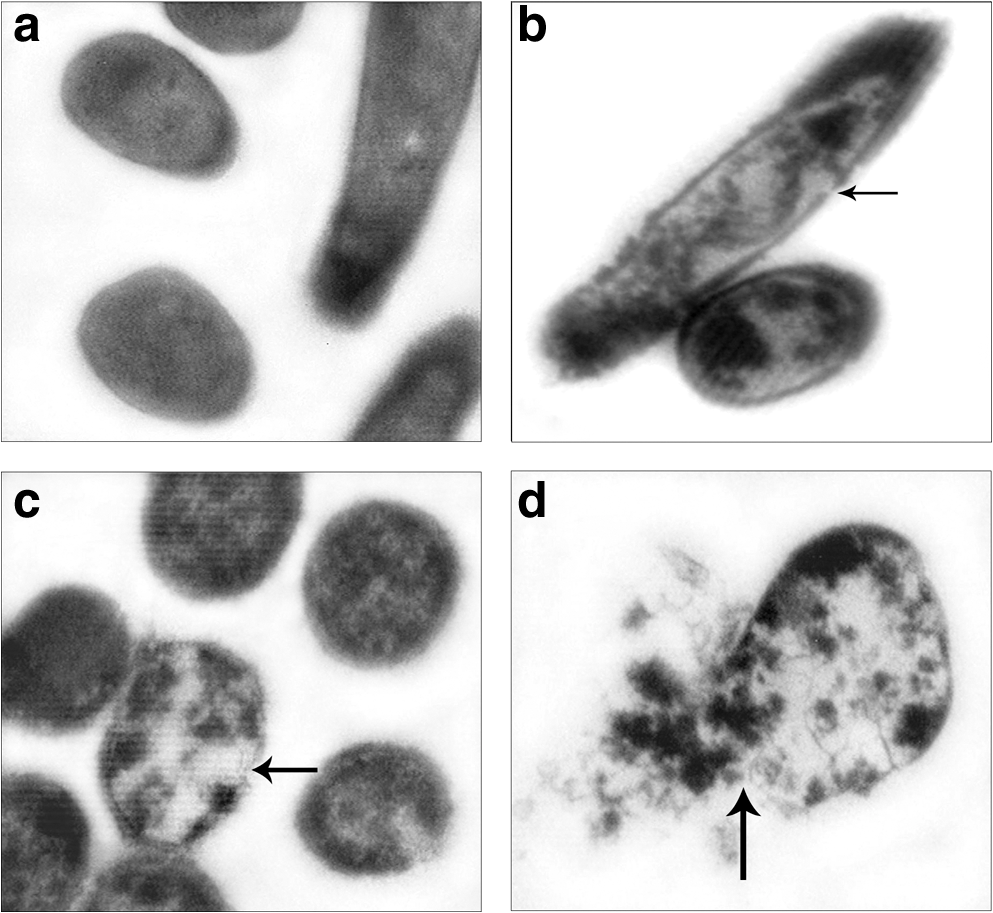
Electron micrographs of Bacillus subtilis.
Discussion
Regarding antibacterial effects of essential oils in food, higher concentrations are needed to achieve satisfactory results, which would inevitably lead to undesired organoleptic changes in food products (Yamazaki et al., 2004). Many efforts have been made to reduce the concentration of essential oils through using other protective compounds and preservatives (Periago and Moezelaar, 2001; Pol et al., 2002; Moosavy et al., 2008; Solomakos et al., 2008). In the present study, the antimicrobial activity of the essential oil of M. longifolia L. alone and in combination with nisin on B. cereus and B. subtilis in barley soup was determined at various temperatures. Bacterial growth inhibitory activity of the essential oil alone and in combination with nisin was also studied using transmission electronic microscopy. GC/MS analysis of the essential oil of M. longifolia L. indicated that pulegone is the main component of the oil. Cis-piperitenone oxide and piperitenone oxide have been also isolated as the main components of M. longifolia L. essential oil by others (Gulluce et al., 2007; Hajlaoui et al., 2009). This discrepancy can be explained through differences in harvesting time, weather condition, geographical zone, and method of extraction (Valero and Salmeron, 2003; Burt, 2004). The results of the present study showed that the essential oil of M. longifolia L. at 8°C increased the preservation time of the barley soup significantly (p < 0.05) compared with the control group. The inhibitory effect of the combination of nisin and the essential oil on B. cereus at 8°C was significantly (p < 0.05) higher than that of the essential oil alone. Pol and Smid (1999) showed that the bactericidal effect of nisin in combination with carvacrol on the vegetative cells of B. cereus was significantly higher at 8°C than 20°C and the combination inhibited more bacterial cells. This finding is in agreement with the results of the present study. Based on the results of the present study, the essential oil of M. longifolia L. at 25°C could not prevent growth of none of the studied bacteria. In contrast, the combination of nisin and the essential oil at the same temperature could decrease the number of B. cereus cells significantly compared with the essential oil alone. The results of the present study showed that the inhibitory effect of a combination of nisin and the essential oil on B. subtilis at 25°C was significantly higher than at 8°C, which supports the work of Rajkovic et al. (2005) that showed that the inhibitory effect of nisin and carvacrol on B. subtilis decreased with reduction of temperature. Our results are also in agreement with the results of Moosavy et al. (2008) regarding the effectiveness of the essential oil of Zataria multiflora Boiss. and nisin on Salmonella typhimurium and Staphylococcus aureus in barley soup. Periago and Moezelaar (2001) demonstrated that the efficacy of the combination of nisin with carvacrol on B. cereus at 8°C was progressively inhibitory. In contrast, the combination of nisin and the essential oil of M. longifolia L. at 25°C inhibited the vegetative form of B. subtilis. Nisin used in our study could prevent the growth of vegetative cells of B. subtilis at 25°C at all concentrations. It seems that the changes in cell membrane, the position of hydrocarbon chains of membrane lipids at lower temperatures, and reduction in mobility of the membrane are responsible for lower activity of nisin at 8°C. This could negatively affect the antimicrobial activity of nisin and other combinations of nisin with essential oils in reacting to their targets in bacterial cells (Abee et al., 1994). The antimicrobial activity of the essential oil in the present study could be related to the presence of pulegone as a main component of the oil. In general, studies on the functions of the essential oils show that their antimicrobial activity is due to their destructive effect on cell membrane (Tassou et al., 2000). Given the action of nisin on cytoplasmic membrane, its combination with other essential oils removes the limitation of the essential oils application as food preservatives (Periago and Moezelaar, 2001). It has been shown that nisin bears antimicrobial activity in combination with other essential oils on B. cereus and B. subtilis (Misaghi and Basti, 2007). As both nisin and essential oils act on cytoplasmic membrane, they are expected to achieve a synergistic function; therefore, using nisin will reduce the quantity of essential oil needed for inhibitory effects (Pol et al., 2002; Yamazaki et al., 2004).
TEM results showed that the structure of bacterial cells treated with the essential oil alone were to some extent similar to those of the control group. However, when combined with nisin, the efficacy of nisin was potentiated. These findings are further evidence that the combined usage of the essential oil of M. longifolia L. and nisin may display a kind of synergistic function on B. cereus and B. subtilis in barley soup.
Higher concentrations of the essential oil (0.60 and 0.75 μL mL−1) had undesired effects on sensory acceptance of the soup. However, combining the essential oil with nisin led to lower concentrations of the essential oil needed to prevent bacterial growth. Based on the results of the sensory analyses, all the concentrations of the essential oil used with nisin in barley soup were accepted. Therefore, the combination of nisin and the essential oil of M. longifolia L. could not only protect foodstuff against pathogens but also prevent undesired effects on sensory acceptance.
The results of the present study showed that the essential oil of M. longifolia L. alone could not inhibit the vegetative cells of bacteria at 25°C. The least concentration of the essential oil used in this study showed an inhibitory effect at 8°C. The combination of nisin with the essential oil of M. longifolia L. could enhance food-protective properties of the essential oil. Our study also indicated that the bacterial cells treated with a combination of nisin and the essential oil underwent massive morphological changes. This is also a further proof that a combination of nisin with the essential oil can exert an inhibitory effect on bacterial growth in a food model.
Footnotes
Acknowledgments
This work was supported by Urmia University. The authors thank M. Behfar and R. Mohammadi for their valuable contributions.
Disclosure Statement
No competing financial interest exists.