




Abstract
This study was conducted to examine the in vitro activity of antimicrobials against Campylobacter spp. isolates from chicken and human sources and the genetic interrelation among them. During 2004–2008, a total of 173 Campylobacter spp. isolated from chicken meats (60 domestic and 62 imported chicken meats) and humans (n = 51) were tested for susceptibility to nine antimicrobials. Of 173 isolates, 140 (80.9%) showed multidrug resistance (MDR) against three to eight antimicrobials. The most frequent pattern type was MDR to four antimicrobials: ciprofloxacin, nalidixic acid, ampicillin, and tetracycline. Over 52.6% (91/173) of the isolates tested were resistant to these four antibiotics simultaneously. Especially, two and five isolates originated from Korea and Brazil showed resistance against all antibiotics tested, except for florfenicol. Further, 95% (57/60) of the isolates originated from domestic chicken showed resistance to ciprofloxacin, the antimicrobial agent of choice for treatment of human campylobacteriosis. Genotypic characterization of all Campylobacter isolates performed by pulsed-field gel electrophoresis yielded 74 types among the 173 isolates. Isolates sharing the same or similar genetic clusters were detected in different countries at different times. The pulsed-field gel electrophoresis patterns of chicken-related isolates were closely related to those of isolates from humans with gastroenteritidis. The results of this study suggest that MDR Campylobacter spp. are widespread and that Campylobacter with similar genotypes are circulating both in humans and in chicken meat in Korea.
Introduction
Most persons infected with Campylobacter spp. recover without medical treatment, except in severe cases and for immunocompromised patients (Nachamkin et al., 1998, 2000). In these specific cases, fluoroquinolones and macrolides are the antimicrobial agents of choice for treatment of human campylobacteriosis. However, resistance of Campylobacter spp. to these classes of antimicrobial agents has been an important concern (Engberg et al., 2001; Padungton and Kaneene, 2003). Ever since fluoroquinolones were approved for use in veterinary medicine, human infections with fluoroquinolone-resistant Campylobacter spp. have increased (Sagara et al., 1987; Endtz et al., 1991; Smith et al., 1999). The use of fluoroquinolone in food animals has been followed by a rise in ciprofloxacin-resistant Campylobacter isolated from animals and humans. These findings provoked the withdrawal of fluoroquinolone use in poultry (Gupta et al., 2004; Nelson et al., 2007). Moreover, the occurrence of multidrug-resistant Campylobacter spp. in food and the human population raises serious concerns regarding treatment failures. Thus, antimicrobial resistance and the emergence of multidrug resistance (MDR) among Campylobacter spp. need to be monitored. Meanwhile, recent studies reported that fluoroquinolone-resistant Campylobacter spp. among poultry flocks rapidly emerged (Chuma et al., 2001; Nachamkin et al., 2002; Hein et al., 2003). In addition, the genetic relationship between Campylobacter spp. isolated from chicken and humans suggests that Campylobacter spp.-contaminated chicken meat could be a potential source of hazard for human health (Hänninen et al., 2000; Zorman et al., 2006). Therefore, the objective of this study was to determine the antimicrobial susceptibility and MDR of Campylobacter spp. isolated from domestic and imported chicken meat and humans in Korea. The genetic relatedness of the isolates originating from different sources was also investigated.
Materials and Methods
Sample collection and bacterial strains
A total of 173 Campylobacter (121 C. jejuni and 52 C. coli) isolates originated from humans (n = 51) and domestic and imported chicken meats (n = 122) were randomly selected from the strain collection of our laboratory for use in this study. Human isolates were received from Korea National Institute of Health and were randomly selected, during 2007–2008. Specimens were collected from local patients with diarrhea enrolled in an ongoing active surveillance system at Korea National Institute of Health operated by Korea Centers for Disease Control and Prevention. The specimens were obtained from seven provincial institutes of health and hospitals in different regions of Korea. The 122 chicken isolates were originated from our previous study (Kim et al., 2010), in which a total of 475 domestic and 867 imported raw poultry meat samples were examined for the presence of Campylobacter spp. during 2004–2008. The samples were obtained randomly from 19 domestic poultry slaughterhouses and 52 cold storages keeping poultry meat imported from Thailand, United States, Denmark, United Kingdom, France, and Brazil.
Bacterial isolation and identification
Campylobacter spp. isolation and identification were performed as previously described with some modification (FDA, 2005; Kim et al., 2010). Each whole poultry carcass was rinsed in 400 mL of buffered peptone water (BBL; Becton Dickinson), and then 25 mL of the rinse fluid was added to 225 mL of Preston broth containing Preston antibiotic supplement (Oxoid CM0983). After 48 h of incubation at 42°C under microaerobic conditions (5% O2, 10% CO2, 85% N2) using Anoxomat™ system (Mart Microbiology B.V), a 0.1 mL portion of the enrichment broth was spread onto Campylobacter spp. blood-free selective agar (Oxoid CM0739) with CCDA selective supplement (Oxoid SR0155E) and Campylobacter spp. growth supplement (Oxoid SR0232E). One presumptive Campylobacter spp. isolate from each selective agar plate was identified by gram staining, catalase and oxidase production, hippurate hydrolysis, and API Campy system (BioMerieux), and confirmed by polymerase chain reaction assay to distinguish C. jejuni and C. coli (Wang et al., 2002). C. jejuni ATCC 33560 and C. coli ATCC 33559 were used as control strains.
Antimicrobial susceptibility test
The minimal inhibition concentrations were determined by agar dilution methods with Mueller-Hinton agar (BBL; Becton Dickinson) supplemented with 5% lysed horse blood (CLSI, 2006). Ampicillin (AM), erythromycin (E), azithromycin (AZ), clindamycin (CM), florfenicol (FFC), gentamicin (GM), tetracycline (TE), nalidixic acid (NA), and ciprofloxacin (CIP) were added to the final concentration from 0.06 to 512 μg/mL by twofold dilution, and a turbidity of the isolates for plating as a 0.6 MacFarland standard. Minimal inhibition concentrations breakpoints for resistance of AM (≥32 μg/mL), E (≥32 μg/mL), AZ (≥8 μg/mL), CM (≥8 μg/mL), FFC (≥32 μg/mL), GM (≥8 μg/mL), TE (≥16 μg/mL), NA (≥64 μg/mL), and CIP (≥4 μg/mL) were adapted in accordance with other published articles (Avrain et al., 2003; Andersen et al., 2006).
DNA extraction
Genomic DNA was extracted from cultures grown for 48 h at 42°C in microaerophilic conditions on Muller-Hinton agar plates supplemented with 5% sheep blood, using the QIAamp DNA Mini kit (Qiagen) according to manufacturer's directions. The DNA concentration was measured spectrophotometrically at A260.
Pulsed-field gel electrophoresis
Pulsed-field gel electrophoresis (PFGE) was performed as described by Gibson et al. (1995) using the CHEF-DRIII system (Bio-Rad Laboratories). Bacterial cells were grown for 48 h at 42°C on blood agar plate. They were suspended in TE buffer (100 mM Tris and 100 mM EDTA, pH 7.5), partially embedded in low-melting temperature agarose, and digested overnight with 10 U of proteinase K (Invitrogen) at 55°C. In brief, DNA was digested with the SmaI enzyme (New England Biolabs) after electrophoresis performed using the Gene Path system (Bio-Rad Laboratories) in 1% agarose gel in 0.5 × Tris Borate-EDTA (TBE) buffer at 14°C, with a linear ramp time of 6.76–38.035 sec over a period of 18 h, a 120 switch angle, and a gradient of 6.0 V per cm. After PFGE, the gels were stained with ethidium bromide and photographed under ultraviolet transillumination.
Data analysis
The PFGE patterns were analyzed using the Molecular Analyst Fingerprinting Plus software package (version 1.2; Bio-Rad). The TIFF images were normalized by aligning the peaks of the size standard strain (Salmonella enterica serovar Braenderup strain BAA-664), which was loaded on three lanes in each gel, with the database global standard. Matching and dendrogram unweighted pair group method with averages analysis of the PFGE patterns was performed using the Dice coefficient with a 1.0% tolerance window.
Results
A total of 173 Campylobacter spp. isolates from domestic and imported chicken meats and humans were tested for susceptibility to nine antibiotics. Antimicrobial resistance patterns of the 173 Campylobacter spp. are shown in Table 1. Only 4.6% (8/173) of the isolates were susceptible to all antimicrobials tested, and the rest (95.3%, 165/173) showed resistance to at least one antimicrobial tested. In total, 24 patterns of antimicrobial resistance were observed, and 140 (80.9%) isolates were resistant to three or more antimicrobials simultaneously. The most frequent pattern type was MDR with four antibiotics, CIP-NA-AM-TE, and 52.6% (91/173) of the isolates tested were resistant to these four antibiotics simultaneously. In particular, this distinct type of resistance pattern was observed in 72.5% (37/51) and 58.3% (35/60) of the isolates that originated from humans and domestic chicken meat in Korea, respectively. The highest diversity of resistance pattern was found among the isolates that originated from Korea and Brazil, where 12 and 11 different patterns were identified among the 60 and 27 isolates, respectively. Also, two and five isolates originated, respectively, from Korea and Brazil showed resistance against all antimicrobials tested, except for FFC. Especially high resistance rates against CIP (95%), NA (95%), TE (95%), and AM (80%) were observed in Campylobacter spp. from domestic chicken meats. Meanwhile, all isolates that originated from humans were susceptible to EM, AZ, FFC, and GE.
All human isolates were originated from campylobacteriosis in Korea.
No. of isolates included (%).
AM, ampicillin; CIP, ciprofloxacin; NA, nalidixic acid; TE, tetracycline; AZ, azithromycin; E, erythromycin; FFC, florfenicol; CM, clindamycin.
Subtyping was performed using PFGE and the enzyme used for cleavage was SmaI. An analysis of the genetic similarity of 114 C. jejuni and 59 C. coli from sources of humans (n = 51), domestic chicken meats (n = 60), and imported chicken meats (n = 62) originated from six countries yielded 74 PFGE types and clustered into 44 clusters (Fig. 1). Strains with similarity coefficients of >80% were considered to belong to a similar PFGE type, whereas those with indistinguishable PFGE banding patterns (>97% similarity coefficient) were considered to be of the same subtype. All C. jejuni and C. coli isolates were highly heterogeneous. Among the 44 clusters, C-20 and C-36, the predominant clusters, were observed in 24 isolates and 19 isolates, respectively. The majority of the isolates shared a similar PFGE genotype originated from different countries at different times. Moreover, the same genotypes were found at different periods from different countries. In some clusters (3, 5, 11, 13, 15, 17, 20, 22, 24, 26, and 34), PFGE patterns of chicken-related isolates were closely related genetically to those of isolates from humans with gastroenteritidis. Seventeen C. jejuni, which were isolated from humans associated with an outbreak of campylobacteriosis, all belonged to the same PFGE type (C-2). Most clusters of C. jejuni were different from those of C. coli except C-24. No correlation was observed between the antibiotic resistance patterns and the PFGE types of the isolates tested in this study.
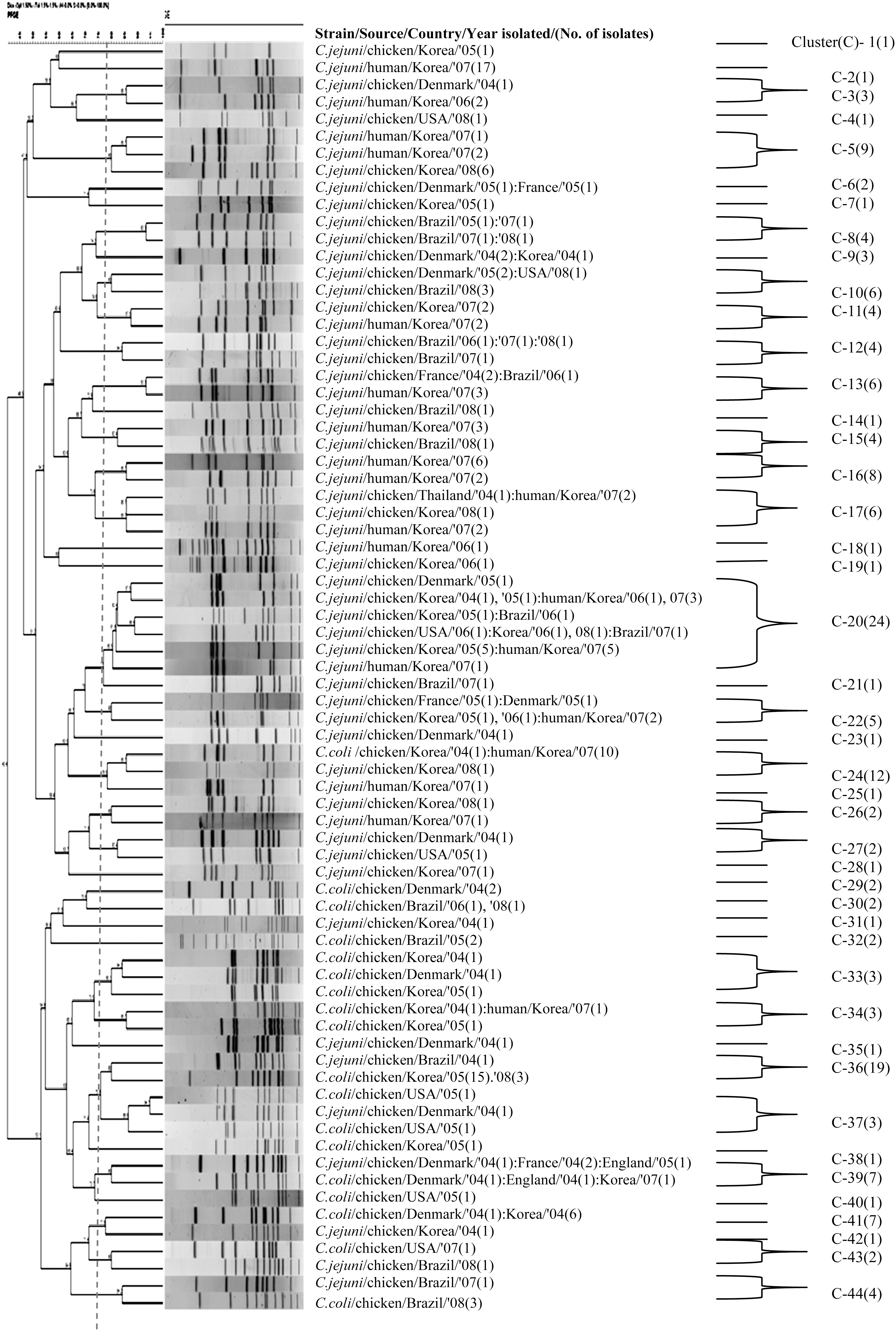
Dendrogram of PFGE banding patterns obtained with 189 Campylobacter isolates from domestic and imported chicken meats and humans. The numbers in parentheses are the numbers of isolates. The dotted vertical line indicates the 80% similarity threshold.
Discussion
In general, the Campylobacter spp. from domestic chicken meats and humans in Korea had a higher rates of antimicrobial resistance compared to imported chicken meats. A higher occurrence of MDR was also found in Campylobacter isolated from domestic chicken meats and humans; 69% of isolates from imported chicken were MDR, whereas 82.3% and over 90% of human isolates and domestic chicken meat isolates were MDR, respectively. Similar to our result, Hong et al. (2007) also reported that 93.4% of the Campylobacter spp. isolated from retail raw meats, including chicken meats in Korea, were MDR. These results suggest that MDR Campylobacter spp. are widespread in chicken meat in Korea.
In this study, the most frequent resistance profile observed among Campylobacter spp. was to CIP-NA-AM-TE. This profile was also the most common MDR pattern among human-origin Campylobacter isolates. Fortunately, however, most Campylobacter spp. originated both from humans and domestic chicken meats were sensitive to erythromycin, the antimicrobial agent used to treat human campylobacteriosis. Previous studies from Korea have also reported low rates of erythromycin resistance in Campylobacter spp. (Kang et al., 2006; Han et al., 2007). The frequency of CIP resistance among human isolates (82.3%) and domestic chicken meat isolates (95%) observed in this study is also similar to the rates of 87.9%–92.2% reported by previous studies from Korea (Kang et al., 2006; Han et al., 2007). Fluoroquinolone-resistant Campylobacter infection is a hazard to human health because they may complicate the antimicrobial treatment of campylobacteriosis. Several studies have proposed a causal relation between the veterinary use of fluoroquinolones in food production and the increase in quinolone-resistant Campylobacter infections in humans (Endtz et al., 1991; Smith et al., 1999; Saenz et al., 2000; Van Looveren et al., 2001; Wu et al., 2002). The use of fluoroquinolones in animals was banned in Korea from July 2008, but fluoroquinolones that have already produced before June 30, 2008, could still be used for 2 years. The complete withdrawal of fluoroquinolone for use in veterinary medicine, which would be started from July 2010 in Korea, may reduce the frequency of fluoroquinolone-resistant Campylobacter spp. in the future.
PFGE typing has been recognized by several authors as an effective method for genotyping of C. jejuni (Ioannidis et al., 2006; Zorman et al., 2006). In this study, genotypic characterization using PFGE yielded 74 types in 173 isolates, revealing high diversity among the isolates (Denis et al., 2008). Interestingly, isolates that originated from different countries at different times shared the same or similar genetic clusters. Similarities between and those from the other six sampled suggest that there is a global distribution of similar clones of Campylobacter spp. (Rönner et al., 2005). Most interestingly, isolates belonged to C-20, the predominant cluster in this study, were found to persist for 4 years, the whole period of this study. All isolates originated from humans associated with an outbreak of campylobacteriosis in Korea shared the same DNA type, C-2, indicating that PFGE method is useful in the molecular epidemiological analysis of a single outbreak.
On the basis of the results of this study, Campylobacter spp. sharing similar genotypes seem to be circulating in both human and chicken meats in Korea. About 45% (78/173) of the isolates were closely related genetically and were grouped into 11 clusters. This result, however, does not indicate that chicken was the direct source for human infections. Humans may be infected with Campylobacter spp. from several sources, but chicken would be the most important direct source of human infections (Hänninen et al., 2000; Dickins et al., 2002). Thus, identical PFGE types among the isolates from domestic and imported chicken meats and humans indicate possible cross-contamination of chicken meats and transmission to humans (Nadeau et al., 2002; Zorman et al., 2006).
Conclusion
The genetic relationship between Campylobacter spp. isolated from chicken meats and humans and their high prevalence of resistance to antimicrobials, including fluoroquinolones, observed in this study suggest that Campylobacter spp. could be an important emerging public health threat. Antimicrobial resistance and MDR among Campylobacter spp. should be continuously monitored and also further epidemiologic research to understand the possible cross-contamination and transmission of Campylobacter spp. is needed. This is the first report of genotypic relation between Campylobacter spp. isolated from chicken meats (domestic and imported) and those from humans in Korea.
Footnotes
Acknowledgment
This work was supported by N-FS08-2008-09-01 from National Veterinary Research and Quarantine Service, Ministry for Food, Agriculture, Forestry and Fisheries, Republic of Korea.
Disclosure Statement
No competing financial interests exist.