




Abstract
Yersinia enterocolitica and Yersinia pseudotuberculosis strains isolated from wild boars and fattening pigs were characterized and compared with each other. In wild boars, ail-positive Y. enterocolitica strains belonged to bioserotypes 4/O:3 (36%, 5/14), 2/O:9 (29%, 4/14), and 2/O:5,27 (21%, 3/14). Additionally, two ail-positive strains were untypable. Among fattening pigs, the bioserotype 4/O:3 was dominating (91%, 71/78), and bioserotypes 2/O:5,27 (8%, 6/78) and 2/O:9 (1%, 1/78) were rare. inv-positive Y. pseudotuberculosis strains of serotypes O:1 and O:2 were isolated only from wild boars. Antimicrobial resistance patterns between wild boar and fattening pig strains differed. Most of the ail-positive Y. enterocolitica strains carried yst, hreP, and virF genes. Several genotypes of Y. enterocolitica strains were obtained by PFGE using NotI, ApaI, XhoI, and SpeI enzymes. All genotypes of wild boar strains differed from fattening pig strains. Especially strains of bioserotype 4/O:3 were clearly different with all four enzymes. These results show that wild boar strains differed from domestic pig strains. More wild boar strains should be isolated to show that wild boars and domestic pigs are reservoirs for different Y. enterocolitica and Y. pseudotuberculosis strains.
Introduction
The reservoirs of human pathogenic Y. enterocolitica and Y. pseudotuberculosis are mostly still poorly known (Fredriksson-Ahomaa et al., 2010). Only Y. enterocolitica strains belonging to bioserotype 4/O:3 and Y. pseudotuberculosis strains of bioserotype 2/O:3 have repeatedly been isolated from fattening pigs at slaughter in Europe (Martínez et al., 2009, 2010a, 2010b). A high genetic similarity between human and porcine Y. enterocolitica 4/O:3 strains has been shown by PFGE using NotI, ApaI, and XhoI enzymes, indicating that pigs are an important reservoir for human pathogenic Y. enterocolitica 4/O:3 strains (Fredriksson-Ahomaa et al., 2006). Pigs might have a role as a source in human Y. pseudotuberculosis 2/O:3 infections, although this link has not yet been confirmed.
Pathogenic Y. enterocolitica and Y. pseudotuberculosis strains have recently been isolated from wild boars; however, their impact on the epidemiology of human yersiniosis is unclear (Fredriksson-Ahomaa et al., 2010). In recent years, wild boar population has exploded all over Europe. At the same time, outdoor pig farming has become popular, which may increase the risk of transmission of zoonotic bacteria like enteropathogenic Yersinia between wild boars and domestic pigs. However, the epidemiological link between wild boars and domestic pigs is unknown. In this study, enteropathogenic Yersinia strains isolated from wild boars were characterized and compared with strains found in domestic pigs.
Materials and Methods
Enteropathogenic Yersinia strains used for characterization
In total, 14 ail-positive Y. enterocolitica strains and 4 inv-positive Y. pseudotuberculosis strains isolated from wild boars were characterized and compared with 78 ail-positive Y. enterocolitica strains isolated from fattening pigs (Table 1). The wild boar strains originated from tonsils of animals sampled during October 2007 and March 2008 in Switzerland (Fredriksson-Ahomaa et al., 2009). The domestic pig strains were from tonsils of fattening pigs sampled during February and March 2006 in Switzerland (Fredriksson-Ahomaa et al., 2007).
NT, not typable.
Bio- and serotyping of enteropathogenic Yersinia strains
The biotype of ail-positive Y. enterocolitica strains was determined using pyrazinamidase and tween esterase activity, esculin hydrolysis, indole production, and salicin, xylose, and trehalose fermentation tests (Wauters et al., 1987). Serotyping was carried out with slide agglutination using commercial Y. enterocolitica O:3, O:5, O:9, and O:27 antisera (Sifin) and Y. pseudotuberculosis O:1 to O:4 antisera (MastGroup).
Antimicrobial resistance of enteropathogenic Yersinia strains
Antimicrobial resistance analysis was performed with disc-diffusion test according to CLSI (2002) except that the incubation temperature was 30°C. Mueller-Hinton broth and agar (Oxoid) were used as the test media and commercially available antimicrobial test disks (Oxoid). The agar plates were incubated at 30°C for 16 to 18 h. Antimicrobial agents commonly used in either treatment of pig disease or as growth promoters or those used in the treatment of human clinical disease were selected for testing. The following 16 antimicrobials were tested: ampicillin (10 μg), amoxicillin/clavulanic acid (20/10 μg), aztreonam (30 μg), cefotaxim (30 μg), ciprofloxacin (5 μg), chloramphenicol (30 μg), colistin (25 μg), erythromycin (15 μg), furazolidon (50 μg), gentamicin (10 μg), nalidixic acid (30 μg), streptomycin (10 μg), tetracycline (30 μg), trimethoprim (5 μg), trimethoprim/sulfamethoxazole (1.25/23.75 μg), and sulfamethoxazole (25 μg). Breakpoints to establish resistance were based on CLSI recommendations for Enterobacteriaceae.
Detection of different genes in enteropathogenic Yersinia strains
Ten different genes were studied by real-time PCR based on SYBRGreen according to Fredriksson-Ahomaa et al. (2007). Y. enterocolitica strains were identified using the 16S rRNA gene (Sen, 2000) and Y. pseudotuberculosis strains using inv gene (Thoerner et al., 2003). Three chromosomal virulence genes, ail (Nakajima et al., 1992; Lambertz et al., 2008), and yst (Ibrahim et al., 1997), hreP (Heusipp et al., 2001), and virF (Nakajima et al., 1992) gene located on the virulence plasmid were studied. Additionally, serotypes O:3 and O:9 of Y. enterocolitica were determined using the rfbC (Weynants et al., 1996) and per (Jacobsen et al., 2005) genes, respectively, and lactamase genes, blaA and blaB, were studied (Stock et al., 1999).
Characterization of enteropathogenic Yersinia strains using PFGE
Genotyping was done using NotI, ApaI, XhoI, and SpeI enzymes for Y. enterocolitica (Najdenski et al., 1994) and NotI, XhoI, and SpeI enzymes for Y. pseudotuberculosis (Niskanen et al., 2002). DNA was isolated using CHEF Genomic DNA Plug Kits (Bio-Rad). The plugs were lysed for 4–6 h at 37°C in lysozyme solution and overnight at 50°C in proteinase K solution. The plugs were washed six times in wash buffer before restriction digestion. The DNA was digested overnight with 10 U of NotI and with 20 U of ApaI, XhoI, and SpeI enzymes according to the manufacturer's instructions (New England Biolabs). The restriction fragments were separated through a 1.0% gel (pulsed-field-certified agarose; BioRad) in 0.5 × TBE with a CHEF Mapper XA system (BioRad). Lambda Ladder PFG marker (New England Biolabs) was used as a size standard. Pulse times were ramped from 1 to 25 sec over 22 h for NotI and ApaI, from 1 to 20 sec over 20 h for SpeI and from 1 to 18 sec over 18 h for XhoI. The gels were stained with ethidium bromide, destained with the running buffer, and photographed with a Gel Doc EQ system (BioRad). Isolates were considered to be different when a one-band difference between fragments over 70 kb was observed (Fredriksson-Ahomaa et al., 2006).
Results and Discussion
Bioserotype 4/O:3 of ail-positive Y. enterocolitica strains was identified in 5 (36%) out of 14 wild boar strains, and this type was the most dominant type (91% of the 78 strains) in domestic pigs at slaughter (Table 1). Bioserotypes 2/O:9 and 2/O:5,27 were identified in four (29%) and three (21%) wild boar strains, respectively. These types were very rare in fattening pigs found only in 1% and 8% of the strains, respectively. Additionally, two ail-positive Y. enterocolitica strains from wild boars could be neither bio- nor serotyped. Bioserotype 4/O:3 is widely distributed and the most common type causing human yersiniosis in Europe (EFSA, 2009). It is also the most common type in European pig population (Martínez et al., 2009, 2010a, 2010b). Bioserotype 2/O:9 is the second most common type identified in human yersiniosis in Europe followed by bioserotype 2/O:5,27. Bioserotypes 2/O:5,27 and 2/O:9 have only sporadically been isolated from domestic pigs in Europe except England, where bioserotypes 2/O:9 and 2/O:5,27 are more common than 4/O:3 (Martínez et al., 2010b). More wild boar strains have to be isolated to get more information about the distribution of different bioserotypes in wild boar population.
Y. pseudotuberculosis strains were only isolated from wild boars in Switzerland. However, it has recently been shown that Y. pseudotuberculosis can also be found in domestic pigs but that the prevalence is clearly lower than the prevalence of Y. enterocolitica (Martínez et al., 2009, 2010a, 2010b). Further studies are needed to show that wild boars are a more important reservoir for Y. pseudotuberculosis than domestic pigs. Two different serotypes (O:1 and O:2) were identified among four inv-positive Y. pseudotuberculosis strains (Table 1). Serotype O:3, which is the dominant type in domestic pigs in Europe, was not found in wild boars (Martínez et al., 2009, 2010a, 2010b). A high isolation rate of Y. pseudotuberculosis strains belonging to a wide variety of serotypes in fattening pigs has recently been reported in England (Martínez et al., 2010b). It was speculated that this might be attributed to wild animals having contact with pigs reared outside.
All strains were sensitive to aztreonam, cefotaxim, ciprofloxacin, chloramphenicol, colistin, gentamicin, and nalidixic acid, and resistant to erythromycin using disc diffusion method. However, there were some differences in the resistance patterns of Y. enterocolitica strains from wild boars and fattening pigs and between the Y. enterocolitica and Y. pseudotuberculosis strains among seven antimicrobials (Table 2). The resistance to amoxicillin/clavulanic acid differed between Y. enterocolitica 4/O:3 and 2/O:9 strains from wild boars and fattening pigs. All Y. enterocolitica 4/O:3 and 2/O:9 strains from wild boars showed resistance to amoxicillin/clavulanic acid, whereas the strains from fattening pigs were sensitive. One explanation may be that the β-lactamase A was not inhibited by clavulanic acid in wild boar strains due to some differences in cell wall between wild boar and domestic pig strains (Sharma et al., 2004). Additionally, out of 71 domestic pig strains studied, 2 strains were resistant to sulphametoxazol—of them, one to trimethoprim as well as trimethoprim/sulphametoxazole (Table 2). Resistance to trimethoprim and trimethoprim/sulphametoxazole seems not to be a cause of major concern. All Y. pseudotuberculosis strains were sensitive to ampicillin, which can be explained by the inability to produce β-lactamases due to the lack of the blaA and blaB genes (Table 3). All Y. enterocolitica strains were resistant to ampicillin and carried both β-lactamase genes.
Number of strains is given in parentheses.
Number of strains is given in parentheses.
All Y. enterocolitica strains belonging to human pathogenic bioserotypes carried yst and hreP genes associated with the virulence (Ibrahim et al., 1997; Heusipp et al., 2001), which shows that the presence of these genes correlates well with the bioserotypes associated with yersiniosis (Table 3). These genes were missing in two ail-positive Y. enterocolitica strains from wild boars, which could not be classified into any bioserotype. This indicates that these two strains may have a lower pathogenicity. This may also indicate that the presence of ail is not a sufficient virulence marker alone to detect and identify human pathogenic strains. The virF gene located on the virulence plasmid was detected in all Y. pseudotuberculosis strains and in all Y. enterocolitica strains of pathogenic bioserotypes isolated from wild boars. This gene was not detected in 31% of Y. enterocolitica 4/O:3 strains recovered from pigs. The virulence plasmid is needed for the full virulence, but it can easily be lost during culturing (Li et al., 1998). Further studies are needed to prove that the virulence plasmid is more unstable in Y. enterocolitica 4/O:3 strains from domestic pigs.
All genotypes of wild boar strains differed from domestic pig strains (Table 4). Especially wild boar strains belonging to bioserotype 4/O:3 were clearly different from domestic pig strains with all four enzymes. The PFGE profiles of bioserotype 2/O:5,27 and 2/O:9 strains isolated from wild boars differed only slightly from domestic pig strains (Fig. 1). Bhaduri et al. (2009) have recently demonstrated that Y. enterocolitica O:3 and O:5 strains isolated from fattening pigs in the United States are highly similar within the serotype. Further, the genotypes of Y. enterocolitica 4/O:3 from human and porcine sources in Europe have shown to be very homogeneous supporting a link between domestic pigs and human yersiniosis (Fredriksson-Ahomaa et al., 2006). Strains from wild boars, domestic pigs, and humans isolated during the same time period are needed to study the molecular epidemiological link between wild boars and domestic pigs, and the role of these strains in human yersiniosis.
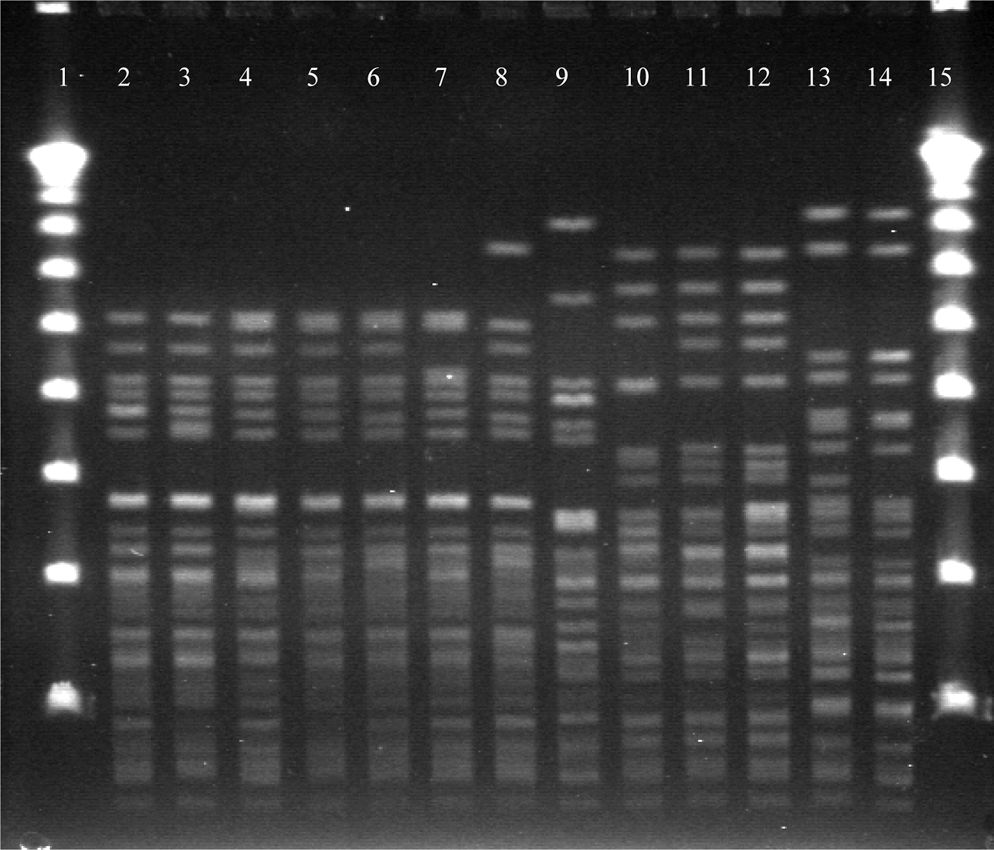
Different NotI profiles of Yersinia enterocolitica strains from wild boars and fattening pigs. 1 and 15: Lambda Ladder marker; 2–8: NotI patterns (GE 1–7) of Y. enterocolitica 4/O:3 strains from fattening pigs; 9: NotI pattern (GE 8) of Y. enterocolitica 4/O:3 strains from wild boars; 10 and 11: NotI patterns (GE 51–52) of Y. enterocolitica 2/O:5,27 strains from fattening pigs; 12: NotI pattern (GE 53) of Y. enterocolitica 2/O:5,27 strains from wild boars; 13: NotI pattern (GE 91) of the Y. enterocolitica 2/O:9 strain from a fattening pig; 14: NotI pattern (GE 93) of Y. enterocolitica 2/O:9 strains from wild boars.
Number of strains is given in parentheses.
GE, genotype for ail-positive Y. enterocolitica.
GP, genotype for inv-positive Y. pseudotuberculosis.
Y. pseudotuberculosis strains belonging to two serotypes presented all different genotypes (Table 4). There was also a clear difference between the three O:1 strains demonstrating a high genetic diversity among wild boar strains belonging to serotype O:1. The genotypes of serotype O:3 strains isolated from domestic pigs in Finland have shown to have a very limited genetic diversity (Niskanen et al., 2002). More research is needed to elucidate the role of wild boars and domestic pigs in the transmission of Y. pseudotuberculosis between animals and from animals to humans.
In conclusion, ail-positive Y. enterocolitica strains isolated from wild boars were different from domestic pig strains. More wild pig strains have to be collected to prove that wild boars and domestic pigs are reservoirs for different strains of human pathogenic Y. enterocolitica.
Footnotes
Disclosure Statement
No competing financial interests exist.