




Abstract
The aim of this work was to study the effect of olive powder combined with high hydrostatic pressure (HHP) on the inactivation of Bacillus cereus spores, to use it as an additional control hurdle in beverages pasteurised by this technology. With this purpose, reference medium prepared at different concentrations of olive powder was inoculated with B. cereus spores and subjected to different pressure treatments. The outgrowth capacity of the treated spores was then determined at 20°C and 32°C. The addition of olive powder was found to slightly reduce the effectiveness of HHP, although in post-treatment storage there was an increased bacteriostatic effect in the samples with 2.5% of olive powder at both temperatures in the samples pressurised at 400 and 500 MPa, and only at 20°C in the samples pressurised at 200 MPa. The addition of olive powder therefore had an additive effect with storage temperature and HHP processing and could act as an additional control hurdle during the shelf-life of products pasteurised by HHP technologies or in the case of cold-chain breakage.
Introduction
Several authors previously reported the antimicrobial activity of olive polyphenols from olive mill waste water (Obied et al., 2005), leaf extracts (Pereira et al., 2007; Sudjana et al., 2009; Lee and Lee, 2010), olive fruit (Tassou et al., 1991; Bisignano et al., 1999; Soni et al., 2006), and olive oil (Medina et al., 2007) against a broad spectrum of microorganisms, such as Bacillus subtilis, Escherichia coli, Campylobacter jejuni, Candida albicans, Helicobacter pylori, Listeria monocitogenes, Salmonella enteritidis, Staphylococcus aureus, and B. cereus spores. In general, four substances have been identified as responsible for this antimicrobial activity: hydroxytyrosol, tyrosol, the dialdehydic form of decarboxymethyl ligstroside, and oleuropein aglycons. Recently, Lee and Lee (2010) demonstrated that a mixture of polyphenols presented higher inhibition effects than the individual compounds, and the application of a mixture of polyphenols has great potential as a functional food ingredient.
In general, bacterial spores are a major concern to the food industry due to their extreme resistance to environmental factors (Nicholson et al., 2000), and their inactivation is normally achieved by high-temperature treatment, which can reduce the food quality. High hydrostatic pressure (HHP) is a preservation technique that preserves to a higher extent the nutritional properties of fresh products (Tassou et al., 2007). However, microorganisms are variable with regard to their sensitivity to HHP treatments, and bacterial spores are the most resistant (Hoover et al., 1989; Knorr, 1995). To solve this problem, the combination of HHP with other hurdle technologies (Leistner, 2000) has been investigated. One of these combinations with an interesting potential is the use of natural antimicrobials, such as nisin and/or sucrose laureate, which have been applied in some dairy products (Roberts and Hoover, 1996; Stewart et al., 2000; Black et al., 2008), to inactivate spores of B. cereus, Bacillus coagulans, B. subtilis, and Clostridium sporogenes. The inactivation of B. cereus spores has also been achieved by HHP combined with moderated temperatures (Raso et al., 1998; Ju et al., 2008).
The aim of this study was to evaluate the combined effect of olive powder and HHP treatment on the inactivation of B. cereus spores in reference medium and the spore growth capacity after HHP treatment.
Materials and Methods
Bacterial spore preparation
B. cereus (ATCC 14579) type strain, provided by the Spanish Type Culture Collection, was used as the target microorganism. Spores were obtained as described by Ferrer et al. (2009) and stored at 4°C at a final concentration of 5 × 10⁹ spores/mL.
Sample preparation and HHP treatment
Vials containing 20 mL of reference medium (BHI broth; Scharlau Chemie, S.A.) at 0%, 1.5%, and 2.5% of olive powder (Natraceutical S.A.) were prepared and sterilized. These vials were then inoculated with 100 μL spore suspension at a final concentration of ∼2.5 × 10⁷ spores/mL, and used to fill the 2 mL vials used as samples for the HHP treatments. For each treatment, three unpressurised samples at each olive powder concentration were reserved as controls (N0) and the rest were submitted to HHP treatment.
HHP samples were placed in polyethylene bags filled with water and heat-sealed (MULTIVAC Thermosealer) before being placed in the HHP unit (High Pressure Food Processor; EPSI). The pressurization liquid used was a mixture of water and glycol. The pressure level, pressurization time, and temperature were controlled automatically. The rate of pressure increase was 300 MPa/min, and the depressurization time <1 min. The treatment times described in this study do not include come-up and come-down times. Samples were pressurised at 200, 400, and 500 MPa for 10 and 25 min at an initial temperature of 20°C.
Immediately after pressurisation, three samples of each olive powder concentration were transferred into an ice-water bath and used for enumeration of colony-forming units (NP). All treatments were applied in triplicate and the results expressed as mean values ± standard deviation. In addition, three pressurised samples of each concentration and three unpressurised controls were stored at 32°C or 20°C, and aliquots from each vial analyzed at different time intervals (0, 24, 48, and 72 h) to determinate the spore growth capacity (Nt).
Microorganisms counting
Decimal dilutions of all samples in peptone water (Scharlau Chemie, S.A.) were pour-plated in BHI agar (Scharlau Chemie, S.A.). Colonies were counted after 24 h incubation at 32°C.
Statistical analysis
Statistical analyses were performed using the statistic software Statgraphics Centurion version XV (Statpoint, Inc.). The effects of pressure and olive powder concentration on the direct spore inactivation were studied by applying multifactor ANOVA.
Results and Discussion
Olive powder, pressure, and treatment time effect on the HHP inactivation of B. cereus spores
In general, HHP inactivation of B. cereus ATCC 14579 spores in the presence or absence of olive powder did not have a significant effect with respect to food safety, as the inactivation levels achieved at all pressures and treatment times were <1 log cycle reduction (Fig. 1), and it is generally accepted that at least 5 log cycle reductions must be achieved when mild technologies are used as preservation processes. In addition, increasing the concentration of olive powder seemed to slightly reduce HHP effectiveness (p < 0.001). Nevertheless, statistically higher inactivation levels (p <0.001) were found at 200 and 500 MPa, than at 400 MPa after 10 min treatment, and increasing the treatment time from 10 to 25 min increased spore inactivation by only 0.5 log cycles (p < 0.001) at 400 MPa.
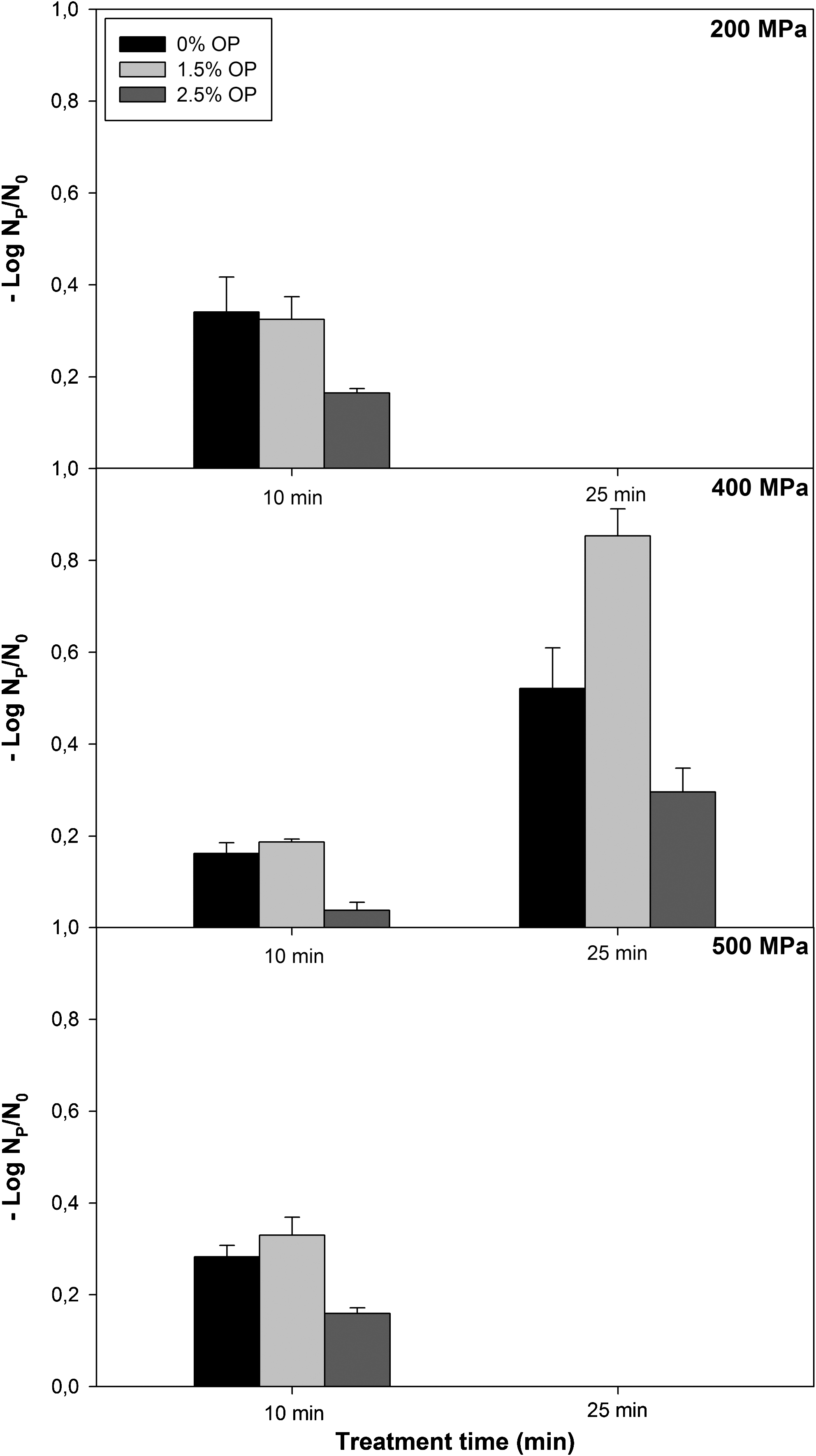
Effect on the inactivation of Bacillus cereus spores in reference medium at different olive powder (OP) concentrations and high hydrostatic pressure treatment conditions.
To explain the inactivation mechanism of bacterial spores by HHP, Black et al. (2007a) deduced that microbial spores had to be germinated to be inactivated, and this could happen at moderately high pressures and very high pressures. This could be the reason why 200 and 500 MPa had more effect than 400 MPa at inactivating B. cereus spores in reference media. Regarding the slight reduction in the HHP effectiveness caused by the presence of olive powder, Goh et al. (2007) reported a baroprotective effect caused by increased solute concentration during HHP processing on yeast and moulds. Moreover, Tassou et al. (1991) previously reported the antigerminative effect of olive phenolic compounds, although strong germination inhibitors such as phenolic compounds have previously been reported to be poor inhibitors for pressure-induced germination (Wuytack et al., 2000; Black et al., 2005, 2007b). With respect to the effect of increasing the treatment time, Stewart et al. (2000) found a decrease in B. subtilis and C. sporogenes spore survival when increasing the pressurization time from 15 to 30 min. In the present study, only 0.5 log cycle reductions were achieved by increasing the treatment time from 10 to 25 min, which is a very low increase in effectiveness at considerably higher energetic cost. It has previously been reported by Ju et al. (2008) that economical considerations compel HHP exposure times to be <20 min.
The present results were obtained with a specific B. cereus strain, and therefore it should be taken into consideration that other strains from foodborne intoxications or other collections strains may behave differently.
Effect of olive powder and pressure on B. cereus spores growth capacity at different temperatures
The outgrowth capacity of the surviving spores in the treated samples was analyzed to assert the effectiveness of HHP processing and olive powder addition at 32°C, which is the optimal growth temperature for B. cereus, and at 20°C as an example of cold-chain breakage. Normal storage temperatures (4°C) or abuse storage temperatures (7°C) were not studied, as no B. cereus spores growth was observed at 7°C in a previous study carried out by Ferrer et al. (2009).
Growth curves of B. cereus spores at 32°C and 20°C in unpressurised controls, and samples pressurised for 10 min at 200, 400, and 500 MPa are shown in Figure 2. In the unpressurised samples, a small bacteriostatic effect can be observed at 1.5% and 2.5% olive powder concentrations as the spore outgrowth is slightly lower at these concentrations than at 0% olive powder, at both 32°C and 20°C. This result agrees with those obtained by Ferrer et al. (2009), who reported a bacteriostatic effect of olive powder that increased when increasing the concentration of olive powder. However, the storage temperature did not seem to have a noticeable effect on the outgrowth of B. cereus spores in these samples.
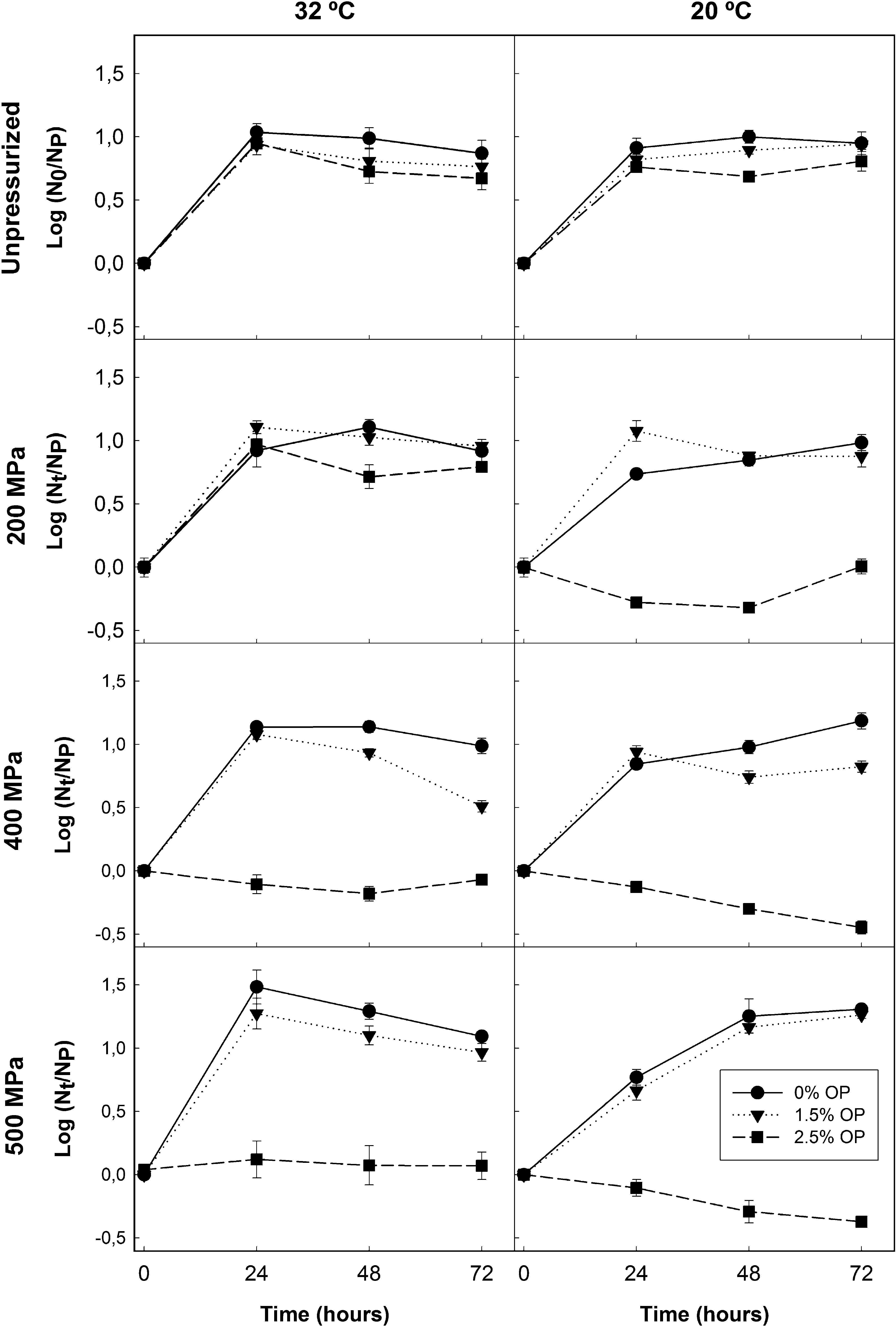
B. cereus outgrowth at 32°C and 20°C after different high hydrostatic pressure treatment conditions at the different olive powder concentrations studied.
Generally, when comparing unpressurised and pressurized samples, pressure did not have any effect on the outgrowth of B. cereus spores during storage in the samples with 0% and 1.5% of olive powder, as they showed a similar behavior to unpressurised samples at the same concentrations.
However, in the samples with 2.5% of olive powder, a possible additive effect between pressure and olive powder on B. cereus outgrowth can be seen in Figure 2 considering unpressurised and 200 MPa samples stored at 20°C. At this temperature, chosen to simulate cold-chain breakage, there is a bacteriostatic effect at 200 MPa, whereas in the unpressurised samples the effect is negligible. There is also a possible additive effect between temperature and olive powder, which can be seen when considering 2.5% olive powder samples treated at 200 MPa, whereas there is a bacteriostatic effect at 20°C but not at 32°C. Samples with 2.5% olive powder pressurised at 400 and 500 MPa showed inhibited outgrowth of B. cereus at 32°C, with a slight decrease in spore fraction during storage at 20°C, thus confirming the possible interaction observed at 200 MPa. Therefore, taking into account results found for 0% and 1.5% olive powder, there seems to be an additive effect for 2.5% olive powder with both pressure and storage temperature.
A possible explanation for the behavior observed is that increasing pressure treatments produce a degree of sensitivity in bacterial spores due to sublethal damage, which, in the presence of high olive powder concentrations, prevents germination and growth.
Taking into account the results obtained in this experience, it seems potentially interesting to consider addition of olive powder to savoury vegetable beverages of low acidity, subjected to mild HHP treatments to prevent the outgrowth of B. cereus spores during cold chain breakage or abuse storage temperatures. However, olive powder would have less interest in acidic foodstuffs, as it has been demonstrated that the concentration of organic acids, that is, lactic acid fermentation, inhibits to a higher extent the growth of B. cereus (Panagou et al., 2008).
Conclusion
The inactivation of B. cereus spores by HHP achieved in this experience was insignificant when compared with the generally accepted requirement of at least 5-cycle log reductions to achieve food safety when using mild technologies in preservation; therefore, different approaches to this problem should be considered to improve the effectiveness of the process. When considering the use of olive powder as an additional control hurdle, it has been found that combining HHP treatment with 2.5% olive powder could permit controlling B. cereus outgrowth, even during storage at optimum growth temperature. Pressures as low as 200 MPa combined with 2.5% olive powder would allow the control of B. cereus outgrowth if cold-chain breakage occurs, at least during the first 72 h. This result is important taking into account both food safety and process cost, as the presence of olive powder allows the application of low pressures for short treatment times, which would otherwise be insufficient to control B. cereus.
Footnotes
Acknowledgments
This work has been supported with founds from the projects GV/2010/064 from Generalitat Valenciana (Spain) and BISOSTAD (PSE-060000-2009-003) from Ministerio de Ciencia y Innovación (Spain). The JAE-predoctoral scholarship to Carmen Ferrer and the I3P-contract to Aurora Marco from Consejo Superior de Investigaciones Cientificas (CSIC) (Spain) and the European Social Fund are also acknowledged. Many thanks to Begoña Muguerza from Natraceutical S.A., Spain, for providing the olive powder.
Disclosure Statement
No competing financial interests exist.