




Abstract
A total of 75 powdered infant milk formula (PIF) samples collected from pharmacies and drugstores in Western Sicily, Italy, and representative of 12 different brands were analyzed in this study to evaluate their microbiological quality. According to the U.S. Food and Drug Administration protocol, 32 samples out of 75 were contaminated by enterobacteria. Commercial biochemical API(r) 20E-system identification method indicated that six PIF samples were presumptively contaminated by Cronobacter spp., but further characterization by alpha-glucosidase based polymerase chain reaction (PCR) assay identification strongly suggested that these strains did not belong to the genus Cronobacter. Phylogenetic analysis of partial 16S rRNA (rrs) sequences combined with the results of biochemical tests allowed to identify the six strains as Citrobacter freundii. Similarly, rrs sequence analysis identified as Enterobacter hormaechei 23 strains originally ascribed to Enterobacter cloacae by the API 20E system. Characterization of C. freundii and E. hormaechei PIF isolates by the DiversiLab(r) repetitive sequence-based PCR (rep-PCR) typing method revealed a variety of amplification patterns, but the recovery of the same rep-PCR genotype in several products might indicate a special adaptation of genetic clones to this food or cross-contamination through common ingredients. Antibiotic-resistance profiles were also determined, but none of the strains tested was resistant to third-generation cephalosporins or fluoroquinolones and extended-spectrum beta-lactamase activity was not detected. Our results confirm that E. hormaechei contamination of PIF is widespread, thus making it a cause for concern. Similarly to what was demonstrated for E. hormaechei, we suggest that C. freundii also may be an under-reported cause of bacterial infection, especially in high-risk neonates, due to misidentification.
Introduction
In recent years, a variety of microbiological methods based on selective enrichment media, fluorogenic or chromogenic isolation media has been developed to detect Cronobacter spp. (Druggan and Iversen, 2009). The FDA method (U.S. FDA, 2002) though having been shown to have both low sensitivity and relatively low specificity for the detection of Cronobacter spp. (Iversen et al., 2008), can be considered an affordable procedure to enumerate members of the Enterobacteriaceae. However, it has been shown that methods based on this biochemical feature are prone to producing false-positive results for presumptive E. sakazakii colonies due to the presence of this enzymatic activity in other species of the Enterobacteriaceae. The reliable distinction of Cronobacter from other Enterobacteriaceae would be of special interest to ascertain the burden of disease for this genus and the pathogenic role in infants and young children of other species belonging to the family. Genetic methods were developed for the purposes of confident identification of Cronobacter. Notably, the dnaG and gluA gene polymerase chain reaction (PCR) assays showed to be 100% sensitive and specific (Iversen et al., 2007). Sequence analysis of the 16S rRNA gene is widely used for bacterial identification and recently revealed that commercial biochemical test kits identified more than one species as E. sakazakii (Iversen et al., 2004).
The objective of this study was to survey and compare a wide range of PIF formulations for Enterobacteriaceae contamination using genetic methods such as gluA gene PCR and 16S rRNA sequence analysis for secure identification. Since the availability of rapid and reliable typing methods is critical to conduct epidemiological investigations to define outbreaks caused by contaminated foodstuff, this study also evaluated the DiversiLab(r) repetitive sequence-based PCR (rep-PCR) typing method to characterize the Enterobacteria isolated from PIF.
Materials and Methods
Samples and microbiological analysis
A total of 75 PIF samples was collected in this study from local pharmacies and drugstores in Western Sicily, Italy. Samples were chosen to be representative of the five best-selling brands, and at least eight different formulations of PIF per brand, including preparations for special medical purposes were analyzed (Table 1). An additional selection of one to eight samples from each of seven minor brands was also analyzed. The samples, whose weight varied from 350 to 900 g, were collected during a 6-month period and transported in the original undamaged package from their point of sale to the laboratory. The Enterobacteriaceae counts were determined within 72 h from sampling and largely before the expiry date of the products. The U.S. FDA (2002)–recommended procedure was followed for the isolation of Enterobacteriaceae, with subsequent biochemical identification using the API 20E system (bioMérieux). Each package was sampled thrice. The most probable number (MPN) of cells per gram was calculated based on the number of triplicate “tubes” at each dilution in which the presence of the microbe was confirmed. Cronobacter sakazakii FSL F6-029 obtained from the strain collection of the International Life Sciences Institute, Washington, DC, was used as the control strain for the identification of Cronobacter. All cultures used in this study are available on request.
The five top-selling brands in Italy are indicated in bold.
All isolates presumptively identified by the API 20E system within the genus Enterobacter or as possible or probable Enterobacter sakazakii; isolates originating from the same sample share the initial figure of their identification code.
AC, anticonstipation; AD, antidiarrhoea; AR, antireflux; HA, hypoallergenic; RB, rice-based; RL, reduced lactose; SB, soy-based.
Antimicrobial susceptibility testing
Susceptibility patterns were determined by the disk diffusion method following the Clinical and Laboratory Standards Institute (CLSI, 2009) guidelines. The following antimicrobial disks (Oxoid) were used: amikacin (30 μg), amoxicillin-clavulanate (20 + 10 μg), ampicillin (10 μg), cefepime (30 μg), cefotaxime (30 μg), ceftazidime (30 μg), ciprofloxacin (5 μg), chloramphenicol (30 μg), gentamicin (10 μg), imipenem (10 μg), piperacillin (100 μg), tetracycline (30 μg), and trimethoprim (5 μg). Escherichia coli ATCC 25922 was used as the susceptible control strain. Extended spectrum β-lactamase (ESBL) screening was performed by the use of a double disk synergy test (Jarlier et al., 1988). The combination disk method based on the inhibitory effect of clavulanic acid was also used according to the CLSI (2005) criteria.
Alpha-glucosidase specific PCR
Genomic DNA was extracted using a commercial nucleic acid extraction kit (QIAamp DNA mini kit; Qiagen) according to the manufacturer's instructions. The specific amplification of the gene encoding the α-glucosidase activity was carried out as previously described (Lehner et al., 2006). The 1680 bp amplification products were analyzed by gel electrophoresis on a 1.5% agarose gel run alongside a 1kb DNA ladder (Promega) at 10 V/cm for 2 h, followed by staining in ethidium bromide.
PCR amplification, sequencing, and phylogenetic analysis of 16S rDNA
PCR amplification of the 16S RNA gene (rrs) was performed by using the Ad and rj primer pair as previously described (Tayeb et al., 2008). The resulting 1481 bp amplification fragments were sequenced with primer Ad to obtain partial 500 bp 5′-end rrs sequences. A phylogenetic analysis was carried out with the rrs sequences obtained in this study and homologous enterobacteria reference sequences retrieved from the GenBank database. Sequence alignment was performed using the CLUSTAL W algorithm, and a phylogenetic tree was drawn with the MEGA software version 3.0 using Kimura 2-parameter model as a method of substitution and the neighbor-joining method to reconstruct the phylogenetic tree. The statistical significance of the phylogenies inferred was estimated by bootstrap analysis with 1000 pseudoreplicate data sets. The GenBank accession numbers of the rrs sequences used in this study are indicated in Figure 1.
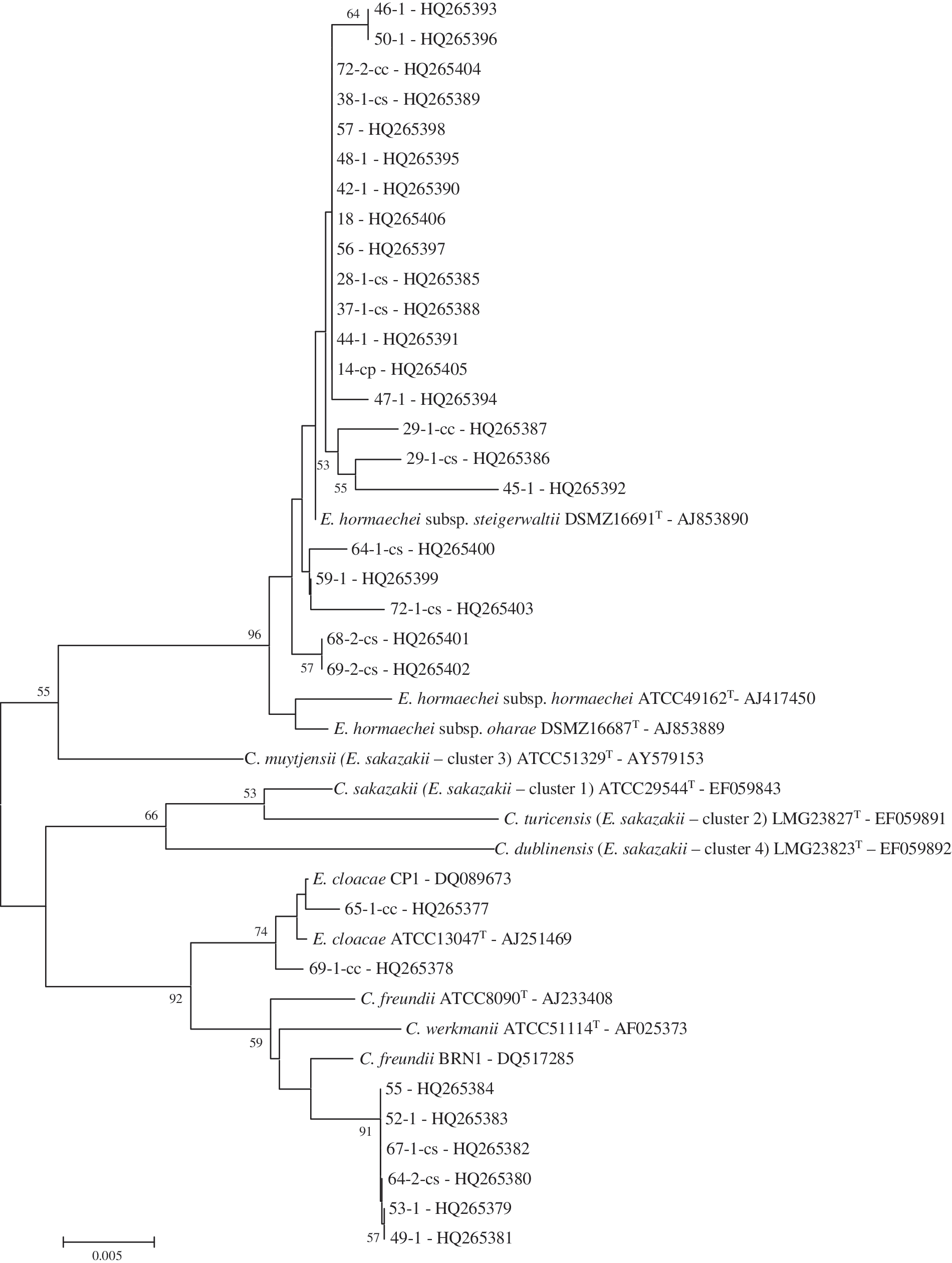
Neighbor-joining phylogenetic tree of partial nucleotide sequences of the 16S rRNA gene showing the relationship between the 30 powdered infant formula isolates analyzed in this study, Cronobacter type strains, and type and reference strains of the closest taxons suggested by the BLAST analysis. Bootstrap values above 49%, estimated with 1000 pseudoreplicate data sets, are indicated at each node. The bar indicates estimated sequence divergence. GenBank accession numbers for all sequences collected for this study and for reference strains are indicated after strain names.
Strain-typing by rep-PCR
The DiversiLab (r) Enterobacter DNA Fingerprinting Kit (bioMeriéux) was used for rep-PCR amplification of noncoding intergenic repetitive elements in the genomic DNA of the isolates. Data analysis was performed with the DiversiLab software version 3.4 using the Pearson coefficient to determine distance matrices and the unweighted pair group method with arithmetic mean to create dendrograms through the “Typing Report” tool. Rep-PCR profiles were designated as identical when they shared >97% similarity, as recommended by the manufacturer, and thus included in the same genotype. Cronobacter sakazakii FSL F6-029 was included as a nonrelated strain control. To assess the discriminatory power of the typing method, the numerical Index of Discrimination proposed by Hunter and Gaston (1988) was calculated.
Statistical analysis
Cross tabulation with chi-square statistics was used, and a α level of 0.05 or below was indicative of a statistically significant difference.
Results
Bacterial growth was observed on violet red bile glucose agar (VRBGA) from 33 (44%) of the 75 PIF samples tested (Table 1). Rates of contamination of the sample ranged from 23.1% to 62.5% for the five major brands examined and from 0% to 100% for the seven minor brands. No statistically significant association was found between bacterial contamination and a specific brand as well as with preparations for special medical purposes. For most of the positive products cell counts by the MPN were <10/g, but two samples displayed higher contamination levels (23 and 210 MPN/g, respectively). In 32 of the positive samples, contamination by a total of 46 enterobacterial isolates (one to three per sample) was ascertained by the FDA protocol. No Salmonella was isolated, but 27 isolates were presumptively identified by the API 20E system as belonging to the genus Enterobacter and 23 of them were indicated as possible E. sakazakii with probability ranging from 1% to 91.1%. For five of them, E. sakazakii was the most probable identification (probability ranging from 77.4% to 91.1%) (Table 2). Three additional isolates were indicated as possible E. sakazakii (probability ranging from 8.2% to 26%), though they were most probably attributed to the genera Rahnella and Citrobacter. Only six of the 26 possible or probable E. sakazakii isolates were positive to both the yellow pigment production and esculin hydrolysis additional tests used for confirmation. However, no amplification of the gene encoding the α-glucosidase was obtained from these isolates, as well as for all the remaining 24 isolates presumptively belonging to the genus Enterobacter or indicated as possible E. sakazakii by the API 20E. When these 30 isolates were submitted to 16S rDNA sequence analysis, BLAST searches over the GenBank database revealed that six of them, corresponding to the strains showing positive additional tests for E. sakazakii confirmation, actually belonged to the genus Citrobacter being the closest matching sequence that of Citrobacter freundii strain BRN1. Similarly, rrs sequence analysis identified as Enterobacter hormaechei all but two of the remaining 24 isolates that had originally been ascribed to Enterobacter aerogenes (1 isolate), Enterobacter cloacae (18 isolates), E. sakazakii (2 isolates), and Rahmella ornithinolytica (1 isolate). Finally, two isolates were identified as E. cloacae, confirming their phenotypic identification. Phylogenetic analysis of partial 16S rRNA sequences from the 30 isolates and comparison with cognate sequences of the type strains of the closest taxons better defined the speciation suggested by the BLAST analysis (Fig. 1). In particular, close correlation was found between the Citrobacter strains isolated in this study and the type strain of both C. freundii and C. werkmanii (98.7–98.8 nt% identity), whereas consistent genetic distances with the four Cronobacter reference strains (3.5–3.9 nt% diversity) definitely established that these isolates did not belong to the genus Cronobacter. Acid production from sucrose and melibiose determined by the API 20E system suggested that the six isolates clustering with the type strains of C. freundii and C. werkmanii actually belonged to the first species (Frederiksen, 2005). Concomitantly, phylogenies obtained from the comparison of E. hormaechei isolates obtained in this study with type sequences retrieved from GenBank further confirmed their identification, also suggesting attribution to the subspecies steigerwaltii. Rep-PCR analysis revealed the existence of seventeen distinct DNA profiles, including 1 to 5 isolates each, among the 30 isolates analyzed (Table 2 and Fig. 2). The six C. freundii isolates, obtained from different brands of PIF, were subdivided into four genotypes (Cf1-4) including one or two isolates each. Eleven different types consisting of one to five isolates were observed in E. hormaechei. The two most consistent E. hormaechei types were Eh1 and Eh3, including five isolates each from, respectively, five and four different brands of PIF, followed by Eh4, including three isolates from two brands, and Eh9, with two isolates from different brands. All other E. hormaechei genotypes included a single isolate. The two E. cloacae isolates belonged to different and well-distinct genotypes. Two isolates belonging to the same Eh3 type had actually been obtained from the same product sample, but they generated different identification codes in the API system. In general, no clear association between genotypes and API codes was observed. The discrimination index of Hunter and Gaston was calculated on E. hormaechei isolates whose number was consistent enough to allow evaluating the performance of the typing method with confidence. The number of E. hormaechei subtypes obtained produced a discrimination index of 0.90. Four different antibiotic resistance-types (R-types) were obtained from the strains analyzed, including resistance to one to three different molecules (Table 2). Almost all E. hormaechei isolates were resistant to ampicillin and amoxicillin-clavulanic acid and those belonging to genotypes Eh2-6 and part of the strains in genotype Eh1 were also resistant to tetracycline. C. freundii isolates were resistant to amoxicillin-clavulanate only. None of the strains tested was resistant to third-generation cephalosporins, to fluoroquinolones, or tested positive for ESBL production.
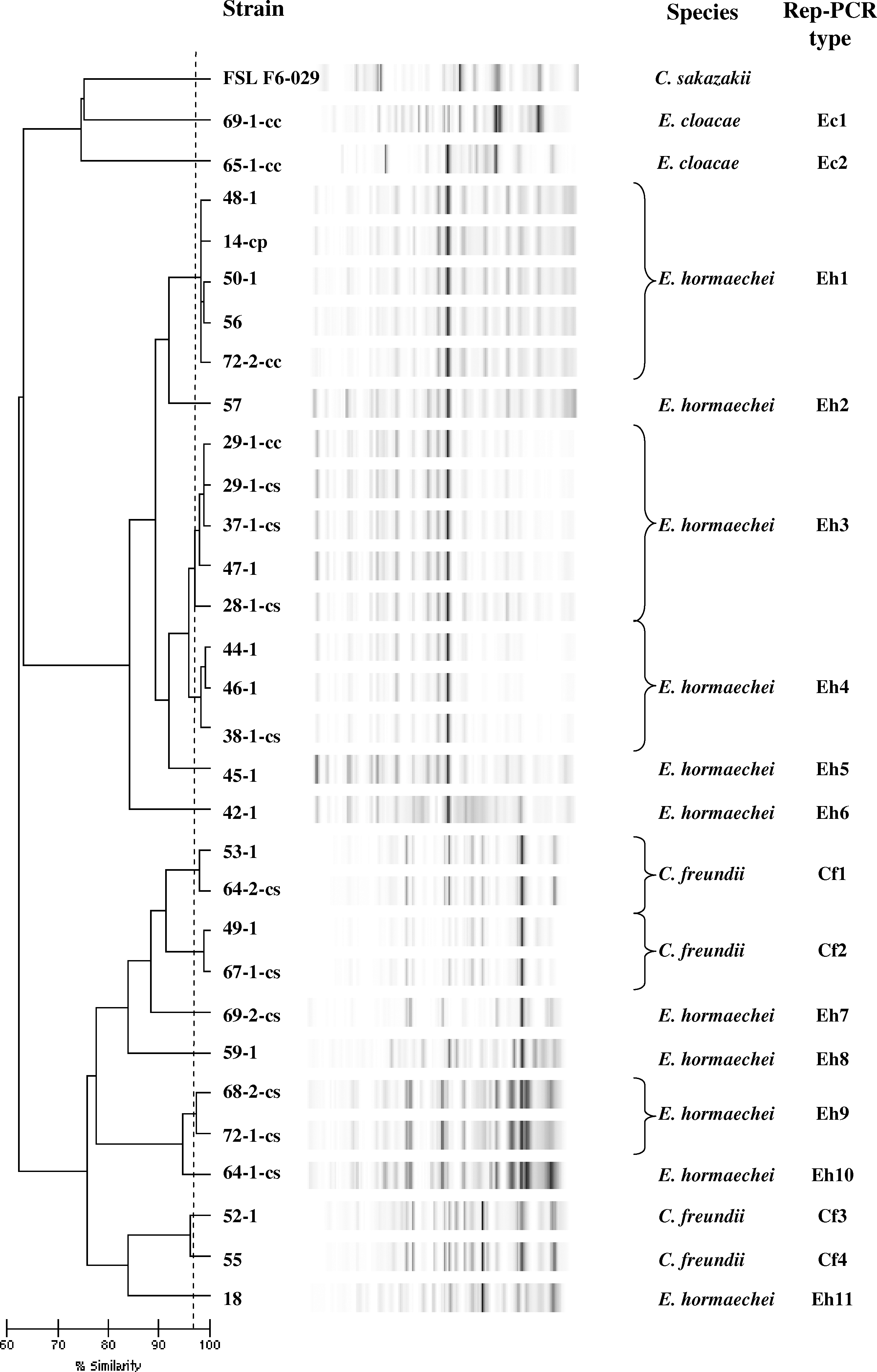
Rep-PCR amplification patterns of the 30 powdered infant formula isolates analyzed in this study. The amplification data were analyzed with the DiversiLab software version 3.4 (bioMeriéux) using the Pearson coefficient to determine distance matrices and the unweighted pair group method with arithmetic mean to generate the dendrogram. Dotted line indicates the 97% similarity limit for designating identical rep-PCR profiles as indicated by the manufacturer. Cronobacter sakazakii FSL F6-029 was included as a nonrelated strain control. rep-PCR, repetitive sequence-based polymerase chain reaction.
Additional tests for presumptive E. sakazakii identification by the API 20E system are the production of yellow pigmented colonies onto Trypticase Soy Agar plates incubated at 25°C for 48–72 h and ESC hydrolysis.
BLAST, basic local alignment search tool; AC, amoxicillin-clavulanate; AP, ampicillin; C, chloramphenicol; T, tetracicline; rep-PCR, repetitive sequence-based polymerase chain reaction; ESC, esculin.
Most of the C. freundii and E. hormaechei isolates were obtained from products with special medical purpose (Tables 1 and 2), but no shared ingredient could be associated to the finding of any of the two species or to the genotypes as defined by rep-PCR.
Discussion
In the present study, despite E. sakazakii identification being claimed by the API 20E system as probable for 5 of 30 enterobacteria and as possible for 20 more, no genetically confirmed isolates of Cronobacter were obtained from PIF. This is not surprising, as in the most recent surveys only 1.4% to 2.4% of infant formulas and 0.7% of follow-up formulas analyzed were contaminated by Cronobacter (Iversen and Forsythe, 2004; Chap et al., 2009; Jaradat et al., 2009). On the contrary, 20 (26.7%) of the 75 PIFs sampled were contaminated by E. hormaechei and 6 (8%) by C. freundii. Noteworthy, all C. freundii isolates were either erroneously indicated by the API 20E as probable E. sakazakii or their attribution to this species was considered to be possible. Similarly, most of the E. hormaechei isolates in this study were misidentified as E. cloacae by the API 20E-system, confirming that the identification through phenotypic methods of environmental enterobacteria such as those belonging to the genera Citrobacter, Cronobacter, and Enterobacter is unreliable especially with food isolates (Becker et al., 2009). The ISO/TS 22964 procedure does not suffer from these limitations and is, therefore, the industry standard method applied in Europe (Anonymous, 2006). Although Salmonella and C. sakazakii are regarded as the most common etiologies for systemic infection in neonates, some other Enterobacteriaceae, including C. freundii, have been listed by the FAO/WHO (2004) as Category B (causality plausible but not yet demonstrated) when isolated from PIF, follow-up formulas, and infant foods. In fact, PIF was indicated as the vehicle of infection in a nosocomial outbreak by C. freundii in a neonatal intensive care unit (Thurm and Gericke, 1994). More recently, the pathogenic potential of C. freundii has been confirmed by a meningitis case in neonatal age (Benca et al., 2007).
E. hormaechei has been shown to be of clinical significance by the report of several outbreaks of sepsis in neonatal intensive care units (Wenger et al., 1997; da Silva et al., 2002; Campos et al., 2007; Townsend et al., 2008). E. hormaechei were among the most frequent isolates from biofilm material grown on nasogastric enteral feeding tubes of neonates on various feeding regimes (Hurrell et al., 2009). Our results indicate that the demonstrated tendency of E. hormaechei to proliferate in enteral feeding tubes should be a matter of concern when PIF is used. The generalized resistance we found in our isolates to ampicillin and amoxicillin-clavulanic acid is not surprising, as E. hormaechei was considered to be naturally resistant to these antibiotics (Stock et al., 2001). None of these strains was resistant to fluoroquinolones, to third-generation cephalosporins, or produced ESBLs. However, the risk to allow gut colonisation of a specially susceptible population such as infants by a germ that has already demonstrated to acquire easily resistances under selective pressure during antibiotic therapy deserves attention (Daurel et al., 2009). Moreover, most of the contaminated products were intended for special medical purpose, which implies that they could be preferentially used to feed neonates not perfectly healthy. Although the association of E. hormaechei to infection in neonates through enteral feeding products and PIF had been demonstrated by Campos et al. (2007) and later confirmed by retrospective genetic studies on isolates previously identified as E. sakazakii (Townsend et al., 2008), this is the first report demonstrating that PIF can be contaminated by E. hormaechei with high frequency. The species E. hormaechei was originally defined by O'Hara et al. (1989) and recently subdivided in three subspecies (Hoffmann et al., 2005). In this study, 16S phylogenetic analysis demonstrated that all E. hormaechei isolates from PIF belonged to subsp. steigerwaltii. However, both E. hormaechei subsp. steigerwaltii and E. hormaechei subsp. hormaechei were previously isolated from PIF and involved in neonatal outbreaks (Townsend et al., 2008). Further surveys are required to demonstrate whether the different subspecies of E. hormaechei are equally adapted to survive in the desiccated state and possess comparable pathogenic potential.
Evidence-based epidemiological investigations rely on precise strain typing. Rep-PCR was demonstrated to be of value to monitor in-process contamination of food from E. sakazakii (Healy et al., 2008). This study showed that rep-PCR is a promising tool also for strain typing of other environmental Enterobacteriaceae such as E. hormaechei, as it reached the minimal discrimination index of 0.90 identified as the desirable threshold for results to be interpreted with confidence (Hunter and Gaston, 1988). Such an approach to study the ecology of the production environment should fit well the needs of the food industry for a molecular-based surveillance tool. The recovery of some rep-PCR genotype in a variety of brands and products might indicate a special adaptation of genetic clones to the peculiar environmental condition represented by this food, as already suggested for other enterobacteria (Osaili and Forsythe, 2009), or the cross-contamination of different products and formulas through common ingredients provided to different producers by the same supplier.
Conclusion
This study showed that PIF is frequently contaminated by opportunistic pathogens within the Enterobacteriaceae family. The European Commission Regulations (ECs) No. 852/2004 and 2073/2005 require food business operators to minimize the risk of Salmonella and Cronobacter species contamination (European Commission, 2004, 2005). However, there is growing agreement not to focus exclusively on C. sakazakii when the microbiological safety of neonatal feeds is concerned. Measures to reduce the risk of exposure to other Enterobacteriaceae some of which may carry or acquire easily antibiotic resistance determinants should also be considered in neonates. Until more is known on the role of the different species in systemic infections, it would be wise to extend to all Enterobacteriaceae the more restrictive measures adopted for Salmonella and Cronobacter in PIF. Most of the enterobacteria isolated in this study were misidentified by the API 20E system. Our results reinforce the opinion that the identification of enterobacteria contaminating powdered milk for infants should rely on genetic methods. Due to misidentification, we suggest that E. hormaechei and C. freundii may be the under-reported cause of bacterial infection, especially in neonates. Also, their isolation from PIF makes them a cause for concern and merits further investigation.
Footnotes
Acknowledgments
This study was partly supported by the Ministero dell'Istruzione, dell'Università e della Ricerca (Italian Ministry of Education, University and Reserch) (Fondi di Ateneo ex 60%).
Disclosure Statement
No competing financial interests exist.