




Abstract
The present study was conducted to investigate serotype distribution, antimicrobial resistance patterns, carriage of class 1 integron, and clonality of Salmonella strains isolated from patients aged 0–12 years in Tehran, Iran, during 2007–2008. A total of 139 Salmonella isolates were studied. Salmonella serotypes Enteritidis, Infantis, and Typhimurium included 84.9% of isolates, Enteritidis accounting for 41.7%. The most prevalent resistances were to doxycycline (64.7%), nalidixic acid (61.2%), tetracycline (51.8%), and streptomycin (42.8%). Fifty-three (38.1%) isolates contained class 1 integron. Eight different gene cassettes were identified, aadA1 being the most frequently encountered. Pulsed-field gel electrophoresis showed that integron-positive Salmonella strains belonging to serotypes Infantis, Enteritidis, and Typhimurium were attributed to two, three, and five different pulsotypes, respectively. The findings indicated that the distribution and drug resistance pattern of most prevalent Salmonella serotypes were broadly similar to that reported globally from human isolates. Presence of class 1 integrons was common among Salmonella serotypes in Tehran, Iran. Concurrent clonal expansion and horizontal transmission events seem to contribute to increase in drug resistance prevalence among Salmonella serotypes.
Introduction
The need for molecular epidemiological studies about the role of integrons in antimicrobial drug resistance in bacteria is increasingly evident. Reports from some Asian countries have shown a high prevalence of class 1 integrons in Gram-negative clinical isolates (Chang et al., 2000, 2007; Yu et al., 2003; Van et al., 2007; Japoni et al., 2008). These data suggest that the integrons are relatively common in this continent, especially among the Enterobacteriaceae, and therefore, they effectively contribute to the spread of antimicrobial drug resistance in healthcare settings.
The present study was conducted to investigate the distribution of serotypes and antimicrobial resistance patterns among nontyphoidal Salmonella strains isolated from pediatric patients in Tehran, Iran, over the 2-year period (2007–2008). Moreover, the prevalence of class 1 integrons and the distribution of integron-associated resistance determinants were analyzed. Typing by pulsed-field gel electrophoresis (PFGE) was also performed to assess clonality of the class 1 integron-carrying strains.
Materials and Methods
Bacterial isolates and antimicrobial susceptibility testing
The study included all patients with enteritis, aged less than 12 years, who had been admitted to Children's Medical Center, a major pediatric hospital in Tehran, during 2007–2008. Of 5900 patients attending the hospital with enteric symptoms, 139 (2.4%) were diagnosed as having salmonellosis based on clinical presentations and laboratory confirmation. A single specimen was obtained from each patient on the day of admission at the hospital. One hundred twenty-one isolates (87.0%) were from stools, whereas 18 (13.0%) from blood, urine, or other biological fluids.
The isolates that had been identified at the microbiology laboratory of the hospital as Salmonella, based upon morphology on selective media, reaction in triple sugar–iron agar and lysin–iron agar, and positive agglutination with a poly-O anti-Salmonella antiserum, were serotyped by slide agglutination with anti-O and H antisera (Staten Serum Institute) at the Centre for Enteric Pathogens of southern Italy, University of Palermo, Italy.
Disk diffusion tests were performed according to Clinical and Laboratory Standards Institute (CLSI, 2009) by using disks (Oxoid Limited) impregnated with ampicillin (AMP, 10 μg), amikacin (AK, 30 μg), amoxicillin–clavulanic acid (AMC, 20/10 μg), cefotaxime (CTX, 30 μg), ceftazidime (CAZ, 30 μg), ceftriaxone (CRO, 30 μg), cephalotin (CF, 30 μg), chloramphenicol (C, 30 μg), ciprofloxacin (CIP, 5 μg), colistin (CT, 10 μg), doxycycline (D, 30 μg), gentamicin (GM, 10 μg), imipenem (IPM, 10 μg), kanamycin (K, 10 μg), nalidixic acid (NAL, 30 μg), piperacillin (PIP, 100 μg), streptomycin (S, 10 μg), tetracycline (TE, 30 μg), trimethoprim–sulfamethoxazole (SXT, 1.25/23.75 μg), and tobramycin (TOB, 10 μg).
Extended spectrum β-lactamase (ESBL) screening was performed by the use of a double-disk synergy test (Jarlier et al., 1988). The combination disk method based on the inhibitory effect of clavulanic acid was also used according to the CLSI criteria (CLSI, 2009).
For quality control purposes, Escherichia coli ATCC 25922 was tested under the same conditions, according to the procedure recommended by the WHO Global Foodborne Infections Network External Quality Assurance System.
Integron analysis
Class 1 integrons were detected by amplification of the integrase genes using the primers Int1F/Int1R and Int2F/Int2R, respectively, as previously described (Mooij et al., 2005). Subsequent amplification of the gene cassettes in strains that contained class 1 integrons was performed with the primers 5′ CS and 3′ CS, followed, as a screening step, by restriction analysis with HaeIII, TaqI, and MseI endonucleases (New England Biolabs), according to the manufacturer's recommendations (Mooij et al., 2005). DNA fragments were separated by electrophoresis at 100 V for 2 h on agarose 1.5% (w/v) gels, stained with ethidium bromide, and visualized under UV light. Restriction fragment length polymorphism (RFLP) patterns were analyzed by visual examination. Identical RFLP patterns were considered to be indicative of identical gene cassettes, and consequently, the respective Salmonella isolates were considered to contain identical integrons. When two amplicons of different length were obtained from a single isolate, each band was excised from agarose gel and purified by a PCR cleanup-gel extraction kit (Millipore). One representative gene cassette of each RFLP type was sent, after purification, for automated sequencing at Eurofins MWG Operon, Ebersberg, Germany.
Pulsed-field gel electrophoresis
For molecular typing, chromosomal DNAs of Salmonella strains were submitted to PFGE analysis according to Ribot et al. (2006), using a CHEF Mapper XA apparatus (Bio-Rad Laboratories). Restriction analysis of chromosomal DNA with XbaI (New England BioLabs) was performed, and separation of DNA fragments was carried out by using 1% pulsed-field gel agarose (SeaKem Gold agarose, Cambrex Bio Science). PFGE profiles were stratified by serotype and compared by visual inspection. All indistinguishable patterns were assigned the same capital letter code preceded by the initial of the serotype; all closely related patterns, that is, those with one to three different fragments, were assigned the same letter code with a different additional numeric code. Isolates whose profiles differed from the first profile by four or more fragments were assigned a new letter.
Results
Fourteen different serotypes were recognized among the strains under investigation. Distribution of serotypes is illustrated in Table 1. Three serotypes of Salmonella, Enteritidis, Infantis, and Typhimurium, accounted for 84.9% of all identified serotypes, with Enteritidis being the most frequent one (41.7%).
The results of the susceptibility tests to antibacterial drugs are summarized in Tables 2 and 3. Proportion of resistant isolates was higher for doxycycline (64.7%), followed by nalidixic acid (61.2%), tetracycline (51.8%), and streptomycin (42.8%). None of the isolates was resistant or exhibited reduced susceptibility to imipenem and colistin.
The abbreviations for the antimicrobial drugs are in the Materials and Methods section.
Among the different serotypes, resistances to the antimicrobials proved to be present with different frequencies (Table 3). Of note, Salmonella Enteritidis showed high frequencies of resistance only to doxycycline and nalidixic acid (52.5% and 64.0%, respectively). Salmonella Infantis proved to be resistant at highest rates, ranging between 79.5% and 92.3%, to doxycycline, nalidixic acid, streptomycin, and tetracycline. Isolates belonging to Salmonella Typhimurium were 55.5% resistant to doxycycline, but were typically resistant also to ampicillin (60.0%), chloramphenicol (70.0%), streptomycin (78.9%), and tetracycline (80.0%). Three Salmonella isolates belonging to serotype Enteritidis and three to serotype Infantis, respectively, proved to be resistant to third-generation cephalosporins ceftriaxone, cefotaxime, and ceftazidime and produce ESBL.
Fifty-three (38.1%) of 139 isolates contained class 1 integron sequences ranging in size, approximately, between 800 and 2200 bp. Integron-positive isolates were included into seven different serotypes of S. enterica: Albany, Enteritidis, Haifa, Infantis, Muenchen, Reading, and Typhimurium (Table 1). Seven RFLP patterns were obtained and designated as class 1 integron types A–G (Fig. 1). Type A was the most frequent pattern being detected in 25 (47.2%) of the integron-positive isolates, whereas types B, C, D, E, F, and G were present in 11 (20.7%), 5 (9.4%), 4 (7.5%), 3 (5.7%), 2 (3.8%), and 1 (1.9%) of the isolates, respectively.
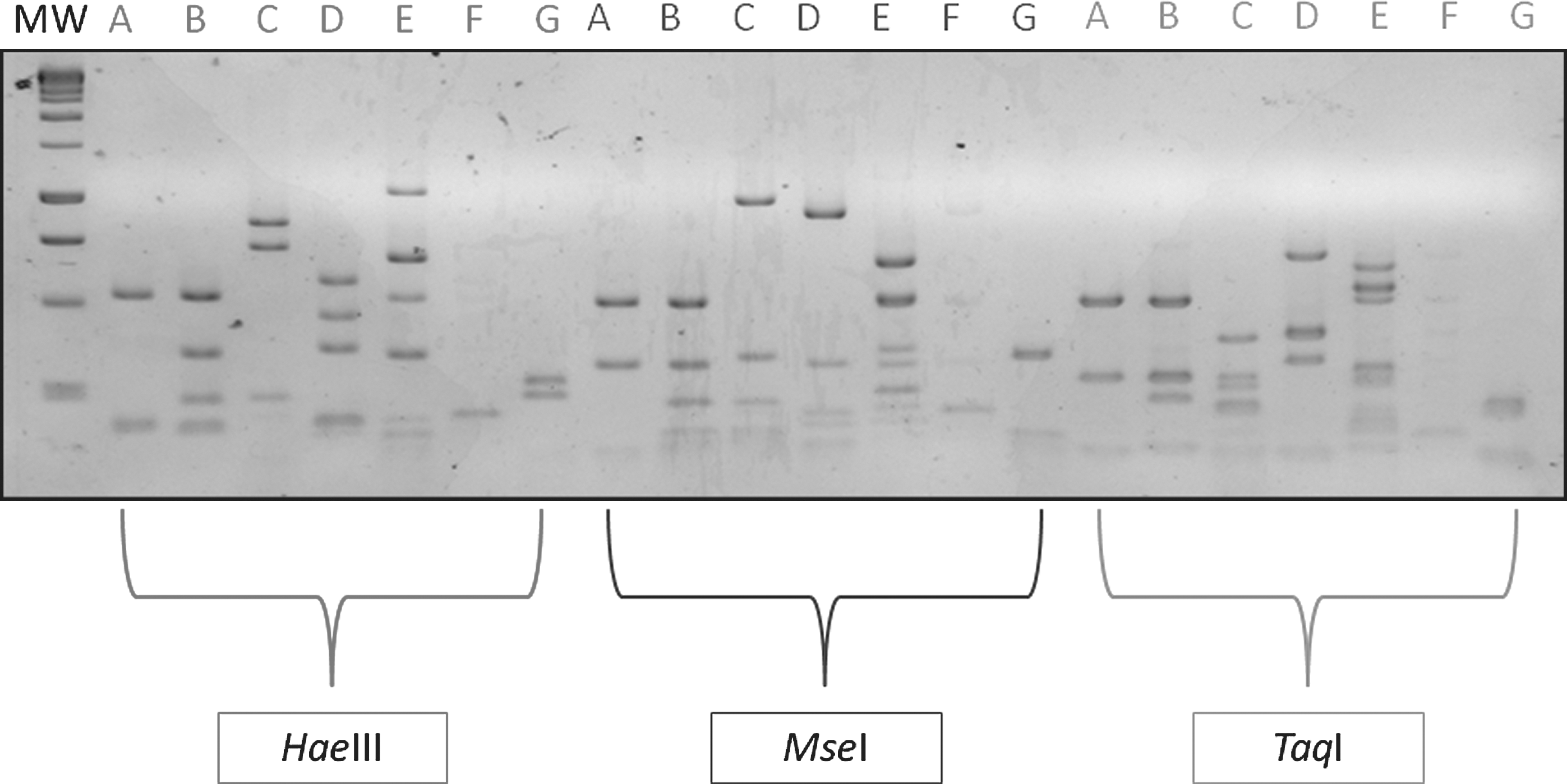
RFLP analysis of the conserved segments of the class 1 integrons. Lanes identified with the same capital letter contain the same amplicon digested with HaeIII, MseI, and TaqI restriction endonucleases, respectively.
Sequence analysis detected eight different gene cassettes (Table 1). Gene cassette aadA1 was the most frequently encountered, being associated with 31 isolates belonging to five different Salmonella serotypes. Gene cassettes dfrA5 and dfrA1 were found in eight isolates of four different serotypes and five isolates of four different serotypes, respectively. The gene cassette profile dfrA5/ereA2 was associated with Salmonella serotypes Typhimurium and Muenchen.
PFGE was performed on the integron-positive Salmonella isolates to assess clonality and discriminate clonal expansion from horizontal transmission of similar integrons within the most numerically represented serotypes. Figure 2 shows the electrophoretic patterns of representative Salmonella isolates belonging to these serotypes. The PFGE banding patterns of the 26 integron-positive Salmonella Infantis isolates were attributed to two different pulsotypes I-A and I-B and 10 different subtypes I-A1 to I-A8 and I-B1 to I-B2. In particular, 19 isolates with pulsotype A and 6 with pulsotype B shared a similar integron of ∼1000 bp containing the gene cassette aadA1 (Table 1). The three ESBL-producing Salmonella Infantis isolates showed closely related pulsotypes, I-A1, IA-4, and I-A8, respectively. Twelve Salmonella Typhimurium isolates showing two integrons of 1000 and 1200 bp, respectively, and the gene cassette profile blaPSE/aadA2 shared an indistinguishable pulsotype named T-A and the resistance pattern AMP, C, S, and TE, whereas the remaining four Salmonella Typhimurium isolates were included into four different pulsotypes, T-B to T-E. The gene cassette profile dfrA5/ereA2 was associated with pulsotype T-B. The four Salmonella Enteritidis isolates were attributed to three different pulsotypes, E-A to E-C. Two isolates showed indistinguishable integrons of ∼800 bp, containing the gene cassette aadA1, but one of them was also ESBL positive.
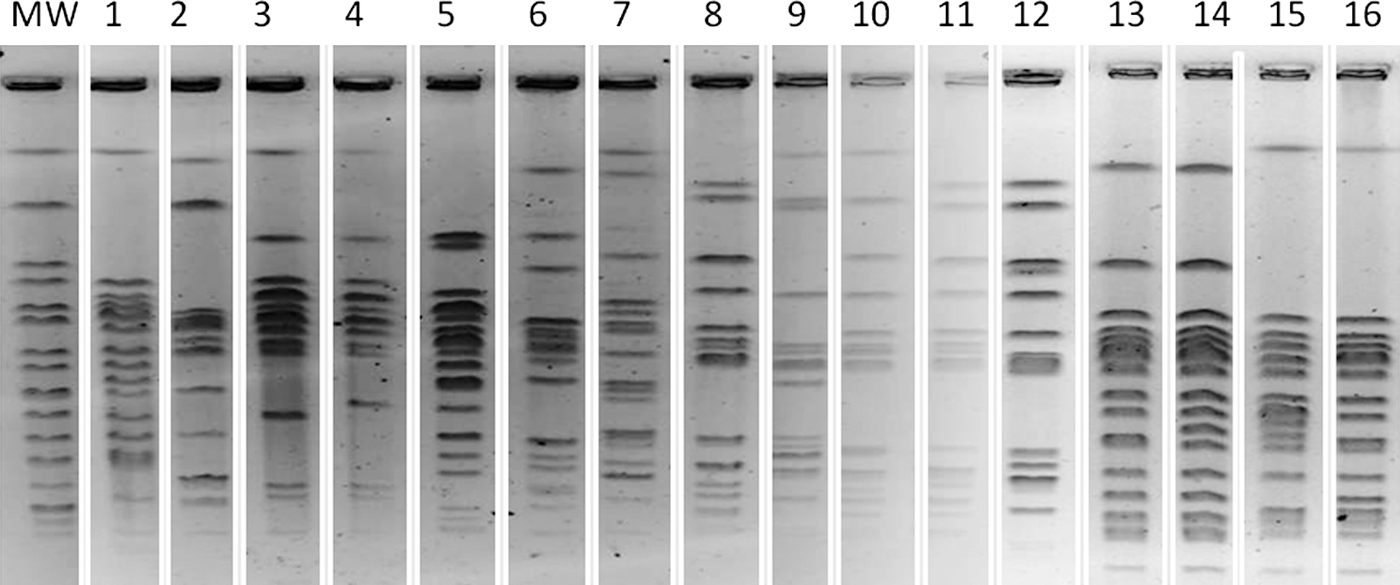
XbaI pulsotypes of representative Salmonella isolates. Lanes: MW Salmonella Braenderup H9812; lanes 1 to 16: 1 and 2, serotype Enteritidis pulsotypes E-A and E-B; 3 and 4, serotype Albany pulsotypes A-A1 and A-A2; 5, serotype Reading, pulsotype R-A; 6, serotype Haifa, pulsotype H-A; 7, serotype Muenchen, serotype M-A; 8–12, serotype Typhimurium, pulsotypes T-B, T-C, T-D, T-E, T-A; 13–16, serotype Infantis, pulsotypes I-B1, I-B2, I-A1, and I-A4.
Discussion
The results of our study suggest that distribution of serotypes within pediatric Salmonella isolates in Tehran, Iran, is broadly similar to that reported globally from human isolates, with Salmonella Enteritidis being the prominent serotype and Salmonella serotypes Typhimurium and Infantis ranking consistently in the 10 most common serotypes (Galanis et al., 2006). Local agricultural and farming practices as well as food distribution and consume patterns and food consumer's preferences and behaviors could likely play a role in the ranking of Salmonella serotypes in a well-defined geographical area, such as Tehran, Iran, but the global food trade and the intercontinental dissemination of resistant Salmonella strains via foods are exerting an unquestionable impact on local or regional epidemiology of Salmonella (Galanis et al., 2006; Krauland et al., 2009). Indeed, resistance patterns also appear to be similar worldwide (Krauland et al., 2009). Moreover, global outbreaks of multidrug-resistant Salmonella have been reported, the most known example being the emergence and dissemination of Salmonella Typhimurium DT104, of which a few clonally related subtypes only have been recognized (Krauland et al., 2009). In our study, high prevalences of resistance were detected to doxycycline, nalidixic acid, and tetracycline. In particular, both Salmonella Infantis and Salmonella Enteritidis isolates were resistant to nalidixic acid with frequencies as high as 90% and 63.8%, respectively. Comparably, high prevalences of nalidixic acid resistance, ranging between 45.7% and 62.0%, have been previously described among Salmonella isolates from patients of all age groups in Iran (Hamidian et al., 2009; Irajian et al., 2009). In a further study on fluoroquinolone resistance in Salmonella and E. coli from different animal species in Iran, proportions as high as 40% and 96%, respectively, were detected (Rad et al., 2010). Nalidixic acid resistance is a worrying situation because fluoroquinolones are the most commonly used antimicrobial agents for the treatment of invasive salmonellosis in adults and failure of therapy has been reported in patients with nalidixic acid-resistant Salmonella infections (Parry, 2003). On the other hand, quinolones and, especially, fluoroquinolones are widely used in poultry farms and in the treatment of companion animals in Iran, contributing to the risk of expanding the zoonotic reservoir of resistant bacterial agents (Rad et al., 2010). A direct link between quinolone use in poultry and prevalence of nalidixic acid-resistant Salmonella isolates from humans has been previously demonstrated (Solnik-Isaac et al., 2007).
Moreover, our findings indicate that presence of class 1 integrons was common among Salmonella serotypes in Tehran, Iran, involving 38.1% of the isolates under study. This prevalence was higher than that reported by Cabrera et al. (2006), who showed that 25% of S. enterica contained class 1 integrons in Spain. Other reports revealed that the prevalence of class 1 integrons in Salmonella spp. was 20.4% in the United Kingdom (Randall et al., 2004), 13% in Hong Kong (Jin and Ling, 2009), and 13% in Vietnam (Van et al., 2007). Contribution of clonal expansion versus horizontal gene transfer to the high prevalence of class 1 integron carriage was assessed by investigating the gene cassette profiles and their distribution within the different serotypes and the different molecular subtypes within the most frequent serotypes. The strongest evidence of the clonal expansion is presented by the DT104-like Salmonella Typhimurium isolates in which the resistance-encoding integrons (blaPSE1 and aadA2) are generally chromosomally integrated. On the other hand, as a possible evidence of horizontal transfer, the gene cassette aadA1 proved to be present in five different serotypes, dfrA5 and dfrA1 in four different serotypes, and the integrons dfrA1/aadA1 and dfrA5/erea2 in three and two different serotypes, respectively. Within strains of Salmonella Infantis, the combined effect of the two mechanisms is evident, as demonstrated by the coexistence of two different pulsotypes, I-A and I-B, likely resulting from an epidemic dissemination, possessing the same integron containing the gene cassette aadA1.
Integrons are widely distributed among bacterial species. The integron dfrA1/aadA1 found in Salmonella serotypes Haifa, Infantis, and Reading has been also documented in E. coli (Ozgumus et al., 2007) and Klebsiella pneumoniae (accession no. AY007807). Moreover, of particular interest is the occurrence of the dfrA5 and ereA2 gene cassettes association in four isolates belonging to Salmonella serotypes Typhimurium and Muenchen. An identical (100% homology) amplicon has been previously reported only in one strain of Salmonella belonging to the serotype Wien isolated from human source in 1988 (accession no. AY827837) (Murphy et al., 2007). The dfrA5/ereA2 association can be regarded as a rare combination because it has been previously reported only in seven non-Salmonella strains, including one Vibrio cholerae non-O1, non O-139 isolate from Calcutta, India (Thungapathra et al., 2002), one Aeromonas veronii isolate from Taiwan, Republic of China (accession no. EU085376), four isolates of E. coli from Japan (accession no. AB188269), Russia (accession no. GQ924768), France (accession no. FJ591050), and Taiwan (Chang et al., 2000), respectively, and one isolate of CTX-M-15–producing Klebsiella pneumoniae from a stem cell transplant patient in Tunisia (Abbassi et al., 2008). It is noteworthy that the spectrum of bacterial genera where the gene cassette array dfrA5/ereA2 has been so far detected encompasses bacteria with environmental, enteric, and healthcare-associated ecology. Even though evidence of the extent of gene cassette homology between the Salmonella isolates under study and Vibrio spp. is not being directly provided by our findings, the presence of an identical array of gene cassettes in the integrons of V. cholerae could support the hypothesis of a trade of antibiotic resistance gene cassettes between epidemic multidrug-resistant V. cholerae strains and Salmonella strains in geographic areas where outbreaks, persistent endemicity, and human colonization by V. cholerae could likely contribute to the aquatic reservoir of resistance determinants (Bakhshi and Pourshafie, 2009).
Conclusions
Resistance to antimicrobials in human Salmonella isolates can be the result of antibiotic abuse/misuse in humans and in veterinary practice (Levin, 2001).
Surveillance and monitoring of antimicrobial drug resistance and mechanisms of emergence and transmission, including screening for integrons as likely indicators of drug resistance and acquisition of new resistance traits, are necessary steps in planning effective strategies for controlling this phenomenon within pathogens, such as Salmonella, which is able to cause serious and potentially life-threatening disease in humans.
Footnotes
Disclosure Statement
No competing financial interests exist.