




Abstract
The purpose of this study was to determine whether combined treatment would produce synergistic effects to facilitate the sterilization of food products during production relative to single treatment. To assess this hypothesis, we investigated the bactericidal effects of ultraviolet (UV) irradiation and a commercial chemical disinfectant, sodium hypochlorite (NaClO), on Bacillus cereus F4810/72, Cronobacter sakazakii KCTC 2949, Staphylococcus aureus ATCC 35556, Escherichia coli ATCC 10536, and Salmonella Typhimurium novobiocin/nalidixic acid in vitro. Various concentrations of NaClO (20, 60, 100, and 200 ppm NaClO) were tested along with exposure to UV radiation at various doses (6, 96, 216, 360, and 504 mW s/cm2). The combined NaClO/UV treatments resulted in greater reductions in bacterial counts than either treatment alone. The synergy values against B. cereus, C. sakazakii, S. aureus, Salmonella Typhimurium, and E. coli were 0.25–1.17, 0.33–1.97, 0.42–1.72, 0.02–1.44, and 0.01–0.85 log10 CFU/mL, respectively. The results of this study suggest that a significant synergistic benefit results from combined NaClO/UV processing against food-borne pathogenic bacteria in vitro.
Introduction
Traditionally, single-physical sanitization and disinfection methods have been used, such as high-voltage pulsed electric fields, oscillating magnetic fields, high hydrostatic pressures, sonication, microwave treatment, low-temperature storage, ultraviolet (UV) irradiation, heating, and electron beam irradiation (Kalchayanand et al., 1994; Qin et al., 1995). Single-chemical sanitization and disinfectant methods using chlorine, hydrogen peroxide, ethanol, and ozone have also been used to reduce the amounts of coliforms and pathogenic bacteria contaminants in food products (Shin et al., 2001).
Sodium hypochlorite (NaClO), which is a highly-effective and low-cost biocide, has been one of the most widely used and studied disinfectants and sanitizers. NaClO has been broadly used across many industries to reduce pathogenic bacterial contamination in food products or on kitchen utensils because these compounds have been shown to effectively inactivate foodborne pathogenic bacteria. However, the frequency of use and concentrations of NaClO during treatment have been decreasing because NaClO can produce disinfection byproducts or other chemical residues (Lazarova et al., 1998) that can be harmful to human health. Recently, new physical technologies to reduce pathogenic bacteria have become of interest. Among these technologies, UV radiation has been identified as an important physical technique for food sanitization and disinfection.
The antimicrobial effect of UV light has been known for some time and its antimicrobial properties have been demonstrated in many studies (Ray et al., 2002). UV light can be used by the food industry to inactivate foodborne pathogens and disinfect stainless-steel surfaces and liquids such as water and fruit juice. UV treatment thus aims to reduce putrefactive bacteria in order to prolong the shelf life of food products and to inactivate specific pathogens such as Bacillus cereus, Cronobacter sakazakii, Staphylococcus aureus, Escherichia coli, and Salmonella enterica Typhimurium. The principal inactivation mechanism of UV radiation is the formation of photoproducts in the DNA. Of these photoproducts, the most important is the pyrimidine dimer that forms between adjacent pyrimidine molecules on the same strand of DNA, which can interrupt both DNA transcription and translation (Franz et al., 2009). Recently, many studies have evaluated the inactivation efficiency or synergy of combined chemical treatments and physical techniques relative to individual treatments including hydrogen peroxide, NaClO, ozone, and UV processes (Fernando et al., 1998; Maria et al., 2008).
Studies on combined disinfection treatments are common in the literature (Chawla et al., 2006; Thomas et al., 2008). Despite these studies, very few investigations have examined the efficacy of combined chemical/UV disinfection methods. Some researchers have reported that the combination of chemical methods and UV treatments are highly effective against microorganisms. Koivunen and Heinonen-Tanski (2005) examined combined chemical/UV disinfection treatments for the inactivation of enteric microorganisms.
Therefore, the objective of this study was to determine whether combined processing would produce synergistic effects relative to single treatment in the sterilization of food products during production.
Materials and Methods
Test organisms
Five strains of B. cereus F4810/72, C. sakazakii KCTC 2949, S. aureus ATCC 35556, E. coli ATCC 10536, and Salmonella enterica Typhimurium novobiocin/nalidixic acid (NO/NA), all resistant to NO and NA, were used. The wild-type S. enterica Typhimurium NO/NA was isolated from poultry in South Korea. Each stock culture was maintained at −70°C in tryptic soy broth (Difco Laboratories) containing 50% (v/v) glycerol (Fisher Scientific) until use. To obtain a working culture, each strain was cultured twice successively at 37°C for 18–24 h in tryptic soy broth, streaked onto a tryptic soy agar (TSA; Difco Laboratories) plate, incubated at 37°C for 18–24 h, examined for typical and homogeneous colony morphology, and then used immediately at room temperature. When the TSA was prepared for the S. enterica Typhimurium NO/NA working culture, 25 μL/mL of NO and NA was added. Prior to the disinfection treatments, the prepared microbial culture was added into peptone water (PW; Difco Laboratories) to yield microbial numbers of approximately 7.5–8.5 log10 CFU/mL. Cell populations of the test strain inocula were adjusted to 7.5–8.5 log10 CFU/mL with PW.
Sanitizing solution and evaluation of chemical disinfectants
NaClO (12%) at 20–200 ppm (Duksan) was used as the chemical disinfectant. The efficacy of NaClO was estimated using the European EN 1276 method, which was based on quantitative suspension testing (AOAC, 1995; BSI, 1997). Eight milliliters of sanitizing solution was added to the mixture containing 1 mL of the test strain and 1 mL of the interfering substance. This mixture was then reacted at 20°C ± 1°C (mean ± standard deviation) for 2 min in a water bath, after which it was mixed using a vortex mixer. One milliliter of the mixture was then added into the mixture of 8 mL neutralizing agent and 1 mL distilled water. This mixture was then maintained for 5 min at 20°C ± 1°C to ensure complete neutralization, after which 1 mL of the mixture was immediately poured onto sterilized Petri dish containing TSA for counting.
UV irradiation
The UV irradiation experiments were carried out with a bench-scale collimated-beam UV reactor that was equipped with 10, 15, and 30 W low-pressure UV lamps (Sankyo Ultraviolet Co., Ltd.) that can emit monochromatic UV radiation at 260 nm. The exposed UV light was measured using an HD 2102.2 photoradiometer (Daehyuntech Co.), and the UV dosage was set at 9, 96, 216, 360, and 504 mW s/cm2. The applied UV dosage (mW s/cm2) was calculated by multiplying the time (s) by the irradiance (W/cm2).
Combined disinfection with NaClO treatments and UV irradiation
The combined disinfectant processes that were conducted in this study have been previously described by Koivunen and Heinonen-Tanski (2005). Chemical disinfectant processes and UV disinfection treatments were performed at room temperature. Inactivation efficacies for the combined treatments were compared with those of the individual treatments to estimate any synergistic benefit resulting from combined chemical/UV treatments. The combined disinfection experiments were carried out by first applying NaClO as a primary disinfectant and then UV irradiation as a secondary disinfectant. UV light was used after chemical disinfectants to take advantage of any possible increased radical formation because of UV action, which may produce synergistic effects (Koivunen and Heinonen-Tanski, 2005).
Enumeration of viable microorganism
After samples were subjected to the NaClO and UV disinfection treatments, the organisms on the stainless-steel chips that survived were detached from the chips by vortexing with glass beads and PW. The detached microorganisms were cultured on TSA. One milliliter of sample was poured into a Petri dish and then TSA was poured, and the plate was incubated at 37°C for 24 h.
Statistical analysis
Experiments were conducted in triplicate and Statistical Analysis System software (SAS; SAS Institute) was used to analyze the variance of the UV effects. Average values and significance were analyzed using the Duncan's multiple-range test. Mean values and the standard deviations were presented.
Results and Discussion
The reductions of B. cereus, C. sakazakii, S. aureus, S. enterica Typhimurium, and E. coli in vitro are shown in Figure 1. The reductions in these populations relative to no treatment were 0.42–2.12, 0.43–1.64, 0.60–1.02, 0.68–1.11, and 1.08–2.50 log10 CFU/mL, respectively, and the degree of reduction depended on the UV radiation dose (Fig. 1). Inactivation of foodborne pathogens by UV radiation occurs primarily through DNA damage, which causes neighboring pyrimidine bases to cross-link (thymine and cytosine) (Sastry et al., 2000). These cross-linking events prevent pyrimidine bases from forming hydrogen bonds with purine bases, thus blocking DNA transcription and replication and eventually causing cell death (Unluturk et al., 2008). UV disinfection at 360 and 504 mW s/cm2 significantly reduced the counts of five foodborne pathogens in vitro.
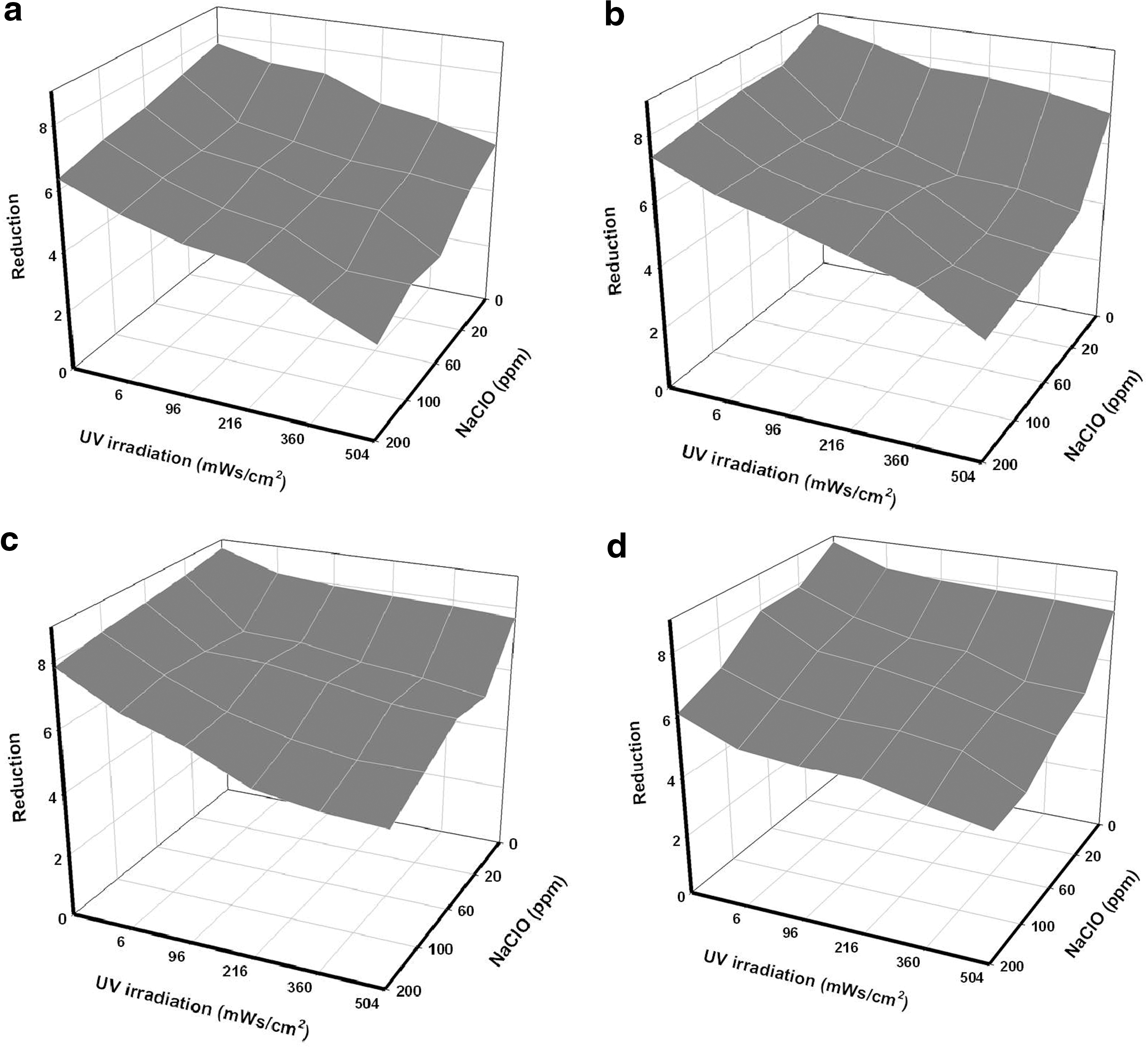
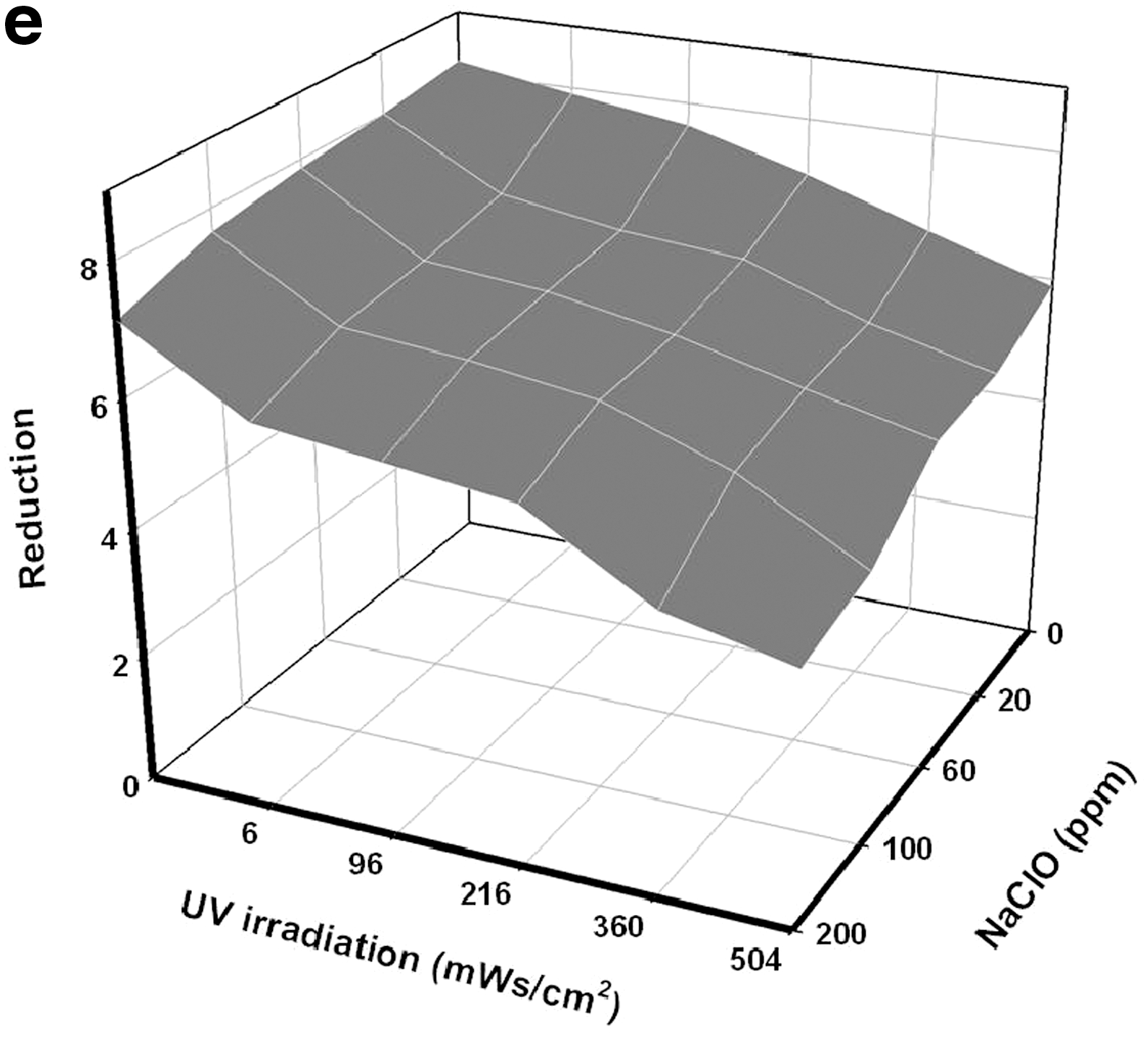
Reduction (log CFU/mL) of combined NaOCl/UV treatment against foodborne pathogens.
The effects of 20, 60, 100, and 200 ppm NaClO treatment alone on the five foodborne pathogenic bacteria in vitro were also investigated. B. cereus, C. Sakazakii, S. aureus, Salmonella Typhimurium, and E. coli in vitro were reduced from 0.38 to 1.39, 0.72 to 1.28, 0.26 to 0.88, 0.92 to 2.70, and 0.20 to 1.11 log10 CFU/mL, respectively, relative to the control and the degree of reduction depended on the NaClO concentration (Fig. 1). Thus, an increase in NaClO concentration led to a decrease in the number of foodborne pathogens in vitro. Many studies have examined the inactivation of pathogenic bacteria by chemical disinfection treatments such as NaClO in vitro. NaClO has been shown to be very active in killing most bacteria, fungi, and viruses and it is also known as a strong oxidizing agent. NaClO is the most commonly used wastewater disinfection compound worldwide and it is an efficient disinfectant against many foodborne pathogens (Tyrell et al., 1995).
The in vitro reduction of B. cereus after treatment with 10–200 ppm NaClO followed by 6–504 mW s/cm2 UV radiation is shown in Fig. 1. When combined treatments were conducted using 200 ppm NaClO (maximum concentration) and 504 mW s/cm2 UV (maximum exposure dosage), B. cereus was reduced by 4.61 log10 CFU/mL. When individual NaClO and UV treatments were used, the microbial numbers decreased to 1.39 log10 CFU/mL after treatment with 200 ppm NaClO and to 2.12 log10 CFU/mL after treatment with 504 mW s/cm2 UV. Thus, the combined NaClO-UV treatment produced a greater microbial reduction than did the sum of the individual treatments, and the numerical difference was 1.11 log10 CFU/mL. These results suggest that combined NaClO-UV treatment produced a positive synergistic effect (Table 1). Synergistic effects were observed for all combined treatments against B. cereus. The maximum numerical synergistic value was 1.17 log10 CFU/mL after combined treatment with 60 ppm NaClO and 504 mW s/cm2 UV irradiation (Table 1). Reduction values of C. sakazakii were similar to those of B. cereus (Fig. 1). When combined treatments were carried out using 200 ppm NaClO (maximum concentration) and 504 mW s/cm2 UV (maximum exposure dosage), the reduction value was 4.86 log10 CFU/mL. In contrast, treatment with 200 ppm NaClO alone produced a reduction of 1.28 log10 CFU/mL and treatment with 504 mW s/cm2 UV alone resulted in a reduction of 1.64 log10 CFU/mL. The biggest numerical synergistic value was 1.97 log10 CFU/mL when 100 ppm NaClO and 504 mW s/cm2 UV irradiation were used (Table 1). S. aureus demonstrated the highest resistance against both NaClO and UV radiation (Fig. 1). When combined treatments were carried out using 200 ppm NaClO (maximum concentration) and 504 mW s/cm2 UV irradiation (maximum exposure dosage), the reduction value was 3.82 log10 CFU/mL. In contrast, treatment with only 200 ppm NaClO produced a reduction of 0.88 log10 CFU/mL and treatment with only 504 mW s/cm2 UV irradiation resulted in a reduction of 1.02 log10 CFU/mL. The numerical synergistic values ranged from 0.42 to 1.92 log10 CFU/mL (Table 1). Figure 1 shows the population reduction values for Salmonella Typhimurium. Combined treatments produced a 3.89 log10 CFU/mL reduction. In contrast, treatment with 200 ppm NaClO alone resulted in a reduction of 2.70 log10 CFU/mL, and treatment with 504 mW s/cm2 UV alone produced a reduction of 1.11 log10 CFU/mL. The numerical synergistic values ranged from 0.08 to 1.44 log10 CFU/mL (Table 1). E. coli was the next highest resistant bacteria against both NaClO and UV radiation (Fig. 1). When combined treatments were carried out using 200 ppm NaClO (maximum concentration) and 504 mW s/cm2 UV (maximum exposure dosage), the reduction value was 4.13 log10 CFU/mL, whereas treatment with only 200 ppm NaClO reduced the microbial numbers by 1.11 log10 CFU/mL and treatment with only 504 mW s/cm2 UV radiation reduced the numbers by 2.50 log10 CFU/mL. The biggest numerical synergistic value was 0.97 log10 CFU/mL for combined treatment using 100 ppm NaClO and 360 mW s/cm2 UV (Table 1).
Synergistic effect values = (reduction achieved with the NaOCl treatment and the UV treatment) – (reduction achieved by the NaOCl + UV treatment). Within the same column, means with different letters (A, B, C, or D) differ significantly (p < 0.05). Within the same row, means with different letters (X, Y, or Z) differ significantly (p < 0.05).
These findings are consistent with the findings of previous studies. Akpomedaye and Ejechi (1998) reported difficulty in limiting fungal growth by using the extracts of Zingiber officinale and Xylopia aetiopica. However, the inhibitory effects of the combined extracts displayed strong synergistic effects when compared with the use of single extracts. Some researchers have reported that a combination treatment of ozonation at lower doses and UV radiation leads to improved water quality (Meunier et al., 2006).
In this work, combined NaClO-UV disinfection treatments resulted in synergistic benefits for reducing the numbers of at least five foodborne pathogens. These results indicate that these combined methods produced greater reduction values than the sum of the single treatments. In our study, combined disinfection with NaClO followed by UV treatments showed synergistic effects. It is well known that NaClO damages the bacterial cell wall and UV radiation inactivates microorganisms by damaging DNA and RNA, which are vital for the synthesis of key proteins and reproduction. Therefore, the differences in the inactivation mechanisms of NaClO and UV radiation led to a synergistic effect when these methods were combined. The potential range of application of combined NaClO treatment and UV radiation is vast and can be successfully used to reduce the number of foodborne pathogens on food surfaces such as eggshell and vegetables or food contact surfaces in food services industries and food-processing plants. In addition, it may allow industries to lower chemical sanitizer doses or shorter treatment times and thus decrease the size of the chemical disinfection chambers and UV lamps, which would effectively decrease the overall costs of disinfection. This method could also improve the bactericidal efficiency and decrease the regrowth potential of foodborne pathogens that have been subjected to these disinfection treatments. The combination of chemical and UV treatment at low doses to destroy foodborne pathogens could be more efficient and economical relative to treatment with a high dose of one disinfectant. This combined nonthermal method is gaining increasing acceptance for the use to destroy foodborne pathogenic organisms. Therefore, further research must be conducted to verify that these findings can be translated to up to plant scale for disinfection against various foods.
Conclusions
Combined NaClO/UV disinfection treatments showed greater reduction than the sum of the single treatments against foodborne pathogens and could be applied on food or food contact surfaces by the food services and manufacturing industries.
Footnotes
Disclosure Statement
No competing financial interests exist.