




Abstract
Control of foodborne Salmonella within the farm-retail continuum is a complex issue since over 2500 serovars of Salmonella exist, the host range of Salmonella spp. varies greatly, and Salmonella is environmentally ubiquitous. To identify Salmonella enterica serovar Typhimurium (Salmonella Typhimurium) genes important for pathogen survival, our research group previously screened a signature-tagged mutagenesis bank in an ex vivo swine stomach content assay. A mutation in the poxA gene, a member of the gene family encoding class-II aminoacyl-tRNA synthetases, decreased survival of Salmonella Typhimurium in the ex vivo swine stomach content assay. In the current study, complementation with a plasmid-encoded poxA gene restored survival of the poxA mutant to the level of the parental, wild-type strain. In vivo analysis of the poxA mutant in the natural porcine host revealed significantly reduced fecal shedding of Salmonella, decreased colonization of the tonsils, and decreased detection of the mutant strain in the cecal contents of the pigs at 7 days postinoculation (p < 0.05). Body temperature (fever) of the pigs inoculated with wild-type Salmonella Typhimurium was significantly higher than that of pigs inoculated with the poxA mutant (p < 0.05). Two-dimensional gel electrophoresis revealed characteristic differences in the protein profile of the poxA mutant relative to the wild-type strain, indicating that deletion of poxA in Salmonella Typhimurium exerts selective effects on translation and/or posttranslational modifications of mRNA species that are necessary for stress survival and colonization of the natural swine host.
Introduction
Sequence identity searches identified poxA as belonging to the class-II aminoacyl-tRNA synthetase family; specifically, the polypeptide encoded by poxA shares 50% similarity to the carboxy-terminal catalytic domain of LysS, a lysyl-tRNA synthetase, but lacks the amino-terminal anticodon binding domain (Kong et al., 1991; Saluta and Hirshfield, 1995; Kaniga et al., 1998). Typically, aminoacyl-tRNA synthetases catalyze the attachment of specific amino acids on to the 3′end of the appropriate tRNA for accurate translation of the genetic information in mRNA into proteins (Martinis et al., 1999; Ibba and Soll, 2000). However, bacterial genome sequencing projects have identified several shorter aminoacyl-tRNA synthetase paralogs that appear to have functions other than classical tRNA aminoacylation (Schimmel and Ribas De Pouplana, 2000; Salazar et al., 2004; Blaise et al., 2005).
Recently, Navarre et al. (2010) described a posttranslational modification of bacterial elongation factor P (EF-P) by PoxA; in an ATP-dependent manner, PoxA catalyzes the ligation of lysine to the Lys34 residue of EF-P. Presumably, this active form of EF-P modifies translation initiation, since the cocrystal structure of EF-P with the ribosome indicates interaction of EF-P with the ribosomal peptidyl-transferase center (Blaha et al., 2009). In this study, we identified an altered protein profile for the poxA mutant compared to wild-type Salmonella Typhimurium (including EF-P), classified phenotypic differences between the poxA mutant and the parental strain, and described a reduction in colonization for the poxA mutant in the natural porcine host.
Materials and Methods
Bacterial strains and media
Table 1 lists the Salmonella enterica serovar Typhimurium strains used in this study. Bacteria were grown at 37°C in Luria-Bertani (LB) broth, E salts minimal medium (pH 7.0) (Vogel and Bonner, 1956) containing 0.4% glucose (EG medium), or Dulbecco's modified Eagle's medium (31053 Invitrogen Life Technologies). Antibiotic concentrations were 100 μg ampicillin mL−1, 30 μg nalidixic acid mL−1, and 50 μg kanamycin mL−1.
Primers were designed using GenBank accession no. AF001831.
RT-PCR, reverse transcriptase–polymerase chain reaction.
Bold text represents nucleotide sequence of the poxA gene. Underlined text denotes nucleotide sequence of the neo gene.
Construction of a Salmonella Typhimurium poxA mutant by recombineering and complementation of the mutant
Polymerase chain reaction (PCR) primers oSBI 218 and oSBI 219 were constructed for amplification of a linear DNA fragment to knockout the Salmonella Typhimurium poxA gene by recombineering (Table 1). The 5′ end of the primers contain 42–45 bp of nucleotide sequence (bold) that is identical to either the upstream or downstream region of the poxA gene. On the 3′ end of the primers (underlined) is a universal sequence containing stop codons in all three reading frames for amplification of the neo gene, as previously described (Bearson and Bearson, 2008; Bearson et al., 2008). The SX 49 strain containing the pKD46 plasmid was induced with arabinose and transformed with the poxA knockout fragment (Datsenko and Wanner, 2000). Kanamycin-resistant transformants were selected and the knockout mutation moved to SX 117 by P22 transduction. The poxA::Km mutation was confirmed by PCR. For complementation, PCR primers oSBI 226 and oSBI 227 were used to amplify the poxA gene from SX 117 chromosomal DNA. The 1.26 kb PCR product was cloned into the pBAD-TOPO® TA expression vector and ligation products were transformed into One Shot® TOP10 E. coli (Invitrogen Life Technologies). Plasmids from ampicillin-resistant colonies were confirmed by DNA sequencing. The pBAD-poxA plasmid was transformed into SX 117 and SB 303 to create SB 343 and SB 344, respectively.
Survival assays
Swine stomach content assay
SB 340, SB 341, SB 343, and SB 344 were grown in EG medium to mid-logarithmic phase (optical density [OD]600 = 0.4), adapted at pH 4.4 for 1 hour, pelleted, and resuspended in an equal volume of filter sterilized swine stomach contents as previously described (Bearson et al., 2006). Viable counts were determined at 0 and 10 minutes for determination of percent survival.
Lauryl sulfobetaine assay
At a starting OD600 = 0.05, above strains were grown in LB with twofold dilutions of lauryl sulfobetaine, providng a concentration range of 1–500 mM lauryl sulfobetaine. Turbidity and viable counts were determined at 0 and 24 hours to assess growth and percent survival.
Swine study
Ten conventionally raised, mixed-sex piglets from sows verified to be fecal-negative for Salmonella spp. were weaned at 12 days of age, shipped to the National Animal Disease Center (Ames, IA), and raised in two isolation facilities (n = 5). Pigs tested fecal-negative for Salmonella spp. thrice over a 6-week period using bacteriological culture techniques. At 8 weeks of age (day 0), the 10 pigs received an intranasal inoculation of 1 mL PBS containing either 1.0 × 10⁹ colony forming units (CFU) of SX 117 (wild-type; n = 5) or SB 303 (poxA::Km; n = 5). Statistical analysis of daily body temperatures (assessed using a rectal thermometer) for each treatment group was performed by GraphPad Prism 5 using one-way analysis of variance; the Dunnett test was used to assess pair-wise differences between day 0 and other time points. Two sample t-test for the Means was used to compare the two treatment groups at a given timepoint. Fecal samples were obtained using fecal swabs on 0, 1, 2, 3, 5, and 7 days postinoculation (dpi) for quantitative and qualitative Salmonella culture analyses as previously described (Bearson et al., 2010). Procedures involving animals followed humane protocols as approved by the Agricultural Research Service, U.S. Department of Agriculture, National Animal Disease Center (NADC) Animal Care and Use Committee. Statistical analysis of Salmonella present (CFU/g) in daily fecal samples and in tissues at 7 dpi was analyzed by SAS Analyst using the two sample t-test for the means following log normal transformation of the data.
Two-dimensional gel analysis and protein sequencing
SX 117 and SB 303 were grown in LB broth to OD600 = 0.4 and ∼1 g of cells (wet weight) was resuspended in Ready Prep 2D starter kit rehydration/sample buffer (Bio-Rad). After sonication, cellular debris was removed by centrifugation. Protein samples (2 mg) were loaded on a pH 3–10 isoelectric focusing gel and proteins were separated according to charge using the IPGphor Isoelectric Focusing System (GE Healthcare Biosciences). Second dimensional separation based on molecular weight was performed on 15% sodium dodecyl sulfate (SDS)–polyacrylamide gel with a 4% stacking gel using the Hoefer DALT system (GE Healthcare Biosciences). Coomassie-stained gels were digitally analyzed using Progenesis SameSpots (Nonlinear Dynamics). For N-terminal sequencing, the proteins from SDS–polyacrylamide gel electrophoresis (PAGE) gels were transferred to polyvinylidene difluoride and the membranes were stained with Coomassie Blue R-250. Protein spots of interest were excised and sequenced at the Iowa State University, Office of Biotechnology Protein Facility, Ames, IA (
RNA isolation and real-time PCR
Total RNA was isolated using the RNeasy Mini kit (Qiagen) and DNase I digestions were performed twice using the Turbo DNase-free kit (Ambion). RNA integrity, quality, and quantity were assessed using the Agilent Bioanalyser 2100 and RNA Nano 6000 Labchip kit (Agilent Technologies).
Using Applied Biosystems High Capacity cDNA Reverse Transcription Kit, cDNA was prepared. Real-time PCR was performed using Applied Biosystems SYBR Green Master Mix and the Chromo4 Real-Time PCR Detection System (Bio-Rad). Primer sequences are given in Tables 1 and 2. Transcripts were amplified in duplicate from four experiments: 94°C for 10 minutes, 35 cycles at 94°C for 60 seconds, 60°C for 60 seconds, and 72°C for 120 seconds. At the 72°C step, fluorescent data were acquired. Relative quantification of gene amplification was evaluated using the comparative CT method (2−ΔΔCT) as described by Livak and Schmittgen (Livak and Schmittgen, 2001; Bearson et al., 2008). Statistical analyses of the ΔCT values were analyzed by SAS Analyst using the two-sample t-test for the Means.
The STM prefix indicates the gene numbers as assigned by the Salmonella enterica serovar Typhimurium LT2 complete genome sequencing project.
Primer sequences for each gene were selected using GenBank accession no. AE006468.
Bacterial motility assay
The bacterial motility assay was performed using Dulbecco's modified Eagle's medium with 0.3% agar, and statistical analysis of the results was performed as previously described (Bearson et al., 2010).
β-Galactosidase assay
The β-galactosidase assay was performed in N Minimal Medium (Nelson and Kennedy, 1971) with 50 μM MgSO4 and calculation of enzyme activity was performed according to the method described by Miller (1992).
HEp-2 invasion assays
HEp-2 cells were maintained and experiments performed in RPMI 1640 (Gibco) containing 10% fetal bovine serum at 37°C in a 5% CO2 humidified incubator. SX 117 and SB 303 were incubated with the HEp-2 cells for 1.5 hours at a multiplicity of infection of ∼20. Extracellular bacteria were killed with gentamycin (100 μg/mL) during 1.5 hours of incubation. HEp-2 cells were lysed using 1% Triton X at 37°C, and lysates were plated on LB containing 30 μg/mL nalidixic acid. After overnight growth, percent invasion was calculated by dividing CFU recovered by CFU added.
Results and Discussion
The poxA mutant has increased sensitivity to environmental stress
Previously, we constructed and screened a signature-tagged mutagenesis bank of Salmonella Typhimurium to identify genes important for survival in the gastric environment of swine (Bearson et al., 2006). In the current study, we confirm the involvement of one of the identified genes in Salmonella survival by inserting a kanamycin cassette into the poxA gene. The poxA mutant was 100-fold more sensitive in the swine stomach content assay than the parental, wild-type strain (0.08% vs. 8% survival, respectively). The increased sensitivity of the poxA mutant was eliminated by expression of the poxA gene from a plasmid (12% survival), indicating that mutation of the poxA gene is responsible for the increased sensitivity in the ex vivo gastric assay.
The poxA mutant is sensitive to a wide range of bacterial growth inhibitors, including antibiotics, amino acid analogs, and dyes (Van Dyk et al., 1987; Kaniga et al., 1998; Navarre et al., 2010). Similar to the phenotypic microarray data recently published by Navarre et al. (2010), we also observed a diminished response by the poxA mutant to various chemical and stress conditions, including membrane detergents, chelators, antibiotics, toxic cations, and ionizing and oxidizing reagents (data not shown). Assays performed to confirm the phenotypic microarray data revealed, for example, that growth of the poxA mutant is inhibited in the presence of >2 mM lauryl sulfobetaine, a zwittergent with antimicrobial effects, whereas the parental wild-type strain can grow in the presence of up to 50 mM lauryl sulfobetaine. The increased sensitivity of the poxA mutant to a variety of diverse agents could suggest disturbance of a general stress response or perturbation of the cellular membrane. Alternatively, the phenotypic microarray analysis by Navarre et al. (2010) and our group (data not shown) also revealed a striking increase in metabolism by the poxA mutant for the main catabolic pathways, suggesting unregulated growth under stringent or extreme conditions (unfavorable growth conditions whereby the wild-type strain would limit metabolic activity). The inability of the poxA mutant to reduce respiration could be a contributing factor to its sensitivity to a plethora of chemical compounds as well as its decrease in colonization fitness of the porcine host (see below).
A poxA mutant has decreased gastrointestinal colonization and clinical signs of infection in swine
To determine if the ability of Salmonella Typhimurium to colonize a natural host (swine) is altered when the poxA gene is disrupted, 8-week-old pigs were inoculated intranasally with either wild-type Salmonella Typhimurium (SX 117; n = 5) or the poxA mutant (SB 303; n = 5). The pigs inoculated with wild-type Salmonella Typhimurium developed an average body temperature (fever) significantly higher than pigs inoculated with the poxA mutant at 1, 2, and 3 dpi (Fig. 1; p ≤ 0.05). In fact, the average body temperature of the pigs inoculated with the poxA mutant did not significantly increase during the 7-day study, whereas the body temperature of the pigs inoculated with the wild-type strain significantly increased at 2 dpi compared to day 0. Shown in Figure 2A, average fecal shedding of the poxA mutant was significantly reduced by 2–5 logs (p ≤ 0.05) compared to the wild-type strain during the course of the 7-day study. Further, the ability of the poxA mutant to colonize some tissues of the digestive tract was also diminished (Fig. 2B). At 7 dpi, the poxA mutant showed significant reductions (p ≤ 0.05) in colonization of the tonsils (400-fold) and its presence in the cecal contents (71-fold) compared to the wild-type strain. No difference in colonization of the ileocecal lymph nodes was detected, and a trend toward a significant decline of the poxA mutant was noticed in the Peyer's Patch region of the ileum (9-fold; p = 0.075) and the cecum (2.6-fold; p = 0.054). Cellular invasion of the poxA mutant using a HEp-2 cell culture invasion assay was similar to the parental strain, indicating that entry into the host cell is not impaired by the poxA mutation (data not shown). These data indicate that a mutation in the poxA gene reduces Salmonella Typhimurium virulence in a natural host, since diminished clinical signs of disease, colonization, and shedding were observed for the poxA mutant in swine. Kaniga et al. observed virulence attenuation for a poxA mutant of Salmonella Typhimurium in the mouse model of systemic disease; further, the poxA mutant induced a strong humoral response in mice, suggesting a potential vaccine application (Kaniga et al., 1998).
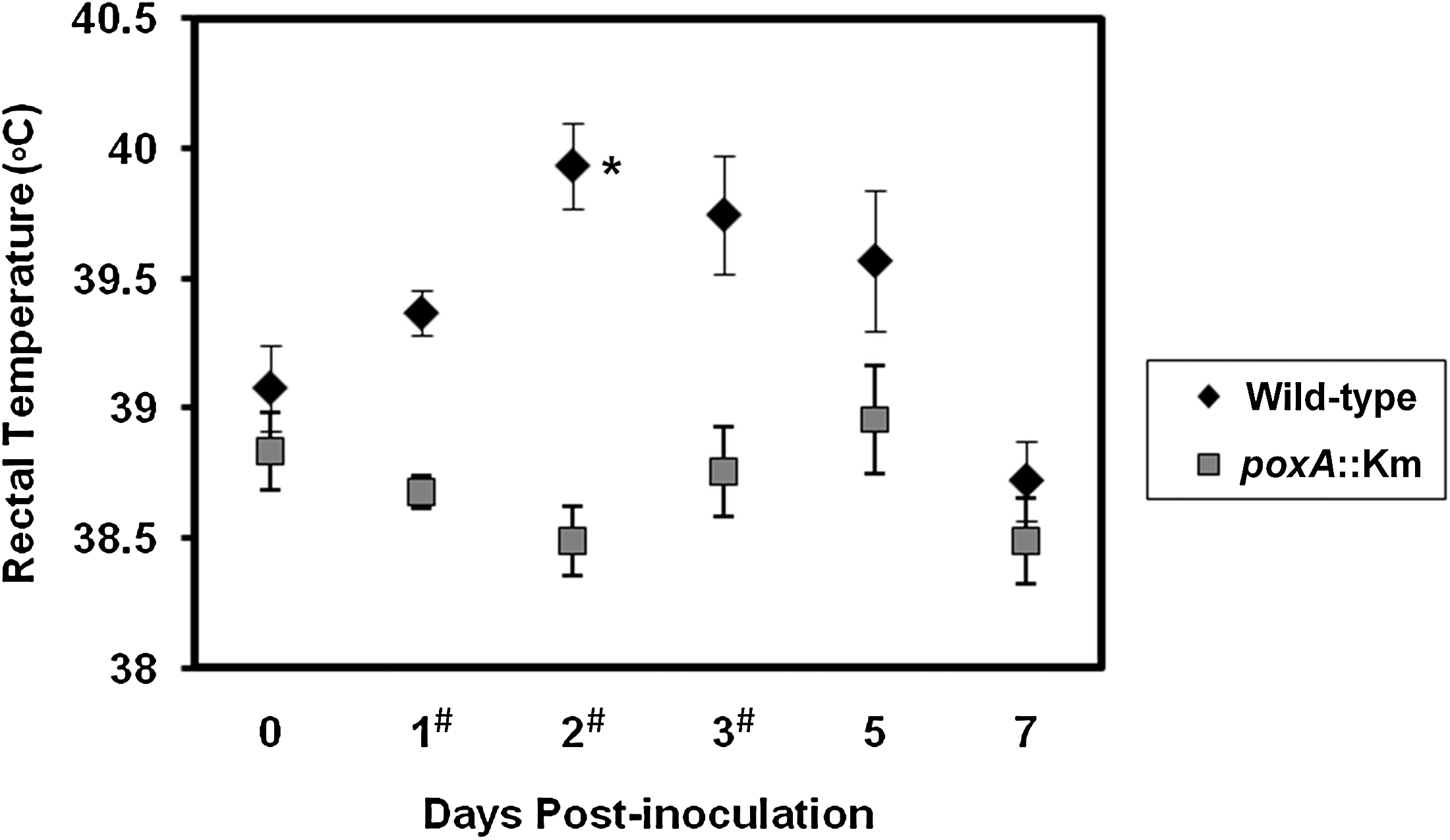
A poxA mutant of Salmonella Typhimurium fails to increase body temperature during colonization of the porcine host. Eight-week-old pigs were intranasally inoculated with 1.0 × 10⁹ colony forming units (CFU) of either wild-type Salmonella Typhimurium (SX 117; n = 5) or the poxA mutant (SB 303; n = 5). Over a 7-day period, body temperature was measured using a rectal thermometer. The number symbols (#) located on the x-axis denote a significant difference between pigs inoculated with wild-type Salmonella Typhimurium and the poxA mutant at the specific time point (p ≤ 0.05). The asterisk symbol (*) indicates a significant increase in rectal temperature at day 2 postinoculation compared to day 0 for the pigs inoculated with the wild-type strain (p ≤ 0.05). Note that the normal body temperature of a pig is 38.5°C–39°C.
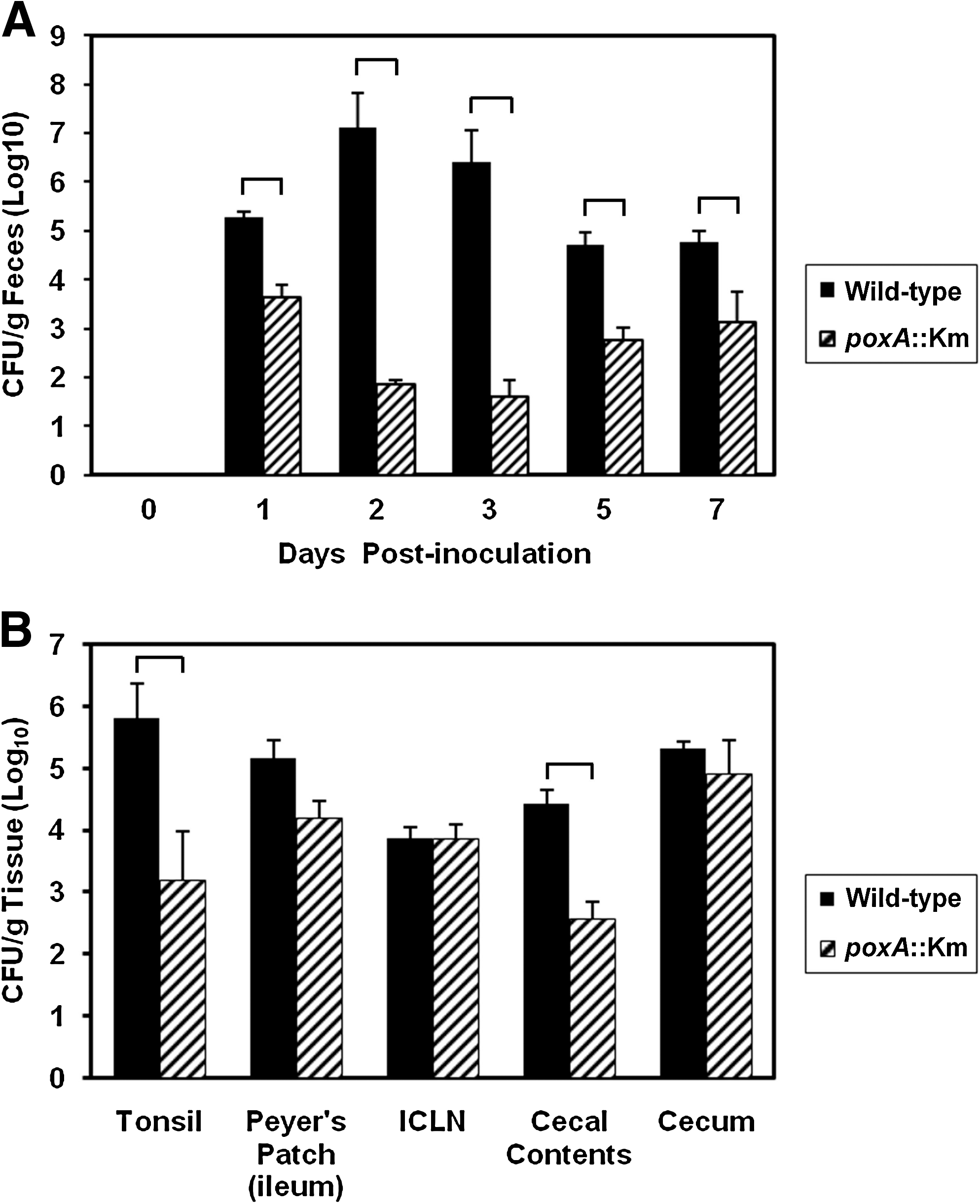
Decreased fecal shedding and tissue colonization of the poxA mutant compared to wild-type Salmonella Typhimurium in swine. (
Protein profile differences between the poxA mutant and parental, wild-type Salmonella Typhimurium
Two-dimensional SDS-PAGE analysis was performed to compare the protein profiles of the poxA mutant to wild-type Salmonella Typhimurium (Fig. 3). N-terminal sequencing to identify the differentially expressed proteins revealed higher levels of FliC, GlnH, RplI, RpsB, and YifE in wild-type Salmonella Typhimurium compared to the poxA mutant, whereas larger quantities of GarR, GudD, PhoP, SspA, and YgbJ were observed in the poxA mutant than in the wild-type strain (Fig. 3 and Table 2). Two of the proteins, RpsB (30S ribosomal protein S2) and RplI (50S ribosomal protein L9), with decreased levels in the poxA mutant are involved in translation. The level of FliC was also reduced in the poxA mutant. FliC is one of two flagellin proteins produced by Salmonella that are antigenically distinct and alternatively produced by the phase variation system (Lederberg and Iino, 1956; Silverman et al., 1979). To assess phenotypic effects of differential expression of FliC, motility phenotypes of wild-type Salmonella Typhimurium and the poxA mutant were analyzed. Motility of the poxA mutant (13 mm) was significantly (p < 0.0001) decreased compared to the parental strain (23 mm), corroborating the lower levels of FliC observed for the poxA mutant.
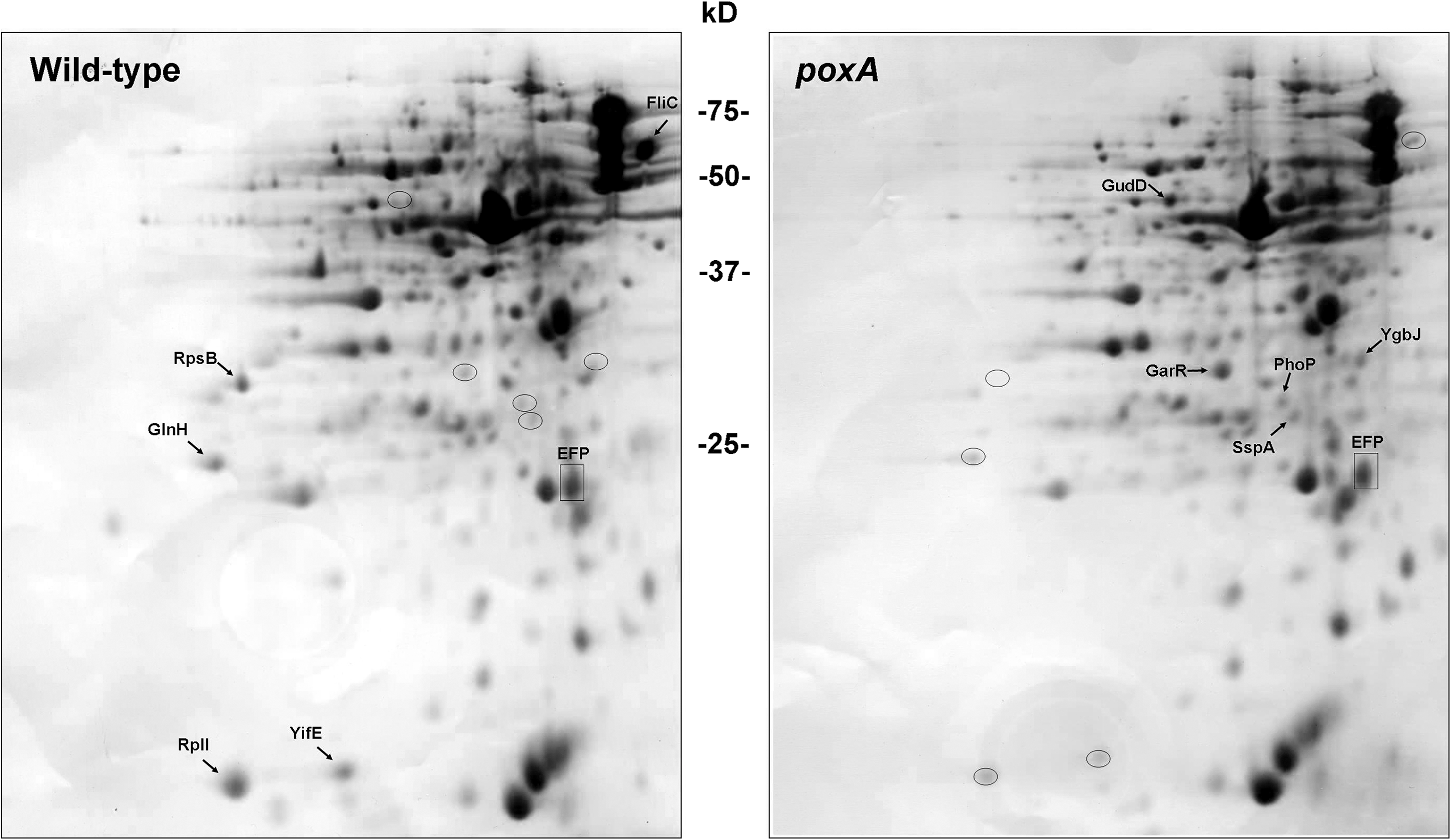
Two-dimensional gel analysis identifies alterations in protein production in the poxA mutant. Coomassie-stained polyacrylamide gels of wild-type Salmonella Typhimurium (SX 117) and the poxA mutant (SB 303) grown to mid-logarithmic phase. Isoelectric focusing (first dimension) was performed on a pH gradient ranging from 3 to 10 followed by 15% sodium dodecyl sulfate–polyacrylamide gel electrophoresis (second dimension). Arrows indicate the presence of a protein, and circles denote the absence/reduction of a protein. The rectangle designates the pI shift of elongation factor P.
Several proteins that were expressed at higher levels in the poxA mutant are necessary for critical cellular processes. GarR (tartronate semialdehyde reductase, TSR) and GudD (D-glucarate dehydratase) are both involved in the conversion of glucarate to glycerate. SspA (stringent starvation protein A) is required for stationary phase acid tolerance and P1 lytic phage development (Hueck et al., 1995). YgbJ (3-hydroxyisobutyrate dehydrogenase) is encoded from the ygbJKLM operon that has recently been shown to be required for gluconate metabolism and virulence in the soft-rot pathogen, Pectobacterium carotovorum (Mole et al., 2010). PhoP is the response regulator of the PhoP/PhoQ two-component signal transduction system that controls various virulence mechanisms in Salmonella (Miller, 1991). Transcriptional regulation by PhoP was analyzed in the poxA mutant using a pagA-MudJ fusion. A twofold increase (p = 0.02) in β-galactosidase activity was observed in the poxA mutant for the pagA-MudJ transcriptional reporter compared to the parental strain.
The two-dimensional SDS-PAGE assays detected a pI shift for EF-P, which is involved in translation initiation by positioning the fMet-tRNA for creation of the first peptide bond (Blaha et al., 2009). An interaction between EF-P and PoxA was recently described by Navarre et al. (2010), whereby PoxA posttranslationally modifies EF-P via aminoacylation with lysine. In our two-dimensional gel analysis, EF-P has a more basic charge in the wild-type strain compared to the poxA mutant; this pI shift is indicative of the additional lysine residue present on EF-P in the wild-type strain but absent in the poxA mutant.
Transcriptional analysis of the genes encoding the differentially produced proteins in a poxA mutant
Since PoxA is a modifier of EF-P, the differential regulation observed in the 2-D gel assays for the poxA mutant could occur at the translational level. Alternatively, transcriptional regulation could also be responsible for the differences in protein profiles, especially if PoxA translationally influences a transcriptional regulator. Transcriptional analysis revealed no significant difference in gene expression for the fliC, glnH, rpsB, yifE, and phoP genes between wild-type Salmonella Typhimurium and the poxA mutant, implying that their regulation by PoxA is post-transcriptional. A significant decrease in rplI (2.6-fold) and a significant increase in garR (11.4-fold), gudD (10.7-fold), sspA (2.0-fold), and ygbJ (9.2-fold) gene expression was observed in the poxA mutant compared to the wild-type strain (Fig. 4; p < 0.05). This suggests that, if regulation by PoxA occurs at the translational level via modification of EF-P, then transcriptional regulation of these genes (observed in the real-time assays) occurs through a PoxA-translationally regulated protein(s).
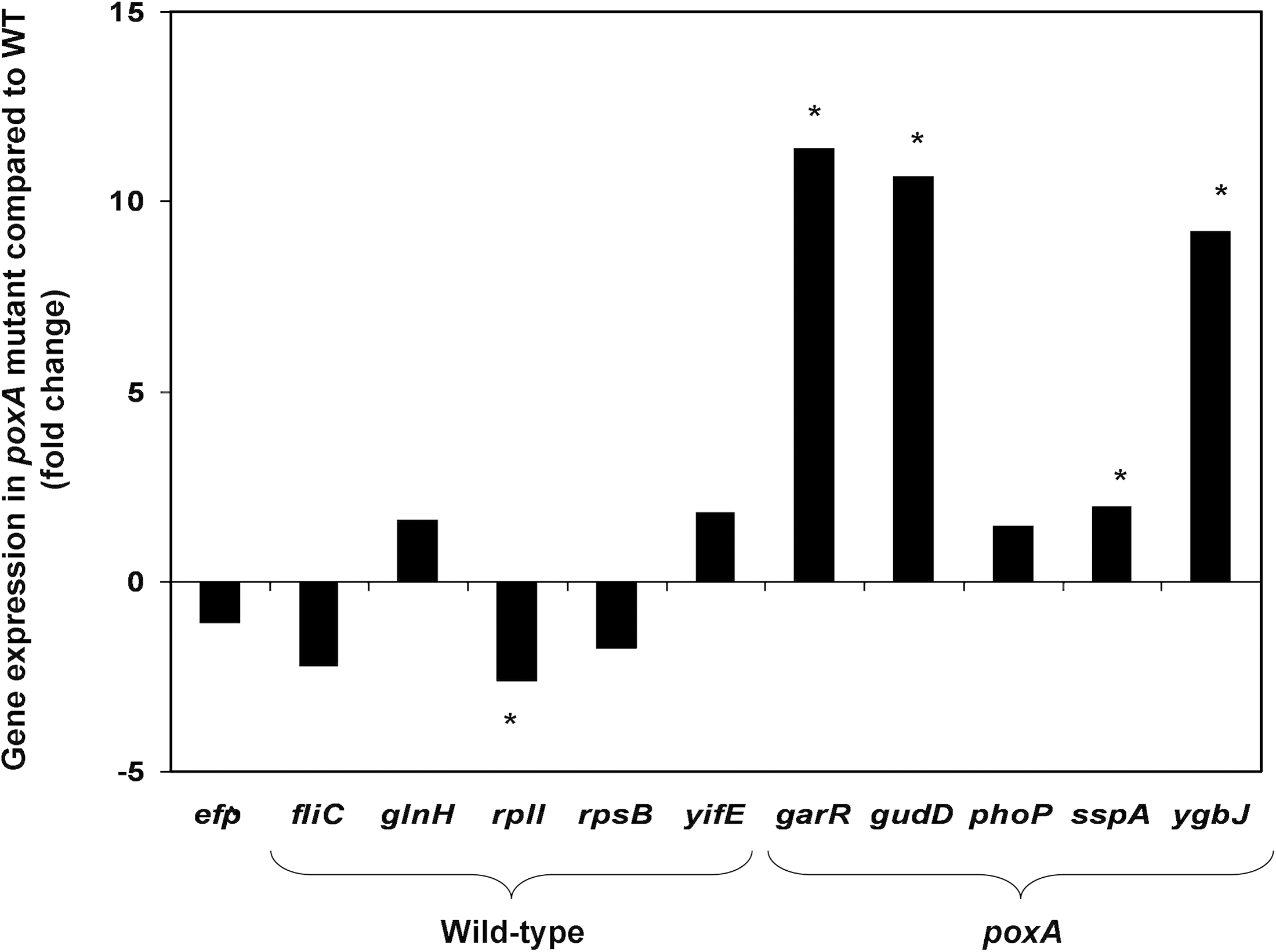
Real-time polymerase chain reaction analysis of genes identified in two-dimensional gel assays. RNA isolated from wild-type Salmonella Typhimurium (SX 117) and the poxA mutant (SB 303) grown to mid-logarithmic phase was reverse transcribed into cDNA and transcriptionally analyzed using the primer sets given in Tables 1 and 2. The fold change in gene expression in the poxA mutant compared to wild-type Salmonella Typhimurium was considered significant (*) when p < 0.05.
Conclusions
A mutation in the poxA gene renders Salmonella Typhimurium more susceptible to the harsh environment of the swine stomach and other environmental stressors, as well as reduces colonization potential in the natural swine host. Two-dimensional SDS-PAGE analysis and protein sequencing identified differentially expressed proteins in the poxA mutant, indicating that the presence of PoxA influences selective translation of mRNA transcripts that ultimately influence a variety of bacterial processes.
Footnotes
Acknowledgments
The authors are grateful to Ann Hoffman, Kellie Winter, Jennifer Jones, and Stephanie Jones for technical assistance. This research was supported by Agricultural Research Service, U.S. Department of Agriculture funds.
Disclosure Statements
No competing financial interests exist.
Mention of trade names or commercial products in this article is solely for the purpose of providing specific information and does not imply recommendations or endorsement by the U.S. Department of Agriculture.
U.S. Department of Agriculture is an equal opportunity provider and employer.