




Abstract
Verotoxigenic Escherichia coli (VTEC) are one of the most important emerging foodborne pathogens and the principal cause of hemolytic uremic syndrome (HUS). This entity has been recognized worldwide as a priority issue in the field of zoonoses and public health, and Argentina is the country with the highest incidence of HUS in children less than 5 years of age.The lack of specific treatment, combined with the high morbidity rate of VTEC infection, makes prevention the main tool for reducing the incidence of HUS. The current work aimed at assessing the factors associated with sporadic VTEC infection in children with acute diarrhea from the Central Eastern area of Argentina where the incidence rate of HUS in children under 5 is the highest worldwide. A univariate analysis was performed to identify potential factors associated with VTEC infection by calculating odds ratios (OR) with 95% confidence intervals (CI). Then, a multivariate logistic regression model was performed. Interaction and association between significant factors were checked. “Recent consumption of food prepared outside home” (OR: 2.4, 95% CI 1.05–5.7) and “recent vegetables consumption” (OR=0.4; 0.2–0.8) were identified as independent factors associated with VTEC infection. We believe that the data obtained from this study further the current knowledge about the epidemiology of VTEC infection in Argentina and could be considered when planning strategies for the prevention of the disease.
Introduction
V
VTEC infection in children can cause gastroenteritis, and approximately 5%–15% of infections develop hemolytic uremic syndrome (HUS). The latter is defined by acute renal failure, thrombocytopenia, and microangiopathic hemolytic anaemia. Currently, there is no specific treatment for HUS, and the mortality rate among clinical cases is about 5% (Repetto, 1997; Rivas et al., 1998; Noris and Remuzzi, 2005). After recovery from the acute stage, 20%–40% of patients may suffer persistent forms of renal sequelae. From 3% to 15% of these children will develop terminal chronic renal failure requiring kidney transplantation (Loirat, 1993; Repetto, 1997; Spizzirri et al., 1997; Gerber et al., 2002; Karch et al., 2005). Almost all diarrhea-associated HUS cases in children are due to VTEC infection, belonging to O157:H7 or non-O157:H7 serotypes (Proulx et al., 2001; Tarr et al., 2005; Rivas et al., 2008).
Argentina has the worldwide highest incidence of reported HUS cases (13.9/100 000 children aged 5 or less) (SINAVE, 2004; Rivas et al., 2006, 2008; Ibarra et al., 2008). HUS represents the main cause of acute renal failure and is one of the leading causes of chronic renal failure and renal transplantation in children (Rivas et al., 2006, 2008). Although cases are reported throughout the whole year, in the Central and Southern provinces the frequency of HUS is higher, especially during warm months (SINAVE, 2004; Rivas et al., 2006; Ibarra et al., 2008; Caletti et al., 2009). For example, in Buenos Aires and Córdoba provinces (located in the Central Eastern region of the country), the mean incidence rate of HUS is almost 20/100,000 children aged 5 or less (SINAVE, 2004). Due to the high rate of HUS in Argentina, the lack of specific treatment, and the severe sequelaes associated with this disease (Rivas et al., 2006, 2008), primary prevention of VTEC infection is essential to reduce the incidence of HUS. Such preventive measures should be based on a detailed understanding of the local epidemiology of this infection (Karch et al., 1999, 2005; Tozzi et al., 2001; Tarr et al., 2005). However, despite the importance of HUS for Public Health, the factors connected with this infection in our country have yet to be fully understood.
The objective of the study was to identify factors associated with sporadic VTEC infection/HUS in children aged up to 6 with acute diarrhea from the Central Eastern area of Argentina.
Materials and Methods
Study design
A cross-sectional study was carried out in the Central Eastern area of Argentina (El Palomar, Tandil and Bahía Blanca cities, located in Buenos Aires Province, and Río Cuarto city, located in Córdoba Province) (Fig. 1).
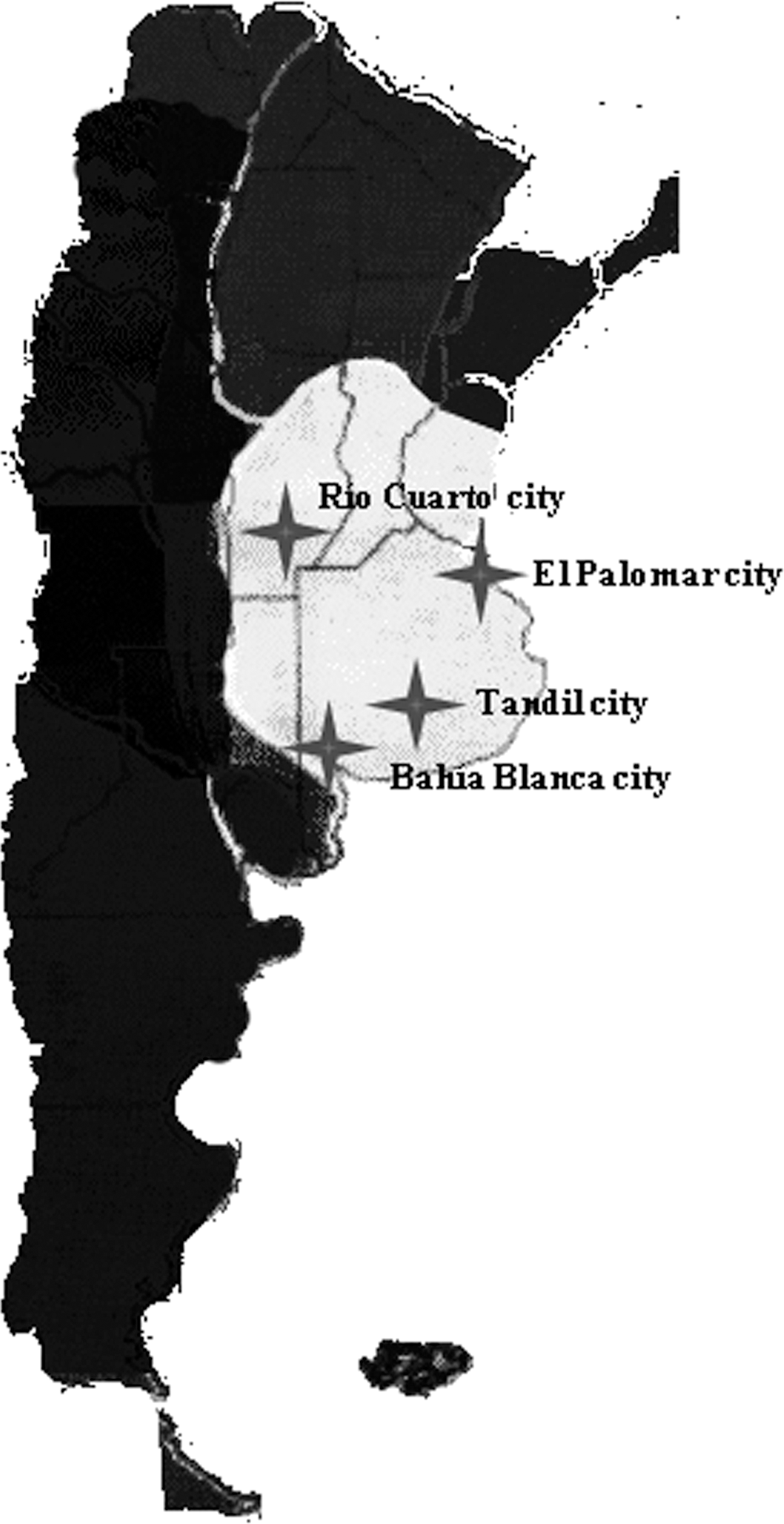
Geographical location of health centers involved in the study.
Stool samples from children up to 6 years old with acute diarrhea were collected, identified by code number, and kept refrigerated in Stuart transport medium until they were analyzed in the laboratory. Patients included in the study (n=437) were diagnosed by a physician when they were treated at hospitals, clinics, and other health centers. The median age of the patients was 18 months (ranging from 1 to75 months).
VTEC/HUS case was defined as a patient having either VTEC-associated diarrhea and/or diarrhea-associated HUS (n=63). Noncase was defined as a patient having diarrhea associated with neither VTEC nor HUS (n=374). Cases and noncases belonged to the same sample—they were not selected for their condition of cases or noncases. Instead, individuals were tested for the presence of the disease and for the exposure status.
Acute diarrhea was defined as a change in normal stool pattern, characterized by a decrease in consistency and an increase in the frequency of bowel movements to over three stools per day for a period of less than 4 weeks (Baldi et al., 2009).
Stool samples were tested for the presence of VTEC by a multiplex polymerase chain reaction. Bacteriological and polymerase chain reaction procedures had been described in a previous study (Rivero et al., 2010).
Data gathering and statistical analysis
Considering that the median incubation period of VTEC infection is of 3 days (Tarr et al., 2005), recent exposure was defined as the last 72 hours before the beginning of diarrhea. For each patient included in the study, a structured questionnaire was filled out requiring information about factors that could be associated with VTEC infection. Not all cases were able to provide information on every aspect surveyed. Table 1 shows the factors selected for study, their categorization, and the number of responses corresponding to the cases and noncases.
Recent = In the last 72 hours.
First, a univariate analysis was performed to assess associations between the dependent variable (case/noncase) and the independent variables (potential risk or protective factors). Associations among all independent variables were also assessed. All variables were compared by using a χ 2-test. The null hypothesis was that there were no differences between groups, and alpha was 5%. Second, a stepwise-forward logistic regression was performed with VTEC/HUS case/noncase as the dependent variable, and patient characteristics were offered as independent variables (SAS, 2009). When seeking for the simplest model that could explain the presence of VTEC/HUS in patients with diarrhea, only variables significantly associated (p<0.05) with the dependent variable after χ 2-tests were offered to the model. The estimation method was maximum likelihood with a convergence criterion of 1E-8. Interaction and potential confounding factors were also tested. Analyses were performed using Epi Info 3.5.1 (CDC and WHO, 2008) and SAS 9.1.3. (2009).
Ethical considerations
Recommendations established in the Declaration of Helsinki for Biomedical Research Involving Human Subjects, adopted by the 18th World Medical Assembly (Helsinki, Finland, 1964) and revised by the World Medical Assembly in Tokyo (1975), Venice (1983), Hong Kong (1989), Somerset West (1996), Edinburgh (2000), Washington (2002), Tokyo (2004), and Seoul (2008), were followed.
Results
Univariate analysis of all the variables studied
Table 2 shows the exposition of VTEC/HUS cases and VTEC/HUS noncases to the variables under study and the estimate odds ratios (OR) and 95% confidence intervals (CI). There was a significant association (p<0.05) between VTEC infection and factors related to quality of housing (HUS/VTEC infection cases were less likely to have had garbage disposal than noncases), time of the year (the frequency of VTEC infection/HUS was higher during the warm months), recent travel (cases were more likely to have travelled recently), and food consumption (cases were more likely than noncases to have recently consumed meat and food prepared outside home. However, they were less likely to have recently consumed vegetables).
The results are expressed in No. exposed/total (%) and were calculated according to the information that was available from the patient questionnaires; not all information was available for each patient.
Factors significant at the 5% significance level.
OR, odds ratio; CI, confidence interval.
When assessing associations among all independent variables that were related to VTEC infection/HUS, a direct link was found between “recent vegetables consumption” and “recent meat consumption” (p=0.02) as well as between “recent consumption of food prepared away from home” and “recent travel” (p<0.01) (Table 3).
Factors significant at the 5% significance level.
Multivariate analysis of variables associated with HUS/VTEC infection
Since the variable “recent consumption of food prepared outside home” was associated with the variable “recent travel,” multicollinearity was present. Since both variables would be measuring the same effect, we decided to perform a model with all the variables that were statistically significant in the univariate analysis (p<0.05), excluding the variable “recent travel.” In this model, “recent consumption of food prepared outside home” (OR: 2.4, 95% CI 1.05–5.7) and “recent vegetables consumption” (OR: 0.4, 95% CI 0.2–0.8) were independently associated with HUS/VTEC infection. No interactions were detected between the covariates included in the model. The results of the multivariate logistic regression analysis are shown in Table 4.
Factors significant at the 5% significance level.
Discussion and Conclusions
The data obtained in this study allow us to determine two factors independently associated with HUS/VTEC infection in a sample of children with acute diarrhea from the Central Eastern area of Argentina. Cases were 2.4 times more likely than noncases to have recently consumed food prepared outside home and were 2.5 times less likely to have recently consumed vegetables.
Recent travel history has been described as a risk factor associated with VTEC infection. Schmid et al. (2002) postulated that VTEC infections may have some implication for traveler's diarrhea. O'Brien et al. (2001) also found that a history of having travelled during the exposure period was associated with an increased risk of infection. It should be noted that under such circumstances, a person is more likely to eat food prepared outside home, which might be prepared or preserved under nonideal conditions. We actually found that patients who had travelled recently had consumed food prepared outside home more frequently than patients who had not travelled. Moreover, eating foods prepared outside home has been described as a factor associated with VTEC infection in different studies (Locking et al., 2001). In this work, “recent consumption of food prepared outside home” was independently associated with VTEC infection, as “recent travel” did not always account for this factor. In fact, of the 11 cases that were exposed to “recent consumption of food prepared outside home,” 3 (27.3%) had not travelled recently. It is, therefore, strongly advised that we be more careful and monitor food that children could eat from restaurants, cafes, street vendors, schools, and so on.
Although in certain outbreaks vegetables were involved as vehicles for VTEC infection (Ackers et al., 1998; Hilborn et al., 1999; CDC, 2006; Grant et al., 2008; Söderström et al., 2008), the results obtained from this study suggest a possible risk reduction in VTEC infection (in this case sporadic) associated with the consumption of this kind of food. Other studies carried out in the United States (Kassenborg et al., 2004; Voetsch et al., 2007), Scotland (Locking et al., 2001), and Argentina (Rivas et al., 2008) have also pointed out the protective effects of a diet that includes vegetables. The mechanisms that mediate this effect appear not to be related to the replacement of potentially riskier foods (e.g., those of animal origin) by vegetables—in fact, “vegetables consumption” proved to be positively associated with “meat consumption.” Therefore, they may rather result from the benefits of a balanced diet that might increase resistance to disease by providing the necessary intestinal flora, micronutrients, and other substances that promote the protection against pathogen colonization (Kassenborg et al., 2004; Voetsch et al., 2007; Rivas et al., 2008). People with a balanced diet could be more informed and aware of hygienic measures during food preparation or may spend more money on high-quality raw materials and ingredients. Unfortunately, the findings of this study cannot confirm this. Instead, we found there are no differences between noncases that eat vegetables and noncases that do not eat them in regard to sewage services, tap water provision, electric light service, health insurance, and so on.
The current study design does not allow drawing any inferences for the general population but rather estimates the risks among young children with diarrhea of being a VTEC/HUS case. Conclusions of this study may, consequently, be generalizable only to children with diarrhea.
We believe that some of the factors associated with diarrhea were not detected in this study, because they are present in both groups of cases and noncases. Instead, the factors we found associated with VTEC infection are specific to this infection and not to other pathogens.
Potential biases of this study are selection biases (some children with diarrhea who live far away from hospitals may not have received any medical attention and for that reason were not included in the study), recall biases (especially when the patient-has-had-mild-diarrhea cases are less likely to remember exposure), and misclassification biases (in some cases, samples may have been taken at a time when the child was not excreting VTEC, therefore resulting in a false noncase).
The results obtained from this study further the current knowledge on the epidemiology of VTEC infection in the Central Eastern area of Argentina. The factors that emerged as associated with VTEC infection could be taken into account when planning strategies for the local prevention of the disease in order to diminish the incidence of HUS in this region. Eating a varied diet that includes fruits and vegetables and being more careful when traveling and consuming food prepared outside the home could be beneficial to the prevention of this infection.
Footnotes
Acknowledgments
We are grateful to the following institutions for their invaluable help in sample collection: “Sociedad Argentina de Pediatría,” Hospital “Ramón Santamarina,” Laboratorio “Pérez Cambet,” “Nueva Clínica Chacabuco,” Municipalidad de Bahía Blanca, Hospital “Dr. José Penna”; Hospital “Alejandro Posadas,” Nuevo Hospital de Río Cuarto “San Antonio de Padua.” M.A.R. was a holder of a fellowship from CONICET. M.A.R. is a holder of a fellowship Carrillo-Oñativia. Comisión Nacional Salud Investiga. Ministerio de Salud, Argentina. M.L.S. is a member of CONICET. A.E.P. is a member of CICPBA. This work was made possible through grants from CICPBA, CONICET, Fundación Alberto J. Roemmers, SECAT-UNICEN, and FONCYT.
Disclosure Statement
No competing financial interests exist.