




Abstract
Verocytotoxigenic Escherichia coli (VTEC) can produce serious human illness linked to the consumption of contaminated food, mainly of bovine origin. There is growing concern about non-O157 VTEC serotypes, which in some countries cause severe infections in a proportion similar to O157:H7 strains. As several epidemiological studies indicated the important role of meat as the major vehicle in the transmission of this pathogen to human consumers, our aim was to investigate the genetic diversity among non-O157:H7 VTEC isolated from raw beef products. We performed a multiple-locus variable-number tandem repeat (VNTR) analysis (MLVA), and to our knowledge, this is the first time that VTEC serotypes O8:H19, O112:H2, O113:NM, O171:NM, ONT:H7, ONT:H19, and ONT:H21 were typed by this method. MLVA typing grouped the total number of strains from this study (51) into 21 distinct genotypes, and 11 of them were unique. Several MLVA profiles were found in different serotypes, O178:H19 being the most variable. The isolates could be principally discriminated by alleles of three of seven loci studied (CVN001, CVN004, and CVN014), and on the other hand, CVN003 rendered null alleles in all the isolates. As some VNTR markers might be serotype specific, it is possible that the implementation of new VNTR loci will increase intraserotype discrimination.
Introduction
Rhoades et al. (2009) reviewed information published about VTEC prevalence in cattle and beef, from the farm to the final ready-to-eat product, and noted that prevalence in the beef chain varies considerably between surveys. Several studies have confirmed that cattle also are a reservoir of VTEC in Argentina (Sanz et al., 1998; Parma et al., 2000; Mercado et al., 2004), with prevalence values as high as 63% (Padola et al., 2004). Among beef products, there are reports in which VTEC contaminate 8.4%–29% of hamburger samples, 25%–43% of ground beef samples, and 25% of retail beef cuts (Parma et al., 2000; Sanz et al., 2007; Etcheverría et al., 2010).
Molecular typing methods are used for epidemiological investigation to trace bacterial contamination, determine the distribution of pathogens isolated from ill people, and also rule out nonrelated isolates from a particular outbreak (Foley et al., 2009). Multiple-locus variable-number tandem repeats (VNTR) analysis (MLVA) has been found to be very useful in discriminating otherwise indistinguishable types in highly clonal organisms such as E. coli and it was first described in E. coli for O157 strains (Lindstedt et al., 2003; Noller et al., 2003; Keys et al., 2005). As these protocols are specific for O157, Lindstedt et al. (2007) developed an MLVA method generic for E. coli. More recently, Miko et al. (2010) obtained genetic profiles of E. coli O26 strains by this assay, and Bustamante et al. (2010) compared VTEC isolates belonging to several serotypes, mostly obtained from bovines.
As several studies indicated the important role of meat as the major vehicle in the transmission of this pathogen to human consumers, our aim was to investigate the genetic diversity among all non-O157:H7 VTEC isolated from raw beef products in a study performed during summer 2003. As several of these isolates belonged to serotypes that have been reported from diarrhea and HUS cases worldwide (
Materials and Methods
Bacterial strains
Fifty-one non-O157:H7 VTEC isolates from the collection of the Laboratorio de Inmunoquímica y Biotecnología (UNCPBA, Tandil, Argentina) were investigated. They had been obtained in a previous study by Sanz et al. (2007) from minced meat and hamburgers. The isolates belonged to 13 serotypes and were previously analyzed by PCR for the presence of genes encoding for verocytotoxin 1 and 2 (vtx1 and vtx2), intimin (eae), enterohemolysin (ehxA), and STEC autoagglutinating adhesin (saa) (Sanz et al., 2007) (Table 1).
Examined in previous studies.
NM, nonmotile; NT, nontypeable; MM, minced meat; H, hamburger.
MLVA typing
The seven VNTR loci studied and the primers used were those proposed by Lindstedt et al. (2007) and the assay was performed as described by Bustamante et al. (2010).
To confirm the results of the fragment analysis, representative alleles were sequenced with an ABI PRISM 3730XL genetic analyzer (Macrogen).
Data analysis
The alleles were named according to the number of tandem repeat sequences. If no amplification product was detected, the allele was designated with an arbitrary number (30). Alleles that presented partial repeats were rounded up or down to the closest complete repeat number, in agreement with Hyytiä-Trees et al. (2006). The diversity index (D N), based on Nei's marker diversity, was calculated for each locus using the formula D N=1−Σ(fra)2, where fra is the allelic frequency (Noller et al., 2003). Null alleles were also taken into account to determine this index.
MLVA profiles were defined with an order of the allele string that was always CVN001-CVN002-CVN003-CVN004-CVN007-CVN014-CVN015. The dendrogram was constructed using the UPGMA clustering method implemented by START Vs. 1.0.5 software (Joley et al., 2001). The discriminatory power of the typing method was evaluated using the Simpson's index of diversity (D S) (Hunter and Gaston, 1988). As the dependency between isolates originating from a single sample was unknown, two different discriminatory indexes were calculated, one including all VTEC isolates and another including only a representative isolate from each MLVA profile and serotype.
Results
The 51 VTEC isolates tested could be typed by this MLVA assay and a total of 21 alleles were observed. The number of alleles detected per locus ranged between 0 (CVN003) and 11 (CVN014) (Table 2). All the samples presented a null allele at locus CVN003 (Table 2) and this suggests either locus absence or sequence polymorphism at one or both of the priming sites.
NA, nonamplified product.
MLVA typing divided the total number of strains into 21 distinct genotypes, and 11 of them were unique to a single strain (Fig. 1). The serotypes that presented the highest diversity according to MLVA were O8:H19 and O178:H19. The former presented four of eight isolates with an identical profile, and three profiles were detected among the remaining four isolates. Among the five O178:H19 isolates, three profiles were seen (two of them shared each by two isolates and the other unique). The intraserotype differences among profiles were explained by three loci at most.
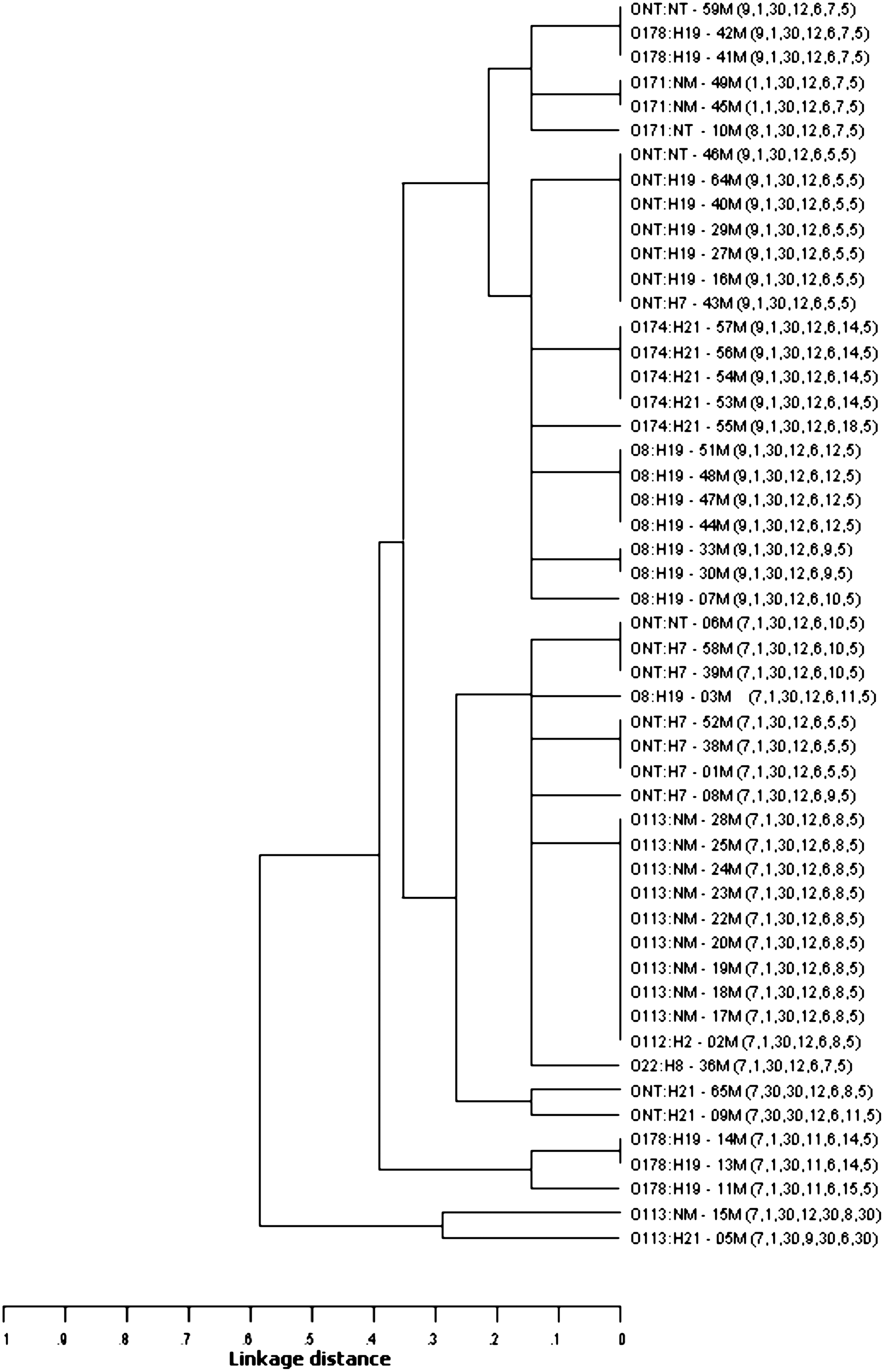
Multiple-locus variable-number tandem repeat analysis–based clustering of verocytotoxigenic Escherichia coli non-O157:H7 isolates investigated in this study. The multiple-locus variable-number tandem repeat analysis profile comprises the allele numbers at all seven loci in the order CVN001, CVN002, CVN003, CVN004, CVN007, CVN014, and CVN015.
Profiles corresponding to different serotypes differed in one to three loci. Exceptionally, some profiles were shared by isolates belonging to different serotypes. The most frequent MLVA profile was 7-1-30-12-6-8-5, shown in 10 isolates (19.6%), nine of these isolates belonged to O113:NM and one to O112:H2. The other frequent profile (9-1-30-12-6-5-5) was found in seven isolates (13.7%) (Fig. 1).
Almost all the analyzed isolates carried vtx 2, but one belonging to serotype O8:H19 and one ONT:H19 also possessed vtx 1 (Table 1). The vtx 1/vtx 2-positive isolate belonging to O8:H19 presented an MLVA profile different from the other isolates of the same serotype. Nevertheless, the profile from the remaining vtx 1/vtx 2-positive isolate was shared by several isolates.
Nei's diversity indexes calculated for all the VNTRs that could be amplified showed that CVN002 and CVN007 had the lowest values (D N=0.07), whereas CVN014 (D N=0.85) was the most polymorphic locus (Table 2). When we analyzed intraserotype loci diversity, we found that indexes notably differed among serotypes (data not shown). The isolates could be principally discriminated by alleles of loci CVN014 and CVN001, followed by those of CVN004. The most variable serotype (O178:H19) showed different alleles for these three loci, whereas O174:H21 and ONT:H21 isolates presented variability in only one locus, CVN014 (Table 2).
Simpson's index of diversity, calculated for the combined typing set, showed a value of D S=0.93 including all VTEC strains, and one of D S=0.96 when excluding replicates possibly originated from a single food sample.
Discussion
Our study compared VTEC isolates from meat products belonging to several serotypes, using MLVA, to study the genetic diversity among them. The authors who developed this assay, Lindstedt et al. (2007), applied it for detecting an HUS outbreak caused by E. coli O103:H25 in Norway and to ascertain the source of infection, cured mutton sausages (Schimmer et al., 2008). To our knowledge, this is the first time VTEC serotypes O8:H19, O112:H2, O113:NM, O171:NM, ONT:H7, ONT:H19, and ONT:H21 have been typed by MLVA.
Not all the loci studied by us had an equal diversity, and moreover, they had different diversity indexes in different serotypes. In the present study, CVN014, or the alternative name O157–11 according to Keys et al. (2005), was the most variable locus, coinciding with the results of Lindstedt et al. (2007) and Bustamante et al. (2010). The finding of low diversity in some loci (CVN002, CVN004, CVN007, and CVN015) in relation to the values published by Lindstedt et al. (2007) and Bustamante et al. (2010) might be due to the limited number of isolates. The locus CVN003 presented a null allele for all the samples studied, coinciding with the results reported by Lindstedt et al. (2007) for isolates belonging to the O103 serogroup; however, amplification of this VNTR locus has been reported in other serotypes such as O145:NM and O157:H7 (Lindstedt et al., 2007; Bustamante et al., 2010).
According to the epidemiological information that was available, we cannot determine whether most of the isolates that formed clusters with identical MLVA profiles were derived from a unique source and constitute a single clone.
The discriminatory power evaluated by two Simpson's indexes of diversity, as described by Stakenborg et al. (2006), resulted in values that can be considered discriminatory (D S=0.93 and 0.96). This implies that if in the sampling some isolates represent an identical clone, the true value of this index should fall between these two estimated values.
Major advantages of MLVA are the speed of analysis, low cost, and the ability to produce numerical data that are easily portable between laboratories. Keeping in mind that the MLVA typing scheme used in this study was developed for E. coli and as some VNTR markers might be serotype specific, it is possible that the proposed VNTR loci are not variable enough for typing all non-O157:H7 strains. New VNTR loci for specific serotypes were recently implemented for Izumiya et al. (2010) and other ones are under development in our laboratory.
In conclusion, our findings corroborate the usefulness of the MLVA method as a tool for non-O157 VTEC typing and also point out that the implementation of new VNTR is needed for a more efficient MLVA typing scheme, with increased intraserotype discrimination.
Footnotes
Acknowledgments
The authors thank Marcelo Sanz and Alejandra Krüger for providing information about the isolates studied. This work was supported by grants from the CONICET, CIC, FONCYT, and SECAT-UNICEN.
Disclosure Statement
No competing financial interests exist.