




Abstract
Pathogenic Escherichia coli strains on raw or insufficiently cooked foods are of public health concern as serious disease may result from their ingestion. Therefore, many commercial producers of beef products screen for E. coli O157:H7 before shipment. While Salmonella is not considered an adulterant on raw beef products, it is used as an indication of process control. To detect these microorganisms, rapid screening methods are often used to provide results within 8–24 hours after sampling. During 2005–2008, about 971,389 samples from several commercial beef production plants were tested using a rapid screening method based on the polymerase chain reaction to determine if they were presumptively positive for bacterial cells carrying Salmonella or Shiga toxin–producing E. coli–specific genes. Of the product lots sampled (trim, ground beef, and variety meats), 15% were positive for the stx1 and/or stx2 (Shiga toxin genes), 9.1% for the eae gene (the attaching and effacing gene [eae] encoding intimin), 3.0% for an rfb gene region (encoding the O157-specific O side chain polysaccharide), and 1.67% for Salmonella by the polymerase chain reaction assay. In general, lots of ground beef showed the lowest frequency of contamination, and variety meats (by-products of carcass evisceration), the highest. Overall, 4.6%, 4.6%, and 0.8% samples were screen-positive for enteropathogenic E. coli, enterohemorrhagic E. coli, and E. coli O157, respectively. Of the E. coli O157–positive samples, 14% were also Salmonella positive. The frequency of screen-positive samples increases during the summer months, probably because of the prevalence of climatic conditions more conducive to microbial growth. The presence of fecal organisms in beef products suggests a failure of sanitary controls during processing and the more prevalent relatives of E. coli O157, Shiga toxin–producing Escherichia coli, enteropathogenic E. coli, and enterohemorrhagic E. coli, serve as more sensitive indicators of contamination than O157 strains alone.
Introduction
The Shiga toxin–producing E. coli (STEC) harbor the stx1 and/or stx2 genes (or other variants) that encode closely related forms of this toxin. The elaboration of this toxin is not the only factor that causes disease in humans because stx-negative strains are found among the enteropathogenic (EPEC) E. coli (Donnenberg et al., 1997; Elliott et al., 1998; Trabulsi et al., 2002). Many STEC strains that harbor the attaching and effacing gene (eae, encoding intimin) can cause HUS. STEC strains that contain eae are often referred to as EHEC because of their ability to cause bloody diarrhea. One EHEC serotype, O157:H7, which was first associated with a foodborne disease outbreak in 1982 (Riley et al., 1983), causes an estimated 75,000 cases and 60 deaths annually in the United States (Mead et al., 1999) at an economic cost over $400 million each year (Frenzen, 2007).
In response to a large outbreak of illnesses in 1993 caused by E. coli O157:H7 associated with improperly prepared hamburgers at a U.S. fast food restaurant chain (Bell et al., 1994; Samadpour et al., 1994), there has been considerable interest in reducing its frequency in beef products, especially raw ground beef. As raw ground beef can be undercooked, E. coli O157:H7 was declared an adulterant (as defined in 9 CFR §301.2) in this product; (Anonymous, 1999; Donnenberg and Whittam, 2001) and there is interest in identifying the occurrence of other groups of species that elaborate these toxins (Karmali et al., 1985; Jaeger and Acheson, 2000; Bosilevac et al., 2007; Eblen, 2007) as they, too, have been shown to have public health impact (Neill et al., 1985; Murphy et al., 2005) and occur in beef (O'Brien et al., 1982; O'Hanlon et al., 2004).
The test results reported here represent the analysis of samples from ∼2 billion pounds (∼900,000 kg) of meat produced during 2005–2008. The data were from a polymerase chain reaction (PCR)-based screening assay that can be conducted within 12 hours of sample delivery and from a lateral flow (LF) device that detects an E. coli O157–specific antigen. The multiplex PCR detected the stx1 , stx2 , rfb, and eae genes and two Salmonella-specific regions. We report the frequency of the occurrence of these genes on raw ground beef, trim, and variety meats (by-products of carcass evisceration taken from parts other than skeletal muscle such as heart and cheek meat, and lips) throughout this 4-year period. Because there are a considerable number of comparisons that can be made, we will tend to emphasize comparisons between the frequencies of Shiga toxin gene–containing (stx +) and Salmonella-positive (sal+) samples.
Materials and Methods
Sample collection
Samples for this study were collected from 2005 through 2008 at 20 commercial meat-processing facilities in the Midwestern United States ranging in size from about 200 lots per month to over 9300. As there are many variables associated with beef processing (source of cattle, weather, sanitation, etc.) it is difficult to determine if these plants are representative of the entire industry. Beef trim samples came from plant-defined product lots consisting of 1–5 combo bins, each combo bin consisting of ∼900–1000 kg of product. Samples (375 g) were comprised of 60 pieces of meat ∼1″×2″ in size from the surfaces corresponding to outside carcass surfaces and then placed into sterile, filtered stomacher bags (Nasco) for transport to the laboratory. Ground beef and variety meat samples (375 g portions) were collected in sterile, filtered stomacher bags (Nasco), and transported to the laboratory.
Enrichment, multiplex PCR screening, and O157 antigen detection
Prewarmed (42±2°C) Institute for Environmental Health (IEH) media (Molecular Epidemiology Incorporated) was added to each sample bag. All samples were incubated at 42±2°C for a minimum of 8 hours. Samples tested for the presence of EHEC and Salmonella genes were screened by transferring 1 μL of TSB culture to PCR tubes containing lysis and PCR reagents. Negative controls were prepared by substituting 1 μL sterile deionized water for sample enrichment into the lysis reagent. All PCR-positive controls and LF tests were conducted according to the manufacturer's (MEI) protocols. All amplicons were resolved using 2% low electroendosmosis agarose (Fisher Scientific) gel electrophoresis (Bio-Rad Laboratories Sub-Cell® Model 192) for 35 minutes at 270 V. Agarose gels were stained with ethidium bromide (Fisher Scientific) and amplicon patterns were observed using an ultraviolet UVP Epi Chemi II Darkroom UV Transilluminator (UVP, Inc.). The fat content of a sample was that reported by each beef-processing plant.
Enrichment culture screening and strain definitions
These test data were obtained from screening composited enrichment samples. For the purposes of this report we are defining STEC samples as those positive for the stx1 and/or stx2 genes. EPEC samples are defined as stx − and eae +. EHEC samples are defined as STEC with the addition of the eae gene. Samples positive for the EHEC signals plus the rfb gene and/or LF + are designated as screen-positive for E. coli O157 (O157+). Samples identified as sal+ are sal1 + and/or sal2 + for the two Salmonella-specific PCR targets.
Statistical analyses
Data were transformed into contingency tables according to the presence or absence of the various PCR signals across product classes and sample collection months. The significance of differences in frequencies was determined using Fisher's Exact Test (as implemented at
Results
Products tested and the frequency of positive lots
The years in which samples were collected and the products from which they came are shown in Table 1. Trim samples were the majority (92%) of the total of 971,389 samples tested. The frequency of samples yielding positive PCR signals for the Shiga-like toxin genes, the intimin gene, E. coli O157-specific results, and Salmonella-specific sequences are shown in Table 2. Of the samples tested, 208,835 (22%) produced one or more positive signals. The frequency of positive signals and the average number of signals per sample for each product class tested is also shown. The percentage of STEC-positive samples is less than the sum of stx1 + and stx2 + because some samples are positive for both stx1 and stx2.
stx1 + , Shiga toxin type 1; stx2 + , Shiga toxin type 2; eae+ , gene encoding intimin; rfb+ , gene encoding the O157 antigen; LF + , LF test for the O157 antigen (MEI; Neogen); sal + , either of two Salmonella-specific targets.
All percent positive values in the “total” column are significantly different from each other (p<0.05) using Fisher's Exact test (
Values sharing the same superscript are not significantly different from other product class values in the same row (p>0.05).
STEC + , stx1 + , and/or stx2 + ; EPEC, enteropathogenic Escherichia coli; eae+ and STEC − , EHEC, enterohemorrhagic E. coli; STEC + and eae+ ; O157, EHEC and rbf+ and/or LF + . STEC, Shiga toxin–producing Escherichia coli; LF, lateral flow.
Association of stx and sal signals
Many comparisons can be made to determine if signals for pathogenic determinants are preferentially associated with each other, but we will use the association of STECs (stx+ ) with Salmonella as an example (Table 3). The observed number of stx + sal+ samples (7354) was compared with the number expected if stx + and sal+ signals were occurring in samples independently (0.145 [STEC+]×0.0157 [sal+]×971,389=2222; frequencies from Table 2, total from Table 1). For all samples, there is a 3.3-fold excess of stx + sal+ samples. However, for ground beef samples, there is an 8.4-fold excess of stx + sal+ samples. The association of stx + and eae + with sal+ signals also varies between product classes (Fig. 1).

Association of stx and eae with Salmonella in different products. Each bar is the percent of polymerase chain reaction-screen Salmonella-positive samples that are stx
− eae
−, stx
− eae
+, STEC+ eae
−, or STEC+ eae
+, respectively. Error bars are one standard error. (□, ground beef; , trim; ▪, variety meats). STEC, Shiga toxin–producing Escherichia coli.
Calculated from 2×2 contingency tables.
Values sharing the same superscript are significantly different from other values in the Obs/Exp row (p≤0.05).
PCR, polymerase chain reaction.
Comparison between the rfb and LF tests
Both the rfb and LF tests are designed to be specific for E. coli O157. The rfb gene was detected using a PCR-based assay, whereas the LF test is an antibody-based detection system specific for a part of the O157 antigen. Here, we have an opportunity to compare these two assays. Of the 37,709 samples that tested positive for rfb and/or LF, the majority (64%) were rfb+ and LF− (Table 4). Of the rfb − LF+ results, only 6.1% of the samples were presumptively positive for E. coli O157, whereas the rfb + LF− and rfb + LF+ results yielded 25% presumptively E. coli O157–positive samples.
STEC+ eae + and rfb + or LF+ are considered presumptive for O157 by the definition given in Table 2.
Changes in signal frequencies over time
To assess the change in contamination of beef products over time, we determined the percent stx + samples for each product class by month during 2005 to 2008 (Fig. 2). The fractions of positive tests for the stx, eae, and E. coli O157 classes were determined for each month during the calendar year (Fig. 3). The data suggest an increase in the fraction of stx + samples during the summer for all product classes (Fig. 4). By using the plotting method described by Williams et al. (2010), it appears that E. coli O157 reaches a lower level early in the year and a higher level than STEC during the summer (Fig. 5). To determine if there were differences in the frequencies of presumptive pathogens over time in different products, the percent positive samples for stx + (STEC), EPEC, EHEC, E. coli O157, and Salmonella were determined for each year and product (Table 5).
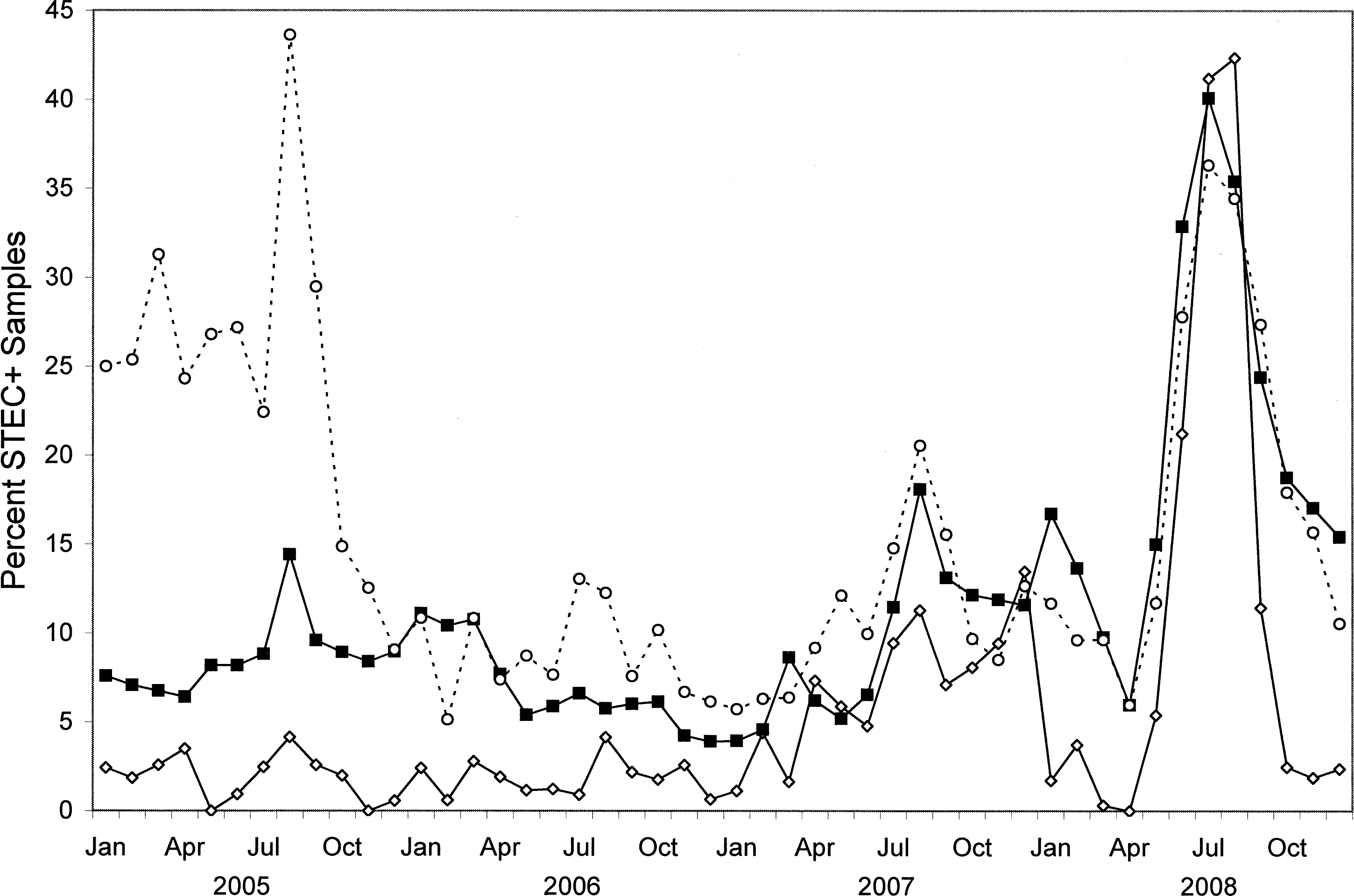
Percent STEC+ samples during 2005–2008. (⋄, ground beef; ▪, trim; ○, variety meats).
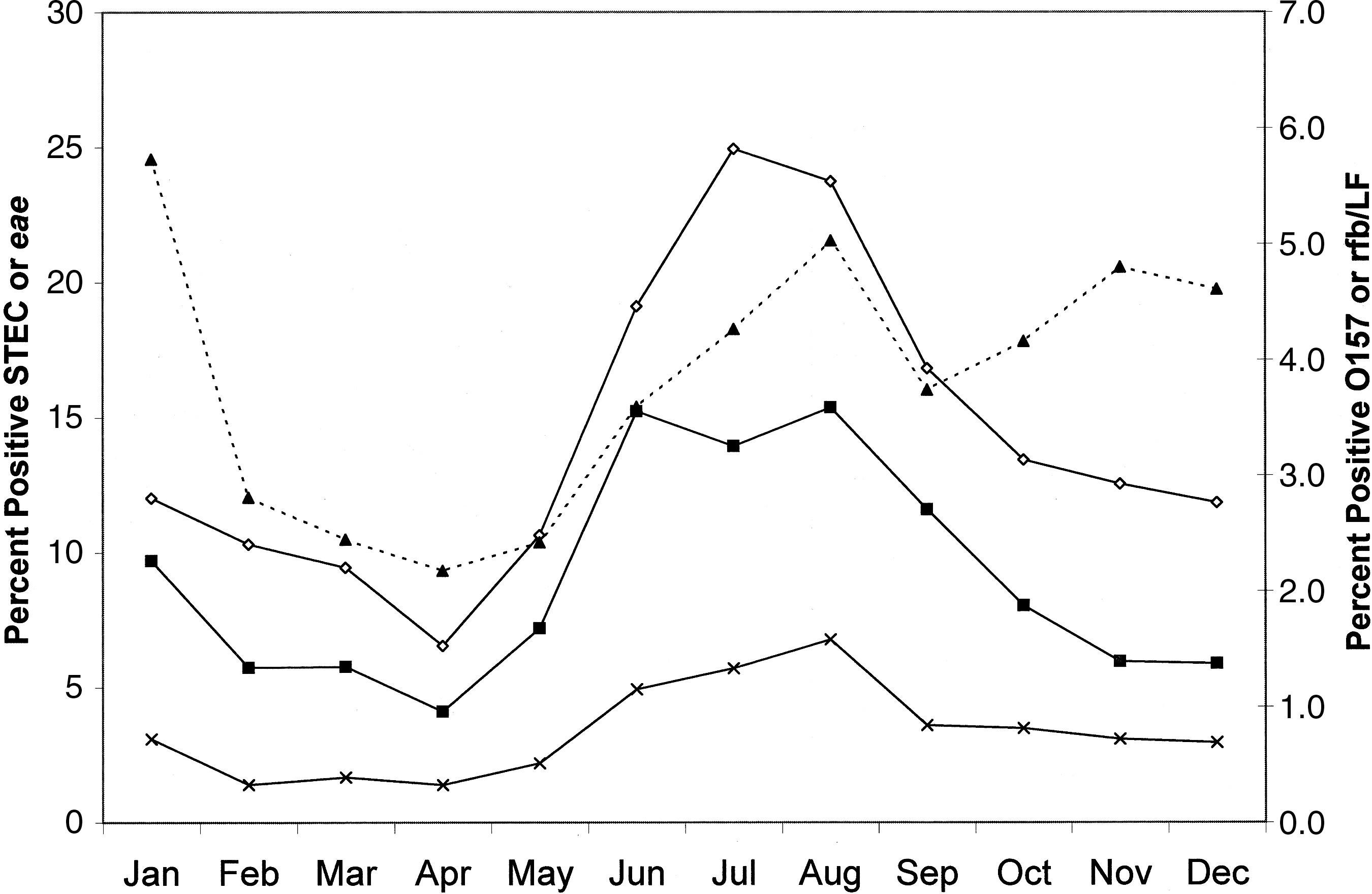
Frequency of STEC−, eae−, rfb−, and LF-positive tests and O157 screen-positive results throughout the calendar year. Each month is the average for the years 2005–2008 and for all meat product classes (⋄, STEC+; ▪, eae +; ▴, rfb + and/or LF+; X, O157-positive). LF, lateral flow.
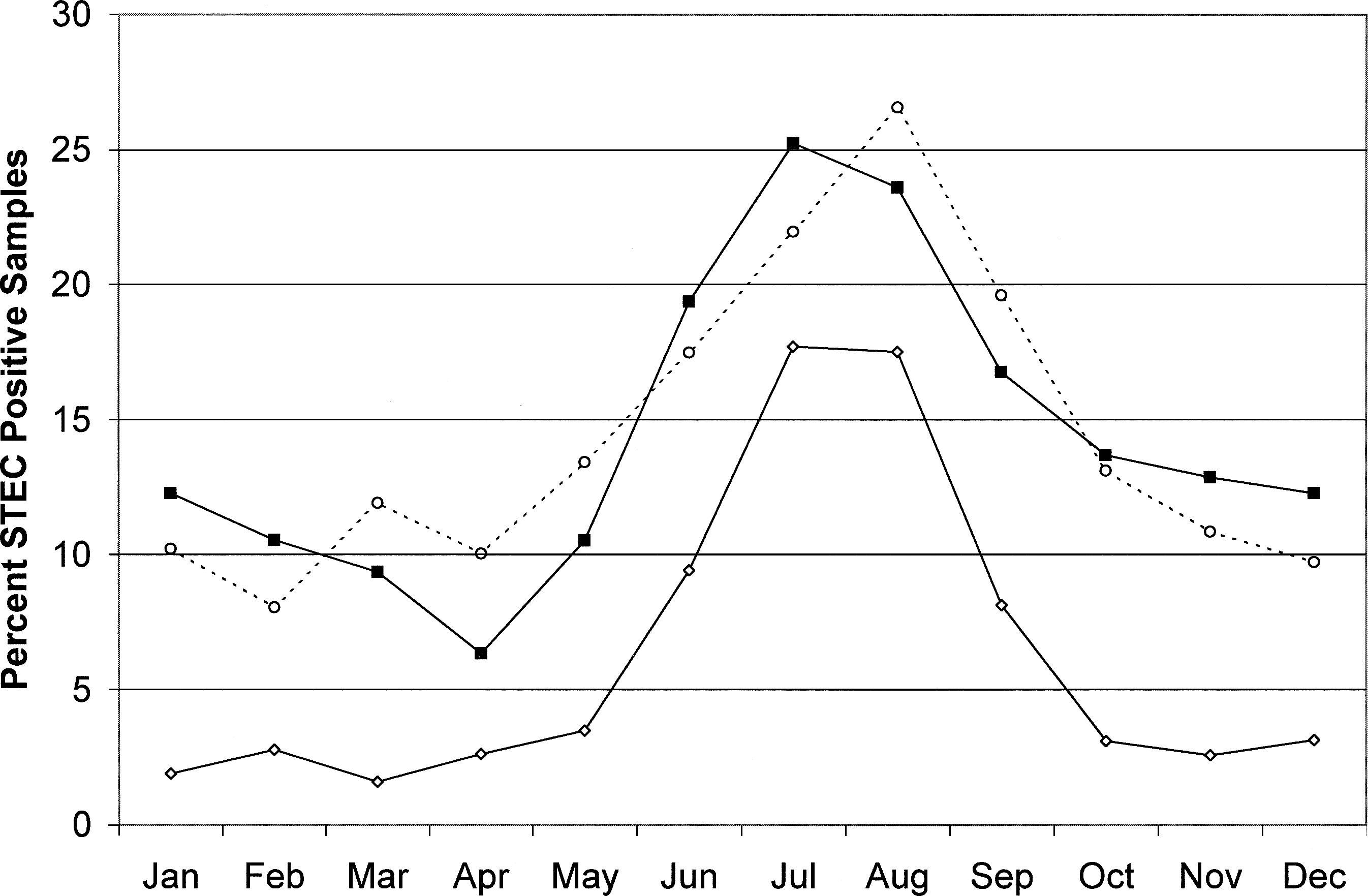
Fraction of STEC+ samples by month and product class. Each month is the average for the years 2005–2008 and for all pathogen classes. (⋄, ground beef; ▪, trim; ○, variety meats).
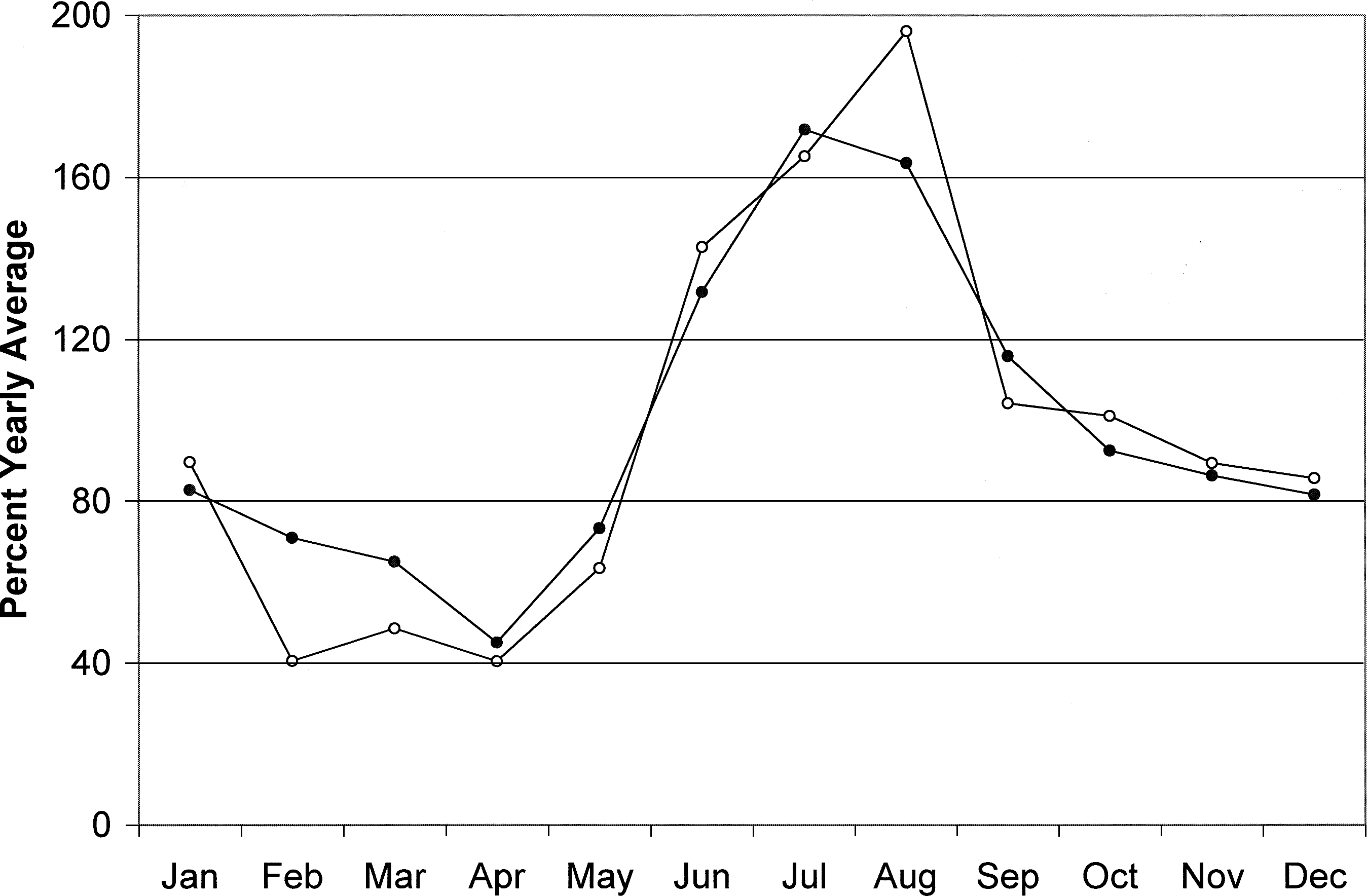
Distribution of STEC− and E. coli O157–positive samples throughout the year as a percentage of the yearly average. (•, STEC+; ○, E. coli O157).
G, ground beef; T, trim; V, variety meats.
Differences in signal frequencies between trim samples of different lean content
To determine if rates of sample contamination were dependent on the lean content, we calculated the percent of samples that were stx + for extra fat samples, variety meat samples, and trim samples for which we had fat content information (512,407, Table 6). Samples with higher lean contents were less likely to be stx +.
The fatty layer on the muscle surface often designated XF.
Values sharing the same superscript are significantly different (p≤0.05).
XF, extra fat.
Discussion
From 2005 through 2008, samples from 971,389 lots of ground beef, trim, and variety meats were examined by using a multiplex PCR to screen for the presence of the stx, eae, and rfb genes, two genes specific for the genus Salmonella, and by using a LF test for the O157 antigen of E. coli.
Salmonella and pathogenic E. coli can be isolated from cattle (Stephens et al., 2007) and may be found together on meat products that have not been successfully decontaminated. Therefore, as a measure of sanitary process failure, we have examined the association of stx+ and sal+ signals within the same sample. We also present the distribution of positive samples during the year and between years, and the influence of sample fat content on the presence of pathogens. As samples were collected over a 4-year period in up to as many as 20 meat-processing plants, comparisons between establishments may not be instructive because of the many uncontrollable variables involved such as the source of cattle, feedlot conditions, weather, and processing conditions such as line speed and sanitizing procedures.
During 2005–2008, this study found that 0.04%, 0.08%, 0.61%, and 0.24% of ground beef samples, respectively, were screen-positive for E. coli O157. FSIS, during this same period, indicated that rates for confirming E. coli O157 in ground beef samples were 0.17%, 0.19%, 0.24%, and 0.47%, respectively (Anonymous, 2008a, and other years). Although only the estimates of E. coli O157 contamination on raw ground beef for 2007 are significantly different (p<0.05), the rates are difficult to compare because the population of establishments, the sampling plans, and the laboratory testing methodologies are different. Therefore, it is difficult to get statistically valid estimates of the nation-wide frequency of contamination of this product by E. coli O157.
Under the Hazard Analysis Critical Control Point standards, manufacturers are allowed to have up to 7.5% of ground beef samples positive for Salmonella (Anonymous, 2007). Over the 4-year period reported here, 1.3% of the ground beef samples were screen-positive for Salmonella. The frequencies in 2007 and 2008 (1.45% and 1.79%, respectively) were statistically significantly higher (p<0.05) than in 2005 and 2006 (0.34% and 0.13%, respectively). For comparison, the FSIS Hazard Analysis Critical Control Point verification testing for “A” sets reported the following frequencies of positive samples for raw ground beef: 1.1%, 2.0%, 2.7%, and 2.4% in 2005, 2006, 2007, and 2008, respectively (Anonymous, 2008b). The comparison of these data by years is significantly different (p<0.05) with the same caveats with regard to making comparisons as were stated above for the E. coli O157 data.
The occurrence of Salmonella and E. coli O157 in samples is correlated. Using the frequencies of 1.6% and 0.81% for samples presumptively positive for Salmonella and E. coli O157, respectively (Table 2), the expected frequency of O157+–sal+ samples, if each pathogen occurs in samples randomly, would be 1.6%×0.81%=0.013%. However, the observed frequency of O157+–sal+ samples is 0.11%—about 8.5 times higher than if these bacterial species occurred independently of each other.
In this study, about 6.4% (10/157) of the Salmonella-positive raw ground beef samples in 2008 were screen-positive for E. coli O157. Therefore, Salmonella-positive samples represent an increased health risk and might be routinely considered for further testing for the presence of E. coli O157. As the observed level of Salmonella in trim is higher than E. coli O157 (12.6 and 0.56 cfu/g, respectively [Anonymous, 2008c]), the prevalence of E. coli O157 might be underestimated compared with that of Salmonella. However, presence of any pathogens in beef products could represent a failure of the processes designed to mitigate product contamination.
A test for the rfb gene and/or a LF test for the O157 antigen can be used to screen samples for E. coli O157. We examined test results to compare these assays. Samples that are rfb − LF+ could be due to the LF assay cross-reacting with non-O157 strains (Asper et al., 2007). The rfb + LF− samples could result from PCR assays generally requiring fewer cells to produce a positive reaction than immunological tests. The same proportion of rfb + LF− samples and rfb + LF+ samples were screen-positive for EHEC (25%), suggesting that the LF test does not significantly increase the detection rate of presumptively positive E. coli O157 samples. While the inclusion of the LF test only slightly increases the detection rate of E. coli O157 samples (Table 4), it does reduce the false-negative rate.
The contamination of beef products generally stems from unclean hides and intestinal contents. Although the contamination prevalence of beef product classes differ (Table 2), one might expect the association of virulence determinants within the same sample to be similar. We examined the relationship between the stx and eae test results and the presence of Salmonella in different products (Fig. 1). For each genotype, the percentage of sal+ samples was plotted. When both stx + and eae + are present, a ground beef sample is about three times more likely to be contaminated with Salmonella than are samples with stx + or eae + alone. This finding could be used to design more risk-based sampling protocols.
Positive test signals are more frequent in trim and variety meats than in ground beef (Table 2). While the entire ground beef sample is tested, primarily the surface of trim is analyzed. The exposed surfaces of meat (compared with the interior of muscle masses) are more likely to be contaminated during hide removal (Elder et al., 2000; McEvoy et al., 2003). As hides are often contaminated with E. coli O157 and Salmonella with levels above 104 cells per g (Arthur et al., 2009; Kalchayanand et al., 2009), when trim is ground, surface contamination is diluted as it becomes spread throughout the entire volume of the product, not just on the surface. Therefore, levels of bacteria on the surface of trim might be easier to detect than those present in ground product. This is supported by both the average number of signals per sample and the fraction of samples having at least one positive signal (Table 2). Even though the frequency of stx + and eae + samples from ground beef is lower than those from trim and variety meats, the association with Salmonella is higher (Fig. 1). A final consideration regarding the differences between the detection of contamination in ground beef compared with trim are the sampling plans for these products. In general, the sampling plan for ground beef is less robust than for trim; a sample of ground beef may consist of a small number of 375 g portions from a lot of 10,000 pounds (∼4500 kg) or more. Trim samples often consist of 60 surface samples often taken from smaller lots.
The prevalence of Shiga toxin–producing E. coli (stx +) on beef products can vary considerably (Hussein and Bollinger, 2005) and E coli O157 levels can be affected by a variety of conditions, including seasonality (Cray et al., 1998; Barkocy-Gallagher et al., 2003; Fegan et al., 2009; Rhoades et al., 2009). There are significant differences in the frequencies of stx + signals between years, especially for ground beef and less often for trim and variety meats (Fig. 3). This may merely be the result of lower levels of pathogens (and therefore less consistent detection) in ground beef than on the surface of trim or in variety meats. Due to lower numbers of positive ground beef samples, statistical tests on this class of product have less power. Our data show a consistent increase in the frequencies of positive samples during the summer months (Fig. 2). An obvious explanation is that higher temperatures result in higher bacterial levels in the environment, feed, and water because of the increased growth rate, but this relationship under actual processing conditions is difficult to rigorously demonstrate. It appears that E. coli O157 reaches a lower level early in the year and a higher level than STECs during the summer (Fig. 5). A possible explanation is that the lower levels of E. coli O157 during the colder months may be below the level of detection and yield negative results. When their levels increase during the summer, a greater percentage of the O157-containing samples are detected.
To determine if there was a relationship between the occurrence of pathogens, and the amount of fat in a product, we examined the frequency of stx + samples in trim, which was 50%–65% lean and compared it to trim with 70%–100% lean content (Table 5). While contamination of fattier cuts could occur during hide removal as they tend to be on the surface of the carcass (Elder et al., 2000; Samadpour et al., 2002; McEvoy et al., 2003), this does not appear to be the case for trim samples. However, there does appear to be a relationship between hide cleanliness as evaluated macroscopically and numbers of bacterial cells on carcass surfaces (McEvoy et al., 2000).
Conclusions
There is a higher frequency of positive samples during the warmer months, so mitigations and monitoring should reflect this fact. STECs and Salmonella are indicators of sanitation failure, and positive samples should be further tested for E. coli O157. Products higher in fat are more likely to be contaminated and should be tested more frequently than leaner ones. Further work in this area should address how processing variables, especially sanitation procedures, affect the frequency and levels of pathogens in beef products.
Footnotes
Acknowledgments
The authors thank Jarret Stopforth and Mohammad Koohmaraie for their comments on the article and Balasubrahmanyam Kottapalli for statistical consultation.
Disclosure Statement
No competing financial interests exist.