




Abstract
Objectives:
In summer 2009, the Utah Department of Health investigated an outbreak of Shiga-toxigenic Escherichia coli (STEC) O157:H7 (O157) illness associated with attendance at multiple rodeos.
Materials and Methods:
Patients were interviewed regarding exposures during the week before illness onset. A ground beef traceback investigation was performed. Ground beef samples from patient homes and a grocery store were tested for STEC O157. Rodeo managers were interviewed regarding food vendors present and cattle used at the rodeos. Environmental samples were collected from rodeo grounds. Two-enzyme pulsed-field gel electrophoresis (PFGE) and multiple-locus variable-number tandem repeat analysis (MLVA) were performed on isolates.
Results:
Fourteen patients with primary STEC O157 illness were reported in this outbreak. Isolates from all patients were indistinguishable by PFGE. Isolates from nine patients had identical MLVA patterns (main outbreak strain), and five had minor differences. Thirteen (93%) patients reported ground beef consumption during the week before illness onset. Results of the ground beef traceback investigation and ground beef sampling were negative. Of 12 primary patients asked specifically about rodeo attendance, all reported having attended a rodeo during the week before illness onset; four rodeos were mentioned. All four rodeos had used bulls from the same cattle supplier. An isolate of STEC O157 identified from a dirt sample collected from the bullpens of one of the attended rodeos was indistinguishable by PFGE and MLVA from the main outbreak strain.
Discussion:
Recommendations were provided to rodeo management to keep livestock and manure separate from rodeo attendees. This is the first reported STEC O157 outbreak associated with attendance at multiple rodeos. Public health officials should be aware of the potential for rodeo-associated STEC illness.
Introduction
S
Materials and Methods
Patients were interviewed regarding exposures during the week before illness. A ground beef traceback investigation was performed. Ground beef samples were collected and tested for STEC O157. Rodeo management and rodeo bull suppliers were interviewed regarding rodeo events and bull source. Rodeo management supplied lists of food vendors. Environmental samples were collected from the grounds of Rodeos D and B. Immunomagnetic separation was performed on meat and environmental samples. Two-enzyme pulsed-field gel electrophoresis (PFGE) (Ribot et al., 2006) and multiple-locus variable-number tandem repeat analysis (MLVA) (Hyytia-Trees et al., 2010) were performed on isolates.
Results
Seventeen patients with STEC O157 illness were reported in this outbreak; three represented secondary transmission. The 14 primary patients were residents of northern Utah (n=13) and southeast Idaho (n=1) and ranged in age from 19 months to 55 years (median, 15 years). Illness onset dates ranged from July 11 through August 27, 2009. Eight (57%) patients were female. One patient experienced HUS. No deaths were reported. All isolates were indistinguishable by PFGE. The PFGE pattern combination (EXHX01.0008/EXHA26.0569) was ninth most common nationally but had been detected in Utah only twice previously. Isolates from nine patients were indistinguishable by MLVA (main outbreak strain), and five had minor differences. All MLVA patterns were new to the national database.
During initial interviews, 13 (93%) of the 14 primary patients reported ground beef consumption during the week before illness onset. Hypothesis-generating interviews with three patients indicated that ground beef was the only food consumed by all three. The ground beef traceback investigation did not identify a common ground beef source. Six ground beef samples from patient homes and three from a grocery store tested negative for STEC O157.
During initial interviews, 8 (57%) of the 14 primary patients mentioned rodeo attendance. An association with rodeo attendance was not initially investigated because contaminated ground beef seemed a more likely vehicle and>1 rodeo was mentioned. However, after the negative ground beef investigation findings, rodeo-related hypotheses were reconsidered. Of the 12 patients who were able to be recontacted and were asked specifically about rodeos, 12 (100%) reported having attended a rodeo during the week before illness onset. Each reported having attended only one rodeo; four different rodeos were mentioned (Rodeos A–D). The number of patients who attended each rodeo is as follows: Rodeo A, one; Rodeo B, five; Rodeo C, five; Rodeo D, one (Fig. 1). No single activity or food consumed at rodeos was reported by a majority of patients. None reported animal contact; five mentioned direct contact with cattle manure (e.g., touching manure on fences or walking through manure) at rodeos. None reported contact with ruminants or ruminant manure outside the rodeo environment. Vendor lists revealed that no single food vendor was present at>2 rodeos. Interviews with rodeo management and cattle suppliers indicated that bulls used at all four rodeos were from the same supplier.
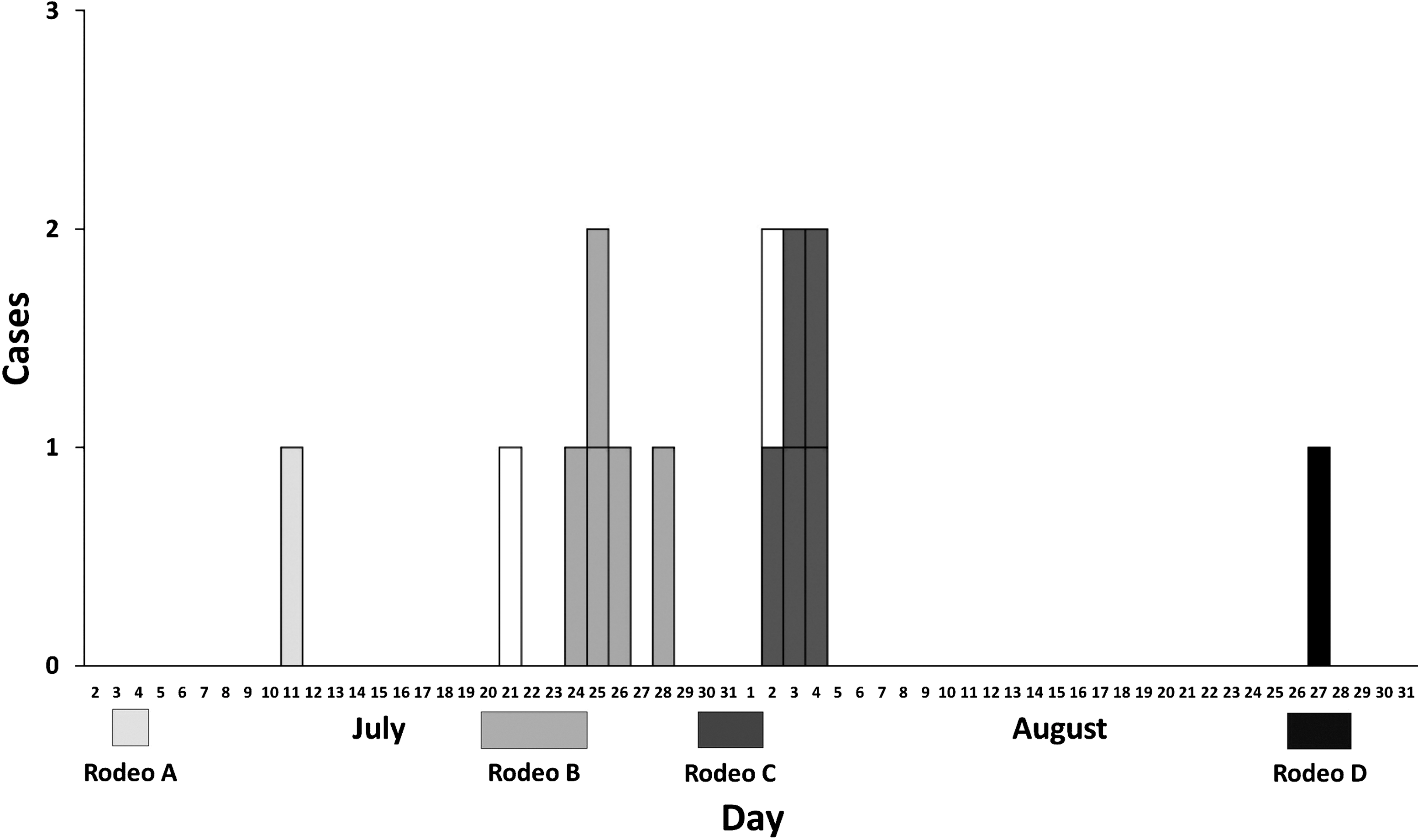
Shiga-toxigenic Escherichia coli O157:H7 cases (n=14) associated with attendance at multiple rodeos—Utah and Idaho, July–August 2009, by day of illness onset and rodeo attended (shade-coded). Shaded bars under graph indicate attended rodeo duration. Blank bars represent cases with unknown patient rodeo attendance history.
All 11 environmental samples collected from the grounds of Rodeo D tested negative for STEC O157. Of the environmental samples collected from the grounds of Rodeo B (90 days after the end of the rodeo), four samples tested negative, and one dirt sample from the pens where bulls were kept tested positive for STEC O157 indistinguishable by two-enzyme PFGE and MLVA from the main outbreak strain. No cattle events had occurred at the grounds of Rodeo B between the end of the rodeo and sample collection. Bulls from the supplier were unavailable for testing.
Discussion
Evidence strongly suggesting that this outbreak was associated with rodeo attendance includes the findings that all recontacted patients attended a rodeo during the week before illness and that STEC O157 isolated from dirt collected from the bullpens of an attended rodeo was indistinguishable from the outbreak strain (with a PFGE pattern combination rare in Utah and a previously undetected MLVA pattern). Contact with cattle manure at the rodeo was the likely transmission route; the findings that bulls used at each rodeo shared a common source and that several patients mentioned direct contact with cattle manure at the rodeo provides support for this hypothesis. Sampling of bulls from the supplier would have been ideal, but the results would likely not have changed the investigation outcome.
An STEC O157 outbreak linked to rodeo attendance has been reported previously (Durso et al., 2005). However, to our knowledge, an STEC O157 outbreak associated with attendance at multiple rodeos has not been reported. STEC O157 was isolated from the rodeo grounds 90 days after the end of the event. STEC O157 reportedly has been recovered from rodeo grounds 46 days after the event (Durso et al., 2005) and from fairgrounds ∼1 year after the presence of livestock (Keen et al., 2006).
Recommendations provided to rodeo management included: (1) separate animals and manure from attendees and food; (2) provide hand-washing facilities for attendees; (3) educate attendees regarding the importance of avoiding contact with animals and manure in the rodeo environment; and (4) remove manure from public areas after each day's events (CDC, 2009b). Managers of Rodeos A and B reported making changes during the 2010 rodeo season consistent with recommendations. Managers of all four rodeos reported having obtained cattle in 2010 from the same supplier used in 2009. Of the 42 Utah STEC cases during June–September 2010, only one reported recent attendance at a rodeo (Rodeo D).
Association with rodeo attendance was determined after thorough investigation of an outbreak recognized by PFGE. Sporadic cases might not be as thoroughly investigated. Visiting cattle farms is a risk factor for sporadic STEC O157 illness (Kassenborg et al., 2004). Sporadic STEC illness associated with attendance at a rodeo where cattle are present might occur more frequently than is recognized. Public health officials should be aware of the potential for STEC illness associated with rodeo attendance.
Footnotes
Acknowledgments
We are grateful to the following for their assistance with the investigation and laboratory testing: Utah local health department staff, including Bear River, Davis County, Salt Lake Valley, Tooele, and Weber-Morgan Health Departments; Melissa Stevens Dimond, Utah Department of Health; James M. Colborn, Idaho Department of Health and Welfare; Patsy L. White, Food Safety and Inspection Service, United States Department of Agriculture; and Patricia C. LaFon, National Center for Emerging and Zoonotic Infectious Diseases, Centers for Disease Control and Prevention.
Disclaimer
The findings and conclusions in this report are those of the authors and do not necessarily represent the official position of the Centers for Disease Control and Prevention.
Disclosure Statement
No competing financial interests exist.