




Abstract
The aim of the current work was to assess the influence of two temperatures, 4°C and 24°C, on pH and water activity and their association with Brucella melitensis survival during the traditional manufacture of ripened goat cheese. Raw milk from a brucellosis-free goat herd was used for the manufacture of ripened cheese. The cheese was inoculated with 5×10⁹ of the B. melitensis 16M strain during the tempering stage. The cheeses were matured for 5, 20, and 50 days at both temperatures. To assess Brucella survival, the pH and a w were recorded at each stage of the process (curd cutting, draining whey, immersion in brine, ripening I, ripening II, and ripening III). B. melitensis was detected at ripening stage III (1×10³ colony-forming unit [CFU]/mL) from cheeses matured at 4°C with a pH of 5.0 and a w of 0.90, and at a ripening stage II (1×10⁴ CFU/mL) from cheeses ripened at 24°C with a pH of 4.0 and a w of 0.89. The remaining stages were free from the inoculated pathogen. In addition, viable B. melitensis was recovered in significant amounts (1–2×10⁶ CFU/mL) from the whey fractions of both types of cheese ripened at 24°C and 4°C. These results revealed the effects of high temperature (24°C vs. 4°C) on the low pH (4) and a w (0.89) that appeared to be associated with the suppression of B. melitensis at the early stages of cheese ripening. In the ripened goat cheeses, B. melitensis survived under a precise combination of temperature during maturation, ripening time, and a w in the manufacturing process.
Introduction
Globally, Brucella melitensis is responsible for 70% of human brucellosis cases (Doganay and Aygen, 2003). In Mexico, >35% of cow's milk and 85% of goat's milk is consumed unpasteurized under poor sanitary conditions. In this country, brucellosis is one of the most serious bacterial diseases; in 2010, the health ministry reported 2599 cases of human brucellosis (Luna-Martinez and Mejia-Teran, 2002; Solorio-Rivera et al., 2007; Dirección General de Epidemiología, 2010). In the United States, brucellosis is a sporadic disease with a national rate of 0.02/100 000, but in the southern border region, its rate has reached 0.18/100 000, nine times the national rate, and is associated with the consumption of Mexican cheese (Thapar and Young, 1986; Doyle and Bryan, 2000). Diverse factors influence the pathogen persistence in cheese, such as temperature, acidity, salinity, water activity (a w), microbial load, variety, and a number of other microorganisms (Bourgeois and Larpent, 1995; ICMSF, 1996). Little is known about how these factors interact to affect the survival of Brucella in goat cheese.
Water activity describes the intensity with which water associates with various nonaqueous constituents; it is defined as the vapor pressure generated by the water present in a hygroscopic product, for example, pure water has an a w of one. Most microorganisms display a maximal tolerance to low a w values at optimal growth temperatures. Moreover, in aerobic medium, aerobic microorganisms tend to endure lower a w values than under anaerobic conditions (Scholz, 1997). The survival of microorganisms in dairy products is affected by a w decrement (0.92–0.65), which reduces the bacteria survival rates dramatically as they approach the minimum growth limit.
Brucella is known to possess constitutive mechanisms for osmoregulation (Hernández-Castro et al., 2003) that are active during exposure to lethal acid conditions. High temperatures (>20°C) accelerate Brucella death at lethal pH or a w compared with refrigeration temperatures (Shadbolt et al., 2001). It has been proposed that the amount of time ripening affects B. melitensis survival in cheese (Clasessens and Ring, 1996; Öztürk and Nazli, 1996). However, it is not yet clear whether the combination of a w and pH affects B. melitensis viability during the manufacture of goat cheese. The aim of the current work was to determine the effect of two temperatures, 4°C and 24°C, on a w and pH, and their association with B. melitensis survival in ripened goat cheese manufactured with raw milk.
Materials and Methods
Bacterial strain and media
The B. melitensis 16M reference strain (ATCC 23456) was grown in selective brucella agar medium (Oxoid, Hampshire, England) or in brucella broth at 37°C with orbital shaking. Bacterial counting was done by serial dilutions and plated on Farrell agar to determine the number of colony-forming units (CFUs). The inoculated cheese was processed in a biosafety type III laboratory.
Production of ripened goat cheese
A total of 600 mL of milk from a brucellosis-free goat herd were inoculated with B. melitensis 16M (5×10⁹ CFU/mL) during the tempering stage and then divided into two cheese groups. The first group of three cheeses was ripened at 4°C and maintained for the ripening periods of 5, 20, and 50 days. The second group of three cheeses was ripened at 24°C and also maintained for the ripening periods of 5, 20, and 50 days. The pH and a w were measured at the beginning, at each maturation stage, and at the end of ripening.
The manufacture of ripened cheeses was divided into eight stages according to the methodology described by Scholz (1997) for traditional goat cheese. These eight stages are described as follows: (A) milk tempering at 24°C for 24 h, (B) addition of commercial starter cultures Lactococcus lactis lactis and Lactococcus cremoris, (C) cutting curd (30 min), (D) draining of whey (18 h), (E) immersion in brine (30 min), (F) ripening I (first 5 days), (G) ripening II (from days 6 to 20), and (H) ripening III (from days 21 to 50). The ripening stages (ripening I, II, and III) were performed at 4°C and at 24°C (Fig. 1). The cheeses were elaborated in three independent experiments.
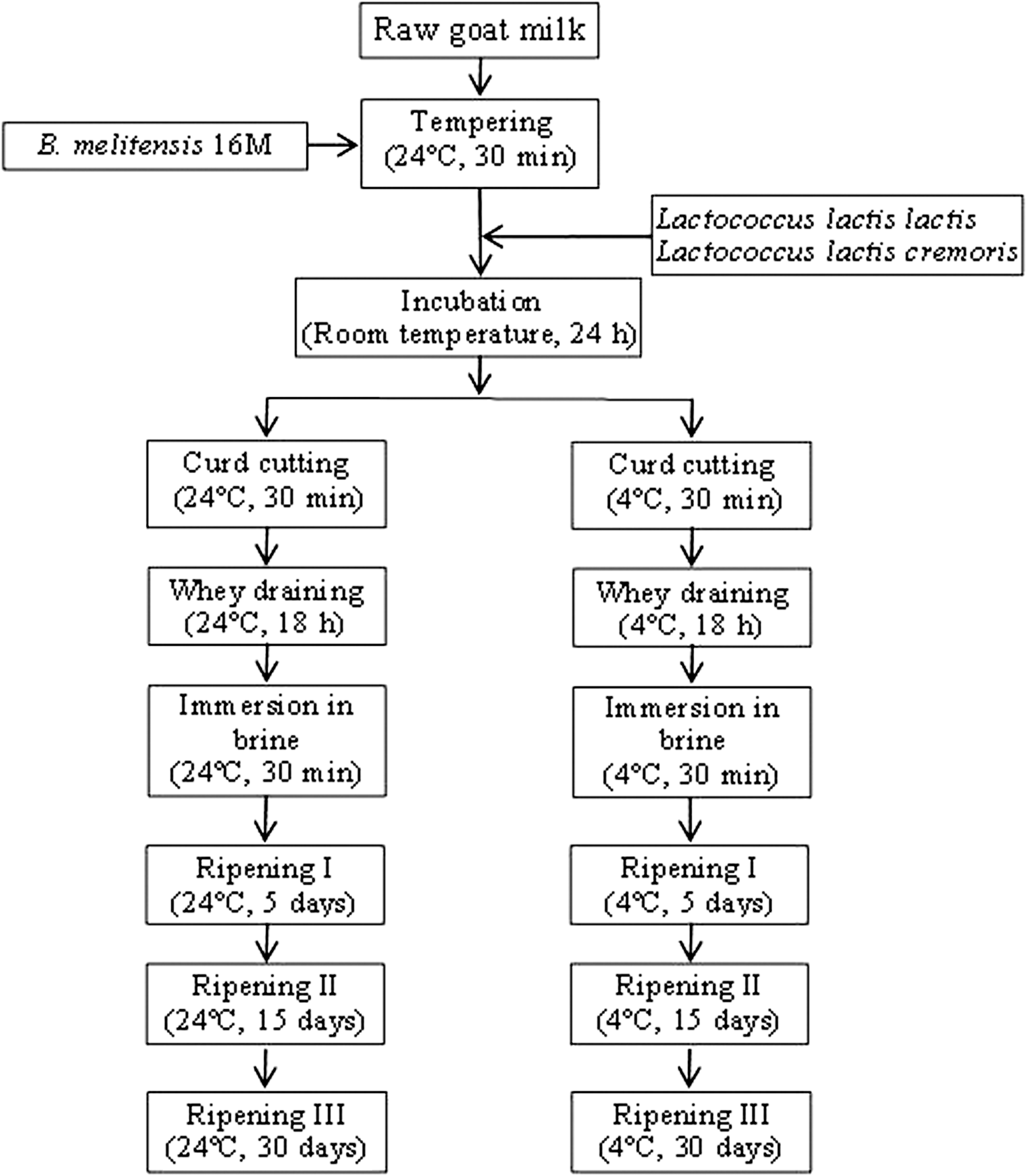
Flow scheme of the manufacturing process of ripened goat cheese. Time of manufacturing steps and temperature through the process are indicated.
Determination of Brucella in cheese and cheese whey
The isolation and identification of B. melitensis was performed by standard microbiology procedures (Alton et al., 1975; De la Rosa, 2000). On sampling days, cheese (10 g) or whey (10 mL) were sampled under aseptic conditions and transferred to a sterile container, and 90 mL of a phosphate-buffered solution was added before maceration. Logarithmic dilutions (10−1–10−8) were made and plated onto Farrell medium (Oxoid). Finally, the plates were incubated at 37°C for 3 days.
pH and a w determination
The pH was determined in each sample from the manufacturing stages by using an Orion benchtop pH/temperature meter 410A (Thermo, Beverly, MA). The water activity was determined by using an Aqualab CX-2 meter (Decagon, Washington, DC). All experiments were conducted in three independent replicates.
Statistical analysis
The bacterial counts were converted to log10 CFU/mL. The data were subjected to Spearman's correlation test, and points values were expressed as average±standard deviation. p-Values of <0.05 were considered statistically significant. The statistical analyses of each treatment were performed by using Prism3, version 3.0 (GraphPad Software, San Diego, CA).
Results
Ripening time influence on B. melitensis viability
The B. melitensis survival slightly declined during cheese manufacture under both temperatures (24°C and 4°C). The cheese that matured at 4°C had a load of 1×10³ CFU/mL in ripening stage III, and the cheese that matured at 24°C had a load of 1×10⁴ CFU/mL in ripening stage II (Figs. 2 and 3). A statistically significant correlation was observed between B. melitensis viability at 4°C and B. melitensis viability at 24°C (p<0.01). B. melitensis was found in the whey from cheese ripened at both temperatures at the curd-cutting stage (2×10⁶ CFU/mL) and at the draining whey stage (1×10⁶ CFU/mL).
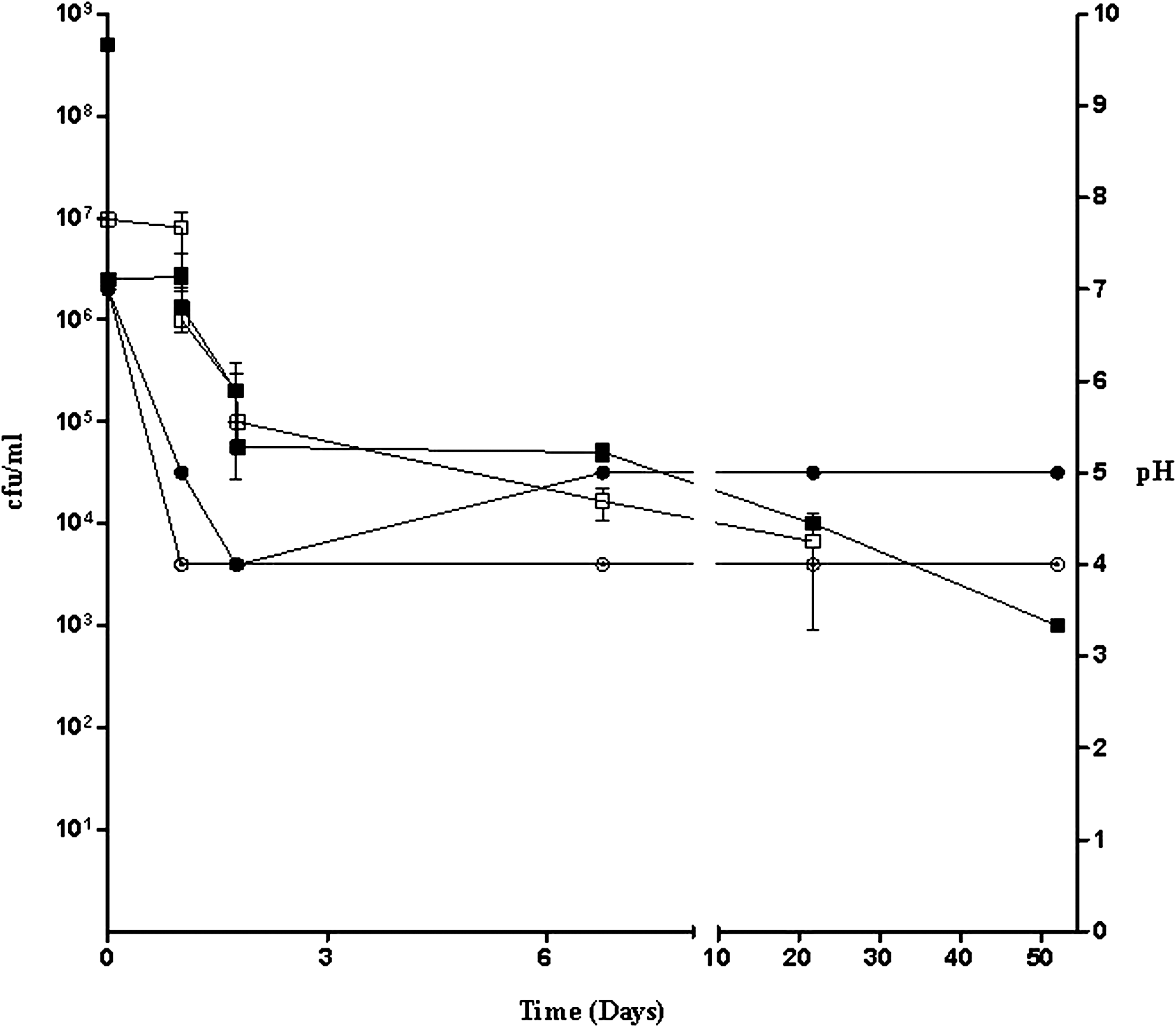
pH and Brucella melitensis survival determinations during ripening goat cheese manufacture using raw milk at 24°C and 4°C. Each point represents steps of the ripened goat cheese process. The last three points represent the stages I-II-III of ripening (•) pH at 4°C; (O) pH at 24°C; (▪) B. melitensis survival at 4°C; (□) B. melitensis survival at 24°C. Data represents means±standard deviation (SD) of three independent experiments.
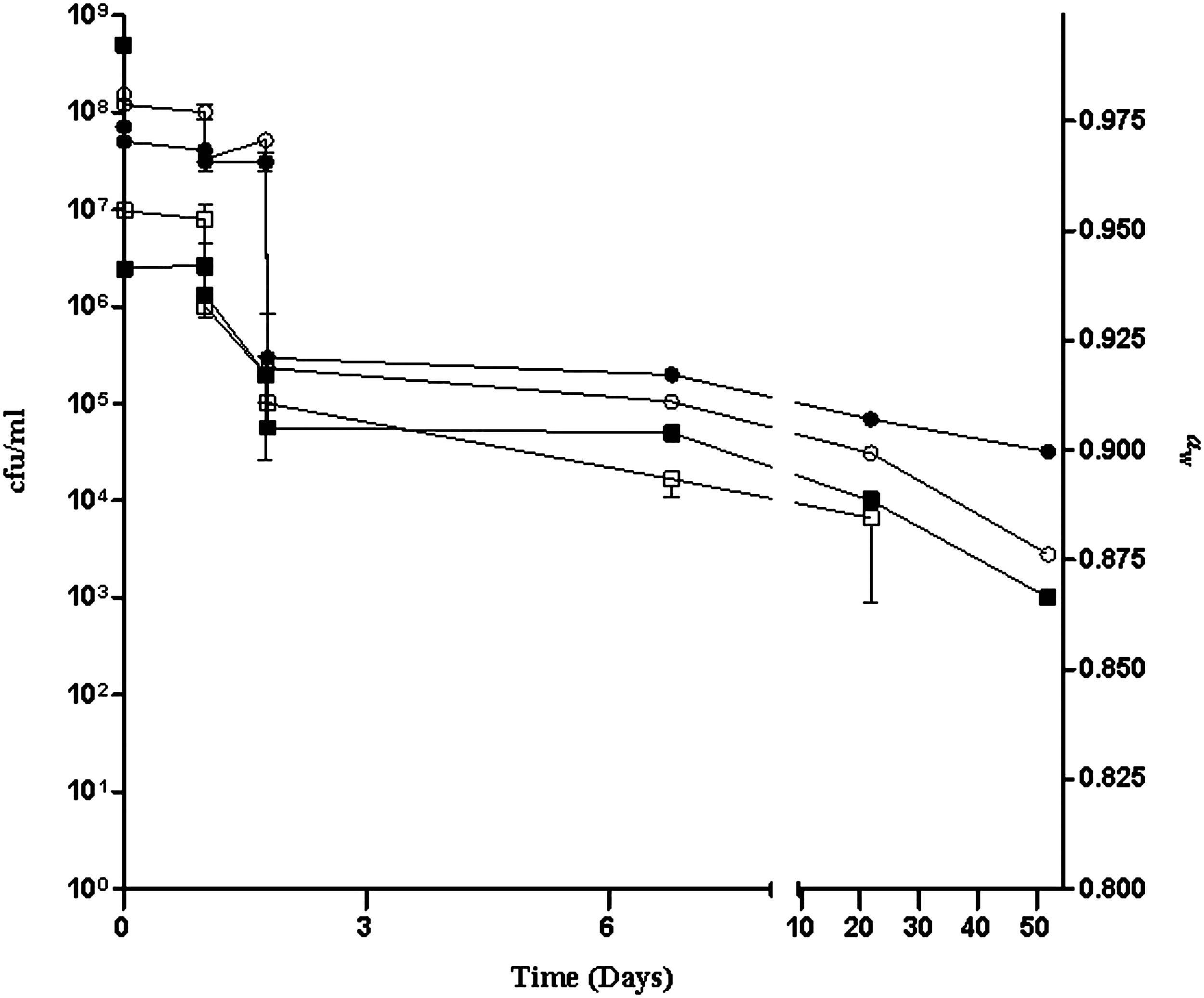
Water activity and B. melitensis survival determinations during ripening goat cheese manufacture using raw milk at 24°C and 4°C. Each point represents steps of the ripened goat cheese process. The last three points represent the stages I-II-III of ripening. (•) a w determination at 4°C; (O) a w determination at 24°C; (▪) B. melitensis survival at 4°C; (□) B. melitensis survival at 24°C. Data represents means±SD of three independent experiments.
a w association with B. melitensis survival
The water activity was measured at each stage. The initial value of a w in the milk used for cheese manufacture was 0.98. The a w values slightly decreased along the process, and at the brine immersion state, the a w value abruptly decreased from 0.96 to 0.91. In the ripening stages of the cheese matured at 4°C, the a w values were maintained (0.91 to 0.90). In the cheese matured at 24°C, the a w value decreased from 0.91 to 0.87 (Fig. 2). The B. melitensis in cheese matured at 24°C was detected at ripening stage II, during which the a w value was 0.89. No B. melitensis were recovered from ripening stage III with a w values of 0.87. In contrast, the cheese matured at 4°C contained viable B. melitensis in all stages of ripening with a w values close to 0.90. Therefore, the a w decrement appears to have influenced the B. melitensis viability at 24°C (p<0.01).
pH association with B. melitensis survival
The initial pH of the milk used for cheese manufacture was 7.0, which remained constant until the starter cultures of L. lactis lactis and L. cremoris were added. After inoculation, the pH decreased dramatically to 4.0, and a low pH remained during the ripening stages. In cheese ripened at 24°C, the pH value of 4.0 remained constant for the 30-day ripening period. In cheese ripened at 4°C, pH values (4.0 to 5.0) increased at the beginning of the ripening stages. B. melitensis was detected in cheese matured at 24°C in ripening stage II at a pH of 4.0, whereas B. melitensis was not found in ripening stage III (Figs. 2 and 3). In contrast, B. melitensis was detected at all stages of cheese ripened at 4°C with a pH of 5.0 (Fig. 3). Statistical significance was found between the pH and B. melitensis survival at 24°C (p>0.05), compared with the survival at 4°C.
Discussion
Changes in the pH affect Brucella abortus survival in milk and dairy products (El-Daher et al., 1990). When B. abortus is experimentally inoculated during yogurt manufacture, it is able to survive up to 10 days when stored at 4°C at the end of the fermentation period (pH 4) (Zúñiga-Estrada et al., 2005). Moreover, if Brucella spp. is inoculated into raw milk, it can survive the processing of “Mexican-style” white soft cheese for 21 days. During this process, Brucella may be inhibited but not eliminated (Diaz-Cinco et al., 2000).
In México, as in other countries of Latin America, the quality of cheese is closely associated with the production region and its deep-rooted traditions (Cervantes et al., 2008). The cheese ripening process seems to reduce B. melitensis content. However, Clasessens and Ring (1996) reported that B. melitensis survives up to 90 days in ripened cheese made with raw milk from sheep and goats. Additionally, Öztürk and Nazli (1996) observed that inoculated B. melitensis strain Rev1 was viable until day 21 of ripening in cheeses made with raw milk from sheep and cows. They concluded that under this manufacturing process, Brucella elimination cannot be guaranteed. Plommet et al. (1988) suggested that B. abortus cells, which have multiplied in vivo and were excreted in milk along with antibodies and inflammatory cells, may be more susceptible to inactivation during the cheese making process than laboratory-grown Brucella cells.
According to our results, during the traditional cheese manufacture process, B. melitensis has the ability to survive low temperatures and sublethal levels of pH (5) and a w (0.90) (Figs. 2 and 3). On the contrary, at 24°C, the synergy between low a w, low pH, and ripening periods of at least 20 days appeared sufficient to ensure Brucella-free products. B. melitensis appears not to multiply in cheese, but the higher the water content (water activity) in cheese, the longer the survival time that can be expected. The influence of a w on B. melitensis survival seems to be more profound at high temperatures and long ripening periods. These observations are consistent with the FDA and other national guidelines for cheese manufacture (Secretaria de Salud, 1994; FDA, 2005).
A remarkable fact, never previously reported, is that we found B. melitensis in whey at an amount (1×10⁶ CFU/mL), previously reported as the equivalent to the dose needed to infect a person (Corbel, 2006). Undoubtedly, these data revealed a potential menace for the personnel involved in cheese production, as cheese whey is not subjected to any thermal treatment or biosafety measure (Kaoud et al., 2010).
Acidic pH is an environmental stress factor frequently faced by Brucella during its life cycle in the extracellular environment and during cell invasion (Hernández-Castro et al., 2003). Within the phagosome, Brucella suis endures low pH values as low as 4 and 4.5 (Porter et al., 1999). In milk, Brucella should adapt to pH values ranging from neutral to those reached in fermented dairy products, such as cheese (pH 4–6) and yogurt (pH 3–4). Low pH should be endured starting the first day of production and through the ripening periods, in combination sublethal a w levels, thus providing an environment in which Brucella should employ adaptation mechanisms to survive.
The long B. melitensis survival in our cheese model is consistent with the findings of Torres-Llanez et al. (2006), who determined that these bacteria can endure harsh conditions in “Mexican-style” fresh cheese, thereby placing Brucella among the most tenacious organisms.
These findings highlight that cheese produced according to traditional manufacture with raw milk contaminated with Brucella possibly contains bacteria at levels capable of causing illness by the time the cheese reaches the consumer. The isolation of Brucella from ripened goat cheese in this study confirms the potential health risk for the urban and rural population, which should be considered to promote safer practices.
Footnotes
Acknowledgments
This work was financed by project CONACYT–SEP 2003–C02-45271. K.Y. Méndez-González was supported by a fellowship from CONACYT (No.189569) and DGEP-UNAM. The authors thank Isabel Guerrero Legarreta and Carolina Castro Hernández for their support and technical assistance.
Disclosure Statement
No competing financial interests exist.