




Abstract
Salmonella shedding often increases in pigs after transportation and/or lairage. We previously showed that administering anti-Salmonella bacteriophages to pigs by gavage significantly reduced Salmonella colonization when the pigs were exposed to a Salmonella-contaminated holding pen. Here we tested whether a microencapsulated phage cocktail would remain effective if the treatment was administered to pigs in the feed. Pigs (n=21) were randomly placed into three groups: feed, gavage, and control. The feed group was direct-fed a microencapsulated phage cocktail daily for 5 days. On the fifth day, the gavage group received the same phage cocktail by gavage, whereas control pigs received a mock treatment containing no phage. All pigs were then orally challenged with Salmonella enterica serovar Typhimurium. Fecal swab samples were collected every 2 h. At 6 h postchallenge, all pigs were euthanized, and ileal and cecal contents and mesenteric lymph nodes were collected and analyzed for the challenge organism. Pigs in the feed group were less likely to shed Salmonella Typhimurium at 2 h (38.1%) and 4 h (42.9%) postchallenge than pigs in both the gavage (2 h: 71.4%; 4 h: 81.1%) and control (2 h: 71.4%; 4 h: 85.7%) groups (p<0.05). Likewise, concentrations of Salmonella Typhimurium in ileal (2.0 log10 colony forming units [CFU]/mL [contents]) and cecal (2.7 log10 CFU/mL) contents from feed pigs were lower than ileal (3.0 log10 CFU/mL) and cecal (3.7 log10 CFU/mL) contents from control pigs. High concentrations of anti-Salmonella phages were detected in ileal and cecal contents from both feed and gavage pigs (feed ileal: 1.4×10⁶; feed cecal 8.5×10⁶; gavage ileal 2.0×10⁴; gavage cecal: 2.2×10³). It is concluded that direct feeding of microencapsulated phages is a practical and effective means of reducing Salmonella colonization and shedding in pigs.
Introduction
While there are similar studies in ruminants (Barrow et al., 1998; Callaway et al., 2008), fewer groups have examined the efficacy of phage therapy in swine production. Smith and Huggins (1993) initially demonstrated that phage therapy reduced enteric colonization and associated mortality in small pigs challenged with pathogenic E. coli. Lee and Harris (2001) challenged young pigs with Salmonella Typhimurium and administered a single broad-spectrum anti-Salmonella phage (Felix O1) and found that phage treatment significantly reduced Salmonella concentrations in several tissues (e.g., cecum, tonsils). In a more recent study, Callaway et al. (2011) found that administration of a phage cocktail to weaned pigs significantly reduced Salmonella colonization of the rectum in Salmonella-challenged pigs. Likewise, Gebru et al. (2010) reported that administration of phages to pigs reduced the negative effect of a Salmonella challenge on average daily gain and average daily feed intake.
In pigs, Salmonella shedding increases just before processing after transport and lairage (Larsen et al., 2004; Hurd et al., 2002). Such increases are due to stress-induced reactivation of older infections or rapid infections from contaminated postfarm environments, such as transport trailers and holding pens (Isaacson et al., 1999; Larsen et al., 2004; Rostagno et al., 2003; Hurd et al., 2002). Increases in shedding just before processing are problematic as they increase the amount of Salmonella entering the processor and the possibility of contaminated products.
We identified phage therapy as a means to prevent increases in Salmonella shedding before processing, and in previous studies we found that administration of an anti-Salmonella bacteriophage cocktail to market-weight pigs prior to their entry into a Salmonella-contaminated holding pen reduced Salmonella colonization. We have also shown that the phages in the cocktail are lytic against several Salmonella serovars and can be microencapsulated to protect them from the gastric environment of the stomach. This helps to ensure that high concentrations of phages reach the actual sites of infection when administered orally (Wall et al., 2010; Zhang et al., 2010). The ability to treat multiple animals simultaneously, however, will be necessary to effectively transfer this technology to the livestock industry. Toward this end, we aimed to test whether our phage cocktail remained effective if administered to pigs through the feed.
Materials and Methods
Bacterial and phage strains
Salmonella enterica serovar Typhimurium γ4232 (Salmonella Typhimurium) was used for the challenge experiments. This strain was originally isolated from diseased pigs and contains a chromosomally located nalidixic acid resistance selection marker (Ebner and Mathew 2000; Wall et al., 2010). The phage cocktail contained 14 wild-type phages that were isolated from 14 wastewater treatment plants as previously described (Wall et al., 2010). Before administration, phages were microencapsulated using a previously published protocol (Zhang et al., 2010).
Live animal trials
All animal experiments were conducted under the approval of the Purdue University Animal Care and Use Committee. Twenty-one small pigs (∼15 kg of live weight) in each of three replicates were randomly separated into three treatment groups. Each pig was housed in an individual pen. Fecal swab samples from each pig were screened to ensure that no pigs were actively shedding Salmonella. One group (feed) was administered the microencapsulated phage cocktail via feed daily (5.0×10¹¹ plaque-forming units [PFU] per day) for 5 days. On the fifth day all of the pigs were challenged with 5 mL of 109 CFU/mL Salmonella Typhimurium. A second group (gavage) of seven pigs then received 60 mL of the phage cocktail (5.0×10¹¹ PFU
Statistical analysis
Bacterial concentrations (CFU/mL of sample) were converted to logarithmic scale (log10 CFU/mL of sample) before statistical analysis. Bacterial concentrations were analyzed using the mixed models procedure of SAS (SAS Institute Inc., Cary, NC). LSMeans were compared using a two-sample t-test. Statistical inferences were based on a p level of <0.05.
Results
Fecal shedding
Fecal swab samples were collected from all pigs at 0, 2, 4, and 6 h postchallenge (Table 1). All fecal swab samples from pigs in all groups were negative for the challenge organism at 0 h (i.e., prechallenge). By 2 h postchallenge, the challenge organism was detected in 71.4% of fecal swab samples from pigs in both the gavage and control groups compared to fecal swab samples from pigs receiving the phage in-feed (38.1%; p<0.05). At 4 h postchallenge, 42.9% of pigs in the feed group shed the challenge organism, which was significantly less than the number of pigs shedding the challenge organism in both the gavage and control group (81.1% and 85.7%, respectively; p<0.05). By 6 h postchallenge, 100.0% of pigs in each group shed the challenge organism in the feces.
All pigs were challenged with Salmonella Typhimurium, and fecal swab samples were gathered every 2 h for 6 h. Numbers represent the percentage of pigs with Salmonella Typhimurium-positive fecal swab samples at 0, 2, 4, and 6 h. Numbers with different superscripts are statistically different at p<0.05.
Ileal and cecal contents, and mesenteric lymph node
All pigs were euthanized at 6 h postchallenge, and ileal and cecal contents, and mesenteric lymph node were collected. The concentration of the challenge organism was determined in both ileal and cecal samples. Salmonella Typhimurium concentrations in ileal contents from both the feed group (2.0 log10 CFU/mL) and the gavage group (1.0 log10 CFU/mL) were significantly lower than Salmonella Typhimurium concentrations in ileal contents from control pigs (3.0 log10 CFU/mL; p<0.05; standard error [SE]=0.37; Fig. 1). Significantly higher percentages of pigs in both the feed group (42.8%) and the gavage group (71.4%) had no detectable Salmonella Typhimurium (detection limit: 102 CFU/mL) in the ileum compared to pigs in the control group (19.0%; p<0.05; Fig. 1).
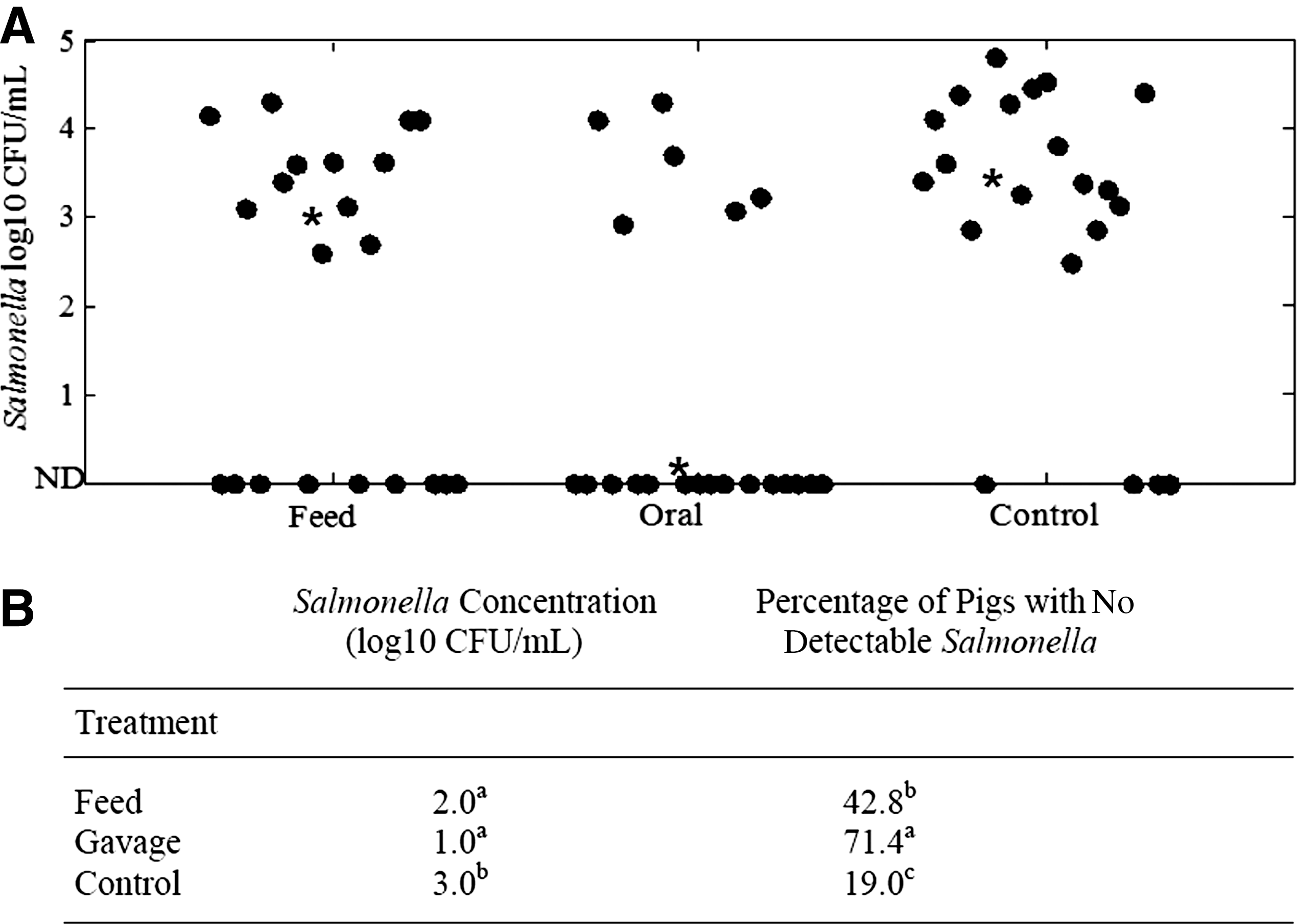
Concentration of Salmonella Typhimurium in the ileal contents of pigs. Twenty-one pigs (in three replicates; n=63) were co-administered Salmonella Typhimurium and anti-Salmonella phages in the feed or by gavage. Control pigs received a Salmonella Typhimurium challenge, but no phage. Ileal contents were collected at 6 h postchallenge.
Salmonella Typhimurium concentrations in cecal contents from the feed group (2.7 log10 CFU/mL) were lower than Salmonella Typhimurium concentrations in cecal contents from control pigs (3.7 log10 CFU/mL; p<0.1; SE=0.38; Fig. 2). There were no significant differences in Salmonella Typhimurium concentrations of cecal contents of pigs in the gavage group (3.3 log10 CFU/mL; Fig. 2) compared to Salmonella Typhimurium concentrations in the cecal contents of pigs from either the feed or control group. Higher percentages of pigs in both the feed group (28.5%) and the gavage group (14.2%) had no detectable Salmonella Typhimurium (detection limit: 102 CFU/mL) in their cecal contents compared to pigs in the control group (9.5%; Fig. 2), but these values were not significantly different (p>0.05). Lymph node samples from each pig in each group were positive for the challenge organism at necropsy.

Concentration of Salmonella Typhimurium in the cecal contents of pigs. Twenty-one pigs (in three replicates; n=63) were co-administered Salmonella Typhimurium and anti-Salmonella phages in the feed or by gavage. Control pigs received a Salmonella Typhimurium challenge but no phage. Cecal contents were collected at 6 h postchallenge.
Phage concentrations in ileum and cecum
The cecal and ileal contents were analyzed for concentrations of the anti-Salmonella phages. Concentrations of 1.4×10⁶ PFU/mL and 8.5×10⁶ PFU/mL were detected in the ileum and cecum, respectively, of pigs in the feed group. Concentrations of 2.0×10⁴ PFU/mL and 2.2×10³ PFU/mL were detected in the ileum and cecum, respectively, of pigs in the gavage group. Concentrations of 2.2×10³ PFU/mL and 3.8×10³ PFU/mL were detected in the ileum and cecum, respectively, of pigs in the control group (Table 2).
Ileum and cecum contents were collected from all pigs at 6 h postchallenge with Salmonella Typhimurium. Anti-Salmonella phages were enumerated in each sample by standard plaque assay.
PFU, plaque-forming units.
Discussion
In the United States, pigs are transported and held in lairage for an average of 6–8 h before processing (Scanga et al., 2003). Previous studies have indentified this period as a critical point in the dissemination of Salmonella in swine. Hurd et al. (2002) reported a sevenfold increase in the number of pigs shedding Salmonella after transportation to the abattoir. Other groups have shown similar results working with different livestock and bacterial species (Bach et al., 2004; Arthur et al., 2007). These increases in shedding may be caused by stress-induced reoccurrence of a previous infection, or new infections from contaminated transport trucks or holding pens in the processing facility (Isaacson et al., 1999; Rostagno et al., 2003; Hurd et al., 2002). Regardless of the exact cause, increases in shedding just before processing serve to increase the likelihood of contaminated end products by bringing greater loads of Salmonella into the processing facility.
We identified phage therapy as a promising intervention strategy to reduce transport and lairage-associated increases in foodborne pathogen shedding. Ideally, administering the phage treatment just before transportation would prepare the animal for the numerous microbiological challenges that it will face between the farm and abattoir. Indeed, we have previously shown that administration of an anti-Salmonella phage cocktail to pigs can reduce Salmonella colonization in challenged animals. In experiments designed to mimic a contaminated holding pen, administering a 14-phage cocktail to pigs before their entry into a Salmonella-contaminated environment significantly reduced colonization of both the small intestine and cecum (Wall et al., 2010; Zhang et al., 2010).
In the United States, livestock producers market hundreds and often thousands of animals simultaneously. Thus, simple and affordable delivery systems are integral to the adoption of any preharvest food safety intervention strategy. In our previous studies, we administered the treatment to individual pigs by gavage (Wall et al., 2010). Here we tested whether the phage treatment would remain effective if administered to pigs by direct-feeding. Including the phage in the water was considered as microencapsulated phages remain stable for several hours in water (Ma et al., 2008). Feed-based delivery was chosen, however, as we predicted there would be problems with adequate dosing given the amount of water wasted by pigs with automatic watering systems.
Our results here showed that incorporating the microencapsulated phage cocktail in the feed was as effective as administration by gavage in reducing Salmonella colonization. Fecal swab sample results showed that there was a significantly lower chance of Salmonella shedding in the feed group than both the gavage and the control groups at 2 h and 4 h postchallenge. All pigs, however, produced positive fecal swab samples by 6 h postchallenge. Pigs fed the bacteriophage cocktail also had significantly reduced Salmonella concentrations in ileal contents. Salmonella concentrations were also lower in the cecal contents of pigs fed the phage cocktail, but at p<0.10. Given the high amount of variation in Salmonella challenges, from infection to recovery of the challenge organism, differences at this level could also be considered important.
The treatment, while reducing Salmonella colonization, could be made more effective by removing its inconsistencies. While every pig received the same amount of phage (either by gavage or in the feed), our results indicate that there was considerable variability in the amount of phages recovered from the actual sites of infection (i.e., ileum or cecum). Ileal and cecal samples from pigs administered the phage cocktail in the feed contained 2–3 log higher concentrations of anti-Salmonella phage compared to similar samples taken from both the control pigs and pigs administered the phage treatment by gavage. This could partially explain why Salmonella colonization of the cecum did not differ between the gavage and the control group. We did not screen pigs for indigenous Salmonella phages before their enrollment in the study. Therefore, it is unclear whether pigs carried low levels of Salmonella phages before challenge or phages isolated from control pigs were the result of the spread of the viruses throughout the pens. A full characterization of the re-isolated phages was outside the scope of this project.
We are currently characterizing more thoroughly the different viruses in our cocktail in terms of genetic relatedness and, more importantly, kinetics and killing efficiency. Our preliminary experiments show that kinetic characteristics vary greatly in the different bacteriophages, indicating that some viruses may not be appropriate for our treatment (data not shown). We had originally included a high number of phages in our cocktail out of concern that resistance to a single or small number of phages could develop rapidly and limit the efficacy of the treatment. Hurley et al. (2008), however, predict through modeling that resistance development may not be common in the field. Therefore, a smaller number of the most effective virus strains could be more consistent and still remain effective over time. Likewise, higher doses could produce a more consistent effect.
Although we did not see any deleterious effects of the phage treatment on animal health, future studies should better characterize any reaction that the pig may have as immune responses to phages have been reported in other animals (Capparelli et al., 2010). It may be that previous exposure could enhance clearance of the phages, which would, in turn, decrease the efficacy of the treatment. A strong immune reaction could also impact meat quality, which would be of particular concern if the treatment is administered just before processing.
Producers and processors are very limited as to antibacterials available for administration to food animals just before processing. The majority of antimicrobials approved for livestock production must be withdrawn several days to months before slaughter. Phage therapy offers a biological treatment with an organism with no known toxicities to livestock. Coupled with the fact that such treatments can rapidly reduce bacterial populations, phage-based therapies show great potential in significantly reducing increases in Salmonella shedding that result from transportation and lairage.
Footnotes
Acknowledgment
This research was supported in part by the National Pork Board.
Disclosure Statement
No competing financial interests exist.