




Abstract
Shiga toxin–producing Escherichia coli (STEC) remains a major public health concern. Microbial resistance may be due to use of antimicrobial agents (AAs) as a growth promoter in food animals or overuse of AAs in humans. The objective of the current study was to determine the antimicrobial susceptibility patterns of STEC strains isolated from food, veterinary, and clinical sources against 14 AAs by using the spiral gradient endpoint method. One hundred ten isolates from three sources were characterized. Results of the current study showed that all strains were resistant to the folate pathway inhibiting AAs including tylosin tartrate (gradient minimum inhibitory concentration [GMIC] ranges from ≥180.00 to 256.00 μg/mL; end concentration [EC] ranges from ≥130.00 to 151.22 μg/mL; and tail-end concentration [TEC] ≥145.00 μg/mL). All the strains isolated from three sources were susceptible to the fluoroquinolone class of AAs (GMIC ranges from ≤1.00 to 64.30 μg/mL; EC ranges from ≤3.33 to 72.00 μg/mL; and TEC ranges from ≤12.13 to 45.00 μg/mL). Among the food isolates, less resistance was found within the aminoglycoside and amphenicol group (GMIC ≥256.00 μg/mL; EC=161.00 μg/mL). Eight strains were resistant to one to three, 44 strains were resistant to four to six, and two strains were resistant to seven or more AAs. All the clinical isolates (100%) were susceptible to the fluoroquinolones and gentamycin. Results also showed that antimicrobial resistance was observed between four and six AAs among the isolates. Some veterinary isolates were resistant to five AAs. Least AAs resistance was shown by 3.7% of isolates to gentamycin and 7.45% to chloramphenicol. This study showed an increasing trend of antimicrobial resistant strains of STEC, and we suggest that periodic surveillance of the antimicrobial susceptibility may be a useful measure to detect the antimicrobial resistant pathogens.
Introduction
S
Dairy cattle are considered to be reservoirs of STEC, thus contamination of raw milk or ground beef from dairy cattle poses a significant risk to humans. Ground beef is also produced from meat of culled dairy cows; thus, it poses a significant health risk (Hussein and Sakuma, 2005). It is a major bacterial foodborne pathogen that causes mild watery diarrhea to bloody diarrhea mainly in children and the elderly, which could lead to complications, such as Hemolytic-uremic syndrome (HUS) (Rangel et al., 2005). This pathogen was first recognized as a major foodborne pathogen since a multistate outbreak of E. coli O157:H7 associated with bloody diarrhea and HUS from hamburgers in 1982 (Riley et al., 1983). In general, STEC infection is very difficult to treat, because antibiotics do not change the course of the enteritis of STEC, but it increases the incidence of HUS caused by the pathogen (Noel and Boedeker, 1997; Spears et al., 2006). The 2008 multistate ground beef outbreak led to 49 confirmed cases including one case of HUS, 27 hospitalizations, and the recall of ∼5.3 million pounds of ground beef ingredients and products (CDC, Department of Health and Human Services, 2008). Fresh vegetables are increasingly being identified as a source of foodborne outbreaks around the world (Lynch et al., 2009). There have been many outbreaks associated with the consumption of fresh vegetables linked to STEC. In the United States, the percentage of outbreaks associated with fresh produce increased from <1% in the 1970s to 6% in the 1990s (Sivapalasingam et al., 2004). Recent multistate outbreaks of human E. coli O145 infections were linked to shredded romaine lettuce (CDC, Department of Health and Human Services, 2010), a total of 23 confirmed and 7 probable cases related to this outbreak have been reported from four states (New York, Michigan, Ohio, and Tennessee) since March 1, 2010. In 2006, Utah and New Mexico health departments investigated a multistate cluster of STEC O157 associated with consuming bagged spinach (FDA, 2007). The bacteria responsible for this outbreak were STEC. According to United States Department of Agriculture, Economic Research Service (USDA, ERS), the annual economic cost of illness caused by STEC O157 was 478 million dollars, which includes costs of acute illness, medical costs, the costs of time lost from work due to nonfatal illness, and the cost of premature death (USDA, ERS, 2009).
Spiral gradient endpoint (SGE) method is used to determine the antimicrobial susceptibility. This method is used for determining minimal inhibitory concentrations of antimicrobial agents (AAs) and has been extensively used in clinical studies of bacteria (Andrew and Corkilla, 1989; Hill, 1991; Rocky et al., 2010; Vijaya et al., 2010). A spiral plater is used to deposit a known concentration of an AA onto the surface of an agar plate in a precise spiral pattern of increasing dilution of the compound from near the center of the plate to the periphery, thereby setting up a concentration gradient (Spiral Biotech, Inc.).
Antibiotic usage as feed additive and growth promoter in animal husbandry is possibly the most important factor that promotes the appearance, selection, and propagation of antibiotic-resistant microorganisms (Piddock, 1996). The misuse and overuse of antibiotics in meat production is a growing concern, most likely due to the use of antibiotics as growth promoters in animals feed (Johnson et al., 2006). Resistance may also be due to overuse of antibiotics in humans, but some of it is probably due to the use of antibiotics as growth promoters in food animals (Levy et al., 1988; Levy, 1997; Alexander et al., 2008).
Twenty million pounds or 40% of the total amount of antibiotics produced in the United States are used in agriculture (Nawaz et al., 2001). Mellon et al. (2001) reported that livestock producers in the United States use 24.6 million pounds of antibiotics annually for nontherapeutic purposes. From a public health perspective, there is potential for antimicrobial-resistant pathogens and commensal organisms to disseminate to humans via direct contact with animals or via the food chain (Call et al., 2008). There is strong evidence that antibiotic-resistant bacteria can be transferred from livestock to humans (Barton, 2000); thus, it is a great concern for human health. E. coli readily exchanges genetic material with other bacterial species (Davison, 1999; Blake et al., 2003), and it is possible that this organism may pass antibiotic resistance genes to transient bacterial pathogens that cause disease in humans (Hummel et al., 1986). There is limited information available on the antibiotic susceptibility patterns of STEC isolated from food, veterinary, and clinical samples by using the SGE method. Therefore, the objective of this study was to evaluate the antibiotic susceptibility patterns of STEC strains isolated from food, veterinary, and clinical samples.
Materials and Methods
Microorganisms
Samples of veterinary (local Rabbit farms), clinical (local hospitals-fecal), and food consisting of ground beef, spinach, and vegetable packs with lettuce, carrot, and cabbage were analyzed. Food samples were purchased weekly from local grocery stores and immediately processed according to FDA-BAM method (1996) at the Food Microbiology and Biotechnology Lab in the Center for Excellence in Post-Harvest Technologies, Kannapolis, NC. Isolation of STEC was carried out according to the procedure described by the FDA (1998). Twenty-five grams of each samples in duplicates were aseptically added to 225 mL of modified trypticase soy broth (Difco Lab) supplemented with novobiocin (20 mg/L), blended in sterile stomacher bags for two minutes, and incubated at 37°C for 24 h. After overnight incubation, 1 mL of sample from duplicate flasks was then transferred to 10 mL tubes containing 9 mL of Tryptone buffer (Difco Lab), and a 10-fold serial dilution was performed. About 0.1 mL of the serially diluted homogenate was plated onto Sorbitol MacConkey (CT-SMAC) agar supplemented with cefixime (1 mg/mL) and tellurite (50 mg/mL) (Dynal, Inc.) in duplicates to selectively isolate STEC positive colonies. The plates were incubated at 37°C for 18 h and then visually examined for transparent colonies on the plates. At least 10 sorbitol negative (transparent) colonies from each plate were selected and examined under a phase contrast microscope for morphology. The rod-shaped bacilli exhibiting motility and gram negative stain reaction were reinoculated into brain heart infusion (BHI) media, and incubated overnight at 37°C. Then, they were streaked onto CT-SMAC agar and incubated at 37°C for 18 h to observe the transparent colonies. The pure cultures were transferred to micro tubes containing 3 mL of BHI soft agar (BHI broth 37 g/L and Bacto agar 8 g/L) for storage until use.
Detection of virulence genes by multiplex polymerase chain reaction
Polymerase chain reaction (PCR) was performed in an MJ Science thermal cycler model Delta II. Primers directed at the Shiga toxin (STX1 and STX2) genes were synthesized by Invitrogen. The PCR assay for virulent genes was performed as previously described (Blanco et al., 2004). Escherichia strain EDL 933 was used as a positive control, because it contains the stx genes (Stx1 and Stx2). In this experiment, E. coli ATCC 25922 was used as an STX-negative control for all PCR assays. On the basis of PCR results 110 isolates from three sources were confirmed positive for STEC (Supplementary Tables S1–S3 and Supplementary Fig. S1; Supplementary Data are available online at
Antimicrobial agents
The AAs selected for this study were commonly used to treat human or veterinary infections. Fourteen AAs were obtained from Manufacturers in powder form (Acros Organics, and Gemini Bio-Products). They were chloramphenicol, ciprofloxacin, doxycycline, enrofloxacin, gentamicin, neomycin, norfloxacin, oxfloxacin, oxytetracycline, sulphadimidine, sulphamethazole, tetracycline, trimethoprim, and tylosin tartarate. Lyophilized AAs were weighed, dissolved in the appropriate solvents, and stored at 4°C until used.
Susceptibility testing
Antimicrobial susceptibility testing was determined by SGE testing on Mueller-Hinton Agar (MHA) (Difco) by using an Automated Spiral Plater, Autoplate 4000 (Spiral Biotech Inc.) with an inoculum density equivalent to a 0.5 McFarland turbidity standard. The AAs were applied by using the exponential disposition mode onto the MHA plates (diameter, 150 mm), air dried for 10 min at room temperature under a laminar flow hood. Overnight cultures were streaked in triplicate onto the surface of MHA, containing the appropriate antibiotic from low to high concentration (0.5–512 μg/mL) with sterile cotton swabs. Plates were incubated overnight at 37°C in an incubator (Fischer Scientific Inc.). To determine the gradient minimum inhibitory concentration (GMIC), end concentration (EC), and tail-end concentration (TEC), the SGEs were measured as the radius from the center of the plate to the endpoint of growth by using the breakpoints based on the recommendations of the Clinical and Laboratories Standards Institute (CLSI, 2007). The radius at which growth ends is termed a “tail ending radius.” The point at which a heavy, confluent line of growth became less dense (marked changes from control growth) was labeled as “tail beginning radius.” The radial measurements were entered into a software program provided by the manufacturer, using the molecular weights and diffusion characteristics of the AA, to calculate the corresponding concentrations (GMIC, TEC or EC).
Results
Results of this experiment showed that among the 110 isolates characterized by the PCR method and antimicrobial susceptibility testing, the fluoroquinolones class of AAs was more effective in food, veterinary, and clinical isolates showing 100% susceptibility, which indicated that Fluoroquinolones class of compounds absolutely inhibit the growth (no growth) of STEC present in the samples (Table 1). The GMIC ranges from ≤1 to 64.30 μg/mL; EC ranges from ≤3.33 to 72 μg/mL; and TEC ranges from ≤12.13 to 45 μg/mL (Table 2). Resistance was highest (100%) among the sulfur drugs/folate pathway inhibitors (Table 1), with GMIC ranges from ≥180 to 256 μg/mL; EC ranges from ≥130 to 151.22 μg/mL; and TEC ranges ≥145 μg/mL (Table 2). In addition, all isolates were resistant to tylosin tartrate (Fig. 1). Results of this experiment clearly indicated that there was a trend toward higher resistance frequency among the isolates, especially against tetracycline in the food isolates (68.52%) and in clinical isolates (93.1%) (Fig. 1). A much smaller percentage of isolates was resistant to doxycycline.

Antimicrobial resistant profile of Shiga toxin–producing E. coli strains isolated from food, veterinary, and clinical isolates against 14 antimicrobial agents.
CLSI, Clinical and Laboratory Standards Institute; SGE, spiral gradient endpoint; GMIC, gradient minimum inhibitory concentration; TEC, tail end concentration; EC, end concentration; NBP, no breakpoint.
Among the food isolates, less resistance was found within the aminoglycoside and amphenicol group. Eight strains were resistant to one to three AAs, 45 strains were resistant to four to six Aas, and two strains were resistant to seven or greater AAs (Fig. 2). The most frequent number of multiantibiotic resistance among the isolates was resistant to five AAs. Within the clinical isolates, all the isolates (100%) were susceptible to the fluoroquinolones and gentamicin (Fig. 1). On the other hand, all the strains (100%) were resistant to the sulfa drugs and tylosin tartrate (Fig. 1). Prevalence of antibiotic resistance was observed to four to six AAs among the isolates. In case of clinical isolates, multi-antimicrobial resistance was observed against the four AAs (Fig. 2). All veterinary isolates showed resistance to sulphadimidine, sulphamethoxazole, and tylosin tartrate (Fig. 1). All the veterinary isolates were susceptible to doxycycline, enrofloxacin, norfloxacin, ciprofloxacin, and oxfloxacin. Minimal antimicrobial resistance among veterinary isolates was observed for gentamycin (3.7%), neomycin, and chloramphenicol (7.4%). Results of the current study also showed increased resistance to tetracycline (74.07%) (Fig. 1). Highest multidrug resistance within the veterinary isolates was to four to six AAs (Fig. 2). Among the veterinary source, only five isolates were resistant to AAs. Intermediate susceptibility was observed against the tetracycline group of compounds in the clinical (31.03%), food (29.63%), and veterinary (29.63%) isolates; whereas intermediate susceptibility was observed against the chloramphenicol in the food (25.93%), clinical (17.24%), and veterinary (7.41%) isolates. However, intermediate susceptibility was observed against the neomycin in clinical isolates (41.38%) compared with all isolates from three sources.

Multiantimicrobial resistant testing of Shiga toxin–producing E. coli isolates from food, veterinary, and clinical isolates.
Among the different sources (food, veterinary, and clinical isolates), multi-AAs resistance was highest among the food isolates. The lowest prevalence rates for AAs resistance were demonstrated in the veterinary isolates, whereas the highest prevalence rates were observed among the food isolates, which were from ground beef (Fig. 2). Isolates were found to be more resistant to Aas, mainly tetracycline, neomycin, and gentamycin, which have been extensively used in livestock industry. Most of the STEC isolates displayed multiresistance, and this is a major public health concern. Figure 3 showed the results of AAs testing by the SGE Method for E. coli. Full growth on a plate means the isolate was resistant to the antibiotic (Fig. 3A). Where there is no growth indicates that the isolate was susceptible to the antibiotic (Fig. 3B).
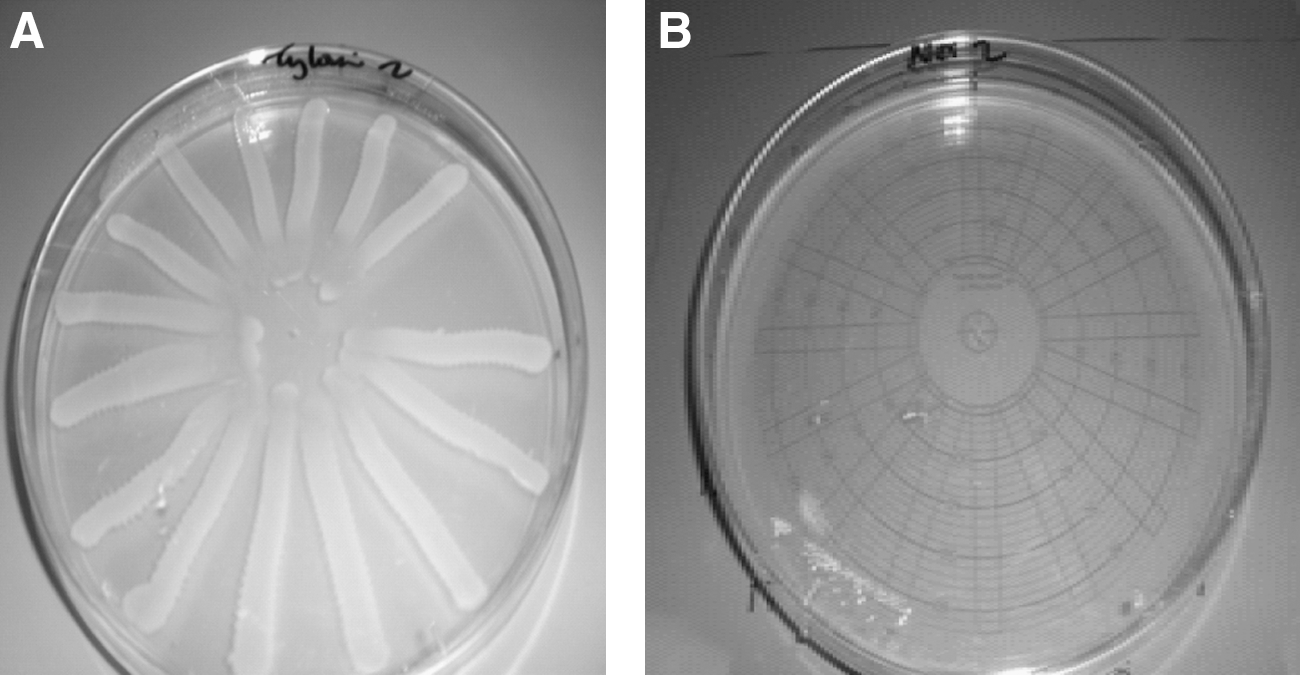
Antimicrobial testing by the Spiral Gradient Endpoint Method of Shiga toxin–producing E. coli strain isolated from food, veterinary, and clinical sources against Tylosin Tartrate
Discussion
Several reports have suggested that the use of AAs can lead to the emergence and dissemination of resistant strains of E. coli, which is ultimately passed onto consumers via food or through the direct contact with animals (Levy et al., 1976; Meng et al., 1998; Galland et al., 2001; van den Bogaard and Stobberingh, 2001; Schroeder et al., 2002). The food isolates used in this study are primarily ground beef, and AAs are intensively used in the cattle industry. In our opinion, this may be the one reason in this study that we found more multiantimicrobial resistance strains of E. coli in the food isolates compared with clinical and veterinary isolates.
The results of the current study showed that all isolates from three sources demonstrated susceptibility to the entire fluoroquinolones group of AAs (enrofloxacin, ciprofloxacin, oxfloxacin, and norfloxacin). However, van den Bogaard and Stobberingh (2001) reported that high resistance to the fluoroquinolones was observed in poultry. Thielman and Guerrant (1999) reported that fluoroquinolones are used to treat a range of E. coli infections in humans; thus, the findings from this study can be considered encouraging. The fluoroquinolones have been found to have much greater effectiveness against Enterobacteriaceae, as it inhibits their growth. It may be due to inhibition of the bacterial DNA gyrase, which is the enzyme responsible for DNA replication, or the fact that they function in such a way that irreversible breakages occur in the DNA strand (Thielman and Guerrant, 1999).
The MICs of the combination for susceptible bacteria are substantially lower than those of either of the individual agent. The combination of sulphadimidine/trimethoprim was found to be bactericidal, whereas neither drug is bacteriostatic (White et al., 2000). Folate-synthesizing bacteria that are resistant or moderately resistant to either drug alone are frequently susceptible to the combination. Schroeder et al. (2002) reported the highest frequency of antimicrobial resistant E. coli O157 strains isolated from humans, cattle, swine, and food sources. In this study, they reported that highest frequencies of resistance occurred among swine isolates (n=70), where 74% were resistant to sulfamethoxazole, 71% were resistant to tetracycline, 54% were resistant to cephalothin, and 24% were resistant to ampicillin. Results of our experiment also showed multiresistant strains of STEC to tetracycline. However, less resistance was observed for doxycycline and oxytetracycline (Fig. 1). Tetracycline is widely used in animal husbandry and in combination with other antibiotics; however, in this study, it was singly tested. The presence and frequency of tetracycline resistance in E. coli from chickens agree with findings of other studies on antibiotic resistance in E. coli (van den Bogaard and Stobberingh, 2001).
Resistances to tetracycline have been attributed in part to widespread and lengthy use of tetracycline in the livestock industry (Levy, 1976). Since tetracycline is a naturally derived compound, bacteria can be exposed to these agents in nature, in human beings as a therapeutic agent, or in livestock as a growth promoter. Tetracycline is a commonly used first-line antibiotic for many domestic animals. According to Prescott et al. (2000), resistance to tetracycline is plasmid mediated, and has a wide variety of genetic determinants. All isolates were 100% resistant to tylosin from the Macrolides class and sulfur drugs (Fig. 1). Increasing trend of resistance to tylosin has some concern, because it is used in livestock to prevent shipping sickness. Among the Aminoglycosides, low levels of resistance were found with gentamycin and neomycin ranging from 3.7% to 17.24% (Fig. 1). Dixon (2007) reported that oral administration of neomycin for 2 days significantly reduced generic E. coli and E. coli O157 shedding in the feces of cattle, which was sampled a day after the last dose.
In conclusion, increasing trend of multiantibiotic resistance among the foodborne pathogens is a growing public health problem. Results of this experiment showed the increasing AAs resistance of STEC isolates from food, veterinary, and clinical sources. The AAs use, whether for therapy or prevention of bacterial diseases, or as performance enhancers, will result in antimicrobial resistant microorganisms, not only among pathogens but also among bacteria of the commensal bacteria of animals. This study showed that all the isolates from three sources were resistant to sulphadimidine, sulphamethoxazole, and tylosin tartrate and also indicated the increasing trend of multiple antimicrobial resistances among the foodborne pathogens.
Footnotes
Disclosure Statement
No competing financial interests exist.
References
Supplementary Material
Please find the following supplemental material available below.
For Open Access articles published under a Creative Commons License, all supplemental material carries the same license as the article it is associated with.
For non-Open Access articles published, all supplemental material carries a non-exclusive license, and permission requests for re-use of supplemental material or any part of supplemental material shall be sent directly to the copyright owner as specified in the copyright notice associated with the article.
