




Abstract
Destructive and nondestructive sampling procedures were compared for Escherichia coli and Salmonella spp. detection in 60 fresh chicken carcasses, which were submitted to the following sampling procedures: rinsing, skin swabbing, tissue excision, and skin excision; the proximity or not to the cloacae region was also considered. The obtained results were compared to identify significant differences (p<0.05). Forty eight chicken carcasses were positive for E. coli, and five were positive for Salmonella spp. For E. coli, nonsignificant differences were observed between rinsing and tissue excision, rinsing and skin excision, and skin excision and tissue excision (p>0.05), thus indicating equivalencies between these techniques. Skin swabbing produced a statistically significant lower frequency of positive results (p<0.05) than all other techniques for E. coli, thus indicating its inadequacy for detection of this microorganism. For Salmonella spp., no significant differences were observed between the sampling techniques (p>0.05), possibly due to the low overall frequency of positive carcasses. No significant differences in the number of positive samples (E. coli or Salmonella spp.) were observed between samples collected near or far from the cloacae region (p>0.05), regardless of the sampling technique. The obtained results demonstrate that the tested sampling techniques were equivalent for Salmonella spp. detection in chicken carcasses, as observed for E. coli with the exception of skin swabbing.
Introduction
The presence of enteric microorganisms in foods is used as a possible indicative of Salmonella spp. contamination; and in addition, it suggests poor hygienic conditions during production and processing (Álvarez-Astorga et al., 2002; Ghafir et al., 2008). Escherichia coli is considered a good indicator of both poor hygiene in industrial slaughter and production, and the possible presence of foodborne pathogens (Ghafir et al., 2008). In addition, several E. coli strains are also pathogenic, justifying testing for this microorganism in foods, including avian products (Tsola et al., 2008).
Sampling procedures are fundamental to the reliability of tests for the presence of specific microbial groups of foodborne pathogens in food. Several sampling procedures are used for animal carcasses, and are typically classified as destructive or nondestructive (Snijders et al., 1984; Capita et al., 2004). Considering their specific advantages and disadvantages (Palumbo et al., 1999; Capita et al., 2004), the best sampling procedure can be chosen by specific food industries or regulatory agencies to obtain reliable data for microbial monitoring (Gill and Jones, 2000). The objective of the current study was to compare destructive and nondestructive chicken carcass sampling techniques for the detection of E. coli and Salmonella spp., and to evaluate their limitations and possible equivalencies.
Materials and Methods
Chicken carcasses
A total of 60 fresh chicken carcasses were obtained from commercial establishments in Viçosa city and the surrounding region, in the state of Minas Gerais, Brazil. Each carcass was collected in its commercial package, and kept under refrigeration in isothermal containers until analysis.
Sampling techniques and dilution
Under aseptic conditions, each carcass was divided into two halves along the longitudinal section of its spine by using a sterile knife (Fig. 1). One half of the carcass was used to obtain a rinsing (nondestructive) sample, using a procedure modified from the USDA/FSIS (2008). The other half of the carcass was submitted to sampling by using two destructive (tissue excision and skin excision) and one nondestructive (skin swabbing) procedure, according to Gill et al. (2006). The breast and back regions of this half-carcass were divided into six areas of 25 cm2 (5×5 cm) by using sterile templates for reference, to obtain samples according to cited procedures (see Fig. 1). For each procedure (with the exception of rinsing), two areas were randomly selected from the breast and back regions of the carcass and from areas near or far from the cloacae region.
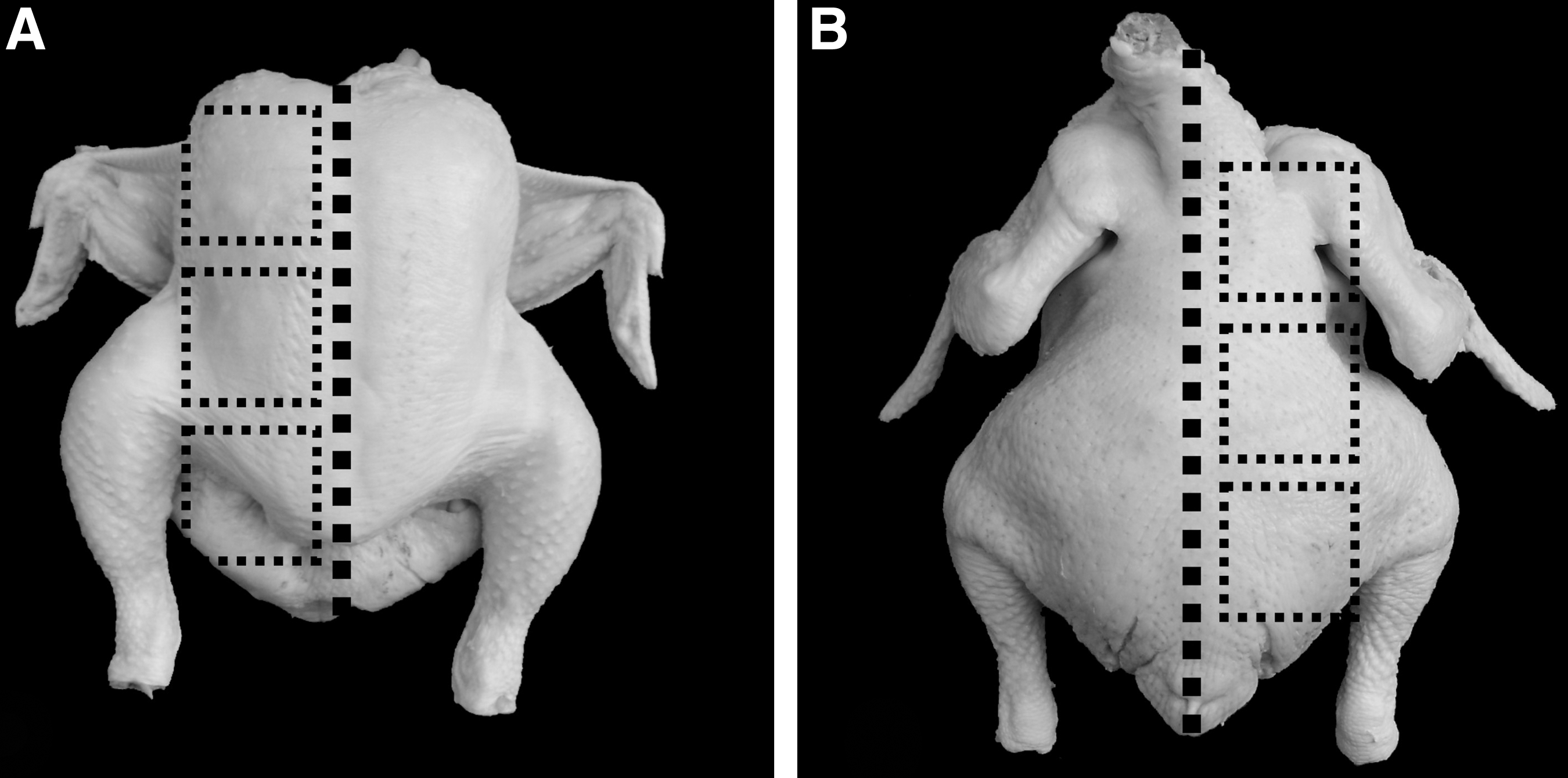
Front
For rinsing (nondestructive), the half carcass was placed in a sterile bag and weighed, and an equal amount (in mL) of buffered 0.1% peptone water (Oxoid Ltd., Basingstoke, England) was added. Then, the contents of the bag were manually homogenized for 5 min, and the final homogenate was collected in a sterile flask. The final sample concentration was defined as 1 mL=1 g of the carcass.
Skin swabbing (nondestructive) samples were obtained by swabbing selected areas of the carcass with moistened (5 mL of buffered 0.1% peptone water; Oxoid) sterile sponges. Sponges were collected in sterile bags with 45 mL of buffered 0.1% peptone water and automatically homogenized for 5 min (Stomacher® 400 Circulator; Seward Ltd., Sussex, England). The final sample concentration was defined as 1 mL=1 cm2 of the carcass.
Tissue excision (destructive) samples were obtained by excision of skin and tissue fragments from selected areas of the carcass by using sterile scalpels and pincers. Tissue excision samples were collected in sterile bags until a weight of 25 g was obtained. Then, 225 mL of buffered 0.1% peptone water (Oxoid) was added, and the mixture was automatically homogenized for 5 min (Stomacher 400 Circulator). The final sample concentration was defined as 1 mL=0.1 g of the carcass (1:10).
Skin excision (destructive) samples were obtained by excision of skin from selected areas of the carcass by using sterile scalpels and pincers. Skin excision samples were collected in sterile bags containing 50 mL of buffered 0.1% peptone water (Oxoid) and automatically homogenized for 5 min (Stomacher 400 Circulator). The final sample concentration was defined as 1 mL=1 cm2 of the carcass.
All the obtained homogenates were then ten-fold diluted by using buffered 0.1% peptone water (Oxoid).
E. coli detection
For each chicken carcass and sampling technique, a 1:100 sample dilution was plated on Petrifilm™ Escherichia coli (3M Microbiology, St. Paul, MN) for E. coli detection, followed by incubation at 35°C for 48 h. The presence of counts of 100 colony forming units per g or cm2 (cfu/g or cfu/cm2) or higher was considered a positive result for E. coli (a typical colony is blue in color, associated with gas formation). This concentration was considered a reference for the presence of E. coli, once it is used as a quality and safety parameter for foods in the United States and other countries (Álvarez-Astorga et al., 2002; USDA, 2003).
Salmonella spp. detection
Samples from each sampling technique were submitted for Salmonella spp. detection according to a protocol modified from ISO 6579 (ISO, 2002). Aliquots containing 25 g (tissue excision samples) or 25 mL (rinsing, skin swabbing, and skin excision samples) of the final homogenates were added to 225 mL of buffered 1% peptone water (Oxoid), and incubated at 37°C for 18 h (pre-enrichment step). Then, 1 mL of the resulting culture was inoculated in 10 mL of selenite cysteine broth (Oxoid; incubated at 37°C for 24 h). About 0.1 mL of this culture was then inoculated in 10 mL of Rappaport-Vassiliadis enrichment broth (Oxoid; incubated at 42.5°C for 24 h) (selective enrichment step). After incubation, culture aliquots were streaked on brilliant green phenol red lactose sucrose agar (PBLS; Oxoid) and xylose lysine deoxycholate agar (XLD; Oxoid), and incubated at 37°C for 24 h (selective plating). Typical or suspected Salmonella colonies (PBLS: small, transparent, colorless or pink or opaque white, usually surrounded by a pink or red halo; XLD: pink with or without black centers) were transferred to triple sugar iron (TSI, Oxoid) and lysine iron (LIA; Oxoid) slants, and incubated at 37°C for 24 h. When a typical reaction was observed in at least one of the slants (TSI: red slant and yellow butt, with or without H2S formation; LIA: purple butt, with or without H2S formation), cultures were subjected to serological testing with somatic (O) and flagelar (H) polyvalent antisera (Probac do Brasil SA, São Paulo, SP, Brazil), followed by molecular confirmation by using the polymerase chain reaction to detect the presence of invA gene (Galan et al., 1992). Taking into consideration all the confirmation steps just mentioned, final results were expressed as positive or negative for Salmonella spp. in 25 g or 25 cm2 of each sample and sampling procedure.
Data analysis
Results from E. coli and Salmonella spp. detection tests for each chicken carcass and each of the four sampling procedures were compared by McNemar test to verify the statistical significance of differences between sampling techniques (p<0.05). Frequencies of positive results were compared by considering the sampling site (near or far from cloacae) and sampling procedure, using the Chi-square test (p<0.05) to verify statistically significant differences. All statistical analyses were conducted by using Statistica 7.0 (StatSoft Inc., Tulsa, OK) and XLSTAT 2009.1.02 (Addinsoft USA, New York, NY).
Results
The frequencies of positive E. coli (≥100 cfu/g or cm2) and Salmonella spp. samples are presented in Table 1. Comparisons of the results obtained from each sampling procedure are presented in Tables 2 and 3. For the detection of E. coli positive carcasses, only nonsignificant differences were observed between samples obtained by rinsing and tissue excision, rinsing and skin excision, and skin excision and tissue excision (p>0.05). However, skin swabbing presented significant differences when compared with the other sampling procedures for E. coli detection (p<0,05). For Salmonella spp., no significant differences were observed among all tested sampling protocols (p>0.05).
McNemar test. p-Values lower than 0.05 indicate significant differences between the paired compared sampling methods.
McNemar test. p-values lower than 0.05 indicate significant differences between the paired compared sampling methods.
The results of frequencies of E. coli and Salmonella spp. isolation considering the tested sampling procedures (except rinsing) as well as while considering the proximity of the cloacae region are shown in Table 4, and no statistically significant differences were observed (p>0.05).
Discussion
Considering the obtained results, rinsing and tissue excision sampling procedures resulted in positive E. coli detection with a higher frequency than skin swabbing. In addition, only skin swabbing was unable to detect Salmonella spp. from chicken carcasses, whereas all other tested procedures resulted in two positive samples each (Table 1). In a similar study, Gill et al. (2005) were able to identify E. coli in 100% of chicken carcasses analyzed by using skin excision samples of different sizes (1, 10, and 100 cm2). Gill and Jones (2000) compared tissue excision with swab samples obtained by using three distinct swab materials, and found similar frequencies of positive results for E. coli. In the same work (Gill and Jones, 2000), the influence of the size of the sample area was investigated, and higher frequencies of positive E. coli detection were found to correlate with larger carcass sampling areas. Further, rinsing of chicken carcasses was associated with higher frequencies of positive results for E. coli detection than both tissue excision and skin swabbing (Table 1), and is considered the most adequate sampling procedure for the recovery of microorganisms present at low levels, such as E. coli (Gill et al., 2005).
Rinsing and tissue excision protocols yield final results in the same units (≥100 cfu/g), thus enabling direct comparison. Moreover, the observed equivalence between rinsing and tissue excision (Table 2) is economically valuable, once rinsing is a nondestructive sampling technique. In agreement with the current study, Cox et al. (2010) compared positive results for E. coli from chicken carcasses obtained by rinsing and tissue excision, and also failed to observe significant differences between the sampling protocols. Considering skin swabbing and skin excision, procedures that yield final results in the same units (≥100 cfu/cm2), skin excision was able to recover higher frequencies of positive results for E. coli (Table 1) and presented significant differences when compared with skin swabbing (Table 2), thus being considered a better option despite being destructive.
The absence of differences between the sampling procedures for Salmonella spp. (Table 3) was probably caused by the overall low frequency of positive results identified in the current study. However, in a similar study, Cox et al. (2010) compared the frequencies of Salmonella spp. detection in chicken carcasses sampled by rinsing and tissue excision, and did not find significant differences between the tested procedures. Salmonella spp. is usually present at low levels in chicken carcasses, limiting the use of sampling procedures with low sensitivity, which can underestimate its presence (Cox et al., 2010). Considering this, King et al. (2008) obtained higher frequencies of positive results for Salmonella spp. in chicken carcasses when larger sample volumes were used for microbiological analysis, a procedure that improved the sensitivity of the isolation.
Since E. coli and Salmonella spp. are enteric microorganisms, the sampling site on the carcasses might influence the final results, once regions near the cloacae may be potentially contaminated with Enterobacteriaceae (Palumbo et al., 1999; Cason and Berrang, 2002). However, the absence of significant differences between the results considering the sampling sites and procedures frequencies of E. coli and Salmonella spp. positive results in chicken carcasses submitted to distinct sampling procedures considering the sampling sites (Table 4) may be explained by the characteristics of chicken slaughtering. The avian evisceration step tends to contaminate the carcass in a similar way, and the several subsequent washing steps result in a uniform distribution of microbial contamination throughout the carcass (Mead et al., 1994; Gill et al., 2005). The sampling site of the carcass tends to be more relevant for microbiological analysis of other animal carcasses, such as swine (Palumbo et al., 1999) and cattle (Grau, 1986).
Considering the obtained results, relevant information is presented for food industries and official regulatory organs in choosing the sampling technique that is most convenient and appropriate to obtain the desired microbiological control during production and inspection. These findings are economically valuable, because rinsing preserves the integrity of the carcass for commercial use by the food industry, and provides similar results when compared with tissue and skin excision for detection of both E. coli and Salmonella spp. So, this procedure could be adequately employed in quality control programs and in monitoring the presence of these microorganisms in chicken carcasses.
The current study provided specific information about distinct sampling procedures, allowing both the food industry and official regulatory agencies to apply the most appropriate technique during chicken production, after taking into consideration safety and quality goals. The tested sampling techniques were equivalent for Salmonella spp. detection, as observed for E. coli with the exception of skin swabbing.
Footnotes
Acknowledgments
L.A. Nero and P.S.A. Pinto are supported by CNPq and FAPEMIG. M.V.C. Cossi and M.V. Almeida are supported by CNPq (master scholarship), and M.R. Dias is supported by FAPEMIG (Scientific scholarship).
Disclosure Statement
No competing financial interests exist.