




Abstract
Staphylococcus aureus are a hazard to human health since they can cause infections and food poisoning. Antimicrobial resistant strains render the treatment of infections problematic and contribute to the spread of antimicrobial resistance. They are therefore of great public concern. This study determined the resistance pattern of coagulase-positive S. aureus (CPSA) isolated from nasal swabs of 100 slaughter pigs from one farm in Uruguay. Out of 69 animals, 71 CPSA were collected. Minimum inhibitory concentrations of 20 antimicrobials were determined using the broth microdilution method in accordance with CLSI recommendations. No methicillin-resistant S. aureus were detected. All CPSA were resistant to three or more classes of antimicrobials (i.e., multiresistant), whereby all CPSA were resistant to spectinomycin. Most of the isolates (46%) were resistant to six classes of antimicrobials. Almost all isolates were resistant to penicillin (99%), ampicillin (99%), gentamicin (96%), tetracycline (90%), and tilmicosin (87%). Very high resistance rates were observed against erythromycin (77%) and clindamycin (70%). High resistance was observed against tiamulin (40%), enrofloxacin (31%), and florfenicol (23%) and low resistance was observed against amoxicillin/clavulanic acid (4%). All CPSA isolates were mecA negative. The results of the present study could be related to an overuse of antimicrobials in pig production and should encourage veterinarians and pig holders to practice a controlled administration of chemotherapeutics in pig husbandry.
Introduction
S
S. aureus can adapt rapidly to the selective pressure of antimicrobials that has led to the development and spread of multiresistant S. aureus and methicillin-resistant S. aureus (MRSA) (Deurenberg et al., 2007), making the treatment of infections more complex and often problematic. The spread of these bacteria in foods, especially in meat, may occur during the slaughtering process through the contamination of carcasses, contact surfaces, and processing equipments in the slaughterhouse by pigs infected or colonized with multiresistant S. aureus (Nitzsche et al., 2007; Simeoni et al., 2008).
MRSA is resistant to all β-lactam antibiotics through the possession of a modified penicillin-binding-protein 2a that is encoded by the mecA gene (Deurenberg et al., 2007). They are also often resistant to most of the antimicrobials commonly used for treatment, such as tetracyclines, aminoglycosides, macrolides, and fluorochinolones (Turkyilmaz et al., 2010). MRSA have been found in pigs in several countries (EFSA, 2009b), but so far no data have been reported about these pathogens in Uruguayan pigs. The aim of this study was therefore to determine the occurrence of MRSA and CPSA in pigs in Uruguay and then determine their antimicrobial resistance.
Materials and Methods
Sample collection
In March 2010 nasal swabs (Heinz Herenz, Hamburg, Germany) were taken from the nostril of 100 fattening pigs directly after exsanguination. All pigs originated from one farrow to finish farm with about 7000 pigs. Each swab was placed in 5 mL brain-heart infusion (BHI) broth (Merck, Darmstadt, Germany) supplemented with 7.5% NaCl and transported under refrigeration to the laboratory in Germany. The BHI was used to enrich both MRSA and CPSA and to keep the level of background flora as low as possible.
Isolation of MRSA and CPSA
The swabs in BHI broth were incubated for 24 h at 37°C. One loop (10 μL) of the BHI broth was streaked onto chrom ID MRSA agar (Biomérieux, Marcy l'Étoile, France) and Baird-Parker agar (Merck). The plates were incubated for 24 h at 37°C. Presumptive positive CPSA colonies on Baird-Parker agar were identified using standard methods: catalase, tube coagulase, and heat-stable DNase tests (typical colonies: black or gray with a clear halo and opalescent ring; atypical: colonies black or gray with or without a barely visible halo and opalescent ring). All CPSA were confirmed by PCR to be S. aureus. One colony per sample and one of each type of the mixtures of typical and atypical colonies was selected for the study.
Antimicrobial resistance testing
Minimum inhibitory concentrations (MIC) of 20 antimicrobials were determined using the broth microdilution method according to the CLSI (2008). Microtitre plates and MIC-Strips (both Merlin, Bornheim-Hesel, Germany) were used. Results were interpreted as susceptible, intermediate susceptible, or resistant, according to the CLSI (2008). Enterococcus faecalis ATCC 29212, S. aureus ATCC 25923, and ATCC 29213 were used as control strains. Multiresistance was determined as resistance to three or more classes, not including colistin, of antimicrobials (Schwarz et al., 2010).
All isolates were analyzed by PCR for the presence of a S. aureus-specific DNA sequence and the mecA resistance-specific sequence. Two separate multiplex real-time PCR were performed using the Sure MRSA Plus V Kit (Congen, Berlin, Germany). The extraction and detection were done following the manual of the manufacturer. Each reaction contains an internal amplification control marked with the fluorophore VIC. According to the manufacturer, the limit of detection was ≤5 DNA copies.
Results and Discussion
Overall, 71 CPSA were isolated from 69 animals. No isolate was mecA positive. This may indicate a low prevalence of MRSA in pigs from Uruguay compared with approximately 50% in pigs from other countries (Graveland et al., 2009; Smith et al., 2009; Tenhagen et al., 2009). Previous studies also reported the absence of MRSA in pig specimens and pig carcasses (Lee, 2003; Nitzsche et al., 2007; Riesen and Perreten, 2009). To exclude a negative influence of the sample transport upon recovery of MRSA, the detection of MRSA and MSSA in BHI broth after five days under refrigeration was checked (data not shown); but the mentioned storage conditions did not have any influence on the result.
MIC results were obtained for 70 CPSA (for one isolate the growth control in the microtitre plate was negative). All CPSA were found to be multiresistant; the most susceptible were resistant to four classes of antimicrobials (Table 1). The rates of multiresistant CPSA found in the present study were much higher in comparison with previous studies (Nitzsche et al., 2007; Murphy et al., 2009; Riesen and Perreten, 2009) and might be related to the use of antimicrobials in pig farming. The highest resistance rates were observed against spectinomycin, penicillin, ampicillin, gentamicin, tetracycline, and tilmicosin that is in accordance with most other reports about staphylococci from animals (Khalid et al., 2009; Murphy et al., 2009; Riesen and Perreten, 2009; Schwarz et al., 2010).
ACY, aminocyclitols; PEN, penicillins; AGL, aminoglycosides; TET, tetracycline; QUI, quinolones; MAK, makrolid; PLEU, pleuromutilin; AMC, amoxicillin/clavulanic acid; LINC, lincosamide; PHE, phenicols.
Discrepant results were obtained for aminoglycosides and aminocyclitols (Table 2). These may be linked to the overuse of gentamicin and spectinomycin in pigs and may also be attributed to the use of different interpretative criteria, since no interpretative criteria exist for neomycin and apramycin in the CLSI document.
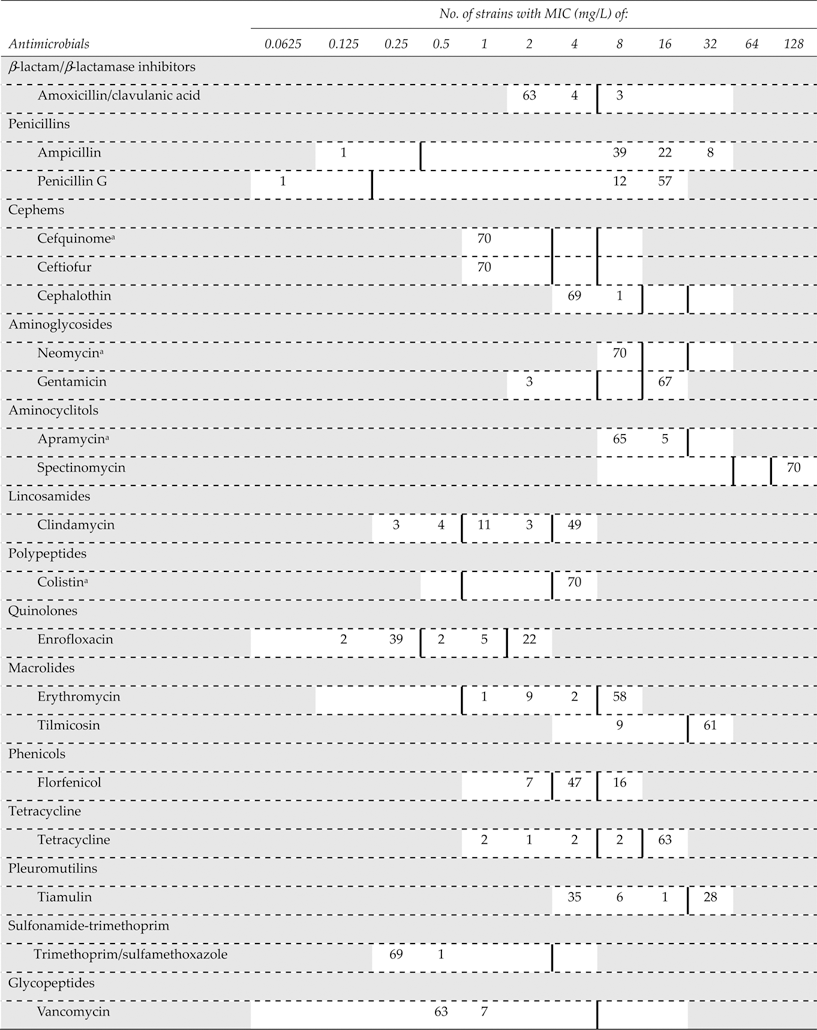
The concentration ranges tested for each antimicrobial agent are those within the white area. Vertical lines are breakpoints.
Breakpoints according to Luhofer et al. (2004).
MIC, minimum inhibitory concentrations.
Interestingly, 90% of all CPSA were resistant to tetracycline, the most commonly used antimicrobial in pig farming (Wulf and Voss, 2008). Previous studies suggested that the use of tetracycline in livestock may contribute to the emergence of MRSA (Wulf and Voss, 2008). Any use of antimicrobials in human or veterinary medicine leads to the development of resistant bacteria (Murphy et al., 2009), but there are different opinions about the impact of chemotherapeutic use in farm animals and the subsequent emergence of resistant bacteria. MRSA have already been found in humans in Uruguay (Pardo et al., 2009). The findings of this study may thus indicate that the main source of MRSA in Uruguay might currently be humans.
In conclusion, this study indicates that pigs from Uruguay are a source of multiresistant S. aureus and thus a risk for human health. As these results could be related to the excessive use of antimicrobials in pig farming, surveillance is needed to promptly identify the emergence of MRSA in pigs in Uruguay. The veterinarians and pig holders should be encouraged to practice a controlled administration of antimicrobials in pig husbandry.
Footnotes
Acknowledgments
We thank Prof. Christiane Werckenthin and Dr. Heinz Becker for supplying reference strains and for their helpful advice. We also thank the farm and slaughterhouse staff for their excellent cooperation.
Disclosure Statement
No competing financial interests exist.