




Abstract
There is a lack of information about the role of poultry, specifically chicken, in transmission of Escherichia coli (E. coli) O157 and subsequent human illnesses. This study was therefore aimed at investigating the presence of E. coli O157 and its virulence genes in various samples collected from broiler chickens and humans in Eastern Turkey by culture, immunomagnetic separation (IMS), and polymerase chain reaction (PCR). The genetic relationship between broiler and human isolates was also examined by pulsed-field gel electrophoresis (PFGE). In the PCR analysis of sorbitol-negative isolates, E. coli O157 was identified in 0.1% (1/1000) and 0.4% (4/1000) of the liver and cecum samples of broiler chickens, respectively. On the other hand, none of the carcass samples were determined to be positive for E. coli O157. Overall, the results indicated that 12% (3/25) of the flocks were positive for E. coli O157. The differences between the flocks in terms of the positivity were determined to be statistically significant (p<0.001). Ten (2.7%) of 367 human stool samples were also positive for E. coli O157 in the PCR examination. None of the broiler and human E. coli O157 isolates possessed H7, shigatoxins 1-2, or enterohemolysin genes, whereas all the broiler isolates and one of the human isolates were positive for intimin gene. In the PFGE analysis, a total of eight different profiles (four from broiler and four from human isolates) were observed. However, there were no genetic relationships between broiler and human E. coli O157 isolates. It can be concluded that more detailed studies are needed in poultry to better understand the role of these species in the epidemiology of E. coli 0157 infections in humans.
Introduction
Most of the microbiological studies carried out in poultry species around the world have examined processed and/or marketed meats for the presence of E. coli O157, whereas only a few studies have investigated cloacal samples. In these studies, different isolation rates were reported in chickens such as 9.3% in Slovakia (Pilipčinec et al., 1999), 0.4% in India (Wani et al., 2004), and 0.3% in The Netherlands (Schouten et al., 2005). In Turkey, the frequency of E. coli O157 in chickens was reported as 6% (Gülhan, 2003).
Molecular characterization is important in identifying relationships between E. coli O157 isolates of animal and human origin. This helps us to better understand the etiology of human outbreaks. Pulsed-field gel electrophoresis (PFGE) is the gold standard of subtyping methods and is used by the U.S. Centers for Disease Control and Prevention (CDC) PulseNet members for several foodborne bacteria. This method is widely used in outbreak investigations and epidemiologic studies of E. coli O157:H7 field isolates (Ribot et al., 2006).
The purpose of this study was to determine the presence of E. coli O157 and its virulence genes (i.e., fliCh7, stx1 -stx2 , eae, and ehxA) in various samples randomly collected from broiler chickens in Eastern Turkey by conventional culture, immunomagnetic seperation (IMS), and PCR. In addition, stool samples collected from humans who were admitted to regional hospitals with the complaints of diarrhea were examined for the presence of E. coli O157 by employing the same methods. Also, genetic relationships between broiler and human isolates were investigated by PFGE typing.
Methods
Sample collection
Internal organ samples (liver and cecum) from randomly selected broilers (n=1,000) of an average age of 43 days were collected weekly at three abattoirs in Malatya and Elazig provinces, which were located in Eastern Turkey between September 2009 and April 2010. Of the 1,000 broilers, 500 were from one abattoir in Elazig, and 500 were from two abattoirs (250 from each) in Malatya. Also, under the same conditions, 1,000 carcasses were sampled from the same flocks shortly after internal organ sampling, by swabbing around the carcass following treatment in the chlorine dip tank. Carcass swab samples were suspended in 1 mL of modified tryptone soy broth (mTSB) (Merck 1.05459) containing 20 mg/L novobiocin (Lab M) and transferred to the laboratory. Samples collected for this study were obtained from 25 different flocks located in 16 geographically distinct areas.
The visited abattoirs received animals regularly from 450 different flocks, each being at the average capacity of 12,000 broilers, well distributed in Eastern Turkey. The area from which the samples were originated encompasses more than 30,000 km2. The finished products from broilers slaughtered at these abattoirs are consumed in approximately 25 provinces in Eastern Turkey and also in Northern Iraq.
In addition to broiler samples, stool samples were collected from a total of 367 diarrheic human patients in two hospitals (M and N) in Malatya (n=61) and three hospitals (U, S, and C) in Elazig (n=306) during the study period. All the samples (broiler and human samples) were stored in cool boxes and transported to the laboratory within 2 h.
Bacteriological culture
Approximately 1 g of cecum and liver samples was inoculated into 5 mL of modified tryptone soy broth (mTSB). Similarly, 1 mL of carcass swab suspensions was transferred to 5 mL of mTSB. Also, approximately 1 g of human stool samples was suspended in 5 mL of mTSB, and all the broths were incubated aerobicallly at 41.5°C for 24 h for pre-enrichment.
Following enrichment, IMS was carried out, using dynabeads anti–E. coli O157 (Dynal Biotech, Oslo, Norway), as described by the manufacturer. The pellet was resuspended in 50 μL of distilled water and used for isolation. Because of the lower bacterial load of liver and carcasses, only broiler cecum samples and human stool samples were subjected to IMS.
Forty microliters of the samples from IMS and a loopful (5 mm diameter) from pre-enrichment broths were plated onto CT-SMAC (sorbitol MacConkey's agar [SMAC; Merck 1.09207.0500] containing 0.05 mg/L Cefixime and 2.5 mg/L tellurite [SR0172; Oxoid]). The plates were then incubated at 37°C for 24 h. Non-sorbitol-fermenting pale colonies were selected for the detection of O157 (rfbE) and virulence genes by PCR (Mead and Griffin, 1998). Isolates that were detected as E. coli O157 were subtyped by PFGE.
DNA extraction and PCR
Three to five representative colonies were transferred into a microcentrifuge tube containing 300 μL of sterile distilled water and were subjected to DNA extraction using the method described by Cetinkaya et al. (2002). The sorbitol-negative isolates were examined by PCR to determine the presence of O157 rfbE, fliCh7, stx1, stx2, eae, and ehxA genes. The assays were performed in a TC 512 Temperature Cycling System (Techne, Staffordshire, United Kingdom) in a total reaction volume of 50 μL, containing 5 μL 10×PCR buffer (750 mM Tris HCl, pH 8.8, 200 mM (NH4)2SO4, 0.1% Tween 20), 5 μL of 25 mM MgCl, 250 μM of each dNTP, 1.25 U Taq DNA Polymerase (MBI Fermentas, St Leon-Rot, Germany), 20 pmol of each primer (Table 1), and 5 μL of template DNA. The conditions for the assay were an initial denaturation step at 94°C for 2 min, followed by 35 cycles of 94°C for 1 min (denaturation), 55°C for 1 min (primer annealing), and 72°C for 1 min (DNA synthesis).
bp, base pair.
A multiplex PCR was used for the detection of stx1 and stx2 genes. The amplified products were detected by ethidium bromide (0.5 μg/mL) staining after electrophoresis at 80 V for 2 h in 1.5% agarose gel. Reference strains of E. coli O157:H7 (ATCC 43894, ATCC 43895) were included as positive controls, and distilled water was used as a negative control.
In addition, four (two from broilers, two from humans) randomly selected PCR products amplified with O157 rfbE specific primers were subjected to partial DNA sequence analysis.
Pulsed field gel electrophoresis (PFGE)
Separation of genomic DNA for subtyping of isolates was carried out by standardized PFGE according to the standardized laboratory protocol of PulseNet USA (Ribot et al., 2006). The fragments were separated by using a CHEF-DRII apparatus (Bio-Rad Laboratories, Nazareth, Belgium) in 0.5×TBE buffer at 6 V/cm for 20 h at 14°C with ramped pulse time of 2.2–54.2 s. Gels were stained with ethidium bromide and visualized with a gel documentation system (Infinity 3000 WL; Vilber Lourmat, Marne-la-Vallée, France).
Statistical analysis
A chi-square test was used to compare differences between the culture and PCR results. A probability of less than 0.05 was considered statistically significant. The PFGE patterns were analyzed with gel compare software BioD 1++ (Infinity Capt Software; Vilber Lourmat). The dendrogram was constructed to provide a visual representation of the relationship among E. coli O157 isolates.
Results
Bacteriological findings
Sorbitol-negative isolates, as indicated by pale colonies on the CT-SMAC agar plates, were obtained from 38.5%, 26%, and 11.7% of internal organs, carcasses, and human stool samples, respectively. The number and distribution of the isolates by isolation procedure and sample type are presented in Figure 1.

Distribution of sorbitol-negative isolates obtained from broilers and humans.
PCR findings
In the PCR analysis, E. coli O157 was detected in five of 385 sorbitol-negative broiler isolates, giving the proportion of 0.5% (5/1000) overall (Table 2). E. coli O157 was isolated from 1.04% (3/288) and 0.8% (1/128) of sorbitol-negative isolates originated from cecum and liver samples by direct plating, respectively. The difference between these percentages was not significant (p>0.05). The PCR amplification of cecum samples processed by IMS after pre-enrichment produced positive results in two (1.1%) of 179 isolates, one of which was also detected in direct plating. The difference between the direct plating and IMS results for the isolation of E. coli O157 from cecum samples was not significant (p>0.05). None of the 260 sorbitol-negative isolates from the carcass samples were positive for E. coli O157 by PCR analysis.
PCR, polymerase chain reaction.
When the findings were considered at flock level, E. coli O157 was identified in 12% (3/25) of the flocks sampled in the study. The positivity percentages in each of the three flocks were detected as 2% (1/50), 4% (2/50), and 6.7% (2/30), respectively. The difference between the positive flocks was determined to be statistically significant (p<0.001).
In the PCR analysis of five E. coli O157 isolates for the presence of virulence genes, it was determined that all the isolates were positive for eae gene, but none were positive for fliCh7, stx1 -stx2 , or ehxA genes (Table 2).
In the O157-specific PCR analysis, E. coli O157 was identified in 23.3% (10/43) of sorbitol-negative human isolates. When all the human stool samples were taken into consideration, this proportion was calculated as 2.7% (10/367). E. coli O157 was identified in 22.5% (9/40) and 9.4% (3/32) of the sorbitol-negative isolates obtained by direct plating and IMS, respectively. Of the three isolates detected by IMS, two were also detected in direct plating. The difference between the isolation procedures was not statistically significant (p>0.05).
E. coli O157 isolates from 10 humans were also analysed for virulence genes by PCR and none of them were positive for fliCh7, stx1 -stx2 , or ehxA genes; only one was detected to possess the eae gene (Table 2).
The partial sequence analysis of four isolates (two from broilers and two from humans) using O157 rfbe gene revealed 98–99% homology with sequences of reference strains (accession numbers AF00163336.1, CP001368.1, AF163333.1) in the BLAST (National Center for Biotechnology Information [NCBI]).
PFGE findings
In the PFGE analysis of the isolates, a total of eight different profiles (four from broiler and four from human isolates) were observed (Fig. 2), and the results were assessed using the Tenover criteria (Tenover et al., 1995). The isolates obtained from a broiler (no. 183) by both IMS and direct plating were identical as expected and were considered profile A. Likewise, nos. 411 and 421 isolates, which were isolated from different animals and organs in the same flock, were identical (profile C). Although the isolates that represented profiles A and B were closely related (81%) and originated from the same flock, no relationship was observed between the other profiles.
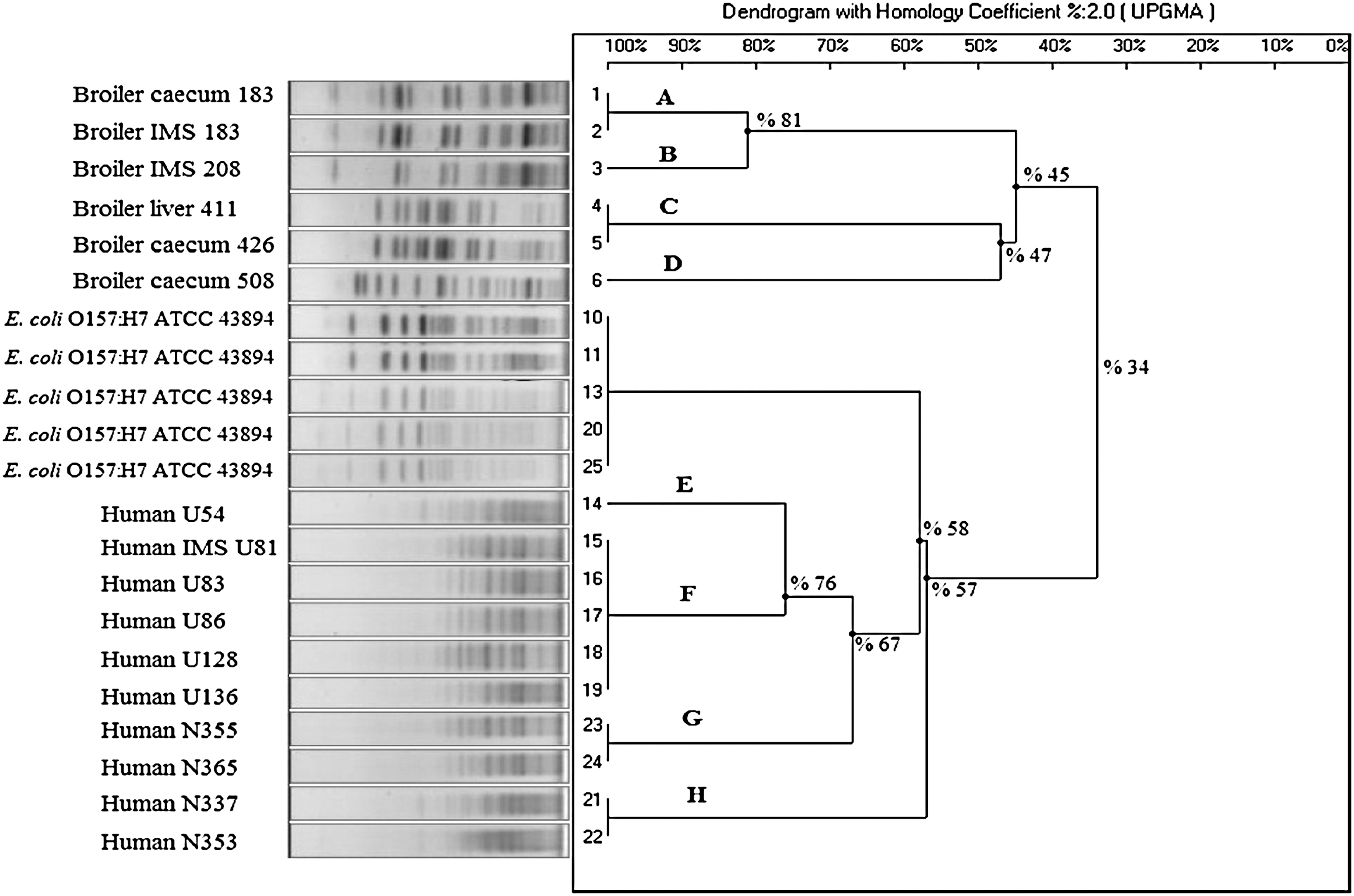
Dendrogram of pulsed-field gel electrophoresis (PFGE) patterns of broiler and human Escherichia coli O157 isolates.
Human samples taken from hospitals U and N produced two profiles each: profiles E and F (U), and profiles G and H (N), respectively. Analysis of human isolates demonstrated that profiles E and F were probably related (76% ratio), but no relationship was determined between the other profiles (Fig. 2). In the comparison of PFGE patterns, no genetic relationships were observed between the profiles of broiler (A, B, C, D) and human (E, F, G, H) E. coli O157 isolates.
Discussion
Animal products such as raw or undercooked meat play a significant role in the occurrence of E. coli O157–originated infections in humans (Mead and Griffin, 1998). Although ruminants, particularly cattle, have been considered the most important animal species in this regard, some studies indicated that poultry meat and products may also play a role in the transmission of E. coli O157 to humans (Doyle and Schoeni, 1987). However, there is a paucity of information about the role of poultry in this aspect. This study was therefore conducted to obtain quantitative data for the presence of E. coli O157 in various samples collected from broiler chickens and to investigate the genetic relationship between broiler and human isolates.
In the present study, E. coli O157 was detected in 0.5% of chickens by both conventional and molecular methods. Although this proportion can be regarded as low when compared to the previous studies conducted in other species, it may be logical to interpret the results at the flock level rather than the animal level due to the fact that closed breeding systems are utilized in broilers. In this case, the isolation rate was calculated as 12% at flock level, which suggests that E. coli O157 infection can be significant in broilers.
IMS and molecular methods, which are regarded to be more reliable, were used in addition to conventional culture methods to investigate the presence of E. coli O157 in broiler samples. The PCR analysis showed that only 1.3% of 385 sorbitol-negative isolates determined in direct plating and IMS were positive for E. coli O157. Although the application of the IMS method has been suggested to improve the accurate isolation rate of E. coli O157, false positive results have been observed in some studies (Fukushima and Seki, 2004; Ongor et al., 2007) due to the presence of other organisms (such as Proteus species, Escherichia hermanii, and Salmonella O group N). In this study, PCR examination of 179 sorbitol-negative isolates (as assessed via the IMS method) resulted in only two positive samples (i.e., 1.1%). Thus, the possibility of false positives was suspected. The same percentage of positives (4/355, or 1.1%) was obtained in the examination of sorbitol-negative isolates obtained from direct plating. Inadequacy of the IMS to improve E. coli O157 isolation in this study might be related to higher bacterial loads in ceacal samples in contrast with food samples.
Carcass samples collected from broilers were also examined for the presence of E. coli O157 in this study, but none of the samples were determined to be positive. Similar results have also been reported elsewhere (Jo et al., 2004; Baran and Gulmez, 2003). This might be due to the use of chlorine which is added to dip tanks to prevent contamination by Salmonella species and other bacteria (Beuchat et al., 2001; Zhao et al., 2001).
Shigatoxins, enterohemolysin, and intimin play significant roles in E. coli O157 infections (Blanco et al., 2004). Shigatoxigenic E. coli has been isolated from patients with diarrhea which was linked to the consumption of chicken meat at a nursing home (Best et al., 2003). In a few studies conducted to investigate the presence of virulence genes in poultry originated isolates, stx, eae, and ehx genes have been determined at different rates (Pilipcinec et al., 1999; Heuvelink et al., 1999). Although stx1 -stx2 , ehxA, and fliCh7 genes were not detected, all the broiler isolates in this study were found to contain the eae gene. It has been reported that intimin alone can lead to diarrhea in humans by an attaching and effacing (A/E) ability (Blanco et al., 2004). Therefore, it can be concluded that the O157 isolates recovered in this study pose a health risk to humans.
E. coli O157 infection has been reported in 2–7% of sporadic cases and 20% of outbreaks in the world (Paton and Paton, 1998). In Turkey, there is insufficient information about the prevalence of E. coli O157 in humans. However, a prevalence of 0–4% has been reported in recent studies (Erdoğan et al., 2008; Ekşi et al., 2007; Güney et al., 2001; Hascelik et al., 1991). In the current study, the isolation rate of 2.7% was obtained in human stool samples. While E. coli O157 was detected in nine stool samples processed by direct plating, only three samples were positive by the IMS method. Therefore, the IMS method failed to contribute to direct plating. In light of the PCR results, a general conclusion can be drawn that the likelihood of a false positive was higher in the IMS procedure due to the reduced sensitivity.
In the examination of human isolates by PCR for the presence of virulence genes, none were found to possess H7, enterohemolysin, or shigatoxin1-2 genes, and only one isolate was positive for the intimin gene. Therefore, only one human isolate in this study posed a risk for public health due to the absence of virulence genes.
PFGE analysis of both broiler and human isolates produced a total of eight different profiles. In the comparison of broiler profiles, only profiles A and B were found to be closely related (81%), which was expected as these isolates originated from the same flock. PFGE patterns of human isolates demonstrated that profiles E and F of isolates from hospital U were probably related (76% ratio), but not isolates from profiles G and H of hospital N. The absence of genetic relationships between broiler and human E. coli O157 isolates in this study suggests that broilers do not a play significant role in the transmission of infection to humans. However, large-scaled epidemiological studies are needed to support this conclusion.
Conclusion
This study determined that E. coli O157 was present, in Turkey, in broilers, though to a lesser extent than in ruminants (Ongor et al., 2007; Paton et al., 1998). All the broiler isolates were determined to possess the eae gene, which is alone sufficient to induce diarrhea in humans. Although this finding indicates that broiler food products may play a role in human cases of E. coli O157 infection, genetic comparison of both broiler and human isolates in this study did not support this. When considering the fact that consumption of chicken meat is on an increase in comparison to red meat, it may be necessary to conduct large-scale studies examining the frequency and virulence genes of E. coli O157 in the poultry population of Turkey in order to better understand the epidemiology of E. coli O157 infection in humans. This will help develop more effective control strategies against infections and outbreaks due to this microorganism.
Footnotes
Acknowledgments
We wish to thank Nilgün Daldal, Önder Otlu, personnel at the Inonu University Turgut Özal Medicine Center Parasitology Laboratories in Malatya, Bülent Taşdemir (Elazig Veterinary Control and Research Institute, Turkey), Nejdet Toraman, Yener Uluata, Bilal Yildirim, Savaş Karatepe, Necati Tut, Naciye Özen, and Bülent Göztok for their contributions to this work, which was funded by the Firat University Scientific Research Projects Unit (FUBAP 1763).
Disclosure Statement
No competing financial interests exist.