




Abstract
The potential of Salmonella population to rebound on non-washed and washed roma tomatoes and jalapeño peppers in humid storage at 4°C, 10°C, 15°C, 21°C, or 35°C for ≤12 days was investigated. The initial inoculation levels of Salmonella on peppers and tomatoes were 5.6 and 5.2 log CFU/cm2, respectively. Air-drying of fruit surfaces resulted in contamination levels of 3.9 and 3.7 log CFU/cm2 on inoculated peppers and tomatoes, respectively. At 21°C and 35°C, the levels of air-dried Salmonella inoculums on produce surfaces increased ≥2 log cycles, with the most rapid growth in the first 3 days. Mechanical washing on rollers (rinsing; R-treatment) or revolving brushes (rinsing and brushing; RB-treatment) with water decreased Salmonella counts by ≥2.5 log CFU/cm2 on both peppers and tomatoes. After R- or RB-treatment, peppers stored at 21°C and 35°C permitted residual Salmonella (≤1.4 log CFU/cm2) to grow to 2.6–3.9 log CFU/cm2. During storage, residual Salmonella (≤1.0 log CFU/cm2) on washed tomatoes increased to 3.1 log CFU/cm2 at 35°C following R-treatment and 3.8 log CFU/cm2 at 21°C following RB-treatment. Cold storage at 4°C and 10°C effectively prevented the proliferation of Salmonella on both washed and non-washed produce. The current study on jalapeño peppers and roma tomatoes demonstrated that Salmonella population can rebound on produce in humid storage before or after washing. The finding highlights the benefit of uninterrupted cold storage for safer produce operations.
Introduction
Washing is a significant post-harvest practice for reducing levels of pathogens such as Salmonella on produce surfaces. Previous studies have investigated the effects of washing and sanitization to reduce surface pathogen concentrations on produce (Pao et al., 2007, 2009; Zhuang et al., 1995). These studies have demonstrated that washing and sanitizing can significantly reduce levels of undesirable microflora on produce. However, washing is unlikely to eliminate pathogens completely, potentially due to bacteria attachment and survival at inaccessible sites and/or formation of biofilms, which are more resistant to inactivation by intervention treatments (Sapers, 2001; Frank, 2001; Chmielewski and Frank, 2003; Iturriaga et al., 2007; Bassett and McClure, 2008). In terms of washing methods, brush washing is more effective than simple rinsing to dislodge attached microbial contaminants for produce sanitization (Pao et al., 2009). However, brushing may also alter the surface conditions of produce by physically stripping away natural protective waxes (Hall and Sorenson, 2006).
For fresh produce, the U.S. Food and Drug Administration (FDA) recommends washing them under running water just before consumption, although the agency does not recommend the use of soap, detergent, or commercial produce washes (FDA, 2011). Produce washing is often considered a necessary step in packinghouse operations to reduce potential surface contaminants (FDACS, 2007; Pao and Brown, 1998). However, commercial handling and storage conditions vary amongst washed produce. For example, roma tomatoes often are harvested and washed while green, before being treated for ripening at ∼20°C with 90–95% relative humidity (USDA, 2004). Jalapeño peppers, on the other hand, are harvested at maturity before being packed for shipment. Numerous extension articles recommend the storage of peppers and tomatoes at cool and moist conditions for quality preservation (USDA, 2004; Boyhan et al., 2009; Tong, 2009). However, cold storage is not considered a food safety mandate in delivering, selling, or serving fresh whole produce.
Data have shown that foodborne pathogens can grow readily on produce subsequent to contamination (Beuchat 2002; Charkowski 2002; Knudsen et al., 2001; Liao et al., 2010; Zhuang 1995). For example, Zhuang et al. (1995) reported that raw tomatoes stored above 10°C resulted in a significant increase of Salmonella Montevideo over a short period of time. Similarly, Liao et al. (2010) reported a 3 log increase of Salmonella Saintpaul on jalapeño peppers that were stored at room temperature for 48 h; however, no significant growth of Salmonella was observed on peppers stored at 4°C. Furthermore, as a function of temperature, Pao et al. (1998) reported the growth potential of Salmonella on peeled orange, and Pan and Schaffner (2010) developed predictive models for Salmonella growth in cut tomatoes. Although knowledge about the growth of inoculated pathogens on produce at various processing and handling stages has been established, direct evidence that supports the rebound capability of residual pathogens after produce washing treatments remains lacking. Iturriaga et al. (2007) found that the colonization of manually rinsed tomatoes by Salmonella Montevideo is affected by relative humidity (60–97%) at 22°C and 30°C. However, no significant growth of Salmonella Montevideo on untreated tomatoes kept at 97% relative humidity for 10 days at 30°C was observed by Iturriaga and Escartin (2010). Prior research on the rebound of Salmonella populations was conducted primarily using simple rinsing treatments that do not represent the thorough brush washing practices of the industry.
The objective of this current study was to investigate the effect of spray washing over rollers or revolving brushes on the rebound of Salmonella populations on jalapeño peppers and roma tomatoes during humid storage (≥88% relative humidity) at various temperatures (4–35°C).
Methods
Inoculum preparation
Four serotypes of H2S-positive Salmonella enterica (Salmonella Enteritidis ATCC 13076, Salmonella Montevideo ATCC 8387, Salmonella Newport ATCC 6962, and Salmonella Typhimurium ATCC 14028) were maintained at 4°C on tryptic soy agar (TSA; unless otherwise stated, all media were Bacto, from Becton Dickinson, Sparks, MD). The cultures were transferred to tryptic soy broth containing 0.6% yeast extract (TSBYE) and incubated for 22–24 h at 35°C. The cultures were then centrifuged, resuspended, and pooled in sterilized tap water to achieve an inoculum level of ∼9 log colony forming units (CFU) per milliliter.
Fruit inoculation
Jalapeño peppers were harvested from Virginia State University's Randolph Farm (Ettrick, VA), and roma tomatoes were procured from a local retail market (Colonial Heights, VA). Produce was refrigerated at 10°C for use within 1 week. Individual fruit was placed at ∼21°C, after which a smooth, non-stem scar area (∼10 cm2) was circle marked. The aforementioned regions were spot inoculated with 300 μL of each inoculum in ∼20 droplets (Pao et al., 2009). Droplets were air-dried for 20–24 h at room temperature (22±2°C) before washing treatments.
Fruit washing and rinsing
The inoculated fruits (peppers or tomatoes) were subjected to spray washing with city water (Ettrick, VA) for 60 s in a produce washer with two rollers rotating at 85 revolutions per minute by a motor (Gearmotor, model 42R-5L; Bodine Electric Co., Chicago, IL) as described by Pao et al. (2009). Water at a flow rate of 9.3 mL/s per fruit was discharged through two full cone nozzles (Spraying System Co., Wheaton, IL) ∼15 cm above the fruit. Rollers with and without synthetic polyethylene brushes (circular, 6.4-cm radius and 46-cm width; Industrial Brush Co., Lakeland, FL) were used for rinsing and brushing (RB-treatment) and rinsing (R-treatment), respectively.
Produce storage
Experimental produce was stored in sterile plastic bags (17.8×30.5 cm in dimension, 76.2 μm thick, SCL-7012; Labplas, Quebec, Canada) at 4°C, 10°C, 15°C, 21°C, and 35°C for up to 12 days before analyzing. The bags (3 fruits/bag) were loosely folded (but not sealed) to allow produce respiration. During storage, the relative humidity in the sample bags spontaneously reached to ≥88% overnight as determined by a humidity detector (Thermo-hygro; Fisher Scientific, Pittsburg, PA).
Microbial enumeration
Peppers and tomatoes were analyzed for populations of Salmonella before and after inoculation, after surface air-drying, and after subsequent storage at day 0, 1, 3, 7, and 12. After each storage time, thin fruit pieces were manually cut with a sterilized knife from the circled surface areas (10 cm2 per fruit) of three treated fruit. Each sample of fruit was then placed in a sterile sample bag containing TSBYE with 0.2% sodium thiosulfate (Fisher, Fair Lawn, NJ) and then blended using a laboratory masticator (IUL Instruments, Barcelona, Spain) at high speed for up to 4 min before plating. Appropriate dilutions of each sample were then spread plated on TSA and incubated at room temperature for 2 h (for recovering injured cells) before overlaying with xylose-lysine-desoxychlolate agar (XLD) and further incubated at 36°C (Pao et al., 2007, 2009) with the lowest detection level at 1 CFU/cm2. Black colonies on XLD were enumerated after 24 and 48 h of incubation for presumptive Salmonella counts since no similar colony was found in preliminary tests with non-inoculated samples. Representative colonies were biochemically confirmed as Salmonella using API 20E test strips (bioMérieux, Inc., Durham, NC).
Statistical analysis
Three experimental replications were conducted per treatment. Microbial counts were converted to logarithmic values for calculating means, standard errors (SE), and/or reductions. Data were analyzed by one- and two-way analysis of variance (ANOVA) using SigmaStat software (version 3.0; SPSS Inc., Chicago, IL) with significant difference defined at p≤0.05.
Results
Salmonella rebound during storage of non-washed produce
The initial inoculation levels (wet-inoculums) of Salmonella for peppers and tomatoes were 5.6±0.3 and 5.2±0.04 log CFU/cm2, respectively. Air-drying of inoculated fruit surfaces for ∼24 h resulted in contamination levels of 3.9±0.1 log CFU/cm2 on peppers and 3.7±0.04 log CFU/cm2 on tomatoes. Figure 1 illustrates the compounded influence of storage temperature and time (p<0.001) on the air-dried Salmonella inoculums on peppers and tomatoes during subsequent storage. Significant rebound of Salmonella populations (p<0.05) were found on peppers and tomatoes stored for ≥3 days at 15°C and 21°C or ≥1 day at 35°C. No significant change of Salmonella levels were found on fruits stored at ≤10°C, except a 0.9 log reduction on peppers and a 1.2 log reduction on tomatoes observed during storage at 4°C for 12 days.
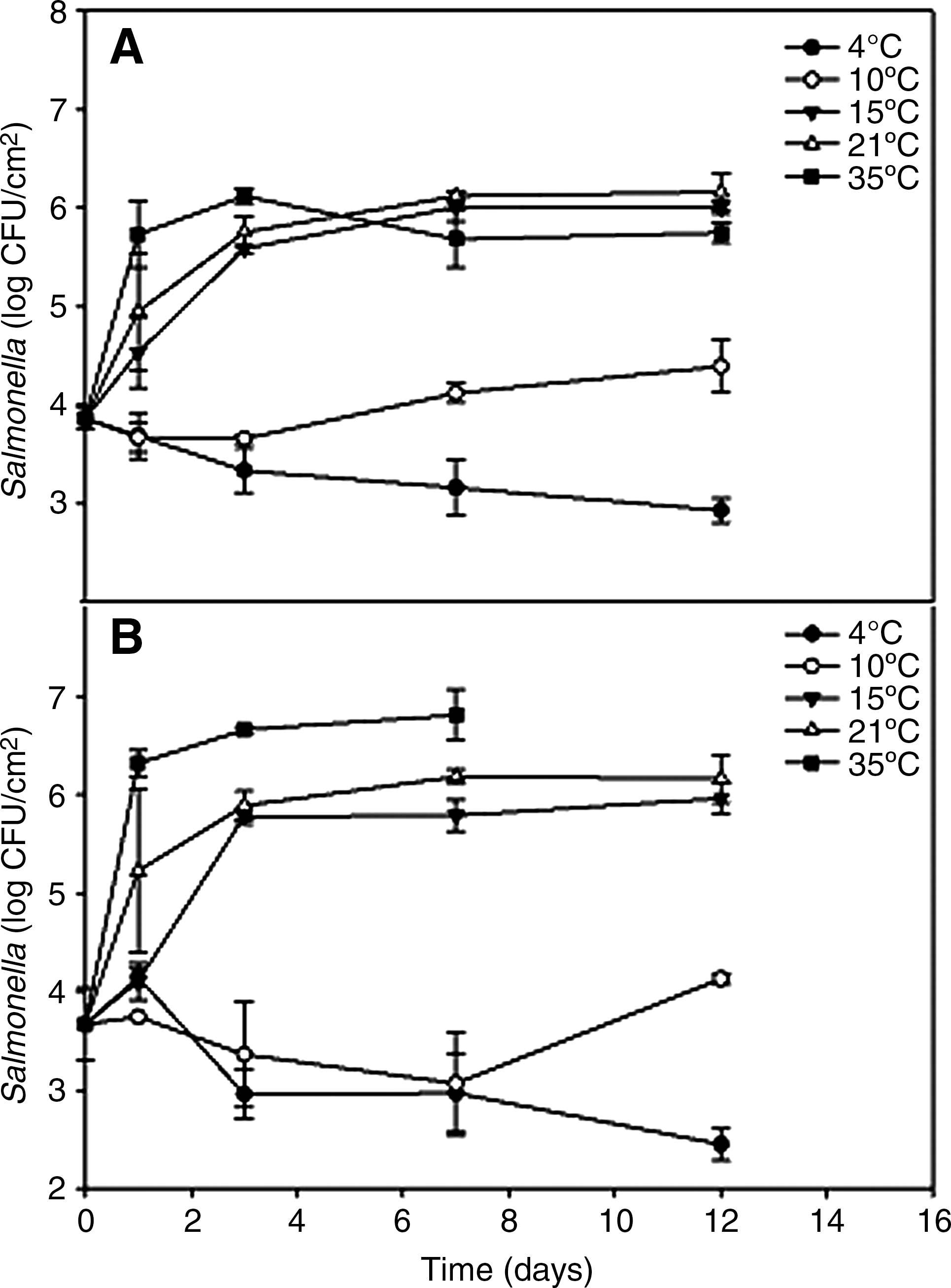
Effect of storage time and temperatures on the growth and survival of Salmonella on non-washed peppers
During storage at 15°C, 21°C, and 35°C, Salmonella levels on peppers either reached or exceeded the initial inoculation (wet-inoculum) level (5.6 log CFU/cm2) by day 3, 3, and 1, respectively. Within 12 days of storage, Salmonella counts reached to 6.0, 6.2, and 5.8 log CFU/cm2, respectively, at 15°C, 21°C, and 35°C on peppers. For tomatoes, Salmonella levels either reached or exceeded the wet-inoculum level (5.2 log CFU/cm2) by day 1 at 21°C and 35°C, and day 3 at 15°C. Within 12 days, Salmonella counts reached to 6.0, 6.2, and 6.8 log CFU/cm2, respectively, at 15°C, 21°C, and 35°C on tomatoes. Salmonella counts of tomatoes for day 12 at 35°C were not available due to sample spoilage.
Salmonella rebound during storage of spray washed peppers
Washing peppers contaminated with air-dried Salmonella inoculums (∼3.9 log CFU/cm2) by water on rotating rollers (rinsing; R-treatment) or revolving brushes (rinsing and brushing; RB-treatment) further decreased the Salmonella counts to 1.2±0.2 or 1.4±0.2 log CFU/cm2, respectively. The difference between the reductions caused by R- and RB-treatments was non-significant (p>0.05).
Figure 2 illustrates the compound influence of storage temperature and time (p=0.03) on Salmonella contamination (residual-inoculums) of peppers following washing treatments. Significant growth of Salmonella was not found during storage at ≤15°C on washed peppers. At 21°C, however, significant growth of residual Salmonella on peppers was observed at day 1, 7, and 12 from the R-treatment group or ≥3 days from the RB-treatment group. For example, residual Salmonella from R- and RB-treatments, respectively, multiplied to 3.1±0.5 and 3.4±0.3 log CFU/cm2 (or 1.9 and 2.0 log-cycle growth, as presented in Fig. 2) at this temperature in 7 days. At 35°C, significant growth was associated with R-treatment at day 3 and 12 or RB-treatment at ≥1 day. The rebounded Salmonella population on washed peppers peaked at 3.9±0.4 log CFU/cm2 (or 2.7 log-cycles of growth) after 12 days at 35°C following R-treatment and 3.7±0.2 log CFU/cm2 (or 2.3 log-cycles of growth) after 7 days at 35°C following RB-treatment.

Effect of storage time and temperatures on the growth of residual Salmonella on peppers after washing treatments. Residual Salmonella levels at day 0, after rinsing (R) or rinsing with brushing (RB), were 1.2 and 1.4 log CFU/cm2, respectively. Bars represent means (n=3) labeled with standard error (SE).
After R-treatment, peppers stored at 21°C for 1, 7, and 12 days and 35°C for 3 and 12 days permitted residual Salmonella to grow to 2.6–3.9 log CFU/cm2, which were not statistically different (p>0.05) from the pre-washing (air-dried Salmonella inoculum) count at 3.9 log CFU/cm2. Similarly, storage for ≥3 days at 21°C and ≥1 day at 35°C following RB-treatment allowed Salmonella population to rebound to 2.7–3.7 log CFU/cm2, not significantly different from the air-dried Salmonella inoculum level.
Salmonella rebound during storage of spray washed tomatoes
Washing of tomatoes with air-dried Salmonella inoculums (∼3.7 log CFU/cm2) by either R- or RB-treatment further decreased the Salmonella counts to ≤1.0 log CFU/cm2. The difference between the reduction caused by R- and RB-treatments was non-significant (p>0.05).
Figure 3 illustrates the influence of storage temperature and time on Salmonella contamination (residual-inoculums) of tomatoes following washing treatments. Within each temperature, Salmonella counts on washed tomatoes were not significantly increased during storage except at 35°C for 1 and 3 days within the R-treatment group and 21°C for 3 and 7 days within the RB-treatment group. The rebounded Salmonella population on washed tomatoes peaked at 3.1 log CFU/cm2 (∼2.1 log-cycle growth) after 1 and 3 days at 35°C following R-treatment or 3.8 log CFU/cm2 (∼2.7 log-cycle growth) after 7 days at 21°C following RB-treatment. Due to sample spoilage, Salmonella counts on washed tomatoes (either with R- or RB-treatments) were not available after 12 days.

Effect of storage time and temperatures on the growth of residual Salmonella on tomatoes after washing treatments. Residual Salmonella levels at day 0, after either rinsing (R) or rinsing with brushing (RB), was ≤1.0 log CFU/cm2. Bars represent means (n=3) labeled with standard error (SE). Data for day 12 is unavailable at 35°C due to sample spoilage.
During storage of washed tomatoes, significant differences of Salmonella contamination levels were found between samples kept under refrigeration (4°C or 10°C within the R-treatment group and 4°C, 10°C, or 15°C within the RB-treatment group) and 21°C by multiple comparisons for the temperature factor. At 21°C, Salmonella rebounded to the levels that were not significantly different (p>0.05) from the pre-washing level (3.7 log CFU/cm2) after 3 and 12 days following the R-treatment or ≥1 day following the RB-treatment. At 35°C, Salmonella counts increased to the levels that were not significantly different from the air-dried Salmonella inoculum level after ≥1 day following the R-treatment or 7 days following the RB-treatment. Samples after storage for 12 days at 35°C were unavailable for evaluation due to spoilage.
Discussion
Produce such as tomatoes and peppers are vulnerable to pathogen contamination at any point prior to consumption. Prior studies indicate that, given sufficient time and suitable conditions, introduced microbial contaminants can become firmly attached and proliferate on produce surfaces (Zottola and Sasahara 1994; Morris and Monier 2003; Long III et al., 2011). Furthermore, many reports have shown that pathogen loads immediately after surface inoculation of wet-inoculums (which simulates a water contamination in the field or postharvest) can be reduced significantly by surface drying processes in part due to desiccation stress (Pao et al., 1999, 2009; Lang et al., 2004; Parnell et al., 2005; Wilford et al., 2008; Long III et al., 2011). These data corroborate with our findings showing potential bactericidal effect of surface drying. The current study demonstrated that, at ambient storage temperatures, the level of air-dried Salmonella inoculums on produce surfaces can increase ≥2 log cycles (rebounding back to wet-inoculum or original contamination levels) in humid storage with the most rapid growth in the first 3 days (Fig. 1). Cold storage with high humidity, which is commonly utilized by industry sectors within the modern produce distribution chain, is capable of preventing the population rebound (or proliferation) of Salmonella on produce.
Washing has been recognized as a significant post-harvest treatment that may effectively reduce pathogen counts on produce (Beuchat et al., 1998; Ukuku et al., 2001; Parnell and Harris, 2003; Parnell et al., 2005; FDACS, 2007; Pao et al., 2009). Best practice manuals and advisories stress the importance of produce washing in produce operations. However, raw produce handling and/or storage temperatures following washing operations are neither clearly advised nor mandated for food safety. This current study revealed that the lack of temperature control following spray rinsing, or rinsing and brushing of peppers and tomatoes may allow residual Salmonella populations to rebound on the washed produce during storage. This finding is directly relevant to the produce industry since modern packing and processing facilities usually use mechanical brushing procedures in their washing operations to achieve produce cleaning and sanitization. Furthermore, the results of our experiment on mechanically spray-rinsed tomatoes corroborate with a prior study by Iturriaga et al. (2007) using manually rinsed tomatoes. Clearly, irrespective of mechanical spraying and brushing action, the pathogen population can rebound on tomatoes under conducive conditions. Typical washing operations cannot be relied upon for complete pathogen elimination in part due to the abundant cell attachment sites available on the surfaces of produce (Pao et al., 1999, 2001; Parnell et al., 2005). Thus, the risk of post-washing growth of residual pathogens on produce should be considered in risk assessment. Furthermore, if fresh produce is not immediately consumed after washing, cold storage may be necessary to prevent pathogen proliferation.
Recently, Castro-Rosas et al. (2011) detected Salmonella on 12% and 10% of jalapeño and serrano peppers, respectively, obtained from the markets in a city of Mexico. However, data from the same report showed significant reduction of experimentally inoculated Salmonella (Salmonella Typhi, Montevideo, Gaminara, or Typhimurium) on the peppers during humid storage at 25°C for 6 days. Using a different experimental design (monitoring the rebound of Salmonella population instead of the direct Salmonella growth after inoculation), the current study was able to demonstrate prompt growth of Salmonella on jalapeño peppers both pre- and post-washing in humid storage. Furthermore, our data suggest that brush washing not only reduces surface contaminates of jalapeño peppers but also may prevent the rebound of Salmonella population during subsequent storage at 15°C.
The current study on jalapeño peppers and roma tomatoes demonstrated that storage temperatures at ≤10°C are adequate for preventing Salmonella population rebound, whereas leaving washed produce at ambient temperatures (≥21°C) in humid storage or ripening may erase the decontamination impact from prior washing. Thus, the benefit of unbroken cold-chain systems from the farm to the dinner table should be considered in produce safety practices, especially under moist storage conditions. Further research on different types of produce, pathogens, and sanitization methods as well as optimized temperature and humidity regimes to achieve integrated produce safety and quality objectives is recommended.
Footnotes
Acknowledgments
Technical support from Dr. Paula Inserra, Catherine Baxley, Larry Jordan, Jr., and the Dietetic Internship Class 18 of VSU is acknowledged. This article is a contribution of Virginia State University, Agricultural Research Station (Journal Article Series Number 286) based on a USDA-funded project.
Disclosure Statement
No competing financial interests exist.