




Abstract
Increased reliance on seafood has brought to light concerns regarding food safety, but the information to inform risk assessment or surveillance needs is lacking. A scoping study (ScS) was conducted to characterize published research investigating selected zoonotic bacteria and public health topics in various wild and farmed aquatic species and seafood. This was followed by a systematic review (SR) on selected bacteria (Aeromonas spp., generic Escherichia coli, Salmonella spp., and Vibrio spp.) and aquatic species (clams, mussels, oysters, salmon, and shrimp [including prawn]); a meta-analysis (MA) was conducted only at the retail level due to considerable variability among various pathogen/seafood combinations. The ScS revealed the most frequently investigated themes were farm-level prevalence and intervention research for Vibrio spp. and Aeromonas spp. Antimicrobial use (AMU) and the association between AMU and antimicrobial resistance were rarely investigated. The SR indicated a consistent lack of reporting regarding study methodology and results, precluding the use of many studies in and full benefits of MA. MA of Aeromonas, E. coli, and Salmonella prevalence in retail salmon resulted in pooled estimates of 13% (6–-27%), 2% (0.1–-11%), and 1% (0–5%), respectively. When MA of pathogen/seafood combination resulted in statistically significant heterogeneity (p<0.1), median/range were reported at the region level. The results from our ScS, SR, and MA could be used for better design of future bacteriological surveys of seafood and as inputs for risk assessments or surveillance initiatives in this field.
Introduction
Internationally, stakeholders at all levels of aquaculture production have started addressing a number of food safety concerns (FAO/OIE/WHO, 2006; FAO, 2010). As in other agri-food sectors, research reviews and expert opinions are frequently used to inform and guide the policy development processes (Sapkota et al., 2008; Cole et al., 2009; Liao and Chao, 2009). Although narrative reviews provide useful issue overviews, their lack of methodological transparency in terms of study selection and appraisal, possible bias in interpretation, and limited utility to the policy and decision-making process are frequently noted (Cook et al., 1997, Sargeant, 2006; Waddell, 2009).
By nature, policy-driven issues or questions in food safety and zoonotic public health are usually broad in scope and heterogeneous in the relevant research. A synthesis method, the scoping study (ScS), used to summarize and contextualize evidence on a broad issue is extensively applied in the healthcare sector to rapidly identify and characterize existing evidence, identify research gaps, and assist with framing questions for rigorous systematic reviews (SRs) and meta-analysis (MA) (Arksey et al., 2005; Anderson et al., 2008; Davis et al., 2009; Ilic et al., 2011). The main difference between the SR and ScS methods is in the appraisal of methodological soundness and quantitative synthesis of data; these are critical steps of SR and rarely part of a ScS (Arksey et al., 2005).
Systematic reviews offer a transparent and replicable way to identify, appraise, and synthesize primary research on specific questions regarding intervention efficacy, etiology, diagnostic test accuracy, and summarizing prevalence of disease estimates that are often needed to inform surveillance, risk assessment, policy, and decision making, and to prioritize future research (Sargeant, 2006; Ruzante et al., 2010). Data synthesis is preferably conducted using MA, a statistical method for pooling the results from multiple, similar, and homogeneous studies resulting in more precise and robust summary estimates of the outcome (Borenstein et al., 2009). The use of these methods has a long tradition in health, environment, and other sectors (Arksey et al., 2005) and more recent application in zoonotic public health (Sanchez et al., 2007; Sargeant et al., 2007; Waddell et al., 2009; Wilhelm et al., 2009; Young et al., 2009).
We used the ScS to identify and characterize all published research knowledge pertaining to aquatic species and seafood from farm to fork, examining eight selected zoonotic bacteria, antimicrobial use (AMU), antimicrobial resistance (AMR), drug residues, and the use of dyes, as well as to identify knowledge gaps, needs, and opportunities that exist in this large field of research. We also applied SR-MA on a focused question to estimate prevalence or concentration of Aeromonas, generic E. coli, Salmonella and Vibrio genera in six major aquatic species/seafood products, from processing to retail, and to identify ways in which study methods can be improved. The results of the complementary SR-MA are presented and discussed within the context of their potential use for design of bacteriological surveys, quantitative risk assessments, and future surveillance initiatives in related topic areas.
Methods
A ScS and SR-MA protocol that includes details of the study methodology, definitions, and samples of all forms used in this project can be obtained from the corresponding author. An expert committee that included members of the Canadian Integrated Program for Antimicrobial Resistance Surveillance Division (CIPARS) of the Public Health Agency of Canada and individual academic experts from Canada, the United States, and Europe was consulted throughout the study to ensure that general and specific surveillance, risk assessment, research, and policy needs of the main stakeholder (CIPARS) were met.
Scoping study
Scope definition
The scope included any research investigating the prevalence, risk factors and/or interventions for eight selected zoonotic bacteria (Vibrio spp., Aeromonas spp., Salmonella spp., generic E. coli, Campylobacter spp., Edwardsiella spp., Erysipelothrix rhusiopathiae, Streprococcus iniae), AMR, AMU, antimicrobial drug residues and dye use in various aquatic species, aquaculture and seafood products or seafood related disease in humans, seafood-related consumption, production, or import/export reports.
Search strategy and execution
The search strategy included the following groups of search terms: 21 population terms (e.g., fish species and aquaculture terms), 11 bacteria terms (e.g., “E. coli” or Escherichia), 21 general antimicrobial, 55 specific antimicrobial, and four dye terms combined into four search strings. The expert committee indicated that the most relevant research was published over the past two decades; thus, the search was limited to research published after 1990.
The initial and updated searches were conducted in October 2008 and November 2010, respectively, in six electronic bibliographic databases: PubMed (1990 to current), AFSA 1 Biological Sciences and Living Resources (1971 to current), AFSA 3 Aquatic Pollution and Environmental Quality (1990 to current), AFSA Aquaculture abstracts (1984 to current), Ecology Abstracts (1982 to current), and ZoologicalRecordPlus (2008). The search was verified by hand searching reference lists from five literature reviews (Toranzo et al., 2005; Lin et al., 2008; Sapkota, 2008; Heuer et al., 2009; Kummerer, 2009) discussing recent research knowledge on a variety of topics within the study scope.
Relevance screening and exclusion criteria
Two levels of relevance screening were conducted as part of the ScS. An initial, abstract-based relevance screening 1 (RS1) was conducted to rapidly exclude research irrelevant to the scope of the study (e.g., diagnostic tests, non-primary research). Article-based, relevance screening 2 (RS2) was applied to confirm article relevance, apply specific exclusion criteria and characterize the relevant research according to type of bacteria, location of sampling, antimicrobial drug/dye investigated, sampling point in the production/processing chain, type of fish/shellfish sampled, study design, and research focus (e.g., prevalence). At this stage, studies were excluded for the following reasons: if only sediment, water, or diseased fish or shellfish (studies reporting primarily morbidity and mortality) were sampled; if laboratory-based studies reported only genotyping results; and if the study setting was “outside of field conditions” (studies that employed strictly controlled experimental conditions or used samples not originating from wild or aquaculture populations).
Systematic review of literature
Development of focused question for SR
The ScS results (RS 1 and 2) were summarized into various research knowledge maps visually representing the distribution of the primary research within the main research themes (e.g., prevalence) and topics (e.g., Vibrio or AMR), and the characteristics of research knowledge (e.g., point in chain or region). The maps were used to identify and evaluate, through interactive discussions with the expert committee, knowledge gaps and research needs, and to identify and prioritize focused relevant questions potentially suitable for SR-MA. The framing of a focused question for rigorous SR-MA was guided by the findings of the ScS, current global food safety and zoonotic public health trends, and the information needs for future surveillance and monitoring programs, risk assessments, and research direction within the global and Canadian contexts.
The question prioritized for the SR-MA part of this study was as follows: What is the reported prevalence (or concentration) of Aeromonas, generic E. coli, Salmonella, and Vibrio genera in clams, mussels, oysters, salmon, shrimp (including prawn), and tilapia from processing to retail, including ready-to-eat (RTE)? Escherichia genus was restricted to generic E. coli because this opportunistic bacterium is frequently used as an indicator of bacterial contamination of products and frequency and distribution of AMR in the agri-food sector (McEwen et al., 2006).
Inclusion of studies, methodological assessment, and data extraction
Studies published in languages other than English, French, Spanish, Portuguese, or any of the Slavic languages were excluded at this stage due to a lack of resources. Assessment of methodological soundness and reporting (MSR) included two steps conducted in parallel. First, full articles were checked to confirm their relevance to the prioritized question and that they met the minimum inclusion criteria for the SR-MA. Studies were included if they reported the following: the numbers of samples collected and tested positive in raw or unadjusted form; adjusted data (if applicable) or measures of association/effect and at least some measures of variability (standard error, standard deviation, confidence intervals, or p-value). Second, all studies that met those criteria were evaluated for MSR and categorized according to study design, subject selection, sample size and strategy, type of operation sampled (e.g., commercial farm, supermarket), and sufficient reporting of laboratory methods for bacterial culture and/or polymerase chain reaction (PCR) to allow their replication. Studies with less than a total of 30 samples were excluded at this stage due to their low utility for evaluating population-based prevalence estimates.
Data extraction (DE) was conducted on all studies that passed the above mentioned exclusion criteria and included general information (author, journal, publication type); population investigated (e.g., fish/shellfish species); sampling characteristics (e.g., sample type, sample weight) and outcome measured (e.g., type of test and cut-off threshold); and reported results (e.g., number of samples positive/total samples). Some studies had multiple unique lines of data that contributed to multiple “trials” for our MA.
Management of ScS and SR
Citations were managed and de-duplicated using Procite 5.0 (Thomson ResearchSoft, Philadephia, PA) and imported into an electronic SR management program, SRS 4.0 (Trialstat! Corporation, Ottawa, Canada) followed by DistillerSR (Evidence Partners, Ottawa, Canada) after RS1. A priori designed forms for every level were pre-tested and refined to standardize interpretation among eight reviewers. All stages of the review were conducted by two independent reviewers, and disagreements were resolved by the reviewing pair or group consensus, if required.
Meta-analysis
Concentration data that were not already presented on the natural logarithm scale was transformed into log cfu/g to meet the MA assumption of normally distributed data. Clean data were exported to Comprehensive Meta-Analysis Software V2 (Borenstein et al., 2005). Datasets were created of studies measuring prevalence or concentration on the same seafood product with the same target bacteria, and were sub-grouped by the region where the study was conducted (e.g., North America, Europe, or Asia) to adjust the variation by region and to increase data utility for future use. Among 55 subsets of data, 14 had only one line of data, and MA was individually applied to 41 datasets with ≥2 sufficiently similar lines of data.
Given the a priori assumption of significant heterogeneity, random-effects MA models were constructed. Heterogeneity was assessed via a χ2 test using the Cochran's Q-statistic and quantified on a relative scale using the Higgins I2 value (Higgins et al., 2003; Borenstein et al., 2009). Due to low power (small number of included studies), χ2 tests for heterogeneity were considered significant if p<0.10 (Borenstein et al., 2009; Higgins and Green, 2009) and/or I2>50%. Between-trial and -study variance was estimated using the DerSimonian and Laird method; it was not possible to control for study level because the models would not converge given the study/trial proportion and insufficient number of studies (DerSimonian and Kacker, 2007; Borenstein et al., 2009). When heterogeneity statistics were not significant (p>0.10 or I2<50%), MA pooled estimates of prevalence or concentration and the upper and lower 95% confidence intervals were reported; otherwise, the median and range were calculated from the individual studies within the subset of data and reported. An a priori decision was made to evaluate the potential for publication bias through Begg's adjusted rank correlation and Egger's regression asymmetry tests only for homogeneous datasets with ≥10 unique observations (Begg and Mazumdar, 1994; Egger et al., 1997; Ioannidis et al., 2007) with publication bias considered present if either Begg's or Egger's tests resulted in a p≤0.05.
Results
Scoping study
Research themes, study characteristics, and the focused question
The citation flow through various stages of the ScS is shown in Figure 1, and the evidence map is displayed in Figure 2. In total, 1,760 research studies fell within the a priori determined broad scope (Fig. 2). All of these were captured by the electronic search; no additional potentially relevant citations were identified during search verification. Investigation of the prevalence or intervention pertaining to the eight selected zoonotic bacteria was the focus of 80% (n=1,405 studies) of the relevant studies that were captured. Studies investigating AMR in aquaculture had the second highest amount of relevant research accounting for 10% (n=182) of the relevant studies; however, for brevity reasons, the AMR findings will be presented in another article. A relatively low to moderate amount of research was identified investigating other public health aspects such as dyes and drug residues (n=47). The knowledge gaps (least often investigated topics) included AMU in aquaculture (n=12), association between AMU and AMR (n=4), and AMU or AMR as a risk factor for human illness (n=1). Knowledge strengths included investigation of Vibrio across all research themes, followed by Aeromonas, E. coli, and Salmonella. The majority of studies targeted the pre-harvest (farm/production) level, followed by a moderate number of studies investigating prevalence of selected zoonotic bacteria at the retail level (Fig. 2).

Scoping study and systematic review process flow-chart.
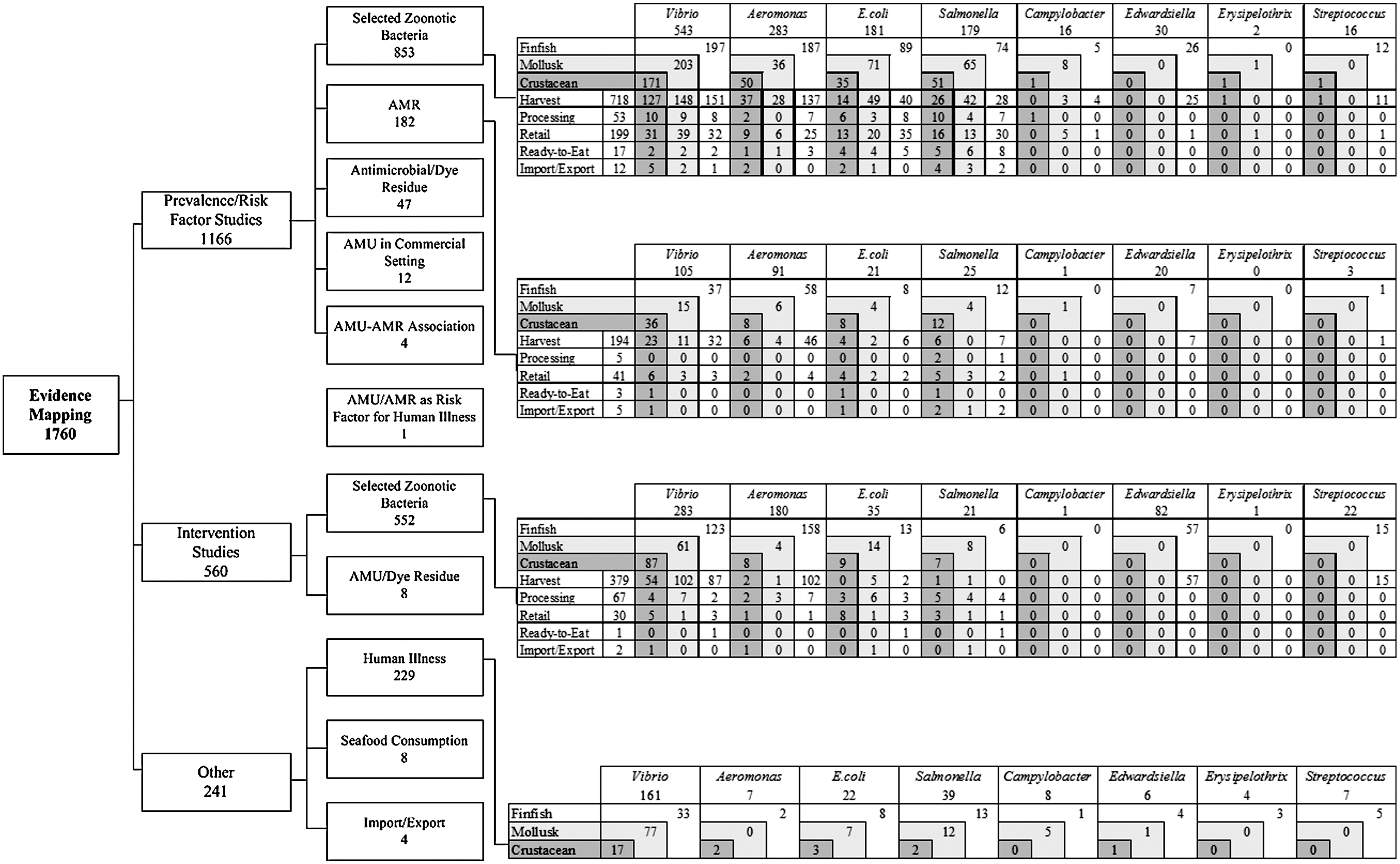
Evidence mapping. Distribution of primary research according to type of study, topic, pathogen, aquatic species, and point in food chain. Studies may be counted multiple times to reflect combinations investigated. Edwardsiella is exclusive to E. tarda and E. ictaluri. Erysipelothrix is exclusive to E. rhusiopathiae. Streptococcus is exclusive to S. iniae.
Aside from the formulated question selected for our SR-MA, other potentially suitable topics for future SR-MA include the prevalence of AMR in various bacteria recovered from aquaculture and seafood, and to a lesser extent, due to a relatively small number of published studies, prevalence of drug and dye residues in seafood (Fig. 2).
MSR, SR database, and meta-analysis
Steps in the SR process, complementary to the ScS, including confirmation of relevance to the SR question, and the reasons for study exclusion at the MSR stage are depicted in Figure 1. From 146 studies relevant to the prioritized SR-MA topics and subjected to MSR, 79% (n=114) were cross-sectional prevalence surveys and the remainder were of longitudinal prevalence design. Thirty-nine studies were excluded as they did not report a measure of effect or association, and four studies were excluded as measures of variability were not reported for adjusted data. Over 80% of the studies (n=121) reported a total sample size of ≥30; 14 and 11 studies had sample sizes of 11–29 and ≤10 samples, respectively, and were excluded. Sampling mostly occurred at local or specialty markets (n=78), followed by commercial processing plants and supermarkets (each n=34) and commercial farms (n=22). Laboratory methods were adequately reported in 89% (n=130) of studies; 76% (n=111) reported media type, time and temperature of incubation and enrichment steps, and the remaining studies reported methods described in other articles (n=19). Due to language restriction, six potentially relevant foreign articles (all in Japanese) were excluded at this stage. The SR database contained 72 relevant prevalence studies that passed the exclusion criteria of the first step of MSR assessment (Fig. 1). The distribution of studies by aquatic species, bacteria, and point in food chain is presented in Table 1. Over 70% of studies were published in 2000 or later, and all were published in English except two published in Spanish (Torres Vitela et al., 1993; Pereira et al., 2007). The overwhelming majority of all studies reported prevalence outcomes (n=66) as opposed to concentration (n=6 studies). The SR database included samples collected and tested in 23 countries. The most frequent sampling location was India (n=18 studies) followed by the United States (n=7), China (n=7), Brazil (n=6), and Japan (n=4). Others included Italy, Spain, and Taiwan (each n=3); Bangladesh, Malaysia, Mexico, Thailand, and Vietnam (each n=2); and Chile, Germany, Indonesia, Nigeria, Peru, Philippines, Portugal, Switzerland, Trinidad and Tobago, Turkey, and the United Kingdom (each n=1).
Studies may be counted multiple times to reflect combinations of aquatic species, pathogen, and point in food chain investigated.
Includes studies that have explicitly stated that the samples investigated originate from imported or exported products.
The MA was restricted to studies (n=56 studies/252 unique data observations) conducted at the retail and RTE settings (Fig. 1) due to the close proximity of this setting to the point of consumption and to low numbers of studies and considerable heterogeneity across studies at other levels (Table 1). Region-level MA pooled summary estimates and respective confidence intervals were reported for homogenous data subsets (p>0.10), and median and range for heterogeneous (p≤0.10) bacteria-seafood combination data subsets (Tables 2 and 3). The subgroup analysis showing reported prevalence trends of Aeromonas, E. coli, and Salmonella in salmon by country is presented in Figure 3. None of the MA data subsets met a priori selected criterion for evaluating potential publication bias.
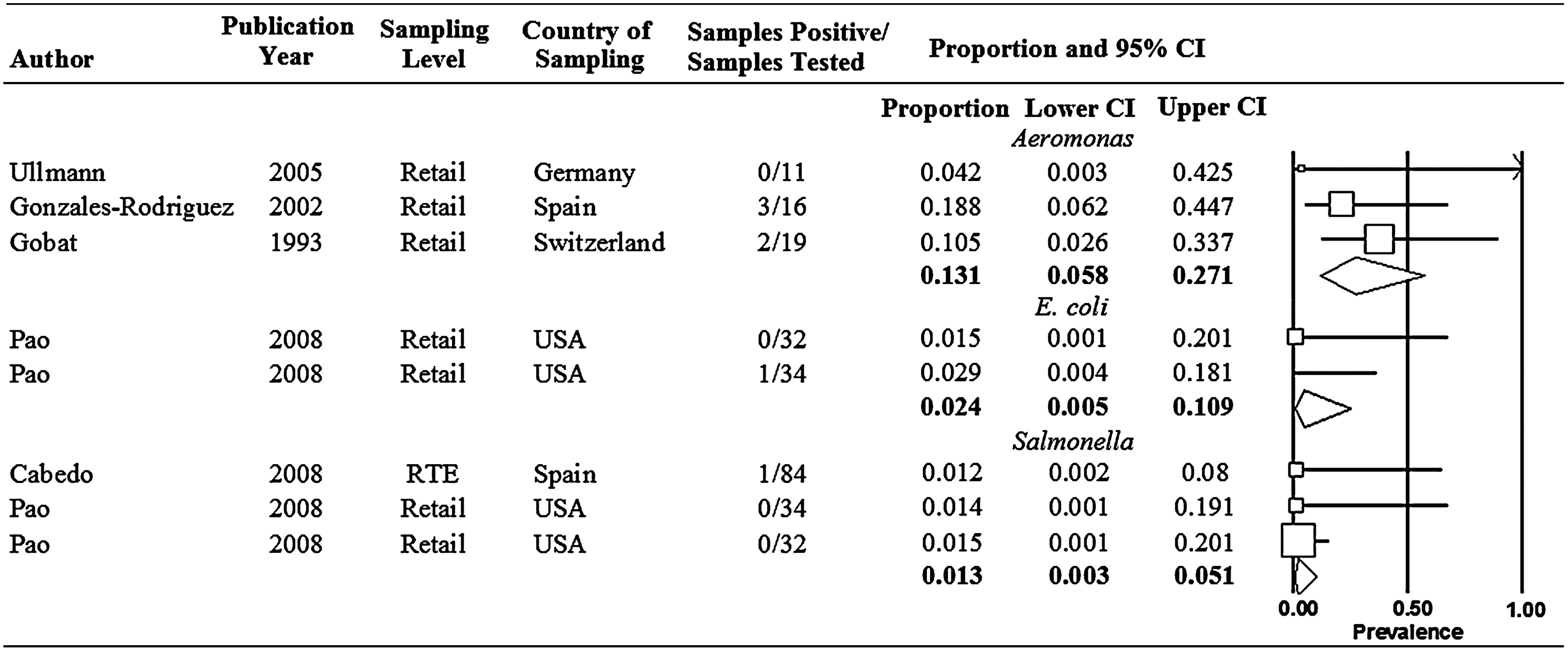
Random effects meta-analysis and forest plot of the prevalence (expressed as proportion) of Aeromonas spp., E. coli, and Salmonella spp. In salmon. Study prevalences were homogeneous. I2 statistics of 0%. Pooled prevalence: Aeromonas spp. 0.131 (0.058–0.271), E. coli 0.024 (0.005–0.109), Salmonella spp. 0.013 (0.003–0.051).
Samples were reported as retail or RTE products.
Trial is a unique combination of aquatic and bacteria species using a specific outcome and sample type.
Heterogeneity refers to the difference in the estimates of effects due to variability between studies.
Pooled prevalence estimate (confidence interval) is presented only in absence of heterogeneity (p>0.10).
Median (range) is reported in presence of heterogeneity using reported prevalence from individual studies representing a unique subset of data.
Only a single trial was available in this subset of data; meta-analysis was not attempted.
CI, confidence interval; N. Amer, North America; ME, Middle East; Carib/SA, Caribbean and South America.
Samples were reported as retail or RTE products.
Trial is a unique combination of aquatic and bacteria species using a specific outcome and sample type.
Heterogeneity is the differences in the estimates of effects due to variability between studies.
Pooled prevalence estimate (confidence interval) is presented only in absence of heterogeneity (p>0.10).
Median (range) is reported in presence of heterogeneity using reported prevalence from individual studies representing a unique subset of data.
N. Amer, North America; ME, Middle East; Carib/SA, Caribbean and South America.
Discussion
Through the ScS, we were able to identify, in a transparent manner, the overall amount and distribution of published aquaculture-related research by various topics, main characteristics, strengths, and gaps in the body of knowledge. The format of the interactive ScS methodology with engagement of the main stakeholder/end user of this information throughout the study was useful for identifying areas with sufficient amount of data potentially suitable for more rigorous SR-MA and prioritizing focused questions for SR-MA.
Overall, MA results indicated significant heterogeneity across studies representing various pathogen/ seafood combinations. Wide ranges in prevalence may be due to the fact that most seafood is purchased in only lightly processed forms so improper harvesting or processing can introduce bacterial contaminants, potentially posing public health risks (Canadian Aquaculture Industry Alliance, 2008). Heterogeneity could be potentially explained with the difference in study design or other country-contextual factors that might impact microbial contamination of seafood. For example, some heterogeneity might be attributed to geographic differences in study locations; however, information on the country of product origin was rarely available, precluding better analysis of this aspect. Study design–related factors, for example, inadequate randomization at sampling, type of sample used (e.g., homogenized meat), and type of tests used for measuring bacterial prevalence (e.g., culture media), or concentration are likely contributors to observed differences (Lijmer et al., 2002).
In the agri-food sector, SR format has been primarily used to assess intervention efficacy, but also to evaluate diagnostic test accuracy or prevalence and risk factor research knowledge (Sanchez et al., 2007; Sargeant et al., 2007; Waddell et al., 2009; Wilhelm, 2009; Young et al., 2009). In this study, we identified relatively large amounts of intervention research investigating Vibrio and Aeromonas at the farm level. The suitability of these areas could be further explored through rigorous SR process and potential MA and provide useful insights for future research direction, and depending on the data, perhaps even information on more effective intervention strategies. To the best of our knowledge, SR-MA addressing these topics in aquaculture does not currently exist. We identified a lack of published research investigating AMU in aquaculture, associations between AMU and AMR, and the human health impact of AMU/AMR from aquaculture. This is similar to the conclusions of authors of previously published narrative reviews discussing rising public health concerns in aquaculture (MacMillian, 2001; Cabello, 2006; Sapkota, 2008). Specific quantitative AMU data publicly available on an annual basis in a few European surveillance programs (e.g., DANMAP, NORM-VET) do not likely exist in other regions. In Canada, the province of British Columbia has been collecting AMU information since 1995 but only reports the number of grams of active drug per metric tonne of salmon produced, regardless of the class of antimicrobial (Ministry of Agriculture and Lands, 2008). AMR and AMU are internationally recognized public health priorities (WHO/OIE/FAO, 2007), and more primary research and funding for such research is needed globally and particularly in the main seafood-producing and primarily importing countries.
Although Vibrio was most often investigated across the research themes, the overall number of relevant studies of sufficient quality investigating this pathogen was low to moderate (1–21 studies/species). This bacterium is a leading cause of seafood-borne disease in the United States (Kaysner et al., 2001) and Japan (IDSC, 1999), and accounts for about a third of all foodborne outbreaks in China (Liu et al., 2004). Given the importance of Vibrio as human pathogen and frequently reported high prevalence at retail, there is a need for larger and representative bacteriological surveys measuring prevalence and concentration of this bacterium, particularly in shellfish/crustaceans. The broad range of prevalence (often >90%) observed across and within specific species-bacteria-region in shellfish/crustaceans at retail is of particular interest.
Aeromonas is common in finfish (Herrera et al., 2006; Yücel et al., 2010), resulting in contamination likely during processing (e.g., smoking) or retail packaging (Butt et al., 2004). Only 11 relevant prevalence studies of bacterial contaminants were found in selected finfish populations (salmon and tilapia) with only two to three studies investigating each of the four selected bacteria at retail. Random-effect MA highlighted that Aeromonas and E. coli, two bacteria generally considered as commensals with pathogenic potential, tend to be more frequently isolated than Salmonella in retail salmon, highlighting these bacteria as potential targets for surveillance initiatives.
Salmonella and E. coli were studied in 1–14 and 1–8 studies, respectively, across the species and mostly in shrimp. However, given that between 2005 and 2010, most seafood-borne outbreaks of Salmonella were attributed to consumption of oysters and salmon, perhaps future studies and surveillance programs should focus more on this combination to determine the importance of oysters and salmon as vehicles for Salmonella.
Lastly, a relatively low volume of research investigating Campylobacter, Edwarsdiella tarda and E. ictaluri, Erysipelothrix rhusiopathie, and Streptococcus iniae was found. This might be explained by their perceived lack of relevance to seafood safety and/or public health, their higher relevance to other types of food-animal production (e.g., Campylobacter in poultry), or recent emergence in the aquaculture sector.
The scarcity of information for many species-bacteria-region combinations can be partly explained by small and sporadic sampling, or low-quality studies. The assessment of methodological soundness of studies included in the SR consistently indicated study design and reporting deficiencies. The sample size or sampling frame was not justified in any study; >100 retail or RTE samples were collected in only 26 studies, and all studies utilized convenience as opposed to random sampling, which would have ensured sample representativeness of target populations. We could not evaluate the effects of these aspects through sub-analysis because of the overall low number of studies and trials per unique pathogen-aquatic species-seafood combination. A low sample size used in almost all studies limits the precision and generalizability of an individual study or our pooled estimates (Borenstein, 2009). Meta-regression of all prevalence retail data might provide some additional insights, and inclusion of additional research published after November 2010 would increase the power of such analysis.
To avoid any study exclusion and inform the overall SR-MA process with better designed and reported data, researchers in food (including seafood) safety should follow the STROBE (Strengthening the Reporting of Observational Studies in Epidemiology) (Vandenbroucke et al., 2007) and REFLECT (Reporting Guidelines for Randomized Controlled Trials for Livestock and Food Safety) guidelines (Sargeant et al., 2010). These guidelines provide reporting suggestions with the aim of standardizing the quality and utility of published data. Implementation of these guidelines, already adopted by many relevant journals, would considerably improve the overall utility of SR-MA, an otherwise powerful methodology.
We used a comprehensive search and search verification strategy to identify published literature. There may be a significant amount of data in aquaculture industry that is unpublished and of proprietary nature. We did not contact any researchers working in this area to find out about potential on-going projects or in-press publications, and did not perform specialized aquaculture web searches. These aspects should be addressed in updated and similar studies. Our efforts to reduce language bias included comprehensive efforts to secure sufficient number of reviewers who were proficient, beside English, in either French, Portuguese, Spanish, or Slavic languages. Exclusion of six articles published in Japanese might have resulted in omission of relevant and important data given that Asia is one of the leading aquaculture regions (FAO, 2010). International organizations dealing with aquaculture (e.g., FAO) would benefit from the ScS-SR-MA approach when addressing and prioritizing the needs, gaps, and opportunities associated with research knowledge in a large research field. International collaboration among researchers with complementary technical and language capabilities could be better facilitated through international organizations and benefit all collaborators.
Although the seafood species for the SR-MA were selected based on their importance within the Canadian context, a lack of any published research was observed both for domestic and imported products to Canada. To address these knowledge gaps, the Public Health Agency of Canada is currently piloting a study investigating seafood contamination and antimicrobial resistance at retail (personal communication with Brent Avery, PHAC). More primary research within the Canadian context is needed, as is better coordination of various initiatives among various agencies (e.g., CFIA and PHAC), academic and government research groups working in this area, and various groups of aquaculture stakeholders. Canadian regulatory agencies in charge of program and policy development for this vital component of the agri-food sector could use the findings from our SR-MA along with other relevant data to adapt current surveillance initiatives for both domestic and imported aquaculture and seafood products within the context of internationally recognized risk-based surveillance (Stärk et al., 2006).
The ScS-SR-MA approach is time-, expertise-, and manpower-demanding. However, the transparency and soundness of the overall approach, including overall utility of generated inputs even in the presence of scarce or low-utility published research, outweighs those challenges. The main advantage of this initially resource-demanding approach is that it can be updated over time using the same review protocol. Updated searches typically capture far fewer citations than the initial reviews, and the rest of the ScS-SR-MA process can be completed very quickly. As new research becomes available, this on-going approach could (a) streamline research direction or preclude duplication of research, (b) generate more robust pooled intervention efficacy or prevalence estimates for quantitative risk assessments and surveillance initiatives, and (c) inform policy and decision making. This is particularly applicable to policy relevant and complex agri-food public health issues requiring engagement of multiple stakeholders. Similar to the healthcare sector (including public health), government and academic organizations working on the interface of humans, animals, and environment should consider developing operational research knowledge synthesis and translation capacity in support of evidence-informed policy making in this field.
Conclusion
Although the use of the ScS framework is still being validated in the agri-food industry, our initial experience indicated that this methodology was useful for a transparent assessment of existing research knowledge, strengths, gaps, and needs pertaining to selected zoonotic bacteria and public health topics in aquatic species and seafood. Through our SR, we identified specific areas in reporting of study methodology and results that could be improved to increase the general quality of studies and their utility in MA. Our MA resulted in pooled prevalence estimates only for salmon and need to be interpreted with caution due to the small number of studies and a low power of heterogeneity test. Full benefits of SR-MA methods will be realized when larger, better designed, and reported bacteriological seafood surveys become available globally and within the Canadian context.
Footnotes
Acknowledgments
We would like to thank Drs. Sophie St-Hilaire and Carol McClure for their guidance; Drs. Ian Young and America Mederos Silveira, Marjorie Bercier, Rebecca de Parent, and Karine Forget for reviewing papers; Janet Harris, Nanky Rai, Kyle Burgers, Oliver Bucher, and Malcolm Weir for their help in procurement of papers; as well as the funding support of the Public Health Agency of Canada.
Disclosure Statement
No competing financial interests exist.