




Abstract
Campylobacter jejuni is susceptible to low temperatures. Freezing and chilling are effective interventions for reducing the occurrence of C. jejuni on poultry meat. The survival rates of three C. jejuni strains (ATCC33560, JR0706-2, and ALM-80) inoculated onto chicken meat samples were measured at −20°C and 4°C, and the survival curves of these three strains were determined. The results showed that the number of surviving cells decreased by 3.16, 2.87, and 3.14 log colony-forming unit (CFU)/g, respectively, at −20°C during the 55-day storage period. The survival curves showed that the mean inactivation speeds were slow in the initial 20 days of storage at −20°C, dropped rapidly between 25 and 45 days, and reached a plateau in reduction between 45 and 55 days. The number of surviving cells during the 10-day storage period at 4°C decreased by 3.47, 3.35, and 3.51 log CFU/g, respectively. The mean inactivation speeds at 4°C were 0.347, 0.355, and 0.439 log CFU/day. There were some differences in the inactivation speeds of the three strains of C. jejuni, but there was no significant difference in the trend of inactivation among the strains (p>0.05). Only the seven parameters are different for the strains originating from diverse sources when the inactivation trend was determined using a formula. Data-fitting software, MATLAB, was used to fit the survival rates data. The results showed that the established inactivation kinetics function fit the data well for the three different strains stored at −20°C and 4°C. This study revealed the inactivation kinetics for three C. jejuni strains on chicken meat during low-temperature storage and provided useful information for C. jejuni risk management.
Introduction
In recent years, mathematical models have been used to predict the effect of food characteristics and environmental factors on bacterial growth. These models have also been used to evaluate and monitor food shelf life and microbiological safety (Murphy et al., 2006), which provide important information for establishing food safety evaluation models. However, most models are suitable for studying the growth dynamics of specific bacteria under a certain temperature range. Inactivation models for bacteria under low-temperature storage are less reported. In this study, we contaminated chicken samples with three C. jejuni strains from different sources and investigated the survival of the bacteria under −20°C and 4°C storage conditions. This study provides information to help predict the survival ability of C. jejuni during low-temperature storage.
Methods
Strains
The standard strain of C. jejuni ATCC33560 was kindly provided by the Shanghai Entry-Exit Inspection and Quarantine Bureau. Strain JR0706-2 was isolated from chicken samples in the farmer market. Strain ALM-80 was isolated from swab samples of chicken. All strains were confirmed by multiplex polymerase chain reaction method (Huang et al., 2009).
Culturing of bacteria
Three strains of C. jejuni (ATCC33560, JR0706-2, and ALM-80) were streaked onto Campylobacter blood-free selective agar plates containing charcoal-cefoperazone-deoxycholate agar (CCDA) selective supplement (Oxoid, Basingstoke, Hampshire, UK). The plates were immediately placed into microaerophilic airbags and sealed in an anaerobic jar. After 48 h of growth, single colonies were chosen and streaked onto CCDA plates. After an additional 48 h of growth, bacteria were washed off with the appropriate amount of Brucella broth, and the bacterial suspension was adjusted to 107 CFU/mL for future use.
Contamination and storage experiments
The chicken samples were pealed and washed before being cut into similarly sized pieces of diced chicken (1 cm×1 cm×0.5 cm). The diced chicken samples were placed into sterile bags with three samples in each bag. Samples were weighed, and the bags were sealed with clips. The chicken samples were irradiated (25 kGy) at the Yangzhou Gamma-Ray Center. Irradiated samples were placed in an ice box and shipped to laboratories for future use. Each bag of the diced chicken samples was immersed into a 200- mL flask containing the bacterial cultures. After shaking for 30 min at 120 rpm, the bacteria were evenly distributed on the surface of the chicken samples. The diced chicken samples were removed using forceps and placed into a clean bag for 2 min. Subsequently, the samples were placed into a sterile bag, sealed and stored at either −20°C or 4°C. The chicken samples stored at −20°C were collected every 24 h for the first week, and the bacterial CFU was determined at each time point. After the first week, the bacterial CFU was determined every 48 h. The chicken samples stored at 4°C were collected every 24 h, and the bacterial CFU was determined at each time point.
Repeatability of the CFU counting in different samples
To confirm that similarly sized chicken samples had a similar ability to absorb C. jejuni and to ensure the repeatability of the CFU counting, three groups of chicken samples were randomly selected, and the CFU was determined.
Determination of the bacterial CFU in the chicken samples after storage
The contaminated samples were collected from −20°C or 4°C storage and stored at the same temperature; three fractions of contaminated chicken samples by each strain were tested synchronously. Brucella broth (volume=9 folds of the sample weight) was added to each chicken sample before the samples were minced. The ground chicken samples (1 mL) were 10-fold serially diluted with Brucella broth. The diluted samples (0.1 mL) were spread onto modified CCDA (plus 32 mg/L cefoperazone and 10 mg/L amphotericin B)plates for CFU counting. The average count was converted into CFU/mL of the sample.
Establishment of the bacterial inactivation formula
The survival rate of the bacteria was calculated according to the formulas:
where R represents the survival rate, Nt represents the CFU/g of sample after t hours of storage, and N0 represents the CFU/g of sample at 0 h of storage. The survival curve was generated by defining the survival rate as the x-axis and the storage time as the y-axis. The MATLAB7.7.7 (Mathworks, Natick, MA) software was used to describe the characteristics of the bacterial inactivation during low-temperature storage.
Results
Repeatability of CFU counting in different samples
The bacterial CFU counting in the contaminated chicken samples is shown in Table 1. After immersion of the chicken samples (1×1×0.5 cm3) into the bacterial culture (107 CFU/mL), the average CFU of C. jejuni was 2.423×10⁶ CFU/g. Analysis of the three groups of chicken demonstrated that the similarly shaped chicken samples had comparable capability of absorbing C. jejuni.
After shaking for 30 min at 120 rpm, bacteria were evenly distributed on the surface of the chicken samples. Diced chicken samples were removed using forceps and placed into a clean bag for 2 min. The average CFU of C. jejuni was 2.423×10⁶ CFU/g. Analysis of the three groups of chicken demonstrated that similarly shaped pieces of chicken had comparable capability of absorbing C. jejuni.
Inactivation of C. jejuni after 55 days of storage
Three strains of C. jejuni were inoculated onto chickens, and the survival rate of C. jejuni during storage at −20°C was shown in Figure 1. The number of surviving bacteria for the three strains was reduced by 3.16, 2.87, and 3.14 log CFU, respectively, during the 55 days of storage. The survival rate decreased slowly in the initial 20 days of storage, with an average inactivation rate of 0.045, 0.035, and 0.0505 log CFU/day, respectively. The bacterial CFU was reduced rapidly from 20 days to 45 days, with an average inactivation rate of 0.0816, 0.0808, and 0.0844 log CFU/day, respectively. The reduction of the bacterial CFU further decreased from day 45 to day 55, with an average inactivation rate of 0.03, 0.018, and 0.0175 log CFU/day, respectively. There was no significant difference in the inactivation rates between the three strains.
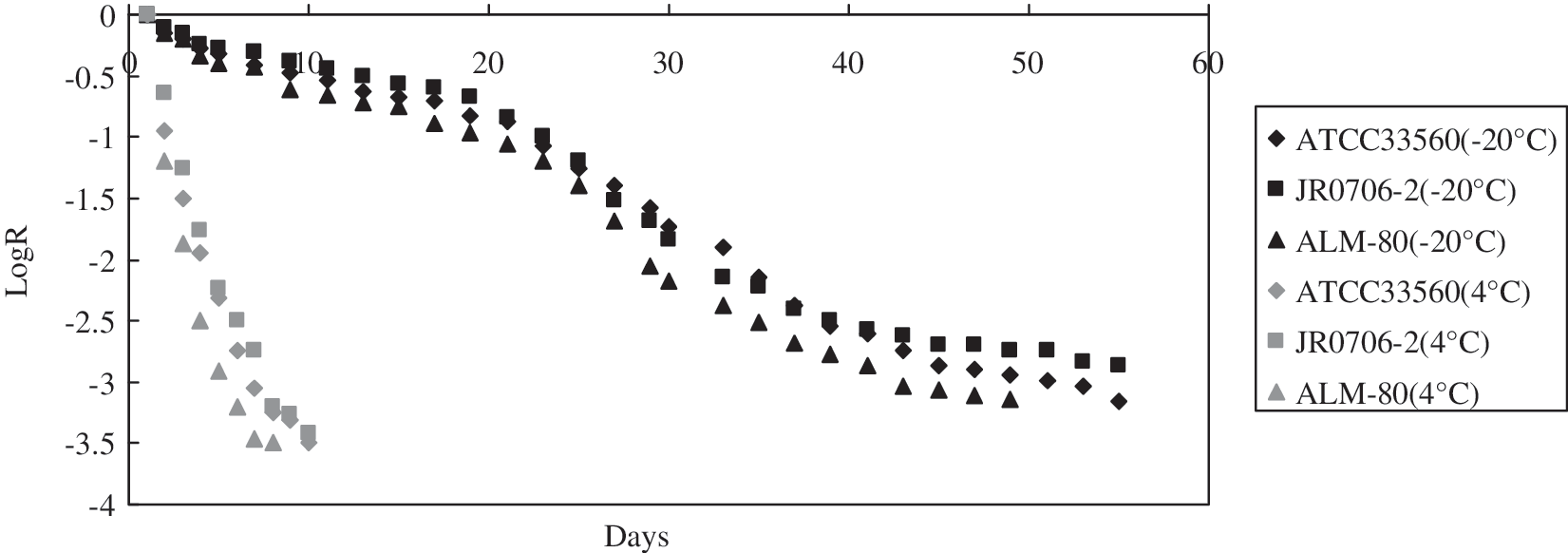
Inactivation characteristics of Campylobacter jejuni in chicken meat stored at −20°C and 4°C. Chicken samples were collected every 24 h for the first week, and the bacterial colony- forming unit (CFU) was determined at each time point. After the first week, the bacterial CFU was determined every 48 h. The survival rate decreased slowly in the initial 20 days of storage, was reduced rapidly from 25 to 45 days, and reached a plateau in the reduction of the bacterial CFU from day 45 to day 55. There was no significant difference in the inactivation rates between the three strains. In the experiment at 4°C storage, chicken samples were collected every 24 h, and the bacterial CFU was determined. The survival rate decreased after 10 days of storage. The bacterial CFU of the ALM-80 strain decreased most rapidly, while the bacterial CFU of the JR0706-2 decreased most slowly.
Dynamic inactivation for C. jejuni under frozen conditions
The inactivation formula for the three strains at −20°C was obtained as follows:
where x and y represent the storage time and the survival rate, respectively, and b 1, b 2 b 3, b 4, b 5, b 6, and b 7 are the seven parameters of the formula. The different strains had different values for each of these parameters in this formula.
Inactivation curve of C. jejuni at 4°C for 10 days of storage
The strains of C. jejuni were inoculated onto chickens, and the survival rate of the C. jejuni during storage at 4°C was shown in Figure 1. The number of surviving cells of the three strains decreased by 3.47, 3.35, and 3.51 log CFU, respectively, after 10 days of inoculation on the chickens. The average inactivation rates of the three strains were 0.347, 0.355, and 0.439 log CFU/day, respectively. The CFU of the ALM-80 strain decreased quicker while the CFU of the JR0706-2 strain decreased slower, which may be due to adaptation to various environmental conditions. The ALM-80 was isolated from swab samples of chicken anus, and this strain has weak resistance to low temperature.
Dynamic inactivation formula for the C. jejuni under chilled conditions
Software was used to obtain the dynamic inactivation formula for the three strains of C. jejuni under cold conditions. The formula is as follows:
where x and y represents the storage time and the survival rate, respectively, and b 1, b 2, and b 3 represent the three parameters. The different strains had different values for each of these parameters.
Evaluation of the formula
The R2 value for the inactivation formula under frozen and chilled conditions is greater than 0.98. The formula predicts the inactivation of the three C. jejuni strains under chilled conditions.
Discussion
Food poisoning cases caused by C. jejuni are distributed worldwide (Huang et al., 2009). The incidence is rising, especially in developing countries (Huang et al., 2009). Chicken is the main carrier for the spread of C. jejuni. Cold storage is an important approach to prevent microbial contamination and proliferation during chicken processing and distribution. Cold storage is also the most common way to extend the shelf life of chicken (James et al., 2007). Therefore, understanding the inactivation of C. jejuni in chicken products during low-temperature storage has great value for the risk assessment and prevention of adverse effects.
Europe's food safety experts believe that fresh chicken should be removed from the food supply chain until effective industrial methods are developed to reduce the level of C. jejuni (Georgsson et al., 2006). It is recommended that consumers buy frozen or processed chicken. Currently, there are many studies on the effect of low temperature on C. jejuni (Georgsson et al., 2006). Different studies have inconsistent results due to the different experimental methods being used. Some research has been performed using predictive food microbiology. The speed of inactivation of C. jejuni on chicken is dependent on the freezing frequency, temperature, and food composition (Turner et al., 2004). The survival ability of C. jejuni on surface of chicken skin is weaker than inside chicken meat (Ritz et al., 2007). In addition, these previous studies only used a single source of C. jejuni strains as experimental subjects. In natural conditions, there are many different ways that chicken can become contaminated with C. jejuni. Therefore, the source of the C. jejuni on the surface of the chicken is not the same, and the inactivation characteristics of the C. jejuni from different sources are different under refrigeration conditions. In our study, three strains from different sources were used to research the inactivation of C. jejuni at low temperature (4°C or −20°C).
We contaminated chicken products with three different strains of C. jejuni and investigated the survival properties of C. jejuni under freezing (−20°C) and refrigeration (4°C) conditions in this study. Our results showed that under the freezing condition, the bacterial inactivation was accelerated after 3 weeks of contamination. The bacterial inactivation entered a plateau phase after 6 weeks of contamination. The inactivation rate under the refrigeration condition was significantly faster than that under the freezing condition. C. jejuni can generate VBNC cells at a low temperature during long-term storage (Gangaiah et al., 2009; Klancnik et al., 2009; Jackson, 2009). In conclusion, we determined the characteristic features of bacterial inactivation for C. jejuni on chicken under low-temperature conditions. The predicted results from the formula were highly consistent with the actual values we obtained. These results provided a theoretical model to analyze the dynamic variation of the residual bacteria during low-temperature storage.
Conclusion
The results of this study indicated that freezing and chilling are the best intervention methods to control the number of C. jejuni on poultry meat. The number of surviving cells decreased by 3.16, 2.87, and 3.14 log CFU/g, respectively at −20°C during the 55-day storage period. The number of surviving cells decreased by 3.47, 3.35, and 3.51 log CFU/g, respectively, at 4°C during the 10-day storage period.
Footnotes
Acknowledgments
This work was supported by the NSFC (grant 31072150), the Ministry of Science and Technology of China (grant 2009BADB9B01), and the Natural Science Foundation of Jiangsu Higher Education Institutions of China (grant 2009KJA230001).
Disclosure Statement
No competing financial interests exist.