




Abstract
In this study, we studied the effects of some plant hydrosols obtained from bay leaf, black cumin, rosemary, sage, and thyme in reducing Listeria monocytogenes on the surface of fresh-cut apple cubes. Adaptive neuro-fuzzy inference system (ANFIS), artificial neural network (ANN), and multiple linear regression (MLR) models were used for describing the behavior of L. monocytogenes against the hydrosol treatments. Approximately 1–1.5 log CFU/g decreases in L. monocytogenes counts were observed after individual hydrosol treatments for 20 min. By extending the treatment time to 60 min, thyme, sage, or rosemary hydrosols eliminated L. monocytogenes, whereas black cumin and bay leaf hydrosols did not lead to additional reductions. In addition to antibacterial measurements, the abilities of ANFIS, ANN, and MLR models were compared with respect to estimation of the survival of L. monocytogenes. The root mean square error, mean absolute error, and determination coefficient statistics were used as comparison criteria. The comparison results indicated that the ANFIS model performed the best for estimating the effects of the plant hydrosols on L. monocytogenes counts. The ANN model was also effective; the MLR model was found to be poor at estimating L. monocytogenes numbers.
Introduction
T
L. monocytogenes contamination has been mostly associated with dairy products. However, contamination of beef, pork, poultry, seafood, and fresh produce (such as cabbage, celery, lettuce, cucumber, and mixed salad) has also been reported (Sizmur and Walker, 1988; Heisick et al., 1989; Abadias et al., 2008). Occurrence of L. monocytogenes in fresh produce is partly due to its presence in animal feces, soil, surface, river and canal waters, and effluent from sewage treatment operations (Beuchat, 1996). Outbreaks caused by L. monocytogenes contamination of fresh-cut apples have been reported less frequently. Sado et al. (1998) isolated L. monocytogenes from two retail apple products: an apple juice and an apple raspberry blend product marketed in the United States. Another recorded incident was the recall declaration in 2001 by the Food and Drug Administration (FDA) for packaged fresh-cut apples due to L. monocytogenes contamination (Lewerentz et al., 2003). L. monocytogenes cannot penetrate to the inner tissues of whole fruits by breaking the barrier provided by the peel or rind (Beuchat, 1996). However, it can survive on fresh-cut apples if they are contaminated after minimal processing procedures such as cutting of the product (Beuchat, 1996; Conway et al., 2000; Alegre et al., 2010).
Washing is an essential step to remove microorganisms from the surface of fresh fruit (Ruiz-Cruz et al., 2007). Chlorine-based sanitizers have been widely tested for their efficiency as fresh-cut sanitizers. However, they have some limitations. In addition to their limited antimicrobial efficiency, the reaction between chlorine and organic compounds may lead to the formation of some carcinogenic byproducts such as trihalomethanes and haloacetic acids (Hua and Reckhow, 2007). Chlorine also results in high amounts of wastewater (Olmez and Kretzschmar, 2009). Due to the health-related and environmental risks of chlorine use, the food industry has been replacing chlorine-based chemicals with organic antimicrobial agents for fresh-cut product sanitation. A number of organic-based chemicals (such as organic acids, mainly citric, lactic and acetic acid, essential oils, vinegar, and lemon juice) have been investigated for their potential use as natural antimicrobial sanitizers (Karapinar and Gonul, 1992; Sengun and Karapinar, 2004; Chang and Fang, 2007; Olmez and Kretzschmar, 2009; Romeo et al., 2010; Gunduz et al., 2010).
Hydrosols are obtained by essential oil distillation as byproducts (Lis-Balchin et al., 2003; Tajkarimi et al., 2010). Volatile components of hydrosols of a particular plant can be very similar to those of their essential oils since a portion of the essential oil becomes dissolved in the hydrosol during hydrodistillation (Rivera et al., 2010). In this case, it could be expected that hydrosols have antibacterial activity similar to that of essential oils.
Predictive food microbiology has drawn great attention in recent years. Different non-linear mathematical models (like modified Gompertz, logistic, Richards, Baranyi, Stannard, Weibull, and Whiting and Buchanan) have been used to predict the behavior of microorganisms in food systems (Whiting and Buchanan, 1994; Baranyi and Roberts, 1995; Erkmen, 2009). Although they are not the kind of modeling technique by which growth kinetics of any pathogenic microorganism could be modeled using non-linear estimating approaches and estimated in terms of any effective factor (e.g., time, temperature, concentration), adaptive neuro-fuzzy inference system (ANFIS) and artificial neural network (ANN) are novel procedures that have recently been applied for the prediction of microorganism behaviors (Ramos-Nino et al. 1997; Esnoz et al. 2006). ANFIS and ANN have also been applied in the prediction of the identification of food characteristics, food quality assessment, food process, optimization of food processes, and food control (Ramos-Nino et al., 1997; Abu Ghoush et al., 2008; Bouharati et al., 2008; Hernandez, 2009; Yalcin et al., 2011). ANN, ANFIS, and multiple linear regression (MLR) models were compared with each other to predict the inhibition effect of benzoic and cinnamic acids against L. monocytogenes (Ramos-Nino et al., 1997). The ANN model was evaluated for the prediction of the combined effect of pH and NaCl on the heat resistance of Bacillus stearothermophilus spores (Esnoz et al., 2006). In these studies, it was demonstrated that the ANN and ANFIS models could be used in predictive food microbiology.
Thus, the objectives of this study were (a) to determine the effects of plant hydrosols on the survival of L. monocytogenes on fresh-cut apples and (b) to evaluate the ability of the those models (ANFIS, ANN and MLR) for describing the survival of L. monocytogenes against the different hydrosols.
Methods
Preparation of plant hydrosols
Thyme (Thymus vulgaris L.), black cumin (Nigella sativa L.), rosemary (Rosmarinus officinalis L.), sage (Salvia officinalis L.), and bay leaf (Laurus nobilis L.) plant materials were obtained from a local spice market in Kayseri, Turkey. Hydrosols were produced using the method of Sagdic (2003). Fifty grams of plant material was ground, placed into a flask (1 L) with 500 mL of distilled water, and hydrodistilled for 1 h using a Clevenger apparatus. During the hydrodistillation, the essential oil was removed through the cooling tunnels. The hydrosols were kept in sterile bottles at 4°C until use.
Preparation of apple samples
Fresh apples (Golden delicious L.) were purchased from a local supermarket (Kayseri, Turkey) and stored at 4°C. The apples were washed with cold tap water for approximately 2 min to remove undesirable residues and to reduce native microbial load; then they were cut into cubes of 1 cm3 (approximately 1 g each) with a sterile knife. These cubes were used in the experiments.
Inoculation and decontamination processes
L. monocytogenes ATCC 7644 was provided from Kayseri Agriculture Control Protection Management Center, Turkey. The strain was maintained at −80°C. Cryopreserved cells were activated twice in Nutrient Broth (Merck) at 37°C for 24 h. Dip inoculum suspension was prepared by transferring the activated culture into Ringer solution (Merck) at the ratio of 1% (v/v) to obtain a targeted level of 105 CFU/mL of L. monocytogenes.
The apple cubes were tested for the absence of L. monocytogenes and then immersed in the inoculum solutions (sample/inoculum ratio of 1:5 w/v). The samples were gently shaken for 20 sec at 10-min intervals to provide a homogenous distribution and kept in a biosafety cabinet for 1 h at 22±2°C.
Inoculated apple cubes (total 50 g) were immersed in sterile bottles containing 100 mL of each sanitizing hydrosol for 0, 20, 40, or 60 min. Control samples were immersed in sterile tap water. Bottles were covered after the addition of samples and subjected to gentle shaking for 30 sec at 5-min intervals during the treatment period.
Enumeration of bacteria
Ten grams of apple cubes were weighed and transferred into sterile bottles containing 90 mL of sterile Ringer solution, and the bottles were shaken vigorously by hand for 1 min. Then the samples were serially diluted in sterile Ringer solutions. Using the spread plate technique, the samples were spread-plated onto Oxford Listeria Selective Agar (Merck) for enumeration of L. monocytogenes. Following the incubation at 37°C for 24 h, colonies formed on the plates were counted. Microbiological analyses were carried out in triplicate.
ANFIS
ANFIS employs an ANN learning algorithm for constructing a set of fuzzy If-Then rules with appropriate membership functions (MFs) from the specified input–output pairs. In the training phase, ANFIS uses two methods for updating MFs: (i) back propagation for all parameters (a steepest descent method); and (ii) a hybrid method consisting of back propagation for the parameters associated with the input membership and least squares estimation for the parameters associated with the output MF (Jang, 1993). The general architecture of an ANFIS is shown in Figure 1A. The ANFIS consists of five layers.
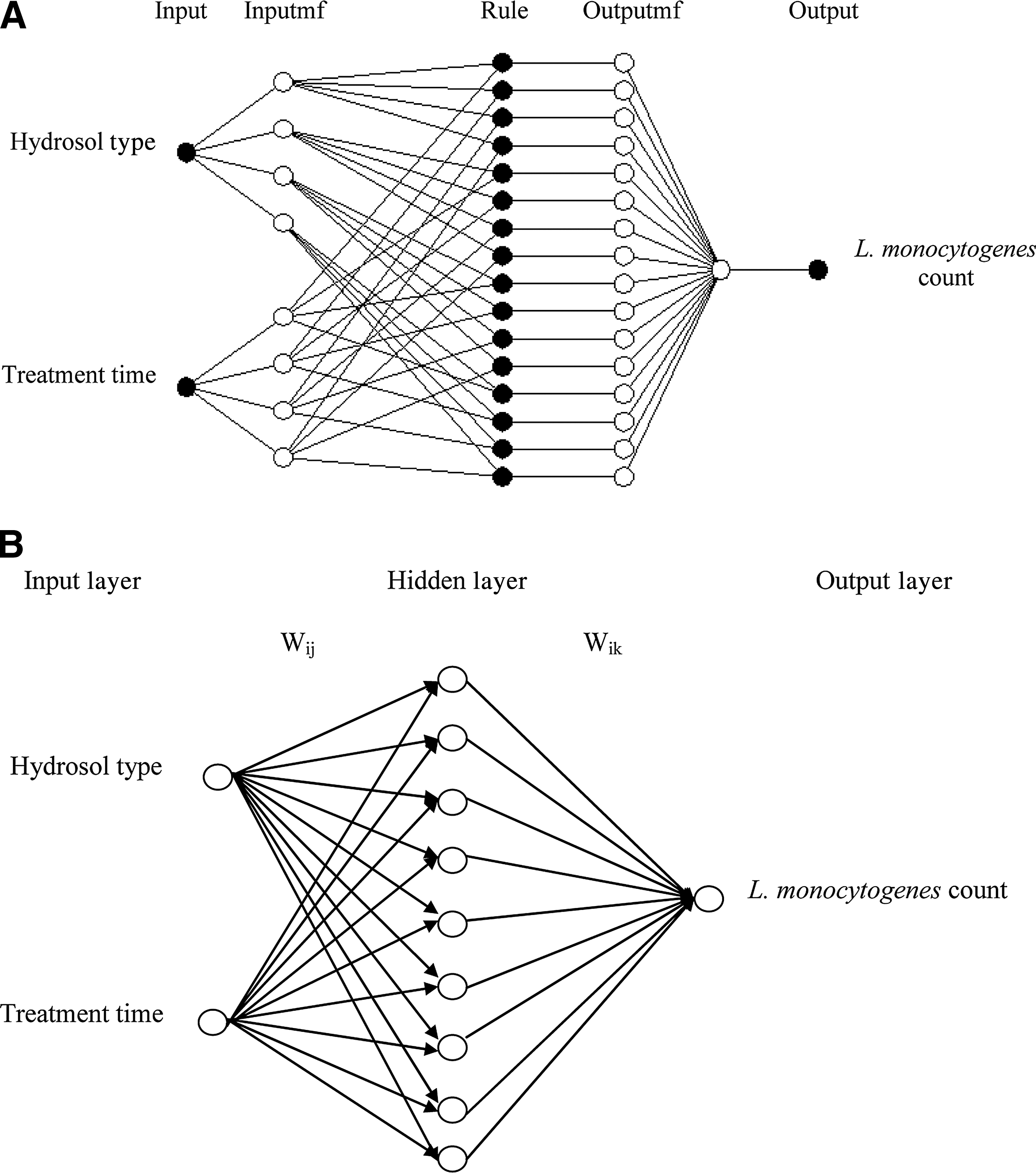
The architectures of the adaptive neuro-fuzzy inference system (ANFIS)
Assume a fuzzy inference system (FIS) is composed of two inputs x and y and one output z. A typical rule set with two fuzzy If-Then rules for the first-order Sugeno fuzzy model can be expressed as
where the A1, A2 and B1, B2 are the MFs for inputs x and y, respectively, and p1 , q1 , r1 are the output function's parameters. The ANFIS system is functionally equivalent to the Sugeno first-order FIS. A detailed explanation of ANFIS can be found in Jang (1993) and Kisi (2006).
ANN
ANN has one or more hidden layers, whose computation nodes are called hidden neurons. Figure 1B shows a three-layered ANN architecture that is composed of three layers i, j, and k, with the connection weights (Wij and Wjk) between the input, hidden, and output layers. Initial assigned weights are corrected during a learning process. In this process, the estimated outputs are compared with the known outputs, and the errors are backpropagated (from right to left in Fig. 1) to obtain the appropriate weight adjustments necessary to minimize errors.
In the current study, the ANN was trained using the Levenberg–Marquardt technique because it is more powerful and faster than the conventional gradient descent technique (Hagan and Menhaj, 1994; Kisi, 2007). The theoretical explanation of ANN can be found in detail in Haykin (1998).
MLR
If it is assumed that the dependent variable Y is effected by m independent variables X1, X2, …, Xm, the regression equation of Y can be written as:
where y is the expected value of the variable Y when the independent variables take the values X1=x1 , X2=x2 , …, Xm=xm .
The coefficients a, b1
, b2
, …, bm
are obtained by minimizing the sum of the eyi
distances of observation points from the plane expressed by the regression equation (Bayazit and Oguz, 1998; Kisi, 2005):
Application of ANFIS, ANN, and MLR
In this study, three different codes were written by using MATLAB 7.01 software for the ANFIS, ANN, and MLR models. For the ANN and ANFIS models, fuzzy logic and neural networks toolboxes were employed. Hydrosol type and treatment time were used as the input parameters for the models to estimate the survival of L. monocytogenes. For the ANFIS, ANN, and MLR analyses, 72 experimental data were used to predict the L. monocytogenes counts on the product. The data were divided into training and testing parts. The first 48 data (67% of the whole data set) were used for training and the second 24 data (33% of the whole data set) for testing. At the first step, the training input and output data were normalized using the following equation:
where xmin and xmax are the minimum and maximum values of the training data set, respectively. The data were scaled between 0.2 and 0.8 by taking a and b values as 0.6 and 0.2, respectively. Then, structures of the optimal ANFIS and ANN models were obtained by trying different model architectures. Gaussian membership functions (MFs) were used for the ANFIS models because they are often selected for practical applications (Russel and Campbell, 1996; Kisi et al., 2006). Different numbers of MFs were tested, and the best one that gave the minimum root mean square error (RMSE) was selected. Four MFs gave the best results for the ANFIS model. An ANN model with one hidden layer was used in the simulations, and the number of hidden nodes was determined using trial-error method. Sigmoid and linear activation functions were used in the hidden and output nodes of the ANN, respectively. As previously mentioned, the ANN was trained using the Levenberg–Marquardt technique. The training of ANN networks was stopped after 100 iterations because the variation of error was too small after this iteration number.
The accuracy of ANFIS, ANN, and MLR models was evaluated using three statistical tools: RMSE, mean absolute error (MAE), and determination coefficient (R
2). The RMSE and MAE can be given as
where N is the number of the data set, and Yi is the L. monocytogenes count.
Statistical analysis
Data were analyzed by two-way analysis of variance (ANOVA) using statistical analysis software (SAS, 2000). Significant differences between the means were further analyzed using a Duncan test.
Results and Discussion
Effect of plant hydrosols on survival of L. monocytogenes
Figure 2 illustrates the effects of plant hydrosol treatments on the survival L. monocytogenes on apple cubes. L. monocytogenes was not detected on unwashed/uninoculated apple cube samples. The initial L. monocytogenes count on inoculated apple cubes was 4.57 log CFU/g. Washing of apple cubes with sterile tap water did not result in a significant (p>0.05) reduction in L. monocytogenes count (Fig. 2), which suggested that water washing made no contribution to reduce L. monocytogenes counts on the surface of apple cubes.
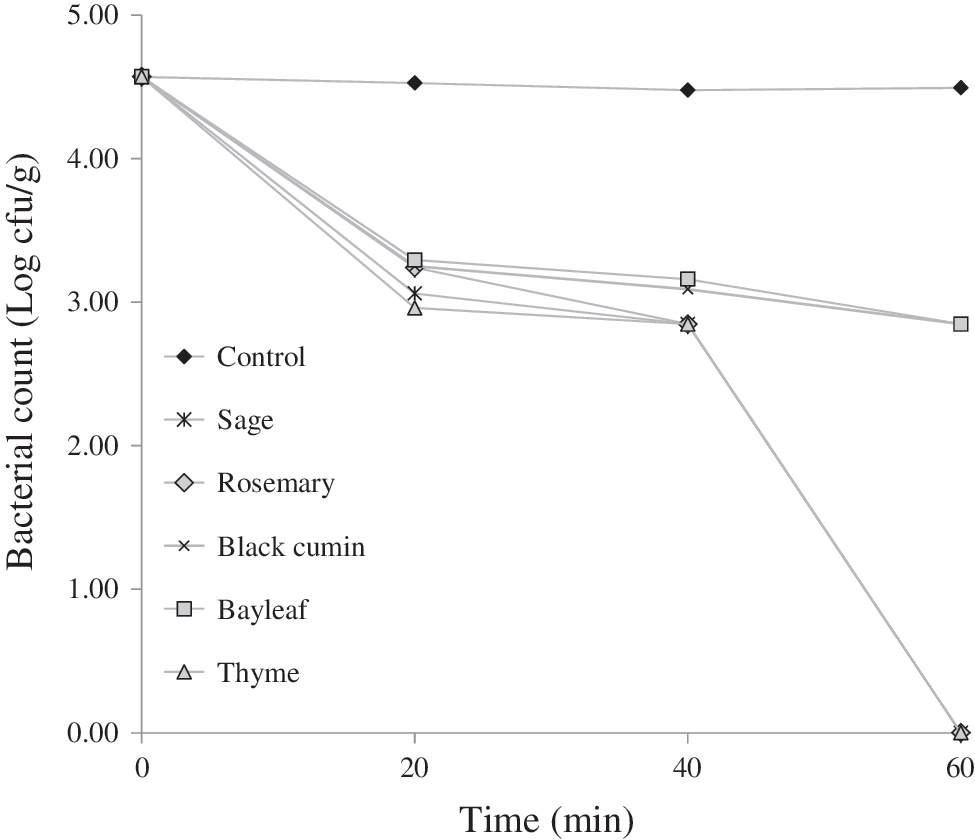
Efficacy of plant hydrosol treatments of apple cubes on Listeria monocytogenes count.
Treatment with plant hydrosols of apple cubes for 20 min provided significant (p<0.05) reductions in the numbers of L. monocytogenes (Fig. 2). While extending the treatment time to 60 min, thyme, rosemary, and sage hydrosols eliminated L. monocytogenes from the apple cubes. There were no significant (p>0.05) differences between the 20- and 40-min treatment times with bay leaf, black cumin, or thyme hydrosols. This may suggest that first contact of those hydrosols with the pathogen produced significant (p<0.05) reductions, although extending contact time to 40 min did not provide additional bactericidal effect. However, treatment with thyme, rosemary, or sage hydrosols for 60 min eliminated L. monocytogenes completely from the apple cubes.
Damaging the fruit's protective epidermal barrier by physical effects or by bacterial/fungi attacks significantly enhances survival or proliferation of foodborne pathogens on those fruits. Fresh-cut produce, by definition, is injured through processes such as peeling, cutting, slicing, or shredding (Harris et al., 2003). Although the presence of L. monocytogenes on fresh-cut fruits and vegetables has been less often reported, contamination of salad vegetables such as cabbage, celery, lettuce, cucumber, onion, leeks, watercress, and fennel with high populations of L. monocytogenes has been reported (Sizmur and Walker, 1988). L. monocytogenes can also multiply and penetrate to the inner tissues of fruits. Conway et al. (2000) reported that L. monocytogenes was capable of surviving and proliferating on Delicious apple slices stored at 10°C or 20°C in air, but did not grow at 5°C. The susceptibility of L. monocytogenes to various antimicrobials has been presented by a number of studies. Chlorine was found to have limited efficiency for inactivation of L. monocytogenes (Nguyen-the and Carlin, 1994). The reduction of L. monocytogenes inoculated to fresh lettuce by treatment with lactic acid, acetic acid, or propionic acid solutions (0.5% or 1%) was found to be less than 1 log CFU/cm2 (Samara and Koutsoumanis, 2009). The number of L. monocytogenes was reduced by 5 log on apple slices by virtue of a commercial wash solution (containing 117 mM calcium ascorbate as the active ingredient) at different pH values (Bhagwat et al., 2004).
Although the in vitro antibacterial activity of plant hydrosols has been reported (Sagdic, 2003; Sagdic and Ozcan, 2003), there has been only a limited number of studies on the effects of plant hydrosols as food sanitizers. In one study, the antibacterial activity of some plant hydrosols against Escherichia coli O157:H7 and Salmonella Typhimurium on fresh-cut apple and carrots was investigated (Tornuk et al., 2011). This, however, is the first study that reports the effects of plant hydrosols as fresh-cut food sanitizers against L. monocytogenes. The main advantage of plant hydrosols is their organic character, which eliminates the negative health concerns of chlorine-based chemicals. Other advantages are that they can be easily and cheaply provided (Tornuk et al., 2011). The results of this study are very promising and should lead to further research in this area.
Modeling the survival of L. monocytogenes by ANFIS and ANN systems
The training and test results of the ANFIS, ANN, and MLR models are presented in Table 1. The optimal number of MFs of the ANFIS model and optimal number of nodes in the input, hidden, and output layers of the ANN model are also given in Table 1. It is clear from the table that both the ANFIS and the ANN models performed effectively, but the MLR model had poor accuracy. Performance of the ANFIS model was slightly better than that of ANN in both the training and testing periods, with lower RMSE and MAE values. By using the ANFIS model, the RMSE and MAE values of the ANN model decreased from 0.2044 to 0.1850 and from 0.1397 to 0.1119, respectively, and R 2 increased from 0.9695 to 0.9752 in the testing period.
ANFIS, adaptive neuro-fuzzy inference system; ANN, artificial neural network; MLR, multiple linear regression; MFs, membership functions; RMSE, root mean square error; MAE, mean absolute error; R2, coefficient of determination; gaussmf, Gaussian membership function.
The estimated and actual L. monocytogenes counts in the training and testing periods are shown in Tables 2 and 3. It can be seen from the last three columns of the tables that the MLR model over/underestimated the L. monocytogenes counts, which demonstrated the nonlinearity of the investigated phenomenon. However, ANFIS and ANN successfully estimated L. monocytogenes counts. The observed and estimated L. monocytogenes counts in the training and testing periods are illustrated in Figures 3 and 4 in the form of a scatterplot, respectively. In addition, three-dimensional graphics for the estimation of L. monocytogenes counts by the ANFIS and ANN model systems in the testing period are given in Figure 5.
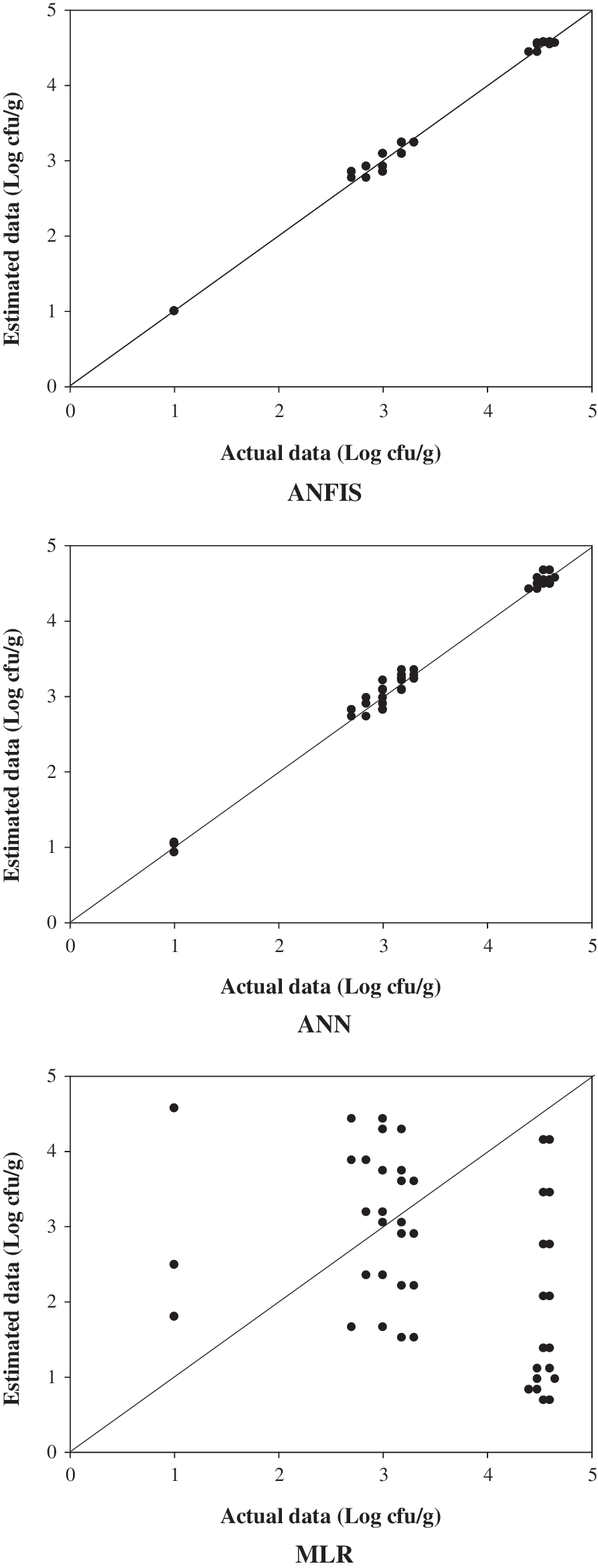
The Listeria monocytogenes count estimates of the adaptive neuro-fuzzy inference system (ANFIS), artificial neural network (ANN), and multiple linear regression (MLR) models for the training period.
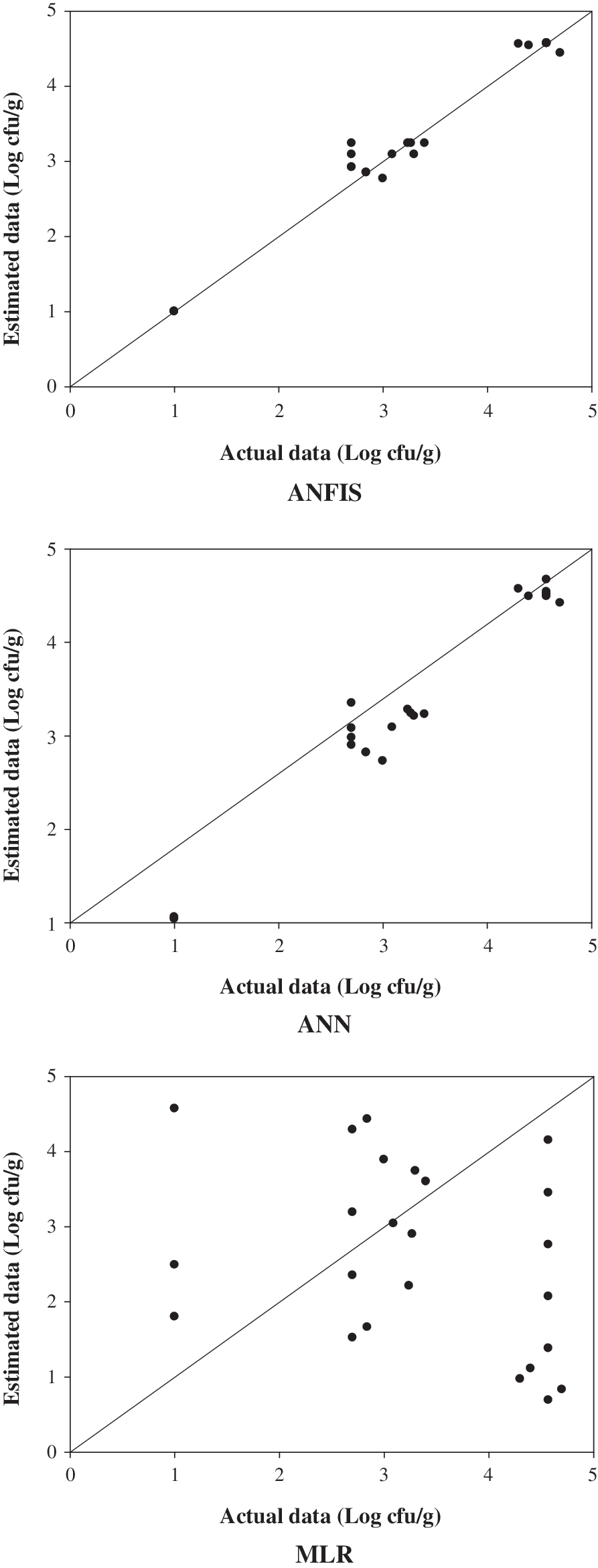
The Listeria monocytogenes count estimates of the adaptive neuro-fuzzy inference system (ANFIS), artificial neural network (ANN), and multiple linear regression (MLR) models for the testing period.
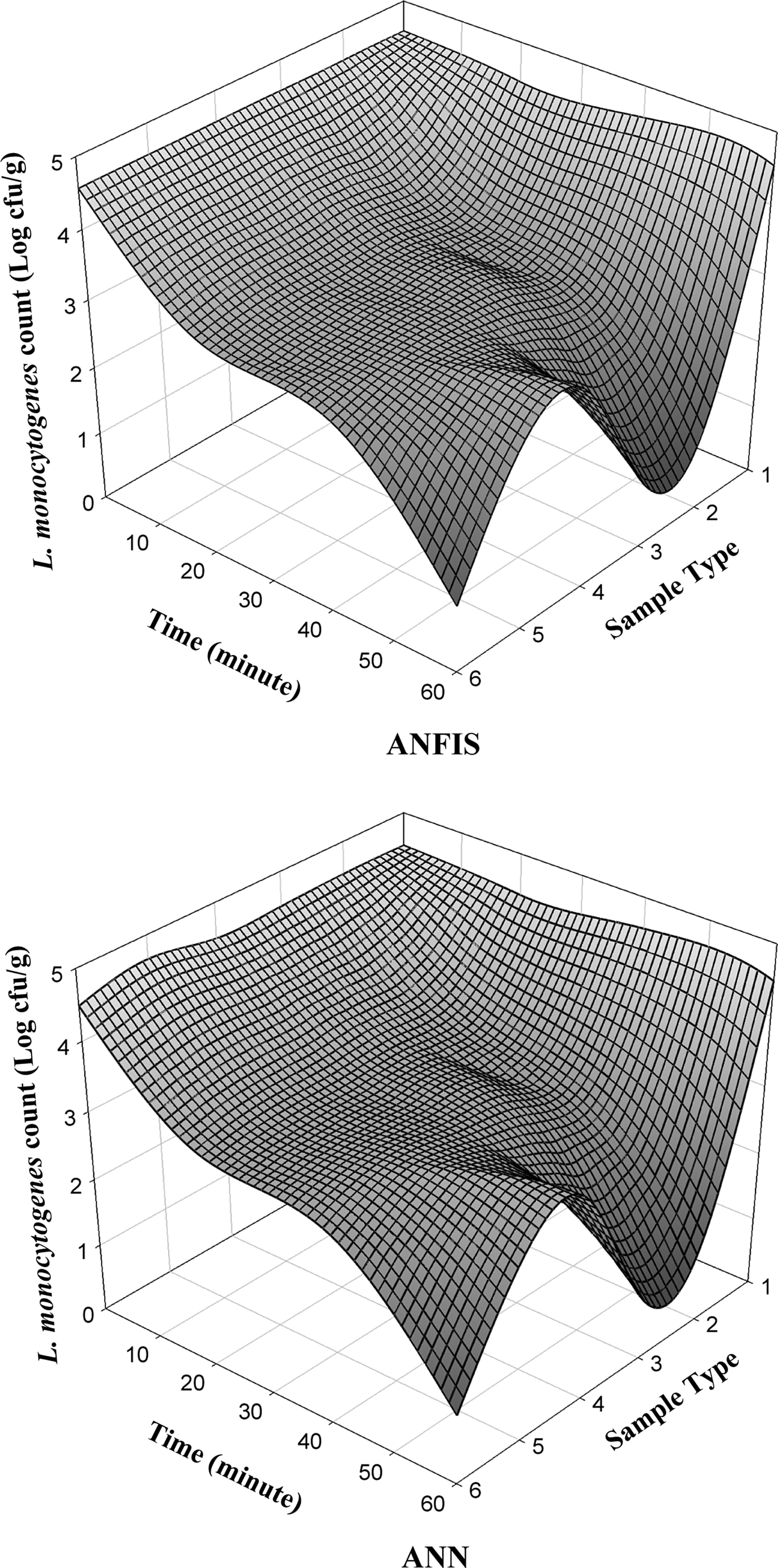
Three-dimensional graphics for the estimation of Listeria monocytogenes count by the adaptive neuro-fuzzy inference system (ANFIS) and artificial neural network (ANN) model systems in the testing period.
ANFIS, adaptive neuro-fuzzy inference system; ANN, artificial neural network; MLR, multiple linear regression; RE, relative error.
ANFIS, adaptive neuro-fuzzy inference system; ANN, artificial neural network; MLR, multiple linear regression; RE, relative error.
The t-test was used for verifying the robustness (the significance of differences between the model estimates and observed values) of the models. Tests were set at a 95% significant level. The statistics of the tests are given in Table 4. The ANFIS and ANN model yields were almost equal with respect to testing values and significance levels.
ANFIS, adaptive neuro-fuzzy inference system; ANN, artificial neural network; MLR, multiple linear regression.
In this study, we did not compare ANFIS and ANN modeling methods with non-linear estimating kinetic models such as Gompertz, logistic, Richards, Baranyi, Stannard, Weibull, and Whiting and Buchanan in terms of their predicting success for the effect of hydrosol type and treatment time. Briefly, ANFIS, ANN, and MLR are modeling techniques that are intrinsically very different from other non-linear microbial growth estimation models (such as modified Gompertz, logistic, Huang, Weibull, Baranyi, etc.) in which growth kinetics of the pathogenic microorganism can be modeled using non-linear estimating approaches and estimated in terms of any factor (e.g., time, temperature, concentration). However, this is not a kinetic study in which the growth kinetic of the pathogen was modeled and estimated using such non-linear estimation models, thus preventing us from comparing ANN and ANFIS modeling techniques with the aforementioned non-linear kinetic estimation techniques. Furthermore, it is not reasonable to fit such non-linear models on kinetics with only four observed points (i.e., 0, 20, 40, and 60 min in this study). This would have been insufficient data for curve-fitting.
Conclusion
Plant hydrosols were found to be effective in reducing L. monocytogenes counts, and 20-min treatments with each hydrosol led to significant reductions. Thyme, sage, and rosemary hydrosols reduced L. monocytogenes counts to undetectable levels after 60 min of treatments, whereas reductions caused by black cumin and bay leaf hydrosols remained lower than 2 log reduction. Comparison of the ANFIS, ANN, and MLR models indicated that the ANFIS and the ANN models performed better than the MLR models with lower RMSE and MAE as compared to MLR.
Footnotes
Disclosure Statement
No competing financial interests exist.