




Abstract
We developed a stochastic simulation model to evaluate the impact of Escherichia coli O157:H7 (O157) vaccination on key epidemiological outcomes. The model evaluated a reduction in the O157 prevalence in feedlot cattle as well as concentration in cattle feces due to vaccination. The impact of this reduction on outcomes at slaughter/harvest and consumption was evaluated by simulating the relationships between the O157 prevalence and concentration at various points in the ground beef supply chain. The uncertainty and variability associated with the O157 contamination was explicitly modeled in production, slaughter, and consumption modules. Our results show that vaccination can have a significant benefit with respect to relevant outcomes such as (1) the number of human O157 illnesses due to the consumption of ground beef, (2) the number of production lots with high O157 contamination levels, (3) the likelihood of detection by U.S. Department of Agriculture Food Safety and Inspection Service testing, and (4) the probability of multiple illnesses due to ground beef servings from the same lot. These results show that these outcomes are strongly impacted by preharvest vaccination. For example, if the vaccine is used so as to reduce the prevalence of E. coli shedding cattle by 80% and if all U.S. steers and heifers were vaccinated, the expected number of human illnesses from ground beef-associated O157 would be reduced almost 60%. If the vaccine is 60% or 40% effective, the illness rate would be reduced approximately 45% or 40%, respectively. The number of production lots (10,000-lb lots) with high O157 contamination levels (>1000 servings) would be reduced by 96% if all steers and heifers received an 80% effective vaccine regimen. The analysis shows that resulting reduction in the number of shedding animals and the reduced concentration of E. coli on carcasses can combine to reduce human illnesses and cost to beef packers.
Introduction
A
For beef cattle producers and the meat industry, O157 contamination creates significant economic burden, legal liability, and public health concern. Ground beef that tests positive for O157 is considered adulterated, so even a low prevalence of contaminated meat produces a major economic risk for packers. Publicity surrounding recalls has also heightened awareness about bacterial contamination among consumers, with 40% saying they are extremely concerned (NCBA, 2010). In practice, reducing O157 contamination requires vigilance along the entire supply chain from farm to fork. Currently, postharvest processes, such as low water activity, chilled storage, and carcass wash procedures are well established and on average work well. For example, the national ground beef prevalence of O157 is about 0.2% (USDA-FSIS, 2009). Yet occasionally the high prevalence of O157 in cattle at the production stage aligns with high O157 carcass presence at the harvest stage, producing high O157 concentration at the consumption stage. The convergence of these outlier events on a single day (an event day) can produce ground beef production lots with an exceptionally high O157 concentration in the final product. Some say a single event day, with its extra testing requirements, quality control interventions, and internal and/or external recalls, can exact a significant economic toll.
Recently, two O157-specific bacterial extract vaccines for use in feedlot cattle have been granted conditional approval by the U.S. Department of Agriculture (USDA). The vaccines do not entirely prevent infections, but preliminary data demonstrated that vaccination reduced the percentage of animals shedding O157 at slaughter (Thomson et al., 2009; Thornton et al., 2009). This phenomenon could potentially decrease the prevalence of contaminated carcasses. The value of preharvest O157 vaccination hinges on three questions: Will vaccination significantly reduce the number of human illnesses and other relevant outcomes resulting from beef contamination with O157? Will those reductions offset the cost of vaccination relative to other interventions? And will the system (farm-to-fork) provide a sufficient signal to cattle feeders to vaccinate? The objective of this article is to provide quantitative analysis of the effect vaccination may have on human health and food safety.
Materials and Methods
Model development
We developed a stochastic simulation model that explicitly evaluates the impact of vaccination in reducing O157 prevalence and concentration in cattle feces. The model includes production, slaughter, and consumption modules, designed to examine four relevant outcomes: (1) the number of human O157 illnesses due to the consumption of ground beef, (2) the number of production lots with high O157 contamination levels, (3) the likelihood of detection by USDA Food Safety and Inspection Service (FSIS) testing, and (4) the probability of multiple illnesses due to ground beef servings from the same lot. We then modeled the impact of preharvest O157 vaccination on these outcomes. Due to space constraints, this article will discuss only the results for outcomes 1 and 2.
Our stochastic model was developed to simulate the O157 prevalence and concentration at various points in the ground beef supply chain starting with feedlots and continuing through various production steps, as the basis for predicting the number of O157 illnesses due to consumption of ground beef from U.S. steers and heifers and imported ground beef. The exact cattle prevalence and other variables are imperfectly known and constantly changing. Limited available studies give a range and statistical distributions that are often not normal (Poisson, Gamma); therefore, the model used these distributions of possible numbers to calculate multiple results. Key modeling assumptions appear in Table 1.
The parameters and calculations of the three modules are listed in Table 2. The Production Module estimates relevant parameters at the feedlot level, such as O157 prevalence among feedlots and among cattle within O157-positive feedlots, under different vaccination scenarios. Given the limited published data on O157 vaccine efficacy, there is significant uncertainty for the values of the parameters (P10 and E) representing the impact of O157 vaccination on the prevalence and concentration in feces. Therefore, in this article, we modeled these parameters with three scenarios.
Two-sided 90% probability interval. The subscripts u and v denote parameters related to unvaccinated cattle and vaccinated cattle respectively. The symbol E denotes expected value of a parameter.
Poisson distribution is a single parameter discrete probability distribution that is used to represent the number of events occurring in an interval of time or space. Given the Poisson distribution, the expected number of events in an interval is proportional to the size of the interval.
Beta distribution is a two-parameter continuous distribution often used to model the uncertainty associated with the probability of an event. The beta(S+1, N-S+1) distribution is used in Bayesian analysis to model the uncertainty in the probability of success of a Binomial process when s successes are observed in N trials.
Binomial distribution is the discrete probability distribution of the number of successes in a sequence of n independent experiments with two possible outcomes in each experiment, each of which yields success with probability p.
NAHMS, National Animal Health Monitoring System; USDA, U.S. Department of Agriculture; FSIS, USDA Food Safety and Inspection Service; CFU, colony-forming units.
The simulation model was based on the approximated linear relationships between O157 prevalence in feces and on carcasses (Barkocy-Gallagher et al., 2003; Arthur et al., 2004; Elder et al., 2000) (Fig. 1). We fit a linear regression model with intercept equal to zero using data from the three studies (R 2=0.68). Uncertainty associated with this parameter was estimated by resampling from the data using @RISK and recalculating the linear coefficient. The final distribution for S1 had a mean of 2 (90% prediction interval [PI], 0.71–4.34). A similar linear model has been used by others and underpins the 2001 FSIS ground beef risk assessment. Similarly, linear models were also utilized to simulate the decreases in O157 concentration due to vaccination or generic slaughter level interventions (Cassin et al., 1998).
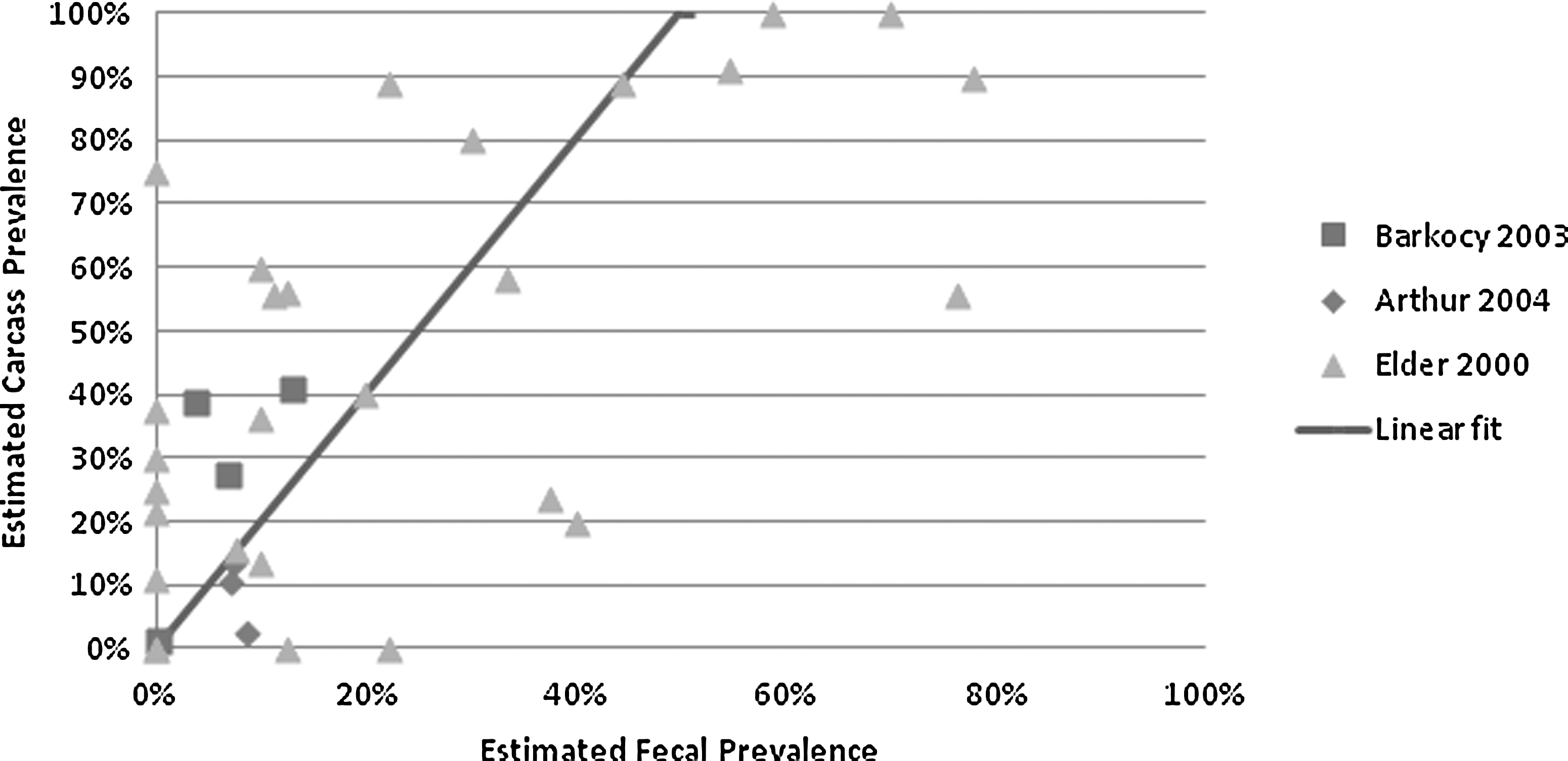
Linear estimation of Escherichia coli O157:H7 prevalence in cattle feces and preevisceration carcasses (%) based on publications shown.
The Slaughter Module estimates the O157 prevalence and concentration on beef carcasses and in ground beef components at various processing points. The specific process points modeled include (1) on carcasses preevisceration, (2) on carcasses after generic postevisceration interventions and chilling, (3) in production lots of trim, and (4) in production lots of ground beef. The statistical relationships utilized in this module were derived from data linking the O157 prevalence and concentration at the processing level to the corresponding variables at the feedlot level. The final output of this module is the O157 prevalence in servings of ground beef from 10,000-lb production lots. The variability in the O157 concentration and prevalence in production lots of trim and raw ground beef influence critical outcomes for packers.
Data on O157 contamination in slaughter plants also indicate that there is a high degree of variance in the O157 concentration in a production lot. Consequently, a small fraction of production lots may be contaminated to a high degree (“hot” lots), although the average load per production lot is relatively small. We defined a “hot” lot as one containing more than 1,000 contaminated servings of ground beef. This variability is likely derived from the variance in prevalence and concentration of O157 observed in feedlot cattle (feces samples) and beef carcasses, as well as the presence of some “super shedders” in herds (Jacob et al., 2010; Gyles, 2007; Barkocy-Gallagher et al., 2003). We assumed that testing methods were sensitive enough to detect a single colony-forming unit (CFU) of O157 in a 325-g portion of ground beef, as recommended by the FSIS guidelines (Murphy and Seward, 2004).
The Consumption Module estimates the number of O157 human illnesses attributed to consumption of ground beef from domestic steer and heifer slaughter and imported ground beef (Table 2). The mixing of imported ground beef with ground beef from domestic steer and heifer slaughter was considered (Bosilevac et al., 2006). We estimated that about 40% of the “average” production lot consisted of imported ground beef based upon ground beef imports and total ground beef production from steer and heifer slaughter in the United States.
The first section of the Consumption Module estimates a baseline probability of an O157 illness per contaminated serving of ground beef (C8). In the second section, the Slaughter Module outputs of the number of O157-contaminated servings of ground beef in a production lot (S25u and S33v) and the annual number of production lots from vaccinated and unvaccinated cattle (S34v and S35u) are utilized to estimate the number of O157 illnesses in the current year in which a specific percent of fed cattle have been vaccinated.
To estimate the baseline probability that an O157-contaminated ground beef serving results in an illness, we started with the fraction of O157 illnesses caused due to consumption of ground beef (the etiologic fraction), from outbreak data and epidemiological studies. The annual number of O157 cases due to consumption of ground beef was then calculated based on CDC Foodnet surveillance data for 2009, the baseline year, and the etiologic fraction. The baseline probability that an O157-contaminated ground beef serving results in a human illness was calculated as the ratio of the number of O157 illnesses caused by consumption of ground beef and the estimated number of contaminated ground beef servings.
Scenarios for the impact of O157 vaccination
We analyzed three scenarios for the impact of O157 vaccination. In Scenarios A, B, and C, we assumed vaccine induced prevalence reductions were 80%, 60%, and 40%. Additionally, for scenarios A, B, and C we assumed reduction of 1, 0.3, and 0.3 log10 CFU/carcass reduction in average concentration on resulting carcasses, respectively. To estimate the impact of vaccination under these scenarios, the simulation model was run for 100,000 iterations using @RISK with Monte Carlo Sampling.
Results
Reduction in human illnesses due to vaccination
The first outcome evaluated was the value of vaccination with respect to the overall number of human O157 cases prevented. Figure 2 and Table 3 show the relationship between the predicted number of human cases of O157 and the number of feedlot cattle vaccinated (termed “production function” in Withee et al., 2009). The model demonstrated that the number of human illnesses attributed to consumption of O157-contaminated ground beef can be greatly reduced by vaccination. If the vaccine were used so as to be 80% effective, and if all U.S. steers and heifers were vaccinated, the expected number of human illnesses could be reduced by almost 60% (90% PI, 56–60). Even with partial adoption of vaccination in say 50% of feedlots (80% effective), human illnesses would be reduced by nearly 30% (90% PI, 26–32), from approximately 20,057 to 14,231 annual cases on average (Fig. 2). In scenario C, with a 40% effective vaccine, human illnesses would be reduced from approximately 20,057 to 12,187 annual cases with full adoption. These results suggest that, depending on vaccine performance parameters, 2,000–3,300 cattle must be vaccinated to prevent one O157 illness. Note that a portion of the illnesses in these scenarios are associated with imported ground beef and would not be prevented with vaccination of domestic cattle.
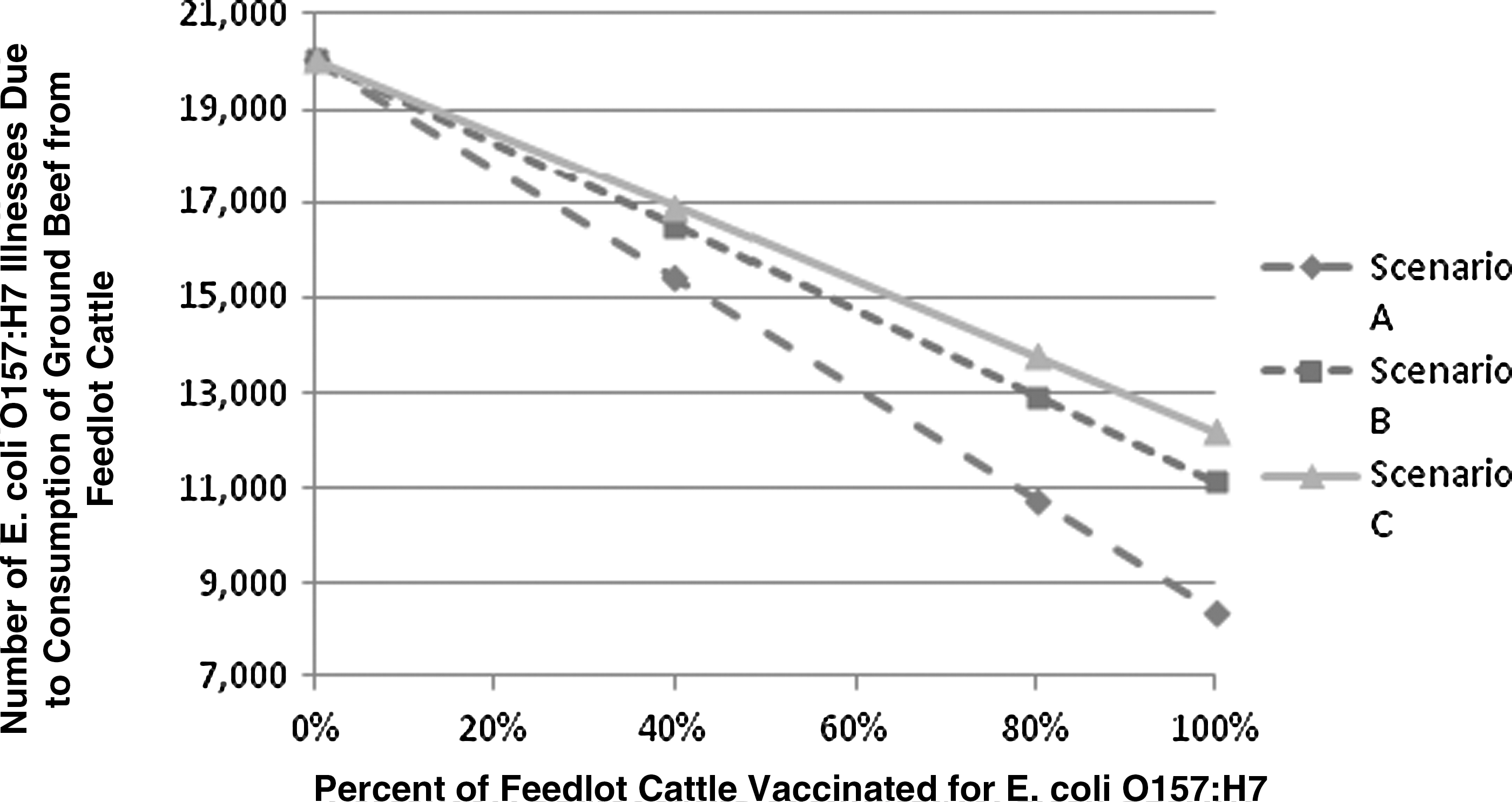
Change in the mean number of human illnesses due to Escherichia coli O157:H7 with the number of cattle vaccinated. Scenario A: Vaccine 80% effective, also 1 log10 CFU/carcass reduction in average concentration on resulting carcass. Scenario B: Vaccine 60% effective, also 0.3 log10 CFU/carcass reduction in average concentration on resulting carcass. Scenario C: Vaccine 40% effective, also in 0.3 log10 CFU/carcass reduction in average concentration on resulting carcass.
The intervals shown here are two-sided 95% probability intervals that represent the impact of uncertainty in input parameter as well as variability in the ground beef processing steps. Possible reasons for the relatively wide intervals include the significant uncertainty in the etiologic fraction for O157 illnesses due to ground beef consumption and the significant variability in the number of contaminated servings per production lot (e.g., due to high shedders).
Decrease in contaminated ground beef production lots due to vaccination
Table 4 shows the impact of vaccination, as adoption increases, on the annual number of “hot” production lots. A “hot-lot” was defined as one containing more than 1,000 contaminated servings in a 10,000-lb lot, as calculated for a hypothetical slaughter plant producing 16,000 lots per year. Hot lots or event days may result in an internal recall by the packer. The extra work required to recover, rework, cook, or destroy product is costly. All levels of vaccine efficacy and adoption reduced risk to the packer. Full adoption of an 80% effective vaccine (Scenario A) could reduce the chance of hot lots by 96%.
The numbers in the parentheses are two-sided 95% probability intervals.
Discussion
Our results demonstrate that preharvest vaccination against O157 could have a significant benefit for the beef industry by reducing the likelihood of hot lots or event days, and the probability of multiple illnesses due to contaminated ground beef servings. In addition, the model results indicate that a large number of ground-beef-associated human O157 illnesses may be prevented by vaccinating domestic feedlot cattle. Thus, both the packer and the consumer could benefit from routine O157 vaccination of cattle.
In our study, the relationship between the number of human illnesses and vaccinated cattle was quite linear (R 2=0.99), similar to the model of Withee et al. (2009). By comparison, we also modeled a reduction in concentration on/in carcasses/feces as well as prevalence of shedders due to vaccination (Fig. 1). Incorporating a reduction in concentration produced an additional impact on epidemiological outcomes.
We propose the reason that vaccine is so effective is its impact on outlier events and the tail-ends of the non-normal distributions. Some have speculated about the possibility of “super-shedder” cattle (Jacob et al., 2010; Gyles, 2007). Most packers agree the occurrence of “event days” is sporadic. Figure 3 shows the tail of the histogram (segment of the histogram showing highly contaminated production lots) of simulation results for the prevalence of O157 in 325-g samples by comparing vaccinated and unvaccinated production lots. The x-axis is the prevalence of positive samples expressed as a fraction, and the y-axis is the relative frequency (proxy for probability from simulation results). The graph shows that the probabilities of a very highly contaminated production lot can be reduced considerably with vaccination. This is because vaccination is an independent mitigation measure from postharvest interventions. Vaccination seems to impact the few rare cases where the production lot could be highly contaminated due to various outlier events.
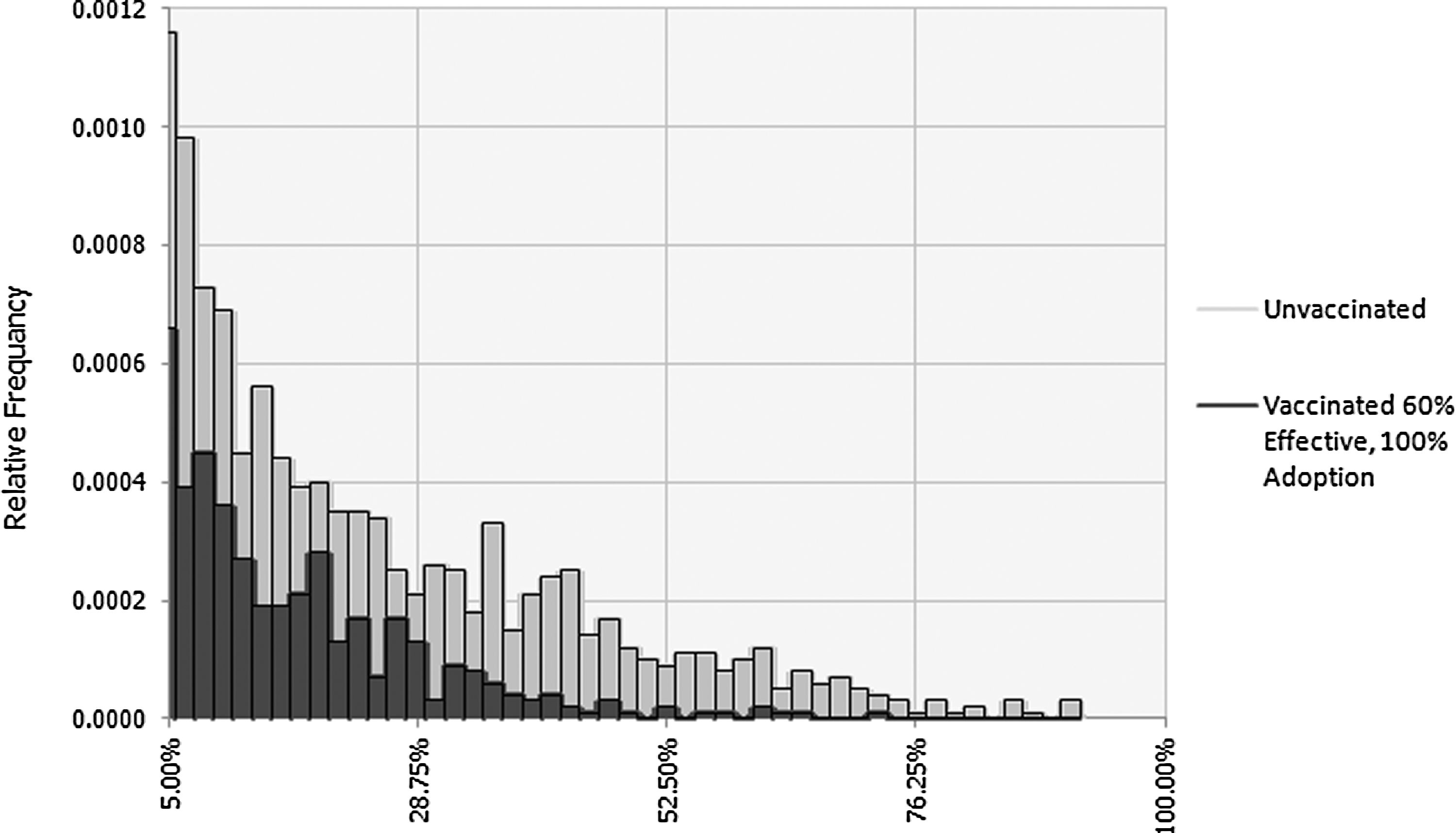
Tail-end of histogram showing impact of vaccination on number of production lots with high Escherichia coli O157 prevalence (>5%) in 325-g samples. Scenario B: Vaccine 60% effective, 100% adoption.
Given that a substantial portion of ground beef consumed in the United States is imported and to aid in further economic modeling, we modeled ground beef imports and the mixing of domestic and imported ground beef explicitly. This approach is conservative (reducing the observed impact of vaccination) since a smaller proportion of the O157 illnesses are attributed to the consumption of domestic ground beef, reducing the estimates of human illnesses which can be prevented by vaccinating domestic feedlot cattle. Withee et al. (2009) did not consider ground beef imports and attributed a greater number of human illnesses to the consumption of ground beef from domestic cattle slaughter. Unlike Hurd et al. (2010), we assumed a constant probability that contaminated servings of ground beef cause illness, regardless of the specific product streams (e.g., food service) or consumption channel (e.g., retail sale). The differences in risks for various product streams and consumption channels were not considered here, as the focus of the current study was on the impact of vaccination on overall human O157 illnesses due to consumption of all categories of ground beef. Given that only approximately 3% of all raw ground beef is sold directly to the consumer, this is an area for further research (NCBA, 2004).
Significant uncertainty surrounds several input variables associated with slaughter processes, such as the amount of a carcass surface area represented in ground beef trim or the effectiveness of carcass decontamination treatments. Given these uncertainties, the model results for slaughter outcomes are more appropriate for predicting the relative impact of O157 vaccination, rather than for predicting the absolute levels of these outcomes. The results for slaughter outcome measures are representative of average values for a hypothetical large production plant in the United States and are not applicable for any specific slaughter establishment. However, we believe that the modeling approach utilized here would be appropriate for evaluating outcomes for specific slaughter plants, provided that the input parameters are calibrated according to the establishment characteristics.
There is significant uncertainty about the inputs in this model representing the impact of O157 vaccination. Preliminary data indicated that vaccination reduces the O157 prevalence and concentration in feces (p≤0.05 based on sampling at specific times post vaccination as described elsewhere [Thomson et al., 2009; Thornton et al., 2009]).
We modeled these parameters as inputs that users can vary to produce different scenarios to consider the impact of the associated uncertainty. Depending on the nature of the biological processes associated with the functioning of the vaccine, it is possible that the reduction in prevalence is correlated with other variables, such as the reduction in fecal concentration. For example, a large reduction in O157 feces concentration due to vaccination may also be associated with a correspondingly large reduction in O157-measured fecal prevalence. Further studies are required to examine the potential correlation between the reductions in concentration and reductions in prevalence under different vaccine dosage regimens and field conditions. Such studies will also provide the data required to evaluate the impact of vaccination stochastically, that is with correlated probability distributions for reduction in feces concentrations and reduction in prevalence.
This stochastic model based on production, slaughter, and consumption factors demonstrated that preharvest O157 vaccination could reduce human illnesses and decrease contaminated ground beef lots. The analysis shows that vaccine-associated reduction in the number of shedding animals and the reduced concentration of O157 in feces both combine to reduce human illnesses. Thus, the benefits of preharvest O157 vaccination of cattle extend to packers as well as consumers.
Footnotes
Acknowledgments
Dr. Guy Loneragan from Texas Tech University assisted in interpreting data from vaccine trials. Sarah Staples, M.A., E.L.S., assisted with manuscript preparation.
Disclosure Statement
This project was funded by an unrestricted grant to Iowa State University from Pfizer Animal Health (New York, NY). Manuscript preparation was supported by an unrestricted grant from Pfizer Animal Health.