




Abstract
The epidemiological role of monophasic Salmonella enterica subsp. enterica serovar Typhimurium tends to increase, indicating pandemic spread. The aim of the present study was to confirm the occurrence of this serological variant in Poland and to report the first cases in Belarus and Ukraine. Genetic similarity of monophasic isolates with Salmonella Typhimurium already present in these countries was assessed. Serotyping, duplex–polymerase chain reaction (PCR) assay, antibiotic resistance and pulsed-field gel electrophoresis (PFGE) profiling have been used to meet the study objectives. Monophasic Salmonella Typhimurium was found at low frequency in various sources along the food chain, including feed, animals, meat, and sewage sludge. The first isolates date back to 2008. The clones observed in other European countries were found, along with a number of new, unrelated genetic lineages appearing locally in three countries. Monophasic Salmonella Typhimurium is claimed to replace and discontinue the domination of pentaresistant Salmonella Typhimurium. Pigs and pork are assumed to be the main vectors of monophasic Salmonella Typhimurium, but their relevance for public health is limited.
Introduction
S
Multiple genes, such as fljA, fljB, and hin, located at the fljBA operon are involved in Salmonella antigen expression. Of these, fljB encodes phase 2 flagella protein, and the others (fljA, hin) are responsible for phase variation—a regulatory mechanism switching between the production of alternative flagellar antigens (McQuiston et al., 2004). Thus, the monophasic phenotype may result from either loss of fljB gene itself, or mutations, deletions, or insertions within its sequence, resulting in discontinued transcription. On the other hand, any disturbance in the regulatory mechanism might also terminate phase 2 flagella production, although fljB itself is not interrupted (Garaizar et al., 2002; Soyer et al., 2009; Trupschuch et al., 2010; Zamperini et al., 2007). As a result, multiple and still not fully recognized genetic mechanisms might be responsible for the occurrence and dissemination of Salmonella Typhimurium, which lack one phase of flagella antigens (Barco et al., 2011; Bugarel et al., 2011; Hauser et al., 2010).
To reflect changes in Salmonella epidemiology, the present study was undertaken to confirm the occurrence of monophasic Salmonella Typhimurium in Poland, Belarus, and Ukraine. The isolates were characterized in order to assess possible genetic relationships with Salmonella Typhimurium strains.
Materials and Methods
Bacterial strains
Laboratory database was searched for Salmonella
Including feed production environment.
Geese, turkey, chicken, and pigs, including farm environment.
Beef, pork, poultry meat, and non–ready-to-eat products.
Including single Salmonella 4,5:i:- isolate showing two-band polymerase chain reaction pattern typical for Salmonella Typhimurium.
Additional not cultivable isolate.
Excluding one of the two isolates of the same source and isolation date.
Ratios of monophasic Salmonella Typhimurium occurrence were calculated against all serotyped Salmonella or Salmonella Typhimurium isolated in a given year from all possible sources where monophasic isolates were obtained from (Table 1).
Serotyping
Slide agglutination with diagnostic antisera (Immunolab, R&D Company Ltd., Gdynia, Poland) was used for verification of the antigenic structure of isolates according to the White–Kauffmann–Le Minor scheme (Grimont and Weill, 2007). Absence of phase 2 flagellar antigen was verified by flagellar phase reversal method (Chiou et al., 2006), modified by replacing trypticase soy agar (TSA) medium with home-made semisolid semisolid AKG nutrient agar.
PCR identification
The assay developed by Tennant et al. (2010) and recommended by the European Food Safety Authority (EFSA) Panel on Biological Hazards (EFSA BIOHAZ, 2010) was used to confirm serotyping, differentiate between monophasic variant and Salmonella Typhimurium, and exclude other closely related serovars (Barco et al., 2011). A total volume of 25 μL amplification mixture composed of 12.5 μl of Maxima® Hot Start PCR Master Mix (2×; Fermentas Life Sciences, Lithuania), 0.1 μL of each primer (50 mM; see Supplementary Table S1 at
Antibiotic resistance
Minimum inhibitory concentrations (MICs) were determined with Sensititre® plates (EUMVS2; Trek Diagnostic Systems, East Grinstead, West Sussex, UK) and interpreted according to epidemiological cut-off values (Fig. 1). Escherichia coli American Type Culture Collection (ATCC) 25922 was used as a quality control.
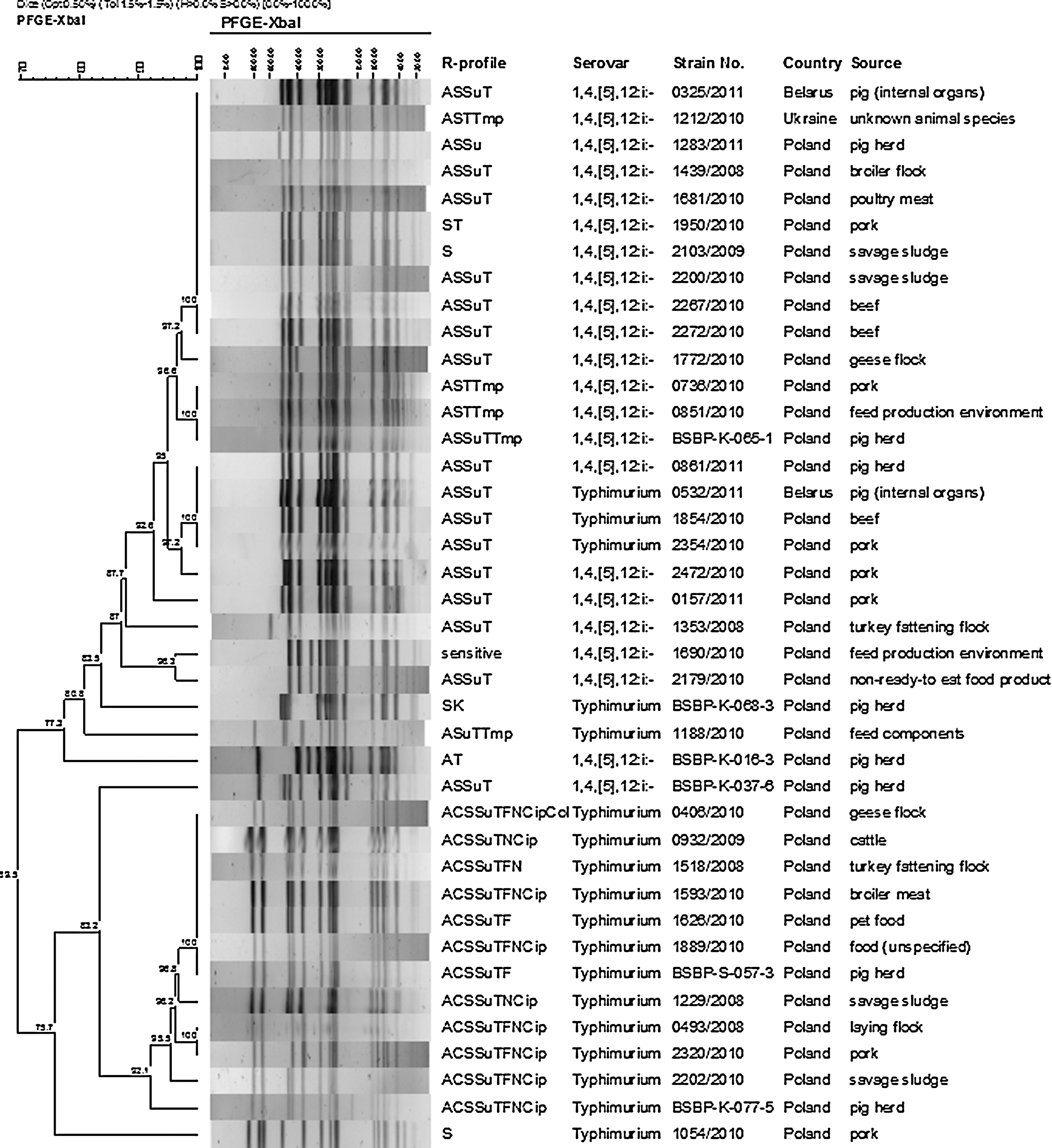
Pulsed-field gel electrophoresis (PFGE) and resistance profiles of tested Salmonella isolates. The cluster of related patterns defined at >85% of similarity. Antimicrobials abbreviations and minimal inhibitory concentration epidemiological cut-off value (non–Wild Type>mg/L): A, ampicillin (8 mg/L); C, chloramphenicol (16 mg/L); S, streptomycin (16 mg/L); Su, sulfametoxazole (256 mg/L); T, tetracycline (8 mg/L); Col, colistin (2 mg/L); F, florfenicol (16 mg/L); K, kanamycin (4 mg/L); N, nalidixic acid (16 mg/L); Cip, ciprofloxacin (0.064 mg/L); Tmp, trimetoprim (2 mg/L).
Pulsed-field gel electrophoresis (PFGE)
Typing was carried out according to PulseNet protocol following DNA digestion with XbaI (Ribot et al., 2006). Results were analyzed with BioNumerics (Applied Maths, Sint-Martens-Latem, Belgium) using PulseNet recommended parameters: Unweighted Pair Group with Arithmetic Mean (UPGMA), Dice coefficient, 0.5% optimization, and 1.5% position tolerance. Bands with molecular weight higher than 33.3 kb were included in the analysis.
Results
Serotyping, including flagellar phase reversal, identified 24 isolates lacking the second phase flagellar antigen. Twenty-two of them produced a single amplicon of 1000 bp, typical for monophasic Salmonella Typhimurium (Supplementary Fig. S1). Two isolates, obtained from a geese flock and a pet snack in 2005, showed two amplicons (1000 and 1389 bp) specific for Salmonella Typhimurium, and thus they were excluded from the study group (Table 1). Overall monophasic Salmonella Typhimurium occurrence ratio reached 1.1%, whereas monophasic Salmonella Typhimurium/ Salmonella Typhimurium ratio increased from 3.2% in 2008 to 21.1% in the first months of 2011. All control isolates were confirmed as Salmonella Typhimurium by slide agglutination and PCR assay.
One monophasic Salmonella Typhimurium isolate was susceptible to all antimicrobials tested, whereas 14 resistance types were observed amongst the remaining isolates (Fig. 1). Pentaresistant ACSSuT pattern was observed exclusively in Salmonella Typhimurium isolates (n=12), whereas ASSuT predominated in monophasic Salmonella Typhimurium (n=14). Both resistance patterns were correlated with serological variant of tested isolates (p≤0.001).
PFGE analysis revealed 19 profiles with an overall genetic similarity of 69.5%. Fourteen profiles were observed in single isolates, and each of the remaining five profiles covered two to 10 isolates (Fig. 1). One of the profiles was found in a single monophasic Salmonella Typhimurium and in three Salmonella Typhimurium isolates. Remaining profiles were observed exclusively in one of serological variants. A similarity threshold of ≥85% identified seven clusters of profiles, five of which were represented by single monophasic Salmonella Typhimurium (n=2) or Salmonella Typhimurium (n=3) isolates. Cluster of five profiles (≥92.1% similarity) embraced 12 Salmonella Typhimurium isolates showing ACSSuT resistance type. The biggest cluster included nine profiles sharing ≥87.0% similarity. It was represented by 20 monophasic Salmonella Typhimurium and three Salmonella Typhimurium isolates. They showed various resistance types, with ASSuT being the most prevalent.
One of the monophasic Salmonella Typhimurium isolates obtained from a pig herd in 2011 revealed a profile that was indistinguishable from three Salmonella Typhimurium isolates from pork, beef and diseased pigs (internal organs) from Belarus. In general, 16 out of 22 tested monophasic isolates of various origin (pigs, broilers, geese, pork, beef, feed production of environment, and savage sludge), which were collected between 2008 and 2010 in Poland, Belarus, and Ukraine, belonged to three highly similar profiles (≥96.6%) and were related to three aforementioned control Salmonella Typhimurium isolates. None of the tested monophasic Salmonella Typhimurium isolates shared indistinguishable PFGE profile with its paired control isolate.
Discussion
The major finding of current study is the confirmation of monophasic Salmonella Typhimurium occurrence in a new geographical setting and the indication of pigs as an important source of infection. This variant of Salmonella Typhimurium was detected in samples representing various stages of food chain, including feeds, animals, and environment. The occurrence of monophasic Salmonella Typhimurium remains low compared to some other countries (Bugarel et al., 2011; Dionisi et al., 2009; Hauser et al., 2010; Soyer et al., 2009), and until now it does not appear to severely affect human populations in Poland (PZH and GIS, 2011). We assume that the current change in Salmonella epidemiology can be caused by replacement of other Salmonella Typhimurium variants by monophasic Salmonella Typhimurium (indicated by the increased ratio of monophasic Salmonella Typhimurium/Salmonella Typhimurium) rather than by an independent emergence of a new serological variant, as a low monophasic Salmonella Typhimurium/Salmonella ratio has been noted. Current results, as well as other reports, tend to support this concept (Barco et al., 2011; Bugarel et al., 2011; Hopkins et al., 2010).
To our knowledge, single isolates obtained from animal samples are the first reports of monophasic Salmonella Typhimurium in Belarus and Ukraine. Although monophasic Salmonella Typhimurium isolates have been found in variable sources, pigs and pork comprised 45.5% of all tested isolates, proving to be the most important reservoirs. This result supports the role of pigs in the spread of monophasic Salmonella Typhimurium (Bugarel et al., 2011; Hauser et al., 2010; Torre et al., 2003). Observed low occurrence of monophasic Salmonella Typhimurium in comparison with other countries might be explained by low Salmonella Typhimurium prevalence (0.6–4.8%) in pig production in Poland (EFSA, 2009).
The reasons for the emergence of monophasic Salmonella Typhimurium remain unknown. With the current case-control approach, genetic relations of this phenotype with a few Salmonella Typhimurium strains of ASSuT resistance profile have been proved. Indistinguishable XbaI profiles, common in both serological variants, were also found by others (Bugarel et al., 2011). The vast majority of control isolates, showing mostly ACSSuT and related resistance profiles, were clearly separated in phylogenetic tree (Fig. 1). This demonstrates replacement of different Salmonella Typhimurium clones currently occurring in the environment. It was also confirmed by values of monophasic Salmonella Typhimurium occurrence ratios (Table 1). The pentaresistant Salmonella Typhimurium clone (Meakins et al., 2008; Wasyl et al., 2006) is diminishing, and it is being substituted by phenotypically different clones of not particularly worrisome resistance profiles (Bugarel et al., 2011; Dionisi et al., 2009). Monophasic Salmonella Typhimurium has already been suggested as a new pandemic strain emerging in Europe (Hopkins et al., 2010). The most common profile found in animal isolates from Poland, Belarus, and Ukraine, as well as in food of animal origin and sewage sludge, was indistinguishable from STYMXB.0131 (Hauser et al., 2010; Hopkins et al., 2010; Lucarelli et al., 2010; Mossong et al., 2007; Trupschuch et al., 2010). The public health impact of monophasic Salmonella Typhimurium was emphasized by large outbreak of human salmonellosis, which led to hospitalizations and one death in Luxembourg. Although a common source was not identified, the outbreak strain was indistinguishable from slaughter pig isolate (Mossong et al., 2007). Another relevant STYMXB.0083 profile (Hopkins et al., 2010; Lucarelli et al., 2010) was also found in pigs during the present study. It was indistinguishable from the profile observed in three Salmonella Typhimurium isolates from pigs in Belarus, as well as Polish pork and beef samples. Both profiles (STYMXB.0131 and STYMXB.0083) observed in different countries might confirm pandemic spread of monophasic Salmonella Typhimurium clones (Dionisi et al., 2009; Pornruangwong et al., 2008). It is worth noting that none of the profiles previously found in a few human isolates from Poland (Hopkins et al., 2010) was observed in the tested isolates. Numerous divergent PFGE profiles found in current and other studies (Zamperini et al., 2007) may suggest some spontaneous genetic changes occurring independently in different geographical locations, not as the spread of a single clone, but as a simultaneous occurrence of different monophasic Salmonella Typhimurium clones.
It has already been shown that multiple genetic events may affect different genes involved in phase 2 flagellum antigen expression (Zamperini et al., 2007). As a result of selection pressure for antigen loss, multiple monophasic Salmonella Typhimurium genotypes may occur (Soyer et al., 2009). Hauser et al. (2010) have found five genetic combinations while targeting three genes co-regulating phase expression. A similar approach has led to identification of various Salmonella Typhimurium–related phenotypes in France (Bugarel et al., 2011). The EFSA-recommended method, targeting some of these genes (Tennant et al., 2010), has limited sensitivity. It allows only for detection of the most frequent serological variants with changes in the fliB-fliA intergenic region, which can be further defined as monophasic Salmonella Typhimurium. Such an approach is essential for epidemiological analysis at the international level to avoid misclassification of monophasic Salmonella Typhimurium and any other Salmonella Typhimurium serological variant (and vice versa). Two strains that failed to comply with the inclusion criteria of the study, but still phenotypically lacking phase 2 antigen presumably show the limitations of the recommended method (Barco et al., 2011). Efficacy and ease of application of the method have also been proved (Tennant et al., 2010), as has its capability to differentiate between monophasic Salmonella Typhimurium and serologically inconsistent Salmonella Typhimurium strains lacking second phase antigen expression, but still carrying the fljB gene (Barco et al., 2011; Bugarel et al., 2011; Hopkins et al., 2010; Soyer et al., 2009; Zamperini et al., 2007).
Conclusion
It has been confirmed that monophasic Salmonella Typhimurium occurs in animal-related sources in new geographical settings complying with its pandemic spread. The study also shows the important role of the pig reservoir. It has been demonstrated that a variety of new, unrelated clones may appear locally, discontinuing the domination of pentaresistant clone. Use of harmonized methods and their development is crucial for surveillance of monophasic Salmonella Typhimurium. Further studies are needed to revise its possible impact on public health, as well as to identify the driving force for the observed interchange in Salmonella Typhimurium clones. Described outbreaks, including the recent one in France (Gossner et al., 2012; Mossong et al., 2007) might be a warning of possible pork-associated public health threats in countries with low Salmonella prevalence in pigs.
Footnotes
Acknowledgments
We thank Katie Hopkins and Anne Brisabois for providing prevailing PFGE profiles in European monophasic Salmonella Typhimurium collection and profiles observed in France, respectively. We acknowledge their inspiring role in the presented study. Magdalena Skarżyńska and Ilona Samcik are thanked for excellent technical assistance. The study was supported by governmental founding of the multi-annual research project Protection of Animal and Human Health (Ministry of Council Resolution 244/2008 of October 28, 2008).
Disclosure Statement
No competing financial interests exist.
References
Supplementary Material
Please find the following supplemental material available below.
For Open Access articles published under a Creative Commons License, all supplemental material carries the same license as the article it is associated with.
For non-Open Access articles published, all supplemental material carries a non-exclusive license, and permission requests for re-use of supplemental material or any part of supplemental material shall be sent directly to the copyright owner as specified in the copyright notice associated with the article.
