




Abstract
In this study, a sandwich enzyme-linked immunosorbent assay (ELISA) based on IgY (egg yolk immunoglobulin) and monoclonal antibody (mAb) against excretory-secretory (ES) antigens of Trichinella spiralis muscle larvae was developed for detection of circulating antigens (CAg) in serum from mice infected with T. spiralis. The IgY-mAb sandwich ELISA involved the use of chicken antibody IgY as a capture antibody and mouse mAb 35B9 as a detecting antibody. This method was able to detect as little as 1 ng/mL of ES antigens added to normal mouse serum. A group of 15 mice was orally inoculated with 500 T. spiralis muscle larvae per animal and the serum samples were daily taken during 1–49 days post-infection (dpi). The level of CAg was detectable as early as 3 dpi in the sera from infected mice, increased gradually, and reached two peaks with detection rate of 40% at 13 dpi and 100% at 24 dpi, respectively. The anti-Trichinella antibodies was first detected in 33.3% of the infected mice at 3 week post-infection (wpi), and reached a peak positive rate of 100% at 5 wpi. Moreover, the infected mice were treated with abendazole at 5 weeks post-infection, and the serum levels of CAg in treated group began to increase rapidly at 2 days post-treatment (dpt) and reached a peak with detection rate of 100% (10/10) at 8 dpt, and then decreased gradually. By 42 dpt, the CAg levels decreased to the undetected level, but the anti- Trichinella antibodies were still detected in 100% of the infected mice. The novel assay appears to be sensitive for detection of antigens of T. spiralis and should be valuable to the early diagnosis and evaluation of the efficacy of chemotherapy in trichinellosis.
Introduction
Circulating antigen (CAg) is the excretory or secretory antigens produced by live worm and can directly enter the peripheral blood circulation. CAg appears earlier than antibody in blood circulation, and disappears more rapidly than antibody because of its short half-life. Hence, the detection of Trichinella CAg seems an effective way to discriminate between active and past infections. Various methods have been developed for detecting Trichinella CAg, including counterimmunoelectrophoresis (Smith and Kennedy, 1984), immunoradiometric assay (Ivanoska et al., 1989), direct ELISA (de-la-Rosa et al., 2001), and sandwich ELISA (Arriaga et al., 1995; Rodriguez-Osorio et al., 1999; Li and Ko, 2001). However, because the serum levels of T. spiralis circulating antigens are usually quite low, the detection rate of CAg in serum samples was usually only 30–50% in the patients with clinical trichinellosis (Nishiyama et al., 1992). Hence, the serological methods available for detecting CAg cannot be applied to serodiagnosis of trichinellosis (Dupouy-Camet et al., 2002; Gamble et al., 2004).
Chicken IgY has been recognized as an excellent source of polyclonal antibodies for decades (Tini et al., 2002). Specific antibodies produced in chickens offer several important advantages over producing antibodies in mammals, for example, avoiding the interference in immunological assays caused by rheumatoid factors (Larsson and Sjouist, 1988), the complement system (Larsson et al., 1992), or anti-mammalian antibodies (Juliarena et al., 2007). Furthermore, chicken IgY recognize more epitopes than the corresponding mammalian antibodies (Svendsen and Hau, 2006). Hence, IgY, instead of mammalian IgG, has been widely used for diagnosis of different diseases (Lei et al., 2011; Dias da Silva and Tambourgi, 2010). However, to our knowledge, there is no report on the use of IgY in the detection of CAg in trichinellosis.
The aim of this study was to develop a sandwich ELISA based on IgY for detection of CAg in serum samples of mice experimentally infected with T. spiralis. The assay consisted of chicken IgY against the excretory-secretory (ES) antigens of T. spiralis muscle larvae as a capture antibody and mouse anti-ES antigen monoclonal antibody (mAb) 35B9 as a detecting antibody. In addition, the serum level of CAg of the infected mice after treatment with albendazole was also investigated. In comparison, anti-Trichinella antibodies were assayed by indirect ELISA using ES antigens.
Methods
Parasite and animals
The isolate (ISS534) of T. spiralis used in the study was obtained from domestic pigs in Nanyang city of Henan Province, China. This isolate was maintained by serial passage in Kunming mice at 6–8-month intervals. BALB/c mice aged 6 weeks were provided by the Experimental Animal Center of Henan province.
Experimental infection and serum samples
Muscle larvae of T. spiralis were recovered from the infected mice by acid pepsin digestion as described previously (Li et al., 2010a). Fifteen BALB/c mice weighing 20–25 g were orally infected with 500 larvae per animal of T. spiralis larvae. About 50 μL of tail blood was collected daily until 49 days post-infection (dpi), and serum was isolated (Li et al., 2010b). Moreover, to evaluate the effect of chemotherapy on antigen levels, the infected mice were divided into two subgroups: albendazole-treated group (10 mice) and untreated group (five mice). Albendazole (Hanjiang Pharmaceutical Factory, Shanxi, China) suspended in distilled water was administered intragastrically at 49 dpi in a dose of 370 mg/kg body weight, twice daily, for 7 consecutive days (Dupouy-Camet et al., 2002). The untreated group was given only distilled water. Blood was collected from 2 days post-treatment (dpt) to 42 dpt. Ten normal mice were used as negative control, and the sera from these non-infected mice were also collected. All sera were stored at −20°C until use. At the end of the study, the carcass of each infected mouse was individually digested by artificial digestion method, and the larvae were collected and counted from each mouse as described previously (Gamble et al., 2000; Li et al., 2010a). Results were expressed as worm reduction rates, calculated as the percent of recovered larvae versus those recovered from control mice.
Chicken IgY against ES antigens
The ES antigens of T. spiralis muscle larvae were prepared as described previously (Wang et al., 2011). Chicken IgY against ES antigens was obtained and characterized in our laboratory as previously described (Li et al., 2010c). In brief, 24-week-old Roman hens that were maintained in a standard specific pathogen free (SPF) condition were immunized with ES antigens four times subcutaneously. Each hen was immunized with 500 μg of ES antigens and then boosted with 250 μg of ES antigens three times at an interval of 10 days. Chicken eggs were collected daily before immunization and after the last immunization. IgY was extracted from yolk according to the water dilution method (Akita and Nakai, 1993), and the purified IgY was analyzed by sodium dodecyl sulfate–polyacrylamide gel electrophoresis (SDS-PAGE). The protein content of IgY was determined by the method described by Bradford (1976).
Monoclonal antibody
The mAb 35B9 against ES antigens of T. spiralis muscle larvae was provided by Zhengzhou Auto Biotechnology Co. Ltd. (Zhengzhou, China) and purified by using caprylic acid and ammonium sulphate precipitation (McKinney and Parkinson, 1987). The 35B9 was typed as IgG3 antibody by a mouse mAb isotyping kit (Sigma, St. Louis, MO).
IgY-mAb ELISA for detection of circulating antigen
The optional dilutions of various reagents were first determined by checkerboard titration. An IgY-mAb ELISA was developed using IgY to capture free antigens present in serum samples and mAb to detect ES components of muscle larvae. In brief, 96-well ELISA plates (Corning Life Sciences, Tewksbury, MA) were coated with 7.5 μg proteins/well IgY in 100 μL of bicarbonate buffer (pH 9.6) and incubated overnight at 4°C. Plates were washed three times with 0.05% Tween-20 in PBS (PBS-T). After blocking with 5% skimmed milk in PBS-T, serum samples were diluted at 1:60 and mAb was used at 1:2,000 dilution. For the detection of bound mAb, horseradish peroxidase (HRP)–conjugated sheep anti-mouse IgG (Sigma) were used at 1:5,000 dilution. The reactions were detected by addition of the substrate O-phenylendiamine dihydrochloride (Sigma) plus H2O2 and stopped with 50 μL/well of 2M H2SO4. Optical density (OD) values at 490 nm were measured with a microplate reader (TECAN, Grödig, Austria). All samples were run in duplicate. Murine sera before infection and PBS were used as negative control and blank control, respectively. All the values were recorded after appropriate blank correction. The reactivity of CAg was expressed as the lower detection limit (LDL) in nanograms of ES antigens/mL. The ES antigen standard was serially diluted in normal serum, ranging from 1 ng to 5 mg/mL, and bovine serum albumin was used as negative control.
Indirect ELISA for detection of antibodies
Anti-Trichinella antibodies in the infected mice before infection, 1–7 weeks post-infection (wpi) and 1–6 weeks after treatment were assayed weekly by indirect ELISA with ES antigens. It was performed as previously described (Cui et al., 2011b).
In both ELISAs, test sera/negative sera OD values of <2.1 were regarded as negative and those of ≥2.1 as positive. The cut-off values of IgY-mAb ELISA for detecting CAg and indirect ELISA for detecting antibodies were 0.21 and 0.20, respectively.
Statistical analysis
All statistical analyses of data were done with SPSS for Windows, version 16.0 (SPSS Inc., Chicago, IL). Chi-square test and Student's t-test were used to determine the difference between CAg and antibody at various periods post-infection, the difference between the treated group and untreated group, and the difference between different time points in the same group with respect to the detection rate and serum level of CAg and antibody. Wilcoxon rank sum test was used to compare the differences of the number of recovered larvae between treated group and untreated group. The level of significance used was 5% (p<0.05).
Results
Sensitivity of IgY-mAb ELISA
To establish the sensitivity and linearity of IgY-mAb ELISA, a standard dilution curve of ES antigen concentrations was produced. As clearly illustrated in Figure 1, there was a significant correlation between the OD value and ES antigen concentration, with a correlation coefficient of 0.994. The LDL of ES antigens detected by the assay was 1 ng/mL with a linear increase in OD from 1 ng to 5 mg/mL. In addition, we also established a sandwich ELISA using rabbit antibody IgG to T. spiralis ES antigens as the capturing antibodies; the LDL of IgG-mAb ELISA was 30 ng/mL of ES antigens. Furthermore, the results indicated that chicken IgY was specifically bound to ES antigens and more sensitive than rabbit IgG.

Relationship between Trichinella spiralis excretory-secretory (ES) antigen concentration and optical density (OD) value. Bovine serum albumin (BSA) was used as negative control. Antigen levels are expressed as mean OD values measured with IgY-mAb sandwich enzyme-linked immunosorbent assay (ELISA).
Kinetics of circulating antigens and antibodies in sera from infected mice
The levels of CAg were determined by IgY-mAb sandwich ELISA in sera from infected mice at different time intervals after infection (Fig. 2). As early as 3 dpi, CAg could be detected, and the level of CAg gradually increased, reaching the first and second peak at 13 and 24 dpi, respectively. Then, the level of CAg began to decline gradually. By 49 dpi, the CA levels decreased to nearly the control level.
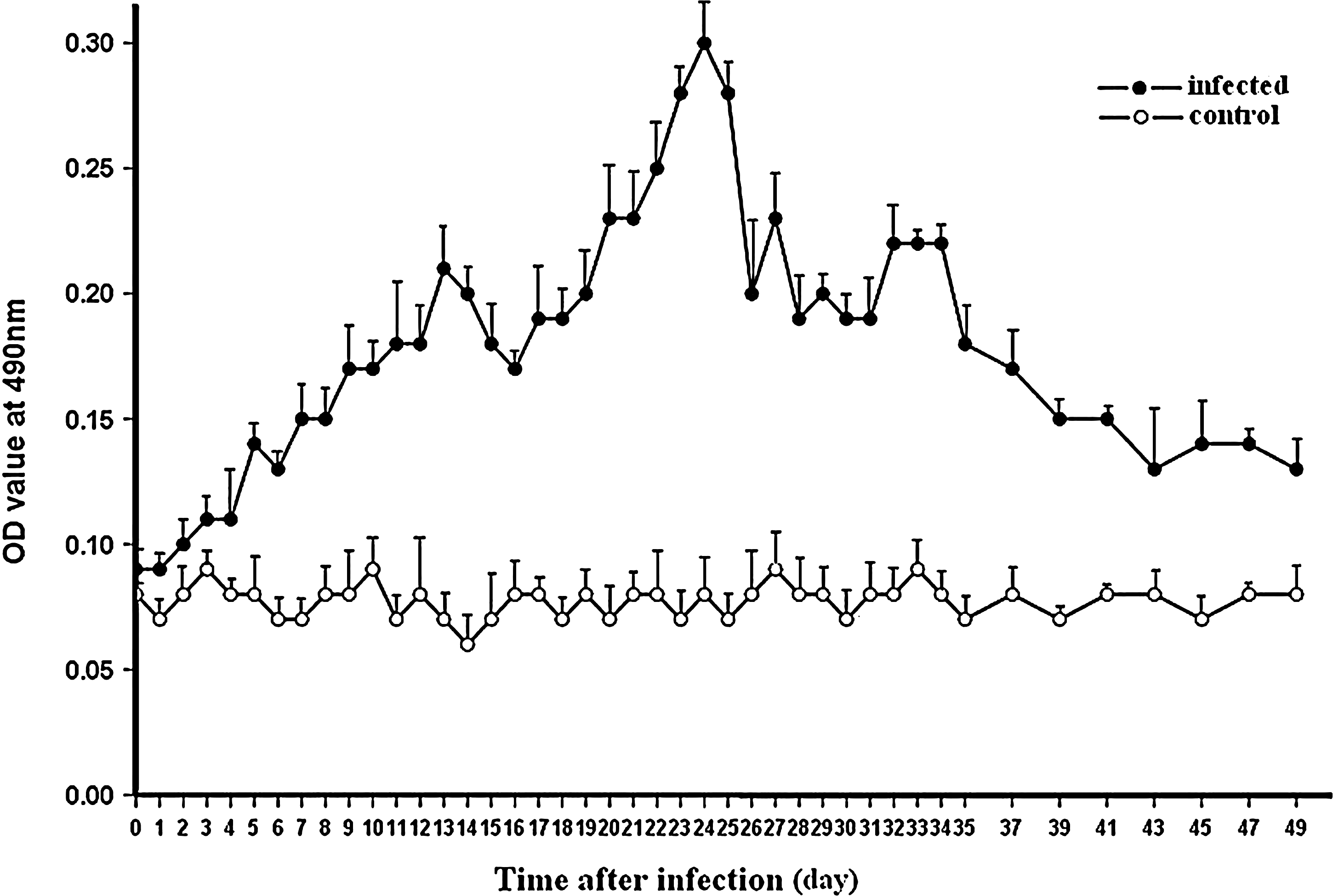
Kinetics of circulating antigens in sera from mice experimentally infected with Trichinella spiralis at different time intervals after infection. Circulating antigens were detected by a sandwich enzyme-linked immunosorbent assay (ELISA) with IgY as the capturing antibodies and mAb as the detecting antibody. Each mouse was given an oral dose of 500 infective larvae. Antigen levels are expressed as the mean optical density (OD) value±SD of the individual serum sample measured by IgY-mAb sandwich ELISA
The level of anti-Trichinella antibodies in the infected mice was first detected at 3 wpi, then increased rapidly and reached a peak at 7 wpi (Fig. 3). The detection rate of CAg and antibodies in sera from infected mice at 1–7 wpi was shown in Figure 4. At 2 wpi, the CAg detection rate (40%) was significantly greater than the antibody detection rate (0%; χ2 =5.208, p<0.05). The detection rate between CAg and antibodies at 3 wpi was also statistically different (93.33% vs. 33.33%, respectively; χ2=11.627, p<0.05).
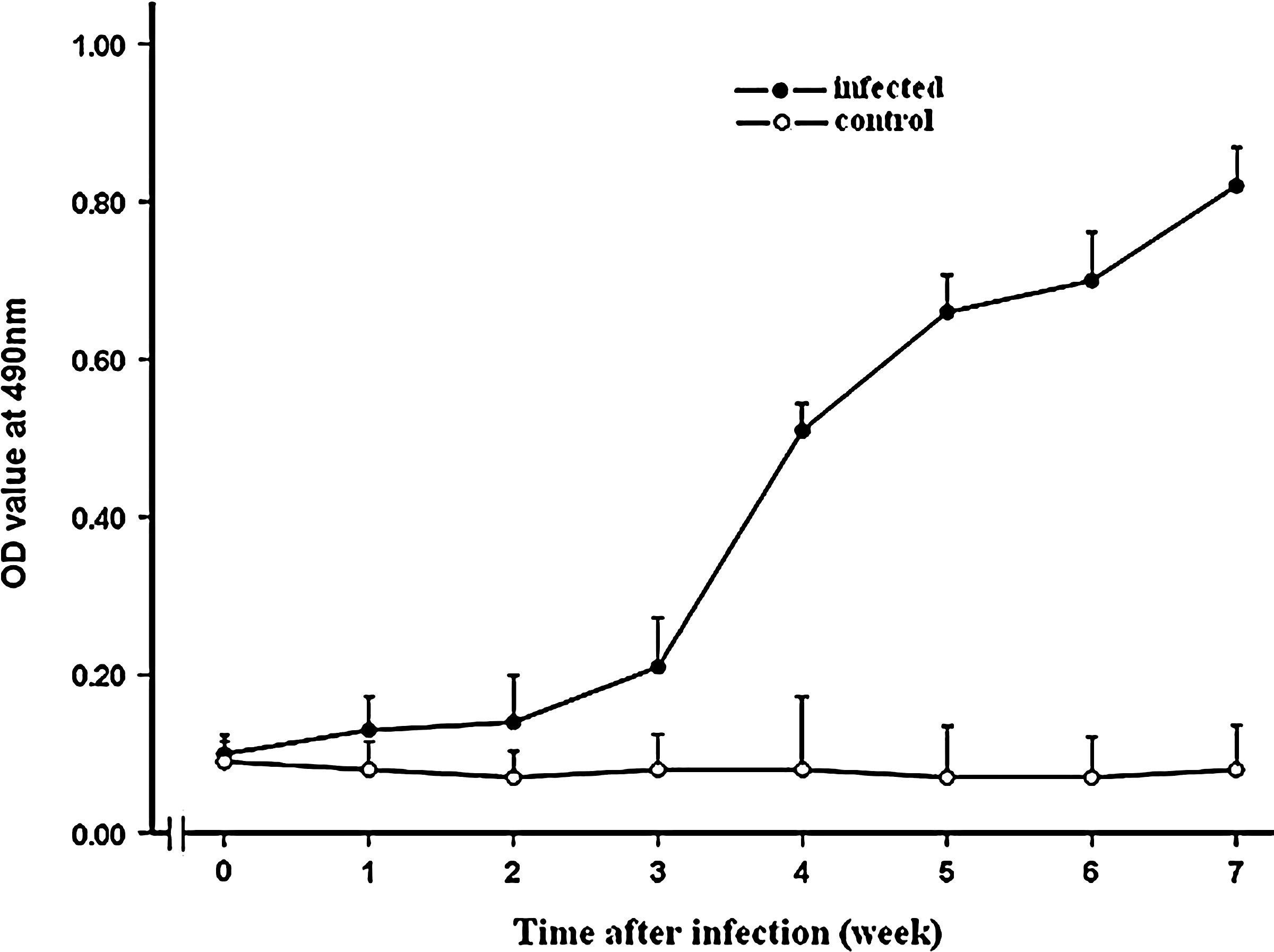
Kinetics of circulating antibodies in sera from mice experimentally infected with Trichinella spiralis at different time intervals after infection. Circulating antibodies were detected by an indirect enzyme-linked immunosorbent assay (ELISA) with excretory-secretory (ES) antigens of T. spiralis muscle larvae. Each mouse was given an oral dose of 500 infective larvae. Antibody levels are expressed as the mean optical density (OD) value±SD of the individual serum sample.
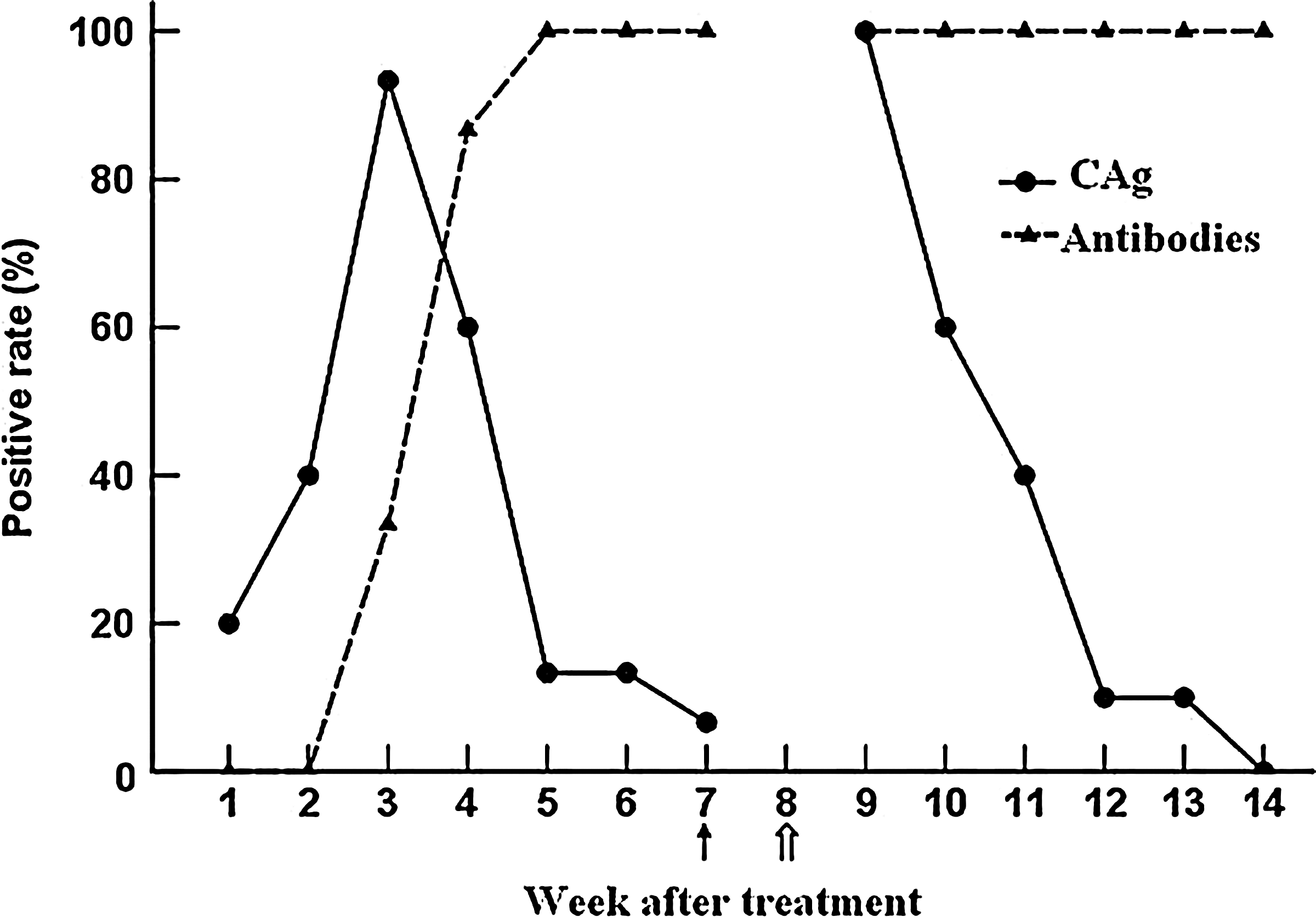
Comparison of detection rate of circulating antigens and antibodies in sera from mice experimentally infected with Trichinella spiralis at different time intervals post-infection and after treatment. The beginning time of treatment is marked as solid arrows(↑), and the ending time of treatment is marked as empty arrow (⇑).
Effect of chemotherapy on the levels of circulating antigens and antibodies
The CAg levels in the untreated and treated groups showed no difference before treatment (t=−0.51, p>0.05), but they had a statistical difference after treatment (t=8.467, p<0.05) (Fig. 5). Compared with that of the untreated group, the levels of CAg in the treated group began to increase rapidly at 2 dpt and reached a peak at 8 dpt, and then decreased gradually. By 42 dpt, the CAg levels decreased to the undetected level.

Comparison of levels of Trichinella spiralis circulating antigens in sera from the infected mice treated and untreated with albendazole. Albendazole was intragastrically administered at 5 weeks post-infection (0 week after treatment). Antigen levels are expressed as the mean optical density (OD) value±SD of the individual serum.
However, as clearly illustrated in Figure 6, the serum levels of antibodies in the treated groups and untreated groups showed no difference after treatment (t=0.721, p>0.05). The detection rate between CAg and antibodies at 3 weeks after treatment was statistically different (40% vs. 100%, respectively; χ2=6.730, p<0.05). By 42 dpt, the CAg was not detected in infected mice, but the detection rate of antibodies was still 100% (χ 2=19.095, p<0.05).
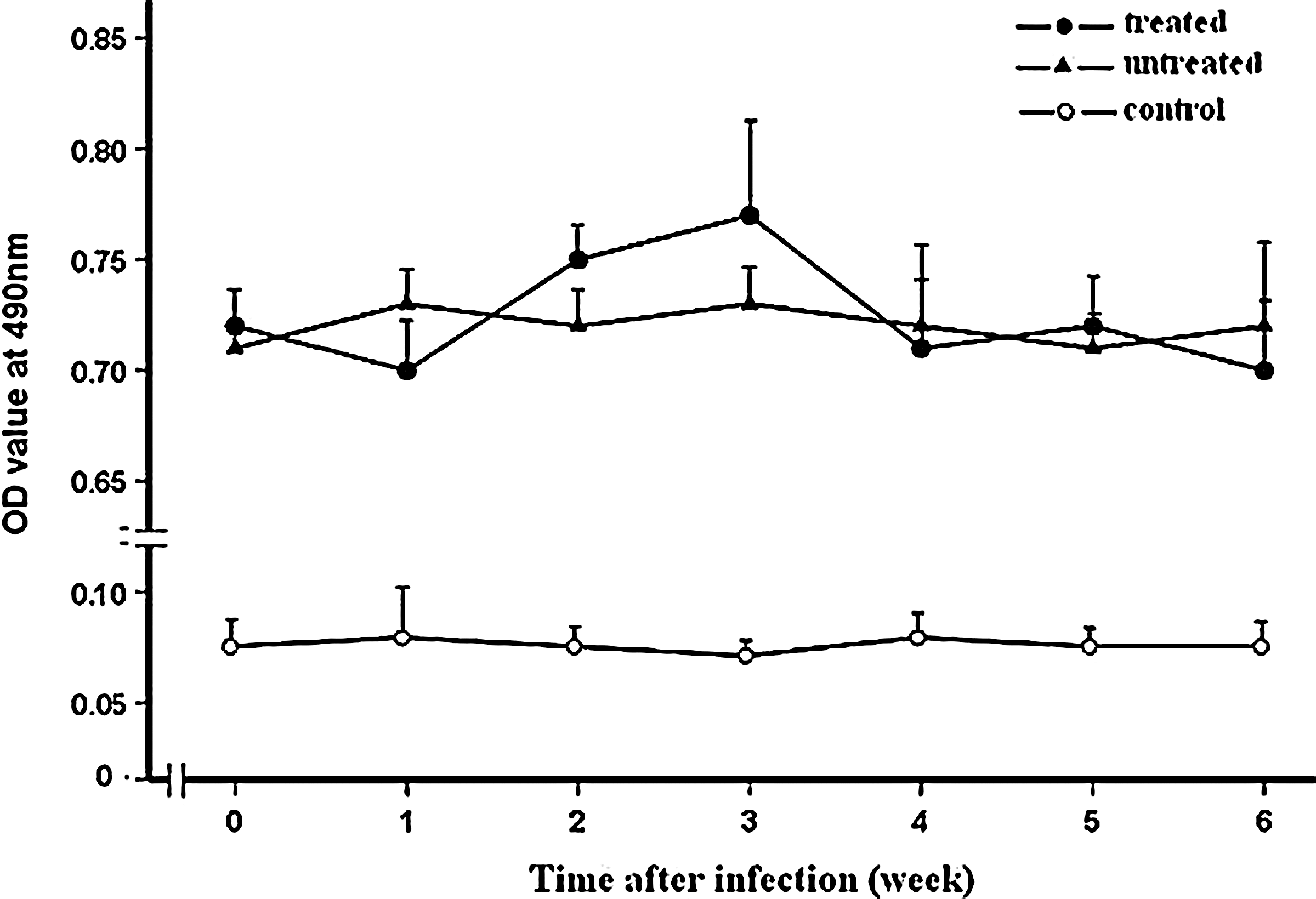
Kinetics of levels of anti-Trichinella antibodies in serum samples of the infected mice treated and untreated with albendazole. Albendazole was intragastrically administered at 5 weeks post-infection (0 week after treatment). Antibody levels are expressed as the mean optical density (OD) value±SD of the individual serum sample.
At the end of the study (at 42 dpt), all the infected mice were slaughtered. The number of larvae recovered from the treated group was 10,120±7487.1 larvae, which was significantly lower than the 73,510±29375.1 larvae recovered from the untreated group (Z=−3.062, p<0.05), and the larval reduction rate in the treated group was 86.2%.
Discussion
In this study, we developed an IgY-mAb sandwich ELISA to detect circulating T. spiralis antigens in serum from experimentally infected mice. This assay appears to be sensitive for detection of T. spiralis CAg in serum and valuable for the early diagnosis and evaluation of efficacy of chemotherapy in trichinellosis.
Detection of antigens in serum samples might be a useful confirmatory test of parasite infection because it is a direct demonstration of the products secreted and excreted by live parasites (Smith et al., 1984; Ivanoska et al.,1989). The level of CAg in serum fluctuates widely at various periods post-infection. CAg was detected in only 13%, 29.9%, and >30% of the clinical cases with trichinellosis by immunoradiometric assay, sandwich ELISA, and dot-blot, respectively (Ivanoska et al., 1989; Nishiyama et al., 1992). Therefore, it is necessary to use an extremely sensitive and stable method that can detect slight quantities of CAg for serodiagnosis. Otherwise, false-negative results may be obtained.
The mAbs have been used in the majority of sandwich ELISA, since the reactivity pattern of each mAb is addressed to a specific molecule epitope (Youssef et al., 1989). The LDL of CAg was variable among different assays, at 1–35 ng antigen/mL (Arriaga et al., 1995; Li and Ko, 2001). In this study, we used polyclonal IgY instead of polyclonal IgG or mAb; the sensitivity of IgY-mAb ELISA could reach 1 ng antigens/mL. The assay can be used to evaluate the existence and level of ES antigens in the serum from infected mice because the OD values increase linearly with ES antigen concentrations. Apparently, the application of IgY to ES antigens is advantageous for the detection of CAg in experimentally infected mice. The factors contributing to this advantage include that chicken IgY reacts with more epitopes on mammalian antigens and then produces an amplification of the signal due to evolutionary differences (Larsson and Sjouist, 1990; Carlander et al., 1999).
In this experiment, CAg of mice infected with T. spiralis was continuously detected by IgY-sandwich ELISA with an early and a late peak of CAg during 3–49 dpi. The serum CAg of the infected mice could be detected by a mAb-sandwich ELISA at 11 dpi (Youssef et al., 1989). Similar observations regarding the two peaks of CAg have also been found in experimentally infected mice and pigs (Arriaga et al., 1995; Li and Ko, 2001). In the present study, the level of CAg reached the first peak at 13 dpi, which was probably related to the massive migration of the newborn larvae released by gravid females to the skeletal muscles. The second peak of CAg occurred at 24 dpi, when the larvae had developed to the infective stage and the encapsulation of the parasite had been completed. The increase of CAg levels, as detected in this study, seems to correlate with the establishment of muscle larvae in infected animals (Murrell, 1985). The subsequent decline in CAg level may be due to the formation of immune complexes, which in turn are eliminated by the host or the confinement of ES antigens in nurse cells isolated by the surrounding capsule (Arriaga et al., 1995).
Circulating antibodies were detected only in 33.3% of the infected mice at 3 wpi and reached 100% at 5 wpi. Although the sensitivity of the antibody detection was higher than antigen detection at 5 wpi, it appears relatively late and cannot discriminate between past and present infection. CAg is present in the serum only during active infection, and the levels of CAg continue to decrease after successful chemotherapy. Thus, detection of CAg can also be used as an effective way to evaluate the efficacy of chemotherapy. Our results showed that the serum levels of CAg increased significantly during 2–8 dpt, which might be induced by the larvae destroyed by albendazole. By 42 dpt, the larval reduction rate in the treated group was 86.2%, which indicated that chemotherapy was efficient. Our results indicated that the CAg drops down to an undetected level by 42 dpt, which indicates that the novel assay can be used to evaluate the efficacy of chemotherapy. Similar observations regarding the killing effects of albendazole on the encapsulated T. spiralis larvae in muscle have been reported. A reduction of 75.5% in the parasitic load was observed, when the mice infected with 10 T. spiralis muscle larvae were treated by using under-dosed with albendazole (20 mg/kg for 7 days) at 40 dpi (de-la-Rosa et al., 2007). While albendazole (200 mg/kg for 7 days) was given to the mice infected with 100 larvae at 35 dpi, the larval reduction rate was 71.8% at 15 dpt (Xue et al., 2010). The efficacy of albendazole against the larvae in muscle tissues depend on the time between infection and treatment and could be dose-dependent (Dupouy-Camet et al., 2002).
Footnotes
Acknowledgments
This work was supported by the National Natural Science Foundation of China (grants 30972492, 81141084, and 30972579).
Disclosure Statement
No competing financial interests exist.