




Abstract
Salmonella Enteritidis (SE) is a genetically homogenous serovar, which makes optimal subtype discrimination crucial for epidemiological research. This study describes the development and evaluation of an optimized multiple-locus variable number tandem-repeat assay (MLVA) for characterization of SE. The typeability and discriminatory power of this MLVA was determined on a selected collection of 60 SE isolates and compared with pulsed-field gel electrophoresis (PFGE) using restriction enzymes XbaI, NotI, or SfiI. In addition, the estimated Wallace coefficient (W) was calculated to assess the congruence of the typing methods. Selection of epidemiologically unrelated isolates and more related isolates (originating from layer farms) was also based on the given phage type (PT). When targeting six loci, MLVA generated 16 profiles, while PFGE produced 10, 9, and 16 pulsotypes using XbaI, NotI, and SfiI, respectively, for the entire strain collection. For the epidemiologically unrelated isolates, MLVA had the highest discriminatory power and showed good discrimination between isolates from different layer farms and among isolates from the same layer farm. MLVA performed together with PT showed higher discriminatory power compared to PFGE using one restriction enzyme together with PT. Results showed that combining PT with the optimized MLVA presented here provides a rapid typing tool with good discriminatory power for characterizing SE isolates of various origins and isolates originating from the same layer farm.
Introduction
S
The aim of the present study was to compare an optimized MLVA with PFGE for typing SE isolates of various origins and different isolation years as well as typing isolates originating from the same layer farm within the same timeframe. If MLVA has comparable discriminatory power to PFGE, this user-friendly technique could replace the elaborate PFGE method performed together with PT. To make this comparison, we first optimized MLVA using a selection of primers from three existing MLVA systems described in literature. We then selected 60 SE isolates previously characterized by PT and used them to compare the optimized MLVA technique and PFGE using restriction enzymes XbaI, NotI, and SfiI. Typeability and discriminatory power were determined for each method separately, and the Wallace coefficient combining the different methods was calculated.
Materials and Methods
Development and optimization of MLVA
Eight characterized SE strains (strains 1–8) of different origins, year of isolation, and/or phage type, and four characterized related outbreak strains (strains 9–12) (Table 1, panel 1) were used to evaluate the typeability and discriminatory power of 25 previously described SE MLVA primer sets (Beranek et al., 2009; Boxrud et al., 2007; Cho et al., 2007, 2008; Malorny et al., 2008; Ross and Heuzenroeder, 2009).
The isolates' corresponding origin, year of isolation, and phage type are noted. Isolates are grouped according to the results obtained by MLVA and PFGE (panel 2).
MLVA, multiple-locus variable number tandem-repeat assay; PFGE, pulsed-field gel electrophoresis; PT, phage typing; RDNC, reacted but did not conform with any standard phage pattern; HH, henhouse; ECA, egg collecting area.
Strains were grown overnight on tryptone soy agar (TSA) plates (Oxoid, Basingstoke, UK) at 37°C. A small loopful of cells were resuspended in 200 μL of high-pressure liquid chromatography (HPLC) water. After incubation during 17 min at 90°C, lysates were stored at −20°C until further use. Lysates were centrifuged for 2 min at 14,000×g before use in polymerase chain reaction (PCR).
Primers defined by Beranek et al. (2009), Boxrud et al. (2007) Cho et al. (2007, 2008), Malorny et al. (2008), and Ross and Heuzenroeder (2009) were tested separately using the described corresponding PCR protocol to evaluate the typeability and discriminatory power of each primer pair. PCR products were analyzed by electrophoresis in 1.5% Seakem LE agarose (Lonza, Rockland, ME) with 0.5×Tris-acetate-EDTA (TAE) for 240 min at 120 V using a 100-bp DNA size standard (Invitrogen, Carlsbad, CA).
Primer pairs generating none or multiple amplicons for each of the 12 SE isolates of panel 1 were excluded. The final MLVA included six primer pairs. Each pair discriminated among the nine strains of different origin, year, phase type, or all three (as expected, the outbreak isolates showed no difference in band size). Each pair also generated only one specific amplicon. One primer in each pair was labeled with one of the following dyes: PET, 6-FAM, or VIC. This ensured accurate assignment of PCR products to a specific VNTR locus after capillary electrophoresis. Table 2 lists the selected VNTR loci and forward primers with their corresponding fluorescent label.
PCR, polymerase chain reaction.
The optimized MLVA protocol was obtained as follows. Template DNA was prepared as described above. PCR was performed using the Qiagen Type-it Microsatellite PCR Kit (model 206243; Qiagen, Hilden, Germany) in two mixes, each in a total volume of 25 μL. The first PCR reaction contained 12.5 μL of mastermix, 2.5 μL of Q-solution, 3.2 μM of primer SE7b, 0.04 μM of primer SE9, 0.08 μM of primer ENTR13, 0.12 μM of primer SENTR6, and 1 μL of template DNA. The second PCR reaction contained 12.5 μL of mastermix, 2.5 μL of Q-solution, 0.16 μM of primer SE5, 0.12 μM of primer SENTR1, and 1 μL of template DNA. PCR reactions were performed in a GeneAmp 9700 PCR system (Applied Biosystems, Foster City, CA). Cycling conditions for the first PCR reaction were 94°C for 5 min, followed by 30 cycles of 94°C for 30 sec, 62°C for 1 min, and 72°C for 1 min. A final extension of 72°C for 5 min was employed. Cycling conditions for the second PCR reaction were 94°C for 5 min, followed by 20 cycles of 94°C for 30 sec, 60°C for 1 min, and 72°C for 1 min with a final extension of 72°C for 5 min. Both PCR products were mixed in equal amounts before capillary electrophoresis on ABI PRISM® 3130 Genetic Analyzer (Applied Biosystems) with the GENESCAN™-1200 LIZ® Size Standard. Fragment sizes/repeat numbers were assigned for each locus for analysis with BioNumerics software version 6.5 using the MLVA plugin (Applied Maths, Sint-Martens-Latem, Belgium).
Isolate collection for comparison of MLVA and PFGE
This study included 60 SE isolates used to compare the typeability and discriminatory power of the optimized MLVA and PFGE. The selection included the ATCC 13076 strain plus 47 isolates of various origins, year of isolation, and phage types considered to be epidemiologically unrelated isolates. In addition, we examined 12 isolates (FODSE) from four layer farms (Farms A, B, C, and H), representing four sets of possibly closely related isolates (Table 1, panel 2). PT of the SE isolates was performed according to the PT scheme of (Ward et al., 1987) at the National Reference Centre for Salmonella (Scientific Institute of Public Health, Brussels, Belgium).
PFGE
Preparation of agarose plugs, cell lysis, and washing of agarose plugs was performed according to the PulseNet protocol (
Delineation of MLVA types and pulsotypes
The VNTR code was defined in the following order: ENTR13—SE5—SE7b—SE9—SENTR1—SENTR6. An MLVA type was assigned based on a difference in repeat numbers of at least one repeat in one VNTR locus. MLVA types were indicated by capital letters. For each PFGE restriction enzyme, a corresponding pulsotype was assigned based on the difference in presence, absence, or clear shift of at least one band in the PFGE fingerprint (Gatto et al., 2006). A pulsotype was indicated by the name of the restriction enzyme followed by a number (e.g., Xba-1).
Calculation of discriminatory power and concordance
The discriminatory index (DI) was calculated as described by Hunter and Gaston (Hunter, 1990; Hunter and Gaston, 1988) on the collection of 47 epidemiologically unrelated isolates and the ATCC 13076 strain. In addition, Wallace's coefficient (W) was determined together with the proposed Wallace 95% confidence interval (CI) and Wallace's coefficient under independence (Wi) (Carrico et al., 2006; Pinto et al., 2008). The W coefficient indicates the probability that two isolates classified as the same type by one method will also be classified as the same type when using the other method (Rasschaert et al., 2009). If the W value is not significantly different from the Wi value, one can conclude that such congruence of classification could arise by chance.
Results
Analysis of the 60 SE isolates using MLVA
All tested SE isolates (Table 1, panel 2) were typeable using the optimized MLVA, except MB 2499, where only two primer pairs (ENTR13, SE9) generated a band. Based on the given VNTR codes, two main clusters and one separate isolate (MB 2499) were generated. In total, 16 allele combinations or MLVA types were found among the 60 SE isolates tested (Table 1 and Fig. 1). VNTR loci SE5 and SENTR6 showed the highest variation.
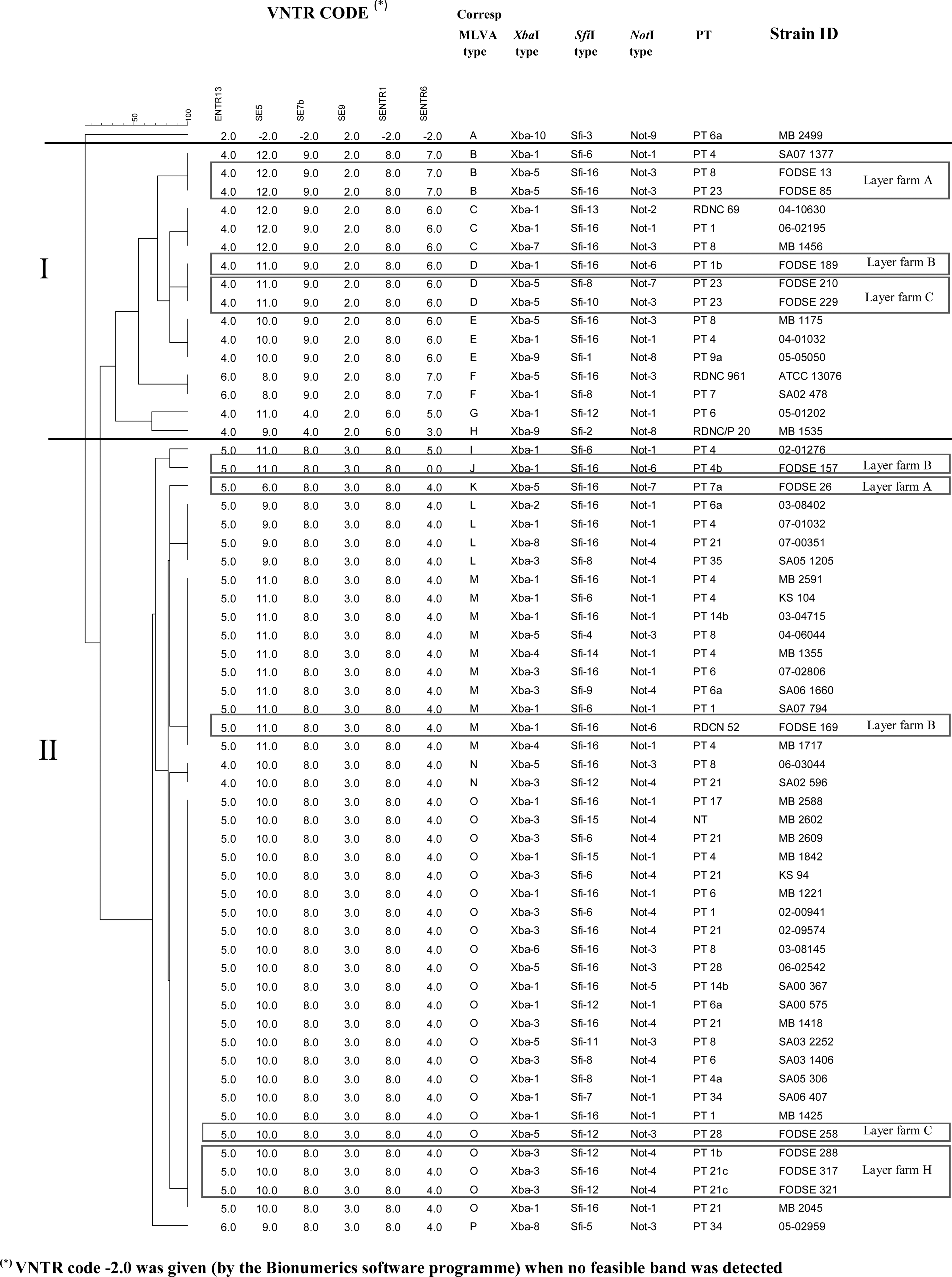
Dendrogram and repeat numbers of each variable number tandem repeat (VNTR) locus for multiple-locus variable number tandem-repeat assay (MLVA) performed on 60 Salmonella Enteritidis (SE) isolates. The similarities between the VNTR codes were calculated using categorical values and the fingerprints were grouped according to their similarities using the unweighted-pair group method using arithmetic averages algorithm (UPGMA) algorithm.
MLVA was able to discriminate among isolates from different layer farms and between isolates from the same layer farm, except within Farm H. MLVA profiles with their respective pulsotype (XbaI, NotI, and SfiI) and PT type are shown in Figure 1.
Analysis of the 60 SE isolates using PFGE
All isolates (Table 1, panel 2) were typeable by PFGE using XbaI, SfiI, and NotI restriction analysis. A cut-off value of 97% for XbaI and SfiI and 96% for NotI for delineation of the different pulsotypes was determined, according to the criteria for the delineation of pulsotypes as described above.
Ten XbaI (Table 1 and Fig. 2) and nine NotI (Table 1 and Fig. 3) pulsotypes were determined within the isolates. Using SfiI (Table 2 and Fig. 4), 16 pulsotypes were distinguished. For each method, the MB 2499 isolate formed a separate pulsotype from the other SE isolates.

Dendrogram and fingerprints for pulsed-field gel electrophoresis (PFGE) using restriction enzyme XbaI with 60 Salmonella Enteritidis (SE) isolates. The similarities between the fingerprints were calculated using the Dice coefficient (optimization 1.0% and position tolerance 1.5%), and the fingerprints were grouped according to their Dice similarities using the unweighted-pair group method using arithmetic averages algorithm (UPGMA) algorithm. XbaI pulsotypes are given with their respective NotI and SfiI pulsotype and multiple-locus variable number tandem-repeat assay (MLVA) type.

Dendrogram and fingerprints for pulsed-field gel electrophoresis (PFGE) using restriction enzyme NotI with 60 Salmonella Enteritidis (SE) isolates. The similarities between the fingerprints were calculated using the Dice coefficient (optimization 1.0% and position tolerance 0.7%), and the fingerprints were grouped according to their Dice similarities using the unweighted-pair group method using arithmetic averages algorithm (UPGMA) algorithm. NotI pulsotypes are given with their respective XbaI and SfiI pulsotype and multiple-locus variable number tandem-repeat assay (MLVA) type.

Dendrogram and fingerprints for pulsed-field gel electrophoresis (PFGE) using restriction enzyme SfiI with 60 Salmonella Enteritidis (SE) isolates. The similarities between the fingerprints were calculated using the Dice coefficient (optimization 1.0% and position tolerance 1.7%), and the fingerprints were grouped according to their Dice similarities using the unweighted-pair group method using arithmetic averages algorithm (UPGMA) algorithm. SfiI pulsotypes are given with their respective XbaI and NotI pulsotype and multiple-locus variable number tandem-repeat assay (MLVA) type.
Using PFGE XbaI or NotI, it was not possible to discriminate between isolates from Farms A and C, whereas PFGE using SfiI found the same pulsotypes on Farms A and B. PFGE using NotI was restricted to discriminate only within isolates recovered from Farm A or from Farm C. PFGE using SfiI could discriminate within isolates within Farm C or Farm H. PFGE using XbaI could not discriminate among any isolates within the same farm.
Discriminatory power and Wallace coefficient
The discriminatory index (DI) of each method was determined separately and combined with PT, as calculated for the 48 epidemiologically unrelated SE isolates and the ATCC 13076 strain (layer farm isolates FODSE were not included; Table 3). For each method considered separately, the discriminatory power of PFGE using SfiI, XbaI or NotI was lower (DI=0.77, 0.75, and 0.69, respectively) compared to MLVA (DI=0.80). Combining PT with MLVA (DI=0.98) or PFGE using SfiI (DI=0.98) resulted in more discriminatory power than combining PT with PFGE using restriction enzyme XbaI or NotI (DI=0.96 and 0.94, respectively).
PT, phage typing; SE, Salmonella Enteritidis; DI, discriminatory index; PFGE, pulsed-field gel electrophoresis.
The congruence between typing methods, expressed by the Wallace coefficient (W), is shown in Table 4. When comparing PT with another typing method, the highest correlation was found between the information provided by PT and PFGE using NotI in both directions. When comparing MLVA with another typing method, the highest correlation was observed with PFGE using XbaI or NotI. A high bidirectional correspondence between PFGE was seen when using XbaI and NotI. However, for this data set, W values were very low and most of the calculated 95% confidence intervals (CI) for W included the respective Wallace coefficient under independence (Wi). This indicates that the congruence of classification could have arisen by chance.
W, Wallace's coefficient; Wi, Wallace's coefficient under independence; PT, phage typing; MLVA, multiple-locus variable number tandem-repeat assay; PFGE, pulsed-field gel electrophoresis.
Discussion
Several MLVA typing schemes for the characterization of SE have been described (Beranek et al., 2009; Boxrud et al., 2007; Cho et al., 2007, 2008; Malorny et al., 2008; Ross and Heuzenroeder, 2009)). However, the use of different loci in each protocol and different primers for the same loci makes it difficult to select the most suitable MLVA scheme. In addition, the different conditions used for running and analysing PCR greatly hinder interlaboratory comparison of the results of the test (Hopkins et al., 2011), which was encountered by our laboratory staff. We therefore evaluated primer pairs from existing MLVA systems for their typeability and discriminatory power and developed an optimized MLVA capillary electrophoresis protocol for the characterization of SE isolates using a new primer combination. Typeability and discriminatory power of this six-locus MLVA were compared with PFGE using restriction enzymes XbaI, NotI, or SfiI on a diverse collection of SE isolates. In this way, we determined the most suitable genotyping method to use in addition to PT. For the different typing methods, we also determined W to analyze correspondence among the classifications of the typing methods. Epidemiologically unrelated (SE isolates with different origins collected over several years) as well as SE isolates sampled on the same layer farm were used to define a suitable subtyping method or a polyphasic approach (combination of typing methods). This enabled us to evaluate their practical use (i.e., a sufficiently high discriminatory power) for the following epidemiological purposes: (i) to distinguish among epidemiologically unrelated SE isolates over several years, (ii) to compare SE isolates originating from layer farms and from human origin, and (iii) to describe contamination routes on SE contaminated layer farms. Results of this study showed that the optimized MLVA method had higher discriminatory power in comparison to PFGE performed with a single restriction enzyme (XbaI, SfiI, or NotI). Only a combination of these three enzymes in PFGE had a considerably higher discriminatory power than MLVA. However, the combination of MLVA with PT had a discriminatory power comparable to combining PT with PFGE using all three enzymes. For any given typing method, W provides an estimate of how much new information is obtained from another typing method. Results indicate that partitions defined either by PT, MLVA, or PFGE using XbaI or SfiI could have been best predicted by PFGE using NotI and vice versa. A combination of methodologies likely provides additional information; however, due to the limited number of isolates tested, the estimated W value was very low and in most cases not significantly different from Wi. No reliable information could be obtained on the directional agreement between the typing methods tested (Pinto et al., 2008; Severiano et al., 2011).
All methods showed good discrimination between isolates from different layer farms. However, only the optimized MLVA, PFGE using restriction enzyme SfiI, and PFGE using all three restriction enzymes provided high resolution for SE isolates from the same layer farm.
The optimized MLVA showed good epidemiological concordance because the isolates from a single-strain outbreak were assigned to identical types (data not shown), which was also confirmed by Boxrud et al. (2007). MLVA typing, albeit with a different combination of primers, has been shown to provide enhanced resolution and good reproducibility for characterizing SE (Boxrud et al., 2007; Cho et al., 2007). Cho et al. (2007) also found that MLVA (although with a different combination of primers than ours) had a higher discriminatory power than PFGE combined with PT as tested on various SE isolates from human and non-human sources. Cho et al. (2010) showed that MLVA (with a composition of seven primers) in combination with PT can be used for effective characterization of SE isolates collected from sporadic human clinical cases. Although they found an association of MLVA-based clusters with phage types using human clinical isolates, this was not confirmed by the present study in which a more diverse and smaller collection of isolates was used.
In conclusion, this optimized MLVA method provides good discriminatory power for characterizing SE isolates. The actual isolate diversity observed by PT could not be obtained by the use of MLVA. A combination of PT and MLVA seems to be providing a higher discriminatory power, as literature and the results obtained from the present study would indicate. In terms of discriminating between SE isolates of different origin and studying contamination routes on a particular layer farm, MLVA, PFGE using SfiI, and PFGE combining all three restriction enzymes can all be used. Nevertheless, MLVA has several advantages over PFGE. MLVA has good discriminatory capacity and has a high throughput because it is a PCR- and capillary-electrophoresis-based technique. These characteristics make MLVA less labor-intensive than PFGE, because the data generated are easier to analyze and interpret. MLVA is thus appropriate for epidemiological studies with a large collection of strains.
Footnotes
Acknowledgments
We thank Rik Lenaerts, Séverine Danschutter, Pieter Siau, and Sabine Van Glabeke for excellent technical assistance, and Miriam Levenson for the English language editing of this manuscript. This research was funded by the Belgian Federal Public Service for Health, Food Chain Safety and Environment (RF 6195).
Disclosure Statement
No competing financial interests exist.