




Abstract
The antimicrobial activity of carvacrol against Escherichia coli O157 was assessed on cattle hide and beef carcass cuts. Carvacrol (0, 10, 20, and 30 mg/mL) was applied using a spray bottle to cattle hide and beef carcass cuts, inoculated with a cocktail of E. coli O157 (5–6 log10 CFU/cm2) and left in contact for 10 min. Following treatment, hide and carcass cuts were sampled using a swab method, and E. coli O157 were enumerated by plate counts on selective media. Carvacrol (30 mg/mL) significantly (p<0.05) reduced inoculated E. coli O157 (1.4 and 1.58 log10 CFU/cm2) compared to the no wash and water wash (0 mg/mL) controls on both carcass cuts and hide respectively. This preliminary study shows that carvacrol has the potential to control E. coli O157 on bovine hide and carcass cuts, but further research with larger scale trials is needed.
Introduction
E
Materials and Methods
Bacterial strains and control reagents
Four toxigenic E. coli O157 strains (380-94, T6H11, J21, and 13C1T3) were obtained from the Teagasc Food Research Centre, Ashtown culture collection. All strains were made resistant to nalidixic acid (50 μg/mL) and streptomycin sulphate (1000 μg/mL), as outlined by Park (1978) to aid in the recovery of the inoculated strains.
Preparation of inoculum and carvacrol
All bacterial cultures were inoculated into 10 mL of tryptone soya broth (TSB; Merck, Whitehouse Station, NJ) and incubated overnight at 37°C. The overnight E. coli O157 cultures were centrifuged at 8000×g for 10 min and washed in 10 mL of phosphate-buffered saline (PBS) prior to use. A cocktail of E. coli O157 strains were prepared in PBS (total volume 20 mL) to achieve a final concentration of 4–5 log10 CFU/cm2 or 5–6 log10 CFU/cm2 to hide and carcass surfaces, respectively.
A stock solution of carvacrol (purchased as a liquid from Sigma-Aldrich, St. Louis, MO) in ethanol (v/v; ratio of 90:10) was prepared to make an emulsification to aid in application, and diluted in sterile water (50 mL) to achieve a final concentration of 10, 20, or 30 mg/mL carvacrol.
Hide and carcass samples
Cattle hide (approximately 2×2 m) and carcass pieces (20×20 cm; from pre-chilled carcasses) were obtained either during in-house processing at Teagasc Food Research Centre, Ashtown or from a local abattoir (from the slaughter line), and transported immediately to the laboratory for processing. The conditions of the hides obtained were dry and moderately dirty. The carcass cuts were obtained from the brisket area of the carcass. The hide or carcass cuts did not undergo any pre-treatments or washes at the abattoir prior to collection. The large sections of hide were cut into smaller 30×30 cm pieces, and one piece was used for each treatment. Each hide and carcass piece was pegged onto a stainless steel board, and smaller sections on each hide (20×20 cm) and carcass (15×15 cm) piece were marked with a permanent marker. The prepared inoculum of E. coli O157 was gently poured onto the marked areas and spread evenly using a sterile plastic plate spreader. Hide and carcass pieces were then left to dry for 1 h in a laminar flow hood to allow for bacterial attachment. The volume of inoculum that was applied dried substantially on both hide and carcass pieces prior to treatment. Inoculated hide and carcass pieces were treated with either a 50-mL wash containing 10, 20, and 30 mg/mL carvacrol or with 50 mL of sterile distilled water only. Treatments were applied to marked areas using a hand-held pressure spray bottle and left in contact for 10 min. A piece of hide and carcass inoculated with the marked E. coli O157 cocktail but not treated with any washes (no wash) was used as a control. A hide and carcass piece not inoculated or treated was tested for the presence of enteric bacteria that possess the same antibiotic-resistant profile as the marked E. coli O157 strains applied in the study. The hide and carcass pieces were held at room temperature throughout the experiment. The assays for all treatments were performed in triplicate (n=3) with separate hide and carcass pieces and inoculum cocktails.
Sampling and enumeration of E. coli O157
The swab samples for microbiological analysis were performed on the hide and carcass portions in accordance with Regulation (EC) 2073/2005. The swab was then placed into sterile stomacher bags (Seward Laboratory, London, UK) and diluted in 90 mL of modified TSB containing streptomycin sulfate (1000 μg/mL) and nalidixic acid (50 μg/mL; mTSB-nas) and stomached for 2 min. The swab samples were performed in duplicate using different areas of each treated sample. The enumeration of E. coli O157 was immediately performed as outlined by McGee et al. (2004), where all stomached swab and excision samples were serially diluted in MRD and 0.1-mL aliquots were spread plated in duplicate onto tryptic soya agar (TSA; Oxoid, Basingstoke Hampshire, UK) and incubated at 37°C for 2 h. Plates were then overlaid with sorbitol MacConkey agar containing streptomycin sulphate (1,000 μg/mL) and nalidixic acid (50 μg/mL; SMAC-nas) and incubated at 37°C for 48 h.
Statistical analysis
All counts for all experiments were log10 transformed, and one-way analysis of means and comparisons of means (Tukey's method) were performed on all data sets using Minitab 12.1 (Minitab Inc., Minneapolis, MN).
Results and Discussion
This study evaluated the ability of carvacrol to reduce E. coli O157 inoculated on cattle hide and carcass cuts. On carcass cuts, carvacrol treatment at concentrations of 10 and 20 mg/mL did not significantly (p>0.05) reduce E. coli O157 compared to the no wash and water wash (0 mg/mL) controls (Fig. 1). However, treatment with 30 mg/mL carvacrol yielded a 1.4 log10 CFU/cm2 reduction in E. coli O157 compared to no wash and water wash controls. On hide, carvacrol treatment at concentrations of 10 and 20 mg/mL did not significantly reduce E. coli O157 compared to the no wash and water wash (0 mg/mL) controls (Fig. 1). However, a concentration of 30 mg/mL carvacrol significantly (p<0.05) reduced E. coli O157 by 1.58 log10 CFU/cm2 in comparison to the no wash and water wash controls. There are no other published studies to date that have investigated the use of carvacrol on hide or carcass matrixes. Many published studies focused on the use of organic acids such as lactic acid and acetic acid on beef carcass and hide, where reductions of 0.7–3.2 log10 CFU/cm2 of E. coli O157 following treatments of 10–100 mg or mg/mL have been reported (Carlson et al., 2008; Cutter, 1994, 1999; Cutter and Rivera-Betancourt, 2000; King et al., 2005). This study demonstrates that carvacrol at concentrations of 30 mg/mL can reduce inoculated E. coli O157 on carcass and hide pieces, and may potentially be used as an alternative control strategy to reduce E. coli O157 in the food chain. However, this experiment was performed as “proof of concept,” and the results shown warrant further investigation using realistic, larger scale experiments prior to any commercial consideration.
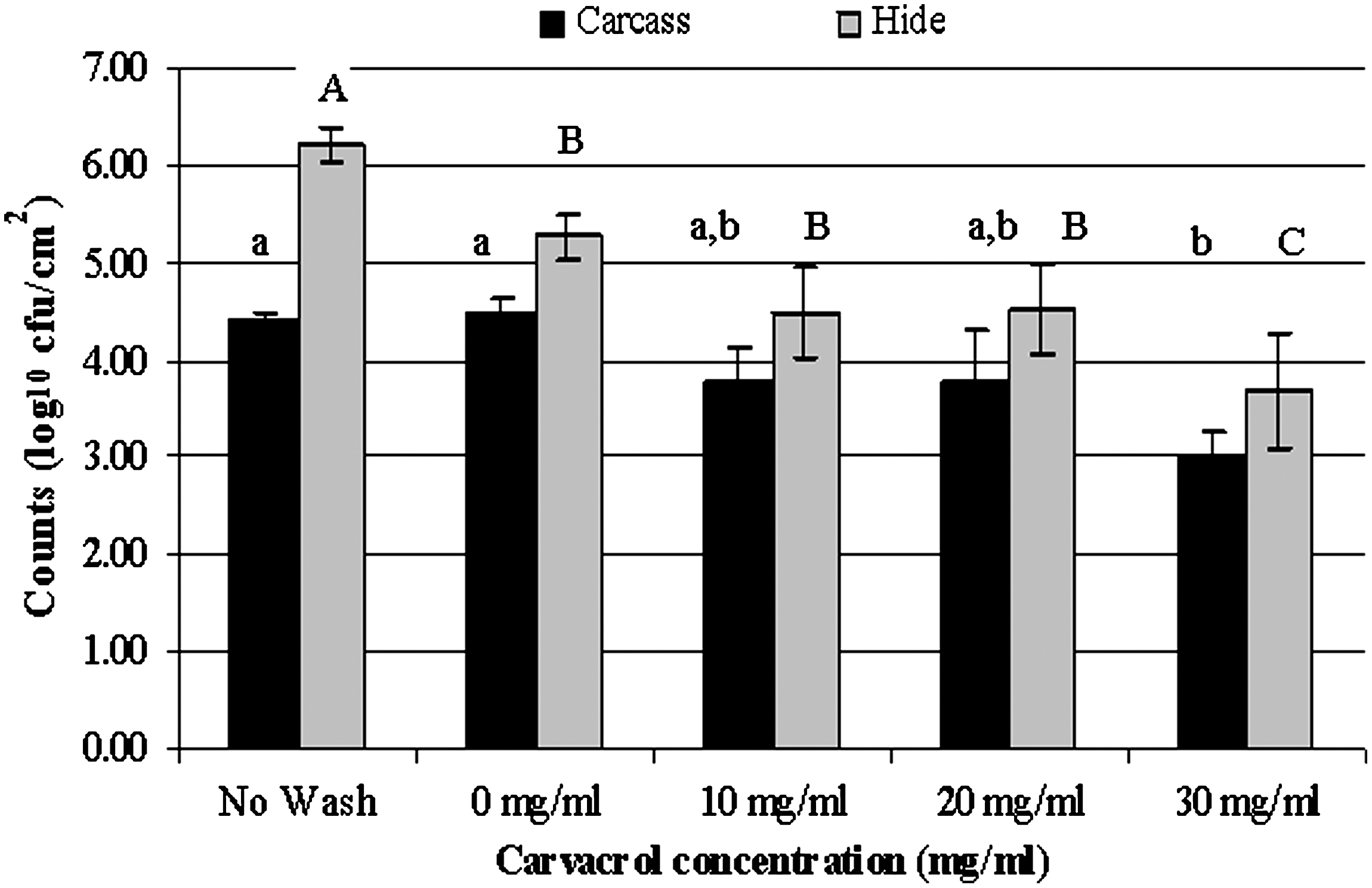
Number of surviving Escherichia coli O157 following exposure to carvacrol on beef carcass cuts and cattle hide. Values noted with the same letter are not significantly (p>0.05) different. Upper case is used for hide samples, and lower case is used for carcass samples.
Footnotes
Acknowledgments
This project was funded by the Department of Agriculture, Food and the Marine under the Food Institutional Research Measure, Ireland. M.J.M. was the recipient of a Teagasc Walsh Fellowship.
Disclosure Statement
No competing financial interests exist.