




Abstract
Monitoring antimicrobial resistance trends among bacteria isolated from food animals and people is necessary to inform public policy regarding appropriate antimicrobial use. Our objectives were to describe the antimicrobial resistance status of Salmonella isolates from dairy cattle in the northeastern United States and to identify trends in resistance to various antimicrobial agents over time. Data were collected retrospectively for all bovine Salmonella isolates that were obtained from samples submitted to Cornell University's Animal Health Diagnostic Center between January 1, 2004 and December 31, 2011. Temporal trends in the prevalence of resistant Salmonella were investigated for each antimicrobial agent using the Cochran-Armitage trend test. Antimicrobial susceptibility testing was performed on 2745 bovine Salmonella isolates from clinical samples submitted during the study period. Overall resistance to each antimicrobial agent ranged from 0% (amikacin, ciprofloxacin, and nalidixic acid) to 72.0% (sulfadimethoxine). There was evidence of a significantly decreasing trend in prevalence of resistance to most agents: amoxicillin/clavulanic acid (AUG), ampicillin (AMP), cefoxitin (FOX), ceftiofur (TIO), ceftriaxone (AXO), chloramphenicol (CHL), chlortetracycline (CTET), florfenicol (FFN), kanamycin (KAN), neomycin (NEO), oxytetracycline (OXY), spectinomycin (SPE), streptomycin (STR), sulfadimethoxine (SDM), sulfisoxazole (FIS), and tetracycline (TET). Among the 265 isolates that were tested using the National Antimicrobial Resistance Monitoring System (NARMS) panel, the most common resistance patterns were pansusceptible (54.0%), AUG-AMP-FOX-TIO-AXO-CHL-KAN-STR-FIS-TET (18.1%), and AUG-AMP-FOX-TIO-AXO-CHL-STR-FIS-TET (12.1%). Increasing prevalence of S. enterica serovar Cerro over the course of the study period presumably had an impact on the observed resistance trends. Nevertheless, these results do not support the notion that the current level of antimicrobial use in dairy cattle is driving an increase in the emergence and dissemination of drug-resistant Salmonella in the region served by the laboratory.
Introduction
S
The cause of rising antimicrobial resistance among Salmonella and other pathogens remains a hotly debated topic. The administration of antimicrobial agents to animals in agricultural settings has historically received much of the blame, as it is believed to exert local selection pressure that promotes drug resistance (Holmberg et al., 1984; Cohen and Tauxe, 1986; Angulo et al., 2000; Fey et al., 2000; Threlfall et al., 2000; White et al., 2001). Antimicrobial agents are used in these settings for the treatment of specific diseases as well as for prophylactic health benefits and the concomitant gains in production. These practices might play a role in promoting drug resistance, depending on the pathogen, drug, and animal host. Subsequent transmission of antimicrobial resistance to humans can be in the form of either resistant pathogens or commensal organisms carrying transferable resistance genes. However, a number of studies have failed to find conclusive evidence that the use of antimicrobial agents in animal production systems leads to either a sustained increase in antimicrobial resistance among animal pathogens or the occurrence of drug-resistant pathogens in people (Ray et al., 2006; Singer et al., 2008; Daniels et al., 2009; Heider et al., 2009; Mann et al., 2011; Morley et al., 2011). In fact, the emergence and dissemination of antimicrobial resistance appears to be a multifactorial process based not only on selection pressure but also on the clonal spread of resistant phenotypes, irrespective of antimicrobial drug use (Davis et al., 2002).
Dairy cattle are an important source of Salmonella serovars that threaten human health, including multidrug-resistant S. enterica serovar Newport and S. enterica serovar Typhimurium (Gupta et al., 2003; Dechet et al., 2006; Varma et al., 2006; Karon et al., 2007). Foodborne transmission is the most common route (Scallan et al., 2011), although Salmonella can also be transmitted by direct contact with the feces of infected dairy cattle (Gupta et al., 2003; Bender et al., 2004; Smith et al., 2004; Karon et al., 2007). The U.S. Department of Agriculture (USDA) National Animal Health Monitoring System (NAHMS) Dairy 2007 study, based on a single sampling visit to 121 herds in 17 major dairy states, found that 14% of cows and 40% of herds were Salmonella-positive based on fecal culture results (CEAH, 2009). Dairy cattle infected with Salmonella can shed organisms for extended durations following clinical disease (Cummings et al., 2009a), and isolates from dairy cattle with salmonellosis are more likely to be multidrug resistant than isolates from cattle that have subclinical infections (Wells et al., 2001; Blau et al., 2005; Ray et al., 2007; Cummings et al., 2009b; Cummings et al., 2010a).
The objectives of this study were to describe the antimicrobial resistance status of clinical Salmonella isolates obtained from dairy cattle in New York and other northeastern states during 2004–2011 and to identify trends in resistance to various antimicrobial agents over time.
Materials and Methods
Study design
Data were collected retrospectively for all bovine Salmonella isolates that were obtained from samples submitted to the Cornell University Animal Health Diagnostic Center (AHDC) between January 1, 2004 and December 31, 2011 and that were subsequently tested for antimicrobial susceptibility. Included in this study were samples submitted by veterinarians in the course of clinical practice (we expect that these were collected predominantly from cattle with evidence of salmonellosis, but some samples might have been collected from cattle without signs of disease) and by veterinarians participating in research projects (only samples collected from clinical cases were included). Research samples collected from environmental sources and from subclinical cases were excluded from this study. Variables collected from the computerized records database included date of Salmonella isolation, sample source, serovar, and susceptibility to each antimicrobial agent.
Microbiologic procedure for Salmonella detection
Personnel at the AHDC used standard bacteriologic culture methods to isolate Salmonella from samples. Individual swab specimens from each sample were enriched in 10 mL of Tetrathionate broth (Difco, Detroit, MI) containing 0.2 mL of iodine solution; the mixture was incubated at 42°C for 18–24 h. After incubation, the sample-broth mixture was streaked onto Brilliant Green agar with novobiocin (Becton Dickinson and Company, Franklin Lakes, NJ) and Xylose Lysine Tergitol 4 (XLT-4) selective media, and both plates were incubated at 35°C for 18–24 h. Red colonies (lactose-nonfermenting bacteria) on Brilliant Green agar with novobiocin and black colonies (hydrogen sulfide–producing bacteria) on XLT-4 were inoculated into Kligler Iron Agar slants and then incubated at 35°C for 18–24 h. XLT-4 plates without suspected colonies were reincubated at 35°C for an additional 18–24 h before checking again for characteristic black colonies. Colonies on Kligler Iron Agar slants that exhibited the biochemical properties of Salmonella were then serogrouped by slide agglutination using standard protocols. Those colonies that were positive by slide agglutination were then identified as Salmonella using the Sensititre Automated Microbiology System's A80 panel (TREK Diagnostic Systems, Cleveland, OH). A proportion of confirmed Salmonella isolates were sent to the National Veterinary Services Laboratories (Animal and Plant Health Inspection Service, United States Department of Agriculture) in Ames, Iowa for serotyping using standard protocols (Edwards and Ewing, 1972).
Antimicrobial susceptibility testing
Antimicrobial susceptibility of Salmonella isolates was determined by use of the microbroth dilution method. Minimal inhibitory concentrations (MIC) were established for each isolate against various panels of antimicrobial agents, including the National Antimicrobial Resistance Monitoring System (NARMS) Gram-negative panel and the Sensititre bovine panel (TREK Diagnostic Systems). The antimicrobial agents used in this study were those included in one or both of these panels: amikacin (AMI), amoxicillin/clavulanic acid (AUG), ampicillin (AMP), cefoxitin (FOX), ceftiofur (TIO), ceftriaxone (AXO), chloramphenicol (CHL), chlortetracycline (CTET), ciprofloxacin (CIP), enrofloxacin (ENRO), florfenicol (FFN), gentamicin (GEN), kanamycin (KAN), nalidixic acid (NAL), neomycin (NEO), oxytetracycline (OXY), spectinomycin (SPE), streptomycin (STR), sulfadimethoxine (SDM), sulfisoxazole (FIS), tetracycline (TET), and trimethoprim/sulfamethoxazole (SXT). Clinical and Laboratory Standards Institute (CLSI) guidelines were used to interpret MIC values when available (CLSI, 2008; CLSI, 2010). Otherwise, MIC values were interpreted using NARMS breakpoints (FDA, 2012). Isolates were classified as being resistant or susceptible to each agent; those few isolates with intermediate susceptibility were categorized as being susceptible. Quality control was performed weekly using four strains of bacteria: Escherichia coli ATCC 25922, Staphylococcus aureus 29213, Enterococcus faecalis 29212, and Pseudomonas aeruginosa 27853. The MIC ranges for quality control recommended by the CLSI were used, and results were accepted if the MIC values were within expected ranges for these bacterial strains.
Statistical analysis
Data were imported into a commercially available statistical software program (SAS, version 9.2; SAS Institute Inc., Cary, NC) for variable coding and analysis. Descriptive analysis was performed on all variables, including sample source, susceptibility to each antimicrobial agent, and serovar. Temporal trends in the prevalence of resistant Salmonella between 2004 and 2011 were investigated for each antimicrobial agent using the Cochran-Armitage trend test. As serovar was considered an important potential confounding variable, the Cochran-Armitage test was also used to evaluate temporal trends in the prevalence of the most common serovars over the duration of the study period. In addition, temporal trends in the prevalence of resistant Salmonella, stratified by the major serovars, were investigated for each antimicrobial agent. For all analyses, p-values<0.05 were considered significant.
Results
Between January 1, 2004 and December 31, 2011, the AHDC performed antimicrobial susceptibility testing on 2745 bovine Salmonella isolates from submitted clinical samples. Among these isolates, 90.9% (2495) were obtained from fecal samples, 6.0% (166) from gastrointestinal tract samples, and 3.1% (84) from other locations (including blood, hide, kidney, lymph node, lung, and milk). Antimicrobial agents were used with varying frequency for MIC determinations, with a median of 1371 isolates (range: 265–2739) being tested for susceptibility to each agent. Resistance to individual antimicrobial agents (Table 1) ranged from 0% (amikacin, ciprofloxacin, and nalidixic acid) to 72.0% (sulfadimethoxine) of all isolates tested. Among the 265 isolates that were tested using the full NARMS panel, the most common resistance patterns (Table 2) were pansusceptible (54.0%), AUG-AMP-FOX-TIO-AXO-CHL-KAN-STR-FIS-TET (18.1%), and AUG-AMP-FOX-TIO-AXO-CHL-STR-FIS-TET (12.1%). Multidrug resistance, defined here as in vitro resistance to two or more classes of antimicrobial agent, was observed in 45.7% (121/265) of isolates that were tested using the full NARMS panel. Of the 1174 isolates that were serotyped, the most common serovars were Cerro (33.1%), Typhimurium (including the 5– variant; 21.7%), Newport (11.1%), Agona (3.2%), and Kentucky (3.1%). Thirty-seven other serovars comprised the remainder (Table 3).
AUG, amoxicillin/clavulanic acid; AMP, ampicillin; FOX, cefoxitin; TIO, ceftiofur; AXO, ceftriaxone; CHL, chloramphenicol; GEN, gentamicin; KAN, kanamycin; STR, streptomycin; FIS, sulfisoxazole; TET, tetracycline; SXT, trimethoprim/sulfamethoxazole.
The Cochran-Armitage test showed evidence of a significantly decreasing trend in prevalence of resistance to most antimicrobial agents (Table 4), including amoxicillin/clavulanic acid and ampicillin (Fig. 1A), all three cephalosporins (cefoxitin, ceftiofur, and ceftriaxone; Fig. 1B), both phenicols (chloramphenicol and florfenicol; Fig. 1C), all three tetracyclines (chlortetracycline, oxytetracycline, and tetracycline; Fig. 1D), four of six aminoglycosides (kanamycin, neomycin, spectinomycin, and streptomycin; Fig. 1E), and two of three folate pathway inhibitors (sulfadimethoxine and sulfisoxazole; Fig. 1F). There were no significant trends for resistance to enrofloxacin, gentamicin, or trimethoprim/sulfamethoxazole. No resistance to amikacin, ciprofloxacin, or nalidixic acid was observed among isolates in this study. The Cochran-Armitage test also showed evidence of a significantly decreasing trend in the prevalence of multidrug resistance among isolates that were tested using the full NARMS panel (p<0.0001).
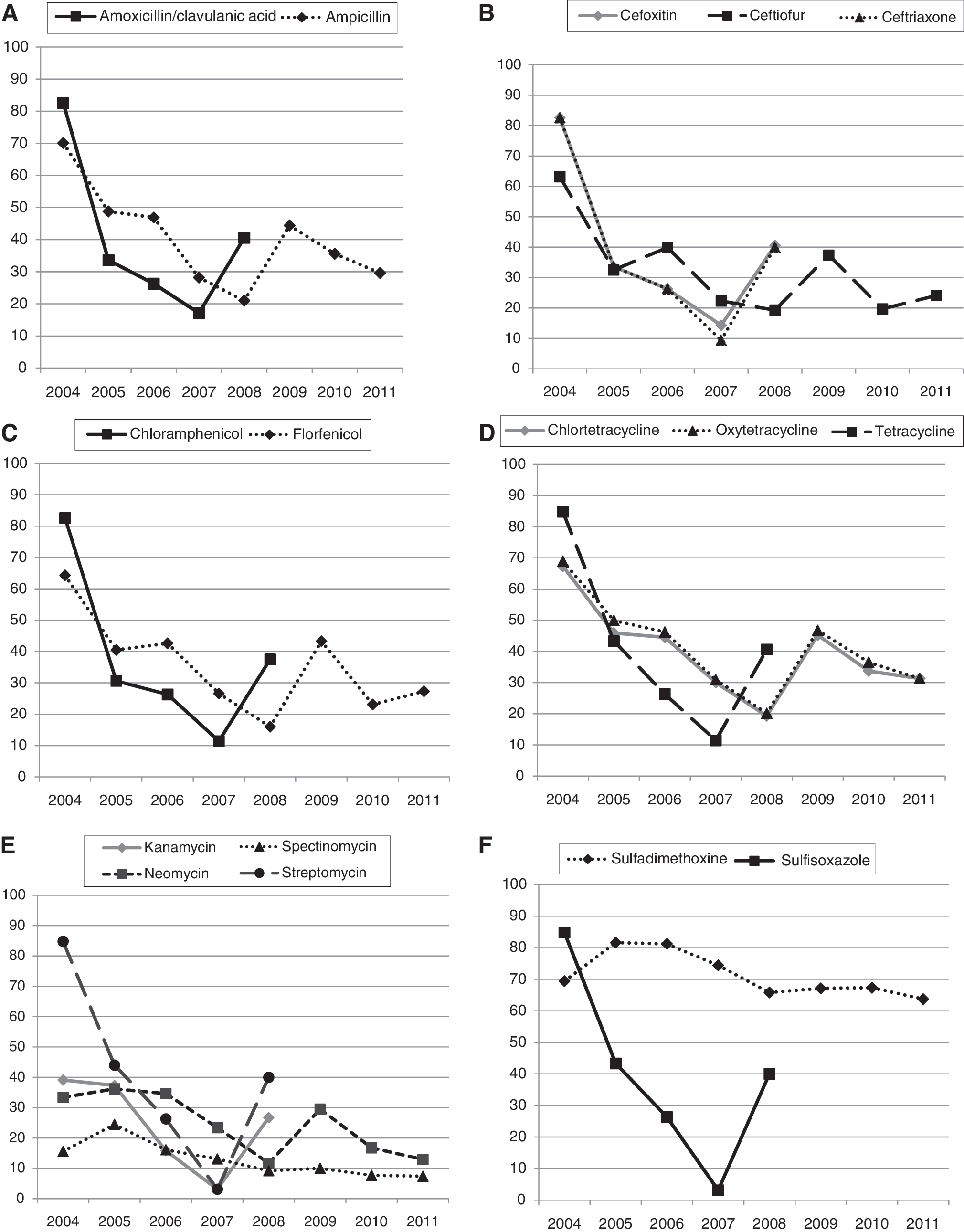
An asterisk denotes that fewer than 10 Salmonella isolates were tested for susceptibility to that antimicrobial agent during that year.
Among those isolates that were serotyped, there was a significant temporal trend for one of the three most commonly observed serovars. The Cochran-Armitage test showed evidence of a significantly increasing trend in the prevalence of S. enterica serovar Cerro isolations (p<0.0001) during the study period (Fig. 2), whereas there was no significant trend for either Salmonella Newport or Salmonella Typhimurium isolations. In order to evaluate whether the temporal trend for Salmonella Cerro isolations was impacting the observed antimicrobial resistance trends, the Cochran-Armitage test was used to analyze serovar-specific trends in the prevalence of resistant Salmonella for each antimicrobial agent over the duration of the study period. There were no antimicrobial resistance trends among either the known Salmonella Cerro (n=389) or Salmonella Typhimurium (n=255) isolates. Among Salmonella Newport (n=130) isolates, however, there was evidence of a significantly increasing trend in prevalence of resistance to ceftiofur (p=0.002), as well as a decreasing trend in prevalence of resistance to spectinomycin (p=0.003).
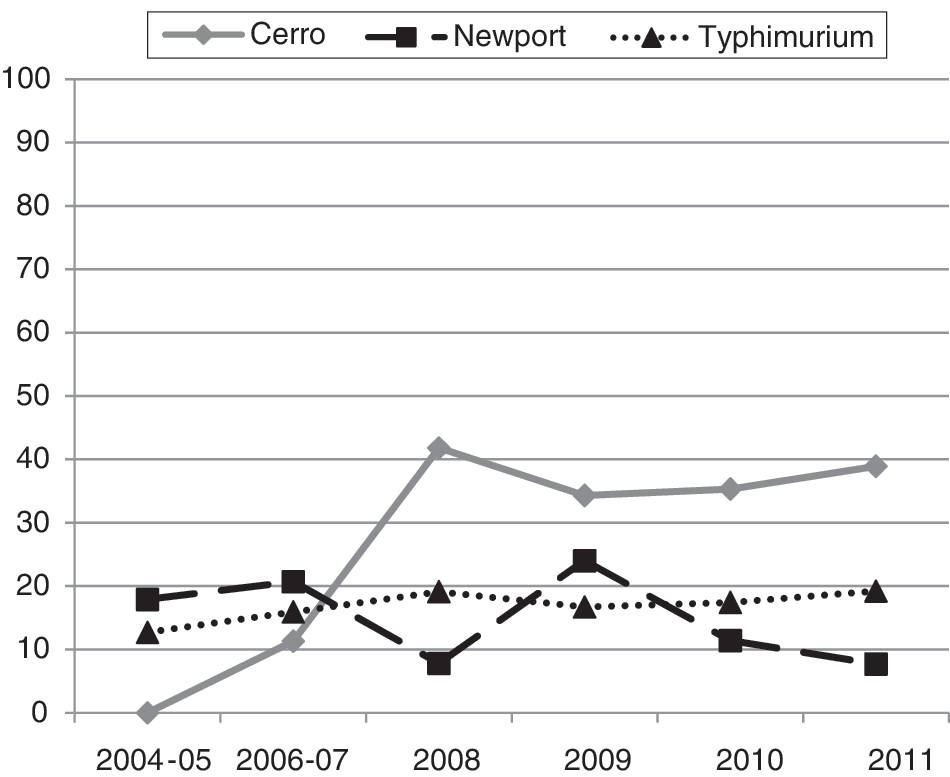
Prevalence of Salmonella enterica serovars Cerro, Newport, and Typhimurium among serotyped isolates obtained from dairy cattle in the northeastern United States, 2004–2011. (Years 2004–2005 and 2006–2007 were combined because a comparatively small number of study isolates were serotyped during 2004 and 2006.)
Discussion
Monitoring antimicrobial resistance trends among bacteria isolated from food animals and humans is necessary to inform public policy regarding the appropriate use of antimicrobial agents in veterinary and human medicine. We are unaware of other studies that have investigated the antimicrobial resistance status of Salmonella isolates obtained from dairy cattle in the same geographic region over several consecutive years. This study was based on data collected from the AHDC database over an 8-year period, thus including 2745 clinical bovine Salmonella isolates upon which antimicrobial susceptibility testing was performed. Although not all isolates were tested for susceptibility to each of the 22 antimicrobial agents used in this study, the scope of our sample (in terms of isolate numbers and time span) and source of our isolates (diagnostic laboratory submissions) made this a valuable dataset for studying antimicrobial resistance trends. In comparison, antimicrobial susceptibility is regularly monitored through the NARMS national surveillance program, a collaborative effort among the U.S. Food and Drug Administration, Centers for Disease Control and Prevention, and the U.S. Department of Agriculture. This program tracks changes in antimicrobial susceptibility among Salmonella and other enteric pathogens from food animals (in addition to humans and retail meats), and reports are published annually. Between 2004 and 2010, NARMS performed susceptibility testing on an average of 379 bovine Salmonella isolates per year (FDA, 2012). However, NARMS samples are not collected from live animals but rather from carcasses and ground products at federally inspected slaughter and processing plants. Antimicrobial susceptibility is also monitored through the NAHMS Dairy studies that have been conducted by the U.S. Department of Agriculture every 5 to 6 years since 1996. Samples for these studies are collected from cattle during a single sampling visit to approximately 100 dairy operations in the major dairy states; the most recent study, carried out in 2007, yielded 556 bovine Salmonella isolates for susceptibility testing (CEAH, 2009).
The prevalence of resistance to most antimicrobial agents among bovine Salmonella isolates decreased significantly over the 2004–2011 study period. Likewise, the prevalence of multidrug resistance among isolates that were tested using the full NARMS panel also decreased significantly. There were no increasing trends in resistance to any of the antimicrobial agents in this study. These results do not support the notion that current antimicrobial use practices on dairy operations are driving an increase in the emergence and dissemination of drug-resistant Salmonella in the region served by the laboratory. Antimicrobial agents that are currently licensed for use in dairy cattle in the United States include enrofloxacin, florfenicol, and various penicillins, cephalosporins, macrolides, sulfonamides, and tetracyclines; extralabel use of some additional drugs is also permitted under certain circumstances. However, the scope of our conclusions is necessarily limited because we do not have data concerning antimicrobial use among this population during the time frame of interest. It is possible that heightened awareness of the potential link between antimicrobial use in animal production systems and antimicrobial resistance among human pathogens has led to a recent decline in the use of certain agents among dairy producers and veterinarians in New York and other northeastern states. According to a NAHMS Dairy report, degree of prophylactic and therapeutic antimicrobial use on dairy operations across the country remained essentially unchanged between its 2002 and 2007 studies (CEAH, 2008). However, if antimicrobial use has recently declined in the geographic area of this study, then local selection pressure may in fact be playing a key role in resistance dynamics for specific antimicrobial agents. Furthermore, our results do not shed light on the discussion of whether antimicrobial use in dairy cattle could be causing an increase in commensal organisms carrying transferable resistance genes; such genes could ultimately confer resistance to pathogenic organisms such as Salmonella via horizontal transfer mechanisms (Barza, 2002). It is also important to consider that other types of food animals might be more important than dairy cattle as a source of antimicrobial resistance transmission.
Two antimicrobial agents of particular concern are ciprofloxacin and ceftriaxone, because of their importance in treating severe Salmonella infections among adults and children, respectively (Guerrant et al., 2001; Hohmann, 2001). In this study, none of the tested isolates were found to be resistant to ciprofloxacin. Nalidixic acid resistance, which is associated with decreased susceptibility to ciprofloxacin, was also absent among tested isolates. In contrast, 39.2% (104/265) of tested isolates were found to be resistant to ceftriaxone, based on the revised breakpoint for resistance that was published by the CLSI in 2010 (CLSI, 2010). As with the other cephalosporins, however, there was a significant decline in prevalence of resistance to ceftriaxone over the course of the study period.
Among serotyped isolates, there was a significant increase in the prevalence of Salmonella Cerro over the 2004–2011 study period. This has implications for the interpretation of our results, as the temporal trend for Salmonella Cerro isolations likely influenced the observed antimicrobial resistance trends. Previous work has indicated that Salmonella Cerro recently emerged as a presumptive pathogen among dairy cattle in New York and perhaps other regions (Cummings et al., 2010b; Hoelzer et al., 2011). In a recent field study in New York, Salmonella Cerro was isolated from 59.2% (71/120) of the dairy cattle with salmonellosis (Cummings et al., 2010b). However, 78.8% (52/66) of the clinical isolates tested for antimicrobial susceptibility in that study were pansusceptible. It is likely that the overall decrease in prevalence of resistance to some antimicrobial agents during the study period was the result of the rise in Salmonella Cerro isolations. Further evidence of this possibility was found in our analysis of serovar-specific temporal trends in the prevalence of resistant Salmonella. The decreasing trends in antimicrobial resistance observed among all bovine Salmonella isolates over the 2004–2011 study period were not reflected in the analyses that were stratified by serovar. No trends in resistance were seen among either the known Salmonella Cerro or Salmonella Typhimurium isolates, and in fact there was a significantly increasing trend in prevalence of resistance to ceftiofur among Salmonella Newport isolates. However, these findings were based on analysis of just a portion of our dataset, as only 42.8% (1174/2745) of isolates tested for antimicrobial susceptibility were also serotyped. The shift in serovar distribution seen among this subset of isolates presumably influenced the overall trends in antimicrobial resistance, but the full extent of the impact is unknown and depends on how well the serotyped isolates represent the entire dataset.
Conclusions
The prevalence of resistance to most antimicrobial agents among bovine Salmonella isolates decreased significantly during the study period. Nevertheless, 46% of isolates that were tested using the full NARMS panel were multidrug resistant. Increasing prevalence of Salmonella Cerro, a serovar that is frequently pansusceptible, presumably impacted the observed antimicrobial resistance trends. Additional research is needed to determine whether these results are consistent in other geographic regions and among other food animal species, ideally with an inclusion of data on antimicrobial use within the studied population as well as more comprehensive serovar data.
Footnotes
Disclosure Statement
No competing financial interests exist.