




Abstract
Foodborne outbreaks associated with the consumption of fresh produce have increased. In an effort to identify natural antimicrobial agents as fresh produce-wash, the effect of essential oils in reducing enteric pathogens on iceberg and romaine lettuce was investigated. Lettuce pieces were inoculated with a five-strain cocktail of Escherichia coli O157:H7 or Salmonella enterica (5 log CFU/g) and then immersed in a treatment solution containing 5 ppm free chlorine, cinnamaldehyde, or Sporan® (800 and 1000 ppm) alone or in combination with 200 ppm acetic acid (20%) for 1 min. Treated leaves were spin-dried and stored at 4°C. Samples were taken to determine the surviving populations of E. coli O157:H7, Salmonella, total coliforms, mesophilic and psychrotrophic bacteria, and yeasts and molds during the 14-day storage period. The effect of treatments on lettuce color and texture was also determined. Cinnamaldehyde-Tween (800 ppm, 800T) reduced E. coli O157:H7 by 2.89 log CFU/g (p<0.05) on iceberg lettuce at day 0; Sporan®–acetic acid (1000SV) reduced E. coli O157:H7 and Salmonella on iceberg and romaine lettuce by 2.68 and 1.56 log CFU/g (p<0.05), respectively, at day 0. The effect of essential oils was comparable to that of 5 ppm free chlorine in reducing E. coli O157:H7 and Salmonella populations on iceberg and romaine lettuce throughout the storage time. The natural microbiota on treated lettuce leaves increased during the storage time, but remained similar (p>0.05) to those treated with chlorine and control (water). The texture and the color of iceberg and romaine lettuce treated with essential oils were not different from the control lettuce after 14 days of storage. This study demonstrates the potential of Sporan® and cinnamaldehyde as effective lettuce washes that do not affect lettuce color and texture.
Introduction
For both organic and conventional operations, chlorine based sanitizers are commonly used on produce surfaces and processing equipment (Suslow, 2000). Effectiveness of these sanitizers depends on their chemical and physical state, treatment conditions, resistance of pathogens, and the nature of the produce surface. Further, plant exudates released during slicing and shredding of fresh produce may react with the chlorine and neutralize its antimicrobial activity (FDA, 2009), requiring frequent monitoring and replenishing of chlorine (Sapers, 2009). Previous research has shown less than 2 log CFU reductions in enteric pathogens when chlorine was used as a produce wash (Lang et al., 2004; Singh et al., 2002). Chlorine may also form harmful chlorinated compounds such as chloramines and trihalomethanes in water (Dychdala, 2001; Lopez-Galvez et al., 2010). Due to these limitations, there is a need for alternative sanitizers in reducing or eliminating pathogens and microbial loads from produce.
Moreover, consumer awareness and concern regarding synthetic chemical additives have led researchers and food processors to look for natural food additives with a broad spectrum of antimicrobial activity (Marino et al., 2001). Essential oils have been evaluated in various foods for their antimicrobial and preservative properties (Burt, 2004; Du et al., 2009; Obaidat and Frank, 2009). The antimicrobial effect of basil oil on spoilage bacteria on lettuce was comparable to washing with 125 ppm of chlorine (Wan et al., 1998). Singh et al. (2002) reported the antimicrobial effect of thyme oil in reducing Salmonella on romaine lettuce. Gunduz et al. (2009, 2010) found that iceberg lettuce washes with 75 ppm oregano oil and 1000 ppm myrtle oil were comparable to 50 ppm chlorine in reducing Salmonella Typhimurium on iceberg lettuce. Lemongrass oil (0.5%) reduced Salmonella Newport by 1.5 and 2 log CFU/g on organic romaine and iceberg lettuce, respectively (Moore-Neibel et al., 2012). The present study is the first report on antimicrobial activity of cinnamaldehyde and Sporan® (a proprietary antimicrobial containing clove, rosemary, and thyme oil) on romaine and iceberg lettuce. The objectives of this study were to compare the antimicrobial effects of cinnamaldehyde or Sporan® alone and in combination with acetic acid against E. coli O157:H7, Salmonella and the native microbiota. The quality parameters of essential oils treated lettuce leaves were also analyzed.
Materials and Methods
Antimicrobials used and preparation of antimicrobial suspensions
Cinnamaldehyde (Sigma-Aldrich, St. Louis, MO) and Sporan® obtained from EcoSMART Technologies (Alpharetta, GA) were used as antimicrobials in this study. Antimicrobial suspensions were prepared as follows: 800 and 1000 ppm cinnamaldehyde (800C, pH 4.17; 1000C, 4.16) and Sporan® (800S, pH 4.70; 1000S, pH 4.62) in sterile distilled water (w/v), 800 ppm cinnamaldehyde in 0.5% Tween 20 (800T, pH 3.83), and combined with acetic acid (20%) as 800 ppm cinnamaldehyde + 200 ppm acetic acid (1000CV, pH 4.00) and 800 ppm Sporan® + 200 ppm acetic acid (1000SV, pH 4.21). A 5 ppm free chlorine solution (pH 6.5) was freshly made by dissolving sodium hypochlorite in deionized water. Chlorine was chosen at 5 ppm as recommended by the Safe Drinking Water Act (4 ppm) (USDA, 2011).
Bacterial culture preparation
Five nalidixic acid–resistant E. coli O157:H7 strains RM 4406, RM 4688, RM 1918, RM 4407, and RM 5279, and five Salmonella enterica serovars described previously (Yossa et al., 2012) were used in the study. Actively growing cells of Salmonella and E. coli O157:H7 strains in tryptic soy broth (TSB; Acumedia, Lansing, MI) and TSB supplemented with 50 ppm nalidixic acid (TSBN), for Salmonella and E. coli O157:H7 strains, respectively, were harvested by centrifugation and adjusted to OD600 of 1 (approximately 8 log CFU/mL). Equal volumes of individual strains were mixed to prepare E. coli O157:H7 or Salmonella cocktails for inoculation studies. Three independent trials were carried out either with E. coli O157:H7 or Salmonella cocktail before each inoculation.
Lettuce inoculation and treatment
The outer leaves of iceberg and romaine lettuce obtained from retail grocer were removed and discarded. Cut lettuce pieces (3×2 cm) were each inoculated with E. coli O157:H7 or Salmonella cocktail (7 log CFU/mL, five spots of 10 μL) on the adaxial surface of the pieces and then air dried for 30 min. Approximately 20 g of air-dried lettuce pieces were placed in a beaker containing 100 mL of treatment solution and washed for 1 min with manual agitation. Treated lettuce pieces were processed in a salad spinner for 1 min and then placed in sterile whirl-pak filter bags (Nasco, Fort Atkinson, WI); the bags were sealed and stored at 4°C for 14 days. Samples washed with sterile water served as control.
Enumeration of E. coli O157:H7, Salmonella, and native microbiota
Lettuce leaves (5 g) were analyzed after inoculation and during incubation period at 0 (after wash treatment), 2, 7, and 14 days for surviving populations of E. coli O157:H7 and Salmonella by spiral plating on Sorbitol MacConkey agar (Acumedia, MI) supplemented with 0.05 mg/L of cefixime, 2.5 mg/L of potassium tellurite and 50 ppm nalidixic acid (Sigma-Aldrich, MO), and xylose lysine tergitol agar (Acumedia, MI) for E. coli O157:H7 and Salmonella, respectively (Yossa et al., 2012).
Uninoculated lettuce pieces (40 g) were washed in 400 mL of the different treatment solutions as described above and stored at 4°C for 14 days. At days 0, 2, 7, and 14, serially diluted suspensions of 10 g of lettuce pieces were spiral plated onto TSA (Acumedia) to enumerate mesophilic (incubation at 37°C/24 h) and psychrotrophic (incubation at 4°C/5–8 days) bacteria; MacConkey Agar (Acumedia; incubation at 35°C/24 h) for total coliforms, and Dichloran Rose Bengal chloramphenicol agar (Acumedia; incubation at 23°C/2–5 days) for yeasts and molds. Colonies were counted using Protocol colony counter (Microbiology International Inc., Frederick, MD).
Color and texture measurement of treated lettuce
Color values (L, a, b) of lettuce leaves treated with selected essential oils were determined using a CR-400 chroma meter (Minolta, Inc., Tokyo, Japan) as described by Park et al. (2001). Texture was measured as the force required to shear 5 g lettuce leaves using the TA-XT2i texture analyzer (Texture Technology Corp., Scarsdale, NY) equipped with Kramer shear cell. Lettuce leaves were placed into the press holder perpendicular to the five shear blades. The force (Newton [N]) of 10 samples was recorded using Texture Expert software (version 1.22; Texture Technology Corp.).
Statistical analysis
The experiment was repeated three times for each treatment and storage period. Reduction in E. coli O157:H7, Salmonella, and background microflora (log CFU/g) from initial populations were compared among treatment-time combinations by a three-way ANOVA using “proc-mixed” procedure (SAS 9.2, Cary, NC). Color and texture data were analyzed similarly by the proc mixed procedure. The level of statistical significance was set at p<0.05 in all cases.
Results
Antimicrobial effects of cinnamaldehyde and Sporan® against E. coli O157:H7 or Salmonella on iceberg lettuce
The initial E. coli O157:H7 populations of inoculated iceberg leaves was 4.39 log CFU/g (data not shown). At day 0, a treatment with 800 ppm cinnamaldehyde+Tween 20 (800T) significantly reduced E. coli O157:H7 by 2.89 log CFU/g compared to that of 5 ppm chlorine (1.49 log CFU/g reduction) and water (0.76 log CFU/g reduction) (Fig. 1). A treatment with 1000SV and 1000S significantly reduced E. coli O157:H7 (2.88 and 2.65 log CFU/g, respectively) in lettuce compared to chlorine (1.20 log CFU/g) and control (0.71 log CFU/g) after 7 days of storage. E. coli O157:H7 were undetectable (<1 log CFU/g) in most treatments after 14 days of storage; more than 2.5 log reductions were reported with all treatments except 1000CV and control.
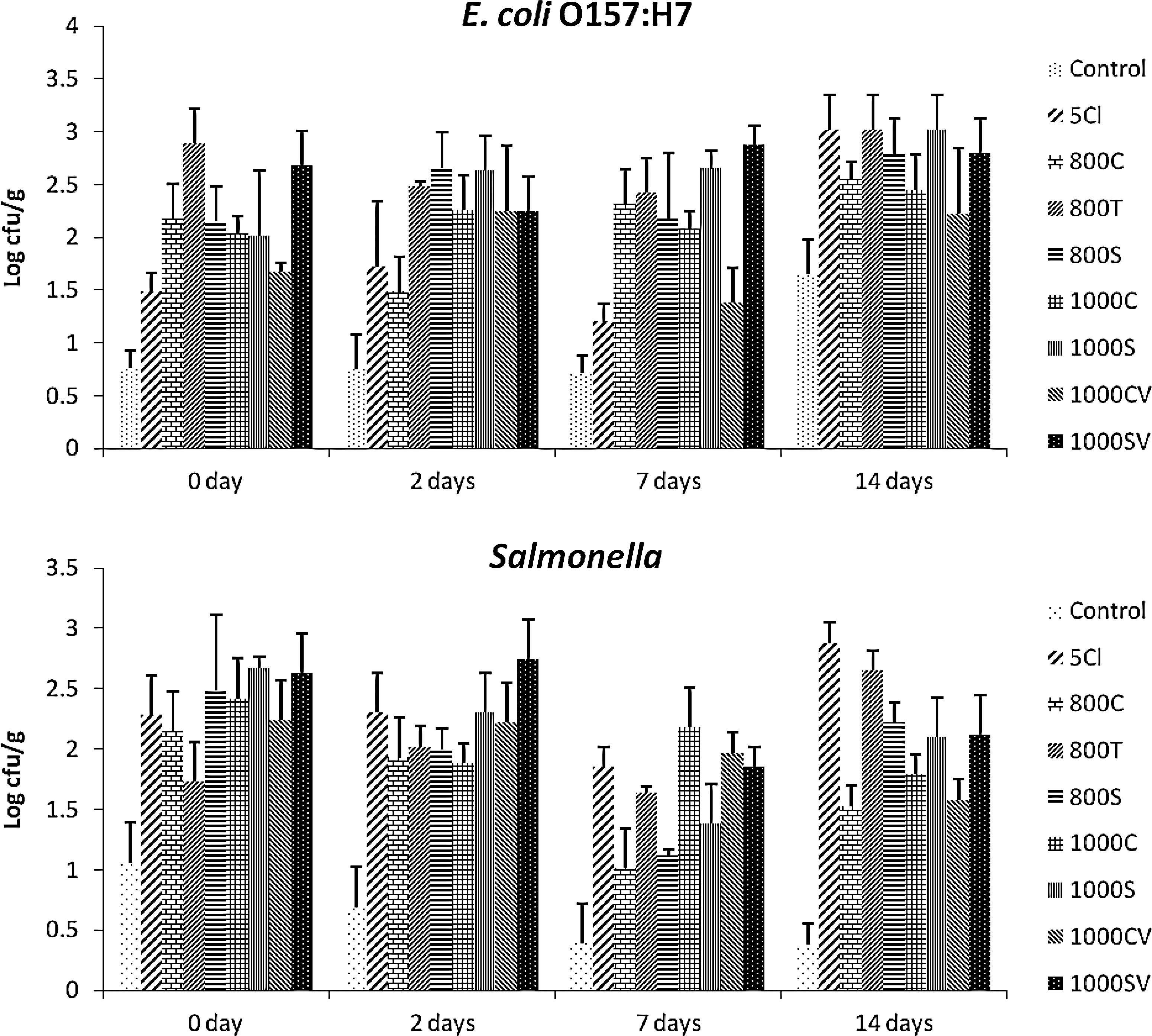
Reductions (log CFU/g) of mixed strains of Escherichia coli O157:H7
Initial Salmonella populations on inoculated iceberg lettuce were 4.62 log CFU/g (data not shown). More than 2.5 log reductions in Salmonella were observed with most treatments on day 0; reductions were significant in lettuce treated with 1000S (2.67 log CFU/g) compared to that of 800T (1.73 log CFU/g) and control (1.06 log CFU/g). Likewise, significant reductions in Salmonella were reported with 1000SV treatment compared to 800S, 1000C, and control on day 2. Salmonella were further reduced during storage in all treated samples. Significant reductions were observed on day 14 in lettuce treated with chlorine and 800T (2.87- and 2.65 log reductions, respectively) compared to other treatments and control.
Antimicrobial effects of cinnamaldehyde and Sporan® against E. coli O157:H7 or Salmonella on romaine lettuce
The initial E. coli O157:H7 populations on unwashed romaine lettuce were 5.22 log CFU/g (data not shown). A treatment with Sporan® plus acetic acid (1000SV) significantly reduced E. coli O157:H7 (1.56 log CFU/g) on romaine lettuce compared to Sporan® alone (800S, 1.14 log CFU/g), 5 ppm free chlorine (1.07 log CFU/g), or water (0.87 log CFU/g) (Fig. 2). E. coli O157:H7 were further reduced at day 2 in most treated samples. The treatments with 1000S, 800T, 1000CV, and 1000SV significantly reduced E. coli O157:H7 on romaine lettuce compared to that with water or Sporan® (800S) after 7 days. An increase in Sporan® concentration from 800 to 1000 ppm resulted in an additional approximately 2 log reduction of E. coli O157:H7 on 14 days. Similarly, addition of acetic acid enhanced the antimicrobial effect of Sporan® against E. coli O157:H7 as evident from significant reductions in 1000SV-treated iceberg lettuce during storage compared to that of Sporan® alone.

Reductions (log CFU/g) of mixed strains of Escherichia coli O157:H7
Salmonella populations were significantly reduced in romaine lettuce following treatment with 5 ppm chlorine and 1000SV (2.58- and 2.28 logs, respectively). Use of acetic acid with Sporan® (1000SV) resulted in significantly higher Salmonella reduction (2.28 log CFU/g) than the treatment with Sporan® alone (800S, 0.96 log CFU/g). Salmonella were reduced during storage in all samples irrespective of treatment. More than 3 log reductions were reported in 5 ppm chlorine-treated romaine lettuce on 2, 7, and 14 days from their respective initial concentrations. Likewise, 2.38–2.99 log reductions in 1000SV-treated romaine lettuce were observed during 2–14 days storage period from their initial concentrations. The antimicrobial effects of chlorine and 1000SV were significantly different from control and all other treatments during 14-day storage period in most cases.
Antimicrobial effects of cinnamaldehyde and Sporan® against native microbiota on iceberg and romaine lettuce
Populations of mesophilic and psychrotrophic bacteria, total coliforms and yeasts and molds on iceberg lettuce were influenced by the treatment and storage period (Table 1). In general, populations of native microbiota from treated samples were not different from control or untreated lettuce leaves. Mesophilic bacterial populations increased significantly on all iceberg lettuce samples by day 7 except on those samples treated with 1000SV and 5 ppm chlorine. Mesophilic bacterial populations on chlorine-treated iceberg lettuce remained similar (p>0.05) throughout the storage time. Total coliforms, psychrotrophic bacterial populations, and yeasts and molds also increased significantly at day 7 in most treated iceberg lettuce.
Values are mean±SD. Each experiment was replicated three times.
Values in the same row not followed by the same letters (xyz) are significantly different; values in the same column not followed by the same letters (ab) are significantly different (p<0.05).
800C–800 ppm cinnamaldehyde, 800T–800 ppm cinnamaldehyde in 0.5% Tween 20, 800S–800 ppm Sporan®, 1000C–1000 ppm cinnamaldehyde, 1000CV–800 ppm cinnamaldehyde+200 ppm acetic acid, 1000S–1000 ppm Sporan®, 1000SV–800 ppm Sporan®+200 ppm acetic acid.
Mesophilic, total coliforms, psychrotrophic, and yeasts and molds populations on treated romaine lettuce were not significantly different from untreated romaine lettuce on day 0 (Table 2). However, populations of this native microbiota increased with storage. Mesophilic bacteria on untreated romaine lettuce, control, and lettuce treated with 5 ppm chlorine, 800S, and 1000SV remained similar (p>0.05) throughout the storage period but increased significantly in 1000S-treated samples at day 14. Similarly, total coliforms recovered from untreated romaine lettuce, control, and lettuce treated with chlorine were not different (p<0.05) throughout the storage time.
Values are mean±SD. Each experiment was replicated three times.
Values in the same row not followed by the same letters (xyz) are significantly different; values in the same column followed by the same letter (a) are not significantly different (p<0.05).
800C–800 ppm cinnamaldehyde, 800T–800 ppm cinnamaldehyde in 0.5% Tween 20, 800S–800 ppm Sporan®, 1000C–1000 ppm cinnamaldehyde, 1000CV–800 ppm cinnamaldehyde+200 ppm acetic acid, 1000S–1000 ppm Sporan®, 1000SV–800 ppm Sporan®+200 ppm acetic acid.
Effect of cinnamaldehyde and Sporan® on texture and color of iceberg and romaine lettuce
Texture of treated iceberg lettuce was not different (p>0.05) from control with the exception of 800C treatment (Table 3). After 14 days, the force measurement of 800 ppm cinnamaldehyde-treated iceberg lettuce were higher (p≤0.05) than those recorded at day 0. Likewise, initial force values of iceberg lettuce treated with 1000 ppm cinnamaldehyde were significantly higher than those stored at 2 days (Table 4). The texture measurements of treated romaine lettuce were not significantly different from that of control. In addition, no differences were observed in the force of treated samples and the control throughout the 14-day storage time at 4°C.
Values are mean±SD. Each experiment was replicated 10 times.
Values in the same row for the same parameter not followed by the same letters (xy) are significantly different; values in the same column not followed by the same letters (ab) are significantly different (p<0.05).
800C–800 ppm cinnamaldehyde, 800T–800 ppm cinnamaldehyde in 0.5% Tween 20, 800S–800 ppm Sporan®, 1000C–1000 ppm cinnamaldehyde, 1000CV–800 ppm cinnamaldehyde+200 ppm acetic acid, 1000S–1000 ppm Sporan®, 1000SV–800 ppm Sporan®+200 ppm acetic acid.
Values are mean±SD. Each experiment was replicated 10 times.
Values in the same row for the same parameter followed by the same letter x are not significantly different; values in the same column not followed by the same letters (ab) are significantly different (p<0.05).
800C–800 ppm cinnamaldehyde, 800T–800 ppm cinnamaldehyde in 0.5% Tween 20, 800S–800 ppm Sporan®, 1000C–1000 ppm cinnamaldehyde, 1000CV–800 ppm cinnamaldehyde+200 ppm acetic acid, 1000S–1000 ppm Sporan®, 1000SV–800 ppm Sporan®+200 ppm acetic acid
Color measurements showed no significant differences (p>0.05) in color coordinate values a (greenness) and b (yellowness) between control and treated iceberg lettuce (Table 5). However, significant differences (p≤0.05) were observed in the lightness (L) values. At day 0, the lightness values of the iceberg samples treated with cinnamaldehyde or Sporan® at 800 and 1000 ppm concentrations were different from control iceberg. During 14 days of storage at 4°C, the lightness values of iceberg samples treated with 800S and 1000SV were similar (p>0.05) to the control. Color coordinate values (L, a, b) of control and treated romaine lettuce were not significantly different throughout the 14 days of storage (Table 6).
Values are mean±SD. Each experiment was replicated 10 times.
Values in the same row for the same parameter not followed by the same letters (xy) are significantly different; values in the same column not followed by the same letters (ab) are significantly different (p<0.05).
800C–800 ppm cinnamaldehyde, 800T–800 ppm cinnamaldehyde in 0.5% Tween 20, 800S–800 ppm Sporan®, 1000C–1000 ppm cinnamaldehyde, 1000CV–800 ppm cinnamaldehyde+200 ppm acetic acid, 1000S–1000 ppm Sporan®, 1000SV–800 ppm Sporan®+200 ppm acetic acid.
Values are mean±SD. Each experiment was replicated 10 times.
Values in the same row for the same parameter not followed by the same letters (xy) are significantly different; values in the same column followed by the same letter (a) are not significantly different (p<0.05).
800C–800 ppm cinnamaldehyde, 800T–800 ppm cinnamaldehyde in 0.5% Tween 20, 800S–800 ppm Sporan®, 1000C–1000 ppm cinnamaldehyde, 1000CV–800 ppm cinnamaldehyde+200 ppm acetic acid, 1000S–1000 ppm Sporan®, 1000SV–800 ppm Sporan®+200 ppm acetic acid.
Discussion
Essential oils have been evaluated to reduce pathogen population on fresh produce. Kim et al. (2011) found significant effect of clove extracts in reducing E. coli O157:H7, Listeria monocytogenes, and Salmonella Typhimurium on fresh lettuce. We found that the antimicrobial efficacy of cinnamaldehyde and Sporan® was dependent on pathogen, type of produce, and storage period. In this study, the washing step was not followed by the rinsing; the presence of residual antimicrobials on the leaves could have contributed to further reduction of these pathogens throughout the storage period. The antimicrobial effect of essential oils against native microflora was not evident in our study. The results are in agreement with Ponce et al. (2011) study who did not observe antimicrobial effect of clove, tea tree and rosemary oils on native microflora of lettuce. Several substances have been used to dissolve the essential oils or to stabilize it in water-based culture media, such as ethanol, Tween 20, acetone, polyethylene glycol, dimethyl sulfoxide (Burt, 2004). A cinnamaldehyde-Tween treatment (800T) significantly reduced E. coli O157:H7 populations on iceberg lettuce at day 2; however, its effect was not evident against E. coli O157:H7 on romaine lettuce. While some researchers have recommended additives to dissolve or stabilize the essential oils in water based culture (Hammer et al., 1999), others have reported reduced activity of oils when emulsifiers and solvents are used (Hili et al., 1997; Mann and Markham 1998; Remmal et al., 1993). Furthermore, a number of potential synergists have been suggested for use with essential oils, such as low pH, low water activity, chelators, low oxygen tension, mild heat and raised temperature (Burt, 2004). In this study, adding acetic acid (200 ppm) to cinnamaldehyde (800 ppm) lowered the pH from 4.17 to 4.00; however, the inhibitory effect of cinnamaldehyde was not significant when acetic acid was added. On the other hand, 200 ppm acetic acid in 800 ppm Sporan® (1000SV) lowered the pH from 4.7 to 4.21 and contributed to increased antimicrobial activity of Sporan® in some cases. Juven et al. (1994) stated that the susceptibility of bacteria to essential oils might increase with lower pH values, since the hydrophobicity of the oils increases at low pH, consequently enabling easier dissolution in the lipids of the cell membrane of Salmonella Typhimurium. This result implies that the efficacy of acetic acid added to essential oils may be dependent on the type of oils, strains, and produce surface.
In previous studies, antibacterial activity of Sporan® against E. coli O157:H7 and Salmonella in organic soil was dose dependent (Yossa et al., 2010, 2011). Other researchers have achieved a higher inactivation of enteric bacteria on fresh lettuce with higher concentration of essential oils (Gunduz et al., 2010; Kim et al., 2011). However, the effect of essential oil concentration was not significant on iceberg and romaine lettuce in this study. These results indicated that the antimicrobial effects of these oils were also dependent on bacterial strain, storage period, and type of produce. The antimicrobial activity of essential oils has been attributed to more than one mechanism (Burt, 2004; Moreira et al., 2005). It has been demonstrated that cinnamaldehyde disrupts cell membrane causing leakage of small ions (Gill and Holley, 2004). The mechanism of action of Sporan® on bacteria is unknown, but since it is made up of clove, rosemary, and thyme oil, the mode of action could be disintegration of the cellular membrane, followed by leakage of cellular components (Burt 2004; Devi et al., 2010). Throughout the storage period, the texture of cut iceberg and romaine washed with 800C, 800S, 1000C, and 1000SV was not significantly different from control lettuce, with the exception of iceberg samples treated with 800C at day 0. Likewise, color characteristics of treated romaine lettuce were not significantly different from control; however, the lightness of iceberg lettuce was affected by cinnamaldehyde.
Conclusion
Recovery of E. coli O157:H7 populations from lettuce treated with essential oils were significantly lower than in chlorine-treated samples at days 0 and 7 for iceberg and days 0 and 14 for romaine lettuce stored at 4°C. The effect of these essential oils was comparable to chlorine in reducing Salmonella populations on iceberg and romaine lettuce throughout the storage period. In addition, the texture and the color of iceberg and romaine leaves treated with essential oils were not different from control lettuce. The results of this study suggest that Sporan® plus acetic acid has the potential to be used as a produce wash treatment to control enteric pathogens in fresh produce provided that sensory characteristics of treated lettuce are acceptable. Further studies simulating industrial settings will be helpful.
Footnotes
Acknowledgments
We thank Eunhee Park for texture analysis of samples and Dr. Bryan Vinyard for statistical analysis. The mention of trade names or commercial products does not imply recommendation or endorsement to the exclusion of other products by the U.S. Department of Agriculture.
Disclosure Statement
No competing financial interests exist.