




Abstract
Knowledge translation and transfer (KTT) aims to increase research utilization and ensure that the best available knowledge is used to inform policy and practice. Many frameworks, methods, and terms are used to describe KTT, and the field has largely developed in the health sector over the past decade. There is a need to review key KTT principles and methods in different sectors and evaluate their potential application in agri-food public health. We conducted a structured mixed-method review of the KTT literature. From 827 citations identified in a comprehensive search, we characterized 160 relevant review articles, case studies, and reports. A thematic analysis was conducted on a prioritized and representative subset of 33 articles to identify key principles and characteristics for ensuring effective KTT. The review steps were conducted by two or more independent reviewers using structured and pretested forms. We identified five key principles for effective KTT that were described within two contexts: to improve research utilization in general and to inform policy-making. To ensure general research uptake, there is a need for the following: (1) relevant and credible research; (2) ongoing interactions between researchers and end-users; (3) organizational support and culture; and (4) monitoring and evaluation. To inform policy-making, (5) researchers must also address the multiple and competing contextual factors of the policy-making process. We also describe 23 recommended and promising KTT methods, including six synthesis (e.g., systematic reviews, mixed-method reviews, and rapid reviews); nine dissemination (e.g., evidence summaries, social media, and policy briefs); and eight exchange methods (e.g., communities of practice, knowledge brokering, and policy dialogues). A brief description, contextual example, and key references are provided for each method. We recommend a wider endorsement of KTT principles and methods in agri-food public health, but there are also important gaps and challenges that should be addressed in the future.
Introduction
R
KTT is defined as “a dynamic and iterative process that includes synthesis, dissemination, exchange and ethically-sound application of knowledge” to inform decision-making (Canadian Institutes of Health Research [CIHR], 2012). In other words, KTT attempts to use the best available knowledge to inform policy and practice. Global momentum in KTT research and practice has resulted in a better understanding of its key principles and methods (Mitton et al., 2007; Sudsawad, 2007; Best et al., 2008; Pentland et al., 2011). Many organizations in the health field and other sectors have developed and adopted different KTT frameworks, and they have endorsed a wider use of specific KTT methods and practices to improve the uptake of knowledge for policy and practice (Lavis et al., 2005; Graham et al., 2006; Sudsawad, 2007; Contandriopoulos et al., 2010; Oborn et al., 2010; CIHR, 2012).
The agri-food sector has a long history of KTT in the form of field extension services (Aflakpui, 2007; Klerkx and Leeuwis, 2009). Extension services have traditionally linked knowledge users in the field (e.g., producers and practitioners) with researchers and academics. However, the type and extent of other KTT methods and practices in the agri-food sector are still relatively limited. For example, knowledge synthesis methods such as systematic review–meta-analysis (SR-MA)—key foundations for KTT—have only recently been endorsed and adopted in agri-food public health (Sargeant et al., 2006a; European Food Safety Authority [EFSA], 2010). This is somewhat surprising, given that SR-MA was effectively used during 1998–1999 by an expert panel to inform Health Canada's potential approval of recombinant bovine somatotropin for use in dairy cattle production (Health Canada, 1998; Dohoo et al., 2003a; Dohoo et al., 2003b). The review concluded that there were several animal welfare concerns associated with recombinant bovine somatotropin, and the product was subsequently not approved for sale in Canada (Health Canada, 1998; Dohoo et al., 2003a; Dohoo et al., 2003b). Many funding agencies are now requesting that research proposals include a structured and pre-specified KTT plan, which should help to improve the future use of KTT initiatives in agri-food public health (Ward et al., 2010; Ontario Ministry of Agriculture, Food and Rural Affairs [OMAFRA], 2011).
Researchers in the agri-food public health sector could benefit from a greater understanding of KTT principles and methods to improve the mobilization, uptake, and application of their research. In addition, a greater knowledge of these concepts among policy-makers and practitioners in this sector could support their use of the best available knowledge in decision-making and practice. Therefore, we conducted a structured review of comprehensive literature from different sectors to identify key KTT principles and methods and to discuss their potential application to the agri-food public health sector. The focus of the review was on KTT applications that enhance knowledge utilization in general as well as to inform policy-making. Within the context of this article, we use the term “agri-food public health” to denote a field of activity characterized by the overlap of veterinary public health, one health, and food safety (Sargeant et al., 2006a), and we refer to “end-users” as any potential user of knowledge for decision-making, including practitioners, policy-makers, and research or policy analysts.
Materials and Methods
Structured review methodology, question, and eligibility criteria
We selected and used a mixed-method review approach a priori to meet the structured review objectives (Dixon-Woods et al., 2005; Mays et al., 2005). This approach was used due to the complexity of the research area and to allow flexibility in the review methods as new concepts and challenges emerged during our progression in the various review steps. The review question was: What is meant by KTT in different sectors and what are the key KTT principles and methods that can be used to increase knowledge utilization in general and for policy-making contexts? However, we later focused the review and analysis on the latter part of this question, to investigate key KTT principles and methods.
We defined a “KTT method” broadly as a process, methodology, or strategy to support, facilitate, or conduct KTT for policy or practice decision-making. The literature search and scope was limited to narrative and structured reviews and reports, discussion articles, commentaries, editorials, case studies, technical reports, and books describing practical KTT principles, specific methods, and their application. We excluded articles that described KTT instruments (e.g., measurement scales) and methods that primarily target clinicians, healthcare practitioners, or individual patients (e.g., audit and feedback, reminders, decision-aids) (Straus et al., 2009). We also excluded articles that described the development of theoretical KTT frameworks and models without specific mention of practical KTT principles or methods. We chose this approach because the selected literature was more informative to help in understanding the evolving nature of KTT and to describe the key principles, methods, and recommendations from other sectors.
Search strategy
An electronic search strategy was developed in consultation with two librarians. It used a combination of targeted “KTT,” “method,” “support,” and “policy” terms (e.g., “knowledge synthesis” AND “strategy” AND “inform” AND “policy”). It was implemented on July 25, 2011, in five electronic databases: Medline, Scopus, Commonwealth Agricultural Bureau Direct, Current Contents Connect, and the Cumulative Index to Nursing and Allied Health Literature. These databases were chosen to ensure that a diverse representation of literature was captured from multiple disciplines. Two books about KTT were also included in the review; they were selected based on previous knowledge of the authors and were recommended by a librarian as key publications in the field (Straus et al., 2009; Bennett and Jessani, 2011). A Scopus web search was conducted to identify grey literature (e.g., reports); it was limited to the first 100 relevant hits as sorted by the search platform's algorithm. The search strategy was limited to articles published since 2000 in order to capture the most recent and relevant reviews of KTT literature. Additional articles of potential interest were identified from the reference lists of included articles during article characterization, but these were procured only if they contained relevant information about KTT methods or concepts that was not already captured in the review.
Relevance screening and article characterization
Relevance screening of the titles and abstracts of all identified citations was conducted by two independent reviewers using a pretested form with two questions. Citations were considered relevant if they described one or more methods or principles to support or facilitate KTT for policy- or decision-making. Articles in languages other than English, Spanish, or French were excluded at this stage due to limited resources for translation. Reviewer disagreements were resolved through consensus, and the full article of relevant citations was procured for article characterization.
Due to the complex and diverse range of literature identified, an exploratory approach was used for article characterization and to prioritize articles for more detailed data extraction and synthesis. Two reviewers inductively developed a characterization form after independently reviewing 10 arbitrarily selected relevant articles. The form was applied on these articles, results were discussed, and the form was revised to enhance its clarity and relevance, and then reviewing continued with the remaining articles. The reviewers met periodically to discuss the characterization process, review agreement, and resolve conflicts. The form was used to extract key characteristics from each article (e.g., review type and sector) and to categorize articles into one of three groups: conceptual overviews of KTT (i.e., reviews that described its key principles or characteristics), case studies reporting the use of KTT methods in a specific project or setting, and method reviews that provided detailed descriptions of one or more KTT methods. The latter articles were used to extract key characteristics of reported KTT methods. A brief description of each method along with contextual examples and other characteristics were summarized in tabular format.
Thematic analysis
During the article characterization stage, a purposive subset of conceptual overview and case study articles was selected and prioritized for thematic analysis by reviewer consensus. Thematic analysis involves the identification and description of the most important or recurrent issues and concepts from a body of literature (Dixon-Woods et al., 2005; Mays et al., 2005). We prioritized articles because we believed that data saturation could be achieved without analyzing all captured articles in detail. Our criteria for prioritization included the following: (1) unique or comprehensive insights are provided, (2) article is broadly applicable and generalizable, and (3) sufficient information is reported for coding and extraction. We inductively developed a thematic analysis form and codelist based on our individual review of these articles. We then applied these on five arbitrarily selected articles, discussed our results, and revised the form to ensure that all relevant concepts were captured, and then analysis continued with the remaining articles. Coding involved the identification and extraction of key recommended principles and practices for effective KTT. After completion of coding, we met to discuss and compare our independent coding results, and then we jointly developed a list of overall themes by grouping and aggregating codes that represented similar concepts and issues.
Review management
Four different reviewers conducted relevance screening and two (A.R. and I.Y.) conducted article characterization and thematic analysis. Additional input and feedback on the study approach was received from a larger collaborative team consisting of eight government and academic professionals with research and policy expertise in the agri-food public health sector. All citations identified in the search were imported into RefWorks 2.0 and manually de-duplicated (ProQuest LLC, Bethesda, MD). Citations were subsequently imported into DistillerSR for relevance screening, article characterization, and thematic analysis (Evidence Partners Incorporated, Ottawa, ON). Results were downloaded as Excel spreadsheets (Microsoft Corporation, Redmond, WA) for data management and analysis. Copies of the search strategy and all forms used in this review are available as supplementary material (Supplementary Data are available online at
Results
Characteristics of selected KTT literature
The review approach is shown in Figure 1. From the initial de-duplicated 827 potentially relevant abstracts, 160 were confirmed as relevant and characterized as conceptual overviews (n=75), case studies (n=57) or method reviews (n=28). The main characteristics of the initial selection of relevant articles (n=160) are shown in Table 1. Most were narrative reviews (90.0%) published in the health sector (80.0%). The most commonly referenced KTT definition was from the CIHR (CIHR, 2012), followed by some other definitions (Stetler, 2001; Davis et al., 2003; Graham et al., 2006), while 60.6% of articles did not provide any definition (Table 1). Thirty-three articles (25.0%) were prioritized for thematic analysis based on their overall focus and unique insights (Table 1). The list of articles characterized and prioritized for thematic analysis is available as supplementary material.
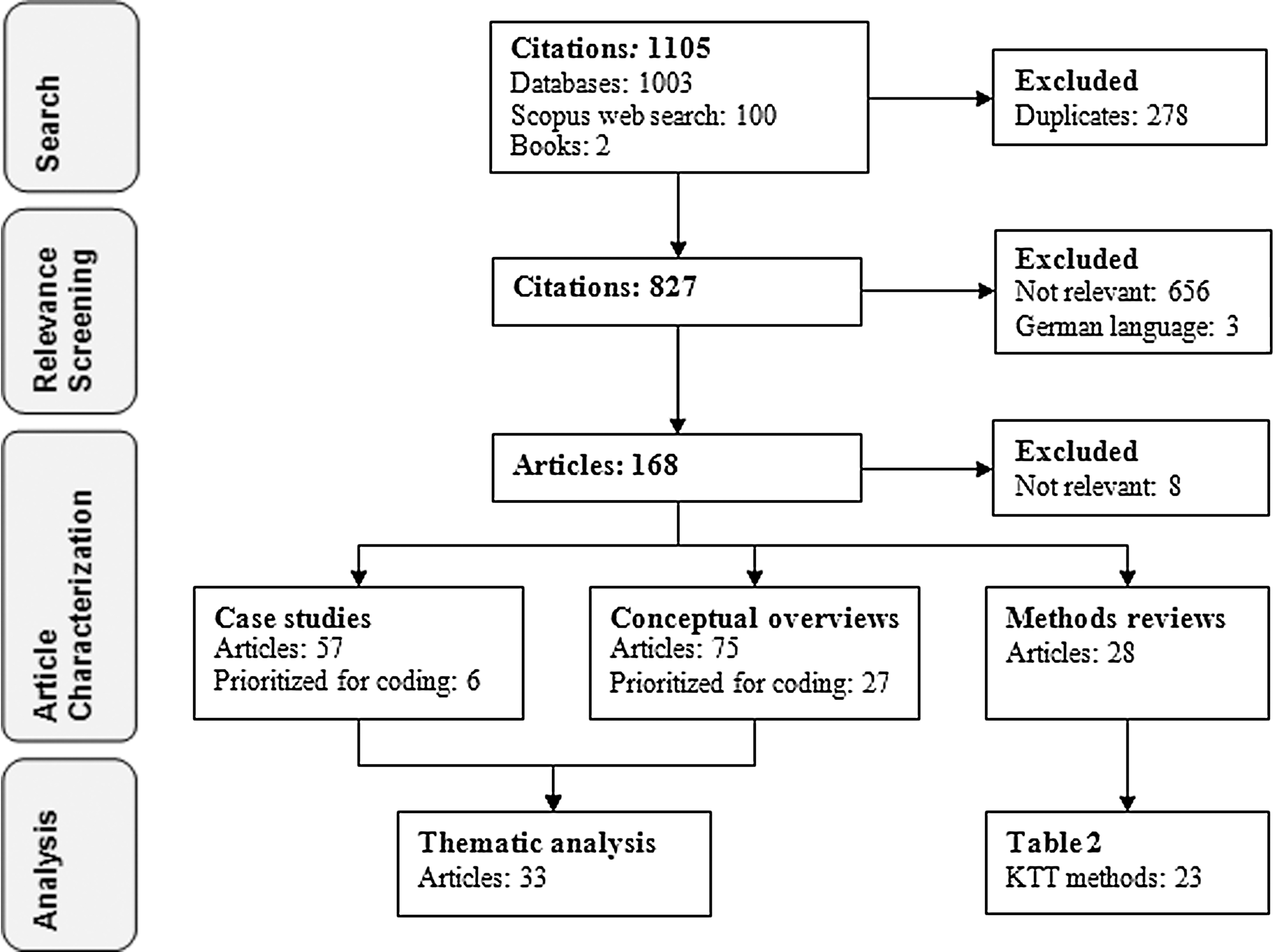
Mixed-method review process.
Information was extracted from both the review and qualitative research or workshop summary component of these articles.
Multiple answers allowed per article (i.e., percentages don't add up to 100%).
Applicable to conceptual review and case study articles only (n=132).
CIHR, Canadian Institutes of Health Research.
Key features and characteristics of KTT
The use of KTT was discussed in the literature within two specific contexts: (1) to support improved research utilization in general, and (2) to support evidence-informed policy-making. We identified five overall themes as key features and characteristics for effective KTT in these two contexts: four relate to KTT for general research utilization (Fig. 2) and the other reflects the unique considerations involved when informing policy-making (Fig. 3). The reviewers agreed that data saturation was reached after analyzing all of the prioritized articles (i.e., all key concepts and insights were identified). The following is a brief characterization of the five identified themes.

Overview of the knowledge translation and transfer (KTT) process and key principles and characteristics. Relevant and credible research must be synthesized and disseminated; researcher, intermediary, and end-user interactions must occur throughout each stage; and monitoring and evaluation of the impact of KTT must occur to measure research application and use. Each of these processes requires organizational capacity and a supportive culture, as well as the implementation of effective KTT methods.

An overview of the evidence-informed policy-making process. Research has a greater chance of influence in the policy process during a favorable political climate and through ongoing researcher–policy-maker interactions. Internal and external influences (e.g., values, habits, beliefs, lobbyists, and stakeholders) also contribute to the policy-making process and compete with research knowledge.
Relevant and credible research
Formal knowledge syntheses (e.g., SR-MA) were frequently identified in the literature as the most credible and reliable methods to inform decision-making because they have greater statistical power, a lower risk of bias and increased contextual applicability than individual studies and expert opinion (Mulrow, 1994; Sheldon, 2005). In addition, they have a more transparent and structured methodology than traditional narrative reviews (Sargeant et al., 2006b; Waddell et al., 2009). However, ensuring credible research is not sufficient to guarantee its uptake and utilization. Research also needs to be presented to end-users in a relevant, timely, understandable, and accessible format (Lavis et al., 2005; Mitton et al., 2007; Bowen et al., 2009). In addition, research needs to incorporate multiple types of evidence (e.g., quantitative and qualitative) that address contextual factors of importance to decision-makers (e.g., cost-effectiveness) to improve the relevance of key messages and implications (Mays et al., 2005; Poulos et al., 2007; Davies et al., 2008; Brownson et al., 2009; Lomas and Brown, 2009).
Communication and collaboration
Direct contact and interactions between researchers and end-users is one of the most important factors facilitating the use of research in decision-making (Innvaer et al., 2002; Draper et al., 2009). Therefore, to ensure greater research uptake, more proactive and ongoing communication and collaboration between researchers and end-users are needed (Mitton et al., 2007; Scott et al., 2009; Oborn et al., 2010). This requires researchers to become more aware of the complexities of the decision-making process, and it requires end-users to develop a stronger understanding of how research is generated and how it can be used to inform policy and practice (Mitton et al., 2007; Oborn et al., 2010).
Organizational support and culture
Another important component of effective KTT is to ensure a supportive organizational culture and sufficient capacity for researchers and end-users to engage in KTT activities (Mitton et al., 2007; Rundall et al., 2007; Draper et al., 2009; Head, 2010; Pentland et al., 2011). For example, the academic promotion and reward process needs to appropriately recognize researcher KTT efforts (Hanney et al., 2003; Best et al., 2008). In addition, end-users must have the appropriate skills and training to identify, critically evaluate, and apply research for decision-making (Rundall et al., 2007; Draper et al., 2009).
Monitoring and evaluation
Measuring the impact of KTT is as important as supporting the use of research in decision-making (Lavis et al., 2003a; Head, 2010). The most frequently used methods for measuring KTT impact are document analysis, in-depth qualitative interviews, and questionnaires (Hanney et al., 2003; Mitton et al., 2007), but other approaches adapted from the international development field (e.g., outcome mapping) could also be used (Hovland, 2007; Bennett and Jessani, 2011). These methods can be used to measure instrumental, conceptual, or symbolic research use among end-users (Lavis et al., 2003a; Mitton et al., 2007). In instrumental research use, end-users change their practices or behavior to act on the research in a specific or direct way (e.g., to develop a policy). Conceptual use is reflected through a change in the end-user's understanding or attitudes of the research, and symbolic—or political—use justifies a position already held or an action already taken.
Evidence-informed policy-making
Policy-making is a complex, value-laden, and negotiated process (Mitton et al., 2007; Greenhalgh and Russell, 2009; Lenton and Allsop, 2010). It involves the consideration of multiple, competing influences and forces, including research, stakeholder views and experiences, and socioeconomic implications (Hanney et al., 2003; Dobrow et al., 2004; Ashford et al., 2006; Lomas and Brown, 2009; Contandriopoulos et al., 2010). However, the process should still be accountable and transparent (Riege and Lindsay, 2006; Rundall et al., 2007). The potential for research to influence policy can be enhanced through researcher and policy-maker interactions and collaborations to address policy-relevant issues and during a favorable political climate or “window of opportunity” for policy change (Hanney et al., 2003; Ashford et al., 2006; Poulos et al., 2007; Head, 2010; Lenton and Allsop, 2010; Sutherland et al., 2012).
Methods for knowledge synthesis, dissemination, and exchange
We identified 23 distinct KTT methods and grouped them into categories based on their primary function: synthesis (n=6 methods), dissemination (n=9) or exchange (n=8). A brief description of each method along with their primary end-users (e.g., practitioners or policy-makers) and contextual examples are shown in Table 2. This list is not meant to be exhaustive of all possible KTT methods, but reflects only those that met our prespecified definition of a replicable and well-defined KTT method. In addition, we excluded methods for knowledge monitoring and evaluation from this table because it was considered beyond the scope of this review (Hanney et al., 2003; Hovland, 2007; Bennett and Jessani, 2011).
Examples from agri-food public health were sought wherever possible through prior experiences and knowledge of the authors and collaborating team and through informal Internet searches.
Key references refer to selected sources to consult for additional information about the KTT method description and process. These were identified from the 23 method reviews captured by this review. Some references were also identified through prior knowledge or “snowball” sampling (i.e., through the reference lists of other articles included in this review).
Examples not provided for peer-reviewed journals and conference presentations because these are common and established practices.
N/a, not applicable; OMAFRA, Ontario Ministry of Agriculture, Food and Rural Affairs.
Discussion
Implications for agri-food public health
A multitude of terms and definitions have been used to refer to KTT, including knowledge transfer and exchange, knowledge mobilization, knowledge integration, knowledge intermediation, and research utilization, which tends to complicate the field (Graham et al., 2006; Best et al., 2008; Davies et al., 2008; McKibbon et al., 2010; Oborn et al., 2010). In addition, numerous conceptual models and frameworks have been proposed to describe the KTT process, and these were primarily developed within a healthcare and clinical context (Graham et al., 2006; Sudsawad, 2007; Wilson et al., 2010). We decided not to focus this review on KTT terminology and theoretical frameworks, and instead, we reviewed comprehensive literature from multiple sectors to synthesize practical KTT principles and methods and to determine their potential applicability to the agri-food public health context.
The majority of relevant literature in this review was published in the health sector, indicating its influence on the direction of KTT research over the last several years (Graham et al., 2006; Best et al., 2008; Oborn et al., 2010). In contrast, we identified only two articles from the agri-food sector, despite its long history of knowledge exchange and brokering through field extension services. We identified some other examples of the application of KTT methods on agri-food public health issues (Table 2), but many of these were not explicitly labeled or characterized as KTT approaches. This could be partly due to differences in the use of terminology to refer to KTT concepts between different sectors, but likely also reflects that KTT as a formal and recognized approach is still developing in the agri-food public health sector.
KTT principles and methods
Research is often generated and presented in a format that does not meet the practical and contextual needs of end-users (Lavis et al., 2005; Mitton et al., 2007; Head, 2010). In response to this, many funding agencies now require researchers to identify their KTT plan in grant proposals and specify targeted end-users and dissemination and exchange formats (Canadian Health Services Research Foundation [CHSRF], 2010; Ward et al., 2010; OMAFRA, 2011). For example, the CHSRF requires a 1:3:25 graded-entry format for their research reports, with one page of key messages, a three-page executive summary and 25-page full report (Lavis et al., 2005; CHSRF, 2010). This format has recently been adapted for selected SRs published in the agri-food public health sector (Table 2), and their utility is currently being evaluated by targeted end-users (Rajić and McEwen, 2010).
Research is one of many sources of information used by end-users for decision-making, and an effective KTT approach requires that researchers address the multiple, contextual factors of importance to the decision-making environment (Lavis et al., 2005; Davies et al., 2008; MacLachlan, 2009; Head, 2010). For example, research will be of increased relevance to end-users if it incorporates an analysis of contextual factors such as economics, public perceptions, and local applicability (Poulos et al., 2007; Davies et al., 2008). One approach to address these factors is through qualitative or mixed-method research (Mays et al., 2005; Brownson et al., 2009). Recent applications of these methods in the agri-food public health sector have investigated issues such as producer attitudes toward on-farm food safety programs and stakeholder opinions about food safety policy development (Sargeant et al., 2007; Young et al., 2011).
Enhanced researcher and end-user collaborations and interactions are needed in agri-food public health to support the use of research to inform policy and practice. Engagement of end-users before and during the conduct of a research study can help to ensure that the topic is relevant and applicable to them, and it can increase the likelihood the results will be used to inform decision-making (Keown et al., 2008; Pentland et al., 2011). For example, in two ongoing scoping reviews addressing broad, policy-driven agri-food public health topics, advisory review committees consisting of diverse stakeholders and end-users were formed early in the process and actively contributed to the review direction, scope, and dissemination and exchange of key findings (Rajić and McEwen, 2010). Similarly, the involvement of researchers more actively in decision-making can help to ensure that research is more accurately evaluated and interpreted by end-users (Lavis et al., 2005; Oxman et al., 2009).
The use of intermediaries has been proposed as a strategy to facilitate researcher and end-user collaborations and exchange (Table 2). Knowledge brokers are one type of intermediary that promotes interaction between researchers and end-users through a variety of roles, including networking, creating partnerships, mediating, capacity building, and facilitating access to and interpretation of knowledge (Dobbins et al., 2009; Ward et al., 2009). They require a range of specialized skills to fulfil these different roles, which are often beyond the traditional training of researchers and end-users (Ward et al., 2009). However, there is still limited evidence on the overall effectiveness of knowledge brokers as a formal KTT strategy, the specific roles they should be expected to perform, and their value compared to increasing the ability of researchers and end-users to conduct these functions more effectively (Ward et al., 2009; Pentland et al., 2011).
Policy-makers make decisions based on several competing factors that attempt to influence the policy process (Fig. 3). These factors often outweigh research, particularly when the issue is polarizing or contentious among different stakeholder groups (Head, 2010). For example, consider the agri-food issue of antimicrobial use and resistance in food animal production in North America, where action on proposed bans of the use of medically important antimicrobials on farms was delayed despite growing evidence of links between antimicrobial use on farms and antimicrobial resistance in bacteria isolated from retail meat products and humans (Webster, 2012). Researcher and policy-maker interactions and a favorable policy window or environment can facilitate the influence of research in policy-making. For example, a window for policy change often occurs following a high-profile disease outbreak when public pressure and political will is high. However, researchers should continue to provide knowledge to policy-makers even without an apparent policy window, because it can affect how they understand and view the issue (Mitton et al., 2007; Lenton and Allsop, 2010).
Table 2 provides a concise resource of the most widely recommended and promising methods to support various KTT activities for agri-food researchers and end-users. For example, SR-MA and other structured review formats were the most frequently recommended and reported methods for knowledge synthesis (Mays et al., 2005; Pawson et al., 2005; Boaz et al., 2006; Lavis et al., 2009b; Grimshaw, 2010; Tricco et al., 2011). However, we did not identify reference in the KTT literature to other important synthesis methods such as risk assessment that have a long history of application in agri-food public health. This is possibly due to different levels of uptake of this methodology between sectors and a lack of characterization of risk assessment as an explicit KTT method. We encourage researchers to explore further how synthesis methods such as SR-MA can be linked formally with risk assessment to inform decision-making in this sector (Bucher et al., 2012b).
The summary of KTT methods in Table 2 complements similar initiatives in the health sector, such as the registry of KTT methods and tools maintained by the National Collaborating Centre for Methods and Tools in Canada and the SUPPORT Tools for Evidence-Informed Health Policy-Making, a collection of guiding articles written for health policy-makers and those who support them (Lavis et al., 2009b; NCCMT, 2012). However, there is still a lack of evidence on the overall effectiveness and reliability of some of these methods (e.g., rapid reviews and knowledge brokering) (Dobbins et al., 2009; Ward et al., 2009; Ganann et al., 2010), which might vary depending on the specific context and situation of use. There is a need to develop and evaluate these methods further in agri-food public health.
Challenges and limitations
One of the challenges of KTT is that researchers and end-users tend to have conflicting time horizons, which could affect their ability to engage effectively with each other to support timely research uptake (Lavis et al., 2005; Mitton et al., 2007; Brownson et al., 2009). Early and frequent interactions between researchers and end-users before research initiation and throughout the project can help to overcome this barrier. However, increased involvement of end-users in the production of research could also have drawbacks. For example, care should be taken to ensure that their input does not create a conflict of interest or compromise the researcher's ability to generate unbiased and rigorous results. Another challenge is the difficulty in evaluating KTT impact and effectiveness. Due to the nature of KTT outcomes (e.g., policy changes), clear and measurable indicators of success might not emerge for several years (Head, 2010). Researchers and end-users should consider a range of short- and long-term indicators during evaluation; several examples are noted by Lavis et al. (2003b).
Many of the principles and recommendations for KTT described in this review are intended to increase the uptake and relevance of research for end-users, but we also recognize that not all research can or should have a direct impact or influence on policy and practice and that it is unrealistic and unnecessary for all research to conform to each of these principles. For example, many KTT principles and methods would not be relevant to proof-of-concept research such as in vitro and laboratory pathogen transmission and challenge studies. However, with an increasing need for governments and funding agencies to ensure accountability of their research and to allocate scarce resources in a way that enhances applied value, we believe that a greater awareness and adoption of these concepts is advantageous for all researchers in this sector.
One of the limitations of this review is the focus on reviews, reports, and commentaries instead of primary research. Given that many of the reviews in this study have already comprehensively and systematically synthesized and analyzed primary KTT research (Mitton et al., 2007; Best et al., 2008; Contandriopoulos et al., 2010; Oborn et al., 2010; Pentland et al., 2011), we believe that our focus was appropriate to determine overall themes and key KTT methods reported or recommended in the literature. However, we also acknowledge that most of the included articles were narrative reviews and could have contained a subjective selection of KTT articles. In addition, there is a possibility that recently published primary research about new or alternative KTT methods, concepts, and applications was not included in this review. Given the rapidly evolving nature of this field, we recommend that researchers and end-users actively monitor KTT developments to support their future activities in this area.
Our search strategy could have missed some important research, given that it was targeted to obtain a pragmatic number of citations and used a combination of KTT terms that might not represent all terminology used in various sectors (Mitton et al., 2007; McKibbon et al., 2010). In addition, our exclusion of articles describing theoretical frameworks and our method of prioritizing relevant articles for thematic analysis involved some subjectivity, which we attempted to minimize through the use of two independent reviewers. We are confident that a more comprehensive search, broader inclusion criteria, or prioritization of different articles would not change the key results of this review, as data saturation was reached in the thematic analysis from a diverse range of comprehensive KTT literature.
Conclusions
We comprehensively reviewed key KTT principles and methods and their potential application to the agri-food public health sector. We believe researchers and decision-makers in this sector would benefit from endorsing a wider use of promising KTT concepts and practices. There is a need for agri-food public health stakeholders to invest in KTT activities and build necessary infrastructure and capacity to support research utilization and evidence-informed policy-making in this sector. However, an important limitation of KTT is that many specific methods and practices have yet to be comprehensively evaluated and validated for use in different contexts. More applied KTT research and evaluation needs to be conducted on agri-food public health issues.
Footnotes
Acknowledgments
A.R. and I.Y. contributed equally to the design and conduct of this study and preparation of this manuscript. S.A.M. contributed to the study conception and critical review of the manuscript. We thank Janet Harris and Judy Inglis for input on the search strategy, Mia Cikovic for article procurement, Judy Greig and Mai Pham for relevance screening, and the other members of the collaborating team for input and feedback on this review: Lisa Waddell, Barbara Marshall, Dr. Katarina Pintar, Dr. Kate Thomas, Dr. Javier Sanchez, and Dr. Andrew Papadopoulos. We also thank Dr. Marnie Brennan for her external review of the manuscript. This review was funded by the University of Guelph and OMAFRA's Agri-Food and Rural Link KTT Funding Program, and the Laboratory for Foodborne Zoonoses, Public Health Agency of Canada.
Disclosure Statement
No competing financial interests exist.
References
Supplementary Material
Please find the following supplemental material available below.
For Open Access articles published under a Creative Commons License, all supplemental material carries the same license as the article it is associated with.
For non-Open Access articles published, all supplemental material carries a non-exclusive license, and permission requests for re-use of supplemental material or any part of supplemental material shall be sent directly to the copyright owner as specified in the copyright notice associated with the article.
