




Abstract
Yersinia pestis can cause oropharyngeal plague as a result of consumption or handling of meat from infected animals. Thus, food naturally or intentionally contaminated can have a role in the dissemination of oropharyngeal plague. The growth of a conditionally virulent pYV-bearing rifampicin-resistant Y. pestis KIM5 (rif-Y. pestis KIM5) in retail raw ground pork (RGP) was studied at temperatures ranging from 4 to 30°C. At 4°C, rif-Y. pestis KIM5 did not grow but survived. In RGP, rif-Y. pestis KIM5 grew at refrigerated temperatures of 10 and 15°C with growth rates of 0.05 and 0.16 log10 colony-forming units (CFU)/h. The growth rates at abusive temperatures of 20, 25, and 30°C were 0.26, 0.30, and 0.77 log10 CFU/h. The growth rate was increased 15.4-fold with the increase of storage temperatures from 10°C to 30°C. The maximum population density ranged from 6.76 to 8.66 log10 CFU/g. Furthermore, there was no detectable loss of pYV in surviving rif-Y. pestis KIM5 at any of the temperatures tested in retail RGP. This suggests that under these conditions, Y. pestis could cause oropharyngeal plague if the meat was not properly cooked. The individual infected by Y. pestis in food is a potential reservoir who can infect others, leading to outbreaks of plague.
Introduction
Y
Yersinia pestis has been shown to carry a 70-kb virulence plasmid (pYV), which is directly involved with virulence. A number of phenotypic characteristics associated with the pYV have been (Bhaduri and Sommers, 2008; Brubaker, 2006; Carniel, 2006; Perry and Fetherston, 1997). The pYV harbors the type III secretion system (T3SS) that secretes an array of virulence effectors called Yops (Brubaker, 2006). It was demonstrated that pYV-containing Y. pestis also expressed temperature-dependent Congo red uptake (red pin point colony, size=0.36 mm) as an indicator of virulence (Bhaduri and Sommers, 2008). The pYV-associated temperature-dependent phenotypes are expressed at 37°C but not at 28°C. At the same time, the expression of these phenotypes at 37°C facilitates the loss of pYV (Bhaduri, 2012; Bhaduri and Smith, 2012; Bhaduri and Sommers, 2008; Brubaker, 2006; Carniel, 2006; Robins-Browne, 2001). Since, the pYV is unstable. Repeated cultivation, refrigerated storage, or freezing may foster the loss of pYV in Y. pestis (Bearden and Perry, 2008; Bhaduri et al., 2011), and consequently, pYV loss results in the loss of virulence and the concomitant disappearance of associated virulence characteristics (Bhaduri et al., 2011; Bhaduri and Sommers, 2008).
Pork products such as chops, ribs, sausage, and pork chops are produced on a large scale. The United States Department of Agriculture estimates the annual per capita pork consumption in the US at 45.9 lb (National Agricultural Statistics Service, USDA, 2011). The resulting pork products are distributed throughout wholesale and retail markets. Among all the pork products, we have chosen ground pork because we have already studied the growth of Y. pestis in a similar product, ground beef (Bhaduri, 2010). The possible deliberate contamination of ground pork with Y. pestis that could affect the health of numerous consumers is an important concern in the United States and of the World Health Organization. In this regard, risk assessors are interested in knowing the fate of Y. pestis for scenarios where bulk foods could be contaminated, thereby exposing a relatively large number of individuals.
Exposure assessments for foodborne disease require information about the behavior of pathogens under various processing and handling conditions that occur throughout the food chain. During processing, transport, and storage by the consumer, pork products may be held at refrigeration temperatures or at abusive temperatures for various time periods. In this regard, there are few available reports concerning the fate of Y. pestis in foods (Bhaduri, 2010), and more specifically, in raw ground pork (RGP). In this report, experiments were conducted to monitor the growth and survival of Y. pestis in retail RGP over a wide range of storage temperatures including refrigerative and abusive temperature conditions. The resulting information can improve exposure assessment and aid in designing more effective food safety controls. Moreover, to fully assess the potential risk of illness, it is necessary to know the stability of pYV in Y. pestis during growth in RGP.
Materials and Methods
RGP
RGP (3.2-mm pieces, 20% fat) was made from fresh pork steak cubes purchased from a local pork slaughtering and processing plant. This nonsterilized RGP was used to study the effect of microflora present in ground pork on the growth of Y. pestis. The RGP was divided into 90-g portions, vacuum-sealed in filtered double-sealed stomacher bags (Koch Industries, Kansas City, MO), and stored at −20°C until experimentation.
Plasmid-bearing Y. pestis strain and maintenance
Y. pestis KIM5, a derivative of clinical strain KIM (Kurdistan Iran man), which lacks the chromosomally encoded pigmentation virulence determinant (Pgm), but contains all three plasmids (pYV [70.3-kb, YOPs, type III secretion system], pFra/pMT1 [96.2-kb, murine toxin: phospholipase, F1 capsule-like antigen], and pCP1/pPst/pPla [9.6-kb, plasminogen activator]) (Brubaker, 2006; Perry and Fetherston, 1997), was used in this study. This strain is conditionally virulent (a conditional mutant is only infectious if inoculated intravenously) and can be used in a BL2 laboratory facility (Bearden and Perry, 2008). This strain is well characterized, and has been extensively used in our laboratory, as well as by other investigators, to study the microbiology and molecular pathogenesis of this bacterium (Brubaker, 2006; Bearden and Perry, 2008; Bhaduri and Sommers, 2008; Bhaduri, 2010; Bhaduri et al., 2011). Since we used retail RGP with its natural microflora to evaluate the growth behavior of Y. pestis KIM5, it was necessary to use an antibiotic-resistant strain of Y. pestis KIM5 to detect the organism in retail RGP. A rifampicin-resistant Y. pestis KIM5 (rif- Y. pestis KIM5) strain was isolated on tryptic soy agar (TSA; Becton-Dickinson, Franklin Lakes, NJ) containing 100 μg of rifampicin (Sigma Chemicals, St. Louis, MO) per milliliter and incubated at 28°C for 72 h to prevent plasmid loss as described by Bhaduri and Phillips (2011). The rifampicin-resistant Y. pestis KIM5 (rif-Y. pestis KIM5) strain was maintained at −80°C in brain heart infusion (BHI; Difco, Sparks, MD) broth containing 20% glycerol until ready to use. Due to the unstable nature of pYV (Bhaduri et al., 2011), the presence of pYV in starting cultures of KIM5 and rif-Y. pestis KIM5 in each experiment was confirmed by low calcium response (Lcr), Congo red (CR) binding, and a polymerase chain reaction (PCR) assay targeting a key regulatory gene, virF, present on pYV (Bhaduri, 2003; Bhaduri and Sommers, 2008).
Culture media
The BHI broth and agar, and 1% peptone water (PW) were prepared following the manufacturer's instruction (Difco). Rifampicin-Congo red (CR) magnesium oxalate agar (rif-CRMOX) was prepared by adding 20%
Preparation of inocula
A rifampicin-resistant Y. pestis KIM5 strain was grown in BHI broth for 18 h at 28°C with shaking at 120 rpm to a population density of approximately 108 colony-forming units (CFU) per milliliter. The cultures were diluted in 1% PW prior to inoculating RGP.
Sample inoculation
Rifampicin-resistant Y. pestis KIM5 inoculum was prepared by diluting overnight cultures in PW to the desired working concentration (∼105 CFU/mL). Prior to inoculation, 90-g samples of RGP were thawed for 2–3 h at room temperature and then maintained at 4°C. For growth experiments, 10 mL of a 105 CFU/mL working suspension of rif-Y. pestis KIM5 were added to 90-g thawed RGP. The inoculum was hand-massaged into the RGP through the stomacher bag for ∼30 s, followed by mixing (Model Bag Mixer 400, Interscience Inc., Weymouth, MA) for 2 min. Next, 3-g (±0.2 g) portions were transferred with a sterile spoon from the 90-g mixed sample to individual 100-mL- capacity stomacher bags. The bags were loosely sealed with tape to permit ambient air exchange.
Test procedures
Temperatures relevant to commercial and consumer handling practices were used in this study. Since growth at temperatures over 30°C facilitates the loss of pYV, the growth of rif-Y. pestis KIM5 was studied at 10, 15, 20, 25, and 30°C, which includes both refrigeration and abusive temperature conditions. The bacteria in RGP were grown at the respective temperatures until they attained the stationary phase. High precision (±0.01°C) temperature-controlled circulating water baths (model RTE 17, Thermo Neslab, Newington, NH) were used to maintain the temperatures at 4, 10, 15, 20, 25, and 30°C. Two trials from separate batches of RGP were conducted for each growth temperature, with triplicate samples per time point and triplicate plating per sample after serial dilution. The water temperatures were continuously monitored using a calibrated temperature data logger (model FT121 or D100, Dickson, Addison, IL) as described by Bhaduri and Phillips (2011). The data loggers were calibrated against a National Institute of Standards & Technology certified thermometer (ERTCO Precision Ever Ready Thermometer Co., West Patterson, NJ).
Bacterial enumeration
Bacterial enumeration took place at differing time intervals dependent on the growth temperature. At least eight sampling points over several days were used for the 4 and 10°C growth temperatures. Growth temperatures above 10°C were sampled at more than 10 periods over a 24-h time period. At each time interval, three samples of RGP were diluted with PW in 10-fold serial increments, mixed for 1 min, 0.05 mL was surface-plated onto rif-CR-MOX agar, and the plates incubated at 37°C for 48 h. Red pinpoint colonies (expression of Lcr and CR-binding phenotypes) appearing on the agar plates indicated the presence of the pYV in rif-Y. pestis KIM5 (Bhaduri and Sommers, 2008). Colonies were counted using a ProtoCOL colony counter with version 3.15.630 software (Protocol PC Model 66000, Synoptics Ltd., UK). Data were transferred to an Excel® spreadsheet (Microsoft Corp., Redmond, WA).
Data analyses
The growth data from each replicate plate for each temperature was fitted to a Gompertz curve using the nonlinear regression procedure of the SAS statistical package (SAS Institute Inc., 2011). The regression provided estimates of four parameters, which were then used to estimate the growth rate and maximum population density (MPD) of rif-Y. pestis KIM5 growth (Gibson et al., 1987). The growth rate and maximum population density estimates were examined using t-tests to determine whether they were significantly nonzero.
Results and Discussion
Growth rate
There are no data concerning the growth of Y. pestis in retail RGP during storage over a wide range of temperatures. In this study, rif-Y. pestis KIM5 was initially grown in BHI broth at 25°C for 18 h and diluted to 105 CFU/mL in 1% PW. Then rif-Y. pestis KIM5 was inoculated into RGP to study its growth at 4, 10, 15, 20, 25, and 30°C. This range is similar to commercial and consumer handling practices. Refrigerator temperatures have been shown to vary from 4°C to a maximum temperature of 17.2°C (Laguerre et al., 2002); hence, the growth of rif-Y. pestis KIM5 was monitored at 4, 10, and 15°C. Storage at 4, 10, and 15°C will determine whether rif-Y. pestis KIM5 is cold tolerant. The temperatures from 20 to 30°C represent abusive temperature conditions. Since the temperatures above 30°C facilitate the loss of pYV, which results in avirulent cells, the growth of the rif-Y. pestis KIM5 strain was not studied above 30°C (Bhaduri and Sommers, 2008; Bhaduri et al., 2011). The rif-Y. pestis KIM5 did not grow in RGP at 4°C storage for a 2-month period but did survive under these conditions (Fig. 1). This is in agreement with our previous study in retail raw ground beef (RGB) (Bhaduri, 2010) but differs from the observation that Y. pestis grew in heart infusion broth at 4°C (Torosian et al., 2009). This may be due to the behavior of Y. pestis in food compared to broth culture. The lag phase ranged between 5 and 23 h at 10, 15, 20, 25, and 30°C. The organisms were allowed to grow to the maximum population density. The rif-Y. pestis KIM5 grew at 10°C with a growth rate of 0.05 log10 CFU/h (significantly nonzero at p=0.01), and which increased to 0.16 log10 CFU/h at 15°C (3.2-fold). The results presented here demonstrate that refrigeration alone is not an effective barrier to prevent growth of Y. pestis in food. Therefore, the survival of Y. pestis KIM5 4°C and its growth at 10 and 15°C in RGP suggests that Y. pests is a cold-tolerant pathogen and a potential health risk for refrigerated foods. These observations are similar to those observed in RGB (Bhaduri, 2010). The rif-Y. pestis KIM5 grew in RGP at abusive storage temperatures of 20, 25, and 30°C. The growth rate increased from 0.26 log10 CFU/h at 20°C to 0.30 log10 CFU/h at 25°C and reached a maximum growth rate of 0.77 log10 CFU/h at 30°C in RGP (Fig. 1). Thus, the growth rate increased 1.15-fold from 20 to 25°C, 2.56-fold from 25 to 30°C and 2.96-fold when the storage temperature was increased from 20 to 30°C (Fig. 1). The overall growth rate was increased 15.4-fold when the storage temperature was shifted from refrigeration temperature of 10°C to an abusive temperature of 30°C (Fig. 1). In comparison, when the storage temperature was increased from 10°C to 25°C, the growth rate was increased 6.00-fold (0.30 log10 CFU/h) in RGP (Fig. 1) compared to 4.57-fold (0.233 log10 CFU/h) in RGB (Bhaduri, 2010). At 25°C, the growth rate of rif-Y. pestis KIM5 was 1.2-fold higher in RGP than the growth rate previously reported in RGB (Bhaduri, 2010). From this observation it could be concluded that Y. pestis might grow better in RGP than in RGB at abusive storage temperatures.
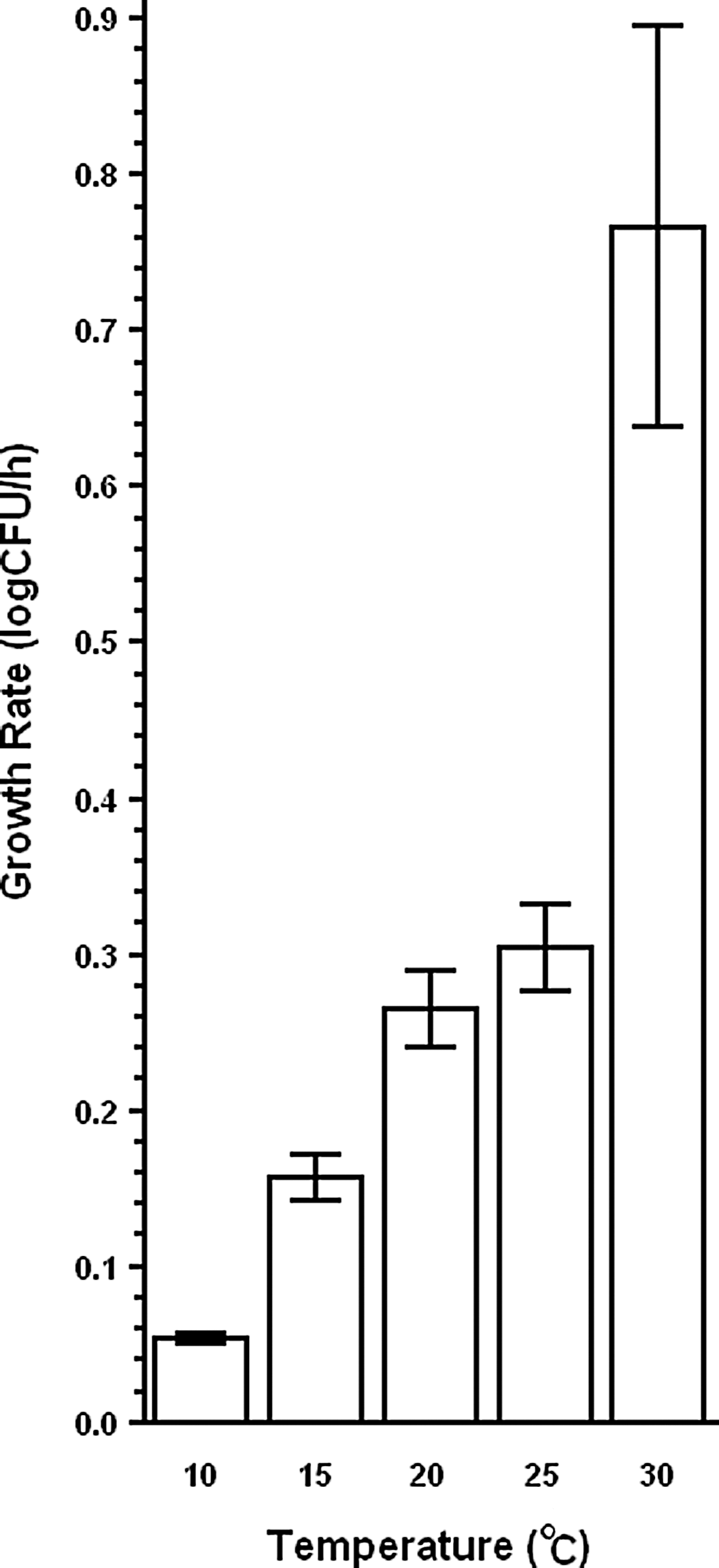
Estimated growth rate of rif-Yersinia pestis KIM5 in raw ground pork as a function of storage temperature from 10 to 30°C. Presence of pYV was indicated by the appearance of red pinpoint colonies on rifampicin–Congo red (CR) magnesium oxalate agar. Error bars (I) indicate a range of ±1 standard deviation of the mean. CFU, colony-forming units.
Since the chromosomal DNA sequences of Y. pestis and Y. pseudotuberculosis are nearly identical (Achtman et al., 1999; Hinchliffe et al., 2003; Wren, 2003), the growth rate of rif-Y. pestis KIM5 in RGP was compared with the previously reported (Bhaduri and Phillips, 2011) growth rate of pYV-bearing Y. pseudotuberculosis at 4–25°C in RGB. In contrast to Y. pestis KIM5, Y. pseudotuberculosis grew in RGB at 4°C (Bhaduri and Phillips, 2011). The growth rate for these two pathogens was similar at 10°C. However, the growth rate of pYV-bearing Y. pseudotuberculosis in RGB was 3.40-fold higher than the growth rate of rif-Y. pestis KIM5 in RGP at 15°C. This indicates that Y. pseudotuberculosis may be psychrotrophic in nature compared to cold-tolerant Y. pestis. Moreover, the growth rate of pYV-bearing Y. pseudotuberculosis in RGB was 2.32-fold and 2.08-fold higher than the growth rate of rif-Y. pestis KIM5 in RGP at 20°C and 25°C, respectively. These observations showed that Y. pseudotuberculosis grew better in food than Y. pestis both at refrigerated and abusive temperatures. However, at 30°C the growth of Y. pseudotuberculosis in RGB was lower by 3.2-fold compared to the growth of rif-Y. pestis KIM5 in RGP. At present, we cannot explain this change in behavior.
MPD
The MPD represents the highest concentration that a microbial population attains in an environment. This level can be influenced by limiting quantities of nutrients and/or by production of inhibitory substances. Since Y. pestis KIM5 did not grow in RGP at 4°C, the MPD was not determined. The MPDs of rif-Y. pestis KIM5 were 8.66 log10 CFU/g at 10°C, 6.76 log10 CFU/g at 15°C, 7.92 log10 CFU/g at 20°C, 8.60 log10 CFU/g at 25°C, and 8.05 log10 CFU/g at 30°C (Fig. 2). There is no practical difference in MPDs at the temperature range 10–30°C. The MPD at 10 and 25°C was similar both in RGP and RGB for Y. pestis. The MPD for Y. pseudotuberculosis in RGB ranged from 8.65 to 9.75 log10 CFU/g (Bhaduri and Phillips, 2011), which is slightly higher than that observed in Y. pestis in RGP.
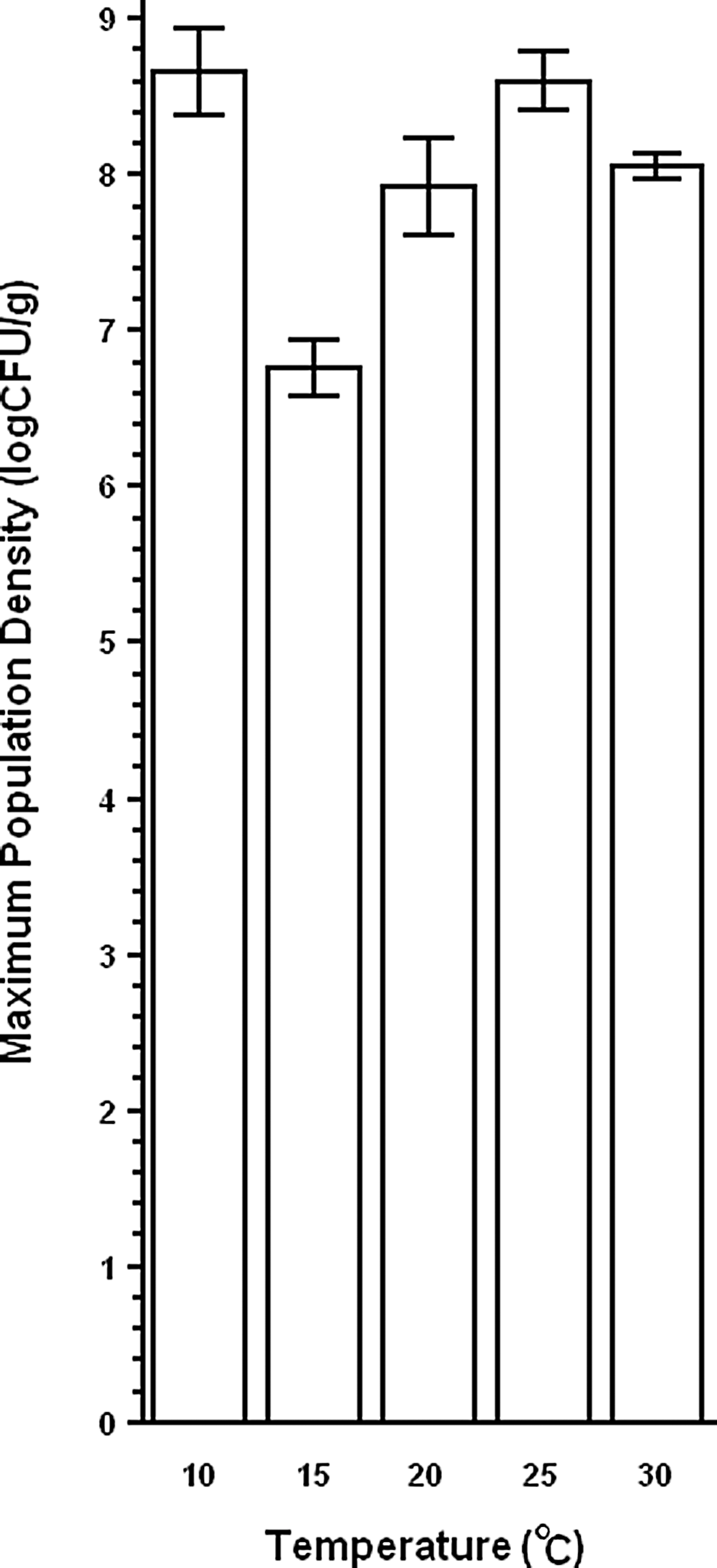
Maximum population density of rif-Yersinia pestis KIM5 in raw ground pork as a function of storage temperature from 10 to 30°C. Error bars (I) indicate a range of ±1 standard deviation of the mean. CFU, colony-forming units.
Stability of pYV in Y. pestis KIM5 during its growth in RGP
Defining Y. pestis growth in food is not the only relevant information for risk assessment. In addition, it is important to understand the stability of genetic elements encoded by the chromosome and plasmids that are necessary for virulence of Y. pestis (Brubaker, 2006). The pYV present in all three Yersinia species pathogenic to humans expresses phenotypic characteristics and is known to be unstable (Perry and Fetherston, 1997; Robins-Browne, 2001; Brubaker, 2006; Carniel, 2006; Bhaduri, 2012; Bhaduri and Smith, 2012). In general, cells lose pYV with subculture and during storage at refrigeration or room temperatures. Moreover, pYV is more unstable in Y. pestis than in Y. enterocolitica, and Y. pseudotuberculosis (Bhaduri and Sommers, 2008; Bhaduri et al., 2011). The loss of pYV leads to the eventual overgrowth by cells lacking pYV and results in the loss of virulence and the concomitant disappearance of associated virulence characteristics (Weagant et al., 2007; Bhaduri and Sommers, 2008; Bhaduri, 2012; Bhaduri and Smith, 2012). By using a pYV encoded Lcr-CR-uptake phenotypic assay (appearance of red pinpoint colony) on rif-CRMOX plates, it was found that pYV in rif-Y. pestis KIM5 was stable in cells during its growth in RGP at 4, 10, 15, 20, 25, and 30°C, indicating that the cells remained pathogenic. This is the first study on growth using a pYV-bearing strain of Y. pestis in food, and this report shows that temperature abuse of Y. pestis KIM5 in food could cause a potential risk for the consumer.
Conclusions
In conclusion, rif-Y. pestis KIM5 survives at 4°C and grows from 10 and 30°C in RGP. The retention of pYV in rif-Y. pestis KIM5 that survives at refrigerated temperatures could pose an increased health risk if retail RGP is intentionally contaminated. It is also of great significance that pYV is stable in rif-Y. pestis KIM5 during its growth in RGP at common storage and handling temperatures. Therefore, RGP contaminated with Y. pestis is potentially capable of causing oropharyngeal plague if it is stored under conditions such as refrigeration failure, temperature abuse (20–30°C), and if the meat is not properly cooked. In addition, the individual infected by foodborne Y. pestis is a potential reservoir of Y. pestis and can infect others, leading to outbreaks of highly infectious pneumonic plague (Leslie et al., 2011). Further studies are required to validate the growth kinetics with plague-causing strains in food and to determine the stability of pYV and other essential virulence determinants during the growth of the pathogen.
Disclosure Statement
No competing financial interests exist.